DNA sequences in ant guts as a
method for assessing termite
predation by ants
by Fayle, T.M., Scholtz, O., Dumbrell, A.J., Russell, S.,
Segar, S.T. and Eggleton, P.
Copyright, publisher and additional information: Publishers’ version distributed under the terms of the Creative Commons Attribution License:
http://creativecommons.org/licenses/by/4.0/
DOI: https://doi.org/10.1371/journal.pone.0122533
RESEARCH ARTICLE
Detection of Mitochondrial COII DNA
Sequences in Ant Guts as a Method for
Assessing Termite Predation by Ants
Tom M. Fayle1,2,3*, Olivia Scholtz4, Alex J. Dumbrell5, Stephen Russell6, Simon T. Segar1,
Paul Eggleton7
1Institute of Entomology, Biology Centre of Czech Academy of Sciences and Faculty of Science, University of South Bohemia, Branišovská 31, 370 05České Budějovice, Czech Republic,2Forest Ecology and Conservation Group, Imperial College London, Silwood Park Campus, Buckhurst Road, Ascot, Berkshire, SL5 7PY, United Kingdom,3Institute for Tropical Biology and Conservation, Universiti Malaysia Sabah, 88400, Kota Kinabalu, Sabah, Malaysia,4Global Conservation Program, Wildlife Conservation Society, Bronx, New York 10460, United States of America,5School of Biological Sciences, University of Essex, Wivenhoe Park, Colchester CO4 3SQ, United Kingdom,6Science Facilities Department, Natural History Museum, Cromwell Road, London SW6 5BD, United Kingdom,7Life Sciences Department, Natural History Museum, Cromwell Road, London SW6 5BD, United Kingdom
Abstract
Termites and ants contribute more to animal biomass in tropical rain forests than any other single group and perform vital ecosystem functions. Although ants prey on termites, at the community level the linkage between these groups is poorly understood. Thus, assessing the distribution and specificity of ant termitophagy is of considerable interest. We describe an approach for quantifying ant-termite food webs by sequencing termite DNA (cytochrome c oxidase subunit II, COII) from ant guts and apply this to a soil-dwelling ant community from tropical rain forest in Gabon. We extracted DNA from 215 ants from 15 species. Of these, 17.2 % of individuals had termite DNA in their guts, with BLAST analysis confirming the identity of 34.1 % of these termites to family level or better. Although ant species varied in detection of termite DNA, ranging from 63 % (5/7;Camponotussp. 1) to 0 % (0/7;Ponera
sp. 1), there was no evidence (with small sample sizes) for heterogeneity in termite con-sumption across ant taxa, and no evidence for species-specific ant-termite predation. In all three ant species with identifiable termite DNA in multiple individuals, multiple termite spe-cies were represented. Furthermore, the two termite spespe-cies that were detected on multiple occasions in ant guts were in both cases found in multiple ant species, suggesting that ant-termite food webs are not strongly compartmentalised. However, two ant species were found to consume onlyAnoplotermes-group termites, indicating possible predatory speciali-sation at a higher taxonomic level. Using a laboratory feeding test, we were able to detect termite COII sequences in ant guts up to 2 h after feeding, indicating that our method only detects recent feeding events. Our data provide tentative support for the hypothesis that unspecialised termite predation by ants is widespread and highlight the use of molecular ap-proaches for future studies of ant-termite food webs.
a11111
OPEN ACCESS
Citation:Fayle TM, Scholtz O, Dumbrell AJ, Russell S, Segar ST, Eggleton P (2015) Detection of Mitochondrial COII DNA Sequences in Ant Guts as a Method for Assessing Termite Predation by Ants. PLoS ONE 10(4): e0122533. doi:10.1371/journal. pone.0122533
Academic Editor:M. Alex Smith, University of Guelph, CANADA
Received:September 15, 2014
Accepted:February 11, 2015
Published:April 8, 2015
Copyright:© 2015 Fayle et al. This is an open access article distributed under the terms of the
Creative Commons Attribution License, which permits unrestricted use, distribution, and reproduction in any medium, provided the original author and source are credited.
Data Availability Statement:All sequences have been archived in the European Molecular Biology Laboratory (EMBL) data base (accession numbers included in the paper).
Introduction
Termites and ants are ubiquitously abundant in tropical rain forests around the world [1–3], with both groups being functionally important [4]. Termites act to break down organic matter, feeding on and processing a range of materials, from lichens, mosses and algae to dead leaves, dead wood, humus, and even soil [5,6]. Ants fill a wider variety of niches, for example as preda-tors,“cryptic”herbivores, and seed dispersers [7]. Given that many species of ant are at least partly predatory and termites are potential prey, it has always been assumed that ants eat large numbers of termites and therefore, that the ant-termite trophic interaction is a key one in trop-ical rain forests [1,8]. This assumption is supported by both the numerous studies focussing on particular ant or termite taxa [8], and the remarkable diversity in defence strategies employed by termite soldiers, which may have evolved in response to predation pressure from ants [9,10]. For example, some species of ant, including those from the generaCentromyrmex[11– 13],Megaponera[12,14–16],Anochetus[17],Tetramorium[18], andPaltothyreus[19] special-ise on particular termite taxa, while species from a wide range of genera are known to predate termites opportunistically to a greater or lesser extent [12]. Other species, such asDorylus
(Anomma) driver ants actively avoid termites, only feeding on alates during swarming [20]. Furthermore, there is substantial (correlational) evidence that the nest density of termites is limited by the abundance of both dominant [21–23] and non-dominant ant species [24]. How-ever, although many studies have confirmed the existence of the interaction between individual ant and termite species, or between small subsets of communities [11,12,17], we know of no di-rect evidence for the importance of this relationship across entire communities of ants and ter-mites. This is mainly because the majority of ant-termite predation events occur underground, making them difficult to observe.
Understanding the strength of the linkages between these two ecosystem engineers is impor-tant, as it is likely to affect many other processes. For example, predation of termites by ants is expected to limit termite-mediated decomposition of organic matter [23,25], even where ants are not termite specialists [23]. Furthermore, since ants are important predators of groups other than termites, increases in the abundance of termites might limit these other taxa through apparent competition e.g. [26].
A method is therefore required by which ant predation on termites can be inferred for whole communities. Numerous laboratory feeding trials have been conducted [27–29], but this approach requires live collection of a complete set of termite species likely to be encountered in the wild, a requirement that also limits field-based feeding trials. Active labelling, for example with tracers such as rabbit immunoglobin protein, can be used when large numbers of repli-cates are not required, and where candidate colonies of termites can be fed with labelled food items [30]. However, for community-level analyses this method would be highly labour inten-sive, particularly for subterranean termites, since it would require feeding every termite colony in an area with labelled food.
We propose molecular methods as the solution to these challenges in generating communi-ty-level data on ant-termite interactions. Such methods have been used to great effect to reveal previously cryptic species interactions, including parasitism [31,32], herbivory [33] and preda-tion [34]. Specifically, we investigate the potential for sequencing entire individual ants, includ-ing their gut contents, as a method for determininclud-ing the rates and specificities of ant predation on subterranean termites. Note that adult ants usually feed only on liquid food, while solids are fed to larvae [35]. However, previous work using protein marking of termites has demonstrated that termite remains are detectable in adult ants (both workers and queens) [30]. Hence our ex-pectation is either that adult ants feed on termite haemolymph, or that sufficient termite DNA remains from the ant having carried a termite (but not having ingested it).
project CZ.1.07/2.3.00/30.0006 co-financed by the European Social Fund and the state budget of the Czech Republic (STS). The funders had no role in study design, data collection and analysis, decision to publish, or preparation of the manuscript.
Materials and Methods
Field collections were made from primary rain forest in Ivindo National Park, Gabon (S 00°10’ E 12°32’). Field work was carried out between March and July 2008 by OS. Permits and approv-als were obtained for field work from ANPN (Agence National Des Parcs Nationaux), and CENAREST (Centre National de la Recherche Scientifique et Technologique). A total of 2,304 soil cores were excavated (25x25 cm area, 10 cm depth) over a 1 ha area, and representatives of all ant and termite species present in each core were collected into 95% ethanol, and preserved at -70°C on return from the field (ranging from 1–5 months later). Preliminary analyses dem-onstrated a spatial association between the termite and predatory ant communities, indicating a possible trophic interaction in the assemblage [36]. We selected 255 ants at random from the occurrences across the entire grid, with no two ants coming from the same soil pit (note that individuals from rare species were not used for all statistical analyses). Ants were randomly se-lected because we wanted to test for overall community patterns in termite predation, rather than focussing on a particular subset of ant species. These ants were then identified initially based on external morphology.
We then extracted DNA from entire individual ants. Specimens were dry-ground with a few grains of sand using a micro pestle in 1.5 ml Eppendorf tubes, with 180μl ATL lysis buffer (Qiagen Ltd, Crawley, UK) and 20μl Proteinase K [40 U/ml] (Sigma) and left to digest over-night at 55°C with agitation. Standard Qiagen blood and tissue kits were used to perform ex-tractions on the lysates, following manufacturer’s instructions (Qiagen Ltd). The concentration of DNA in each extract was recorded using a Nanodrop 8000 DNA spectrophotometer (Thermo Fisher, Waltham, MA USA) to measure the amount of template being added to the PCR reaction. We then conducted PCR on the resulting DNA using termite-specific cyto-chrome c oxidase subunit II (COII) primers (Sequences, 5’to 3’:Modified A-tLeu: CAGATAA GTGCATTGGATTT,B-tLys: GTTTAAGAGACCAGTACTTG; [37]). We used COII, rather than the more commonly-used COI, because the number of available termite sequences is greater for the former. To assist in delineating ant species, extracted DNA was also used for an-other PCR using universal primers for cytochrome c oxidase subunit I (COI)LCO1490: 5’ -GGTCAACAAATCATAAAGATATTGG-3’andHCO2198: 5’-TAAACTTCAGGGTGACCA AAAAATCA-3’[38]. Individual PCR reactions were carried out in a 25μL reaction volume comprising: 16.5μl PCR grade Water, 2.5μl 10x reaction buffer (supplied with TAQ), 1.5μl Magnesium chloride [50 mM], 1μl dNTP mix [100mM], 1μl of each primer [10μM], 0.5μL Hi fidelity BIOTAQ (Bioline, London, UK), and 1μL of DNA template [2–8 ng/μl]. PCR con-ditions for reactions utilising primersModified A-tLeu/B-tLyswere: 94.0°C for 5 min; 35 cycles at 94.0°C for 30 sec, 53°C for 30 sec and 72.0°C for 1 min; and 72.0°C for 10 min. PCR condi-tions for reaccondi-tions utilising primersLCO1490/HCO2198were: 94.0°C for 5 min; 40 cycles at 94.0°C for 30 sec, 48°C for 30 sec and 72.0°C for 1 min; and 72.0°C for 10 min. All reactions were conducted using a Techne TC-512 thermo cycler (Bibby Scientific, Stone, Staffordshire, UK). The resulting ca. 900 base pair PCR products were purified using a purification plate method (Merck, Millipore). DNA strands in the forward and reverse direction were sequenced on an ABI 3730XL capillary DNA analyser (Applied Biosystems Paisley, UK), using Big Dye Terminator kit version 1.3 (Applied Biosystems.) following manufacturer’s instructions, con-ducted at the Natural History Museum London sequencing facility. Text resulting from the AB1 chromatogram traces was edited by hand using FinchTV v1.4.0 (software from Geospiza Inc, 2006) and poor quality sequences were excluded. Contigs were assembled using Unipro UGENE v.1.13.1 [39]. All sequences have been archived in the European Molecular Biology Laboratory (EMBL) data base (European Nucleotide Archive, accession numbers
LN608994-LN609187;http://www.ebi.ac.uk/ena/data/view/LN608994-LN609187).
In order to measure the specificity of ant-termite interactions we clustered COII sequences obtained from ant guts into molecular operational taxonomic units (MOTUs) using jMOTU v.1.0.7 [40]. This method provides an objective way of defining the cut-off point that should be used to delimit intra- and inter-specific variation, and can be used in combination with phyloge-netic assignment of MOTUs to provide more robust delimitation of MOTUs. Given that many of the species involved were sequenced here for the first time, the lack of a termite species list for the area, and the poor state of termite species-level taxonomy in the region, a full reference li-brary for grouping sequences with known species was unavailable. We set the low BLAST iden-tity filter to 97 but otherwise the settings were left as default. We clustered ant sequences in the same way. For both taxa we visually identified the percentage cut-off points that corresponded to the‘barcode gap’[41] (although note that animal barcoding commonly refers to the COI locus, not the COII locus). This can be seen in a plot of MOTU number vs. percentage cut-off and is the value over the short plateau in MOTU number directly following the sharp decrease resulting from intra-specific clustering. For ants this was a pair-wise difference of 2.5% and for termites 2.0%. Sequences were fully aligned in ClustalX v2.1 [42] using the default settings. Bootstrapped maximum likelihood phylogenies were generated using the web-server edition of RAxML [43]. For both ants and termites we selected a General Time Reversible Model in-cluding a Gamma distribution of rate variation between sites and a proportion of invariant sites (GTR+I +G). Where available we included published sequences from ant and termite con-specifics and appropriate out groups [37,44–47]. To test for differences in frequency of termite consumption between different ant taxa (not accounting for termite identity), we used Fisher’s exact tests on frequencies of detection vs. non-detection (P-values generated using 106 simula-tions). Tests were conducted at the ant species level, genus level, and subfamily level. To visualise ant-termite interactions, for the ants for which their gut content could be assigned to termite MOTUs, we plotted a bipartite food web using thebipartitepackage in R [48].
In order to assess limits of detection time following ingestion of termites by ants we con-ducted a laboratory feeding experiment. A single colony ofCamponotussp. was fedad libitum
liveReticulitermes santonensis, and collections of ants made at a range of times following feed-ing (0 h, 1 h, 2 h, 4 h, 8 h, 16 h, 32 h and 64 h, N = 2 for each time). We also collected ants that had recently been seen to carry termites, control (unfed) ants prior to feeding, and living ter-mites. We then dissected out the contents of each ant gaster (including the crop), and extracted total DNA using standard Qiagen blood and tissue kits following manufacturer’s instructions (Qiagen Ltd). We then conducted PCR using the termite specific primers in the same manner as detailed above, and ran agarose gels to screen for presence of termite COII sequences.
Results and Discussion
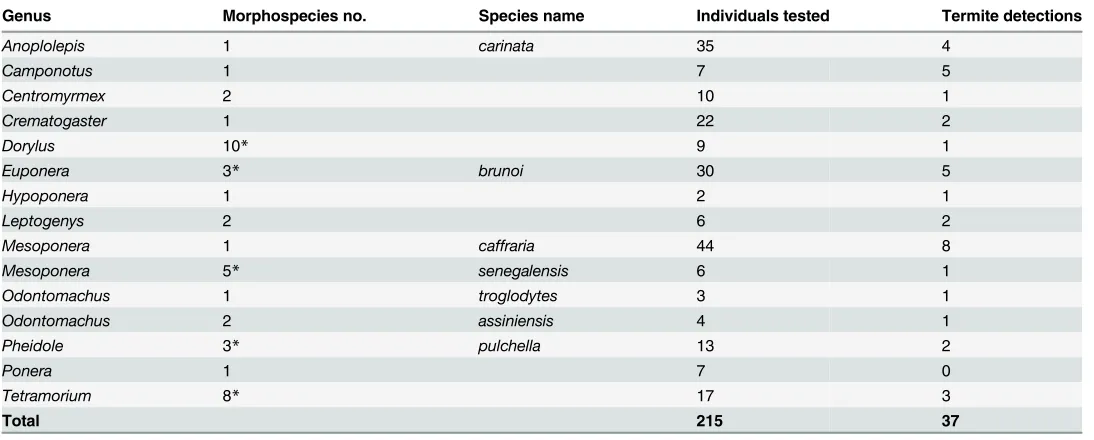
the highest proportion of detections wasCamponotussp. 1, in which 5/7 workers tested posi-tive for termite DNA, while the species with the lowest detection rate wasPonerasp.1, with 0/7 detections. However, despite these differences between ant species in the proportion of termite “hits”, detections were not found to be significantly heterogeneously distributed between spe-cies (Fisher’s exact test: N = 15, P = 0.557), genera (N = 13, P = 0.476) and subfamilies (N = 4, P = 0.851). On the basis of the current evidence (with a relatively small number of samples), we are unable to conclude that there are any differences between ant taxa in terms of their tenden-cy to prey on termites (although note that there might still be preferences between ant species for particular termite taxa, see below). This agrees broadly with previous observations that a wide range of ant genera are known to predate termites both opportunistically and as special-ists on particular termite species [12]. However, the fact that the single species from the genus
Centromyrmex, which is known to be a termite specialist predator [11–13], only had a 10% de-tection rate cautions against using dede-tection rates as a direct measure of termite predation strength. This point is further demonstrated by the low hit rates for the twoOdontomachus
species, both of which are thought to predate large numbers of termites [49,50].
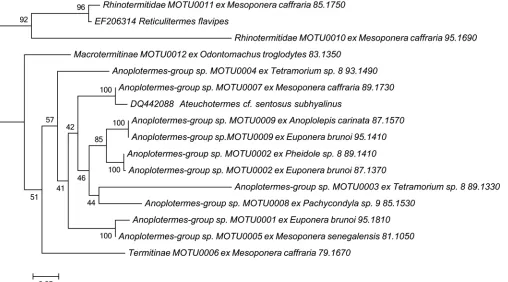
From the 37 termite PCR products sequenced, we found 14 were of suitable quality for fur-ther analysis. These clustered into 12 MOTUs that gave termite matches of over 80% when compared to sequences deposited in Genbank [51] using the discontiguous BLAST algorithm [52] which is suitable for cross-species comparisons when the differences between query and references sequences is less than 95% (as is the case for 12/14 of the termite sequences). A large proportion of the termite sequences were from the soldierless termite clade (theAnoplotermes -group; Termitidae: Apicotermitinae;Fig 1) that are abundant members of the local termite community in the soil [3]. The other close BLAST matches were with groups that are common-ly found in the soil except for the Rhinotermitidae, which are rarecommon-ly encountered in the soil in African old growth tropical rain forests [53]. These are wood-feeding termites and were
Table 1. Species-level detection rates for termite DNA in ant guts.
Genus Morphospecies no. Species name Individuals tested Termite detections
Anoplolepis 1 carinata 35 4
Camponotus 1 7 5
Centromyrmex 2 10 1
Crematogaster 1 22 2
Dorylus 10* 9 1
Euponera 3* brunoi 30 5
Hypoponera 1 2 1
Leptogenys 2 6 2
Mesoponera 1 caffraria 44 8
Mesoponera 5* senegalensis 6 1
Odontomachus 1 troglodytes 3 1
Odontomachus 2 assiniensis 4 1
Pheidole 3* pulchella 13 2
Ponera 1 7 0
Tetramorium 8* 17 3
Total 215 37
Only ant species with>5 individuals presented here, with the exception of known termite predators in the generaHypoponera, andOdontomachus.
*Ant species for which multiple cryptic molecular clades were present, but for which no morphological correlates were found. Since not all ant individuals were sequenced, the morphological identifications for these species were retained.
doi:10.1371/journal.pone.0122533.t001
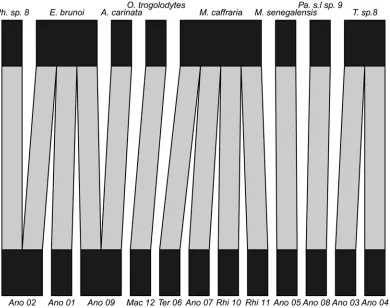
probably devoured earlier in dead wood. Given the small total number of positive termite iden-tifications and the high diversity of the system, even if there is no species-specificity at all, one would expect multiple“singleton interactions”, which is what we observed (three instances;
Fig 2). The only informative interactions in terms of detecting species-level specificity of ant-termite predation are those in which there are multiple records of one ant species consuming termites. Multiple individuals with identifiable termite DNA were found in three species of ants (Euponera brunoi, N = 3;Mesoponera caffraria, N = 4;Tetramoriumsp. 8, N = 2), with all three predating multiple termite species. This provides no evidence for termite species-level specificity in ant predation. However, bothE.brunoiandTetramoriumsp. 8 were only found to feed on termites from theAnoplotermesgroup, indicating a possible genus-group level spe-cialisation on this soil feeding group.
From the ants that were experimentally fed on termites, we detected PCR products of the correct length to be termite COII after 1 h (1/2 samples), and 2 h (1/2 samples;S2 Fig). There was also a very weak band after 64 h (1/2 samples), although we interpret this with caution, due to the lack of any detections at intermediate times. An ant that had been recently observed to carry a termite showed a strong COII-length band, as did a whole termite (1/1 sample for each). These results indicate that fragments of COII sufficient in length to be detected using PCR remain in ant guts up to 2 h after feeding. Although feeding events occurring>2 h previ-ously are not likely to be detected, we argue that the relatively high percentage of occurrences of termite sequences in wild ant guts (17.2%) indicates that where it occurs, ant feeding on termites seems to be sustained through time, hence validating the use of this method for constructing ant-termite predation food webs. If our primers amplify COII with differing
Fig 1. Maximum likelihood phylogeny of termites consumed by ants based on COII sequences.Phylogeny rooted to Rhinotermitidae. Node values give bootstrap support. Scale bar represents substitutions per site based on the GTR+I+G model.
efficiency from different termite species, or if amplification is more difficult for particular ant species, then this might cause biases in our estimations of the strengths of different interac-tions. Hence we are able to confidently state the presence of particular predatory interactions between species, but the absence of an interaction in our data (and in other data generated using this method) should be interpreted with caution. Furthermore, note that our method is unable to differentiate between ant predation on termites, and ant scavenging on termites that are already dead, although presumably the latter is less likely, since degradation of termite DNA will be more advanced for individuals that are dead prior to consumption.
With the proviso that the number of identified sequences was small, our results indicate that termite predation by ants may be widespread, with ant species not differing in the frequen-cy of termite consumption, and with tentative support for both generalism, and specialism at the level of the termite genus-group for ant predators. Our work shows that COII sequencing is a viable method for detecting ant predation of termites. The use of this method, applied to specimens from field collections and laboratory feeding assays, should be expanded to larger datasets, in order to shed more light on the nature of interactions between these key ecological groups.
Fig 2. Bipartite hypogeic (below soil-surface) food web visualising ant predation on termites in rain forest in Gabon.For termites (lower level), abbreviations are as follows. Ano =Anoplotermesgroup; Mac = Macrotermitinae; Ter = Termitinae; Rhi = Rhinotermitidae. For ants, seeTable 1for full genus names. Even with this small dataset there are three species of ants that prey on more than one termite species, and two termite species that are preyed on by multiple ant species. Note thatPheidolesp 8 is included here, although it was not included in statistical analyses, since we tested fewer than six ant individuals for this species.
doi:10.1371/journal.pone.0122533.g002
Supporting Information
S1 Fig. Maximum likelihood phylogeny of the ants sampled that provided high quality COI sequences.Phylogeny rooted toLeptanillasp. andProtanillasp. Node values give bootstrap support. Scale bar represents substitutions per site based on the GTR+I+G model. Note that three ant species were not sequenced, only morphologically determined, and so these are not included in the phylogeny.
(TIF)
S2 Fig. Agarose gel of PCR products from experimental feedings ofCamponotussp. ants on liveReticulitermes santonensis.Numbers in hours refer to time after feeding (N = 2 for each time). TM = the head of an ant that was observed to carry a dead termite prior to collec-tion. A = unfed ant. T = termite. C = PCR negative control. White arrows indicate bands at the expected length for COII. Note that the band at 64 hours is very faint.
(TIF)
Acknowledgments
We would like to thank Walter Federle, Duur Aanen and Tania Nobre for hosting TMF, Andie Hall and Jan Hrcek for methodological advice, and Denis Wright for help with the feeding ex-periment. We would also like to thank Jan Hrcek, M. Alex Smith and two anonymous review-ers for comments that improved the manuscript.
Author Contributions
Conceived and designed the experiments: OS PE. Performed the experiments: TMF SR. Ana-lyzed the data: STS PE. Wrote the paper: TMF OS AJD SR STS PE. Conducted field work: OS.
References
1. Hölldobler B, Wilson EO. The Ants: Cambridge: Belknap Press 732 p.; 1990
2. Fittkau EJ, Klinge H. On biomass and trophic structure of the central Amazonian rain forest ecosystem. Biotropica. 1973; 5:2–14.
3. Eggleton P, Bignell DE, Sands WA, Mawdsley NA, Lawton JH, Wood TG, et al. The diversity, abun-dance and biomass of termites under differing levels of disturbance in the Mbalmayo Forest Reserve, southern Cameroon. Philosophical Transactions: Biological Sciences. 1996; 351:51–68.
4. Folgarait PJ. Ant biodiversity and its relationship to ecosystem functioning: a review. Biodiversity and Conservation. 1998; 7:1221–1244.
5. Donovan SE, Eggleton P, Bignell DE. Gut content analysis and a new feeding group classification of termites. Ecological Entomology. 2001; 26:356–366.
6. Lawton JH, Bignell DE, Bloemers GF, Eggleton P, Hodda ME. Carbon flux and diversity of nematodes and termites in Cameroon forest soils. Biodiversity and Conservation. 1996; 5:261–273.
7. Crist TO. Biodiversity, species interactions, and functional roles of ants (Hymenoptera: Formicidae) in fragmented landscapes: a review. Myrmecological News. 2009; 12:3–13.
8. Cerdá X, Dejean A. Predation by ants on arthropods and other animals. In: Polidori C, editor. Predation in the hymenoptera: an evolutionary perspective: Kerala: Transworld Research Network; 2011. pp. 39–78.
9. Prestwich GD. Defense mechanisms of termites. Annual Review of Entomology. 1984; 29:201–232. 10. Scholtz OI, Macleod N, Eggleton P. Termite soldier defence strategies: a reassessment of Prestwich's
classification and an examination of the evolution of defence morphology using extended eigenshape analyses of head morphology. Zoological Journal of the Linnean Society. 2008; 153:631–650. 11. Dejean A, Fénéron R. Polymorphism and oligogyny in the ponerine antCentromyrmex bequaerti
(For-micidae: Ponerinae). Insectes Sociaux. 1996; 43:87–99.
13. Bolton B, Fisher BL. Afrotropical ants of the ponerine generaCentromyrmexMayr,Promyopias
Santschi gen. rev. andFeroponeragen. n., with a revised key to genera of African Ponerinae (Hyme-noptera: Formicidae). Zootaxa. 2008; 1929:1–37.
14. Longhurst C, Johnson RA, Wood TG. Predation byMegaponera foetens(Fabr.) (Hymenoptera: Formi-cidae) on termites in the Nigerian southern Guinea savanna. Oecologia. 1978; 32:101–107.
15. Longhurst C, Baker R, Howse PE. Termite predation byMegaponera foetens(Fab.) (Hymenoptera: Formicidae)—Coordination of raids by glandular secretions. Journal of Chemical Ecology. 1979; 5:703–719.
16. Longhurst C, Howse PE. The use of kairomones byMegaponera foetens(Fab.) (Hymenoptera: Formi-cidae) in the detection of its termite prey. Animal Behaviour. 1978; 26:1213–1218.
17. Schatz B, Orivel J, Lachaud JP, Beugnon G, Dejean A. Sitemate recognition: the case ofAnochetus traegordhi(Hymenoptera; Formicidae) preying onNasutitermes(Isoptera: Termitidae). Sociobiology. 1999; 34:569–580.
18. Longhurst C, Johnson RA, Wood TG. Foraging, recruitment and predation byDecamorium uelense
(Sanstchi) (Formicidae: Myrmicinae) on termites in southern Guinea savanna, Nigeria. Oecologia. 1979; 38:83–91.
19. Dejean A, Lachaud JP, Beugnon G. Efficiency in the exploitation of patchy environments by the poner-ine antPaltothyreus tarsatus: an ecological consequence of the flexibility of prey capture behavior. Journal of Ethology. 1993; 11:43–53.
20. Schöning C, Moffett MW. Driver ants invading a termite nest: why do the most catholic predators of all seldom take this abundant prey? Biotropica. 2007; 39:663–667.
21. Leponce M, Roisin Y, Pasteels JM. Community interactions between ants and arboreal-nesting ter-mites in New Guinea coconut plantations. Insectes Sociaux. 1999; 46:126–130.
22. Dejean A, Kenne M, Moreau CS. Predatory abilities favour the success of the invasive antPheidole megacephalain an introduced area. Journal of Applied Entomology. 2007; 131:625–629.
23. Pequeno PACL Pantoja PO. Negative effects ofAztecaants on the distribution of the termite Neocapri-termes braziliensisin central Amazonia. Sociobiology. 2012; 59:893–902.
24. Ellwood MDF, Jones DT, Foster WA. Canopy ferns in lowland dipterocarp forest support a prolific abun-dance of ants, termites and other invertebrates. Biotropica. 2002; 34:575–583. PMID:12170413 25. DeSouza O, Araújo APA, Reis-Jr R. Trophic controls delaying foraging by termites: reasons for the
ground being brown? Bulletin of Entomological Research. 2009; 99:603–609. doi:10.1017/ S000748530900666XPMID:19302722
26. Morris RJ, Lewis OT, Godfray HCJ. Experimental evidence for apparent competition in a tropical forest food web. Nature. 2004; 428:310–313. PMID:15029194
27. Buczkowski G, Bennett G. Behavioral interactions betweenAphaenogaster rudis(Hymenoptera: For-micidae) andReticulitermes flavipes(Isoptera: Rhinotermitidae): the importance of physical barriers. Journal of Insect Behavior. 2008; 21:296–305.
28. Quinet Y, Tekule N, de Biseau JC. Behavioural interactions betweenCrematogaster brevispinosa rochaiForel (Hymenoptera: Formicidae) and twoNasutitermesspecies (Isoptera: Termitidae). Journal of Insect Behavior. 2005; 18:1–17.
29. Traniello JFA. Enemy deterrence in the recruitment strategy of a termite: Soldier-organized foraging in
Nasutitermes costalis. Proceedings of the National Academy of Sciences USA. 1981; 78:1976–1979. PMID:16592995
30. Buczkowski G, Bennett G. Protein marking reveals predation on termites by the woodland ant, Aphae-nogaster rudis. Insectes Sociaux. 2007; 54:219–224.
31. Hrcek J, Miller SE, Quicke DLJ, Smith MA. Molecular detection of trophic links in a complex insect host-parasitoid food web. Molecular Ecology Resources. 2011; 11:786–794. doi:10.1111/j.1755-0998. 2011.03016.xPMID:21535428
32. Rougerie R, Smith MA, Fernandez-Triana J, Lopez-Vaamonde C, Ratnasingham S, Hebert PDN. Mo-lecular analysis of parasitoid linkages (MAPL): gut contents of adult parasitoid wasps reveal larval host. Molecular Ecology. 2011; 20:179–186. doi:10.1111/j.1365-294X.2010.04918.xPMID:21083857 33. Jurado-Rivera JA, Vogler AP, Reid CAM, Petitpierre E, Gomez-Zurita J. DNA barcoding insect-host
plant associations. Proceedings of the Royal Society B-Biological Sciences. 2009; 276:639–648. doi: 10.1098/rspb.2008.1264PMID:19004756
34. Pompanon F, Deagle BE, Symondson WOC, Brown DS, Jarman SN, Taberlet P. Who is eating what: diet assessment using next generation sequencing. Molecular Ecology. 2012; 21:1931–1950. doi:10. 1111/j.1365-294X.2011.05403.xPMID:22171763
35. Went FW, Wheeler J, Wheeler GC. Feeding and digestion in some ants (VeromessorandManica). Bio-Science. 1972; 22:82–88.
36. Scholtz O. Inter-continental patterns in the fine-scale spatial ecology of rain forest termites: University of Plymouth, PhD thesis. 2010
37. Inward DJG, Vogler AP, Eggleton P. A comprehensive phylogenetic analysis of termites (Isoptera) illu-minates key aspects of their evolutionary biology. Molecular Phylogenetics and Evolution. 2007; 44:953–967. PMID:17625919
38. Folmer O, Black M, Hoeh W, Lutz R, Vrijenhoek R. DNA primers for amplification of mitochondrial cyto-chrome c oxidase subunit I from diverse metazoan invertebrates. Molecular Marine Biology and Bio-technology. 1994; 3:294–299. PMID:7881515
39. Okonechnikov K, Golosova O, Fursov M. Unipro UGENE: a unified bioinformatics toolkit. Bioinformat-ics. 2012; 28:1166–1167. doi:10.1093/bioinformatics/bts091PMID:22368248
40. Jones M, Ghoorah A, Blaxter M. jMOTU and Taxonerator: turning DNA barcode sequences into anno-tated operational taxonomic units. PLoS ONE. 2011; 6:e19259. doi:10.1371/journal.pone.0019259 PMID:21541350
41. Barrett RDH, Hebert PDN. Identifying spiders through DNA barcodes. Canadian Journal of Zoology-Revue Canadienne De Zoologie. 2005; 83:481–491.
42. Larkin MA, Blackshields G, Brown NP, Chenna R, McGettigan PA, McWilliam H, et al. Clustal W and Clustal X version 2.0. Bioinformatics. 2007; 23:2947–2948. PMID:17846036
43. Stamatakis A, Hoover P, Rougemont J. A rapid bootstrap algorithm for the RAxML web servers. Sys-tematic Biology. 2008; 57:758–771. doi:10.1080/10635150802429642PMID:18853362
44. LaPolla JS, Brady SG, Shattuck SO. Phylogeny and taxonomy of thePrenolepisgenus-group of ants (Hymenoptera: Formicidae). Systematic Entomology. 2010; 35:118–131.
45. Smith MA, Fisher BL, Hebert PDN. DNA barcoding for effective biodiversity assessment of a hyperdi-verse arthropod group: the ants of Madagascar. Philosophical Transactions of the Royal Society B: Bio-logical Sciences. 2005; 360:1825–1834. PMID:16214741
46. Moreau CS, Bell CD, Vila R, Archibald SB, Pierce NE. Phylogeny of the ants: diversification in the age of angiosperms. Science. 2006; 312:101–104. PMID:16601190
47. Cameron SL, Whiting MF. Mitochondrial genomic comparisons of the subterranean termites from the GenusReticulitermes(Insecta: Isoptera: Rhinotermitidae). Genome. 2007; 50:188–202. PMID: 17546084
48. Dormann CF, Gruber B, Fründ J. Introducing the bipartite package: analysing ecological networks. Rnews. 2008; 8:8–11.
49. Ledoux A. Recherches préliminaires sur quelques points de la biologie d’Odontomachus assiniensis
Latr. (Hym. Form., Poneridae). Annales des Sciences Naturelles (Zoologie et Biologie Animale) 1952; 14:231–248.
50. Dejean A, Bashingwa EP. La prédation chezOdontomachus troglodytesSantschi (Formicidae-Ponerinae). Insectes Sociaux. 1985; 32:23–42.
51. Benson DA, Karsch-Mizrachi I, Lipman DJ, Ostell J, Wheeler DL. GenBank. Nucleic Acids Research. 2005; 33:D34–D38. PMID:15608212
52. Johnson M, Zaretskaya I, Raytselis Y, Merezhuk Y, McGinnis S, Madden TL. NCBI BLAST: a better web interface. Nucleic Acids Research. 2008; 36:W5–W9. doi:10.1093/nar/gkn201PMID:18440982 53. Eggleton P, Bignell DE, Hauser S, Dibog L, Norgrove L, Madong B. Termite diversity across an