Evaluation of Symmetrically Planned Diagrid Structures Under
Lateral Loading
Shahebaz. N. Shaikh
PG student, Department of civil engineering, Nagarjuna College of engineering and technologyBangalore, Karnataka
Vanishree C N
Assistant Professor, Department of civil engineering Nagarjuna College of engineering and technology
Bangalore, Karnataka
Introduction
The need for a high rise structure has been increasing drastically with time. The conventional types of high rise structures are often scene in common. The term conventional means traditional or the process that have been followed for long time without an alternative, and high-rise structure means a structure that has the least lateral dimension very much lesser than its height or where the evacuation of people is a serious issue with respect to the height of the building.
The limitations of the conventional techniques have created the necessity to evolve the techniques of construction. Hence the diagrid which is a type of evolution in construction of high rise. The word diagrid is a combination of the words “Diagonal” and “Grid”. Diagrid is a structure consisting of inclined compression members instead of vertical compressive members as in case of closely spaced vertical columns in conventional structure. The diagrid members are usually perimeter members and connect to the substructure directly and may or may not have internal diagonal members depending on the structural requirements. Interior of the structure can have conventional framed structure as required but can be replaced by Diagonalized grid members. Many a times diagrid eliminates the need of core in the high rise structure. The diagrid is simplified as an improvisation in a positive manner over the braced tube structure.
The diagrid frame works in a way that the diagonal segments are primary member carrying both gravity and lateral loading conditions unlike the conventional vertical segments which carry just the vertical gravity loadings. The main aim of diagrid structures is not just to carry the loads but it also makes difference in the dead load of the structure and the economy ultimately.
Abstract: A better structural system is required to ensure the safety and serviceability for every high-rise construction. The development of different structural system has caused a lack of depth in reason of choice and hence every system needs to be evaluated on the basis of different parameters relevant to the design and the system.
This present study deals with the comparison of diagrid and conventional structural system. The different categories made are; symmetrical building plan for both diagrid and conventional structure and diagrid structure with different diagrid angles. Both the types of structures of 40 stories and floor plan of 30mx30m are analyzed. In the present study storey displacement, inter-storey drift, time period and base shear are evaluated and these parameters are compared between diagrid structural system and conventional structural system. ETABS software is used for the numerical analysis of all the models. All the structural members are considered as per IS-codes. Based on the analysis the analysis carried out, diagrid structural system performs better than the conventional structural system under seismic loading.
IT IS PROPOSED TO STUDY THE FOLLOWING
To evaluate the seismic response of bare frame and Diagrid structures with Symmetric plans.
To evaluate the response to wind analysis of both bare frame and diagrid structure with symmetrical plan.
To identify the optimal angle for diagrid diagonal members by comparing results for three varied angles.
To perform seismic analysis using equivalent method and response spectrum analysis.
Models with difference in angle of diagrid to be compared on the basis of storey displacement, storey drift, base shear and time period.
Methodology
The RC bare frames are taken as a square plan of 30m x 30m, with an elevation of 140.5m with bottom story of 4m and typical storey height of 3.5m. The Models are designed as per Code for practice in earthquake IS 1893-2002, and in Concrete design Is 456, in steel design IS 800 and loads due to wind IS 875-Part3.
Typical floor plan for conventional structure
4.2 MODELS
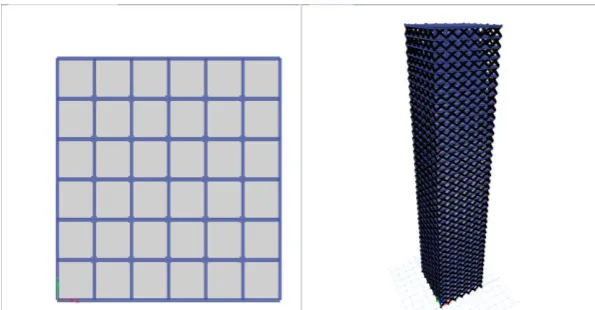
Below are the figures representing the models with conventional and diagrid structural systems. They figures are taken from the ETABS software and are modelled in the same way as below. The bay size of each model is 5mx5m and typical storey height is 3.5m and bottom storey is 4m in height
Fig 4.1 Bare frame model with symmetrical plan
Figure 4.1 shows a structure with conventional structural system bare frame. This model is a typical representation of traditional high rise structure. It is 40 storied and is framed structure with all elements of concrete
Fig 4.2 Diagrid frame with symmetrical plan with diagrid angle 34.99º
Figure 4.2, shows typical diagrid system with diagrid at each floor with an angle of 34.99º, while Figure 4.3 shows a diagrid system at two floors each module with an angle of 54.20º.All the diagrid elements are steel members while interior columns and beams are concrete members.
Fig 4.4 diagrid frame with symmetrical plan with a diagrid angle of 70.34º
Results and Discussions
Fig 5.1
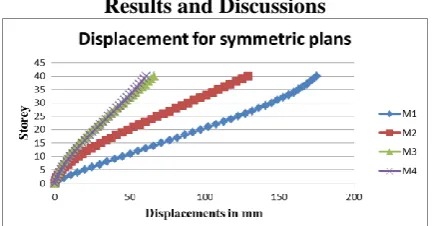
Graph of displacements in mm for models M1 to M4 EQ obtained by ESMFig. 5.2 Displacement graph in mm for Model M1 to M4 obtained RSA
The above graph shows the displacements of different models of diagrid with same plan but different angles of diagrid and evaluated by different analysis procedures. The results shows.
It is observed in the above graph, that maximum displacements in M4 are lesser than M1.The results further on shows that substantial decrease in the displacement values as the diagrid angle increases. The diagrid structural system gives way lesser displacement than the conventional structural system as seen in graphs The present work reveals that both the systems have displacements within permissible limits but the displacements in case of symmetrical plan of diagrid is considerably less.
Conclusion
The values of displacement are less for symmetrical diagrid structure as compared to symmetrical conventional structure under seismic loading.
It is seen that the displacements is less in case of diagrid structures as compared to conventional structures under wind loadings.
The present study also includes evaluation of diagrid systems with different angles that are 34.99º, 54.2º and 70.34º and it is seen that the optimal value of angle between the considered angles is 54.2º angle opted in model M3.
Abbrevations ESM: Equivalent Static Method
RSA: Response Spectrum Analysis
References
[1] Ali, M. M. & Moon, K. (2007). “Structural Developments in Tall Buildings: Current Trends and Future Prospects”. Architectural Science Review, 50(3), 205-223.
[2] Terri Meyer Boake “Diagrids, the new Stability system: Combining architecture with engineering” School of Architecture, University of Waterloo, Cambridge, Canada
[3] Elena Mele, Maurizio Toreno Giuseppe Brandonisio and Antonello De Luca “Diagrid structures for tall buildings: case studies and design considerations” :University of Naples Fedrico II, Faculty of Engineering, Department of Structural Engineering (DIST), Naples, Italy published in Wiley online library 23 July 2012.
[4] Saket Yadav , Dr. Vivek Garg : “Advantage of Steel Diagrid Building Over Conventional Building” International journal of civil and structural engineering (2013).
[5] Raghunath .D. Deshpande, Sadanand M. Patil, Subramanya Ratan “Analysis and comparison of diagrid and conventional structural system”: Gogte institute of technology, belagavi, Karnataka, India (IRJET-2015).
[6] Manthan I. Shah, Snehal V. Mevada, and Vishal B. Patel “Comparative study of diagrid structures with conventional frame structures” (May 2016).
[7] Manthan I. Shah, Snehal V. Mevada, and Vishal B. Patel “Comparative study of diagrid structures with conventional frame structures” (May 2016).