[Roziq* 5(2): February, 2018] ISSN 2349-4506
Impact Factor: 3.799
G
lobal
J
ournal of
E
ngineering
S
cience and
R
esearch
M
anagement
MODELS OF FINANCING WITH PROFIT SHARING AND LINKAGE PROGRAM
FOR MICRO, SMALL, MEDIUM ENTERPRISES IN JEMBER REGENCY, EAST
JAVA, INDONESIA
Ahmad Roziq*, Yulinartati, Norita Citra Y
*University of Jember
University of Muhamadiyah Jember University of Muhamadiyah Jember
DOI: 10.5281/zenodo.1186515
KEYWORDS: Financing Model, Profit-Loss Sharing System, Micro, Small, and Medium Enterprise.
ABSTRACT
Aims of this study are to analyze the implementation of scheme of profit - loss sharing, problems and solutions, construction of financing model with using profit loss sharing and linkage program in financing for Micro, Small, and Medium Enterprises. This study is exploratory and survey research to be carried out in the regency of Jember using a triangulation method. Method of data analysis use Miles and Huberman model which consists of data collection, data reduction,data display and conclusion drawing/verification
The results of research sugested that Islamic financial institutions should apply the profit sharing financing for medium, small and micro enterprises with mudharaba mustaraka which is a combination of mudaraba and musharaka. This scheme can protect losses for Islamic financial institutions and still provide flexibility for Micro, Small, and Medium Enterprise to manage their business without interference hands from islamic financial institutions. Islamic financial institutions such as sharia bank , sharia rural bank, sharia cooperative, baitul maal wat tanwill, sharia micro financial institutions should make linkage program:figure each other’s for medium, small, and micro enterprises with using mudaraba mustaraka scheme.
INTRODUCTION
BACKGROUND
There are two methods of financing applied in Islamic banks, which is a non-profit-loss sharing (non-PLS) in the form of financing the sale and purchase system including hire purchase and method of profit and loss sharing (PLS) in the form of financing under the profit-sharing system. According Triyuwono (200 4) in the profit-sharing system, the interest rate is replaced with the rate of profit, therefore the investment system is driven by the profit rate, while the rate of profit is higher then the total investment was also higher. So that the level of profit that can positively eliminate speculative demand for money, the inflation rate can be reduced, since there are only actual demand for real investment. Profit-sharing essentially keeping the principle of justice is still running in the economy. Because it is economic stability derived from the principles of justice as practiced in the economy. When a bank determines the level determined fixed income funds lent to entrepreneurs regardless of whether the employer can or can not make a profit. When businessmen suffer losses, employers suffer alone, while the other party that the bank still obtain a fixed income from employers. Very different from the system based on profit-sharing, both parties would benefit or suffer losses together. Echoes the revenue sharing system togetherness (cooperation), justice, brotherhood, which may drive a feeling of personal interest and otherwise encourage and strengthen the interests of the community. However, according to Karim (2004: 195) profit-sharing contract does not provide certainty of income in terms of both quantity and time. So in this contract and the return timing its cash flow depends on the business performance mudharib (mudaraba fund manager).
[Roziq* 5(2): February, 2018] ISSN 2349-4506
Impact Factor: 3.799
G
lobal
J
ournal of
E
ngineering
S
cience and
R
esearch
M
anagement
According to Baiq (2006) Islamic banking should be to develop and improve the financing under the profit-sharing systems such as mudaraba because the financing of this type have some positive impact, among others: 1. will stimulate the real sector, 2. r et urn rate of Islamic banks is higher than the interest rate applicable to the commercial banks, 3. support the growth of entrepreneurs / investors who dare to take risky business decisions, 4. can reduce the chances of economic recession and financial crisis and, 5 , profit and loss sharing system can be an alternative solution for the problem that is currently happening overlikuiditas
Yumanita (2005) explains that in general Islamic banking has the problem of low financing any profit-sharing, both of which apply fully Islamic financial system or applying dual banking system. even Saeed (2004) concluded that Islamic banks have failed implementation of profit-loss sharing (PLS). It is characterized by the inadequacy of the magnitude of PLS based financing (Musharaka and mudaraba) compared with Non-PLS (murabaha, Ijarah, and so forth). bagaiamana implementation of the operationalization of the financing system
Based on the explanation, it is necessary to research primarily related to (1) financing model for results apply Islamic financial institutions for for micro, small, medium enterprise (MSMEs) in Jember Regency ; (2) problems encountered in the implementation of the operations of finance for SMEs and good results at Islamic financial institutions; (3) The solution to the problem of financing the operation for a good result on SMEs and Islamic financial institutions; and (4) Construction of financing model for program results and the linkage between financial institutions in the financing of SMEs
RESEARCH OBJECTIVES
Based on the background and the research problem, objectives to be achieved in this study are;
1. To know and analyze models of financing with profit sharing system which are implemented by Islamic financial institutions for MSMEs in Jember Regency
2. To know and analyze problems in models of financing with profit sharing system which are implemented by Islamic financial institutions for MSMEs in Jember Regency
3. How to solve the problems in models of financing with profit sharing system which are implemented by Islamic financial institutions for MSMEs in Jember Regency
4. How to construct models of financing with profit sharing system and the linkage program among Islamic financial institutions for MSMEs in Jember Regency
THEORETICAL REVIEW
Agency Theory
Agency theory explains that in a company there are two parties interact. These parties are the owners of the company (shareholders) and company managers. Referred to as the principal shareholder, while the manager, the person who is authorized by shareholders to run the company, called the agent (Jensen and Meckling, 1976). But on the one hand, agents have more information (full information) compared with the principal on the other side, causing the information asymmetry.
[Roziq* 5(2): February, 2018] ISSN 2349-4506
Impact Factor: 3.799
G
lobal
J
ournal of
E
ngineering
S
cience and
R
esearch
M
anagement
These imperfections will increase the level of risk of the parties contracting. For example shahibul maal (owner of fund) to give loans to mudharib (debtor), but because of lack of information relating to the rate of return (expected return) of a business, then the owner of capital is a potential possibility to experience losses.
Sharia Entreprise Theory
The theory of enterprise sharia functioning of religious (sharia) as a matter of blending in agency theory, it will bring the limits of behavior in the form of a code of conduct for the parties involved in the dimensions of the contractual relationship between principal and agent as well as between the Islamic bank with mudharib inside of financing. If the parties involved in the transaction (contract) business as mudaraba have faith in the life hereafter is everlasting and prosperous it will affect the behavior of the parties involved as the act (ethics) in Islamic and avoid actions that harm one another.
Sarker (1999a) said some researchers argue that there are two reasons why the principal agent problem would be minor in Islamic economics. First, Muslims believe about eternal life hereafter, in which an honest person will get the reward while dishonest people will be punished. Second, if all financial activities by the division, the honest businessmen will encourage dishonest people out of the market.
Accounting sharia as an accounting process that provides appropriate information / appropriate (which is not limited to financial data) to the stakeholders of an entity that would enable them to ensure that the entity operates continuously in the bonds of Islamic law and deliver on the goal Falah, namely achieve happiness in this world-hereafter, material-spiritual wellbeing. According to Hayashi, the sharia accounting No meta rule originating outside accounting concepts that must be adhered to sharia law that comes from God is not a human creation, and sharia accounting in accordance with the tendency of human beings is Hanief demanding that the company also has ethics and responsibility social, even there is accountability in the hereafter, where everyone will be accountable for his actions before God who has the accountant's own (angel Rakib and Atid) that records all human action not only in the economic field, but also social problems and the implementation of sharia law more (Harahap 1997; Gamal, 2007).
Mudharaba Financing
Special forms of financial contracts that have been developed to replace the mechanism of interest in Islamic finance transactions (sharia) is a profit-sharing mechanism. Profit-sharing mechanism is a core product for Islamic financial institutions, such as Islamic banks. For Islamic banks explicitly prohibits the application of the interest rate on all financial transactions.
One form of financing under the profit-sharing system is of mudharaba financing. Antonio (2001: 95) and Karim (2004: 93) define that mudharaba as a partnership contract between two parties in which the first party (shahibul maal) provides capital, whereas on the other a manager (mudharib). Business profits are divided according to the mudaraba agreement set forth in the contract, whereas if the loss is borne by the owners of capital loss was not due to negligence of the manager. If the fault manager then the manager should be responsible for losses.
Scheme of Mudharaba Financing
[Roziq* 5(2): February, 2018] ISSN 2349-4506
Impact Factor: 3.799
G
lobal
J
ournal of
E
ngineering
S
cience and
R
esearch
M
anagement
Scheme of Musyaraka
Figure 1 describe scheme of musyaraka financing between sharia bank (shohibul maal/partner) as owner of capital and customer (partner/musyarik) as both owner and manager as below.
Medium, Small, and Micro Enterprises (MSMEs)
Legislation no: 20 year 2008 mention that criteria for Micro, Small and Medium Enterprises as follows (Depkop, 2011):
1. Micro-businesses are productive enterprise belonging to individuals and / or entities that meet the criteria of individual businesses Micro is the effort that has maximum assets of Rp. 50 million and has a sales turnover or a maximum of Rp. 300 million.
2. Small Business Is a productive economic activities that stand alone, carried out by an individual or business entity that is not a subsidiary or not a branch of the company owned, controlled, or be a part either directly or indirectly from medium or large business ventures that have assets of more than Rp. 50 million up to Rp. 500 million and or have a sales turnover of more than Rp. 300 million up to Rp. 2.5 Billion.
3. Medium Enterprises dalah productive economic activities that stand alone, carried out by an individual or
[Roziq* 5(2): February, 2018] ISSN 2349-4506
Impact Factor: 3.799
G
lobal
J
ournal of
E
ngineering
S
cience and
R
esearch
M
anagement
RESEARCH METHODS
This study is exploratory and survey research to be carried out in the district of Jember using a triangulation method. S tudi field / surveys are used to find uncover, unravel the problem of financing system for results in the SME and its partners, Bank Syariah Mandiri, Bank Muamalat, Bank BNI Syariah and Islamic Cooperative Baitul Maal Wat Tamwil. Research at this stage is expected to generate financing model system for results that match the characteristics of SME. Data used in this study primary and secondary data. The primary data of perception / opinion towards the financing of respondents sharing system. While the secondary data, the performance of SMEs development, data / forms of financing transactions reporting system for results. The primary data of perception / opinion on the financing system for the results obtained from the perception of SMEs business operators and managers' perceptions of Bank Syariah Mandiri, Bank Muamalat, Bank BNI Syariah and Islamic Cooperative Baitul Maal Wat Tamwil.Sedangkan secondary data obtained from a source document SME business, SME financial statements and documents made / published by its partners, namely sharia islamic banks and cooperatives. Data collected by the way; (a) questionnaire (questionnaire); (b) interview (interview); (c) documentation and (d) focus group discussion (FGD). Analysis of the data in this study using Miles and Huberman approach where the steps are (a) data collection; (b). data reduction; (c) data display and (d) conclusion drawing / verification
RESULTS AND DISCUSSION
Implementation of model of Profit Sharing Financing System for MSMEs in Jember Regency
Researchers conducted survey and interviewed manager at such as sharia bank , sharia rural bank, sharia cooperative, baitul maal wat tanwill, sharia micro financial institutions which implement financing with using profit-sharing system. Research find out that Schema / contract used in financing under the profit-sharing system consists (a) mudharaba sheme and (b) musharaka scheme. But, total these financing is still smaller than non- profit-sharing system such as murabaha, istisna and ijarah.
The mudharaba and musyaraka scheme can be used in financing for medium, small, and micro enterprises. Islamic banks implement the mudharaba and musyaraka scheme for financing big and medium enterprises. As for sharia BPR, implement the mudharaba and musyaraka scheme for financing medium and small enterproses but Islamic Cooperative, BMT and micro financial institutions implement the mudharaba and musyaraka scheme for financing smal and micro enterprises. Financing with profit sharing system more implemented for MSMEs in trading sector and islamic financial service. While in the industrial sector, Islamic financial institutions are not interested in financing.
Profit sharing system implemented by the Islamic financial institutions use three basis in sharing profit consist of (a) net profit, (b) gross profit and (c) sales revenue. But, the National Sharia Board fatwa allow to use two basis that are : (a) net profit, (b) gross profit. In the financing system for the results of this, it would require the financial statements of SMEs are prepared properly and well, but in the implementation of the financing system for the results is still no effort by financing SMEs do not have the financial statements and do not even require SMEs to prepare financial statements. If in this financing, SMEs do not make the financial statements to the risk of violating the provisions of sharia in the financing system for the results of this and also did not heed the commands of Allah as stated in the letter al-Baqarah 282.
The financing with profit sharing system has advantages compared with the financing scheme murabaha scheme or others, (a) more flexible to follow the pattern of business, (b) profit could exceed margin murabaha, (c) fair and transparent, ( d) business of parners be monitored, (e) partnerh pays profit sharing according to ratio agreed at the beginning (e) easy / obvious transaction.
[Roziq* 5(2): February, 2018] ISSN 2349-4506
Impact Factor: 3.799
G
lobal
J
ournal of
E
ngineering
S
cience and
R
esearch
M
anagement
Problems in Implementating Profit Sharing Financing System for MSMEsDifficulties or constraints faced and felt by MSMEs associated with profit sharing system as follows; (a) requierement of administration difficult, (b) need collateral, (c) high cost (big profit sharing), (d) short period of financing (1 year), (e) difficulties in calculating income and profit sharing, (f) difficult to prepare financial statements, (g) do not understand the pattern of sharia and (h) bear loss.
Difficulties or constraints faced and felt by IFI associated with profit sharing system as follows (a) income / loss is not transparent, (b) manipulation of results of operations, (c) side streaming, (d) late payments, (e) defaults/mismanagement, (f) creative accounting, (g) lack of discipline in implementing agreements
Solutions of Problems on of Profit Sharing Financing System for MSMEs
Islamic financial institutions have to improve implementation financing with profit sharing schemes for MSMEs as follows
a. Sosialize and educate MSMEs and society about pattern of financing with profit sharing system b. Train MSMEs prepare financial statement before financing MSMEs
c. Monitor businsess of MSMEs and usage of fund d. Audit financial statement of MSMEs
e. Held a meeting with MSMEs regurally
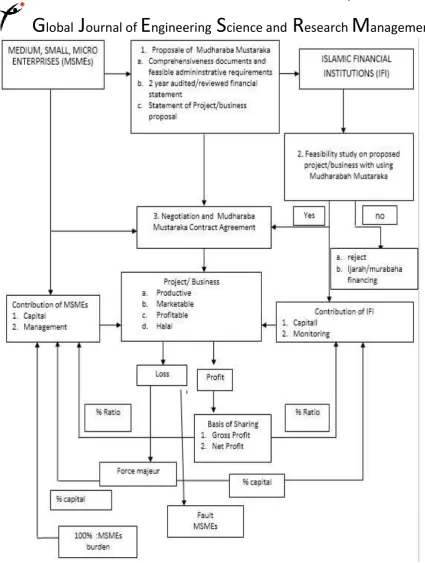
f. Follow and obey Islamic Law regarding to implementation of the patern of financing g. Change financing scheme with mudharaba mustaraka
Constructed Financing Modelof Profit Sharing System for MSMEs
[Roziq* 5(2): February, 2018] ISSN 2349-4506
Impact Factor: 3.799
G
lobal
J
ournal of
E
ngineering
S
cience and
R
esearch
M
anagement
Figure 3. Constructed Scheme of Mudharaba Mustaraka
Constructed Modelof Linkage Program Among Sharia Financial Institutions for SMEs
[Roziq* 5(2): February, 2018] ISSN 2349-4506
Impact Factor: 3.799
G
lobal
J
ournal of
E
ngineering
S
cience and
R
esearch
M
anagement
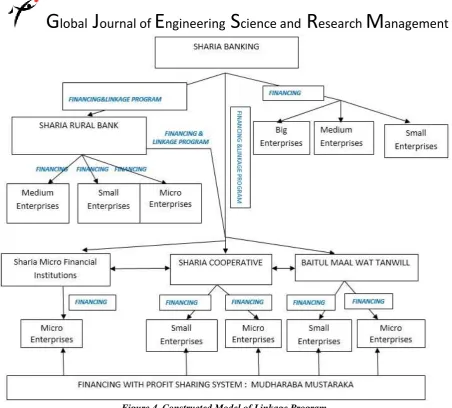
Figure 4. Constructed Model of Linkage Program
Explanation of figure 4 as follows
1. Islamic Banks provide financing directly (financing) to large enterprises, medium and small businesses use deng an mudharabah m uystarakah
2. Islamic Banks provide financing directly (financing) to Sharia Rural Bank (Sharia BPR) and or provide indirectly financing (Linkage Program) to medium-sized businesses, small businesses and micro enterprises through cooperation with the Sharia Rural Bank (Sharia BPR) using mudharaba muystaraka 3. Islamic Banks provide financing directly (financing) to the Sharia Cooperative and Baitul Maal Wat
Tanwill and Sharia Micro Financial Institutions and or provides financing indirectly (Linkage Program) to medium-sized businesses, small businesses and micro enterprises through cooperation with Sharia Cooperative and Baitul Maal Wat Tanwill and Sharia Micro Financial Institutions using mudharaba muystaraka.
4. Sharia Rural Bank (Sharia BPR) provide direct financing to medium-sized enterprises, small businesses and micro-enterprises and providing financing or indirectly (Linkage Program) to medium-sized businesses, small businesses and micro enterprises through cooperation with Sharia Cooperative and Baitul Maal Wat Tanwill and Sharia Micro Financial Institutions using mudharaba muystaraka. 5. Sharia Cooperative, Baitul Maal Wat Tanwill and Islamic Micro Finance Institutions provide direct
[Roziq* 5(2): February, 2018] ISSN 2349-4506
Impact Factor: 3.799
G
lobal
J
ournal of
E
ngineering
S
cience and
R
esearch
M
anagement
CONCLUSION
Based on the analysis and discussion of this research, the conclusions are;
1. Scheme / contract used in financing under the profit-sharing system consists of; (a) mudharaba financing (b) musharaka financing. But, total these financing is still smaller than non- profit-sharing system such as murabaha, istisna and ijarah
2. Islamic financial institutions use basis for sharing profit with (a) net profit , (b) gross profit and (c) sales. But National Sharia Board make fatwa that basis of profit sharing (a) net profit , (b) gross profit 3. Financial statements of MSMEs are very required to report performance of its business and as basis to
calculate profit sharing, MSMEs did not prepare financial statements.
4. Some shortcomings of the financing scheme for the results to SMEs compared with the financing scheme murabaha or scheme in addition to the results, among others, (a) the lack of unanimity in perception between the customer and the Islamic bank, (b) lack of awareness make the financial statements, (c) financial records are still manual or not automatically to the system, (d) schematic system for the results requires a system in an orderly manner, (e) reporting earnings that is not the objective of the SMEs, (f) the paradigm of society if a big profit will likely jump, (g) if murabaha people bothered to find stuff and (h) easier / clear the transaction
5. Difficulties or constraints faced and felt by MSMEs associated with profit sharing system as follows ; (a) requierement of administration difficult, (b) need collateral, (c) high cost (big profit sharing), (d) short period of financing ( 1 year), (e) difficulties in calculating income and profit sharing, (f) difficult to prepare financial statements, (g) do not understand the pattern of sharia and (h) bear loss
6. Difficulties or constraints faced and felt by IFI associated with profit sharing system as follows (a) income / loss is not transparent, (b) manipulation of results of operations, (c) side streaming, (d) late payments, (e) defaults/mismanagement, (f) creative accounting, (g) lack of discipline in implementing agreements
SUGGESTION
Based on the analysis, discussion and conclusions, the suggestions of the study's findings are;
1. Islamic financial institutions have to improve implementation financing with profit sharing schemes for MSMEs as follows :
a. Sosialize and educate MSMEs and society about pattern of financing with profit sharing system b. Train MSMEs prepare financial statement before financing MSMEs
c. Monitor businsess of MSMEs and usage of fund d. Audit financial statement of MSMEs
e. Held a meeting with MSMEs regurally
f. Follow and obey Islamic Law regarding to implementation of the patern of financing g. Change financing scheme with mudharaba mustaraka
2. Islamic financial institutions should apply the profit sharing financing for MSMEs with mudaraba mustaraka which is a combination between mudharaba and musyaraka sheme, which this scheme will be able to protect losses for islamic financial institutions (and still provide free for MSMEs to manage their business without interference from Islamic financial institutions as described in figure 3.
3. Islamic financial institutions (IFI) such as (Islamic Bank, Sharia Rural Bank, Sharia Cooperative, Baitul Maal Wat Tanwill and Sharia Micro Financial Institutions) should make Linkage Program in financing for the results to SMEs. Here is contructed model of linkage program among the Islamic financial institutions for financing medium, small, and micro enterprises (MSMEs) as described in figure 4
BIBLIOGRAPHY
1. Abdurahman Yusuf and Unti Ludigdo, 2004. Deconstruction of Values Agency Theory With Values of
the Shariah: An Effort to Build Accounting Principles bernafaskan Islam. Proceedings of the National Symposium on Islamic Economic System II: 249-262. Malang: Unibraw.
2. Ahmadsyah, Israk, 2004. Practice Murabaha, Bai Bithaman Ajil and Idea Bank Baitulmaal. Proceedings
of the National Symposium on Islamic Economic System II: 455-463. Malang: Unibraw.
3. Antonio, Muhammad Shafi, 2001. Sharia Bank From Theory to Practice. Jakarta: Gema Insani.
[Roziq* 5(2): February, 2018] ISSN 2349-4506
Impact Factor: 3.799
G
lobal
J
ournal of
E
ngineering
S
cience and
R
esearch
M
anagement
5. Chariri, Anis, 2008. Questioning The Popularity of Agency Theory in Accounting Research. Journal of
Economics and Business: 16 (1): 1-14. Semarang: Diponegoro University.
6. Choudhury, Masudul Alam, 2001. Financial Globalization and Islamic Financing Institutions. Journal
Of Islamic Economic Studies 9 (1): 17-38.
7. Cooper, David J and Michael J. Sherer, 1984. The Value of Corporate Accounting Reports: Arguments
for a Political Economy of Accounting, Journal of Accounting, Organizations and Society 9: 207-232. USA: University of East Anglia.
8. Gamal, Merza, 2007. Know Accounting Principles of Sharia. http: // www. kabarindonesia.com /
9. Hameed, Shahul Bin Mohamed Ibrahim and Rizal Yaya, 2006. The Emerging Issues on the Objectives
and Characteristics of Islamic Accounting for Islamic Business Organizations. Malaysian Acc. Review.
International Islamic University Malaysia.
10. Harahap, Sofyan Safri, 1997. Accounting Islam. Jakarta: PT Bumi Literacy.
11. Jensen, Michael C. and William Meckling H, 1976. Theory of the Firm: Managerial Behavior, Agency
Costs and Ownership Structure. Journal of Financial Economics 3 (4): 305-360. Harvard Business School.
12. Karim, Adiwarman 2004 (a). Sharia Bank: Fiqh and Financial Analysis. Second Edition, Jakarta: PT.
King Grafindo Persada.
13. Kazmi, Abid, 2004. The Islamic Economic Model. Financial Services 3 (3).
14. Manzilati, Asfi, 2004. Financing Murabaha as prerequisites Mudharabah in the framework of the Generalized Others. Proceedings of the National Symposium on Islamic Economic System II: 107-115. Poor.
15. Muhammad, 2002. Sharia Bank: Analysis of Strengths, Weaknesses, Opportunities and Threats. Second
Edition, Yogyakarta: UII Ekonesia Faculty of Economics.
16. Mulawarman, Aji Smith, Iwan Triyuwono, and Unti Ludigdo. 2006. Reconstruction Technology
Accounting Integralistic Syari'ah: Shari'ate Value Added Statement. Accounting Prosisiding National Symposium IX. Field.
17. Pratamasari, Frinta, 2003. Analysis of Factors Influencing Practice Alignment Income (Income
Smoothing) In Manufacturing And Finance Company Listed on The Jakarta Stock Exchange. Journal
Skripsi.com. Malang: Unibraw.
18. Rahmawati, Suparno Yacob and Nurul Qomariyah, 2006. Effect of Information Asymmetry Of Practice
Management Profit On Public Banking Companies Listed on the Jakarta Stock Exchange. Proceedings of the National Symposium on Accounting IX. Field.
19. Roziq, Ahmad.2011. In the Islamic Business Ethics at Bank Syariah Mudharabah In East Java. Journal
of Accounting University of Jember.
20. Rizki, Mohammad, 2003. Deleting Phobia Of Financing For-Results. PSTTI UI Tazkia. http: // www.tazkia.co.id .
21. Samad, Abdus, and M. Kabir Hassan, 1999. The Performance of Malaysian Islamic Bank During
1984-1997: an Exploratory Study. International Journal of Islamic Financial Services 1 (3): 1-12.
22. Sarker, Abdul Awwal, 1999 (a). Islamic Business Contracts, Agency Problem and Theory of Islamic Firm. International Journal of Islamic Financial Services 1 (2): 12-28.
23. Scott, William R, 2006. Financial Accounting Theory. Fourth Edition. Toronto USA: Prentisce Hall. 24. Setiawan, Nana, 2006. Management Profit In Islam Ethics Review. Journal Skripsi.com. Malang:
Unibraw.
25. Shidiq, M. Sofyan Kabu, 2007. The Pros and Cons of the Financial System For-Results. MSI-UII Net.
26. Triyuwono, Iwan, 2004. Trust (Amanah), the Divine Symbol: Interpretations in the Context of Islamic
Banking and Accounting Practices. Asia-Pacific Interdiciplinary Research in Accounting. Singapore. 27. ______________, 2006a. Perspective, Methodology and Sharia Accounting Theory. Jakarta: PT.
RajaGrafindo Persada.
28. Warjiyo, Tarsidin Perry, 2003. Sharia Banking and Banking with Interest: Which Is Which Optimal. Info Bank News.com
[Roziq* 5(2): February, 2018] ISSN 2349-4506
Impact Factor: 3.799
G
lobal
J
ournal of
E
ngineering
S
cience and
R
esearch
M
anagement
30. Yusof, Selamah Ruzita Abdullah and Mohammad Amin, 2007. A Survey on The Objective of the Firm