ISSN (online): 2207-4414
Centre for Islamic Studies and Civilisation Charles Sturt University CRICOS 00005F
Islamic Sciences and Research Academy of Australia
https://ajis.com.au
Halal Certification and Islamophobia
A Critical Analysis of Submissions Regarding the Review of
Third Party Certification of Food in Australia Inquiry
Manal Etri & Salih Yucel
To cite this article:
Etri, Manal and Salih Yucel. “Halal Certification and Islamophobia: A Critical Analysis of Submissions Regarding the Review of Third Party Certification of Food in Australia Inquiry.” Australian Journal of Islamic Studies 1, no. 1 (2016): 1-22.
Published online: 14 January 2016
View related and/or other articles in this issue Submit your article to this journal
HALAL CERTIFICATION AND ISLAMOPHOBIA:
A CRITICAL ANALYSIS OF SUBMISSIONS REGARDING
THE REVIEW OF THIRD PARTY CERTIFICATION OF
FOOD IN AUSTRALIA INQUIRY
Manal Etri
*and Salih Yucel
**Abstract: In recent years, there has been growing concern regarding halal certification, which has resulted in targeted campaigns against halal food and products. On 13 May 2015, the Australian Senate commissioned a six month parliamentary inquiry into food certification processes in Australia, but given focus on the halal certification process. A central component of the investigation involved seeking public submissions, with 1,492 received in total. The Senate released a report of its findings on 1 December 2015. All public submissions and the Senate report are analysed in this paper. This article first argues there is an emerging link between targeted campaigns against halal certified products and related processes, and broader Islamophobic campaigns against Muslims living in Australia; demonstrating how Islamophobic discourse takes shape. Second, while the context may differ, the Islamophobic narrative remains effectively the same even as it pertains to halal certified foods. Finally, the article will demonstrate that a small segment of the Australian public used the commissioned Inquiry into the Third Party Certification of Food as an opportunity to whip up anti- Muslim sentiment within the wider Australian community.
Keywords: Islam, halal, Islamophobia, Australia, halal certification
Introduction
On 13 May 2015, the Australian Senate commissioned a six month parliamentary inquiry into food certification processes in Australia. The Inquiry, which was carried out by the Senate Economics References Committee, set out to examine the extent of food certification in Australia, current labelling requirements and need for companies to label products, details regarding certification fees, importance of certification schemes in relation to export markets and availability of information to consumers regarding certifiers, their fees and financial records. The Senate released a report of its findings regarding the public submissions on 1 December 2015. As highlighted in the Inquiry, this can be attributed to a consistent line
* Manal Etri is a researcher at the Centre for Islamic Studies and Civilisation, Charles Sturt University. ** Salih Yucel is an Associate Professor at the Centre for Islamic Studies and Civilisation, Charles Sturt
of arguments and perspectives adopted by anti-halal groups, which have been used to lay the foundation for their objection to halal certification.
This article summarises the key arguments presented in the submissions and how they have been used to fuel Islamophobic narrative within an Australian context.
Islamophobia and Anti-Halal Campaigns in Australia
The term Islamophobia was first used by French scholar Etienne Dinet in 19181 and
developed by the Runnymede Trust Commission in 1997, which defined Islamophobia as “a useful shorthand way of referring to dread or hatred of Islam and, therefore, the fear or dislike of all or most Muslims”.2 The Runnymede Trust Report distinguishes between “legitimate
criticism and disagreement” of Islamic dogma and practices, and bigotry and hatred directed towards Muslims and Islam.3 Gottschalk and Greenberg argue that Islamophobia is “a social
anxiety towards Islam and Muslim cultures.”4 Imhoff and Recker’s definition highlights eight
key features about Islamophobia:
views of Islam as (1) monolithic, (2) separate from and (3) inferior to Western cultures. Islam is seen as (4) “an enemy” and as (5) a manipulative political ideology. Criticism of the West is (6) a priori rejected, (7) discrimination against Muslims is justified, and (8) Islamophobia is seen as natural.5
These characteristic elements of Islamophobia permeated a significant number of the submissions received by the Senate Inquiry; thus, supporting the claims of the existence of this phenomenon in the wider Australian community. In recent years, anti-halal campaigns have surfaced in Western countries across the globe and point towards a targeted Islamophobic campaign against halal food and products. The surfacing of anti-halal campaigns may be attributed to the rapid expansion of the halal food market, which has led to the entry of multinational and international companies into the halal market.6
The expansion of the global halal industry has given rise to a new form of Islamophobia targeting halal certification. This was highlighted in the anti-halal campaigns that sought to garner support for its stance against halal certification prior to, during and after the Inquiry. Halal Choices founded by Kirralie Smith, the Australian Consumers against Halal Certification, Bernard Gaynor and the Q-Society have led some of these anti-halal campaigns in Australia. Halal Choices was borne out of Kirralie’s opposition to what she considers to be
1 Burak Erdenir, Muslims in 21st Century Europe: Structural and Cultural Perspective, ed. Anna
Triandafyllidou (London: Rutledge, 2010), 29.
2 E. Bleich, “What is Islamophobia and how much is there? Theorizing and measuring an emerging comparative concept,” American Behavioral Scientist 55, no. 12 (2011): 1583.
3 Ibid.
4 Peter Gottschalk and Gabriel Greenberg, Islamophobia: Making Muslims the Enemy (US: Lanham, Rowmen & Littlefield Publishers Inc, 2008), 5.
5 Roland Imhoff and Julia Recker, “Differentiating Islamophobia: Introducing a New Scale to Measure Islamoprejudice and Secular Islam Critique,” Political Psychology 33, no. 6 (2012): 812.
the imposition of Islamic religious practices on non-Muslims. She specifically targets halal certified products and Islam more broadly as a religion, arguing that funds from certification schemes could be used to fund terrorist organisations.7 Misinformation and Islamophobic
sentiments regarding halal certification and Islam were scattered throughout the submission, also appearing on the Halal Choices website. Kirallie found the Inquiry to be the appropriate platform to air her views about Islam, arguing the religion and its institutions in Australia, including mosques, promote, inter alia, violence, hatred, intolerance, bigotry and terrorism. She qualifies her comments by adding that “thankfully the majority of Australian Muslims do not follow the example of their Prophet.”8 Interestingly, Kirallie does not see Kosher certification
as an issue because “the Jewish community is well integrated into Australian culture and support the laws, values and morals of a free, democratic nation.”9
The majority of submissions adopt key terms and ideas promulgated by the Halal Choices campaign. For example, terms and phrases such as “informed decisions”, “clearer labelling”, “deception”, “discrimination” and “halal = sharia” can be found within numerous submissions, highlighting the influence of such campaigns on the public conscience.10 A
template that is available on the Halal Choices website was also found to be used by respondents in their submissions to the Inquiry.
Bernard Gaynor, another anti-halal proponent, describes himself as “… a conservative Catholic who writes what normal men dare not speak out loud … and is an advocate for … the preservation of Australian society from those who would replace its Christian Heritage.”11
Gaynor’s submission to the Inquiry states, while he focuses on halal certification, his argument encompasses all religious certification so as not to “be viewed as being of an inherently anti- Islamic nature.”12 However, the information published on his website conflicts with this
statement as his emphasis is on halal certification and sorting out this “scam” for good.13
Further to this, the petition to garner support for his submission only refers to the issue of halal certification. Thus, the submission can be deemed to be anti-Islamic in nature as it targets halal certification while ignoring other certification schemes. It is also important to note that Gaynor and Smith used their social media accounts and websites as a means of encouraging members of the public to not only support their campaign targeting halal certification, but also submit a response to the Inquiry.
7 “Submissions,” Parliament of Australia, accessed November 30, 2016, http://www.aph.gov.au/
Parliamentary_Business/Committees/Senate/Economics/Food_Cert_Schemes/Submissions, Halal Choices, No. 1278, 60.
8 Ibid, 55. 9 Ibid, 10. 10 Ibid, 2.
11 “About Bernard Gaynor,” accessed November 30, 2016, http://bernardgaynor.com.au/about/. 12 “Submissions,” Bernard Gaynor, No. 1383, 8.
Research Design
A mixed method approach was deemed appropriate for this study involving a meta- analysis of the 1492 submissions made to the Inquiry. A coding framework was developed where each submission was coded using both a qualitative and quantitative coding scheme. The coding scheme was developed after reading a random selection of submissions and identifying the key of areas of interest for this research.
The quantitative analysis allows for an understanding of the background of those who made a submission to the Inquiry. Areas of interest include:
• Whether the contributor opted to withhold personal/identifying details
• Whether submissions were lodged by individuals, couples or family groups
• Whether submissions were lodged on behalf of an organisation
• The state in which the contributors reside
• Personal information provided by the contributors
• Quantum of submissions (length of each submission made)
The qualitative analysis will offer an examination of the content and themes raised by the Inquiry respondents. This will give some insight into the thoughts and attitudes expressed by the respondents, including whether arguments posed in their submissions lend themselves to Islamophobic tendencies (refer to the coding below for criteria) or if legitimate concerns have been identified. As well as the key topics of interest I have selected for this study, the qualitative coding scheme will also explore the style and format of submissions including:
• Whether submissions are Islamophobic in nature
• Whether submissions address single or multiple issues
• Whether submissions were confidential or non-confidential
After reading all available submissions, and coding each submission into their relevant categories, N-Vivo software was used to search for key words and phrases in order to ensure the submissions were thoroughly coded. While wide-ranging areas of interest were selected for this study, it is important to note that some submissions may have expressed views that do not fall within the various categories of selected interests. Thus, it may not be possible to gauge every opinion expressed by the contributors. Nonetheless, this research will examine the key discourses presented in the submissions.
Coding of Islamophobic submissions was based on Tell MAMA’s definition of Islamophobia and anti-Muslim prejudice: “hatred or outward hostility towards Muslims”14 This
definition is further categorised into four different areas:
• Associating Muslims collectively to terrorism, extremism, terrorist attacks and murder.
• Promoting rhetoric that states that social, political, economic and spiritual rights for Muslims should be less than members of other faith communities.
• Associating Muslims to terms that portray them as being dangerous, untruthful, deceitful, devious and untrustworthy, through to the association with organisms that cause death, decay and disease.
• Linking Muslims with the take-over of the United Kingdom or a global take-over and to the ‘infiltration’ of institutions with a view to meeting these ‘hidden’ objectives.15
This paper establishes an analytical framework around the above definitions and classifications as a means to identifying and categorising Inquiry submissions that appear overtly Islamophobic in nature.
Quantifying the Inquiry Data
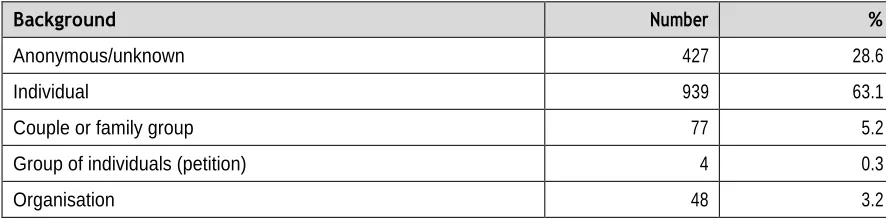
The majority of submissions came from individuals (63.1%). Other contributions were received from couples or family groups (5.2%), organisations from the food industry, certification agencies, religious communities, boycott campaigners and right wing political interest groups (3.2%) as well as government agencies. Submissions were also lodged in the form of group petitions, the highest containing 5,860 signatures from anti-halal campaigner Gaynor in Queensland (0.3%).
Table 1: Background of Submissions
Background Number %
Anonymous/unknown 427 28.6
Individual 939 63.1
Couple or family group 77 5.2
Group of individuals (petition) 4 0.3
Organisation 48 3.2
NB: Respondents may fall into more than one of the above categories
14 Mark Littler and Matthew Feldman, Tell MAMA Reporting 2014/2015: Annual Monitoring, Cumulative
Extremism, and Policy Implications (UK: Teesside University, 2015), https://www.tellmamauk.org/wp-
Location
The largest number of submissions lodged originated from Queensland (13.1%), ahead of NSW (12.4%) and Victoria (9.7%). The Northern Territory recorded the least number of submissions (0.3%).
Table 2: Location
State Number %
ACT 14 0.9
NSW 185 12.4
NT 5 0.3
QLD 195 13.1
SA 48 3.2
TAS 12 0.8
VIC 145 9.7
WA 99 6.6
Unknown 788 52.9
Total 1491 99.9
NB: Percentages may not add to exactly 100 percent due to rounding
Religious/Faith-based Orientation
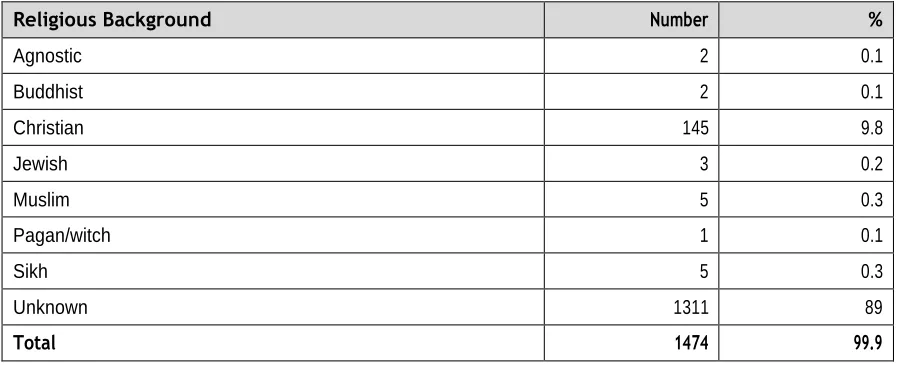
Most submissions did not disclose details relating to religious orientation (89.0%). However, of those who did provide this information, Christians formed the majority of respondents (9.7%) followed by Muslims and Sikhs (0.3%).
Table 3: Religious/Faith-based Orientation
Religious Background Number %
Agnostic 2 0.1
Buddhist 2 0.1
Christian 145 9.8
Jewish 3 0.2
Muslim 5 0.3
Pagan/witch 1 0.1
Sikh 5 0.3
Unknown 1311 89
Total 1474 99.9
Figure 1: Religious Background
Quantum of Submissions
Of the total submissions, 51.5% were less than one page, while 40.8% ranged between 2 and 10 pages.
Table 4: Quantum of Comment
Quantum of comment Number %
1 page 759 51.5
2-10 pages 601 40.8
More than 10 pages 26 1.8
Unknown (confidential submissions) 85 5.8
Total 1474 99.9
NB: Percentages may not add to exactly 100 percent due to rounding Non-Halal related submissions were excluded from the data
Style and Format of Submissions
Seventy-two percent of submissions were considered to be original, while 16.6% were categorised as formulaic. Submissions were deemed to be formulaic if they were an exact copy of another submission or followed a particular template in which exact terms and phrases were used. The majority of respondents did not seek to have their submissions dealt with confidentially. However, 23% requested their personal details be withheld. Confidential submissions could not be accessed via the Senate Inquiry website. It is also important to note
Religious Orienation
the Senate Report Inquiry mentioned, due to the “sensitive to the nature of some of the material in question ... some submissions were not published.”16
Table 5: Style of Submissions
Style of submission Number %
Single issue 461 33.2
Multiple issues 922 66.4
NB: Percentages may not add to exactly 100 percent due to rounding Non-halal related submissions were excluded from the number of issues data
Table 5.1 Format of Submissions
Format of submission Number %
Confidential 85 5.7
Non-confidential 1064 71.4
Name withheld 343 23.0
NB: Percentages may not add to exactly 100 percent due to rounding Non-halal related submissions were excluded from the number of issues data
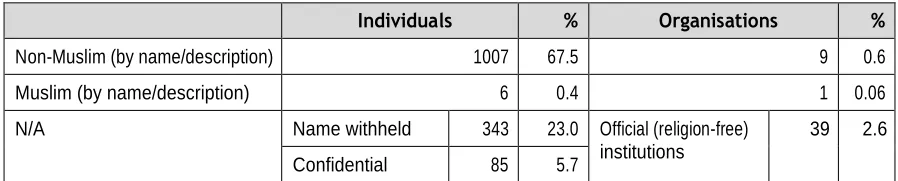
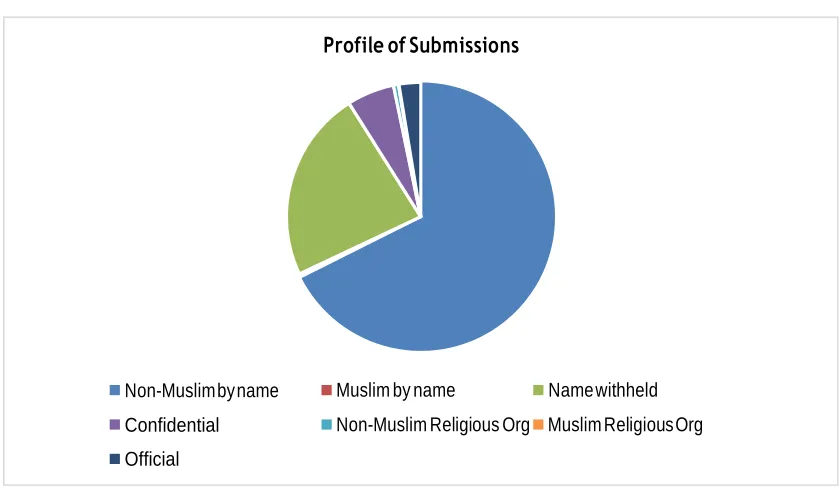
Analysis of the names and descriptions provided by respondents reveals that 67.5% of submissions lodged by individuals were of non-Muslim background and a further 0.6% were prepared by non-Muslim organisations. This is in stark contrast to the 0.4% of Muslims who provided a written submission to the Inquiry and the single (0.06%) submission sent in by the Halal Certification Authority Australia. Further research into this area is required to ascertain the reasons why other halal certification authorities did not participate in the Inquiry and why Muslims made up such a small minority of the total number of respondents. The large number of non-Muslim respondents may be attributed to the highly publicised anti-halal campaigns and opposition concerning halal certified products.
Table 6: Non-Muslim vs Muslim Submissions
Individuals % Organisations %
Non-Muslim (by name/description) 1007 67.5 9 0.6
Muslim (by name/description) 6 0.4 1 0.06
N/A Name withheld 343 23.0 Official (religion-free)
institutions
39 2.6
Confidential 85 5.7
Figure 2: Profile of Respondents (Non-Muslim vs Muslim)
Content of Submissions
Ninety-three percent of submissions made reference to halal certification. Only 6% of submissions could not be classed as halal-related, either due to their content or because of the confidential nature of the submission. This demonstrates the Inquiry into Third Party Certification of Food heavily targeted halal certification. Analysis of the submissions containing references to halal indicates high levels of anti-Islamic and Islamophobic attitudes. Fifty-eight percent of submissions were classified as Islamophobic in nature (note: only overt Islamophobia was measured, and levels of Islamophobia and anti-Muslim prejudice may be higher than reported if covert Islamophobia is included in the analysis).
Table 7: Content of Submissions
Content of submissions Number %
Halal related 962 64.5
Non-halal related 17 1.1
Combined 427 28.6
Unknown 85 5.7
Total 1491 99.9
NB: Percentages may not add to exactly 100 percent due to rounding
Table 8: Islamophobia
Existence of overt Islamophobia Number %
Islamophobic style or elements of Islamophobia 806 58.0
Non-halal related submissions and confidential submissions were excluded from the data
Profile of Submissions
Non-Muslim by name
Confidential
Official
Muslim by name Name withheld
Issues Relating to Halal Certification
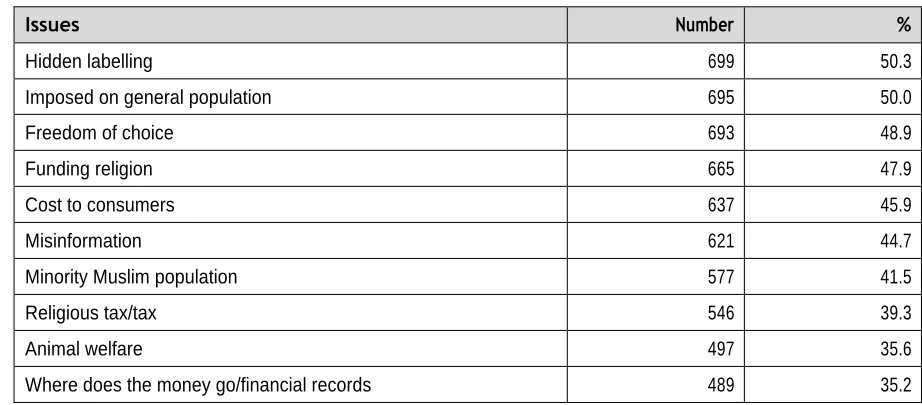
There were a number of similarities between the submissions, suggesting that consumers were influenced by anti-halal campaigns. Fifty percent of submissions were concerned with the lack of labelling on halal certified products. The perceived imposition of halal certified food on the Australian public was equally an issue. Members of the community were also frustrated at their lack of choice in purchasing non-halal certified products and the perceived increase in the cost of food due to certification. Misinformation regarding halal certification, Islam and Muslims was found to be present in 44.7% of the submissions. Such a high percentage demonstrates a lack of understanding of certification processes, in addition to the prevalence of certain attitudes within some segments of the Australian community that align with stereotypical portrayals of Islam and Muslims. These depictions of Muslims correspond closely with Tell MAMA’s definition of Islamophobia and anti-Muslim prejudice, which incorporates the generalisation of all Muslims as terrorists, extremists or partaking in terrorist activities, expressing the curtailing of Muslim rights and freedoms, promoting negative representations of Muslims as being deceitful and untrustworthy and connecting Muslims to taking over the country they reside or a global takeover.17
One quarter of respondents believed halal certification funds terrorism, while a further 35.2% demanded to know where the money from certification fees is channelled. Animal welfare was another area of concern that featured commonly throughout submissions, with 35.2% concerned about animal abuse and the suffering of animals during the slaughter process. A further 25.9% were threatened by the “creeping” Islamisation of Australia or enforcement of sharia law in the country. Some individuals also considered halal certification to be a form of discrimination (26.3%), with a further 12.5% taking offence to the existence of such a scheme. This particular finding points to a lack of understanding of certification processes as well as the prevalence and acceptance of stereotypical depictions of Islam and Muslims.
Table 9: Issues with Halal Certification
Issues Number %
Hidden labelling 699 50.3
Imposed on general population 695 50.0
Freedom of choice 693 48.9
Funding religion 665 47.9
Cost to consumers 637 45.9
Misinformation 621 44.7
Minority Muslim population 577 41.5
Religious tax/tax 546 39.3
Animal welfare 497 35.6
Where does the money go/financial records 489 35.2
Issues Number %
Cost of certification 478 34.4
Scam/rort 420 30.2
Discriminatory 366 26.3
Sharia/Islamic law 360 25.9
Terrorist funding 358 25.8
Deceptive/misleading labelling 292 21.0
Ritual slaughter 283 20.4
Threats/bullying and blackmail by certifiers 273 19.6
Islamisation/spread of Islam/world domination 262 18.9
Offensive 174 12.5
Monopoly of the market 58 4.2
Death cult 33 2.4
Proposed Solutions to Halal Certification
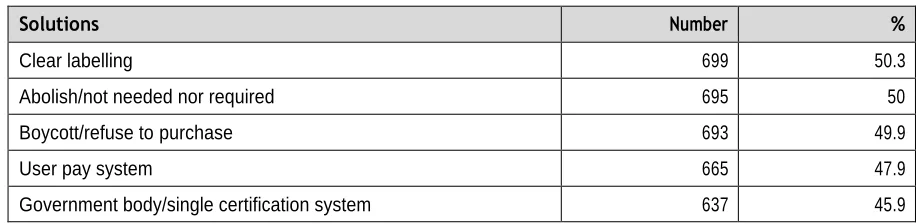
Half of all respondents (50.3%) called for clearer labelling on food products to allow consumers to make informed decisions when shopping. As mentioned earlier, the terms “informed choices” and “clearer labelling” are mottos propagated by Halal Choices and other anti-halal campaigners. For example, this can be seen in Kirralie Smith’s submission, which uses the phrases “informed decisions,” “informed choices” and “clear labelling” throughout her response:
Most products which have paid halal certification fees are not clearly labelled which greatly diminishes choice for those opposed to funding halal certification. It means both Muslim and non-Muslim consumers are unable to make an informed decision at the point of sale.18
These anti-halal sentiments formed the bulk of submissions, highlighting the influence campaigners against halal certification had in relation to the rest of the submissions lodged by the public. The proliferation of anti-halal slogans did not go unnoticed by Submission 1333, which stated that terms such as “raises the cost of food,” “funding Islam with your everyday grocery purchases,” “religious tax” and “extortion” are a result of “anti-Muslim misinformation” that are “repeatedly” spread by “Halal Choices (Q Society)” and “other boycott pages.”19
“How could customers be funding anything in their grocery purchases when the cost of certification is not included in the product price?” Submission 1333 argues and claims that the “religious tax myth” has been effective in fooling people to support the anti-halal campaigns
because “everyone hates taxes, especially … if they’re being forced on you by a religion you don’t follow.”20
Fifty percent of respondents also stated their belief that halal certification was not necessary or should be abolished. This finding is contrary to the claims made by the Inquiry and Senator Bernadi:
In many cases, submitters were not calling for a complete removal of halal certification; just more information so that they could choose whether or not to buy halal certified products. This reflects the committee’s view that “calling for reform is vastly different from advocating abolition.”21
A further 49.9% gave insight into their decision to boycott halal products and refusal to purchase halal certified goods. Respondents also suggested the introduction of a user pay system (47.9%), while others were keen for the government to establish a regulatory body to oversee the halal certification process.
Table 10: Proposed Solutions to Halal Certification
Solutions Number %
Clear labelling 699 50.3
Abolish/not needed nor required 695 50
Boycott/refuse to purchase 693 49.9
User pay system 665 47.9
Government body/single certification system 637 45.9
Positive Submissions
Out of the 1389 submissions received that contained views about halal certification, only 2.2% spoke positively about halal certification. Although 52 respondents spoke about inclusivity and supporting the right of Muslims to have their own types of food, they also mentioned issues they had with halal certification, which therefore excluded them from being categorised as completely positive.
Table 11: Positive Submissions
Positive Submissions Number %
Positive 31 2.2
Inclusive 13 0.9
Muslims have a right to their food 39 2.8
Sarcastic response 2 0.1
NB: Sarcastic responses were those that made fun of the inquiry targeting halal certification.
Qualitative Analysis of the Inquiry submissions
Islamophobic attitudes and sentiments permeated a significant number of submissions lodged for the purpose of the Inquiry. The majority of issues raised by the Inquiry can be classified as covert Islamophobia, overt Islamophobia or misinformation. Covert Islamophobia can be defined as:
… the influences and attitudes of everyday life rather than high-profile and widely publicised violent attacks and infringements. It contains a disguised and covert version of old-fashioned prejudice. This subtle prejudice is widespread, particularly by the young, well-educated, and liberal groups who perceive Muslims as a threat to the values and norms of their society, but do not express it explicitly because anti-blatancy is an established norm among these groups.22
Specifically criticising and questioning halal certified products and halal certifiers and targeting Muslims and Islam, while simultaneously ignoring other types of religious and food certification schemes, highlights the existence of covert Islamophobia within the context of the Inquiry and the broader Australian context. In relation to the Inquiry, issues such as clearer labelling specific to halal certification, discrimination of workers and animal cruelty can be categorised as forms of covert Islamophobia. For example, respondents who wrote about their genuine concern regarding animal welfare differ in their stated position to those who spoke of animal cruelty only in relation to halal slaughter and without reference to slaughter practices that exist in other religious communities. Overt Islamophobia can therefore be classified as acts of anti-Muslim prejudice that are explicit in nature. Linking halal certification to terrorism, claiming that Muslims refuse to integrate or are encroaching on Australian values, and labelling Islam as a death cult can be labelled as overt examples of Islamophobia due to their clear and unquestionable visibility. The following section will examine issues concerning covert and overt Islamophobia as highlighted in Inquiry submissions.
In general, the nature of the majority of submissions received seems to suggest that segments within the non-Muslim Australian population are convinced that Muslims refuse to integrate or assimilate into Australian society. This is evidenced in the views lodged by Shirley Hollister who questions how a minority religion can change her “way of living” and how everyone except Muslims have integrated without forcing their beliefs upon the wider community.23 This concept of “forcing” and “demanding” all Australians to conform to the
Islamic way of life was referred to in a number of submissions. For example, Iris Tisdale is “astonished and appalled” at how “we are allowing other countries to colour, form and distort Australian culture.”24 This is “our country” Tisdale continues and argues how “wogs” in the
past were “grateful for the opportunity afforded to them” and “such gratitude … saw names
22 Erdenir, Muslims in 21st Century Europe, 36.
Australianised in an effort to be more Australian.”25 Today, Tisdale “sees a culture that
constantly makes demands” rather than integrates into mainstream Australian society.26
There appears to be an expectation that Muslims must change key aspects of their identity in order to fit into the broader Australian community. To not do so is, according to Shirley Hollister, demonstrative of a lack of respect for the host country. This idea of being thankful for the opportunity to migrate to Australia was promoted in Edward McCann’s submission who stated:
I find it so irritating that these people have come to our country and refuse to integrate, instead of demanding their rights to practice their religious rites at our expense. Where is their sense of gratitude? It seems to be lacking.27
Viv and Fay Pampling also expressed similar views:
Why should other people dictate to us about our laws and customs? Should not these other cultures be thankful that Australia is open to accept them and allow them to enjoy a lifestyle that should be the envy of all?28
Such Islamophobic statements highlight the expectation by some Australians that migrants leave their identity at the door before entering Australia. They suggest, in order to appreciate the opportunities Australia affords all people and to demonstrate true gratitude, one must forgo who they are to be accepted as part of Australian society. Yet statements such as “This is our country” denote a sense of ownership of Australia by some, which in turn has the potential to alienate those who choose not to strip themselves bare of their cultural and religious heritage.
Halal certification is having “a divisive effect on the Australian multicultural mindset”29
and these immigrants have no right “to demand something of their host country” as “they are required to integrate into our society, not the other way around.”30 What many of these
submission respondents may not be aware of is the reality that businesses and food companies are approaching halal certifiers in order to tap into new and lucrative markets. It is not the Australian Muslim community demanding certification of all products, or attempting to change Australian culture. Rather, they are merely availing themselves of business opportunities emerging between certifiers and Australian corporations. Worldwide, the halal market is valued at $2.1 trillion. The halal market is injecting about $8.5 billion into the Australian economy annually.31
25 Ibid. 26 Ibid.
27 Ibid, No. 777, 1. 28 Ibid, No. 751, 1.
29 Ibid, name withheld, No. 414, 2. 30 Ibid, Mark Parham, No. 558, 3.
The above arguments are overtly Islamophobic as they are in solid alignment with a number of categories established by Tell MAMA and the Right-Wing Watch, which include practices involving direct hatred and hostility towards Muslims, and the revocation of rights and freedoms from Muslims (such as religious freedom) as classic Islamophobia.32
Threat to Australian Way of Life
Some submission respondents regarded halal certification practices as an encroachment on Australian values and a threat to the Australian way of life, identifying a need to proactively preserve Australian values and culture. Australian culture and values are also seen as vastly superior to Islamic values. Mark Shay found it “offensive” that he be required to “support a morally bankrupt religion.”33 This is further emphasised by Chris Newman, who states:
In fact, they are inferior to our ways. We must root out and eradicate any and all impositions of Islamic systems, they are inferior to ours and are a negative imposition on our national well-being and security.34
The above comment is in line with the definition of Islamophobia developed by the Runnymede Trust, which includes perceptions supporting the inferior status of Islam to Western culture. Islam is perceived to be foreign, different and rejecting of the values and freedoms of Western democracy. This idea of Islam as religiously and culturally inferior is what some scholars have come to define as “cultural racism.”35 Green states:
This form of racism incites hatred and hostility based on religious beliefs … with Muslims and Islam labeled as barbaric, violent, uncivilized, and inferior to Western culture and civilization.36
Such perceptions are conducive to promoting and fuelling Huntington’s infamous claim of an inevitable “clash of civilisations.”37
Not only is it argued that Islam is inferior, but it also “cannot be compatible” with Western culture and civilisation.38 One cannot “form an opinion of Islam” until they have
familiarised themselves “with the teachings of this totalitarian ideology.”39
Some submissions went so far as to seek the deportation of individuals who refused to integrate or sought halal certified foods. For example, Fay Christie states, “This wonderful
32 Littler and Feldman, Tell MAMA Reporting 2014/2015, 9-1; Right Wing Watch, The Right Wing Playbook
on Anti-Muslim Extremism, accessed November 30, 2016, http://www.pfaw.org/sites/default/files/rwwif-
muslim-playbook.pdf, 2. 33 “Submissions,” No. 200, 1. 34 Ibid, No. 812, 3.
35 Todd H. Green, The Fear of Islam: An Introduction to Islamophobia in the West (Minneapolis: Augsburg Fortress Publishers, 2015), 27.
36 Ibid, 27.
37 Gabrielle Marranci, “Multiculturalism, Islam and the Clash of Civilisations Theory: Rethinking Islamophobia,” Culture and Religion 5, no. 1 (2004): 110.
Christian Country does not need halal food and if Muslims do not like that they should go and live elsewhere.”40 Daryl James’ submission was more direct stating:
Tell the Muslim community if our food is not safe to eat then please go home to your country where your food is safe and your life is not.41
Barbara Legg similarly believes:
Islam is infiltrating our way of life; soon no woman will be safe to walk the streets during the day unless she has a burqa, which whilst it is the Muslim way, I find it disgusting that I have to witness this. There is no integration with Islam; it’s their way or the highway. Deportation of all Muslims who refuse to leave Islam is the only way to stop it changing the way we live.42
The issue of refusing to integrate is countered by Croucher who argues that:
while Muslims immigrants in many nations have found their new homes to be less than receptive, these new immigrants still take steps to assimilate … It is common for these Muslim immigrants to be told … they do not belong, they are different and they should go home.43
While Muslims are making an effort to integrate, members of the community refuse to acknowledge such efforts and at the same time feel threatened by their presence.
Terrorism Funding and Financial Transparency
About 32% of submissions argued for financial transparency in halal certification processes and a further 25.8% indicated some concern that halal certification is a means of funding terrorist organisations, revealing a high level of mistrust towards Muslims living in Australia, particularly halal certifiers. Consumers also alleged that halal certification is being used to collect zakat or jizyah, which contributes towards the Islamisation of Australia and ultimately world domination. Such arguments demonstrate a high level of fear and anxiety towards Muslim ownership of businesses. Further to this, Islamophobia can be demonstrated in disclosure demands being placed on entrepreneurs in relation to how they spend their money. This lack of consistency in standard setting across the business community points to the discriminatory nature of such calls. It is, therefore, arguable that, as Submission 1333 acknowledges, “Certification is a private arrangement between a company and a certifier,” and the community has no right to demand such information.44 Moreover, to claim that revenue
from halal certification schemes is being raised to finance terrorist organisations is a further indication of overt Islamophobia. Islam has become synonymous with terrorism and as a result, Muslims are viewed as the enemy and a threat to the country they live in. Halal certification is
40 Ibid, No. 384, 1. 41 Ibid, No. 872, 1. 42 Ibid, No. 529, 1.
43 Stephen M. Croucher, “Integrated Threat Theory and Acceptance of Immigrant Assimilation: An Analysis of Muslim Immigration in Western Europe,” Communication Monographs 80, no. 1 (2013): 47.
responsible for funding and supplying weapons to ISIL and Al-Qaeda.45 Interestingly, it was
not only Muslims whose trust and loyalty were in question, but the public appeared to have little trust in ASIO and the Australian Federal Police. Andy Leahy demands proof that funds are not being diverted offshore to terrorist organisations stating: “Can you definitively and confidently declare that no Australian registered Islamic charity has any of its funds diverted to terrorist organisations or activities? Where is your proof?” Andy concludes his letter with “A very concerned citizen; what do my grandchildren have to look forward to?”46
This is further emphasised by Kylie Hawson:
The money is transferred to charity organisations that are known fronts for terrorist organisations. And If A.S.I.O is worth their salt as the forefront of Australian Security then they should already know this and be combating it as we speak.47
There were submissions that particularly singled out halal certification and claimed that in no way could it be compared to “7th Day Adventists, Mormons, Buddhists, etc. or organic food certifiers funding projects allied to their beliefs” because “they do not have a terrorist arm or preach hatred of non-believers (kafirs). There is no comparison!”48 Thus, it is being claimed
other certification schemes are not an issue because they have no connection to Islam or Muslims. Covert attacks such as this demonstrate the stereotypical nature of views held about Muslims and Islam: Islam is inherently violent and preaches hatred to all non-believers. These comments are indicative of the misinformation that exists in Western societies and Werbner argues that politicians and intellectuals must “consistently counter the globalizing stereotypes of Muslims as fundamentalists and … recognize that religious fundamentalists in today's world are not uniquely Islamic.”49
Such arguments were counteracted by Submission 454 who explained that certifiers “would be subject to Australian companies’ and financial laws”50 and further argues:
I have confidence in our current security arrangements and I believe that the AFP, ASIO etc are correct when they say there is no evidence to suggest funds from the certification of food are being diverted to illegal activities. I refer specifically here to halal and the disinformation currently being disseminated by certain groups who seem to be irrationally afraid and hateful of Muslims living in peace in Australia.51
In 2014, allegations of this nature were refuted by Chris Dawson, CEO of the Australian Crime Commission, who released a press statement that declared “The Australian Crime
45 Ibid, Robert Bourke, No. 303, 2. 46 Ibid, No. 510, 1.
47 Ibid, Kylie Hawson, No. 464, 1. 48 Ibid, name withheld, No. 1317, 1.
49 Pnina Werbner, “Islamophobia: Incitement to Religious Hatred–Legislating for a New Fear?” Anthropology today 21(1) (2005): 9.
Commission is not aware of any direct links between the legitimate halal certification industry and money laundering or the financing of terrorist groups.”52
The above comment and report highlight the irrational fear and hatred present within some sections of the Australian community and supports the notion that the majority of Australian Muslims are in fact peaceful citizens. They can be classified as overtly Islamophobic, as identified in the assessment criteria above, because they associate Muslims with terrorism and extremism, and portray Muslims as “dangerous, deceitful, devious and untrustworthy”, who are a danger to the society in which they live.53
Covert Islamophobia
Labelling
The halal food supply chain remains unregulated, particularly in local markets.54 As a
result of the lack of regulation, numerous products, which are halal certified, are not labelled as such and display no halal identification, which is problematic for a number of reasons. First, Muslims searching for halal products are unable to identify or easily locate halal certified goods, which may be a cause of revenue loss to the food manufacturer. It also prevents consumers who wish to avoid halal certified products from making an informed decision regarding their purchase.
Labelling is an essential means of providing consumers with information about the product they are purchasing. This is achieved by listing the ingredients of the product, which enables the consumer to make informed choices in their purchasing decisions.55 Certification
or labelling is a crucial identifier of halal products. It is a means of providing Muslim consumers with the ability to select halal products with certainty.56 Due to the flourishing
international market, the halal label has become a “symbol of a good quality product.”57
Legitimate concerns regarding the lack of labelling or “hidden labelling” of halal products were raised as a major issue for consumers with 50.3% of submissions referring to the problem of hidden labelling, and a further 50.3% requesting clear signage on products. Individuals were frustrated with non-existent labelling or “deceptive” labelling of products as it removed their freedom of choice. Some respondents who were affiliated with a religious group, including Christians, Sikhs and a Pagan, were also concerned with the lack of labelling
52 Rebecca Halkett, “Busting the Myths on Halal Certification” Bulletin (Law Society of South Australia) 37(6) (2015): 11.
53 Right Wing Watch, The Right Wing Playbook, 2.
54 Delma Poniman, D., Sharon Purchase and Joanne Sneddon, “Traceability Systems in the Western Australia Halal Food Supply Chain,” Asia Pacific Journal of Marketing and Logistics 27, no. 2 (2015): 324-348. 55 Ismail Abd Latif, Zainalabidin Mohamed, Juwaidah Sharifuddin, Amin Mahir Abdullah and Mohd Mansor
Ismail, “A Comparative Analysis of Global Halal Certification Requirements,” Journal of Food Products Marketing 20, no. 1 (2014): 86-87.
56 Mohd G. Mohayidin and Nitty H. Kamarulzaman, “Consumers’ Preferences Toward Attributes of Manufactured Halal Food Products” Journal of International Food & Agribusiness Marketing 26, no. 2 (2014): 126.
as they claimed eating halal meat goes against their beliefs and would result in sinful conduct if they engaged in eating halal certified products, particularly meat.
In his testimony at the Inquiry hearing, Abdul Ayan, a Melbourne-based international halal consultant, articulated that “in principle” consumers deserve to have access to information about the products they purchase.58 However, Ayan also argued that informed choice should
not “begin with objecting [to a product] on the basis of preconceived ideas and prejudices”. Ayan questions the motives in seeking information asking:
if the product one is seeking information about is the same product he/she has always or often consumed, then what is it does he/she really want to know that is new or different from that which he/she has always known?59
The question one must ask then is: are consumers seeking clearer labelling due to health or religious reasons, or are they requesting this information in order to boycott products because they are linked to Muslims and Islam? Both questions emerged in submissions received by the Inquiry. For example, a Christian-led campaign that surfaced in a select group of submissions argued:
But the apostle Paul warns Christians about eating meat sacrificed to idols. Even though there is nothing wrong with the meat itself, because the idol has no real existence, he warns us of compromising another person’s conscience by eating such meat in company.60
Although this submission is misinformed vis-à-vis its authors’ understanding of who Muslims worship as a deity, the respondent bases their submission on religious values as the core reason for the need to ensure religiously slaughtered meat is labelled. It must be noted that this campaign specifically targeted halal slaughter and not Kosher slaughter. Therefore, demands for regulation of halal slaughter based on religious grounds, in isolation of and without regard to slaughter practices that exist in other religious communities, such as with Jews, may be regarded as covert Islamophobia and a direct campaign focused only on halal certification processes.
It could be argued that, if a consumer had historically purchased a product without having knowledge of it being halal certified and subsequently stopped buying the product upon their learning of this fact, this may be deemed to constitute covert Islamophobia. A number of respondents referred to Australian products such as vegemite or Anzac biscuits in their submissions, expressing their horror at how these products could bear a halal logo.61 Consumers
are seeking information not only as a means to exercise choice in their purchasing decisions, but also specifically as a means of targeting and boycotting products, and in some cases entire brands, because of their association with Islam and halal certification. Therefore, it can be argued that some consumers are interested in exercising informed choice only as a means of
58 “Submissions,” Abdul Ayan, No. 205, 8. 59 Ibid.
furthering the aims of a deliberate Islamophobic campaign against brands that engage in business with halal certifiers. In reality, regardless of whether the halal logo appears on the product, it remains halal because the ingredients in and of themselves are permissible for Muslims to consume.
Further to this, the Halal Certification Authority of Australia claimed manufacturers have had to forgo placing a halal logo on their products as a result of “abusive and threatening calls.”62 Threats to the Halal Certification Authority began as early as the Gulf War and have
since intensified as a consequence of the anti-halal campaign. The organisation claims:
Interested parties started the campaign of fake information and directing their misinformed followers to pester companies that have Halal certification, especially the obvious ones that place the logo on the label. Many companies including HCAA had to call for police intervention because of the bullying and the death threats.63
Such claims were also reported by the Inquiry committee who state:
The committee did not receive sufficient evidence to either support or dispel the possibility that companies and their staff have been subjected to abusive phone calls or threats of violence. However, given the strength of feeling in some sections of the community and the tenor of some of the submissions received over the course of this inquiry, the committee believes such allegations may well have merit.64
Arguments raised, such as the need for labelling and transparency in product information to facilitate informed choice, may appear genuine on the surface, but are in fact being used as a means of furthering sophisticated and organised prejudicial practices against Muslims and Islam. While the committee sought to publish the bulk of submissions received, it is cognisant of the pronounced anti-Islamic tenor permeating a regrettably large portion of these. Many Australians, Muslim and non-Muslim alike, may have been justifiably confronted by the vitriolic nature of some of the published submissions.65 This prejudice is exercised in
subtle and inexplicit forms. It is the specific accusations made against the labelling of halal products and the need for informed choice regarding halal food in order for some consumers to boycott products that categorise them as covert Islamophobia. Targeting one specific religious certification process while ignoring others is indicative of the anti-Muslim prejudice that permeated submissions and subsequent investigations linked to this Inquiry.
Animal Cruelty
Although some Australian businesses voluntarily seek to meet additional requirements and licences for their products, all are required to comply with Australian and international animal welfare standards. This is highlighted by the Department of Industry and Science who state in their submission to the Inquiry that:
62 Ibid, Halal Certification Authority, No. 1437, 8. 63 Ibid.
All animals slaughtered for human consumption in Australia, including those slaughtered as halal, must be produced in accordance with the Australian Standard for the Hygienic Production and Transportation of Meat and Meat Products for Human Consumption. This Standard stipulates requirements for animal welfare including a required outcome of ‘the minimisation of the risk of injury, pain and suffering and the least practical disturbance to animals.66
The analysis of submissions showed that 35.6% of respondents were concerned with animal welfare. Despite the above standard being enshrined in Australian law, anti-halal campaigners, members of the Australian public and Senator Bernardi raised issues in relation to the unethical treatment of animals in the halal slaughtering process, although the Kosher slaughtering process was not immune from this criticism either. In her submission to the Inquiry, Carollyn Muir argued that Islam does not “honour” or “protect” animals. In relation to halal slaughter, she “believe[s] it is very cruel” and such a practice should be “outlawed.”67
Animal cruelty arguments were countered by Andre Bosch from the University of Sydney who asks:
At what point does an act of violence, an act of cruelty, or the process of slaughter, become acceptably or unacceptably inhumane? To draw the line between one type of slaughter, and another which at most results in six seconds of additional pain seems arbitrary in the extreme.
… The opposition to halal slaughter is discriminatory because the proponents selectively concern themselves with animal rights when the abusers happen to be of the race or religion they demonise, rather than also seeking to promote animal welfare elsewhere in Australian society.68
Perpetuating the myth of animal cruelty is an example of subtle anti-Muslim prejudice as it uses “the values and norms” of Australian society in an attempt to indirectly argue that barbaric practices are innate to the Islamic faith. Animal welfare supporters would recognise that, even under Australian law, which requires animals to be pre-stunned, livestock will experience some form of pain. Therefore, to single out the halal slaughter process as one that inflicts more pain on animals than others is problematic, and those who promulgate such views to the exclusion of alternative perspectives is a further indication of Islamophobic tendencies in some of the submissions lodged with the Inquiry.
Conclusion
This article sought to explore the way in which the Senate Inquiry into Third Party Certification of Food was an extension of a wider anti-halal campaign by some members of the Australian public. While the Inquiry was set up to examine all third party food certification schemes, it quickly turned into an inquiry about halal food certification. Respondents to the Inquiry found it to be the appropriate arena to fuel anti-Muslim sentiments and Islamophobia.
66 Ibid, No. 1413, 16. 67 Ibid, No, 1071, 1-2.
The Inquiry departed from an examination of food certification to a public airing of Islamophobic attacks, from predominantly private individuals, on Muslims and Islam.
While anti-halal campaigns, including those by Halal Choices and Bernard Gaynor, sought to maintain prejudice-free submissions, a closer analysis of these respondents’ views revealed covert and overt Islamophobic attitudes. While issues such as hidden labelling, clearer labelling, the right to freedom of choice, animal cruelty and discrimination against workers all appear to be without prejudice, upon further examination, the context in which these concerns were outlined points to a covert manifestation of Islamophobia. The common thread linking a significant number of these submissions was the way in which they specifically targeted halal certified products and the glaring lack of reference to other certification or food schemes. The absence of any substantial commentary on and investigation into other certification schemes suggests the Inquiry was, from the outset, targeted against halal food and certification practices in Australia.