SOME NEW CLASSES OF GRACEFUL DIAMETER SIX TREES
AMARESH CHANDRA PANDA1, DEBDAS MISHRA2,§
Abstract. Here we denote adiameter six treeby (a0; a1, a2, . . . , am; b1, b2, . . . , bn; c1,
c2, . . . , cr), where a0 is the center of the tree; ai, i = 1,2, . . . , m,bj, j = 1,2, . . . , n, and ck, k = 1,2, . . . , r are the vertices of the tree adjacent to a0; each ai is the center of a diameter four tree, each bj is the center of a star, and each ck is a pen-dant vertex. Here we give graceful labelings to some new classes of diameter six trees (a0;a1, a2, . . . , am; b1, b2, . . . , bn; c1, c2, . . . , cr) in which the branches of a diameter four tree incident on a0 are of same type, i.e. either they are all odd branches or even branches. Here by a branch we mean a star, i.e. we call a star an odd branch if its center has an odd degree and an even branch if its center has an even degree.
Keywords: graceful labeling, diameter six tree, component moving transformation,
trans-fers of the first and second types, BD8TF
AMS Subject Classification: 05C78
1. Introduction
Definition 1.1. A diameter six tree is a tree which has a representation of the form (a0; a1, a2, . . . , am; b1, b2, . . . , bn; c1, c2, . . . , cr), where a0 is the center of the tree; ai, i=
1,2, . . . , m,bj, j= 1,2, . . . , n, and ck, k = 1,2, . . . , rare the vertices of the tree adjacent toa0; eachai is the center of a diameter four tree, eachbj is the center of a star, and each
ck is a pendant vertex. We observe that in a diameter six tree with above representation m≥2, i.e. there should be at least two (vertices)ai s adjacent tocwhich are the centers of diameter four trees. Here we use the notationD6 to denote a diameter six tree.
Graceful Tree Conjecture [5] of Ringel and Kotzig was published in 1964. Numerous
efforts of last five decades have failed to resolve this conjecture. One may refer to the latest survey paper of Gallian [1] to have an idea regarding the progress made so far in resolving graceful tree conjecture. All trees up to diameter five [2] are known to be graceful. Among the diameter six trees only banana trees [6] are known to be graceful. By a banana tree
we mean a tree which is obtained by joining a vertex to one leaf of each of any number of stars by a path of length of at least two. Here we give graceful labelings to some new classes of diameter six trees (a0;a1, a2, . . . , am; b1, b2, . . . , bn; c1, c2, . . . , cr) in which all
the branches of a diameter four tree incident ona0 are of same type, i.e. either they are
all odd branches or even branches. Here by a branch we mean a star, i.e. we call a star
1 C.V. Raman College Of Engineering, Bidyanagar Mahura Janala Bhubaneswar-752054 India. e-mail: [email protected];
2 C.V. Raman College Of Engineering, Bidyanagar Mahura Janala Bhubaneswar-752054 India. e-mail: [email protected];
§ Manuscript received: November 03, 2014.
TWMS Journal of Applied and Engineering Mathematics, Vol.5, No.2; cI¸sık University, Department of Mathematics, 2015; all rights reserved.
an odd branch if its center has an odd degree and an even branch if its center has an even degree. We use the concept of component moving and inverse transformation concepts of graceful labelings discussed in [2], [3], and [4] to give graceful labelings to diameter six trees in this paper. Next we give some fundamental prerequisite tools to deduce our results.
Definition 1.2. [3], [4] LetT be a tree andaandbbe two vertices ofT. Bya →btransfer
we mean that some components froma have been moved to b. The successive transfers a1 →a2,a2 →a3,a3 →a4,. . .is simply written as the transfera1 →a2 →a3 →a4. . ..
In the transfer a1 → a2 → . . . → an−1 → an, each vertex ai, i = 1,2, . . . , n−1 is
called a vertex of transfer. Let T be a labelled tree with a labeling f. We consider the vertices ofT whose labels form the sequence (a, b, a−1, b+ 1, a−2, b+ 2) (respectively, (a, b, a+1, b−1, a+2, b−2)). Letabe adjacent to some vertices having labels different from the above labels. The a−→b transfer is called a transfer of the first type if the labels of the transferred components constitute a set of consecutive integers. Thea−→ btransfer is called a transfer of the second type if the labels of the transferred components can be divided into two segments, where each segment is a set of consecutive integers. A sequence of eight transfers of the first typea→b→a−1→b+ 1→a→b→a−1→b+ 1→a−2 (respectively, a→ b → a+ 1 → b−1 → a → b → a+ 1 → b−1 → a+ 2), is called a
backward double 8 transfer of the first typeorBD8T F atoa−2 (respectively,atoa+ 2).
Theorem 1.1. [3], [4] In a graceful labelingf of a graceful treeT, letaandbbe the labels of two vertices. Letabe attached to a setAof vertices (or components) having labelsn, n+1, n+2, . . . , n+ p(different from the above vertex labels), which satisfy (n+ 1 +i) + (n+p−i) = a+b, i≥0 (respectively, (n+i) + (n+p−1−i) = a+b, i≥0). Then the following hold.
(a) By making a transfera→bof first type we can keep an odd number of components atafrom the setAand move the rest tob, and the resultant tree thus formed will be graceful.
(b) IfAcontains an even number of elements, then by making a sequence of transfers of the second typea→b→a−1→b+ 1→a−2→b+ 2→. . .(respectively,a→b→a+ 1→b−1→a+ 2→ b−2→. . .), an even number of elements fromAcan be kept at each vertex of the transfer, and the resultant tree thus formed is graceful.
(c) By a BD8TFatob+ 1 (respectively,b−1), we can keep an even number of elements fromA ata, b, a−1, andb+ 1 (respectively,a, b, a+ 1, andb−1), and move the rest toa−2 (respectively, a+ 2). The resultant tree formed in each of the above cases is graceful.
(d) Consider the transferR0:a→b→a−1→b+ 1→. . .→. . .(respectively,a→b→a+ 1→ b−1→. . .→. . .), such thatR0 is partitioned asR0:T01→T02, whereT10 is sequence of transfers
consisting of the transfers of the first type and BD8TF and T20 is a sequence of transfer of the second type. The treeT∗∗ obtained fromT by making the transferR0 is graceful.
Lemma 1.1. [2] Ifg is a graceful labeling of a treeT withn edges then the labeling gn defined asgn(x) = n−g(x), for all x ∈ V(T), called the inverse transformationof g is also a graceful labeling ofT.
2. RESULTS
Notations: Let D6 = {a0;a1, a2, . . . , am;b1, b2, . . . , bn;c1, c2, . . . , cr} be diameter six
tree. We may have one of or both n = 0 and r = 0. For next couple of results we will consistently use the following notations.
me = Number of diameter four trees adjacent toa0 with centers having odd degree.
mo = Number of diameter four trees adjacent toa0 with centers having even degree, i.e.
m = me+mo.
ne = Number of stars adjacent to a0 with center having odd degree.
Theorem 2.1. Ifm+nis odd,me = 0∼ mod4,ne ∼= 0mod4, and the branches incident on the centerai of the diameter four tree are all odd branches or all even branches then
(a)D6 = {a0;a1, a2, . . . , am;b1, b2, . . . , bn;c1, c2, . . . , cr} has a graceful labeling.
(b)D6 = {a0;a1, a2, . . . , am;b1, b2, . . . , bn} has a graceful labeling. (c) Ifm is odd thenD6 = {a0;a1, a2, . . . , am}has a graceful labeling.
(d)Ifm is odd thenD6 = {a0;a1, a2, . . . , am;c1, c2, . . . , cr} has a graceful labeling. Proof: We prove part (a) first. Let |E(D6)| = q and deg(a0) = m+n = 2k+ 1.
Let us remove the pendant vertices adjacent toa0 and represent the new graceful tree by
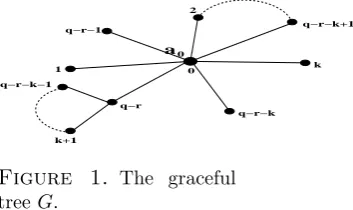
D6(1). Consider the graceful treeGas represented in Figure 1. LetA={k+ 1, k+ 2, . . . , q−k−r−1}.
Observe that (k+i) + (q−r−k−i) = q−r. Consider the sequence of transfer
T1 : q − r → 1 → q − r −1 → 2 →
q−r−2→. . .→k→q−r−k→k+ 1
of the vertex levels in the setA. Observe that the transferT1 and the setAsatisfy
the properties of Theorem 1.1.
a0
0 2
q−r−k+1
k
q−r−k q−r−1
1
q−r−k−1
k+1 q−r
Figure 1. The graceful treeG.
Suppose that the centersa1, a2, . . . , amo are the centers of diameter four trees adjacent
toa0 with even degree and amo+1, amo+2, . . . , am are the centers of diameter four trees
adjacent toa0 with odd degree. Suppose that the centersb1, b2, . . . , bne are the centers
of stars adjacent toa0 with odd degree andbne+1, bne+2, . . . , bn are the centers of stars
adjacent to a0 with even degree. Here T1 consists of mo successive transfers of the first
type, followed by me+ne
4 successive BD8TF, and finally no successive transfers of the first
type. We carry out the transferT1 by keeping desired number of elements of A at each
vertex of the transfer. Observe that
ai =
q−r−i−1
2 ifiis odd i
2 ifiis even
andbj=
q−r−m+j2−1 ifj is odd
m+j
2 ifiis even
ifmis even
m+j
2 ifj is odd
q−r−m+j2−1 ifj is even ifm is odd
LetA1be the set of vertex labels ofAwhich have come to the vertexk+1 after the
trans-ferT1. Since each transfer inT1 is either a transfer of 1st type or a BD8TF, the elements
ofA1 are the consecutive integers. Next consider the transferT2 :k+ 1→q−r−k−1→
k+ 2 → q−r −k−2 → . . . ,→ t, where t =
k+k1+ 1; ifm is odd
q−r−k−k1; if m is even , k1 =
Pm
i=1deg(ai)−m
Observe that the vertices of transfer T2 and the elements ofA1 satisfy the hypothesis
of Theorem 1.1. Let the sum of all odd (or even) branches of the diameter four trees with centersa1,a2,. . .,am bes. So T2 consists ofs−1 successive transfers. Each transfer of
T2 is a transfer of the first or second type according as the branches of the diameter four
trees are all odd or even. By executing the transfer T2 we get back the tree D(1)6 and by
Theorem 1.1 it is graceful. Attach the vertices c1, c2, . . ., cr to a0 and assign them the
labelsq−r+ 1,q−r+ 2,q−r+ 3,. . .,q so as to get backD6 with a graceful labeling.
Theorem 2.2. Ifr≥0,m+nis even,me = 0∼ mod4, eitherne ∼= 0mod4 andno≥1 or ne ∼= 1mod4, and the branches incident on the centeraiof the diameter four tree are all odd branches or all even branches thenD6 = {a0;a1, a2, . . . , am;b1, b2, . . . , bn;c1, c2, . . . , cr}
has a graceful labeling.
Proof: Designate the vertexbn as the center of a star with even degree ifne ∼= 0mod4 and no ≥ 1 and the center of a star with odd degree if ne ∼= 1 mod 4. Construct a tree G6 from D6 by removing the vertices bn, c1, c2, . . . , cr. ObviouslyG6 is a diameter
six tree with center a0 having odd degree. Let |E(G6)| = q1. Repeat the procedure
involving the proof of Theorem 2.1(a) by replacing n with n−1 and q−r with q1 and
give a graceful labeling toG6. Observe that the vertexa0 in the graceful treeG6 gets the
label 0. Attach bn, c1, c2, . . . , cr to a0 and assign the labels q1 + 1, q1+ 2, . . . , q1 +
r, q1+r + 1 to them. Obviously, the tree G6∪ {bn, c1, c2, . . . , cr} is graceful with a
graceful labeling, sayg. Apply inverse transformationgq1+r+1 toG6∪ {bn, c1, c2, . . . , cr}
so that the label of the vertexbnbecomes 0. By Lemma 1.1,gq1+r+1 is a graceful labeling
of G6∪ {bn, c1, c2, . . . , cr}. Let there be p pendant vertices adjacent to bn in D6. Now
attach these vertices tobnand assign the labels q1+r+ 2, q1+r+ 3, . . . , q1+r+p+ 1
to them. Observe that we finally form the treeD6 and the labeling mentioned above is a
graceful labeling ofD6.
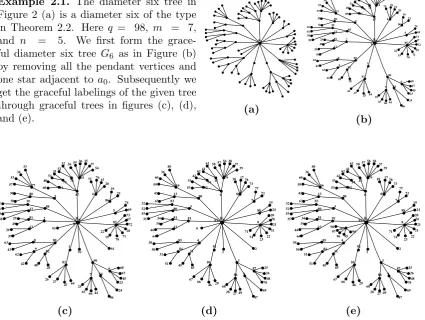
Example 2.1. The diameter six tree in Figure 2 (a) is a diameter six of the type in Theorem 2.2. Here q = 98, m = 7, and n = 5. We first form the grace-ful diameter six tree G6 as in Figure (b)
by removing all the pendant vertices and one star adjacent to a0. Subsequently we
get the graceful labelings of the given tree through graceful trees in figures (c), (d), and (e). a0 (a) a0 0 86 16 21 5 74 69 4 7576 15 20 87 14 78 79 11 35 36 54 55 56 32 52 31 51 40 60 3 80 77 33 34 37 53 57 30 50 88 10 13 41 61 38
58 81 2 12 39 59 29 49 89 8 9 82 63 43 62 42 48 28 1 83 26 27 4764 90 7 84 6 25 6566 44
46 24 23 45 67 68 85 22 19 7071 18 72 17 73 (b) a0 0 86 16 21 5 74 69 4
75 7615 20 87 14 78 79 11 35 36 54 55 56 32 52 31 51 40 60 3 80 77 33 34 37 53 57 30 50 88 10 13 41 61 38
58 81 2
12 39 59 29 49 89 8 9 82 63 43 62 42 48 28 1 83 26 27 4764 90 7 84 6 25 65 66 44
46 24 2345 67 68 85 22 19 70 71 18 72 17 73 91 92 93 (c) a0 81 12 93 0 4 30 50 31 51 84 11 45 65 92 10 67 66 4629 1 3 86 68
2827 49 69 47 9 87 7048 26 25 2 8 20 76 21 75 22 23 74 71 88 19 24 7 77 72 89 18 1778
73 6 79 39 37 38 56 57 58 15 61 41 14 62 42 82 53 33 90 13 16 63 43 59 60 36 40 5 83 52 32 80 55 35 91 59 34 64 44 85 (d) a0 81 12 93 0 4 30 50 31 51 84 11 45 65 92 10 67 66 4629 1 3 86 68
2827 49 69 47 9 87 7048 26 25 2 8 20 76 21 75 22 23 74 71 88 19 24 7 77 72 89 18 1778
73 6 79 39 37 38 56 57 58 15 61 41 14 62 42 82 53 33 90 13 16 63 43 59 60 36 40 5 83 52 32 80 55 35 91 59 34 64 44 85 94 95 96 97 98 (e)
Figure 2. A diameter six tree of the type in Theorem 2.2(b) with a
Theorem 2.3. Let r ≥ 0, me ∼= 1mod 4, the degree of at least oneai, 1 ≤ i≤ m is ≥4, and one of the following conditions hold.
(a)ne ∼= 0mod4, m+nis even.
(b)me ∼= 1mod4m+nis odd, either ne ∼= 0 and no ≥1 or ne ∼= 1.
If the branches incident on the centerai of the diameter four tree are all odd branches or all even branches thenD6 = {a0;a1, a2, . . . , am;b1, b2, . . . , bn;c1, c2, . . . , cr}has a graceful labeling.
Proof:(a) Let us designate the vertices a1, a2, . . ., am in such a way that deg(a2) is
maximum.
Case - I:Ifdeg(a2) is even then we designateai, 1 ≤i≤mo as the centers of diameter four trees with even degree and ai, mo+ 1≤i≤m as the centers of diameter four trees with odd degree. Excluding a0 let there be 2pi+ 1 neighbours of ai, i = 1,2, . . . , mo and there be 2pi neighbours of ai, i = mo+ 1, mo+ 2, . . . , m in D6. Construct a new
diameter six tree, sayG6 by removing the verticesc1,c2,. . .,cr, andam and making 2pm
neighbours ofam adjacent to the vertexa2. Let|E(G6)| = q1. Repeat the procedure for
giving labeling toD(1)6 in the proof of Theorem 2.1 (a) by replacingmewithme−1 andq−r withq1 and give a graceful labeling toG6. Observe that the vertexa2 gets label 1, and the
2(p2+pm)+1 neighbours ofa2get the labelsq1−x,x+1+i, q1−x−i,x = k+p1+1,i =
1,2, . . . , p2+pm. While labelingG6 we allot labelsx+i+ 2, q1−x−i, i = 1,2, . . . , pm to
2pmneighbours ofamthat were shifted toa2while constructingG6. Next attach the vertex
amtoa0, assign it the labelq1+1 and move the verticesx+i+2, q1−x−i, i = 1,2, . . . , pm,
toam. Since (x+i+ 2) + (q1−x−i) = q1+ 2 = 1 + (q1+ 1), fori = 1,2, . . . , pm, by Theorem 1.1 the resultant tree, say G1 thus formed is graceful. Finally, attach the
pendant verticesc1, c2, . . . , cr to a0 and assign the labels q1+ 2, q1+ 3, . . . , q1+r+ 1 to
them Observe that we finally get the treeD6 with a graceful labeling.
Case - II: If deg(a2) is odd then we designate ai, 1 ≤ i ≤ me−1 as the centers of
diameter four trees with odd degree andai, me ≤i ≤m−1 as the centers of diameter four trees with even degree, and am as the center of a diameter four tree with an odd degree. Excludinga0 let there be 2pi+ 2 neighbours ofai, i = 1,2, . . . , me−1, there be 2pi+ 1 neighbours ofai, i = me, me+ 1, . . . , m−1, and there be 2pm neighbours of am inD6. Construct a new diameter six tree fromD6, sayG6 by removing the verticesc1,c2,
. . .,cr, and am and making 2pm neighbours of am adjacent to the vertex a2. Repeat the
procedure for giving graceful labeling toD6(1) in the proof of Theorem 2.1 (a) by carrying the transfer T1 :q−r →1→q−r−1→2→q−r−2→. . .→k→q−r−k→k+ 1
consisting of me−1
4 successive BD8TF, followed bymo+no successive transfers of the first
type, followed by ne
4 successive BD8TF keeping desired number of elements of A at each
vertex of the transfer and give a graceful labeling toG6. Observe that the vertex a2 gets
label 1, and the 2(p2+pm) neighbours of a2 get the labels q1−x, x+ 1 +i, q1−x−i,
x = k+p1+ 1, i = 1,2, . . . , p2+pm−1 and one more vertex . While labeling G6 we
allot labels x+i+ 2, q1 −x−i, i = 1,2, . . . , pm to 2pm neighbours of am that were
shifted toa2 while constructing G6. The remaining proof is same as that in Case - I.
(b): Designate the vertex a2 as the center of diameter four tree whose degree ≥ 4.
Designate the vertex am as the center of a diameter four tree with odd degree, say deg(am) = 2pm + 1. Construct a tree G6 from D6 by removing the vertices c1, c2,
. . .,cr, one star with centerbn, wheredeg(bn) is odd ifne ∼= 0mod4 anddeg(bn) is even ifne ∼= 1mod 4, and one diameter four tree with center am, and attaching 2pm neigh-bours ofam toa2. Let|E(G6)| = q1. Repeat the procedure in the proof of Theorem 2.1
G6. Next attach the vertexam toa0 and assign the labelq1+ 1 and shift the 2pm vertices froma2 toam as discussed in the proof of part (a). Let the new graceful tree thus formed beG1. Next attach verticesc1,c2,. . .,cr, andbntoa0 and assign the labelsq1+ 2,q1+ 3,
. . .,q1+r+ 1, and q1+r+ 2, respectively. Obviously, the tree G1∪ {c1, c2, . . . , cr, bn} is graceful with a graceful labeling, sayg. Apply inverse transformation gq1+r+2 toG1 so
that the label of the vertex bn becomes 0. By Lemma 1.1, gq1+r+2 is a graceful labeling
ofG1. Let there bep pendant vertices adjacent tobn inD6. Now attach these vertices to
bn and assign labelsq1+r+ 3, q1+r+ 4, . . . , q1+r+p+ 2 to them. Observe that we
get the treeD6 and the labeling mentioned above is a graceful labeling of D6.
Theorem 2.4. Ifme ∼= 0mod4 andn= ne ∼= 0mod4,mis even,mo ≥2, the degree of the center of at least one diameter four tree adjacent to a0 ≥ 4, and the branches
incident on the centeraiof the diameter four tree are all odd branches or all even branches thenD6 = {a0;a1, a2, . . . , am;b1, b2, . . . , bn} has a graceful labeling.
Proof: Designate the vertex a2 as the center of diameter four tree whose degree ≥ 4.
Designate the vertex am as the center of a diameter four tree with even degree, say deg(am) = 2pm + 2. Construct a tree G6 from D6 by removing the vertex am and
attaching any 2pm(out of 2pm+ 1) neighbours of am toa2. Let |E(G6)| = q1. Repeat
the procedure in the proof of Theorem 2.1 (a) by replacing m with m−1, n with n−1 and q−r with q1 and give a graceful labeling to G6. Next attach the vertex am to a0,
assign the labelq1+ 1, and shift the 2pm vertices from a2 toam as discussed in the proof
of part (a) of Theorem 2.3 to a get a graceful tree, sayG1 with a graceful labeling, sayg.
Apply inverse transformation gq1+1 toG1 so that the label of the vertex amo becomes 0.
By Lemma 1.1,gq1+1is a graceful labeling ofG1. Now attach one remaining vertex toamo
and assign the label q1+ 2 to it. Let this graceful labeling of the new tree, say G2 thus
formed be g1. Let there be p neighbours of q1+ 2 in D6. Apply inverse transformation
g1q1+2 toG2 so that the label of the vertexq1+ 2 ofG2 becomes 0. By Lemma 1.1,gq1+2
is a graceful labeling of G2. Now attach the p pendant vertices adjacent to the vertex
labelled 0 and assign them the labelsq1+ 3, q1+ 4, . . . , q1+p+ 2. Observe that we finally
form the treeD6 and the labeling mentioned above is a graceful labeling of D6.
References
[1] Gallian,J.A., (2013), A dynamic survey of graph labeling, Electronic Journal of Combinatorics, DS6, Sixteenth edition, url:http://www.combinatorics.org/Surveys/.
[2] Hrnciar,P. and Havier,A., (2001), All Trees of Diameter Five Are Graceful, Discrete Mathematics, 233, pp. 133-150.
[3] Mishra,D. and Panda,A.C., (2013), Some New Transformations And Their Applications Involving Graceful Tree Labeling, International Journal of Mathematical Sciences and Engineering Aplications, Vol.7, No.1, pp. 239-254.
[4] Mishra,D. and Panigrahi,P., (2008), Some Graceful Lobsters with All Three Types of Branches In-cident on the Vertices of the Central Path, Computers and Mathematics with Applications 56, pp. 1382-1394.
[5] Rosa,A., (1968), On certain valuations of the vertices of a graph, in The´orie des Graphes, (ed. P. Rosenstiehl), Dunod, Paris, pp. 349-355, MR 36-6319.
Amaresh Chandra Panda was born in 1981,in Bhadrak, India. He received his B.Sc.degree in Mathematics in 2002 from F.M. University, Balasore, India; M.Sc.and M.Phil. degree from Utkal University, Odisha, India. He is currently working as Assis-tant Professor in the Department of Mathematics, at C.V. Raman College Of Engineering, Bhubaneswar, Odisha, India. His research area is Graph Theory(Graceful and Harmo-nious labeling problems). He has published around 10 papers in various peer reviewed journals of international repute. He has also published two books in Engineering mathematics.
Dr. Debdas Mishra was born in 1975, at Rourkela, India. He completed Msc. in