NUMERICAL SOLUTION OF THE INTERRELATED DIFFERENTIAL EQUATION OF MOTION IN PHONON ENGINEERING
A. ALIZADEH1, H.R. MARASI2,§
Abstract. In this work, we study numeric calculations of phonon modes in
nanostruc-tures. The motion equation of atoms in a crystal with some simplification, results in a second order ordinary differential equation and two interrelated second order differential equations for 3 polarizations according to 3 dimensions. Although first equation can easily be solved, the next two interrelated equations cannot be solved by usual numerical methods. Based on discretization, a new technique is proposed for studying the motion equations. The results are presented by dispersion curves for shear, dilatational, and flexural modes of phonons.
Keywords: Numeric approximation, Eigenvalue problem, Dispersion curve.
AMS Subject Classification: 65f15, 65L12, 65L16.
1. Introduction
In physics and electronics, the quantized energies of elastic vibration in a crystal are called phonons. Similar to electrons, phonons are characterized by their dispersionω(q), whereω is an angular frequency, andq is three dimensional wave vector of a phonon [1]. In order to find the phonon dispersion, the equation of motion for elastic vibration should be solved. In general, the equation of motion for the elastic vibrations in an anisotropic medium can be written as [2,3]
ρ∂ 2U
m ∂t2 =
∂σmi
∂xi m, i=x, y, z (1)
whereU~ (Ux, Uy, Uz) is the displacement vector in three dimensions,ρ is the mass density of the materials,σmiis the elastic stress tensor and is equal toσmi=CmikjSkj; with Skj being the strain tensor,Cmikj being the fourth-order tensor andi, j,andk are threex,y,z directions. Because of symmetry in the above equationsSkj andσmi, as shown in equations (2) and (3), the 3×3 matrices of stress and strain diminishes to six element vectors.
1
Department of Electrical Engineering, University of Bonab, Bonab 5551761167, Iran. e-mail: [email protected];
2
Department of Applied Mathematics, Faculty of Mathematical Sciences, University of Tabriz, Tabriz, Iran.
e-mail: [email protected];
§ Manuscript received: March 14, 2016; accepted: November 28, 2016.
TWMS Journal of Applied and Engineering Mathematics, Vol.7, No.1; cI¸sık University, Department of Mathematics, 2017; all rights reserved.
Furthermore, the forth order tensor of stiffens factors, Cmikj, converts to a symmetric two-index notation presented withCij.
Skj =
Sxx Sxy Sxz Syx Syy Syz Szx Szy Szz
, Sxy =Syx , Sxz =Szx, Syz =Szy, (2)
σmi=
σxx σxy σxz σyx σyy σyz σzx σzy σzz
, σxy =σyx , σxz =σzx, σyz =σzy. (3)
Adopting the two-index notation as: xxxx → 11; yyyy → 22; zzzz → 33; xxyy → 12; xxzz→13; yzyz→44;xzxz→55; xyxy→66, leads to [4,5]:
σxx σyy σzz σyz σxz σxy =
C11 C12 C22 SY M C13 C23 C33 C14 C24 C34 C44 C15 C25 C35 C45 C55 C16 C26 C36 C46 C56 C66 Sxx Syy Szz Syz Sxz Sxy . (4)
In this research we consider the wurtzite crystals for layers for which the 6×6 matrix of the elastic constantsCij is given in [6]:
C= C11 C12 C13 0 0 0 C12 C11 C13 0 0 0 C13 C13 C33 0 0 0 0 0 0 C44 0 0 0 0 0 0 C44 0 0 0 0 0 0 C44 . (5)
The axis x is assumed to be along the propagation direction of the waves. Since the considered structure is a multi-layer hetero-structure with layer growth direction along the z-axis (non-uniform along thez-axis), ρ andCij(i,j=1,. . . ,6) depend on thez coordinate only. We look for a numerical solution [7-12] of equation (1) in the following form of sinusoidal traveling waves subjected to appropriate boundary conditions
Ui(x, z, t) =ui(z)ei(wt−qx), i=x, y, z. (6)
whereuiare the amplitudes of the displacement vector components. Substituting equation (6) for i = y in equation (1), the partial differential equation (1) transforms into an ordinary second order differential equation as below[5]
−ρ(z)ω2uy(z) =C44(z)·
d2uy(z) dz2 +
dC44(z) dz ·
duy(z)
dz −C66(z)q 2u
y(z), (7)
with the initial condition resulting from force equilibrium on the outer surfaces by:
∂uy
∂z |z=±L/2 = 0. (8)
Substituting equation (6) fori=x, z in equation (1), the following two interrelated equa-tions results[5]
−ρω2ux(z) =−q2C11ux(z)+C44d 2ux(z)
dz2 +q(C11+C44) du0z(z)
dz + dC44 dz ( dux(z) dz +qu 0
−ρω2u0z(z) =−q2C44u0z(z) +C33
d2u0z(z) dz2 +
dC33 dz
du0z(z) dz
−q
(C44+C13)du 0 z(z) dz +
dC13 dz ux(z)
, (10)
whereu0z =−iuz, and the boundary conditions on the outer surfaces of structure yields:
∂ux ∂z +qu
0 z
z=±L/2
= 0, (11)
C33 ∂u 0 z
∂z −qC13ux
z=±L/2
= 0. (12)
2. Results:
By discretization and using finite difference method for solving the equation (7), it could be converted to an eigenvalue problem (EVP). Since the materials are homogenous, derivative(dC44(z))/dz is zero everywhere other than on the boundaries. Even on the boundaries, the derivative is ignored because the C44 is very close for the two adjacent layers. The equation (7) converts to the following matrix equation
Au=ω2u, (13)
whereA is an n×n tri-diagonal matrix, u is displacement vector with n points, and is angular frequency corresponding to each wave vectorq. The matrixAwill be of the form
A= 1/h2
As A2
.. .
.. .
A1 A3 A2 .. .
.. .
A1 A3 .. .
.. .
A1 .. . A2
.. .
.. . A3 A2 .. .
.. . A1 A3 .. .
.. .
A1 .. . A2
.. .
.. . A3 A2
.. .
.. . A1 Ae
(14)
whereAs=Ae=C44
n−qC
66n ρn ,A1=
−C44n+1 ρn+1 ,A2=
−C44n−1 ρn−1 ,A3=
2C44n−qC66n
ρn ,h is differential
element, and n is row index. For each value of the vector q in A3,s,e, one can solve the equation (13) as an eigenvalue problem (EVP). Solving the EVP, the resulted eigenvectors represent the displacement vectorsand the eigenvalues represent square of corresponding angular frequencies. Varyingq from its minimum to maximum and solving the associated EVP, the dispersion curves of phonon are found. These modes or polarization of dis-placement of atoms have been named shear modes. Six smallest shear modes of acoustic phonons for a three layer hetero-structure are shown in Fig.1.
Figure 1. Shear modes for 9129 nm AlAs-GaAs-AlAs heterostructure [1].
with error O(h2) and forward difference approximation for dzd in (9) and (10) yields the approximating schemes:
−1 ρ C44
1 h2u
i−1 x +
2C44 ρh2 +q
2C11 ρ
uix−C44
ρh2u i+1 z +
q(C13+C44) ρh u
i−1
z +
−q(C13+C44) ρh u
i
z =ω2uix, (15)
−1
ρh(C13+C44)u i−1
x +
q
ρh(C13+C44)u i x+
−C33 ρh2 u
i−1 z +
2C33 ρh2 +q
2C44 ρ
uiz−C33
ρh2u i+1
z =ω2uiz. (16) Now incorporating the boundary conditions, (11) gives
u0x=u1x+hqu1z, (17) uN+1x =uNx +hquNz , (18)
fori= 1 and i=N, respectively. Moreover from the boundary condition (12) we get
u0z = −hqC13 C33 −u
1
z, (19)
uNz +1= −hqC13 C33 −u
N
z . (20)
Substituting (17) and (19) in the first point of (9) and (10) (i= 1), one can deduce
C44 ρh2 +q
2C11 ρ −
q2C13(C13+C44) ρC33
u1x−C44
ρh2u 2 x+
−
q(2C13+ 3C44) ρh
u1z=ω2u1x,(21)
−C13q ρh u
1 x+
3C33 ρh2 +
q2C13 ρ
u1z−C33
ρh2u 2
z =ω2u1z. (22)
Similarly, for i = N in the last point of (9) and (10) using (18) and (20) the following equations are derived
−C44 ρh2 ω
2uN−1
x +
C44 ρh2 +
q2C11 ρ
uNx + q
ρh(C13+C44)u N−1
z +
−
qC13 ρh
uNz =ω2uNx ,(23)
−q(C13+C44) ρh u
N−1
x +
q(2C13+C44) ρh u
N x −
C33 ρh2u
N−1
z +
C33 ρh2 +
q2C44 ρ
Therefore (9) and (10) can be written in matrix form as the following ordern systems
Aux+Buz =ω2ux,
Cux+Duz =ω2uz. (25) So, we have the new eigenvalue problem of order 2n×2n
A B C D ux uz
=ω2
ux uz (26) where
ux =
u1x u2x .. .
uNx
uz =
u1z u2z .. .
uNz
A= As A2 A1 A3 A2 A1A3
. .. A1 . .. . ..
A2 A3 A2 A1 Ae
As= C44 1 ρ1h2 +q
2[C11 1C
331−(C13) 2−C
131C441] ρ1C
331
, A1 =−C44
n+1
ρn+1h2, A2=− C44n−1 ρn−1h2, A3= 2C44
n
ρnh2 +q 2C11n
ρn , Ae= C44N ρNh2 +q
2C11N ρN , and B= Bs B1 B2
B1 B2
. .. . .. ...
B1 B2 B1 Be
Bs=−q(2C13
1+ 3C441) ρ1h , B1 =
q(C13n−1+C44n−1)
ρn−1h , B2 =−
q(C13n+C44n)
ρnh , Be=− qC13N
ρNh , also C= Cs C1 C2
C1 C2
. .. . .. ...
C1 C2 C1 Ce
Cs=−qC
1 13
ρ1h , C1 =−
q(C13n−1+C44n−1) ρn−1h , C2 =
q(C13n+C44n) ρnh , Ce=
Figure 2. Dilatational and flexural modes. q⊥ is in-plane wave vector (qx, qy) with 0 to π range.
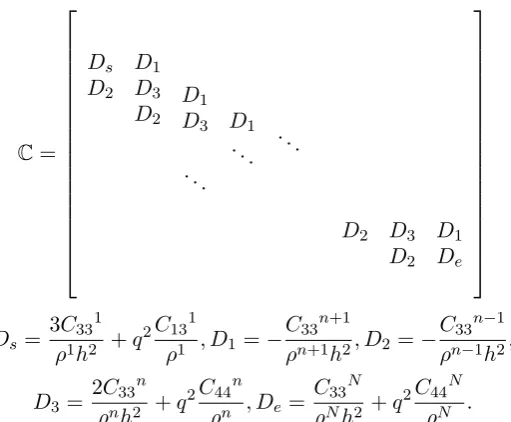
and finally
C=
Ds D2
D1 D3 D2
D1 D3 . ..
D1 . .. . ..
D2 D3 D2
D1 De
Ds = 3C331
ρ1h2 +q 2C131
ρ1 , D1=−
C33n+1
ρn+1h2, D2 =−
C33n−1 ρn−1h2, D3=
2C33n ρnh2 +q
2C44n ρn , De=
C33N ρNh2 +q
2C44N ρN .
For each eigenvalue,ω, there will beux anduz eigenvectors. Because of symmetry inux anduz, we can see that for anyω, when theux is symmetrical, theuz is asymmetrical and vice versa. Due to the spatial symmetry of the considered three layered structure and the mathematical form of Eqs.(9) and (10), the displacement vector should have components with opposite parity, e.g. (uSx,uAz), whenux is a symmetrical function of zwhile uz is an asymmetrical function ofz; or (uAx, uSz) for the case ux is an asymmetrical function of z whileuzis a symmetrical function. The (uSx,uAz) and (uAx,uSz) have been denoted withuSA and uAS respectively. The upper indicesSA and AS of displacement vectors distinguish independent vibrational polarizations which, together with the shear modes, compose a full set of normal vibrational modes in the structure. In the case of a slab the SA modes are referred to as dilatational modes while AS modes are termed the flexural modes. As a result, for the same structures whit shear modes shown in Fig.1, the dilatational and flexural modes of phonon or atom displacements are shown in Fig.2.
3. Conclusion
and a new proposed technique, the resulted motion equations were converted to an eigen-value problem. The results were presented as dispersion curves for shear, dilatational, and flexural modes of phonons.
References
[1] Alizadeh,A. et al., (2014), Tailoring electronphonon interaction in nanostructures, J. Photonics and Nanostructures - Fundamentals and Applications, 12(2), pp.164172.
[2] Balandin,A.A., Pokatilov,E.P., and Nika,D.L., (2007), Phonon Engineering in Hetero and Nanostruc-tures, J. Nanoelectronics and Optoelectronics, (2), pp.140170.
[3] Rostami,A., Alizadeh,A., Baghban H., Alizadeh,T., and Bahar,H.B., (2011), Phonon engineering in nanoscale layered structures, SPIE (7987), 79870F-79871F.
[4] Pokatilov,E.P., Nika,D.L., and Balandin,A.A., (2003), Phonon spectrum and group velocities in AlN/GaN/AlN and related heterostructures, Superlattices Microstruct., (33), pp.155171.
[5] Balandin,A.A., Nika,D.L., and Pokatilov,E.P., (2004), Phonon spectrum and group velocities in wurtzite hetero-structures, phys. stat. sol., 1(11), pp.26582661.
[6] Wright,A.F., (1997), Elastic properties of zinc-blende and wurtzite AlN, GaN, and InN, J. Appl. Phys., 82(2833).
[7] Marasi,H.R. and Pourmostafa Aqdam,A., (2015), Homotopy analysis method and homotopy Pade approximants for solving the FornbergWhitham equation, Eurasian Math. J., 6(1), pp.65-75. [8] Marasi,H.R. and Khezri,E., (2014), Asymptotic distributions of Neumann problem for Sturm-Liouville
equation Computational methods for differential equational, 2(1), pp.19-25.
[9] Mishra,L.N., Agarwal R.P., and Sen,M., (2016), Solvability and asymptotic behavior for some nonlin-ear quadratic integral equation involving Erd´elyi-Kober fractional integrals on the unbounded interval, Progress in Fractional Differentiation and Applications, 2(3), pp.153-168.
[10] Mishra,L.N., and Agarwal,R.P., (2016), On existence theorems for some nonlinear functional-integral equations, Dynamic Systems and Applications, 25, pp.303-320.
[11] Mishra,V.N., (2007), Some Problems on Approximations of Functions in Banach Spaces, Ph.D. Thesis, Indian Institute of Technology, Roorkee 247 667, Uttarakhand, India.
[12] Gandhi,R.B. and Mishra, V.N.,(2016), Local and global results for modified Sz´asz - Mirakjan opera-tors, Math. Method. Appl. Sci. DOI: 10.1002/mma.4171.
Abdulllah Alizadeh was born in 1973 in Brazn, Heris-Azerbaijan, Iran. He re-ceived his B.Sc. degree from Urmia University, M.Sc. degree from Tarbiat Modares University, and Ph.D. degree from Tabriz University, Tabriz, Iran; in 1995, 1997 and 2014 respectively. He is currently working as an assistant professor in the De-partment of Electrical Engineering, University of Bonab, Bonab, Iran. His major research areas are photonics and phonon engineering.
![Figure 1. Shear modes for 9129 nm AlAs-GaAs-AlAs heterostructure [1].](https://thumb-us.123doks.com/thumbv2/123dok_us/8881403.1820007/4.595.220.376.111.241/figure-shear-modes-for-alas-gaas-alas-heterostructure.webp)