VOLUME 39, ARTICLE 24, PAGES 685
,
700
PUBLISHED 2 OCTOBER 2018
https://www.demographic-research.org/Volumes/Vol39/24/ DOI: 10.4054/DemRes.2018.39.24
Descriptive Finding
Fertility compression in Niger: A study of
fertility change by parity (1977–2011)
Thomas Spoorenberg
Hamidou Issaka Maga
© 2018 Thomas Spoorenberg & Hamidou Issaka Maga.
This open-access work is published under the terms of the Creative Commons Attribution 3.0 Germany (CC BY 3.0 DE), which permits use, reproduction, and distribution in any medium, provided the original author(s) and source are given credit.
1 Introduction 686
2 Data and method 687
3 Results 688
4 Discussion 694
Fertility compression in Niger:
A study of fertility change by parity (1977–2011)
Thomas Spoorenberg1*
Hamidou Issaka Maga2
Abstract
BACKGROUND
Very few studies have analyzed the fertility change in Niger – a country where the total fertility rate has remained high and stable over the last decades.
OBJECTIVE
This study looks at the fertility change in Niger from a parity perspective to consider if reproductive behaviors are revealing some ongoing changes under the apparent stability of the total fertility rate.
METHODS
Using birth history data from four representative sample surveys, parity progression ratios and mean birth intervals were computed, covering three decades of fertility change in Niger.
RESULTS
Confirming the stability of the level of fertility, the results show little change in the progression to the successive parities. Yet, although women in Niger still end their reproductive lives with a similar number of children, the birth intervals indicate that the onset of childbearing and the progressions to the successive birth orders have been progressively delayed.
CONCLUSIONS
Over the last three decades, Nigerien women have continued to manage to bear a rather stable average number of children in their lifetimes, compressing their fertility to an ever-reducing number of reproductive years.
1 Population Division, Department of Economic and Social Affairs, United Nations, New York, USA.
Email:[email protected].
* The views expressed in this paper are those of the author and do not necessarily reflect the views of the
United Nations.
CONTRIBUTION
This study documents the parity-specific fertility changes that are indeed at work in a pretransition situation for which few evidences are available, still.
1. Introduction
With an average of 7.4 children per woman in 2010–2015, Niger is the country with the highest level of fertility in the world (UNPD 2017). The level of fertility remained stable over the last decades. Given the importance of fertility in determining Niger’s future population growth, fertility has been the subject of much debate regarding its future course (Potts et al. 2011; Issaka and Guengant 2017; May, Guengant, and Barras 2017; Zourkaleini 2016). Various exercises have linked future fertility levels to changes in marital behaviors and the diffusion of contraception (e.g., Harouna et al. 2005). Marriage in Niger is still very early, and the contraceptive prevalence reaches very low levels. Despite the legal age at marriage set at 15 years old, more than three quarters of the women aged 20–24 were married before the age of 18, and more than a quarter of those were married before the age of 15 (INS and ICF International 2013). The early nuptiality pattern in Niger is influenced by polygamy that remains widely practiced. More than a third of the married women are living in polygamous union (INS and ICF International 2013). In addition, the modern contraceptive prevalence of women living in union remains very low in Niger, with only 11% in 2012 (against 4% in 1992) (INS and ICF International 2013; Kourguéni, Bassirou, and Barrère 1993).
The population of Niger experienced significant demographic increase as the result of the changes in the levels and trends in mortality and fertility. Mortality, especially among infants and children, decreased importantly over the recent years. The under-five mortality rate declined from 318 deaths per 1,000 live births in 1992 to 127 deaths per 1,000 live births in 2012 (Kourguéni, Bassirou, and Barrère 1993; INS and ICF International 2013). While mortality was declining significantly, fertility has remained high and stable, fostering the extreme population increase of the country. Since 1977, the year of the first national census in Niger, the population has increased at an unabated average intercensal rate of 3.5% annually – implying a doubling of the population in less than 20 years – and slightly more than 17 million people were enumerated during the 2012 census (INS 2015).
contraception in the country, such as the importance of cultural and religious factors (Issaka 1995; Nouhou 2016). To the best of our knowledge, no study has ever investigated fertility change in Niger from a parity perspective.
2. Data and method
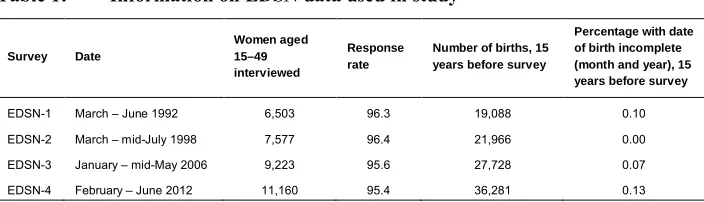
This study uses data from four Enquête Démographique et de Santé du Niger (EDSN). EDSNs are nationally representative sample surveys that collect complete birth history data for all women aged 15–49. These datasets can be freely downloaded on request at: http://www.measuredhs.com. Table 1 gives information on each survey. The 1988 population and housing census served as a sampling frame to draw representative household samples for EDSN-1 and EDSN-2; the 2001 population and housing census was used for EDSN-3 and EDSN-4.
Table 1: Information on EDSN data used in study
Survey Date Women aged 15–49 interviewed Response rate
Number of births, 15 years before survey
Percentage with date of birth incomplete (month and year), 15 years before survey
EDSN-1 March – June 1992 6,503 96.3 19,088 0.10 EDSN-2 March – mid-July 1998 7,577 96.4 21,966 0.00 EDSN-3 January – mid-May 2006 9,223 95.6 27,728 0.07 EDSN-4 February – June 2012 11,160 95.4 36,281 0.13
Source: EDSN survey reports.
In line with the conventional view that fertility decline is a parity-dependent process (Henry 1953; Coale 1973), a woman’s decision to have an additional child is often based on the number of children she already has and the time elapsed since her previous birth. In this regard, parity progression ratios are useful for studying parity-specific fertility behaviors. Based on EDSN’s birth history data, we computed synthetic parity progression ratios (SPPRs) to examine the fertility change in Niger over the last three decades (Hinde 1998; Pullum 2004).
EDSN data follows similar methodological procedures and choices. Women with inconsistent birth histories (i.e., more than 25 years between age 10 and a first birth or birth intervals of less than 8 months or more than 10 years) were excluded from the computation of SPPRs. While such exclusions vary from one survey to another and from one parity to the next, they do not amount to any significant proportion of the samples and only marginally affect the results. To obtain completed annual birth histories, SPPRs were computed for a 15-year period before each survey, excluding the survey years. SPPRs can be interpreted as the probability that a woman of parityi will move to parityi+1 if she maintains the fertility level observed during the given year throughout her reproductive life.
In addition to SPPRs, we computed the mean birth intervals. The use of the mean birth intervals allows us to assess further the changes in reproductive and family-building behaviors. In the case of Niger, where the level of fertility has changed very little, this indicator is critical to investigating the possible changes at work under seemingly unchanging conditions in the level of fertility.
We computed SPPRs and mean birth intervals for each EDSN dataset without pooling the four surveys together. Treating each EDSN separately allows us to determine the quality of the collected birth history data. Many studies have shown that birth history data is affected by the transfer of some births outside a reference window of time (usually the last five years before the survey) (Arnold 1990; Pullum 2006; Schoumaker 2014). Based on EDSN birth history data, it is likely that SPPRs and mean birth intervals will be affected by similar effect. Due to the displacement of children’s birth dates, the progression to a given birth could decline artificially and the resulting birth intervals increase in the years preceding the survey. This issue has not received particular attention in the case of Niger.
3. Results
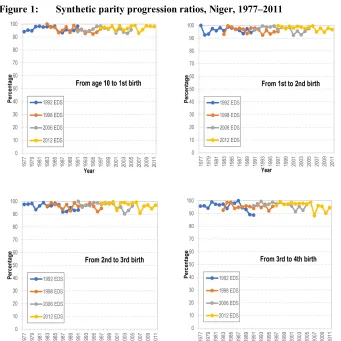
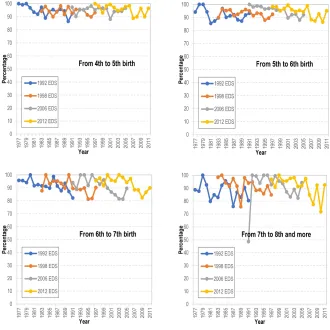
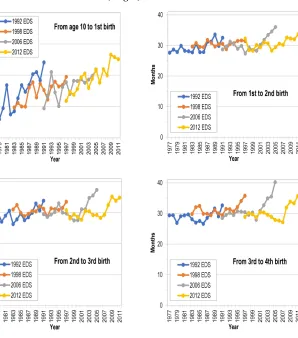
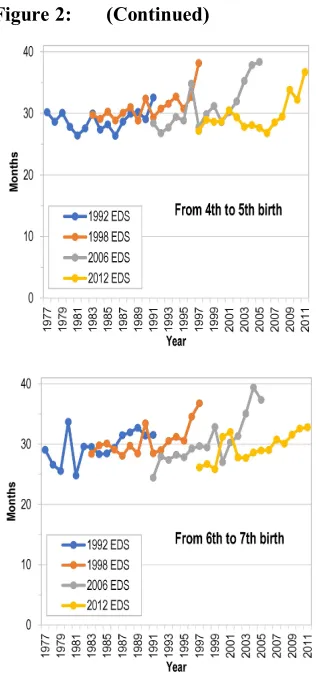
Figures 1 and 2 present SPPRs and the mean birth intervals between the successive births for Niger between 1977 and 2011.
Figure 1: (Continued)
Source: Authors’ calculations based on EDSN surveys.
The level of fertility, and the stability of the SPPRs, suggests a stability scenario over the last three decades in Niger, but some changes were actually at work. These changes, while limited, can be detected by considering the sequence of fertility. Figure 2 shows the length of the mean birth intervals between successive birth orders. The mean birth interval between the seventh and eighth births is not shown here as it is too volatile due to the small number of women entering the computation. Figure 2 indicates that the mean age at first birth has increased by about 18 months over the last 25 years (that is between the late 1970s to the end of the first decade of the 21st century) and that
less than half a year during the same period. The length of the mean birth intervals for the other order births has experienced much less significant increase or remained stable, indicating that the reproductive behaviors at higher parities did not change compared to the past.
Figure 2: (Continued)
Source: Authors’ calculations based on EDSN surveys.
survey because fewer births are reported during that period and also causes an artificial lengthening of the corresponding birth intervals. Despite these patterns, Figures 1 and 2 indicate high consistency across surveys, as well. With the exception of the five years before a survey, SPPRs and mean birth intervals are very similar in the remaining overlapping years, showing that birth histories collected in EDSN were actually consistent.
Figure 3 gives a synthetic view of the changes that took place in Niger since the late 1970s. It shows the different ages at which each parity is reached at the beginning and the end of the time period considered in the analysis. The ages were computed by summing the successive mean birth intervals starting from age 10 for the three years at the beginning (1977–1979) and the end (2006–2008) of the analytical period. Due to the effect of the birth transference on the duration of the intervals between births (see above and Figure 2), the three years preceding the survey were excluded to avoid distorting the results of the comparison. The ages shown in Figure 3 are based on unconditional birth intervals and blend the reproductive experience of women reaching distinct parities.
In the late 1970s, the mean length of birth intervals in Niger already exceeded two years between any birth orders, putting Niger in the traditional pattern of long postpartum periods observed throughout sub-Saharan Africa (Caldwell, Orubuloye, and Caldwell 1992).
Between the end of the 1970s and the middle of the first decade of the 21st century,
Figure 3: Comparison of the ages at which each successive parity is reached, Niger, 1977–1979 and 2006–2008
Source: Authors’ calculations based on EDSN surveys.
4. Discussion
For decades, the level of fertility remained stable in Niger. Under such circumstances, almost no study has examined in detail the fertility change in the country. Using birth history data from four representative sample surveys, this study has investigated, for the first time, the fertility change in Niger from a parity-specific perspective.
According to the conventional view, the fertility transition should be considered a parity-dependent restriction of fertility, resting on women’s conscious choice on the number of their children (Henry 1953; Coale 1973). In this regard, demographers have therefore focused on identifying the onset of a fertility transition and its contributing factors, tracking signs of early parity-dependent fertility control, diffusing from higher to lower parities according to the classic model (Henry 1953). For Niger, the study of the synthetic parity progression ratios does not point to parity-specific fertility limitation behaviors. Women in Niger have continued to bear as many children as possible, without limiting their transition to high-order births. In line with the classic perspective, the onset of fertility transition has not begun in the country.
age at first marriage increased only very little since the late 1970s (Hertrich 2017). The intervals between the other higher birth orders have also been slowly extended, though to a much lesser degree. Compared to the late 1970s, women in Niger had on average their seventh birth about two years later in the early 2000s. It is true that between the ages of 34 and 49 (i.e., the conventional age ending female reproductive life), women theoretically still have enough years ahead to bear one or more children. But given the finitude of the reproductive life (i.e., both fecundity and the chances of successfully bringing a pregnancy to term decline with age), the postponement of the age at which women have their last birth in Niger bears implications for their maximum number of children. Compared to the late 1970s, women in Niger have experienced a reduction in the number of years available for reproduction. Until now, women have continued to manage to bear a rather stable average number of children in their lifetimes, compressing their fertility to a reduced number of reproductive years.
These changes are in line with official policy choices taken by the Government of Niger since the 1990s – with support from the United Nations system, nongovernmental organizations, and national and international associations – that have focused almost exclusively on the postponement of early marriage and of the first birth (to avoid early pregnancy) and on spacing rather than stopping childbearing.
While still in a fertility pretransition situation, the case of Niger illustrates the early steps toward the onset of the fertility transition. The lengthening of the birth intervals, starting from the transition to the first birth toward the other higher birth orders, corroborates earlier observations regarding the fertility decline in sub-Saharan Africa (Caldwell, Orubuloye, and Caldwell 1992). It remains to be seen, however, if the fertility transition in Niger, once started, will operate through a postponement of higher parities rather than stopping behaviors – a pattern proposed by Moultrie, Sayi, and Timæus (2012) for sub-Saharan Africa. Based on the results of the parity-specific analysis, the initial path taken by fertility in Niger is one of a postponement of the onset of childbearing and a much smaller postponement of the other birth orders.
If these postponements were to continue in the future, it would become increasingly challenging, and physiologically impossible, for women in Niger to compress their fertility further in order to maintain a stable number of children. When such a limit would be reached, the only possible reproductive path would most likely be a reduction of the high-order births through the further extension of the duration of birth intervals and, therefore, a reduction of the level of fertility.
References
Arnold, F. (1990). Assessment of the quality of birth history data in the demographic and health surveys. In: Institute for Resource Development (ed.).An assessment of DHS-I data quality. Maryland: Institute for Resource Development/Macro Systems: 83–111.
Caldwell, J.C., Orubuloye, I.O., and Caldwell, P. (1992). Fertility decline in Africa: A new type of transition? Population and Development Review 18(2): 211–242.
doi:10.2307/1973678.
Coale, A.J. (1973). The demographic transition reconsidered. In: Proceedings of the International Population Conference, Liege, 1973. Liege: International Union for the Scientific Study of Population: 53‒57.
Harouna, S., Soumaila, B., Issaka Maga, H., and Guengant J.-P. (2005). Projections de la population du Niger de 2005 à 2050 [electronic resource]. Niamey: UNFPA, IRD, Travaux Démographiques. http://horizon.documentation.ird.fr/exl-doc/ pleins_textes/divers16-09/010067313.pdf.
Henry, L. (1953).Fécondité des mariages: Nouvelle méthode de mesure. Paris: INED. Hertrich, V. (2017). Trends in age at marriage and the onset of fertility transition in
sub-Saharan Africa. Population and Development Review 43(Supplement: Fertility in sub-Saharan Africa): 112–137.
Hinde, A. (1998).Demographic Methods. London: Arnold.
Hosseini-Chavoshi, M., McDonald, P., and Abbasi-Shavazi, M.J. (2006). The Iranian fertility decline, 1981–1999: An application of the synthetic parity progression ratio method.Population–E 61(5–6): 701–718.doi:10.3917/pope.605.0701. INS (Institut National de la Statistique) (2015).Recensement général de la population
et de l’habitat 2012: Etat et structure de la population du Niger en 2012. Niamey: Ministère de l’économie et des finances, Conseil national de la statistique, Institut national de la statistique.
INS (Institut National de la Statistique) and ICF International (2013). Enquête démographique et de santé et à indicateurs multiples du Niger 2012. Calverton: INS and ICF International.
Issaka Maga, H. and Guengant, J.-P. (2017). Countries with very slow or incipient fertility transitions. In: Groth, H. and May, J.F. (eds.). Africa’s population: In search of a demographic dividend. Cham: Springer: 147–154. doi:10.1007/978-3-319-46889-1_10.
Kourguéni, I.A., Bassirou, G., and Barrère, B. (1993). Enquête démographique et de santé, Niger 1992. Niamey and Columbia: Direction de la Statistique et des Comptes Nationaux, Direction Générale du Plan, Ministères des Finances et du Plan, and Marco International Inc.
Lerch, M. (2013). Fertility decline during Albania’s societal crisis and its subsequent consolidation. European Journal of Population 29(2): 195–220. doi:10.1007/ s10680-012-9282-1.
Lerch, M. and Spoorenberg, T. (2017). Fertility transition in sub-Saharan Africa: A view using parity progression ratios. Paper presented at IUSSP XXVIII International Population Conference, Cape Town, South Africa, October 29 – November 3.
May, J.F., Guengant, J.-P., and Barras, V. (2017). Demographic challenges of the Sahel countries. In: Groth, H. and May, J.F. (eds.).Africa’s population: In search of a demographic dividend. Cham: Springer: 165–177. doi:10.1007/978-3-319-46889-1_11.
McDonald, P., Hosseini-Chavosi, M., Abbasi-Shavazi, M.J., and Rashidian, A. (2015). An assessment of recent Iranian fertility trends using parity progression ratios.
Demographic Research 32(58): 1581–1602.doi:10.4054/DemRes.2015.32.58. Moultrie, T., Sayi, T.S., and Timæus, I.M. (2012). Birth intervals, postponement, and
fertility decline in Africa: A new type of transition? Population Studies 66(3): 241–258.doi:10.1080/00324728.2012.701660.
Nouhou, A.M. (2016). Liberté reproductive et recours à la contraception: Les influences religieuse et sociale au Niger.African Population Studies/Etude de la Population Africaine 30(Supplement 2): 2614–2628.
Potts, M., Gidi, V., Campbell, M., and Zureick, S. (2011). Niger: Too little, too late.
International Perspectives on Sexual and Reproductive Health 37(2): 95–101.
doi:10.1363/3709511.
Pullum, T.W. (2006).An assessment of age and date reporting in the demographic and health surveys, 1985–2003. Calverton: Macro International Inc.
Schoumaker, B. (2014). Quality and consistency of DHS fertility estimates, 1990 to 2012. Rockville: ICF International (DHS methodological reports 12).
Spoorenberg, T. (2009). The impact of the political and economic transition on fertility and family formation in Mongolia. Asian Population Studies 5(2): 127–151.
doi:10.1080/17441730902992067.
Spoorenberg, T. (2010). Fertility transition in India between 1977 and 2004: Analysis using parity progression ratios. Population-E 65(2): 315–332. doi:10.3917/ pope.1002.0313.
Spoorenberg, T. (2013a). An evaluation of the recent fertility changes in Afghanistan: A parity-specific analysis. Journal of Population Research 30(2): 133–149.
doi:10.1007/s12546-013-9107-z.
Spoorenberg, T. (2013b). Fertility changes in Central Asia since 1980. Asian Population Studies 9(1): 50–77.doi:10.1080/17441730.2012.752238.
Spoorenberg, T. and Dommaraju, P. (2012). Regional fertility transition in India: An analysis using synthetic parity progression ratios. International Journal of Population Research 2012: 1–20.doi:10.1155/2012/358409.
UNPD (United Nations Population Division) (2017). World population prospects: The 2017 revision. New York: United Nations, Department of Economic and Social Affairs, Population Division (working paper ESA/P/WP/248).