61
Available online at www.ijiere.com
International Journal of Innovative and Emerging
Research in Engineering
e-ISSN: 2394 - 3343 p-ISSN: 2394 - 5494
Load Flow Analysis & Simulation on IEEE 30 Bus System
Alpit A. Tejlavwala
P.G. Student, Department of EE, S.C.E.T. College, Surat, Gujarat, India.
ABSTRACT:
In this papers present design analysis and simulation on IEEE 30 bus system and comparison for MATLAB programme (G-S method or N-R method). Load flow Simulink model develops and design for IEEE 30 bus system in MATLAB. In load flow used at constant load connected and transmission line calculated capacitor and inductor from MATLAB. All buses Vabc and Iabc waveform and pu calculation.
Keywords: Power Flow, One-line diagram, Simulink Model.
I. INTRODUCTION
Besides giving real and reactive power the load flow study provides information about line and transformer loading through Out the system and voltage at different point in the system for evaluation and regulation of the performance of the power systems. Growing demand of the power and complexity of the power system network, power system study is a signification tool for a power system operation in order to advent of digital computers, load flow solutions were obtained using network analysers load flow analysis used in different method [1]. Every method has got advantages as well as dis advantages. The objective of this papers is to develop an MATLAB Simulink model to perform load flow analysis for IEEE 30 bus system. In this bus system provided data form generation bus, shunt capacitor, transmission line, load on bus. But MATLAB Simulink model calculated data for series admittance (conductance and susceptance), value of inductor and capacitor.
The formulation of the load flow problem assumes that the data provided is absolutely precise and provides results totally compatible with the given data apart from round-off errors. However, in practice, it can be readily appreciated that load flow data can only be known within some finite precision, the being more the case as the study represents conditions that are more distant into the future. As a normal screening process, the engineer looks at the range of possible values for a particular piece of data and selects an average value as the number to be used in the load flow study [4].
II. POWER FLOW OVERVIEW
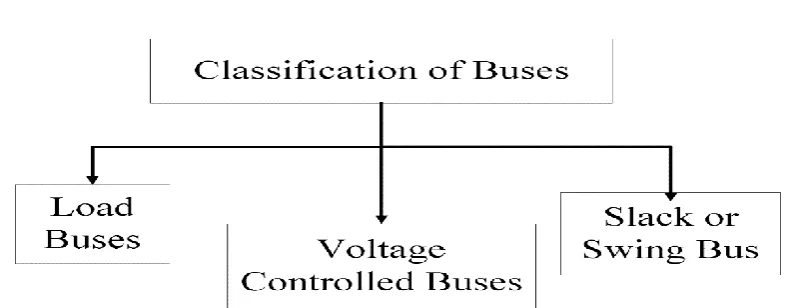
Figure 1. Bus classification [2]
Table 1. Types of buses
No. Bus types Specified Variables [known]
Unspecified Variables [unknown]
Remark
62 Qg,
the machine bus
3. Load/PQ bus Pg, Qg |𝑉|, About 80% buses are of
PQ type
4. Voltage controlled bus Pg, Qg, |𝑉| , a ‘a’ is the % tap change in tap-changing transformer
A. DATA FOR LOAD FLOW
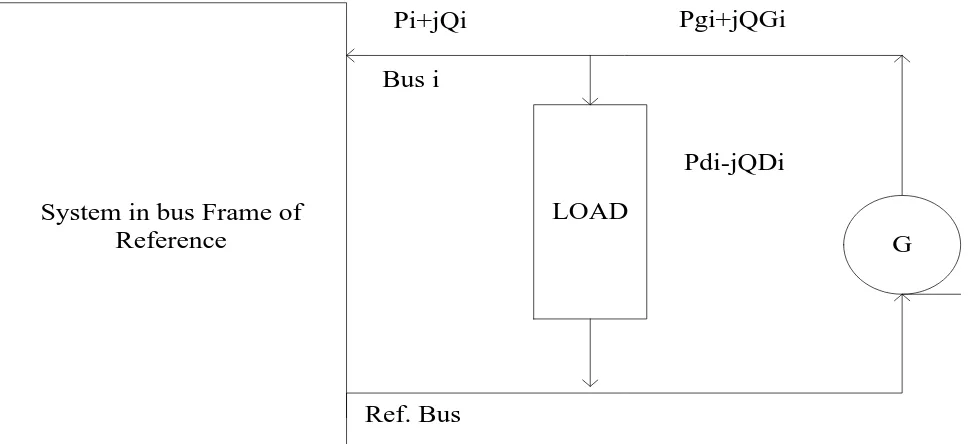
Irrespective of the method used for the solution, the data required is common for any load flow. All data is normally in pu. The bus admittance matrix is formulated from these data. The various data required are as under:
System data: It includes: number of buses-n, number of PV buses, number of loads, number of transmission lines, number of transformers, number of shunt elements, the slack bus number, voltage magnitude of slack bus (angle is generally taken as 00), tolerance limit, base MVA, and maximum permissible number of iterations [3].
Generator bus data: For every PV bus i, the data required includes the bus number, active power generation PGi, the specified voltage magnitudeVi,sp minimum reactive power limit Qi,min, and maximum reactive power limit Qi,max [3].
Load data: For all loads the data required includes the the bus number, active power demand PDi, and the reactive power demand QDi [3].
Transmission line data: For every transmission line connected between buses i and k the data includes the starting bus number i, ending bus number k, resistance of the line, reactance of the line and the half line charging admittance [3]. Transformer data: For every transformer connected between buses i and k the data to be given includes: the starting bus number i, ending bus number k, resistance of the transformer, reactance of the transformer, and the off nominal turns-ratio a [3].
Shunt element data: The data needed for the shunt element includes the bus number where element is connected, and the shunt admittance (Gsh + j Bsh) [3].
System in bus Frame of
Reference
LOAD
G
Pi+jQi
Pgi+jQGi
Bus i
Ref. Bus
Pdi-jQDi
63
B.
LOAD FLOW SOLUTIONStart
1. Read input data
2. Perform a conventional load flow study
3. Calculate the covariance matrix of voltages from the linear model
4. Calculate the bise in the estimated voltages
5. Augment the expected values with the change in bias. Calculate the new Jacobian
7. Calculate the expected values and the covariance matrix of active and reactive line flows
6. Is the change in bias less than e ?
Stop
Figure 3load flow
64
BUS 2 BUS 1 or slack G1
B U S 4 B U S 5 B U S 6 B U S 7 B U S 9 B U S 1 0 BUS11 B U S 1 2 B U S 13 B U S 14 B U S 15 B U S 16 B U S 17 B U S 18 B U S 19 B U S 21 B U S 22 BUS23 B U S 24 BUS25 BUS26 BUS27 BUS28 B U S 29 B U S 30 G2 G3 G4 G5 T1 T3 BUS 3 BUS 8 G6 Line 6 T2 Generator BUS Load Shunt Capacitor Transmission Line
One Line Diagram – IEEE – 30 Bus System
100 MVA Line 2 Line 1 Line 3 Line 4 Line 5 Line 7 Line 8 Line 9 Line 10 Line 11 Line 12 Line 13 Line 14 Line 15 Line 16
Line 18 Line 17 Line 19 Line 20 Line 21 Line 22 Line 23 Line 24 BUS 20 Line 25 Line 26 Line 27
Line 28 Line 29
L in e 30 Line 31 Line 32 Line 33 Line 34 Line 35 Line 36 Line 37 Line 38 L in e 29 Line 40 Line 41
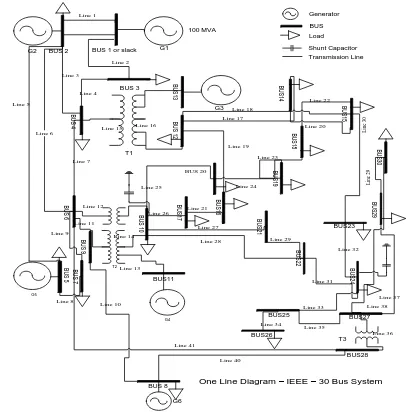
Figure 4. One-line diagram
Slack bus: 1
P-V buses: 2, 3, 4, 5, 6. (voltage controlled) P-Q buses: 7 to 30.
N = 30 and Ng = 5, there are 2N – Ng – 2 = 53 equation to be solved for the 53 state variables shown.
Table 2. transmission line data
Line No. From Bus To Bus
Series Admittance (p.u.) 1
Z
Y
Line Capacitor Susceptance (p.u.)G B
65 11. 12. 13. 14. 15. 16. 17. 18. 19. 20. 21. 22. 23. 24. 25. 26. 27. 28. 29. 30. 31. 32. 33. 34. 35. 36. 37. 38. 39. 40. 41. 6 6 9 9 4 12 12 12 12 14 16 15 18 19 10 10 10 10 21 15 22 23 24 25 25 28 27 27 29 8 6 9 10 11 10 12 13 14 15 16 15 17 18 19 20 20 17 21 22 22 23 24 24 25 26 27 27 29 30 30 28 28 0 0 0 0 0 0 1.52656 3.09539 1.95199 2.49095 1.89780 1.80769 3.07568 5.88235 1.78483 3.95603 5.10185 2.61931 16.77454 1.96834 2.54053 1.46140 1.30989 1.21653 1.96929 0 0.99553 0.68745 0.91205 1.44397 4.36284 -4.807692 -1.798561 -4.807692 -9.090909 -3.906250 -7.142857 -3.173425 -6.097275 -4.104359 -2.250874 -4.379363 -3.691423 -6.218758 -11.76470 -3.985358 -10.31744 -10.98071 -5.400770 34.127718 -3.976064 -3.954402 -2.989238 -2.287622 -1.817144 -3.760212 -2.710027 -1.881005 -1.293971 -1.723358 -4.540814 -15.46357 0 0 0 0 0 0 0 0 0 0 0 0 0 0 0 0 0 0 0 0 0 0 0 0 0 0 0 0 0 0.02140 0.00650
Table 2. transmission line data (MATLAB)
Line No.
From Bus
To
Bus R L C
66 2. 3. 4. 5. 6. 7. 8. 9. 10. 11. 12. 13. 14. 15. 16. 17. 18. 19. 20. 21. 22. 23. 24. 25. 26. 27. 28. 29. 30. 31. 32. 33. 34. 35. 36. 37. 38. 39. 40. 41. 1 2 3 2 2 4 5 6 6 6 6 9 9 4 12 12 12 12 14 16 15 18 19 10 10 10 10 21 15 22 23 24 25 25 28 27 27 29 8 6 3 4 4 5 6 6 7 7 8 9 10 11 10 12 13 14 15 16 15 17 18 19 20 20 17 21 22 22 23 24 24 25 26 27 27 29 30 30 28 28 0.04520 0.05700 0.01320 0.04720 0.05810 0.01190 0.04600 0.02670 0.01200 0 0 0 0 0 0 0.12310 0.06620 0.09450 0.22100 0.08240 0.10700 0.06390 0.03400 0.09360 0.03240 0.03480 0.07270 0.01160 0.10000 0.11500 0.13200 0.18850 0.25440 0.10930 0 0.21980 0.32020 0.23990 0.06360 0.01690 -6.24624e-4 -6.12443e-4 -1.35273e-4 -6.66969e-4 -6.22127e-4 -1.42668e-4 -4.27303e-4 -2.88687e-4 -1.44603e-4 -6.62084e-4 -1.76980e-3 -6.62084e-4 -3.50140e-4 -8.14873e-4 -4.45633e-4 -1.00304e-3 -5.22052e-4 -7.75541e-4 -1.41416e-3 -7.26840e-4 -8.62295e-4 -5.11854e-4 -2.70563e-4 -7.98698e-4 -3.08516e-4 -2.89880e-4 -5.89378e-4 -9.32701e-5
-8.00565e-4
-8.04950e-4 -1.06485e-3 -1.39144e-3 -1.75170e-3 -8.46521e-4 -1.17456e-3 -1.69223e-3 -2.45994e-3 -1.84723e-3 -7.00997e-4 -2.05845e-4 6.49352e-5 5.85690e-5 1.33690e-5 6.65267e-5 5.95239e-5 1.43239e-5 3.24676e-5 2.70563e-5 1.43239e-5 0 0 0 0 0 0 0 0 0 0 0 0 0 0 0 0 0 0 0 0 0 0 0 0 0 0 0 0 0 6.81183e-5 2.06901e-5Table 3. Y-bus data
67 1.
2. 3. 4. 5. 6. 7. 8. 9. 10. 11. 12. 13. 14. 15. 16. 17. 18. 19. 20. 21. 22. 23. 24. 25. 26. 27. 28. 29. 30
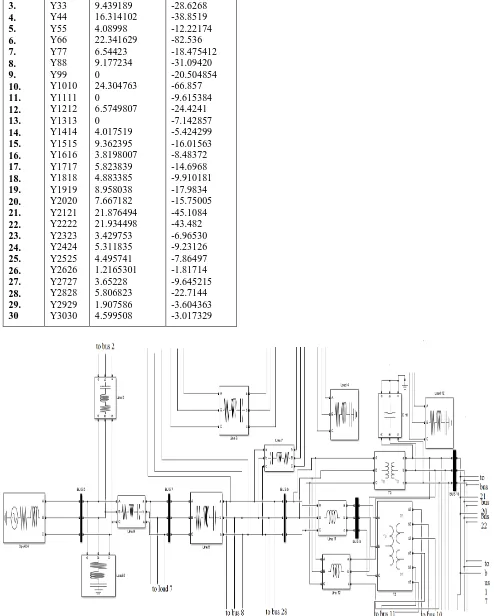
Y11 Y22 Y33 Y44 Y55 Y66 Y77 Y88 Y99 Y1010 Y1111 Y1212 Y1313 Y1414 Y1515 Y1616 Y1717 Y1818 Y1919 Y2020 Y2121 Y2222 Y2323 Y2424 Y2525 Y2626 Y2727 Y2828 Y2929 Y3030
6.46834 9.751964 9.439189 16.314102 4.08998 22.341629 6.54423 9.177234 0
24.304763 0
6.5749807 0
4.017519 9.362395 3.8198007 5.823839 4.883385 8.958038 7.667182 21.876494 21.934498 3.429753 5.311835 4.495741 1.2165301 3.65228 5.806823 1.907586 4.599508
-20.74275 -30.7330 -28.6268 -38.8519 -12.22174 -82.536 -18.475412 -31.09420 -20.504854 -66.857 -9.615384 -24.4241 -7.142857 -5.424299 -16.01563 -8.48372 -14.6968 -9.910181 -17.9834 -15.75005 -45.1084 -43.482 -6.96530 -9.23126 -7.86497 -1.81714 -9.645215 -22.7144 -3.604363 -3.017329
69
Figure 6. IEEE 30 bus system (MATLAB Simulation)
70
IV. TEST RESULT
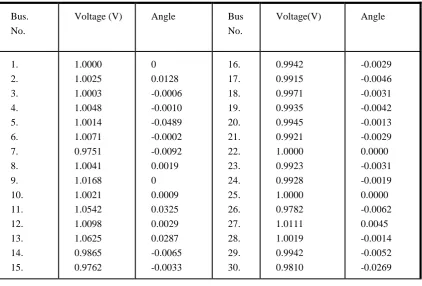
Load flow analysis is carried out in IEEE 30 bus test system. Output Voltage magnitude and Voltage Angle values from IEEE 30 bus system. All data are in per unit. Angle is given in radian.
Table 4. Test output
Bus.
No.
Voltage (V) Angle Bus
No.
Voltage(V) Angle
1.
2.
3. 4.
5.
6.
7. 8.
9.
10.
11. 12.
13.
14.
15.
1.0000
1.0025
1.0003 1.0048
1.0014
1.0071
0.9751 1.0041
1.0168
1.0021
1.0542 1.0098
1.0625
0.9865
0.9762
0
0.0128
-0.0006 -0.0010
-0.0489
-0.0002
-0.0092 0.0019
0
0.0009
0.0325 0.0029
0.0287
-0.0065
-0.0033
16.
17.
18. 19.
20.
21.
22. 23.
24.
25.
26. 27.
28.
29.
30.
0.9942
0.9915
0.9971 0.9935
0.9945
0.9921
1.0000 0.9923
0.9928
1.0000
0.9782 1.0111
1.0019
0.9942
0.9810
-0.0029
-0.0046
-0.0031 -0.0042
-0.0013
-0.0029
0.0000 -0.0031
-0.0019
0.0000
-0.0062 0.0045
-0.0014
-0.0052
-0.0269
V.
CONCLUSIONThe simulation of a Load flow analysis on IEEE-30 bus system was conducted and the effects of load modelling. The reactive power modelling greatly affected the voltage difference, whereas the active power modelling has a greater effect on phase angle differences. The voltage profile remains flat which adds to the advantages of incorporation of load flow models. Thus it is deduced that incorporation of load flow models in load flow analysis is advantageous than conventional load flow analysis as generation cost and losses are reduced and security and stability of the system increases.
VI. REFERENCES
[1] P. S. Bhowmik, D. V. Rajan, S. P. Bose, “Load Flow Analysis: An Overview,” World Academy of Science, Engineering and Technology, International Journal of Electrical Engineering, Vol:6, No:3, 2012.
[2] Dharamjit*, D.K.Tanti,, “Load Flow Analysis on IEEE 30 bus System” International Journal of Scientific and Research Publications, Volume 2, Issue 11, November 2012 1 ISSN 2250-3153.
[3] J. J. Grainger & W.D. Stevenson, Jr. indian edition Tata McGraw-Hill Publishing Company limited.
[4] J. F. Dopazo,O. A. Klitin, A. M. Sasson, “Stochastic load flow,” American Electric Power Service Corp. IEEE Transactions on Power Apparatus and Systems, vol. PAS-94, no. 2, March/April 1975.
AUTHOR



![Figure 7. simulation output [ bus 1, bus 2, bus 3, Vabc]](https://thumb-us.123doks.com/thumbv2/123dok_us/8874851.1816245/9.595.55.469.69.760/figure-simulation-output-bus-bus-bus-vabc.webp)