Experimental Investigation of Mechanical Properties of Mortar with
Varying Constituents
1 Thinn Thiri Soe, 2 Dr.Khin Su Su Htwe
1 Ph.D Candidate, 2 Professor
Department of Civil Engineering, Yangon Technological University, Yangon Technological University, Yangon, Myanmar
Email – 1[email protected], 2[email protected]
1. INTRODUCTION:
Masonry is a heterogeneous composite material consists of masonry unit and mortar. Although masonry has been used as construction materials for past thousand of years, there is limited understanding to its fracture mechanism due to variation in materials used in manufacturing of masonry unit and mortar. Consequently, it is crucial to investig ate these constituent material properties that may influence the fracture behavior of the masonry structure. Masonry units usually consist of fired clay, concrete or calcium silicate bricks; concrete or fired clay blocks; adobe or various types, sizes and shapes of naturally occurring stones. The composition of the mortar joints is usually expressed in terms of the bulk volume or weight ratio of the binder and the sand (or fine aggregate). The most commonly used binder in modern construction is Ordinary Portland Cement (OPC). It is usually up to the mason or bricklayer to add the required quantity of water to obtain the desired workability. The strength of the mortar is classified as per the composition of its constituents e.g. parts of OPC to parts of sand to parts of water (cement: sand: water). From the different combinations of masonry units, mortars and unit bonding patterns, a large number of geometric arrangements and strength characteristics can be obtained.
Consequently, a large variation of geometric arrangements as well as material strength characteristic is
generally expected due to different combination of masonry units, mortars and its bonding behaviour. Generally, the main mechanical features of masonry can be characterized by the rigid nature of the masonry units which have a high resistance to compression; the deformability of the mortar joints with a low resistance to tension and the frictional properties of the unit/mortar joint interface. Masonry structure is composed of individual units laid in and bound together by cement mortar. The commonly materials used for the manufacture of masonry units are brick, stone and concrete blocks. Masonry is generally a highly durable but brittle form of construction. The properties of the bricks in any typical structure will vary according to material used and manufacturing process. Such variations may have a significant impact on the mechanical response to applied load or environmental changes (e.g. humidity and temperature). Some of the factors that may be responsible for variations in the mechanical properties of bricks include: a) the brick manufacturing process; b) the natural variation in the composition and quality of the raw materials used in the brick making process; and c) deterioration due to ageing effects.
Mortar is one of the most commonly used construction materials and it has been used extensively in the construction of various structures since ancient time. The continuous research and development of mortar techniques has results in the production of many construction materials. Most of the mortars possess particular and separated characteristics to fulfill the demand corresponding to the requirements of the actual site construction. It is generally agreed that
Abstract: Brick masonry panel is a composite material consisting of bricks and mortar. The materials used in the construction of panels are cement, sand and bricks. The possibility of combining these elements with different qualities and geometry give masonry a wide possible range of mechanical behaviour and structural performance. It is generally agreed that masonry has a good resistance to compressive loads and in-plane shear while its provide poor performance to resist tensile load and out-of-plane behaviour. This study investigated the mechanical properties such as the compressive strength, tensile strength, modulus of rapture and modulus of elasticity of various cement mortars mixes with sand-cement ratios of 1:3, 1:4 and 1:5 that typically used in Myanmar masonry construction. Further investigation was conducted on the impact of various water-cement ratios is ranging between 0.40 to 0.70 for each mortar mix with constant increment of 0.05. From the experimental results, it was observed that cement ratio of 1:3 generally provides better performance over two other mixes with a sand-cement ratio of 1:4 and 1:5 while water-sand-cement ratio 0.6 was found to provide better compressive and tensile strength for the mortar mix with a cement-sand ratio of 1:3.
compressive strength of cement mortar is inversely proportion to the amount of water added into the mortar mix, while insufficient water content lead to a low workability.
2. LITERATURE REVIEW:
The majority of the masonry construction in Myanmar has limited engineering involvement and consequently, tradi tional bricklayerprefer aworkable mortar mix while forgoing the importance to the strength and durability of the masonry structureIt is, therefore, important to identify the optimal mortar ratio to achieve desire strength and workability. In this study, the optimum water-cement ratio and cement-sand ratio are experimentally investigated for locally available masonry mortar by testing of its compressive strength at 28 days. In addition, the mechanical properties such as flexural strength, modulus of elasticity, and tensile strength of the optimal mix further investigated for better understanding of the locally available of mortar.
Haach et al. [1] investigated the influence of aggregate grading and w/c ratio on the workability and compressive strength of mortar.Haach et al. observed that increase in the w/c ratio has a reduction to the mechanical properties of mortar while increasing its workability. Kim et al. [3] observed that increasing the w/c ratio of cement mortar from 0.45 to 0.60 lead to increase in its porosity by 150% while compressive strength of mortar was reduced to 75.6%. Zhou et al. [4] observed that dynamic compressive strength of cement mortar increased with decrease in water content.Ji-Kai and Li-Mei [5] observed that fracture behavior of low w/c ratio mortar is more brittle than that of mortar with high w/c ratio. Zivica [6] studied the effect of low w/c on the pore structure and compressive strength of the cement paste. Fineness modulus of sand also influences the w/c ratio of the mortar. Lim et al. [7] have stated that finer sand grading specimen requires a higher w/c ratio to achieve an equivalent workability. It has also been observed by Lim et al. [7] that mortar with coarse sand has higher compressive strength than those of the finer sand at lower w/c ratio. Study has also shown that influence of sand grading affects the properties of mortar [8–11]. By experimental investigations, Ruddy and Gupta [8] observed that 55–60% reduction in tensile bond strength as fineness modulus of sand changes from 3.21 to 1.72. As the surface area of sand increases, more paste is needed to cover the surface to attain certain viscosity [10–11].
However, from time to time, the water/cement ratio based mix design has been criticized for not being on the fundamental theory but rather on empirical findings. From an extensive experimental study by Curie and Sinha [12], it has been observed that the important factor affecting the compressive strength of mortar reported to be the water/cement ratio. It has also been revealed from their investigations that the relationship between compressive strength and water/ cement ratio was unaffected by the use of different sands and sand grading.
3. EXPERIMENTAL PROGRAMME:
A. Materials
A.1.Cement
Elephant (SCG) brand (Type I) Ordinary Portland cement was used for the present experimental investigation. Standard Consistency is 29.23% according to ASTM C187 [13] test method. Soundness test result of Portland cement is 'Good'. In this test result the expansion of the cement is 2mm. According to BS 6463 standard, expansion is limited to
10mm. Specific gravity of cement is 3.1. Setting time for cement is tested by ASTM C191-04 [14] and shows as table1. A.2.Fine Aggregate
Natural river sand with sand fraction passing through 4.75-mm sieve and retained on 600-μm sieve was used for this research. Care has been taken to avoid the presence of inorganic and silt particles in the adopted sand fraction. The fineness modulus of sand was 2.38.
A.3.Water
Tube well water available in the laboratory was used for mixing mortar and curing the mortar specimens as well.
B. Experimental Methods and Test Procedure
B.1. Proportioning of mortar mixes
In this research, three mixes of cement: sand proportions (1:3, 1:4, and 1:5) with different w/c ratio varying from 0.4 to 0.7 were prepared by weight batching at a constant increment of 0.05. The cement mortar mix was prepared in the mixer for 2 to 3 min of mixing. After mixing the mortar, six cubes of 50 mm × 50 mm × 50 mm were cast. Specimens were left in the mould inside the moist room (temperature 27±2 °C and relative humidity 65% ±5) for a period of 24 hour. The specimens were removed from mold and placed inside the curing tank at temperature of 27±2 °C for 28 days.
B.2. Compression Strength Test
109/C 109M-02 [15] Standard Methodafter 28 days. Standard metallic cube moulds (50 mm × 50 mm × 50 mm) as shown in figure:1(a), (b), and (c) were used for preparation of the mortar specimens for compressive strength. A table vibrator was used for compaction of the mortar filled cubes. The specimens were cured in the molds and stripped and immersed in saturated lime water until the time of testing. Six cube specimens were used for the determination of average compressive strength. Compressive strength (fcm) was measured by placing the specimens in the contact of bearing surface of the Universal Testing Machine (UTM-1000KN) and the load was applied at the rate of 200 to 400 lbs per second until failure occurs. The compressive strength was calculated by dividing the maximum load applied to the specimen during the test by cross sectional loaded area.
Table 1: Test Results of Setting Time for Portland cement
Sr No. Description Specification Remark
1 Wt. of cement (g) 650
2 Wt. of water (g) 190
3 Initial setting time 1 hr 58 min Minimum 60min
4 Final setting time 3 hr 56 min Maximum 10hr
(a) (b) (c)
Figure 1: (a) Standard metallic cube moulds (50mm x 50mm x 50mm), (b) Cement mortar cubes specimens, (c)Compressive strength test of mortar under UTM-1000KN machine
B.2. Tensile Strength Test
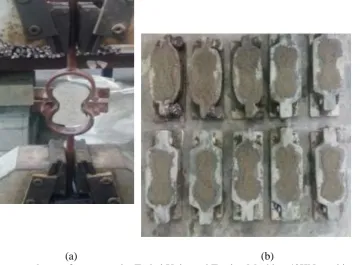
Tensile strength, ftm is one of the important properties of cement mortar. In the case of masonry structure, influence of bond–strength is critical to the performance of masonry and therefore, it is important to understand tensile strength, ftm of the mortar mixes. The tensile strength of cement mortar test samples and methods of test were based on Tensile Strength Test of Hydraulic Cement Mortar in accordance with ASTM Standard Methods (ASTM.C190-85) [16]. The purpose of this test is to determine the tensile strength of optimal ratio of hydraulic cement mortar using briquette specimens as shown in figure:2 (a) and (b).The mortar prepared is placed in a mould of briquette which has central cross-sectional area as 25 mm × 25 mm and length as 76.2 mm and three specimens were tested for each mixture. After curing briquette, specimen is pulled under the grips of tensile testing machine (Trebel Universal Testing Machine-40KN). The failure loads are recorded and maximum tensile stress is calculated by dividing the applied load by the central cross-sectional area.
B.3. Flexural Strength Test
Flexural Strength, frm (sometimes called the modulus of rupture) is actually a measure of tensile strength in bending and modulus of elasticity, Em of mortar. Three samples for each mixture of flexural strength testing is carried
(a) (b)
Figure 2: (a) Tensile strength test of mortar under Trebel Universal Testing Machine-40KN machine
(b) Standard mould of briquette (central cross-sectional area as 25.4mm x 25.4mm and length as 76.2mm)
crosshead of 600±25 lbf/min under Bending Testing Machine (Trebel Universal Testing Machine-40KN) as shown in figure 4 (a) and (b). The deflection of the beam at mid-span was measured with reference to the outer points of loading in the central loading method. From load-deflection curve, load and deflection at proportional limit and maximum load for all flexural strength tests were obtained. The modulus of elasticity (Em) is a measure of the relation between stress and
strain within the limit of proportionality. Modulus of elasticity (Em) provides a convenient figure for expressing the stiffness
or flexibility of a mortar that is derived in a static bending test along with modulus of rupture.
Modulus of elasticity can be calculated Stress-Strain curve, shown in figure 3, the point of inflection is the point where the curve started to deviate from the linear portion. The load at the point of inflection is defined as the proportional limit load. Flexural stress at proportional limit ( frm) is calculated for each beam from proportional limit load in stress-strain curve.
Figure 3: Stress-Strain curve for Flexural Strength Test of Mortar Beam
0.000 100.000 200.000 300.000 400.000 500.000 600.000 700.000 800.000 900.000 1000.000
0.00 0.50 1.00 1.50 2.00 2.50 3.00
F
lex
ura
l
Strength,
frm
(psi
)
Strain (ɛ) x 103
Stress (σ)
4. EXPERIMENTAL RESULTS AND DISCUSSION:
4.1. Compressive Strength Test Result Discussion
The experimental results of mean compressive strength of cube specimens with varied w/c ratio of the all three mortar mixes at the age of 28 days along with standard deviation are presented in figure 5.
(a) (b)
Figure 4: (a) Flexural strength test specimens 40mm x 40mm x 160mm size
(b)Flexural strength test of mortar beam Trebel Universal Testing Machine-40KN machine
It was observed that the compressive strength increases initially with addition of water, which improve hydration of cement paste with increasing water content .However, subsequent water addition leads to the reduction in strength as expected in the trend of 1:3 mix. From the experimental results, it was observed that sand to mortar ratio of 1:3 mortar mix provide better compressive strength than those with higher sand to cement ratio, i.e. 1:4 and 1:5 mix ratio. The experimental results indicated that the compressive strength is directly proportional to the water-cement ratio of the mortar mix in 4 and 1:5. It has been generally observed that the compressive strength at the ages of 28 days increases as the water/cement ratio increases in 1:4 and 1:5.
4.2. Determination Optimal Water Cement Ratio and Cement Sand Ratio
It is necessary to evaluate optimum w/c ratio to fully understand the mechanical properties of cement mortar. Figure 6 shows the 95 percentile confidence level or the characteristic compressive strengths of cement mortar in relations to the varying sand-cement and water-cement ratio. It is interesting that compressive strength was observed to be directly relation to the water content within the mix. However, it is anticipated that there would be an inflection point beyond the water-cement ratio of 0.7, which would signify the optimal compressive strength.
0.4 0.45 0.5 0.55 0.6 0.65 0.7
0 200 400 600 800 1000 1200 1400 1600 1800
Me
an
Compres
sive
Strength (Psi)
Water-Cement Ratio Cement :Sand = 1:3
Cement :Sand = 1:4 Cement :Sand = 1:5
0.40 0.45 0.50 0.55 0.60 0.65 0.70 200 400 600 800 1000 1200 1400 802 922 1178 1138 1220 1170 1327 404 391 512 645 846 956 995 216 369 327 357 428 424 504 Cha racteristic Compres sive
Strength of C
ube,
f'c
(Psi)
Water-Cement Ratio Cement:Sand = 1:3
Cement:Sand = 1:4 Cement:Sand = 1:5
Figure 6: Characteristic Compressive Strength of mortar in relations to water-cement and sand-cement ratio
4.2. Tensile Strength Test result Discussion
The mean tensile strength, ftm of briquette specimens with various water-cement and sand-cement ratio at the age of 28 days are presented in figure 7. The results showed that sand to cement ratio of 1:3 mortar mix performed better in tension than two other mix design. In general, the tensile strength, ftm at the ages of 28 days increases to a maximum at water-cement ratio of 0.55 and decrease again with the addition of water to the mortar mix. Figure 8 present the relationship between mean tensile strength to mean compressive strength of of various mortar mixes. For the highest compressive strength mortar mix with sand to cement ratio of 1:3, the results shows that optimum tensile and compressive strength can be achieved by using water to cement ratio in between of 0.55 to 0.65.
309 294 331 514 485 478 404 176 243 213 250 301 275 257 140 147 191 206
169 184 162
0.4 0.45 0.5 0.55 0.6 0.65 0.7
0 100 200 300 400 500 600 700 Me an Value s of Tensile Str ength (P si) Water-Cement Ratio Cement:Sand = 1:3
Cement:Sand = 1:4 Cement:Sand = 1:5
Figure 7: Mean tensile strength of mortar in relations to water-cement and sand-cement ratio
4.3. Flexural Strength Test result Discussion
200 400 600 800 1000 1200 1400 1600 6
7 8 9 10 11 12 13 14 15
w:c = 0.7
w:c = 0.65 w:c = 0.6
w:c = 0.55
w:c = 0.5
w:c = 0.45
Cement:Sand = 1:3 Cement:Sand = 1:4 Cement:Sand = 1:5
ftm
/v(f
cm
)
Mean Cube Compressive Strength, fcm (Psi)
w:c = 0.4
Figure 8: Relationship between mean compressive strength to tensile strength
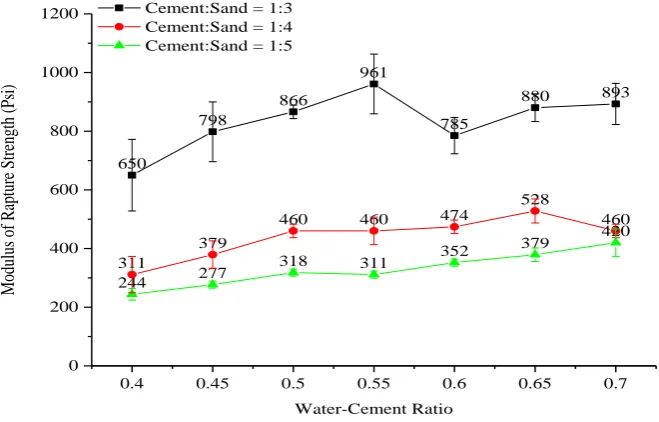
tensile strength results, the sand-cement ratio of 1:3 provided the highest mechanical properties for the mortar mix with optimum modulus of rapture strength was found to be the motor mix with water-cement ratio in excess of 0.55.
650
798
866
961
785
880 893
311
379
460 460 474
528
460
244 277
318 311 352
379 420
0.4 0.45 0.5 0.55 0.6 0.65 0.7
0 200 400 600 800 1000 1200
Modulus
of
Ra
pture Strength (P
si)
Water-Cement Ratio Cement:Sand = 1:3
Cement:Sand = 1:4 Cement:Sand = 1:5
Figure 9: Mean modulus of rapture strength of mortar in relations to water-cement and sand-cement ratio
4.4. Modulus of ElasticityTest result Discussion
The modulus of elasticity is a measure of the relation between stress and strain within the limit of proportionality. The modulus of elasticity provides a convenient figure for expressing the stiffness or flexibility of a mortar that is derived in a static bending test along with modulus of rupture. Modulus of Elasticity values of 1:3, 1:4 and 1:5 mortar mixes with varies water/cement ratio for each mortar beam is calculated from load vs deflection in Stress-Strain curve as presented in figure 10. Similar to previous mechanical properties found in this study, it was observed that mortar mix with the sand-cement ratio of 1:3 provide the highest modulus of elasticity, Em while water-cement ratio of 0.65 is found to be
optimum value. However, it is noted that there is no clear modulus of elasticity trend for three mixes in relation to the water-cement ratio.
5. CONCLUSION:
0.4 0.45 0.5 0.55 0.6 0.65 0.7
0 250000 500000 750000 1000000 1250000 1500000 1750000 2000000 2250000 2500000 2750000
Modulus
of
El
as
ticity of M
otar (Psi)
Water-Cement Ratio Cement:Sand = 1:3
Cement:Sand = 1:4 Cement:Sand = 1:5
Figure 10:Mean modulus of elasticity strength of mortar in relations to water-cement and sand-cement ratio
cement ratio of 1:3 and an optimal water-cement ratio of 0.6 due to its highest compressive strength and its strong relationship to tensile strength of the mix. This study shows that sand-cement ratio plays significant roles in defining the mechanical properties of the cement mortar mix while using an optimum water-cement ratio, which is found to be 0.6, can further enhanced the performance of the mortar mix.
ACKNOWLEGMENT:
First and foremost the author thanks to Professor Dr. Nyan Myint Kyaw, Head of Civil Engineering Department of YTU for his support, guidance and suggestions. Special thanks to Dr. Khin Su Su Htwe, Professor, Civil Engineering Department of YTU, for her support and kind help and then, the support from Structural Laboratory, Department of Civil Engineering, Yangon Technological University, Yangon, Myanmar.
REFERENCES:
1. V.G. Haach, G. Vasconcelos, P.B. Lourenco, Influence of aggregates grading and water/cement ratio in workability
and hardened properties of mortars, Constr. Build. Mater. 25.6 (2011) 2980–2987.
2. J. Schulze, Influence of water-cement ratio and cement content on the properties of polymer-modified mortars,
Cem.Concr. Res. 29.6 (1999) 909–915.
3. Y.Y. Kim, K.M. Lee, J.W. Bang, S.J. Kwon, Effect of w/c ratio on durability and porosity in cement mortar with
constant cement amount, Adv. Mater. Sci. Eng. 2014 (2014).
4. J. Zhou, X. Chen, L. Wu, X. Kan, Influence of free water content on the compressive mechanical behaviour of cement
mortar under high strain rate, Sadhana – Acad. Proc. Eng. Sci. 36.3 (2011) 357–369.
5. Z. Ji-Kai, G. Li-Mei, Effect of strain rate and water-to-cement ratio on compressive mechanical behavior of cement
mortar, J. Cent. South Univ. 22 (2015) 1087–1095.
6. V. Zivica, Effects of the very low water/cement ratio, Constr. Build. Mater. 23.12 (2009) 3579–3582.
7. S.K. Lim, C.S. Tan, K.P. Chen, M.L. Lee, W.P. Lee, Effect of different sand grading on strength properties of
cement grout, Constr. Build. Mater. 38 (2013) 348–355.
8. B.V.V. Reddy, A. Gupta, Influence of sand grading on the characteristics of mortars and soil–cement block masonry,
Constr. Build. Mater. 22.8 (2008) 1614–1623.
9. G. De Schutter, A.M. Poppe, Quantification of the water demand of sand in mortar, Constr. Build. Mater. 18.7
(2004) 517–521.
10. M. Westerholm, B. Lagerblad, J. Silfwerbrand, E. Forssberg, Influence of fine aggregate characteristics on the
rheological properties of mortars, Cem. Concr. Res. 30.4 (2008) 274–282.
11. A. Ganaw, A. Ashour, Rheological properties of mortars prepared with different sands, ACI Mater. J. 111.5
(2014) 561–568.
12. D. Currie, B.P. Sinha, Survey of Scottish sands and their characteristics which affect mortar strength, Chem. Ind. 19
(1981) 631± 645.
13. American Standard Test Method for Normal Consistency of Hydraulic ASTM C187-98.
14. American Standard Test Method for Time of Setting of Hydraulic Cement by Vicat Needle ASTM C191-04.
15. American Standard Test Method for Compressive Strength of Hydraulic Cement Mortars (Using 2-in. or [50-
mm] Cube Specimens) ASTM C109/C 109/M-02
16. American Standard Test Method for Tensile Strength of Hydraulic Cement Mortars ASTM C190-85.