Available Online At www.ijpret.com
INTERNATIONAL JOURNAL OF PURE AND
APPLIED RESEARCH IN ENGINEERING AND
TECHNOLOGY
A PATH FOR HORIZING YOUR INNOVATIVE WORK
OPTIMIZATION OF DOCUMENT CLUSTERING USING PHRASES
A.V.POTNURWAR
Assistant Prof., P.I.E.T
Accepted Date:
27/02/2013
Publish Date:
01/04/2013
Keywords
Clustering
Phrases
Corresponding Author
Mrs. A. V. Potnurwar
Abstract
Available Online At www.ijpret.com
INTRODUCTION
An IR system typically produces a ranked list
of documents in response to a user’s query.
These documents are presented to the user
for examination and evaluation. Although
the documents are ranked, there is
significant potential benefit in providing
additional structure in long retrieved lists.
The role of information organization
becomes even more important in the
interactive model of retrieval, where the
focus is on the user's participation in a
cycle of query formulation, presentation
of search results, and query reformulation.
Traditional information retrieval systems
are useful for retrieval of general
documents; however these systems cannot
support scenario-specific information
retrieval because of:
The lack of effective techniques to
extract key features from free-text for
indexing, to identify phrases with similar
concepts in free-text.
The terms used in a query are often
mismatched with those from the
document containing information on
the same scenario.
•Relevance:
• Browsable summaries:
• Overlap:
• Snippet-tolerance:
• Speed
• Incrementality:
The objective of this paper is automatic
classification of documents into specific
topic areas..
Therefore, at the end of clustering analysis,
semantics must be assigned to each class by
an analyst. There are methods for
document clustering by means of
document-to-cluster similarity function
(coefficient). Should the value of coefficient
exceed threshold value q, the document
falls into the pertinent equivalence class.
2. MOTIVATION
The motivation for this research is to make
search engine results easy to browse.
Document clustering algorithms attempt to
Available Online At www.ijpret.com Clustering the results of Web search
engines can provide a powerful browsing
tool. Document clustering has initially been
investigated in Information Retrieval mainly
as a means of improving the performance
of search engines by pre-clustering the
entire. Our modified user-cluster hypothesis
is that users have a mental model of the
topics and subtopics of the documents
present in the result set; similar documents
will tend to belong to the same mental
category in the users’ model. Thus the
automatic detection of clusters of similar
documents can help the user in browsing
the result set. Clustering of search results
can help users in three ways:
to find the information
faster that a query is poorly formulated)
and to reformulate it, it can reduces the
fraction of the queries on which the
user gives up before reaching the
desired information.
We have identified some key requirements:
Coherent Clusters:
Efficiently Browsable:
Speed
3. CLUSTER INTIALIZATION
After surveying a range of literature
experimented with the following four
initialization techniques[16]:
• Random:
• Perturb:
• Marginal:
• KKZ:
Any clustering technique relies on four
concepts:a data representation model,a
similarity measure,a cluster model, anda
clustering algorithm that builds the clusters
using the data model and the similarity
measure.
3.1 A SIMILARITY MEASURE
As mentioned earlier, phrases convey local
context information,which is essential in
determining an accurate similarity between
documents..The phrase similarity between
two documents is calculated based on the
list of matching phrases between the two
documents. From an information theoretic
point of view, the similarity between two
objects is regarded as how much they share
in common. The cosine and the Jaccard
measures are indeed of such nature, but
they are essentially used as single-term
Available Online At www.ijpret.com formal definition for any information
theoretic similarity measure in the form of:
sim(x,y) = xυy
x∩y
The basic assumption here is that the
similarity between two documents is based
on the ratio of how much they overlap to
their union, all in terms of phrases. This
definition still coincides with the major
assumption of the cosine and the Jaccard
measures, and to Lin’s definition as well.
3.2 CLUSTER MODEL
Any clustering algorithm assumes a certain
cluster structure. Sometimes the cluster
structure is not assumed explicitly, but is
inherent due to the nature of the clustering
algorithm itself. For example, the k-means
clustering algorithm assumes spherical
shaped (or generally convex shaped)
clusters. This is due to the way k-means
finds cluster centers and updates object
memberships. Also if care is not taken, we
could end up with elongated clusters,
where the resulting partition contains a few
large clusters and some very small clusters.
Wong and Fu [13] proposed a strategy to
keep the cluster sizes in a certain range, but
it could be argued that forcing a limit on
cluster size is not always desirable. A
dynamic model for finding clusters
irrelevant of their structure is CHAMELEON,
which was proposed by Karypis et al [10].. A
good example of overlapping document
cluster generation is the tree-based STC
system proposed by Zamir and Etzioni [2].
Another way for generating overlapping
clusters is through fuzzy clustering where
objects can belong to different clusters to
different degrees of membership [5].
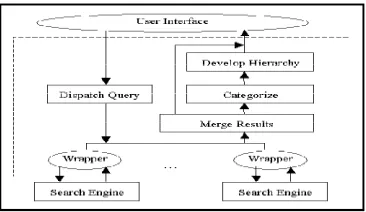
3.2. DOCUMENT ACQUISTION
The documents are retrieved from several
popular search engines, including Google,
Teoma, MSN Search, AltaVista. A wrapper,
communicating with each search engine,
translates the query into an acceptable
request to the search engine, submits the
request, retrieves snippets, and parses the
results to extract noun phrases from each
snippet. After obtaining the snippets from
individual sources, the system removes
duplicates to form an aggregated document
set. A relevancy indicator, which is the
Available Online At www.ijpret.com all sources, used to sort the documents. The
Fig 1 below shows
Fig1 Flow Chart For Document acquisition
3.3 PHRASE EXTRACTION[7]
The phrase extraction is given as follows:
Make a list of all the bigrams in the
input sequence.
Find a bigram (wi, w j ) with the
maximum association weight A(wi, w j )
in the list of rules.
In the sequence, replace all the
instances of the bigram (wi , wj) with a
new symbol wk (taken from the rule).
This is now the new sequence.
for each replaced instance output the
expanded phrase.
Update the list of all the bigrams in the
sequence
3.4 PHRASE RANKING
Phrase features are used to calculate a
score for each phrase. Another method for
scoring phrases was used, which is based on
individual word weights.
3.5COLLECTING PHRASE STASTICS
For each phrase appearing in the cluster,
collect the following statistics: document
frequency (DF), and term frequency (TF)
with respect to the cluster S, the parent
cluster P and the general English corpus E.
Document frequency of a phrase p with
respect to a cluster C, denoted by DFC, is
the number of documents in the cluster
that contain p. Term frequency of a phrase
p in a cluster C, denoted by TFC, is total
number of occurrences of p in the cluster
We have identified three key requirements
for a post-retrieval document clustering
system Relevance.,Browsable Summaries,
Speed.
Therefore the clustering system ought to be
able to cluster up to one thousand
documents in a few seconds
Available Online At www.ijpret.com Algorithm implemented in this paper is
having following steps:
1. Accept thequery of the user
2. Create an UI to accept the directory
which contains all the document
3. After accepting the document, they will
be converted into numerical document
by using vector array ..
4. The query is express as numerical
expression
5. The occurrence of individual words is
done in the document.
6. After getting the words the stops words
are eliminated
7. The frequency of individual words is
calculated
8. According to the occurrence of the
words, the ranking of the documents is
done.
9. This is called as second base cluster
10. After getting the cluster the occurrences
of words with respect to the grammatical
position is calculated
11. The words in noun position the given
most priority and then the rest of the
grammatical positions
The third cluster are prepare with the
maximum accuracy
5. APPLICATIONS
Document clustering has been used in a
number of applications .In information
retrieval systems, it has been used to
improve the precision and recall
performance [14], and as an efficient way to
find similar documents [15] It has also been
proposed in browsing document collections
and organizing the results of a search
engine query] Document clustering has also
been used to automatically generate
hierarchical grouping of documents[18]
6. CONCLUSION
We presented a novel technique for
calculating the probability and expected
document frequency of any given
noncontiguous lexical cohesive relation..
We further described a method that
compares observed and expected
document frequencies through a statistical
Available Online At www.ijpret.com evaluation of the intrinsic quality of a
multi-word unit (or of a set of multi-multi-word units).
This technique does not require work of a
human expert, and it is fully language and
application independent. It is generally
accepted that, in English, two words at a
distance five or more are not connected.
We can attempt to deal with this by using
short documents, for example sentences, or
even comma-separated units We presented
a novel technique for calculating the
frequency of word occurrence such a
statistical test as a way to give a direct
numerical evaluation of the intrinsic quality
of a word unit (or of a set of
multi-word units)
7. REFERENCES
1. Evan ER ijsbergen.“Information
Retrieval”.
2. Zamir, Etzioni, Madani,and R.
M.Karp.“Fast and intuitive clustering of web
documents” In KDD’97, pp. 287 - 290, 1997.
3. M. Steinbach, G. Karypis, V. Kumar, A
comparison of document clustering
techniques. Proc. KDD Workshop on Text
Mining, 1-20, 2000.
4. B. Luke. K-means clustering
tutorial.http://ncisgi.ncifcrf.gov/lukeb/kme
ans.html
5. Taeho Jo, “ Single Pass Algorithm for
Text Clustering by Encoding Documents into
Tables ”, IT Convergence, KAIST Institute
6. Oren Zamir and Oren Etzioni, “ Web
Document Clustering”
7. Mrs. K. P. Supreethi ,“Web Document
Clustering Technique Using CaseGrammar
Structure”
8. MING HEI TSUI, BRESLEY LIM, DAMING
,“ Web Search Result Refinement by
Document clustering”
9. Juhyun Han, Taehwan Kim, Joongmin
Choi, “Web Document Clustering By Using
Automatic Keyphrase Extraction” Dept. of
Computer Science and Engineering Hanyang
University1271 Sa-3-Dong, Ansan,
Gyeonggi-Do, Koreafjhhan,
kimth,[email protected].
10.Ying Zhao and George Karypis “Criterion
Functions for Document Clustering
Experiments and Analysis” University of
Minnesota, Department of Computer
Science / Army HPC Research Center
Minneapolis, MN 55455Technical Report
Available Online At www.ijpret.com 11.Xiaohui Cui, Thomas E. Poto “Document
Clustering Analysis Based on Hybrid
PSO+K-means Algorithm” kApplied Software
Engineering Research Group,
Computational Sciences and Engineering
Division, Oak Ridge National Laboratory,
Oak Ridge, TN 37831-6085, USA cuix,
12.Dell Zhang ,“Semantic, Hierarchical,
Online Clustering of Web Search Results” ,
Department of Computer Science School of
ComputingS15-05-24, 3 Science Drive
National University of Singapore Singapore
1175432 Singapore-MIAllianceE4-04-10, 4
Engineering Drive 3Singapore
13.Kam-Fai Wong, “Improving Document
Clustering by Utilizing Meta-Data” by
Department of Systems Engineering and
Engineering Management, Samuel
Sambasivam and Nick theodosopoulos
14.C. J. var Rijsbergen,Information
Retrieval. Buttersworth,London, UK, 1989.
15.M. Steinbach, G. Karypis, and V. Kumar,
“A comparison of document clustering
techniques”, KDD Workshop on Tat Mining,