Available Online At www.ijpret.com
INTERNATIONAL JOURNAL OF PURE AND
APPLIED RESEARCH IN ENGINEERING AND
TECHNOLOGY
A PATH FOR HORIZING YOUR INNOVATIVE WORK
SYNONYM EXTRACTION USING SEMANTIC SIMILARITY MEASUREMENT
BETWEEN WORDS
ANKUSH MAIND1, PROF. ANIL DEORANKAR2, DR. PRASHANT CHATUR3
1. M. Tech. Scholar, Department of Computer Science and Engineering, Government College of Engineering, Amravati, Maharashtra, India.
2. Associate Professor, Department of Computer Science and Engineering, Government College of Engineering, Amravati, Maharashtra, India.
3. Head of Department, Department of Computer Science and Engineering, Government College of Engineering, Amravati Maharashtra, India.
Accepted Date:
27/02/2013
Publish Date:
01/04/2013
Keywords
Semantic similarity,
Synonym Extraction,
ontology
Corresponding Author Mr. Ankush Maind
Abstract
Available Online At www.ijpret.com
INTRODUCTION
The study of semantic similarity between
words has been a part of natural language
processing and information retrieval for
many years. Semantic similarity is a
generic issue in a variety of applications in
the areas of computational linguistics and
artificial intelligence, both in the academic
community and industry. Examples
include word sense disambiguation [2],
detection and correction of word spelling
errors (malapropisms) [12], text
segmentation [4], image retrieval,
multimodal documents retrieval, and
automatic hypertext linking [8]. Similarity
between two words is often represented
by similarity between concepts associated
with the two words. A number of
semantic similarity methods have been
developed in the previous decade;
different similarity methods have proven
to be useful in some specific applications
of computational intelligence. Generally,
these methods can be categorized into
two groups: Ontology based
(dictionary/thesaurus-based) methods
and Web based methods.
Our Approach is completely web based
because in ontology based approaches
faces the limitation of words in the
dictionary or ontology, if we use the web
search engine each and every updated
new words are available. For example in
WordNet 2.1 there is synonym for apple is
fruit but not as a company but if users are
interested in the company then he has to
face the failure. Therefore we use here
web search engine based approach to
measure semantic similarity between
words.
So using this approach of measuring the
semantic similarity between words one
can find the correct synonym for the
query word from the set of words. For this
firstly we have to measure the semantic
similarity between query word and each
word from the set of given words then
after measuring the semantic similarity
between query word and each word from
set of words, the pair having highest
semantic similarity this will be the correct
synonym for the query words.
The remainder of the paper is organized
as follows. Section 2 describes detail
about the Information Resources such as
database “WordNet” and “Web search
engine” on which many researchers have
done researches. Section 3 gives detail
about the proposed method for
Available Online At www.ijpret.com
between words. Section 4 describes about
the synonym extraction. The paper
concludes in Section 5.
INFORMATION RESOURCES
Information Resources are very important
factor for measuring the semantic
similarity between words. From the
starting work of semantic similarity
measurement between words many
researcher have used WordNet as
Information Resource and recently some
have used Web search engine.
WordNet
WordNet [10] is a lexical database for the
English language. It was created and is
being maintained at the Cognitive Science
Laboratory of Princeton University under
the direction of psychology professor
George A. Miller. Differing from other
traditional lexicons, it groups words into
sets of synonyms called synsets, provides
short, general definitions, and records the
various semantic relations between these
synonym sets. WordNet is particularly
well suited for similarity measures, since it
organizes nouns and verbs into
hierarchies of IS-A relations. Figure 1
illustrates a fragment of the WordNet2.1
IS-A hierarchy.
Ontology based methods are Distance
based method such as approach by Rada
[1], Information content based method
was invented by Resnik [2] also by Lin [11]
and Distance and Information Content
based method was invented by Jiang and
Conrath [3].
Figure 1. A fragment of WordNet2.1
Web Search Engine
Web search engines provide an efficient
interface to the vast information. For the
measurement of semantic similarity
between words many researcher have
been used Web Search Engines results as
a resources. Page counts and snippets [9]
are two useful information sources
Available Online At www.ijpret.com
Page count of a query is an estimate of
the number of pages that contain the
query words. Snippets, a brief window of
text extracted by a search engine around
the query term in a document, provide
useful information regarding the local
context of the query term. Semantic
similarity measures defined over snippets
have been used in query expansion,
personal name disambiguation [7], and
community mining [8]. Processing
snippets is also efficient because it
obviates the trouble of downloading web
pages, which might be time consuming
depending on the size of the pages.
Many researchers have been used
snippets as an information source for the
semantic similarity measurement
between words, few have used only page
count as information source and some
have used combination of both.
Web search engine based methods
include the working of Sahami and
Heilman [5] on web Snippets, Cilibrasi and
Vitanyi [6] on page counts and also
Bollegala, Matsuo and Ishizuka [9] on web
snippets and page counts both.
PROPOSED METHOD
The proposed method is fully based on
the web search engine results. Here some
parameter likes snippets and page counts
have been used.
Outline
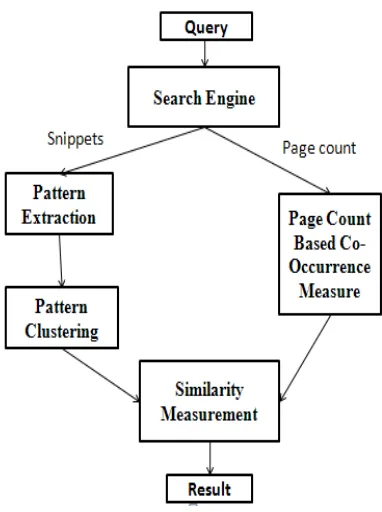
Following fig. 2 shows the outline of the
proposed method. Here firstly one has to
use the search engine for searching a
given query and the query includes the
two words of which we have to calculate
the semantic similarity. Because of the
vastly numerous documents and the high
growth rate of the web, it is time
consuming to analyze each document
separately. Web search engines provide
an efficient interface to this vast
information. Page counts and snippets are
two useful information sources provided
by most web search engines. Then on the
basis of this search result of the query
following steps has to take which are
shown in figure 2.
• Page count-Based Co-Occurrence
measures
• Lexical pattern extraction
• Lexical pattern clustering
Available Online At www.ijpret.com
Figure 2. Outline of proposed method
Explanations of all above steps are as
follows.
[1] Page count-Based Co-Occurrence
measures
In this step we have calculated the page
count for given query and for each word
in the given query separately also. Page
count of a query is an estimate of the
number of pages that contain the query
words. In general, page count may not
necessarily be equal to the word
frequency because the queried word
might appear many times on one page.
Page count for the query “P Q” can be
considered as a global measure of
co-occurrence of words P and Q. For
example, the page count of the query
“apple computer” in Google is
300,000,000, whereas the same for
“banana computer” is only 4,500,000. The
more than 70 times more numerous page
counts for “apple computer” indicate that
apple is more semantically similar to
computer than is banana. Here we have
used page count of query words because
on the basis of this one can easily
conclude about the similarity between
words. But in some cases it is failed.
Consider the query “P Q” for the search
engine. Page counts for the query “P Q”
can be considered as an approximation of
co-occurrence of two words P and Q on
the web. However, page counts for the
query P Q alone do not accurately express
semantic similarity. For example, Google
returns 299,000,000 as the page count for
“car automobile,” whereas the same is
700,000,000 for “car apple.” Although,
automobile is more semantically similar to
car than apple, page counts for the query
“car apple” are more than four times
greater than those for the query “car
automobile.” One must consider the page
counts not just for the query “P Q”, but
also for the individual words P and Q to
assess semantic similarity between P and
Available Online At www.ijpret.com
as a measure of co-occurrence of two
words presents several drawbacks. First
drawback is page count analysis ignores
the position of a word in a page.
Therefore, even though two words appear
in a page, they might not be actually
related. Second, page count of a
polysemous word (a word with multiple
senses) might contain a combination of all
its senses. For example, page counts for
apple contain page counts for apple as a
fruit and apple as a company. Moreover,
given the scale and noise on the web,
some words might co-occur on some
pages without being actually related. For
those reasons, page counts alone are
unreliable when measuring semantic
similarity. Therefore we have compute the
four popular co-occurrence measures [8]
such as Web Jaccard, Web Overlap
(Simpson), Web Dice, and Web Point wise
Mutual Information i.e. Web PMI to
integrate it with snippets based result for
measuring semantic similarity in our
approach.
[2] Lexical pattern extraction
In this step we have retrieved the snippets
from web search results. Snippets is a
brief window of text extracted by a search
engine around the query term in a
document, provide useful information
regarding the local context of the query
term. Snippets returned by a search
engine for the query of two words provide
useful clues related to the semantic
relations that exist between two words.
Snippets are useful for search because,
most of the time, a user can read the
snippet and decide whether a particular
search result is relevant, without even
opening the url. Using snippets as
contexts is also computationally efficient
because it also avoids the need to
download the source documents from the
web, which can be time consuming if a
document is large. For example, consider
the snippet in Figure 3. Here, the phrase
‘is a’ indicates a semantic relationship
between lion and cat. Many such phrases
indicate semantic relationships. For
example, also known as, is a, part of, is an
example of all indicate semantic relations
of different types. In the example given
below, words indicating the semantic
relation between cricket and sport appear
between the query words. Replacing the
query words by special symbol “!” and
“#”, one can form the pattern from
following example “!, is a large heavy-built
Available Online At www.ijpret.com
...lion, is a large heavy-built social cat of
open rocky areas in Africa ...
Figure 3. snippet retrieved for the query
“lion” AND “cat.”
Here we have used this step for extracting
the snippets from the web result. Then on
these collected snippet, Prefixspan
algorithm is used to sub-sequencing the
snippet into number of patterns. Here we
have collected the patterns from snippets
because snippets may contain
unnecessary materials which are not
needed for describing relation between
queried words. These patterns are used
for the clustering purpose in next step.
[3] Lexical pattern clustering
After extracting the pattern from the
snippet, next step is to cluster the
extracted pattern. So to clustering the
extracted pattern in proposed method
Sequential pattern clustering algorithm [9]
is used because it is performed well for
more results. Moreover, sorting the
patterns by their total word-pair
frequency prior to clustering ensures that
the final set of clusters contains the most
common relations in the data set. This
pattern clustering is done on the basis of
frequency of patterns because on the
basis of this cluster we have computes the
feature vector to integrate it with the
page count based co-occurrence measure.
[4] Measuring semantic similarity
After completing all above steps, on the
basis of co-occurrence measures using
page counts and result of feature vector
the semantic similarity between queried
words are calculated. We have taken
feature vector of clusters of lexical
patterns from snippets to represent
numerous semantic relations that exist
between two words. In this section we
have integrate both page counts-based
co-occurrence measures, and
snippets-based lexical pattern clusters to construct
a robust semantic similarity measure.
EXPERIMENTAL RESULT
The experimental results include semantic
similarities between given two words by
using page counts and text snippets
retrieved from search engines for given
words. For example we have taken here
“Apple Computer” as a query to search
engine means we have to calculate the
semantic similarity between words Apple
and Computer here. By using our method
following are the steps for measuring
Available Online At www.ijpret.com
and Computer. Before applying the each
step firstly we have to give the query
“Apple Computer” to Google search
engine.
1. In this step Page count for the query is
taken from the web search engine which
is as follows in Table I.
Table I. Page Count for Query words
Query Words Page count
Apple 1,750,000,000
Computer 2,820,000,000
Apple Computer 425,000,000
On the basis of this page count we have
calculate the Co-Occurrence Measure
which are as shown in following Table II.
2. In this step patterns are extracted using
the PrefixSpan algorithm from the
snippets. Here we have used the 500
snippets and from those snippets we have
got the 260 patterns. This all patterns are
in between the words “Apple” and
“Computer”.
Table II. Co-occurrence Measure
Co-occurrence
Measure Name
Co-occurrence
Measure
WebJaccard 0.102533172
WebOverlap 0.242857142
WebDice 0.185995623
WebPMI 23.03790942
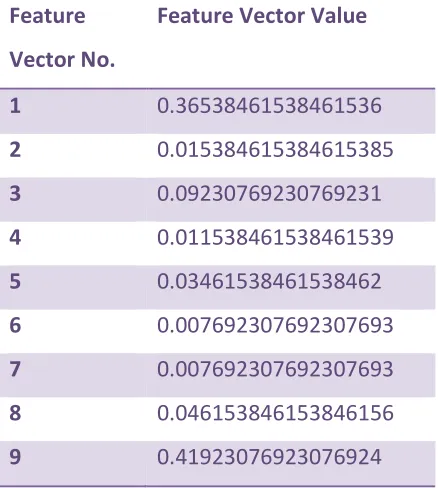
3. Then after extracting the patterns we
have clustered it in this step into nine
clusters using the Sequential Pattern
Clustering Algorithm which are based on
relation like is, has, will, being etc. After
making the cluster we have calculated the
occurrence of each relation in that cluster
and then on the basis of this we have
calculated the feature vector from that
clusters such as follows follows in Table III.
Table III. Feature Vector
Feature
Vector No.
Feature Vector Value
1 0.36538461538461536
2 0.015384615384615385
3 0.09230769230769231
4 0.011538461538461539
5 0.03461538461538462
6 0.007692307692307693
7 0.007692307692307693
8 0.046153846153846156
9 0.41923076923076924
4. Then from the step 1 and step 3 we
integrate the result of both the steps.
From step 1 we have normalised the value
greater than 1 into 0 to 1 and then taking
the average of all co-occurrence measure
which is 0.19044 and from step 3 we have
ignored the feature vector no. 1, 2 and 9
Available Online At www.ijpret.com
relation therefore remaining are added
and got the result as 0.20000001 and the
we have added both result as from step 1
as 0.19044 and from step3 as 0.20000001
and got the result as 0.39044 as a final
result i.e. semantic similarity between
“Apple” and “Computer”. So Semantic
Similarity between “Apple” and
“Computer” by our method is 0.39044.
SYNONYM EXTRACTION
Synonym extraction is finding the correct
meaning to the query word. Here query
include only single word. This is also one
of the applications of semantic similarity
measurement between two words. Here
we just have to use the above methods of
semantic similarity measurement for each
time. Here, we have to measure semantic
similarity between query word and each
word from the given set of words. Then
and Then one can say which one is the
correct synonym for the query word. For
example we have a question in multiple
choice question paper like to find the
synonym for the following words “APPLE”
and options are FRUIT, COMPANY, TREE
and ORGANIZATION. So from this one get
confused which one is the correct
answer? Because many options are nearly
related to APPLE but one is correct but
which one? So if we used our approach in
this system for finding the correct answer,
it will measure the semantic similarity
between APPLE-FRUIT, APPLE-COMPANY,
APPLE-TREE, and APPLE-ORGANIZATION.
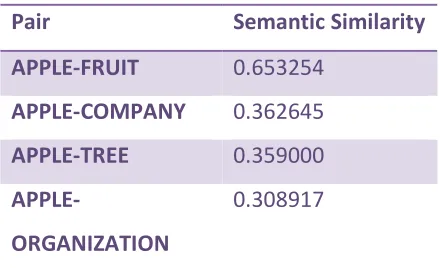
Then from this those pair having the more
semantic similarity it will be the correct
synonym. Here we got the answer like
Table IV. Pair and its Semantic Similarity
Pair Semantic Similarity
APPLE-FRUIT 0.653254
APPLE-COMPANY 0.362645
APPLE-TREE 0.359000
APPLE-ORGANIZATION
0.308917
This result is calculated using the set of
500 snippets from the web search engine
results.
So from this Table IV, pair APPLE-FRUIT
having the semantic similarity highest so
the correct synonym for the word APPLE
is FRUIT. If we use here ontology
(WordNet) based approach then there is
not all meaning of apple available so we
cannot find the semantic similarity
between above each pair and hence we
will fail to find the correct synonym.
Available Online At www.ijpret.com
This paper presented the new approach
for semantic similarity measurement
between words and its application in
synonym extraction. We argue that
information source for defining a
similarity measure like WordNet are used
in many approaches but there is limitation
of new words. Hence our approach is web
based so one can measure the semantic
similarity between any given two words.
Another thing is that we have presented
here the application of the semantic
similarity measurement in the field of
synonym extaction along with example.
So our approach of measuring semantic
similarity between words using the web
search engine is very useful for finding the
correct synonym of query word.
In future we are trying to extend our work
to find the correct synonym for the query
having the multiple words.
REFERENCES
1. R. Rada, H. Mili, E. Bichnell, and M.
Blettner, “Development and Application
of a Metric on Semantic Nets,” IEEE Trans.
Systems, Man, and Cybernetics, vol. 9, no.
1, pp. 17-30, Jan. 1989.
2. P. Resnik, “Using Information Content
to Evaluate Semantic Similarity in a
Taxonomy”, Proc. 14th Int’l Joint Conf.
Artificial Intelligence, 1995.
3. J. Jiang and D. Conrath, “Semantic
Similarity Based on Corpus Statistics and
Lexical Taxonomy”, Proc. Int’l Conf.
Research in Computational Linguistics
(ROCLING X), 1997.
4. D. Mclean, Y. Li, and Z.A. Bandar, “An
Approach for Measuring Semantic
Similarity between Words Using Multiple
Information Sources”, IEEE Trans.
Knowledge and Data Eng., vol. 15, no. 4,
pp. 871-882, July/Aug. 2003.
5. M. Sahami and T. Heilman, “A
Web-Based Kernel Function for Measuring the
Similarity of Short Text Snippets”, Proc.
15thInt’l World Wide Web Conf., 2006.
6. R. Cilibrasi and P. Vitanyi, “The Google
Similarity Distance”, IEEE Trans.
Knowledge and Data Eng., vol. 19, no. 3,
pp. 370-383, Mar.2007.
7. D. Bollegala, Y. Matsuo, and M.
Ishizuka, “Disambiguating Personal Names
on the Web Using Automatically Extracted
Key Phrases”, Proc. 17th European Conf.
Available Online At www.ijpret.com
8. D. Bollegala, Y. Matsuo, and M.
Ishizuka, “Measuring Semantic Similarity
between Words Using Web Search
Engines”, Proc. Int’l Conf. World Wide
Web (WWW ’07), pp. 757-766, 2007.
9. D. Bollegala, Y. Matsuo, and M.
Ishizuka, “A Web Search Engine-Based
Approach to Measure Semantic Similarity
between Words”, IEEE Trans. Knowledge
and Data Eng., vol. 23, no. 7, pp. 977-990,
July 2011.
10.G. A. Miller, “WordNet: A Lexical
Database for English”, Comm. ACM, vol.
38, no. 11, pp. 39-41, 1995.
11.D. Lin, “An Information-Theoretic
Definition of Similarity”, Proc.Int’l Conf.
Machine Learning, July 1998.Budanitsky
and G. Hirst, “Semantic Distance in
WordNet: An Experimental,
Application-Oriented Evaluation of Five Measures,”
Proc. Workshop WordNet and Other
Lexical Resources, Second Meeting North
Am. Chapter Assoc. for computational