A STUDY TO ASSESS THE EFFECTIVENESS OF STRUCTURED
TEACHING PROGRAMME ON KNOWLEDGE REGARDING
BREATHING TECHNIQUE AMONG PEOPLE
RESIDING NEAR FACT, AT AMBALAMEDU
1Prof. Dr. Sindhu Devi M., 2Mrs. Limy Mathew,
1Professor and Principal, 2Asst. Professor,
1Obstetrical and Gynaecological Nursing , 2Medical Sursing Nursing ,
Sree Sudheendra College of Nursing, Ambalamedu /Cochin, India Email - 1[email protected] 2[email protected]
1. INTRODUCTION:
Breathing is a normal physiological process which maintains the vital function of the body .Breathing is a complex behavior requiring the co-ordinated activity of several muscle groups, both in the upper airway and in the chest wall. The primary function of the respiratory system is the exchange of gases between atmosphere and blood. At the end of the last century Austrian physiologists Breyer and Gering made a sensational discovery - Man is the only biological specimen on earth who had not developed a correct way of breathing. All other beings know how to breath but not humans. Just observe those around you carefully and you will find that people breathe differently. Some breath deeply others superficially ,some faster, others slower ,with pauses and some without.
The function of our respiratory system is not just to push air in and out but to maintain a very specific ratio of oxygen and carbon dioxide . When we over breath and hyperventilate, we loss valuable carbon dioxide . Hyper ventilation causes a depletion of carbon dioxide .Low levels of carbon dioxide in the organism cause blood vessels to spasm and also cause oxygen starvation of the tissues. The air that we breath contains 200 times less carbon dioxide that we need and 10 times more oxygen than we need.
At the end of the last century Russian Physiologist Verigo and Dutch scientist Bohr independently discovered that without carbon dioxide , oxygen is bound to the hemoglobin of the blood and simply does not work .This consequently leads to oxygen deficiency in the tissues of the brain ,heart ,kidneys and other organs and a raising of the blood pressure and many respiratory diseases and complications occurs due to the oxygen deficiency in the human body.Many measures have been employed to prevent complications, such as administering broad spectrum antibiotics, adequate pain management by opioid .Among these the simplest and easiest method to prevent pulmonary complication is the deep breathing and coughing exercises , Russian Medical Scientist Professor KONSTANTIN PAVLOVICH BUTEYKO has devoted over 40 years of research in to breathing and in the process discovered that only one in ten people breath correct . Natural and normal breathing results in very specific accumulated gas mixture that our organisms requires to function properly. Traditional wisdom tells as that deep breathing is the best as it is thought to provide the most oxygen
2. NEED OF THE STUDY :
The respiratory diseases are common in all age groups. The contributing factors are hereditary, cigarette smoking, change in temperature, allergens, food, medications, pollens, fumes, dust, air pollution, viral infection, stress, laughing, crying, exercise, and strong odours. Among these people who are living in a polluted area have a more chance
Abstract: STP on knowledge regarding the Breathing Technique among the people residing near the FACT, Ambalamedu area of Ernakulam District. The objectives were to assess the existing level of knowledge of the people residing near the FACT , Ambalamedu regarding the Breathing Technique before the structured teaching programme and to evaluate the effectiveness of structured teaching programme in terms of gain in knowledge . The pre experimental design of one group pre test post test design was used for our study. The sample size was 36 people who were residing near the FACT chosen by means of convenient sampling technique .The data for the study was collected by structured questionnaire following which samples were subjected to STP on breathing technique for duration of one hour. Post test was done on 7th day following intervention. The same tool was used to conduct the post test .The data was analyzed by descriptive and inferential statistics. . The paired t test provide" T" value of 11.955 with a p<001 which was very highly significant which shows that the teaching programme was effective.
for respiratory diseases. We are all aware of danger of pollution and declining quality of air. Many respiratory diseases such as asthma, emphysema are caused by environmental pollution. The problem faced by the evolving human organism has been the depletion of carbon dioxide in our atmosphere from the tens of 0.03%. Human evolution has dealt with this dilemma, by creating an autonomous internal air environment within alveolar spaces of the lungs. These alveoli ideally contain around 6.5% of carbon dioxide quite a contrast to the surrounding air.
From this studies we think that breathing technique will be essential for the people who are residing near the FACT, because of they have more chance for getting pulmonary diseases than other area due to the expulsion of highly polluted gases from FACT.
According to the founding principles of the breathing techniques some 200 diseases are linked to dysfunctional breathing, asthma, allergies and emphysema are just a few examples. More than 40 years of research have produced the
Buteyko method, which can recondition and normalize the breathing and restore the body’s most important function.
We can see many respiratory diseases in the people who are residing near the FACT .So Buteyko Breathing Technique is effective and acceptable method for them
Many measures have been employed to prevent respiratory diseases and its complications such as administering broad spectrum antibiotics, and adequate pain management by opoids. Among these the newly invented simplest and easiest method is Buteyko Breathing Technique
From this studies we think that breathing technique will be essential for the people who are residing near the FACT, because of they have more chance for getting pulmonary diseases than other area due to the expulsion of highly polluted gases from FACT.
According to the founding principles of the breathing techniques some 200 diseases are linked to dysfunctional breathing, asthma, allergies and emphysema are just a few examples. More than 40 years of research have produced the
Buteyko method, which can recondition and normalize the breathing and restore the body’s most important function.
We can see many respiratory diseases in the people who are residing near the FACT .So Buteyko Breathing Technique is effective and acceptable method for them
Buteyko Breathing method can reverse the symptom such as asthma attacks blocked nose, dizziness, chest pain, palpitation and coughing. When we breathe very deeply for 5-10 minutes because reducing the depth of our breathing by shallowly can reverse the symptoms within a few minutes.
We conducted an interview with medical officer in FACT and understood that the people who are residing near the FACT, have more chance for getting respiratory diseases. As said above Buteyko breathing technique can be effective for those people with severe respiratory difficulties. As such we selected this teaching programme on breathing technique for the people residing near FACT.
3. OBJECTIVES :
To assess the existing level of knowledge of the people residing near the FACT regarding the Breathing Technique before the structured teaching programme measured by structured questionnaire.
To develop a structured teaching programme.
To evaluate the effectiveness of structured teaching programme in terms of gain in knowledge
To associate pre-test knowledge with certain demographic variables such as educational level and income.
4. RESEARCH APPROACH :
Research approach, is the method used to find out the effectiveness of structured teaching programme on knowledge regarding the Breathing Technique among people residing near FACT Ambalamedu. In this study quantitative research approach is used.
5. RESEARCH DESIGN :
One group pre test pre-experimental research design was adopted for this study. In this study structured teaching programme was given to the samples after pre test. Seven days after the structured teaching programme post test was done to assess the knowledge regarding breathing technique .In this study a comparison between the pre test and post test score was done to find out the effectiveness of structured teaching programme.
5.1 STUDY SETTING
The people residing near FACT, Ambalamedu were selected for the study
5.2 POPULATION
5.3 SAMPLE
A sample is a small portion of population selected for observation and analysis. In this study, sample consist of people residing FACT
5.4 SAMPLING TECHNIQUE
Sampling is the process of selecting a portion of the population to represent the entire population. In this study convenient sampling technique was used to select the sample.
5.5 SAMPLE SIZE
A sample is a subset of the population, that is selected for a particular study and the members of a sample are the subjects. The study sample consists of 36 people residing near the FACT, Ambalamedu.
5.6 DATA COLLECTION PROCEDURE:
Structured questionnaire methods consisting of two parts
Section A. Demographic variable
Items on demographic variable include ,name, age.sex, education, income, occupation, data of previous class attended.
Section B. Structured questionnaire
Structured questionnaire on the knowledgeof people residing near FACT, Ambalamedu regarding breathing techniques and its performance
6. FINDINGS:
The data was presented in the form of table and figures.
SECTION-1 AGE
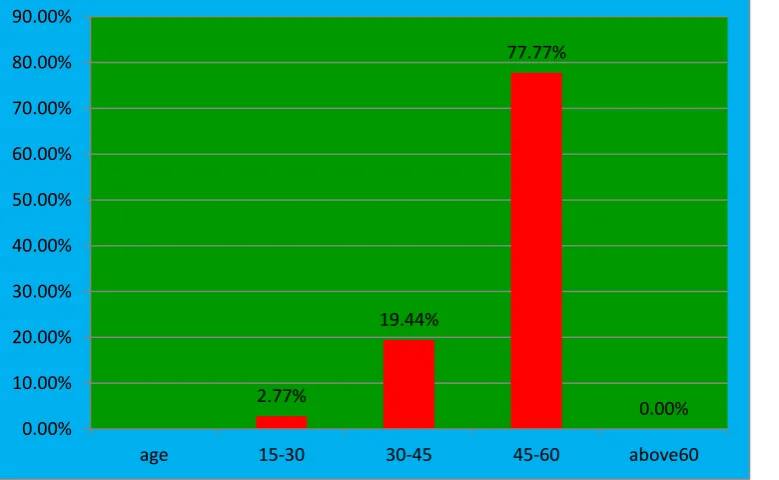
Table 1: Distribution of age among people residing near the FACT
SL NO: AGE IN YEARS FREQUENCY %
1 15-30 1 2.77%
2 30-45 7 19.44%
3 45-60 28 77.77%
4 Above 60 0 0
The table shows % of sample, 3% within the age group of 15-30.19% were between 30-45 , 78% were between 45-60 and nobody was there above 45-60years.
Figure: 1. Distribution of people in terms of age
2.77%
19.44%
77.77%
0.00% 0.00%
10.00% 20.00% 30.00% 40.00% 50.00% 60.00% 70.00% 80.00% 90.00%
EDUCATION
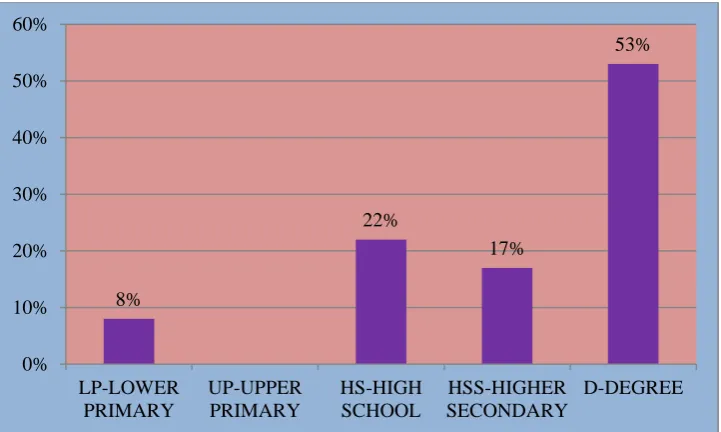
Table:3 Distribution of education of people residing near the FACT
SL NO: EDUCATION FREQUENCY %
1 Lower primary 3 8%
2 Upper primary - -
3 High school 8 22%
4 Higher secondary 6 17%
5 Degree 19 53%
The highest frequencies of the sample (53%) were graduates, (22%) were having the high school education, (17%) having higher secondary education and (5%) with lower primary education.
Figure 3: Distribution of people in terms of their education OCCUPATION
Table 4: Distribution of occupation among people residing near the FACT
SL NO: OCCUPATION FREQUENCY %
1 Yes 14 39%
2 No 22 61%
The highest frequencies of the sample (61%) have no occupation and (39%) have occupation
Figure 4: Distribution of people in terms of their occupation
8%
22%
17%
53%
0% 10% 20% 30% 40% 50% 60%
LP-LOWER PRIMARY
UP-UPPER PRIMARY
HS-HIGH SCHOOL
HSS-HIGHER SECONDARY
D-DEGREE
39%
61%
0% 10% 20% 30% 40% 50% 60% 70%
%
YES
INCOME
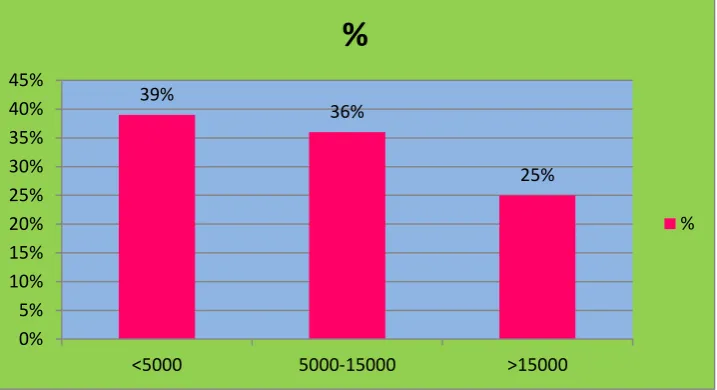
Table 5: Distribution of income among people residing near the FACT
SL NO: INCOME FREQUENCY %
1 <5000 14 39%
2 5000-15000 13 36%
3 >15000 9 25%
The highest frequency of sample (39%) having income <5000, (36%) having 5000-15000 and 25% were having income above 15000.
Figure 5: Distribution of people in terms of their income
NUMBER OF FAMILY MEMBERS WHO HAVE RESPIRATORY DISEASES
Table 6:Distribution family members who have respiratory diseases
SL NO: NO: OF FAMILY
MEMBERS WHO HAVE Resp.Diseases
FREQUENCY %
1 None 27 75%
2 1-3 Members 8 22%
3 Above-3 1 3%
The highest frequency of sample 75% have no respiratory diseases,22% were in 1-3 members in the family having respiratory diseases and 3% were in more than 3 members having respiratory diseases.
Figure 6: Distribution of people in terms of number of family members who have respiratory diseases
39%
36%
25%
0% 5% 10% 15% 20% 25% 30% 35% 40% 45%
<5000 5000-15000 >15000
%
%
75%
22%
3% 0%
10% 20% 30% 40% 50% 60% 70% 80%
None 1-3 members Above-3
%
SECTION-2
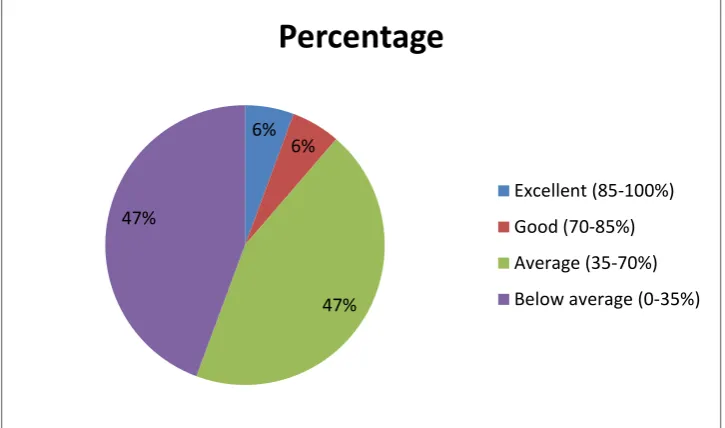
Table 7-Distribution of pre test level of knowledge regarding breathing technique among people residing near FACT
LEVEL OF KNOWLEDGE NUMBER OF RESPONDENTS
FREQUENCY PERCENTAGE
Excellent (85-100%) 2 6%
Good (70-85%) 2 6%
Average (35-70%) 17 47%
Below average (0-35%) 15 47%
The above table shows that the frequency and percentage distribution of people residing near FACT according to the pre test level of knowledge regarding the breathing technique. The level of knowledge was seen into 4categories, Excellent, Good, Average, Below Average. Among people almost 6% have excellent knowledge,6% have good knowledge ,47% have Below average knowledge.
Mean, SD, Mean percentage, Range of pre test knowledge regarding breathing technique among people residing near FACT.
DOMAIN MAXIMUM
SCORE
RANGE MEAN STANDARD
DEVIATION
MEAN%
KNOWLEDGE 22 1-19 9.19 4.744 4.77%
The statistical outcome such as mean, median.SD, mean% of pre test knowledge regarding breathing technique among people residing near FACT were shown in the table. Out of maximum score of 22, the people attained mean knowledge of 9.19 with SD of 4.744.The mean % attained was 41.77%
SECTION-3
Table 8: Distribution of post test level of knowledge regarding breathing technique among people residing
near FACT, using descriptive statistics
LEVELOF KNOWLEDGE NO: OF RESPONDENTS
NUMBER %
Excellent(85-100%) 21 58%
Good (70-85%) 12 33%
Average (35-70%) 2 6%
Below average (0-35%) 1 3%
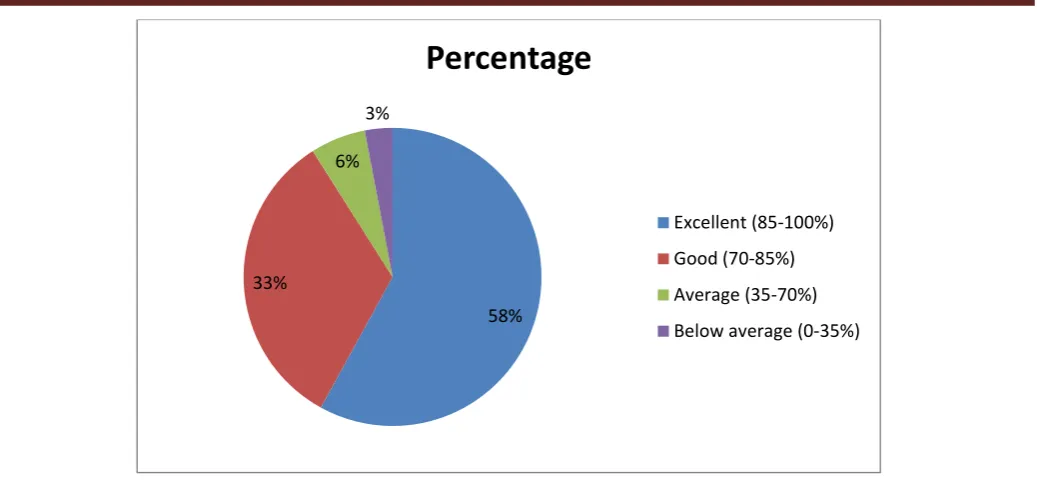
The above table shows the frequency and % distribution according to the post test level of knowledge regarding breathing technique among people residing near FACT. Among these 58% had excellent knowledge, 33% had good knowledge,6% had average knowledge,3% had bad knowledge.
6% 6%
47% 47%
Percentage
Excellent (85-100%)
Good (70-85%)
Average (35-70%)
Figure 8: Percentage distribution of post test knowledge among people residing near FACT
Table 11: Mean, SD, Mean% of post test knowledge regarding the breathing technique among people residing near FACT.
DOMAIN MAXIMUM
SCORE
RANGE MEAN STANDARD
DEVIATION
MEAN%
KNOWLEDGE 22 16-22 18.67 1.724 84.8%
The statistical outcomes such as mean, SD, mean% of post test knowledge regarding breathing technique among people residing near FACT were shown in the table. Out of maximum score of 22 the people had attained mean knowledge of 18.67 with SD 1.724.The mean% attained is 84.8%.
SECTION 4
Effectiveness of STP on knowledge regarding breathing technique
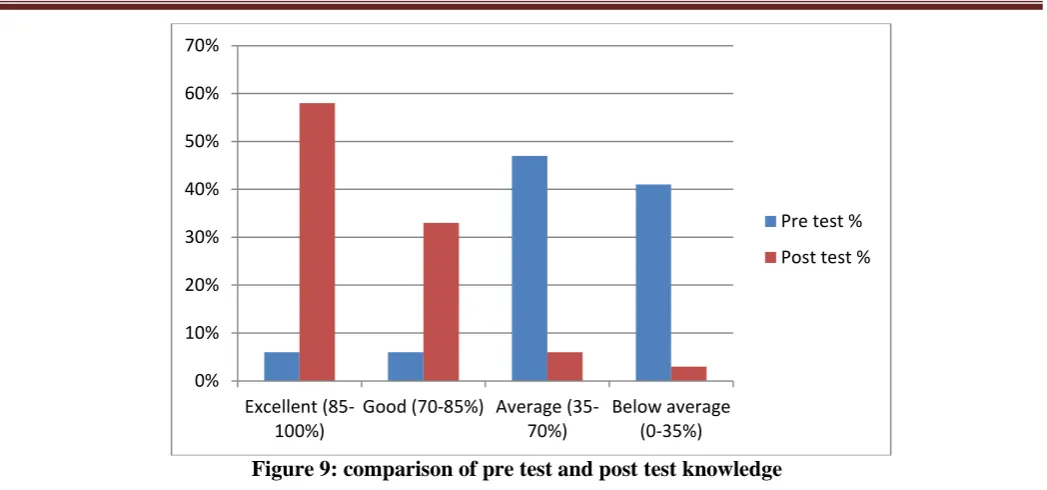
Table 12: Pre test and post test level of knowledge among people residing near FACT
LEVEL OF KNOWLEDGE
PRE TEST POST TEST
NO: % NO: %
Excellent(85-100%) 2 6 21 58
Good (70-85%) 2 6 12 33
Average(35-70%) 17 47 2 6
Below average (0-35%)
15 41 1 3
Table 13: Comparison of mean and SD of pre test and post test level of knowledge regarding breathing technique among people residing near FACT.
DOMAIN MEAN SD PAIRED ‘T’ TEST
Pre test 9.19 4.744 11.955
Post test 18.67 1.724
Enhancement 9.472 4.757
The people knowledge on breathing technique was studied on questionnaire method with 22 items. The
knowledge was evaluated by the questionnaire method of 22 questions with a total score of ‘0’ or ‘22’.This was also
test after the STP with the same way of scoring. Before the STP knowledge was evaluated by taking the total score and the mean score observed 9.19 with a SD of 4.744 and after the training the similar procedure was adopted and the total score observed 18.67 with a SD of 1.724 which gave an improvement of 9.472(mean difference and this was tested by
using paired‘t’ test).The paired‘t’ test provide‘t’ value of 11.955 with a P<001 which is very highly significant. That
means the knowledge was improving
58% 33%
6% 3%
Percentage
Excellent (85-100%)
Good (70-85%)
Average (35-70%)
Figure 9: comparison of pre test and post test knowledge
SECTION 5
Find out the association between level of pretest knowledge and selected demographic variables Table 14 : shows association between knowledge and demographic variables
Sl no Demographic variables
No % Level 0f
Knowledge
Chi square Excellent Good
No % No %
1 Education 1.000
a Primary 11 30.6 7 31.8 4 28.3
b Secondary 25 69.4 15 68.2 10 71.4
2 Income .738
a <5000 14 38.9 8 36.4 6 42.9
b >5000 22 22.0 14 13.4 8 8.6
The above table shows the association between knowledge and selected demographic variables of people such as education, income.
TESTING THE HYPOTHESIS
Research Hypothesis 2. :
* There is a significant association between pre test knowledge and selected demographic variables
* The results of chi square analysis shows that there is no significant association between the pre test knowledge of people residing near the FACT and the selected demographic variables
FINDINGS OF THE STUDY
There was a significant improvement following structured teaching programme on Breathing Technique among
peoples living near the FACT. Paired ‘t’test value was significant. There is no association between knowledge and
selected demographic variables of peoples identified according to age, sex, religion, education, occupation, income and no: of family members who have respiratory diseases..
Major Findings of the study.
Sample characteristics.
According to age: The people residing near the FACT (78%) were between the ages of 45-60,19% were between ages of 30-45 and between 15-30 only 3%.
According to sex:67% were females and rest of 33% were males. Of the people (78%) were Hindu,19% were Christian and only 3% were Muslims.
According to Education: Majority (53%) were graduates,22% were high school education completed persons,70% Higher secondary and 8% were Lower Primary completed persons
According to Occupation: Majority(61%) have no occupation and rest of 39% are employees.
Regarding monthly income: 39% were <5000, 36% were having within 5000-15000 and 25% having the income of 15000 above.
0% 10% 20% 30% 40% 50% 60% 70%
Excellent (85-100%)
Good (70-85%) Average (35-70%)
Below average (0-35%)
Pre test %
Regarding no. of family members who have respiratory disease: Majority (75%) have no respiratory diseases,22% having 1-3 members with respiratory diseases and 3% were in above 3 members having respiratory diseases
Pre test Level of knowledge of people regarding breathing technique
The table shows frequency and % distribution according to the pre test level of knowledge regarding breathing techniques among people residing near the FACT. Among these people almost 6% have excellent knowledge ,47% have average and 41% have bad knowledge.
Post test Level of knowledge of people regarding breathing techniques
The table shows frequency and % distribution according to the post test level of knowledge regarding breathing techniques among people residing near the FACT. Among these people most of them(58%)had excellent knowledge,33% had good knowledge,6% had average knowledge and 3% had poor knowledge.
Effectiveness of STP on knowledge regarding breathing technique
Before the STP knowledge was evaluated by taking the total score and the mean score observed 9.19 with a standard deviation of 4.744 and after STP the similar procedure was adopted, and total score observed 18.67 with a standard deviation of 1.724 which give an improvement of 9.472(mean difference) and this was tested by using t test. The paired t test provide" T" value of 11.955 with a p<0.001 which is very highly significant that means the knowledge was increasing.
The association between level of pre test knowledge and selected demographic variables
The table describes the association between knowledge and selected demographic variables such as education, income..
The results of chi square (Fisher’s Exact Test) analysis indicates that p>0.001 so there was no significant
association between knowledge and selected demographic variables such as education, income.
7. CONCLUSION:
This chapter enlightens importance of this research, reveals that there was significant lack in knowledge regarding Breathing technique among people residing near FACT and structured teaching programme had a significant role in improving the knowledge. The study also reveals that there was a significant association between knowledge with age, gender, occupation, education and no: of family members who have respiratory diseases
8. RECOMMENDATION:
The study can be repeated by taking a large sampling in another area.
A similar study can be conducted among FACT workers.
A comparitive study on the knowledge of urban and rural peoples regarding breathing technique can be conducted.
A similar study can be replicated on a large sample with a control group using a large population of the community.
REFERENCES:
1. Bowler SD, Green A, Mitchell CA. Buteyko breathing techniques in asthma: a blinded randomised controlled trial. Med J Aust. 1998 Dec 7 page no: 575–79
2. Cowie RL, Conley DP, Underwood MF, et al. A randomized controlled trial of the Buteyko technique as an adjunct to conventional management of asthma. 2008 May;5 : 726–32.
3. Cooper S, Oborne J, Newton S, et al. Effect of two breathing exercises (Buteyko and pranayama) in asthma: a randomised controlled trial. Thorax. 2003 Aug; 8 : 674–79.
4. Thomas M, McKinley RK, Mellor S, et al. breathing exercises for asthma: a randomized controlled trial. Thorax. 2009 Jan;1:55–61.
5. Opat A, Cohen M, Bailey M, et al. The Buteyko breathing techniques in asthma: a clinical trial. Proceedings of the Thoracic Society of Australia & New Zealand, Annual Scientific Meeting; Canberra. 1999: 36.
6. White AR. Positive evidence of the effectiveness of Buteyko breathing techniques in asthma. Focus Alt Comp Ther.1999 Dec; 4:207–08.
7. James T. Doctors gasp at Buteyko success. In step Asthma Free. [Accessed September 7, 2011]. www.nqnet.com/buteyko/Asthma_relief_pressd.html.
9. McHugh P, Aitcheson F, Duncan B, et al. Buteyko Breathing Technique for asthma: an effective intervention. 2003 Dec; 116-710.
10. Abramson M, Borg B, Doran C, et al. A randomised controlled trial of the Buteyko method for asthma. In 2004:6:24.
11. McHugh P, Aitcheson F, Duncan B, Houghton F. Buteyko breathing technique for asthma: an effective intervention. The New Zealand Medical Journal 2003; 116-1187:
12. Slader C, Redde H, Spencer L, Belousova E, Armour C, Bosnic-Anticevich S, Thien F, Jenkins C. Double blind randomized controlled trial of two different breathing techniques in the management of asthma
13. Cowie R, Conley D, Underwood M, Reader P, A randomised controlled trial of the Buteyko technique as an adjunct to conventional management of asthma. Respiratory Medicine 2008; 102:726-32
14. Invine J, Brooks A, Walled R. The role of air pollution, smoking and respiratory illness in childhood in the development of chronic bronchitis. Chest 1980, 77: 251-253.
15. Courtney R, Cohen M. Investigating the claims of Konstantin Buteyko: the relationship of breath holding time to end-tidal CO2 and other proposed measures of dysfunctional breathing. Journal of Alternative and Complementary Medicine 2008; 115-123
16. Centers for Disease Control and Prevention. Current Asthma Prevalence Percents by Age, United States: National Health Interview Survey, 2007. 2008.
17. Vollmer WM, Markson LE, O’Connor E, et al. Association of asthma control with health care utilization: a
prospective evaluation. Am J Respir Crit Care Med. 2002 Jan 15;165 (2):195–99
18. Vollmer WM, Markson LE, O’Connor E, et al. Association of asthma control with health care utilization and
quality of life. Am J Respir Crit Care Med. 1999 Nov; 160(5 Pt 1):1647–52.
19. Williams LK, Pladevall M, Xi H, et al. Relationship between adherence to inhaled corticosteroids and poor outcomes among adults with asthma. JAllergy Clin Immunol. 2004 Dec; 114(6):1288–93.
20. Apter AJ, Reisine ST, Affleck G, et al. Adherence with twice-daily dosing of inhaled steroids. Socioeconomic and health-belief differences. Am J Respir Crit Care Med. 1998 Jun; 157(6 Pt 1):1810–17.
21. Partridge MR, Dockrell M, Smith NM. The use of complementary medicines by those with asthma. Respir Med. 2003 Apr; 97(4):436–38.
22. Osborne CA, O’Connor BJ, Lewis A, et al. Hyperventilation and asymptomatic chronic asthma. Thorax. 2000
Dec; 55(12):1016–22
23. van den Elshout FJ, van Herwaarden CL, Folgering HT. Effects of hypercapnia and hypocapnia on respiratory resistance in normal and asthmatic subjects. Thorax. 1991 Jan; 46(1):28–32.
24. Jones PW. Interpreting thresholds for a clinically significant change in health status in asthma and COPD. Eur Respir J.2002 Mar; 19(3):398–404.
25. Juniper EF, Guyatt GH, Cox FM, et al. Development and validation of the Mini Asthma Quality of Life Questionnaire. Eur Respir J. 1999 Jul;14(1):32–38.