Effectiveness of a structured teaching programme on the knowledge and
attitude of adolescents regarding junk food in selected high schools of
Ernakulam district
THRESIAMMA ANTONY
SENIOR LECTURER
DEPARTMENT OF CHILD HEALTH NURSING SREE SUDHEENDRA COLLEGE OF NURSING
AMBLAMEDU, ERNAKULAM, KERALA Email – [email protected]
1. INTRODUCTION:
Adolescence is the age between ten to nineteen years (WHO). The word meaning of adolescence is ‘to grow, to
mature’. Adolescent group are extremely important producers who will form the main workforce of India tomorrow.
Today in India’s population structure, there is significant percentage of young people of whom adolescents in the age group of 10-19 years represent 22.5% (nearly 225 millions). Adolescence is a period of rapid growth and personal development. The growth and development of adolescents depends to a large extent on their nutrition. The complex myriads of physiological as well as psychological change accompanied by rapid growth and increase in physical activity
create special nutritional needs that are higher during adolescence than at any other time in life. Junk food is food that can be prepared easily and is easy to consume. The most well known junk food facts are
that they do not have any nutritional value and are very high in fats which make them even more harmful for the body. In recent years, public health officials and school administrators have come to realize that schools are frequently working against the cause of sound nutrition in children and adolescents. In many districts schools have negotiated exclusive contracts with fast food and beverage companies to provide their products to students, with a portion of the revenues
Abstract: A quasi experimental study was conducted to assess the effectiveness of a structured teaching programme on the knowledge and attitude of adolescents regarding junk food in selected high schools at Ernakulam district. The Objectives of the study were to: - 1) Assess the pre and post test knowledge and attitude of adolescents regarding Junk foods in experimental and control group using a structured knowledge questionnaire and attitude scale. 2) Compare the pre test and post test knowledge and attitude scores of adolescents regarding junk foods in experimental and control group using paired t test. 3) Associate between knowledge and attitude of adolescents regarding junk foods and selected demographic variables using chi-square test.
METHODS
Pre-test, post-test control group research design. A total of 100 samples were selected using convenience sampling of which 50 students were included each in experimental and control group respectively. Data was collected with the help of a structured knowledge questionnaire for assessing the level of knowledge regarding junk food and a five point likert scale to assess the attitude towards junk food developed by the researcher. The analysis was done using descriptive and inferential statistics.
RESULTS
The mean post-test knowledge score (20.30) regarding junk food among adolescents in the experimental group was significantly higher (p=0.001) than the pre- test score (11.08). Similarly the mean post-test (20.30) knowledge score regarding junk food among adolescents in the experimental group was significantly higher (p=0.001) than the mean post- test knowledge score (11.90) of control group(t=14.371,p=0.001) .The mean post test attitude score(48.98) regarding junk food among adolescents in the experimental group was significantly higher(p=0.001) than the pre test score(33.36). Similarly the mean post-test attitude score(48.98) regarding junk food among adolescents in the experimental group was significantly higher than the mean post test attitude score(32.80) of control group(t=14.371,p=0.001). It was found that only age and family income has significant association with knowledge and attitude of adolescents.
INTERPRETATION AND CONCLUSION
Junk food can cause serious health hazards among adolescents. So in order to overcome this, the researcher took a planned effort to encrypt an awareness programme which would be of great help for growing generation to follow healthy practice.
Key words: STP, knowledge, attitude, junk food.
going to the schools. Exacerbating the situation, approximately twelve thousand schools (with eight million students) show medias like TV, which features commercials promoting junk food. The United States Department of Agriculture and five major medical associations have instructed school administrators to reverse this trend and foster better nutrition in schools. The movement has begun to take hold, as school systems including Los Angeles, New York, and Texas have taken steps to ban junk food from vending machines and cafeterias. The fact is Junk food become as much part and parcel of our busy lives as our regular hours of sleep.
2. NEED OF THE STUDY:
Junk food and health do not go well together. Due to major changes in life style people have started to opt for junk foods and junk food health problems are on the rise. Consumption of junk food is one of the leading causes of obesity all over the world. Since junk food and health problems go hand in hand it is important to know Junk food facts, its health hazards and mould the eating habits accordingly to improve the health. Junk food is most appealing because they are very tasty and consume more and more. The advertisement of junk foods also plays a major role in the addiction to it. It is important to know the real truth about junk foods. Soft drinks, canned foods, chocolates and muffins all these have serious health risks. Today because of rising popularity of junk food among children, it is important to teach about the Junk food facts in schools so that children can make right food choices4. According to recent research, scientists are warning that children who regularly consume Junk food have a host of disorders which is caused by the under functioning of the activities of brain and thus also leading to underachievement.
A survey conducted in 20 schools across the Indian capital region suggest that Junk food like burgers and packaged foods such as chips are among the most sold in canteens. A recent study by the NIN (National Institute of Nutrition) in Hyderabad suggests that health education interventions may correct food habits and even bring about changes in the body weight patterns rather quickly.
Lot of studies in adolescents pertaining to fast food consumption and their various correlates has been conducted in developed countries. But in developing countries this field is not studied to great extent. Moreover out of these only few account to interventional studies. Hence the present interventional study in adolescents is an endeavour to find the effectiveness of teaching programme regarding Junk food. Adolescents need nutritional education to help them develop healthy eating pattern to meet their nutritional demands. Schools create nutrition friendly environments which reinforce messages on healthy eating behaviour.
3. OBJECTIVES
Assess the pre and post test knowledge and attitude of adolescents regarding Junk food in experimental and control group using a structured knowledge questionnaire and attitude scale.
Compare the pre test and post test knowledge and attitude scores of adolescents regarding junk food in experimental and control group using paired t test.
Associate between knowledge and attitude of adolescents regarding junk food and selected demographic variables using chi-square test.
4. MATERIAL AND METHODS:
Quantitative study with evaluative research approach was adopted; quasi experimental pre test post test control group design was used for the study. In this study pre test was done to both the groups on day one and the next day 50mts. teaching programme was imparted only to the experimental group. On the day one pre test was given to control groups. Post test was conducted on 7th day for both groups.
The tools used for the study were:
Tool I- Structured questionnaire: Section A- socio-demographic data. Section B - Structured questionnaire to assess knowledge of adolescents on Junk food.
Tool II–Five point likert like scale to assess the attitude of students towards junk food It consists of 14 statements which were placed against strongly agree=5, agree=4, uncertain=3, disagree=2, strongly disagree=1 respectively. The negative items were having reverse scoring.
5. ANALYSIS & RESULTS:
Section I - Characteristics of the subjects
This section deals that majority of the subjects in the experimental group 21 (42%) and control group 31 (62%) belongs to the age group of 14 years. Regarding the sex 37(74%) and 26(52%) were males in the experimental and
control group respectively. Regarding father’s education, 39 (78%) and 35 (70%) were educated up to high school in
Majority of the subjects in the experimental 43 (86%) and control group 31 (62%) had family monthly income less than Rs.5000/.
Section II – Pre test knowledge level regarding junk foods in experimental group and control group
This section shows distribution of the level of knowledge of high school children in both experimental and control group which is assessed by using a self-administered questionnaire in the pre-test
0 10 20 30 40 50 60 70
Experimental Control
40 38
60 62
P E R C E N T A G E
Pretest knowledge level
Poor
Average
Figure 1: Distribution of the pre test knowledge level of the school children regarding junk food in experimental and control group
The findings of the figure 1shows that in experimental group 30(60%) subjects have average knowledge, 20(40%) have poor knowledge. In control group 31(62 %) subjects have poor knowledge and 19(38%) have average knowledge.
Section III- Post-test knowledge level regarding junk food in experimental group and control group
This section shows distribution of knowledge scores regarding junk food obtained from post test in experimental and control group.
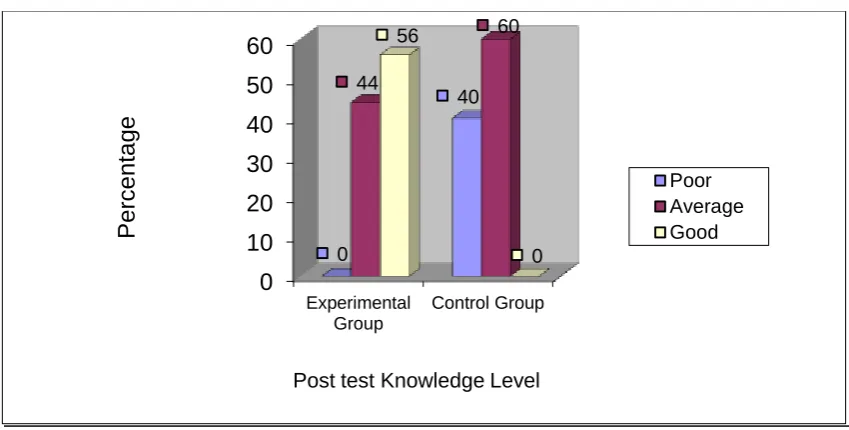
Fig2 distribution of the post test knowledge level of school children regarding junk food
The figure 2 reveals the difference in the knowledge scores of experimental group and control group. It is very clearly demarcates the difference in the good category28(56%) as well as in case of the average category22(44%) the experimental group is having much number when compared to control group where as in the poor 20(40%) and average category30(60%) of control group dominates over the group
Section IV –Pre test Attitude level s regarding junk food in experimental group and control group
This section explains the distribution of the level of attitude of high school children in both experimental and control group which is assessed by using an attitude scale i.e. five point likert scale in the pre test.
0
10
20
30
40
50
60
Experimental Group
Control Group
0
40 44
60 56
0
P
e
rcen
ta
g
e
Post test Knowledge Level
0 10 20 30 40 50 60 70
Experimental Control
38 38
62 62
P E R C E N T A G E
Pre-attitude level
favourable
partially favourable
Figure 3: Distribution of the pre test attitude level of the school children regarding junk food
The figure 3 reveals the difference in the attitude scores of experimental group and control group. In experimental group 62% subjects have partially favourable attitude, 38% have favourable attitude towards junk food. In control group 62% subjects have partially favourable attitude and 38% subjects have favourable attitude towards junk food.
Section V- Post-test attitude level of experimental group and control group
This section explains the level of attitude of high school children in both experimental and control group which is assessed by using an attitude scale i.e. likert scale in the post test
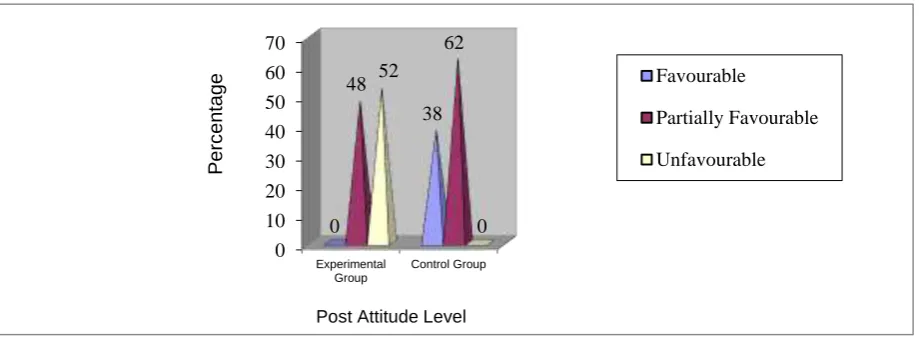
Figure 4 Graph comparing the post test attitude level of the school children regarding junk food
Figure 4 delineates that the frequency of the children who is categorized under the unfavourable attitude is 24(26%) in experimental group where as no one in control group. Another important finding is that the difference in the frequencies of partially favourable attitude category in experimental group it is 24(26%) but in case of control group it is 31(68%) and no frequencies in favourable category. It is very clearly demarcates the difference in the unfavourable categories well as in case of the favourable category in the former the experimental group is having much number when compared to control group where as in the favourable category in control group dominates over the group.
Section VI -Comparison of Pre-test and Post-test knowledge scores within the group
This section is regarding mean pre test and post test knowledge scores of experimental and control group regarding junk food. Paired t -test is used to compare the pre test and post test scores.
Table 1: comparison of pre test and post test knowledge sores regarding junk food in experimental and control group using paired ‘t’ test . ( n=50)
Group Knowledge
score Mean SD
Mean
difference t- value
Experimental group
Pre test 11.080 2.40611 9.220 26.411*
Post test 20.300 3.18318
Control group
Pre test 11.78 2.53377
0.12 1.950ns
Post test 11.90 2.6361
( t49=3.52,p<0.001) *significant
0 10 20 30 40 50 60 70
Experimental Group
Control Group 0
38 48
62 52
0
P
erc
en
tag
e
Post Attitude Level
Favourable
Partially Favourable
The table 1 reveals that mean pre test knowledge score of experimental group is 11.080 and mean post test knowledge score is 20.30 and .paired t value is 26.411 (t49=3.52) it is significant at 0.001 level. Hence the statistical hypothesis is accepted. The results interprets that knowledge is significantly increased after structured teaching programme. But in the control group mean pre test knowledge score is 11.78 and mean post test knowledge score is 11.90 .The paired t value is1.950 (t49=3.52) and it is not significant.
Section VI -Comparison of Pre-test and Post-test attitude scores within the group
This section is regarding mean pre test and post test attitude scores of experimental and control group regarding junk food. A paired t -test is used to compare the pre test and post test scores.
Table 2 Mean, SD, Mean difference and t-value of experimental and control group (n=50)
Group Attitude score Mean SD Mean
difference t- value Experimental
group
Pre test 33.36 8.97334 15.62 11.324***
Post test 48.98 7.12423
Control group
Pre test 32.66 9.26175 0.14 1.632ns
Post test 32.80 9.29779
(t49=3.52, p=0.001) ***significant at 0.001 level
The table 2 reveals that mean pre test attitude score of experimental group is 33.36 and mean post test knowledge score is 48.98 and .paired t value is 11.324 (t49=3.52) it is significant at 0.001 level. Hence the statistical hypothesis is accepted. The results interprets that attitude towards junk food is significantly changed after structured teaching programme. But in the control group mean pre test attitude score is 32.66 and mean post test attitude score is 32.80 .The paired t value is1.632 (t49=3.52) and it is not significant.
Section Vll – Comparison of the Pre-test knowledge scores of Experimental group and Control group
This section is regarding pre test knowledge scores regarding junk food in experimental and control group. An independent t-test is used to compare the pre test scores between the groups.
Table 3 Mean SD and t- value of pre-test knowledge score between experimental group and control group. . ( n=100)
Group Mean SD t- value
Experimental Group
Control Group
11.080
11.78
2.40611
2.5337
1.417ns
(t98=1.99, p=0.05) ns-non significant *significant
The comparison of the pre test scores of the control and experimental group was done by independent t-test. From the table 3it is evident that the mean pre test score of experimental group is 2.40611 and that of control group is11.78 .It is also clear that the calculated value (1.417) is less than that of the table value (1.9901) so the null hypothesis H01 is accepted.
Section Vll –Comparison of the Post-test knowledge scores of Experimental group and Control group
This section is regarding post test knowledge scores regarding junk food in experimental and control group. An independent t-test is used to compare the post test scores between the groups.
Table 4 Mean SD and t- value of post-test knowledge score between experimental group and control group . ( n=100)
Group Mean SD t- value
Experimental Group
Control Group
20.30
11.900
3.18318
2.63609
14.371***
The comparison of the post test scores of the control and experimental group was done by independent t-test. From the table 4 s it is evident that the mean post test score of experimental group(20.30) is much higher than that of control group (11.90) .It is also clear that the calculated value (14.371)is higher than that of the table value (1.9901) so the null hypothesis H03 can be rejected and alternative hypothesis is accepted that is there is significant difference
between the mean post test score of the control group and mean post test score of the experimental group.
Table 5 Mean SD and t-value of pre-test attitude score between experimental group and control group . (n=100)
Group Mean SD t- value
Experimental Group
Control Group
33.36
32.66
8.97334
9.26175
.384ns
(t 98=3.3959,p=0.001) *significant
The comparison of the pre test scores of the control and experimental group was done by independent t-test. From the table 5 it is evident that the mean pre test score of experimental group(33.36) that of control group (32.66) .It is also clear that the calculated value (.384)is less than that of the table value (3.3959) so the null hypothesis can be accepted that is there is no significant difference between the mean pre test score of the control and mean pre test score of the experimental group.
Table 6 Mean SD and t- value of post-test attitude score between experimental group and control group . (n=100)
Group Mean SD t- value
Experimental Group
Control Group
48.98
32.80
7.1243
9.29779
9.767*
(t 98=3.3959,p<0.001) *significant
The comparison of the post test scores of the control and experimental group was done by independent t-test. From the table 6 it is evident that the mean post test score of experimental group (48.98 ) is much higher than that of control group (32.80) .It is also clear that the calculated value (9.767)is higher than that of the table value (3.3959) so the null hypothesis can be rejected and alternative hypothesis can be accepted that is there is significant difference between the mean post test score of the control and mean post test score of the experimental group.
Section VI-Association of level of knowledge regarding junk food and selected variables
In this section chi square test is used to find out the association between knowledge and selected demographic variable
Table 7 Chi Square value computed between knowledge scores and age of the children
( n=100)
χ²(2)=5.9915,*p = 0.05, ns=non significant, F = frequency Level of knowledge
Age in years
χ² value
13 14 15
F % F % F %
Average 15 44.12 37 71 9 64.28
*6.390
The data presented in table 7 shows that the calculated χ² value is 6.390 whereas the table value is 5.9915. So the null hypothesis HO5 has to be rejected alternate hypothesis is accepted that is there is significant association between the age of children and the knowledge level children regarding junk food in selected schools.
Table 8: Chi Square value computed between knowledge scores and family income of the children
(n=100)
Level of knowledge (pre-test )
Family income
χ² value
<5000 >5000
F % F %
Average 40 54.05 21 80.77
5.772*
Poor 34 45.94 5 19.23
χ²(1)=3.8415,*p = 0.05, ns=non significant, F = frequency
Table 8shows that the estimated χ² value is 5.772whereas the table value is 3.8415so the null hypothesis H05 has to be rejected and alternate hypothesis is accepted that is there is an association between the family income and the knowledge level of the school children regarding junk food
Table 9: Chi Square value computed between pre test knowledge scores regarding junk food and other demographic variables like sex, area of residence, type of family . (n=100)
SL. NO Variable Chi square
value Df Table value Significance
1 Sex 1.191 1 3.8415 NS
2 Area of residence 0.964 1 3.8415 NS
3 Type of family 0.252 1 3.8415 NS
Since the calculated value is less than table value, H05 is accepted that there is no association between knowledge and selected demographic variables like sex, area of residence and type of family as P value >0.05.
Table 10 Chi Square value computed between attitude scores and age of the child
. ( n=100)
Level of attitude Age χ² value
13 yrs F %
14 yrs F %
15 yrs F %
Favourable 19 55.88 14 26.9 5 35.72
7.354* Partially
favourable 15 44.12 38 73.0 9 64.28
χ² (2) =5.9915,*p =0.05, ns=non significant, F = frequency
The data presented in table 10 shows that the calculated χ² value is 7.354 whereas the table value is 5.9915. So the null hypothesisH0 has to be rejected that is there is significant association between the age of children and the attitude level children regarding junk food in selected schools.
Table 11 Chi Square value computed between attitude scores and family income of the children .(( (n=100)
Level of attitude (post-test )
Family income
χ²value
<5000 F %
>5000 F %
Favourable 32 43.2 6 23.07 4.933*
Partially favourable 42 56.7 20 76.92 χ²(1)=3.8415,*p > 0.05, ns=non significant, F = frequency
Table 12 Chi Square value computed between pre test attitude scores regarding junk food and other demographic variables like sex, area of residence, type of family. (n=100)
SI NO Variable Chi square value
Df Table value Significance
1 sex 1.191 1 3.8415 NS
2 Area of residence 0.065 1 3.8415 NS
3 Type of family 0.267 1 3.8415 NS
Since the calculated value is less than table value, H05 is accepted that there is no association between attitude and selected demographic variables like sex, area of residence and type of family as P value >0.05.
6. FINDINGS:
The finding of the study concluded that among 100 subjects about the analysis of post test knowledge score showed that in experimental group56%samples had good knowledge score and 44% had average score but in the control group60% had average and 40% had poor knowledge score in post test regarding junk food. The analysis of post test attitude score showed that in experimental group52%samples had unfavourable attitude score and 48%had partially favourable score but in the control 62% had partially favourable score and 38%had favourable score.
7. RECOMMENDATIONS:
A similar study can be replicated in larger sample to draw generalisation Studies can be done to assess the practice of junk food among students Comparative study can be done among rural and urban students Similar studies can be conducted among students of smaller classes
8. CONCLUSION:
Majority of the samples had poor and average knowledge regarding junk food. There was improvement in the knowledge score of the samples in the experimental group after intervention. There was association between knowledge score and age of children and type of family. There was association between attitude score and age of children and type of family. The effectiveness of structured teaching programme measured by pre test and post test score of samples and research hypothesis was tested. The finding shows that structured teaching programme is more effective in improving knowledge and attitude on junk foods among adolescents.
REFERENCES
1. Swaminathan N. (2008):Adolescent health problems. Health Action,17(2), 4-6
2. Fisterk(.2005):JunkfoodadvertisingcontributestoyoungAmericansobesity.Britishmedicaljournal,331(17530).14 26
3. Bauerk.Larson NI.(2009)Fast food intake among adolescents secular and longitudinal trends from 1999to2004,Preventive medicine.48(3)284-7.
4. Laxmaiah a, and Nagallab,(2007):Factors affecting prevalence of overweight among adolescents. Obesity, volume 15 .1384-13900
5. Wangnoo SK. (2003):Adolescent obesity is an epidemic, India Today , Aug 4; 44-45
6. Shanthy AB, Steven LG et al. Effects of fast food consumption on energy intake and diet quality among children in a house hold survey. British Medical Journal42,969-981.
7. Chethana M.Sonia P(.2008)Impact of diet and nutrition related education package on the awareness and practices of school children. The internet journal of public health.6(1 ).
8. Jain S Pant B ,Chopra H .(2010): Obesity among adolescents of affluent public school. Indian Journal of public health.;54(3),158-60.
9. Rachel WI, Dianne NS . (2009 ):Eating behaviors and perceptions of food among food insecure youths. American Journal of public health.;99(5)822-828
10. Lundwig D, Peterson K, Gortmaker S(2001):A prospective observation analysis on relationship between consumption of sugar-sweetened drinks and childhood obesity.Lancet.,358;505-508
12. Mikki N, Abdulrahim HF. (2010): Dietary habits of Palestenian adolescents and associated socio demographic characteristics' ,Public Health Nutrition.;13(9)1419-29 .
13. Rampersaudg C.(2003).National survey beverage consumption data for children and Adolescents. Journal of American diet association,103(1):97-100.
14. Nielsen SJ Seiga-Riz AM, Popkim BM. (2004):Changes in beverage Intake between1977 and 2001,American.Journal of Preventive Medicine,27(3) :205 -10.
15. Summer bell CD, Moody RC, Shanks J, Stock MJ, Geissler C.(1995): Sources of energy from meals versus snacks in 220 people in four age group Clinical Nutrition,49(1): 33-41.
16. Watt RG, Sheiham A. (1996):Dietary patterns and changes in inner city adolescents. Journalof Human Nutrition Diet, 9(6)451.
17. Bowman SA. (2002):Beverage choice of Young females : changes and impact on nutrient intakes. Journal of American Diet Association, 102 (9): 1234-9.
18. Kolahdooz F, Sheikholeslam R, Naghavi M, Abdollahi Z.(2004) Junk food consumption, an indicator of changing dietary habit in children. Asia Pacific Journal of Clinical Nutrition,13 (Suppl) : 5121.
19. Coon KA, Goldberg J, Rogers BL, Tucker KL.(2001):Relationship between use of television during meals and
children’s food consumption patterns. Pediatrics,107 (1)
20. Story M, Perry C, Casey MA, Neumark S D.(1999):Factors influencing food choices of adolescents. Journal of American Diet Association,99(8):922-37.
21. .Story M,Resnick MD et al (1998):lessons learned about adolescent nutrition from Minnesota Adolescent health survey. Journal of American diet association,98(12);1449-56
22. .Hyun S,Kyung SL(2011).fast food consumption status among middle school students in Seoul. Nutrition Research and Practice,5(2).169-178.
23. Tin SP, Ho SY et al.(2011):lifestyle and socio economic correlates of break fast skipping in Hong Kong school children. prev medicine,52(3):250
24. .Kuriyan R,Bhat S et al.(2007):Television viewing and sleep are associated with overweight among urban and semi urban south Indian children. Nutritional journal,6:25
25. Little Flower A, Rashmi HP (2003) Prevelence of obesity among urban high school. Indian Journal Community Medicine,28:187-190.s
26. .Bishav M, Naveen K, etal,(2004): Prevalence of Sustained hypertension and obesity in urban and rural school going children in Ludhiana. Indian heart Journal,40(6).310-314.