Available Online At www.ijpret.com
INTERNATIONAL JOURNAL OF PURE AND
APPLIED RESEARCH IN ENGINEERING AND
TECHNOLOGY
A PATH FOR HORIZING YOUR INNOVATIVE WORK
IMAGE SECURITY SOLUTION BASED ON CHAOS
MORE POONAM M., PROF. KHOBRAGADE SANJAY V
Electronics and Telecommunication Department, Dr. Babasaheb Ambedkar Technological University, Lonere, Raigad, Maharashtra, India
Accepted Date:
27/02/2013
Publish Date:
01/04/2013
Keywords
Image encryption,
Piecewise Linear Chaotic
map,
Modified Reversible
Hidden Transform
(MRHT),
Random sequence
generator
Corresponding Author
Ms. Poonam M. More
Abstract
In this paper new encryption technique for image is described
which may be considered as efficient security solution for image.
This encryption technique is based on chaotic map with modified
Reversible Hidden transform and, random sequences. The basic
idea of this technique is to process gray values in the special
domain using chaotic map with RHT which is being further
processed by random sequences generated by random sequence
Available Online At www.ijpret.com •INTRODUCTION
Encryption is used to securely transmit as well as to
store the data. Each type of data presents a relative
importance, especially images; therefore different
techniques should be used to protect confidential
image data from unauthorized access or
modification. Image encryption has applications in
internet communication, multimedia systems,
medical imaging, telemedicine, military
communication, etc. Many image content
encryption algorithms have been proposed [3-6, 8].
Many among these are chaotic based algorithms
since chaotic system properties such as
aperiodicity, sensitivity to initial conditions and
system parameters are preferred.
In this paper, a new encryption technique is
proposed based on modified reversible hidden
transform (mRHT), piecewise linear chaotic map
which may provide a security solution for images.
The core idea will be to transform the original
image first using chaotic map with modified RHT.
Then, the transformed image will be further
processed by random sequences generated by
chaotic map to get the encrypted image. Exact
reverse process will be followed at receiver to
decrypt the image.
This paper is organized as follows: In section II,
chaotic maps, modified RHT and random sequence
generator are described followed by the proposed
encryption technique’s description in section III,
then along with the results of proposed system. In
section IV, some security analysis techniques are
discussed with respect to proposed scheme and in
section V we conclude the paper.
•PRELIMINARIES
In this section, the description of RHT is
discussed along with the basic details of chaotic
maps.
A. Chaotic Maps
Chaos is sustained and disorderly-looking
long-term evolution that satisfies certain special
mathematical criteria and that occurs in a
deterministic nonlinear system. Chaotic maps are
the principles and mathematical operations
underlying chaos. Recently chaotic maps have
become interesting research areas because of their
attractive features such as aperiodicity, sensitivity
to initial conditions and system parameters [1].
Mostly, one-dimensional chaotic maps, such as
Logistic maps with the advantages of high-level
efficiency and sensitivity, are widely used but their
some drawbacks, such as weak security and
nonuniformity, are disturbing factors.
In this paper, the another chaotic map having
Available Online At www.ijpret.com
used, namely PWLCM, which is mathematically
represented as
= =
0 ≤ ≤
. ≤ ≤ 0.5
1 − ≥ 0.5
(1)
where ί (∙) ϵ (0,1) and the control parameter ϵ
(0, 0.5).
B. modified RHT
The RHT, used in [2] states that if [0, L] is the
image gray level range then a pair of pixels, x= (x1,
x2) can be transformed into another pair of pixels,
y= (y1, y2) by using two fixed numbers α, β as
follows:
Forward Transform:
= !"
!#$ =
% " & #
% # & "$ (2)
such that α + β=1, and 0 ≤ α, β ≤ 1.
Inverse Transform:
' = ('"
'#) = * +,"-.,#
+#-.# .,"/+,#
.#-+#
0 (3)
But these forward and inverse transform
equations pairs will not be able to reconstruct the
original image properly. That means,
reconstruction of a pair of pixels, x= (x1, x2), is not
possible in reverse way using above mentioned
inverse transform. Hence we change these
equations and proposed a modified RHT as follows:
Modified Forward Transform:
= !"
!#$ =
% " & #
% # & "$ (4)
Modified Inverse Transform:
' = ('"
'#) = * +,"-.,#
+#-.# +,#-.,"
+#-.#
0 (5)
This pair of modified forward and inverse
transform equations will give us proper mapping of
integer values of pixel pairs in forward and reverse
direction. The term hidden is used because of the
values of α and β are generated randomly, and
hence all transformed images corresponding to an
image will be different as the values of α and β will
Available Online At www.ijpret.com
Figure 1: Block diagram of proposed system
In the proposed encryption technique, we have used
modified RHT to transform an integer pair to another
integer pair with lower mathematical computation
based on some secret parameters that are nothing but
α and β.
C. Random Sequence Generator
To process the resultant transformed image from
mRHT further a random sequence is required which
can be obtained by using the Eq. (1) and using different
initial and parameter values. The generated sequence
of Eq. (1) is processed as follows to obtained proper
random integer sequence which will be used to
generate encrypted image.
1 = 234 5 (6)
where 1 is generated random sequence, is
sequence generated by Eq. 1, and 5 is the maximum
pixel value in the transformed image.
•PROPOSED SECURITY SOLUTION FOR IMAGE
In this section we are discussing the method of
encryption and decryption for making image
secure as shown in fig. 2.
A. Encryption Process
1) Create two x and y random integer
sequences using piecewise linear chaotic map
with 1, 2 as control parameters and x0, y0 as
initial values for x and y respectively, such that
x, y ϵ (1, M*N), where M, N are dimensions of
original image say ‘A’.
2) Perform modified RHT on original image A
using x, y sequences as pixel indices of the
original and transformed image respectively to
get transformed image B.
3) Generate another random sequence 1 using
Available Online At www.ijpret.com
parameter and x1 as initial value and perform
EXOR operation as follows on the transformed
image using randomly generated sequences to
get encrypted image E.
6 = 7 ⨁1 (7)
where i ϵ (1, M*N).
B. Decryption Process
Decryption process is exact reverse of the
encryption process. It is assumed that all the
basic key values used for encryption are
available at the receiver end to decrypt the
encrypted image.
The robustness and validity of the proposed
scheme are demonstrated using MATLAB
platform. Different images are used as
experimental images for experimental purpose.
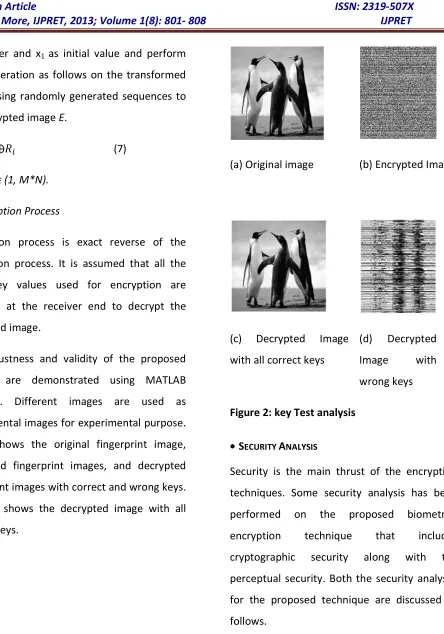
Fig. 2 shows the original fingerprint image,
encrypted fingerprint images, and decrypted
fingerprint images with correct and wrong keys.
Fig. 2(c) shows the decrypted image with all
correct keys.
(a) Original image (b) Encrypted Image
(c) Decrypted Image
with all correct keys
(d) Decrypted
Image with
wrong keys
Figure 2: key Test analysis
•SECURITY ANALYSIS
Security is the main thrust of the encryption
techniques. Some security analysis has been
performed on the proposed biometrics
encryption technique that includes
cryptographic security along with the
perceptual security. Both the security analyses
for the proposed technique are discussed as
Available Online At www.ijpret.com A. Cryptographic security
The cryptographic security can be viewed as
the ability of the technique to resist the
cryptanalysis process. Cryptanalysis is the
science of analyzing and breaking the secure
channel; this report includes the key and
original image sensitivity analysis.
a. Key Sensitivity:
Key sensitivity is defined as the change in the
encrypted fingerprint due to change in the key.
For a good security solution, the slight
difference in the keys should cause great
changes in the encrypted media. The key
sensitivity (KS) can be computed by
59 =: ; <,<>?×A × 100 % (8)
where C and C> are the encrypted fingerprint
images using correct and wrong keys with M ×
N as the dimension of encrypted images.
Mathematically, Dif(C, C>) is defined as
D EC, C>F = ∑ ∑ C , H ⊗ C> , HA
JK" JK"
?
K"
K" (9)
where
C , H ⊗ C> , H = L1, C , H ≠ C0, C , H = C> , H> , H (10)
Generally, for a good encryption scheme, the
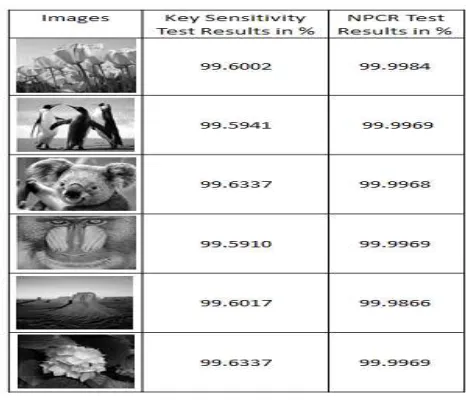
value of KS is about 75%. And with our
encryption method it is achieved around 100%
(Refer fig. 2).
Table I: Test Results
b. NPCR:
Similar to key sensitivity, Number of Changing
Pixel Rate (NPCR) is defined as the changes in
the encrypted image caused by the changes in
the original fingerprint image. For better
security, the slight difference in the original
media should cause great changes in the
encrypted media. It is the most common test
used to evaluate the strength of image
encryption algorithms/ciphers with respect to
differential attacks. A high NPCR score is usually
Available Online At www.ijpret.com
attacks. If C1 and C2 are ciphered images
before and after one pixel change in a plaintext
image respectively, and D is a bipolar array
defined as
D = L1 C1 , H = C2 , H 0 3OℎQRS TQ
(11)
Then the NPCR is defined as
UVC1 =∑ : ,W,J
X×Y × 100% (12)
Ideally encrypted image always have 100%
NPCR value. And with our encryption method
we have got approximately 99.9969% of NPCR
values in most of the cases as shown in Table I.
B. Perceptual Security
The perceptual security ensures that the
encrypted image cannot reveal the overview of
the original image. Histogram analysis is the
popularly used analysis to check perceptual
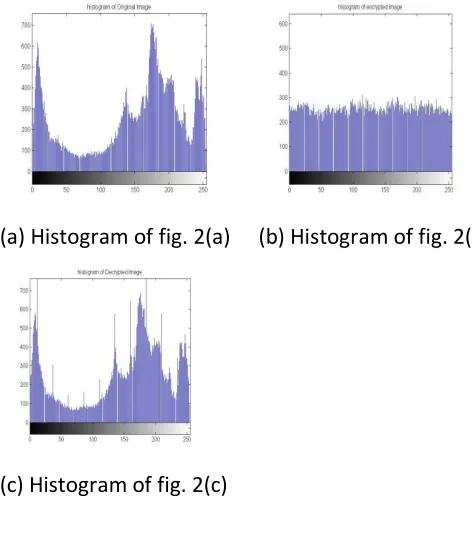
security of system. The histograms of the
original and encrypted image are compared. If
the histogram of the encrypted image is fairly
uniform and is significantly different from the
histogram of the original one, then the
encryption is said to be perfect. Moreover, the
histogram of the decrypted fingerprint must be
similar to the original one.
(a) Histogram of fig. 2(a) (b) Histogram of fig. 2(b)
(c) Histogram of fig. 2(c)
Figure 3: Histogram Analysis
The corresponding histograms of the original,
encrypted and decrypted images are depicted
in Fig. 3. Fig. 3 shows that, after encryption, the
histogram becomes uniform, and the
decryption process makes it similar to the
original image histogram, which is the major
Available Online At www.ijpret.com •CONCLUSION
In this paper, a new simple security solution for
images is proposed. In the proposed scheme
we used PWLCM along with the modified RHT
to create randomness in the original image, to
make image more secure we have further
processed transformed image with random
sequences. Then further security analysis like
key test analysis, histogram analysis are carried
out to ensure the effectiveness of the proposed
scheme. This kind of security solution can be
used in the web applications to secure images
from the adversaries.
REFERENCES
1. G. P. Williams, Chaos Teory Tamed. NW
Washington DC: Joseph Henry Press, 1999, ch.
2.
2. G. Bhatnagar, Q. M. Jonathan Wu,
“Chaos-Based Security Solution for Fingerprint Data
during Communication and Transmission”, IEEE
Trans. Instrum. Meas., Vol. 61, No. 4, pp. 876–
887, April 2012.
3. K. D. Patel, Sonal Belani, “Image Encryption
Using Different Techniques: A Review”, IJETAE
International Journal of Emerging Technology
and Advanced Engineering, Vol.1, No. 1,
November 2011.
4. Zhang Yun-peng, Liu Wei, Cao Shui-ping, Zhai
Zheng-jun, Nie Xuan , Dai Wei-di, “Digital image
encryption algorithm based on chaos and
improved DES”, IEEE International Conference
on Systems, Man and Cybernetics, 2009.
5. Ismail Amr Ismail, Mohammed Amin,
Hossam Diab, “A Digital Image Encryption
Algorithm Based a Composition of Two Chaotic
Logistic Maps”, International Journal of
Network Security, Vol.11, No.1, pp.1 -10, July
2010.
6. Qais H. Alsafasfeh , Aouda A. Arfoa, “Image
Encryption Based on the General Approach for
Multiple Chaotic Systems”, Journal of Signal
and Information Processing, 2011.
7. H. Gao, Y. Zhang, S. Liang, D. Li, “A New
Chaotic Algorithm For Image Encryption,”
Chaos Solitons Fractals, vol. 29, pp. 393–399,
2006.
8. N. K. Pareek, V. Patidar, and K. K. Sud,
“Image encryption using chaotic logistic map,”
Image Vis. Comput., vol. 24, no. 9, pp. 926–934,