Research Article ISSN 2250-0480 VOL 7/ ISSUE 4/OCT 2017
L-30
Life science Physiology
A COMPARATIVE EFFICACY BETWEEN STRENGTH AND
STABILISATION TRAINING PROGRAMMES IN THE
IMPROVEMENT OF TRUNK AND HIP MUSCLES
ACTIVATIONS OF HEALTHY FEMALES SUBJECT:
AN IMPLICATION FOR THE REHABILITATION
PRACTITIONERS
QAIS GASIBAT*1, NORDIN SIMBAK1, ANIZA ABD AZIZ1 AND RABIU MUAZU MUSA2
1
Faculty of Medicine, Universiti Sultan Zainal Abidin, Kota Campus, 20400 Jalan Sultan Mahmud, Kuala Terengganu, Terengganu, Malaysia
2
Faculty of Applied Social Sciences, Universiti Sultan Zainal Abidin,Gongbadak Campus, 21300 Kuala Terengganu, Terengganu, Malaysia
ABSTRACT
Physical therapists use a variety of training when rehabilitating patients with low back pain (LBP). The traininganalysed are often used in rehabilitation programmes for the spine, hip, and knee. Evidence has demonstrated that the prevalence of lower back pain (LBP) among women population is alarmingly higher due to the hormonal and reproductive factors such as irregular or prolonged menstrual cycle and hysterectomy. As a result, appropriate selection and designation of a training programme capable of stimulating the trunkand hip muscles could be beneficial in both rehabilitation and prevention of LBP. The current study compared the effectiveness of strength training programme (STTP) with stabilisation training programme (SBTP) intending to ascertaining the most effective in stimulating the muscles activations.50 healthy females with normal BMI and ages range from 19 to 24 years randomly allotted to STTP, and SBTP underwent five different sets of exercises three times a week for five weeks. Electromyography (EMG) data were collected from 5 muscles of rectus abdominis, external oblique, multifidus, gluteus maximus and gluteus medius. The readings from the EMG were compared after the five weeks interventions. An independent t-test was used to examine the comparative efficacy between the STTP and SBTP on the targeted muscles. A statistically significant difference of the muscle activations between the two compared training modalitieswas obtained p < 0.05. The SBTP intervention is shown to be more efficient in stimulating the females’ pelvic muscles activations as opposed to STTP. SBTP could, therefore, be a practical measure for prevention and rehabilitation of LBP.
KEYWORDS: Strength training, Stabilisation training, Muscle activations, Pelvic muscles, Lower back pain
INTRODUCTION
A number of studies have suggested that exercise modalities can be designed to prompt the supporting muscles of the spine in a pattern that shows to be valuable for some patients with LBP 1,2
. Likewise, some previous works have pointed out that the study of irregular movement patterns during active trunk motion is crucial in the
Research Article ISSN 2250-0480 VOL 7/ ISSUE 4/OCT 2017
L-31
Life science Physiology
in people with lower extremity injuries and LBP could be effectively improved through exercises interventions6,7. Based on the aforementioned literatures, it could, therefore, be deduced that designation of an appropriate training programme could be beneficial when the right and relevant muscles are targeted. The activations of muscles that are involved in the mobility process could be useful in reduction or rehabilitation of LBP patients and could also serve as a training regimen for a healthy individual to prevent future occurrences of LBP. However, although, training programmes that are developed to enhancing muscles activations have earned acceptance in the general rehabilitation of LBP patients; the evidence for the efficacy of this technique is inadequate and ambiguous8. The few investigations that have considered particular stabilisation exercise programmes among patients with LBP in more homogenous populations have demonstrated some promising effects2. As a result, a study comparing the two sets of exercises with the view of ascertaining the most efficient in the stimulation of the females’ muscles is needful. Hence, the current study endeavours to compare the effectiveness of strength training programme(STTP) andstabilisation training programme(SBTP) in the improvement of the lumber muscles among female’s healthy subjects.
Potential Impact of the Study
Research has demonstrated that the prevalence of LBP among women population is significantly higher due to the Hormonal and reproductive factors such as irregular or prolonged menstrual cycle and hysterectomy as compared to males9.On the other hand, it has been reported that to identify the effectiveness of a particular intervention programme, the first way to commence could be with healthy subjects after that the potential findings could be safely applied to the patient's 10,11. To this effect, the present study examined the
comparative effectiveness of STTP and SBTP in improving the said targeted muscles activations in healthy female subjects. The study aims at drawing the attention of the physiotherapist, trainers and other stakeholders to determine the most appropriate training programme capable of given maximum effects in developing and stimulating the trunk, hip and lumbar muscles of female’s subjects. The findings of the study are anticipated to serve as a guide for application to the reduction and rehabilitations of LBP amongst female patients.
MATERIALS AND METHODS
Participants
A total of 50 healthy female subjects with a normal BMI of 18.5 to 24.9 kg/m2 and without any record for current or previous lower extremity or back problems with ages range of 19 to 24 years were recruited to participate in the study. The participants who volunteered to take part in this study were from the Faculty of Health Sciences of the Universiti Sultan Zainal Abidin. Written consent was obtained, and all the participants signed consent forms. All the exercises procedures, protocol, and equipment for this study were authorised by the Research Ethics Board of the Universiti Sultan Zainal Abidin with an approval number of UniSZAC/628-1jld2 (02).
Selected Exercises for the study
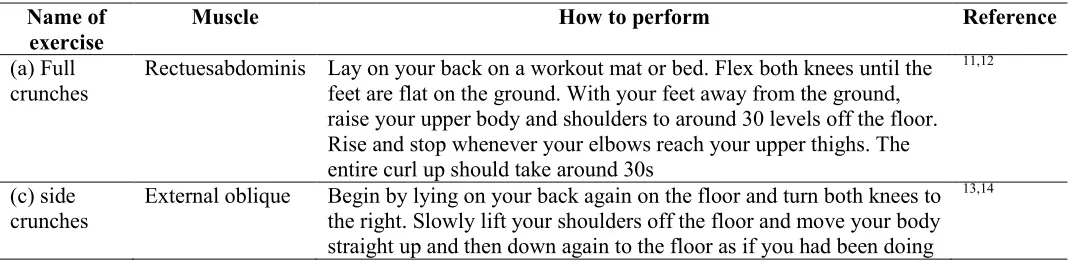
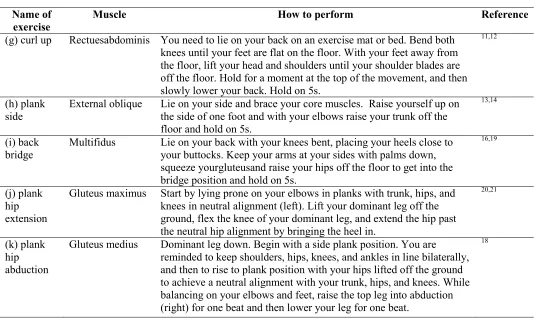
The strength and stability based exercisesthat were considered in the present investigation are shown in Table 1 and 2 respectively. The name of the exercises, the targeted muscles as well as the procedures for the exercises performances istabulated. The selections of the exercises were carefully made based on their ability in strengthening and stabilising the muscles under investigation.
Table 1
Strength exercises procedures
Name of exercise
Muscle How to perform Reference
(a) Full crunches
Rectuesabdominis Lay on your back on a workout mat or bed. Flex both knees until the feet are flat on the ground. With your feet away from the ground, raise your upper body and shoulders to around 30 levels off the floor. Rise and stop whenever your elbows reach your upper thighs. The entire curl up should take around 30s
11,12
(c) side crunches
External oblique Begin by lying on your back again on the floor and turn both knees to the right. Slowly lift your shoulders off the floor and move your body straight up and then down again to the floor as if you had been doing
Research Article ISSN 2250-0480 VOL 7/ ISSUE 4/OCT 2017
L-32
Life science Physiology
a regular crunch. Ensure that you keep your knees turned to the best as you do the crunch.
(d) lumbar full extension
Multifidus Lie on your stomach and put your arms in front of your chest. Take your body up to a fully extended position. Your legs should be fully extended.
15,16
(e) hip extension
Gluteus maximus Lie down, you can put your forehead on your hand or put a towel underneath your forehead. Lift your thigh off the ground and extend the leg.
17
(f) hip abduction
Gluteus medius Lay on your side on an exercise pad or bed in a beginning position. With knees completely extended, slowly abduct while keeping the knees extended. Look at 30% of hip hold and slowly return.
18
Table 2
Stabilisation exercises procedures
Name of exercise
Muscle How to perform Reference
(g) curl up Rectuesabdominis You need to lie on your back on an exercise mat or bed. Bend both knees until your feet are flat on the floor. With your feet away from the floor, lift your head and shoulders until your shoulder blades are off the floor. Hold for a moment at the top of the movement, and then slowly lower your back. Hold on 5s.
11,12
(h) plank side
External oblique Lie on your side and brace your core muscles. Raise yourself up on the side of one foot and with your elbows raise your trunk off the floor and hold on 5s.
13,14
(i) back bridge
Multifidus Lie on your back with your knees bent, placing your heels close to your buttocks. Keep your arms at your sides with palms down, squeeze yourgluteusand raise your hips off the floor to get into the bridge position and hold on 5s.
16,19
(j) plank hip extension
Gluteus maximus Start by lying prone on your elbows in planks with trunk, hips, and knees in neutral alignment (left). Lift your dominant leg off the ground, flex the knee of your dominant leg, and extend the hip past the neutral hip alignment by bringing the heel in.
20,21
(k) plank hip abduction
Gluteus medius Dominant leg down. Begin with a side plank position. You are reminded to keep shoulders, hips, knees, and ankles in line bilaterally, and then to rise to plank position with your hips lifted off the ground to achieve a neutral alignment with your trunk, hips, and knees. While balancing on your elbows and feet, raise the top leg into abduction (right) for one beat and then lower your leg for one beat.
18
Experimental Protocol
The participants were randomly allotted in two groups, i.e. STTP and SBTP group with 25 subjects in each group. Each group were given a separate set of strength and stabilisation training as shown in Table 1 and 2 for a period of five weeks. The participants underwent their peculiar exercises on different days. Before the beginning of the exercises, the initial measurement of the muscles activations was determined at a zero week. Electromyography (EMG) data were collected from 5 muscles during the exercises performance (Rectus abdominis, External oblique, Multifidus, Gluteus maximus and medius), and the readings from the EMG were compared after the five weeks
interventions between the pretreatment readings of STTP and SBTP.
Data Collection Procedure
Research Article ISSN 2250-0480 VOL 7/ ISSUE 4/OCT 2017
L-33
Life science Physiology
umbilicus. The electrodes were positioned midway between the anterior fine iliac spine and the ribs cage for the exterior oblique abdominis muscle. Intended for the lumbar multifidus muscle mass, the electrodes were put 2 cm lateral towards the lumbosacral junction. The electrodes for the gluteus medius muscle were placed above the gluteus maximus muscle and closer to the iliac crest around the lateral side of the pelvis. For the gluteus maximus muscle, electrodes were placed in the
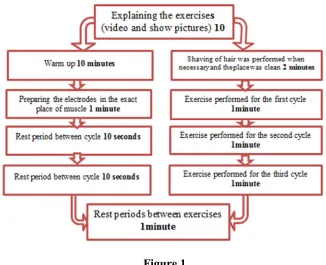
centre from the muscle belly between the extensive edge of the sacrum as well as the posterosuperior edge of the higher trochanter. The reference electrode was located over the anterior superior iliac spine. All the procedures for the electrodes placement were conducted by the recommendations of the previous researchers 22,23. A detail description of the entire data collection procedureis provided in Figure 1.
Figure 1
A flow chart during the data collection process
Figure 1 projects the flow chart organisation during the data collection process. The time for the warm up, preparation of the sites attachment of the electrodes, the time taken for each exercise as well as the rest period interval are displayed. The procedures for all the steps performedwere adopted from the previous researchers 13,24,25.
Data Analysis
An independent t-test analysis was employed in this study to determine whether there is a significant difference between the two training modalities as well as to compare the efficacy of the two interventions training in the improvement of the muscle activations at the post measurement. The types of the training (STTP and SBTP) were used as the independent variables while the meanelectrical activities of all the selected muscles were treated as the dependent variables. All the statistical analysis was conducted using XLSTAT
add in software version 2014 for Windows at a confidence level of p ≤ 0.05.
RESULTS
Research Article ISSN 2250-0480 VOL 7/ ISSUE 4/OCT 2017
L-34
Life science Physiology Table 3
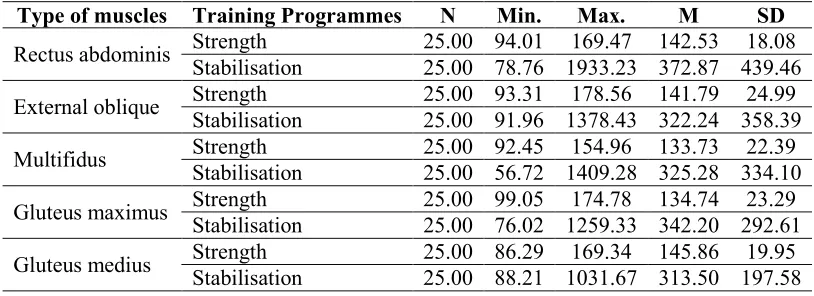
Descriptive Statistics for the comparative efficacy of stabilisation and strength training intervention programme on the muscles.
Type of muscles Training Programmes N Min. Max. M SD
Rectus abdominis Strength 25.00 94.01 169.47 142.53 18.08 Stabilisation 25.00 78.76 1933.23 372.87 439.46
External oblique Strength 25.00 93.31 178.56 141.79 24.99 Stabilisation 25.00 91.96 1378.43 322.24 358.39
Multifidus Strength 25.00 92.45 154.96 133.73 22.39 Stabilisation 25.00 56.72 1409.28 325.28 334.10
Gluteus maximus Strength 25.00 99.05 174.78 134.74 23.29 Stabilisation 25.00 76.02 1259.33 342.20 292.61
Gluteus medius Strength 25.00 86.29 169.34 145.86 19.95 Stabilisation 25.00 88.21 1031.67 313.50 197.58
Table 4 displays the inferential statistics of the pairwise comparison conducted as a follow-up for the t-test. From the table, t observed, t critical, the degree of freedom the difference between the SBTP and STTP at the post evaluations and the significant levels are depicted. It can be seen that there is a statistically significant difference between the
SBTP and STTP on the muscle activations in all the evaluated muscles of Rectus abdominis, External oblique, Multifidus, Gluteus maximus and Gluteus medius p < 0.05. This finding signifies that SBTP intervention is more effective compared to STTP in improving the said muscles activations of the participants evaluated in the study.
Table 4
Inferential Statistics for the comparative efficacy of stabilisation and strength training intervention programme on the muscles assessed.
Muscle types t(obs.) t(crtcl) DF D Sig
Rectus abdominis -2.62 2.01 48 -230.3 0.011 External oblique -2.51 2.01 48 -180.5 0.015 Multifidus -2.86 2.01 48 -191.6 0.006 Gluteus maximus -3.53 2.01 48 -207.5 0.009 Gluteus medius -4.22 2.01 48 -167.6 0.001
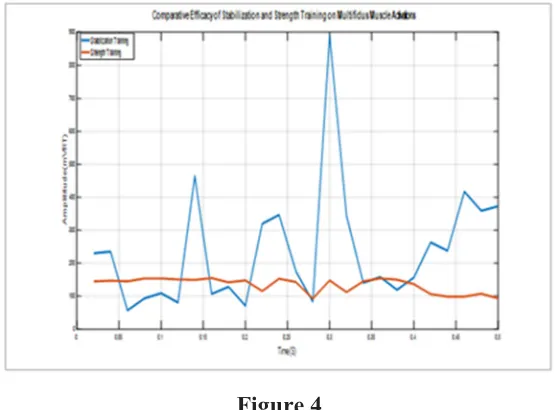
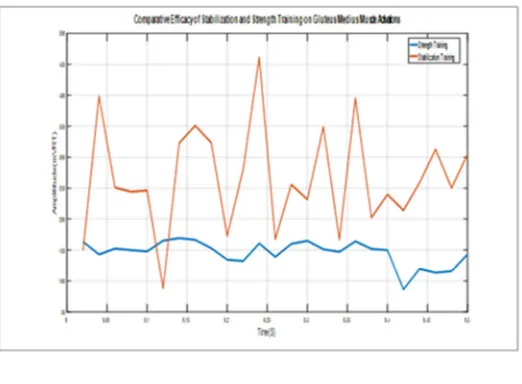
Figure 2 to 6 highlights the
comparable effectiveness analysis between SBTP and STTP in the improvement of all the muscles assessed in the study. From the figures, it can be noted that the SBTP intervention recorded higher muscles activations across all the muscles of the Rectus abdominis, External oblique, Multifidus,
Research Article ISSN 2250-0480 VOL 7/ ISSUE 4/OCT 2017
L-35
Life science Physiology Figure 2
Comparative efficacy analysis between SBTP and STTP in the improvement of
Rectus Abdominis muscle activation
Figure 3
Comparative effectivenessanalysis between SBTP and STTP in the development of External Oblique muscle activation.
Figure 4
Research Article ISSN 2250-0480 VOL 7/ ISSUE 4/OCT 2017
L-36
Life science Physiology Figure 5
Comparative efficacyanalysis between SBTP and STTP in the improvement of Gluteus Maximus muscle activation
Figure 6
Comparative effectivenessanalysis between SBTP and STTP in the improvement of Gluteus Medius muscle activation
DISCUSSION
The general results of the comparative effectiveness of SBTP and STTP intervention programme on the muscles at the post of the electromyography activities of the muscle experimented in the current study have indicated that the SBTP is more efficient in the improvement of the activations of the participant's muscles when compared with the effect produced by the STTP. The evidence presented in Table 3, and 4 as well as Figures2-6 have shown that lumbar, trunk and hip muscles of the females’ participants in the study have reacted better to the SBTP intervention as opposed to the STTP. The results suggested that SBTP could be highly useful as rehabilitation exercises of LBP in females’ subjects.The finding from the current
Research Article ISSN 2250-0480 VOL 7/ ISSUE 4/OCT 2017
L-37
Life science Physiology
motor orders for improved spinal support, counter abnormal micro-motion, and decrease associated pain 29. It is not unexpected, therefore, that some researchers that studied muscle origin and electromyography sequences have recommended that lumbar, trunk and hips muscles are better stimulated through the application of some stability exercises 30.The results of the present study revealed that the participants in the SBTP group experienced a better improved in the said muscle activations determined by spectral electromyography, which could as well have an impact in increasing the overall endurance of the muscles and consequently have an implication in reducing back pain severity. This result shows that improved muscles activations could be associatedwith the better outcome effect of the SBTP efficacy observed. The improvement in the muscles activations capacity in the SBTP intervention group is in conformity with that seen in the results of earlier studies31,32.
CONCLUSION
The results of the present study have demonstrated that the stabilisation training programme observed in the study iseffective in improving the muscles activations of the subjects within the five weeks training interventions period when compared to the training devised from the strength programme. The stabilisation intervention has appeared to be more effective in stimulating the rectus abdominis, external oblique, multifidus, gluteus maximus and gluteus medius muscles. Moreover, the study has shown that the utilisation of surface electromyography signals in detecting muscles activations is nontrivial as it permits the researchers to accurately identify the best intervention training programme that can enhance the activations of the trunk, hip and lumbar muscles amongst healthy female’s subjects. The results of the current study are expected to be valuable for the rehabilitation experts in determining the best training modality which would, in the long run, assist the female’s patients with a record of LBP.
REFERENCES
1. Hides JA, Richardson CA, Jull GA. Multifidus Muscle Recovery Is Not Automatic After Resolution of Acute, First‐Episode Low Back Pain. Spine (Phila Pa 1976). 1996;21(23):2763-2769.
2. O’sullivan PB, Phyty GDM, Twomey LT, Allison GT. Evaluation of specific stabilizing exercise in the treatment of chronic low back pain with radiologic diagnosis of spondylolysis or spondylolisthesis. Spine (Phila Pa 1976). 1997;22(24):2959-2967.
3. Delitto A, Erhard RE, Bowling RW. A treatment-based classification approach to low back syndrome: identifying and staging patients for conservative treatment. Phys Ther. 1995;75(6):470-485.
4. Ogon M, Bender BR, Hooper DM, et al. A Dynamic Approach to Spinal Instability: Part II: Hesitation and Giving‐Way During Interspinal Motion. Spine (Phila Pa 1976). 1997;22(24):2859-2866.
5. Kankaanpää M, Taimela S, Laaksonen D, et al. A Dynamic Approach to Spinal Instability: Part II: Hesitation and Giving‐Way During Interspinal Motion. Spine (Phila Pa 1976). 2013;22(6):209.
6. Baker ADL. Physical Measurements as Risk Indicators for Low-Back Trouble Over a One-Year Period. In: Classic Papers in Orthopaedics. Springer; 2014:257-259. 7. Leetun DT, Ireland ML, Willson JD,
Ballantyne BT, Davis IM. Core stability measures as risk factors for lower extremity injury in athletes. Med Sci Sport Exerc. 2004;36(6):926-934.
8. BenDebba M, Torgerson WS, Long DM. A validated, practical classification procedure for many persistent low back pain patients. Pain. 2000;87(1):89-97.
9. Wijnhoven HAH, de Vet HCW, Smit HA, Picavet HSJ. Hormonal and reproductive factors are associated with chronic low back pain and chronic upper extremity pain in women–the MORGEN study. Spine (Phila Pa 1976). 2006;31(13):1496-1502.
10. Abdullah MR, Eswaramoorthi V, Musa RM, et al. The Effectiveness of Aerobic Exercises at difference Intensities of Managing Blood Pressure in Essential Hypertensive Information Technology Officers. J Young Pharm. 2016;8(4).
Research Article ISSN 2250-0480 VOL 7/ ISSUE 4/OCT 2017
L-38
Life science Physiology
adults: implications for rehabilitation professionals. J Strength Cond Res. 2008;22(6):1939-1946.
12. Sarti MA, Monfort M, Fuster MA, Villaplana LA. Muscle activity in upper and lower rectus abdominus during abdominal exercises. Arch Phys Med Rehabil. 1996;77(12):1293-1297.
13. Ekstrom RA, Osborn RW, Hauer PL. Surface electromyographic analysis of the low back muscles during rehabilitation exercises. J Orthop Sport Phys Ther. 2008;38(12):736-745.
14. Okubo Y, Kaneoka K, Imai A, et al. Electromyographic analysis of transversus abdominis and lumbar multifidus using wire electrodes during lumbar stabilization exercises. J Orthop Sport Phys Ther. 2010;40(11):743-750.
15. Arokoski JP, Valta T, Airaksinen O, Kankaanpää M. Back and abdominal muscle function during stabilization exercises. Arch Phys Med Rehabil. 2001;82(8):1089-1098. 16. Stevens VK, Vleeming A, Bouche KG,
Mahieu NN, Vanderstraeten GG, Danneels LA. Electromyographic activity of trunk and hip muscles during stabilization exercises in four-point kneeling in healthy volunteers. Eur spine J. 2007;16(5):711-718.
17. Moon HJ, Choi KH, Kim DH, et al. Effect of lumbar stabilization and dynamic lumbar strengthening exercises in patients with chronic low back pain. Ann Rehabil Med. 2013;37(1):110-117.
18. Serner A, Jakobsen MD, Andersen LL, Hölmich P, Sundstrup E, Thorborg K. EMG evaluation of hip adduction exercises for soccer players: implications for exercise selection in prevention and treatment of groin injuries. Br J Sports Med. 2013:bjsports-2012.
19. Koumantakis GA, Watson PJ, Oldham JA. Trunk muscle stabilization training plus general exercise versus general exercise only: randomized controlled trial of patients with recurrent low back pain. Phys Ther. 2005;85(3):209.
20. Selkowitz DM, Beneck GJ, Powers CM. Which exercises target the gluteal muscles while minimizing activation of the tensor fascia lata? Electromyographic assessment using fine-wire electrodes. J Orthop Sport Phys Ther. 2013;43(2):54-64.
21. Distefano LJ, Blackburn JT, Marshall SW,
Padua DA. Gluteal muscle activation during common therapeutic exercises. J Orthop Sport Phys Ther. 2009;39(7):532-540. 22. Taha Z, Musa RM, Abdullah MR, et al. The
Application of Inertial Measurement Units and Wearable Sensors to Measure Selected Physiological Indicators in Archery. Asian J Pharm Res Heal Care. 2017;9(2):85-92. 23. Gracovetsky S. Non Invasive Assessment of
Spinal Function. Autom Phys Exam Canada Aardvark Glob Publ. 2010.
24. Gasibat Q, Simbak N Bin. Moderation of Back pain by Rehabilitation Exercises ; Multifidus Muscle ’ Perspective. 2017;4(1):14-18. doi:10.9790/6737-04011418.
25. Ingersoll CD, Knight KL. Patellar location changes following EMG biofeedback or progressive resistive exercises. Med Sci Sports Exerc. 1991;23(10):1122-1127. 26. May S, Johnson R. Stabilisation exercises
for low back pain: a systematic review. Physiotherapy. 2008;94(3):179-189.
27. Byström MG, Rasmussen-Barr E, Grooten WJA. Motor control exercises reduces pain and disability in chronic and recurrent low back pain: a meta-analysis. Spine (Phila Pa 1976). 2013;38(6):E350-E358.
28. George SZ, Fritz JM, Bialosky JE, Donald DA. The effect of a fear-avoidance–based physical therapy intervention for patients with acute low back pain: results of a randomized clinical trial. Spine (Phila Pa 1976). 2003;28(23):2551-2560.
29. Gardner‐Morse M, Stokes IAF, Laible JP. Role of muscles in lumbar spine stability in maximum extension efforts. J Orthop Res. 1995;13(5):802-808.
30. Richardson CA, Jull GA, Hodges PW, Hides JA. Therapeutic Exercise for Spinal Segmental Stabilization in Low Back Pain: Scientific Basis and Clinical Approach. Churchill Livingstone; 1999.
31. Roy SH, De Luca CJ, Emley M, Buijs RJC. Spectral Electromyographic Assessment of Back Muscles in Patients With Low Back Muscles in Patients With Low Back Pain Undergoing Rehabilitation. Spine (Phila Pa 1976). 1995;20(1):38-48.