Risk Assessment Methodology: Quantitative HazOp
Erick Galante1,*, Daniele Bordalo2, Marcele Nobrega3
1Department of Chemical Engineering, IME, Rio de Janeiro, Brazil
2Núcleo de Pesquisas em Sistemas e Gestão de Engenharia da Escola Politécnica, UFRJ, Rio de Janeiro, Brazil 3SSMA, Braskem, Duque de Caxias, Rio de Janeiro, Brazil
Abstract
Risk management can be defined as a systematic application of management policies, procedures and practices,which include identifying, analyzing, evaluating, monitoring and reviewing risk. Usually, the combined risk identification, analysis and evaluation are folded into what is known as risk assessment. As examples of risk assessment methods, one should quote the HazOp (Hazards and Operability Study) and the PHA (Preliminary Hazard analysis). PHA was originally proposed by the US military in the MIL-STD 882, in 1973, which undertook five reviews over time. Currently, the up-to-date version is the MIL-STD 882-E. The aim of this methodology is to be a semi-quantitative technique to assess risk using a risk matrix. On the other hand, the study of hazards and operability (HazOp) is a qualitative method developed to identify risks and operational problems through the deviations effects from design conditions in industrial process plants. It has been used effectively at any stage of the life of plants. Traditionally, a HazOp study and PHA are two sessions held separately, producing two databases. Considering an integrated approach, proposed by this work, the results combine upsides from PHA and HazOp and after determining deviations, through guidewords, the team determines its possible causes and consequences. Thus, it is possible to systematically identify the ways in which the equipment constituting the industrial process may fail or be improperly operated, which would lead to unwanted operating situations, as well as categorize risk in order to prioritize the measures. As a conclusion, this work provides a hybrid methodology between HazOp and PHA, by integrating HazOp and risk matrixes. The HazOp brings structure, procedure and its criteria (mainly the use of nodes, keywords and deviations), while the use of risk matrix brings to this hybrid technique the capability to prioritize risks/deviations, in other to provide information to a more detailed implementation plan.
Keywords
Risk assessment, HAZOP, Risk Assessment Code, and Quantitative Risk Assessment1. Introduction
Risk management can be defined as the collection of culture, processes and structures that are directed towards realizing potential opportunities whilst managing adverse effects [1-4]. It can be defined as a systematic application of management policies, procedures and practices. The risk management also incorporates several other tasks, such as identifying, analyzing, evaluating monitoring and reviewing risk. Usually the combined identification, analysis and evaluation tasks are folded into what is known as risk assessment.
Risk assessment is carried out throughout the use of methods, tools and risk assessment scheme. There are an unlimited number of methods and each of those has its strengths and weakness. Hammer [1] presents several schemes, which could be, after some analysis is folded into tow larger groups, regarding the approach and the method of record the results: analysis in trees and in spread sheets. The
* Corresponding author:
[email protected] (Erick Galante) Published online at http://journal.sapub.org/safety
Copyright © 2014 Scientific & Academic Publishing. All Rights Reserved
schemes of risk analysis in trees are focused on determine a chain of events; while the spread sheets methods address to the full scope of risk assessment (identification, analysis and evaluation). As examples, one should quote the HazOp [5] and the PHA (Preliminary Hazard analysis). The Preliminary Hazard Analysis (PHA) was originally proposed by the US military in the Mil-Std 882 in 1973 [6-8], which undertook five reviews over time. Currently the up-to-date version is the MIL-STD 882-E [8]. The aim of a PHA is to be a semi-quantitative technique to assess risk using a risk matrix.
On the other hand, the hazards and operability (HazOp) analysis qualitative method developed to identify risks and operational problems through the effects of deviations from design conditions in industrial process plants. It has been used effectively at any stage of the life of plants. Traditionally, a HazOp study and PHA are two sessions held separately, producing two databases. In the integrated approach proposed by this work, the result combines PHA and HazOp.
to this hybrid technique the capability to prioritize risks/deviations, in other to provide information to a more detailed implementation plan.
2. Background Knowledge
Risk assessment is part of a risk management program. A risk management program is a bigger initiative carried by an enterprise to control risks and avoid accidents. Hollnagel [3], quoted by Aven and Steen [9], has stated that safety management must not only be reactive, but also proactive. Furthermore, Hollnagel [3] stated that conventional view on safety (risk) management considers performance variability of any kind as a threat and something that should be avoided. The result is often the use of constraining means (in particular for human performance variability) such as barriers, interlocks, rules, procedures, and automation.
Aven [10] suggested a risk framework to make the distinction between risk as a concept per se and risk description. According to Aven [10], risk exists "objectively", in the sense of "broad inter-subjectivity" as explained by the following arguments [9, 11, 12].
Regardless of the framework, risk management is usually described as containing four stages: identification, analysis, evaluation and mitigation.
Risk assessment is carried out throughout the use of any suitable method of study. Hammer [1] presents several methods, which could be, after some analysis be folded into tow larger groups, regarding the approach and the method of record the results: analysis in trees and in spread sheets.
The schemes of risk analysis in trees are focused on determine a chain of events. The TNO Red Book [5] presents the fault tree analysis technique, which is a valid example of “analysis in trees” scheme. Fault trees can increase its degree of complexity using a statistical approach (mean and standard deviation for each probability used in the calculations).
The other type of scheme is the use of spreadsheets that can operate in various ways. Some of them are used for some preliminary identification, such as the HazID [13-17], while others aim to determine a hierarchy among risks, such as the Hazard Matrix [18], while others address the full scope of the risk management, such as HazOp [19] and PHA [8].
2.1. PHA: Preliminary Hazard Analysis
Preliminary Hazard Analysis (PHA) is a qualitative technique, widely used in processes of chemical and petrochemical, industries. It is structured to identify the potential hazards arising from the installation of new process units or operating units existing, dealing with hazardous materials.
PHA technique is applied during risk analysis systems in the design phase and/or project, especially in new technologies uses that require further information about their risks. Through this technique, a superficial analysis of the risks are still in the design phase of the process, so that the
necessary changes due to the risks identified do not imply in significant costs, and easier implementation.
This technique examines risks and process deviations, aiming to determine causes and effects in a qualitative approach. This qualitative approach (causes and effects) can be quantified by the use of a risk matrix and its parameters of frequency and severity. Therefore, the results are qualitative, not providing numerical estimates [8].
Based on this information, preventive or mitigation of identified hazards may be suggested to eliminate or reduce the causes harmful effects resulting from the different accident scenarios analyzed.
The PHA’s scope comprehends hazardous events whose causes have their origin in the installation analyzed, encompassing both the failures of components or systems, as any maintenance or operational errors (human errors).
The process of conducting a PHA consists on the following steps:
1. Subdividing the studied facility in different modules; 2. Defining system boundaries;
3. Determining hazardous materials in the system and its process conditions and/or storage;
4. Completing the worksheets PHA meetings of the analysis group.
PHA results are recorded in spread sheets. A typical PHA spread sheet has eight columns, described as follows: 2.1.1. First Column: Hazard
This column contains the identified hazards for the analyses module in study. In general, hazards are accidental events have the potential to cause damage to the facilities, operators, people or the environment. Therefore, hazards in general, refer to events such as release of toxic and flammable material, burst contained, among others.
2.1.2. Second Column: Causes
These causes may involve both intrinsic failures of equipment (leaks, cracks, instrumentation, etc.), as well as human errors in operation and maintenance.
2.1.3. Third Column: Method of Detection
Installation modes available for the detection of danger identified in the first column are listed in this column. Detection of the occurrence of danger can either be performed by instrumentation (alarms pressure, temperature, etc.), such as through human perception (visual, smell, etc.). 2.1.4. Forth Column: Effect/Consequences
2.1.5. Fifth Column: Frequency Parameter
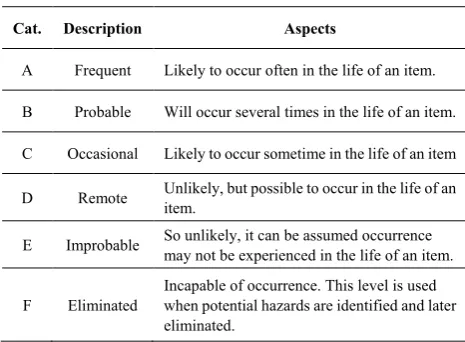
Table 1. Probability Levels
Cat. Description Aspects
A Frequent Likely to occur often in the life of an item. B Probable Will occur several times in the life of an item. C Occasional Likely to occur sometime in the life of an item D Remote Unlikely, but possible to occur in the life of an item.
E Improbable So unlikely, it can be assumed occurrence may not be experienced in the life of an item.
F Eliminated Incapable of occurrence. This level is used when potential hazards are identified and later eliminated.
Source: Mil STD 882-E
An accident scenario is defined as the combination of the identified hazard, its causes and each of its effects. According to PHA method, accident scenarios are
categorized by its frequency, which provides a qualitative indication of the expected frequency of occurrence as defined in Table 1.
2.1.6. Sixth Column: Severity Parameter
Accident scenarios are classified into categories of severity, which provide a qualitative indication of the severity of the consequences of each of the scenarios identified. Table 2 present a possible set of parameters for severity.
2.1.7. Seventh Column: Risk Assessment Code
Combining frequency category, Table 1, with severity, Table 2, one gets the risk matrix as shown in Table 3, which provides a qualitative indication of the risk level for each scenario identified in the analysis.
2.1.8. Eighth Column: Control Measures
This column contains the measures that should be taken to reduce the frequency or severity of the accident or any comments pertaining to the accident scenario under study.
Table 2. Severity Categories
Cat. Description Mishap Result Criteria
1 Catastrophic Could result in one or more of the following: death, permanent total disability, irreversible significant environmental impact, or monetary loss equal to or exceeding $10M.
2 Critical
Could result in one or more of the following: permanent partial disability, injuries or occupational illness that may result in hospitalization of at least three personnel, reversible significant environmental impact, or monetary loss equal to or exceeding $1M but less than $10M.
3 Marginal Could result in one or more of the following: injury or occupational illness resulting in one or more lost work day(s), reversible moderate environmental impact, or monetary loss equal to or exceeding $100K but less than $1M.
4 Negligible Could result in one or more of the following: injury or occupational illness not resulting in a lost work day, minimal environmental impact, or monetary loss less than $100K.
Source: Mil STD 882-E.
Table 3. Risk Assessment Matrix
SEVERITY
Catastrophic (1) Critical (2) Marginal (3) Negligible (4) PROBABILITY
Frequent (A) High High Serious Medium
Probable (B) High High Serious Medium
Occasional (C) High Serious Medium Low
Remote (D) Serious Medium Medium Low
Improbable (E) Medium Medium Medium Low
Eliminated (F) Eliminated
2.2. Classic HAZOP
The Hazard and Operability study (HazOp) is a methodology widely used qualitative risk that was developed to identify risks and operational problems through the effects of deviations from design conditions in industrial process plants [19]. It has been used effectively at any stage of the life of plants.
According to Aven [9, 10], since it is complete, systematic and relatively easy to apply, HazOp is a technique for analyzing risks and deviations within a chemical process plant.
The technique was originated in the “Division of Organic Chemistry heavy ICI, a major British and international chemical company, where in 1963 a team of three people met three days a week during four months to study the design of a new phenol and acetone from cumene factory [20]. Since then, the method has been improved in many works. Besides it was initially developed to analyze chemical process systems, it was later extended to other types of systems and also for complex operations.
A HazOp study is a disciplined procedure to identify how a process can deviate from its design conditions. The application comes from a systematic critical review of process and engineering conditions to evaluate the potential for malfunction of individual parts and/or equipment, and indirect effects on the facility as a whole [19].
The HazOp study both the security problems in order to identify the hazards that can endanger operators and equipment installation, as well as the problems of operability, which, although not dangerous, can cause loss of production or affect the product quality or the efficiency of the process. Therefore, HazOp identifies both problems that may compromise facilities’ safety as those that may cause loss of continuity or loss of the product specification.
Table 4. Lists of Guidewords
Meaning Example
NONE None of the objectives is achieved No flow MORE, BIGGER Quantitative increase in a parameter More temperature
LESS, MINOR Quantitative decrease in a parameter Less pressure
PART OF objectives is achieved Just part of the Part of the yield REVERSE Occurs the opposite of what one expects Reverse flow
OTHER Full replacement Liquids in a gas pipe Source: adapted from Rausand [21].
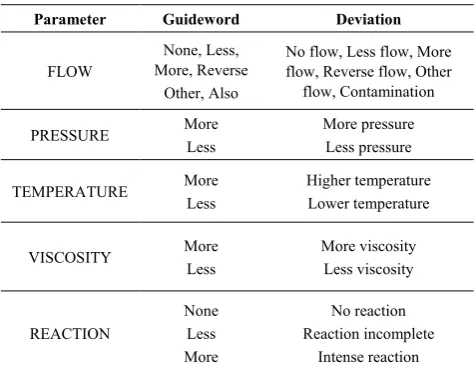
HazOp application is based on formulation questions in a structured and systematic approach, through the appropriate use of guidewords applied to critical points related to the process under analysis. From the guidewords and process parameters, deviations can be identified and further analyzed. Table 4 shows a series of standard guidewords for basic
application of HazOp, as presented by Rausand [21]. As stated previously, each guideword is applied to a process parameter to determine a deviation and each one of them is studied. Table 5 provides possible relationships between guidewords and its consequent deviations.
Table 5. Deviations and Parameters
Parameter Guideword Deviation
FLOW More, Reverse None, Less, Other, Also
No flow, Less flow, More flow, Reverse flow, Other
flow, Contamination PRESSURE More
Less
More pressure Less pressure TEMPERATURE More
Less
Higher temperature Lower temperature
VISCOSITY More Less
More viscosity Less viscosity
REACTION
None Less More
No reaction Reaction incomplete
Intense reaction Source: AUTHORS, based upon Chemical Industries Association
Once the application of the HazOp is completed, the results are recorded in a spreadsheet. The standard version for a HazOp spreadsheet has at least seven groups of information, listed as follows:
1. Parameter 2. Guideword 3. Deviation 4. Causes 5. Consequences 6. Detection
7. Mitigation / control measures
This procedure is applied to critical points of the system control point known as "nodes", which is the separation system to be studied in small sections susceptible to malfunction and defect, to ensure that all equipment and lines are analyzed [5].
After verifying causes and consequences of each type of diversion measures are proposed to mitigate or manage risk or to correct the problem of operability of the facility, such as design changes, establishments or change in operating procedures, testing and maintenance.
One of the first publications related to this methodology became available in 1974 and was called "Operability studies and hazard analysis" [19, 22]. This paper provided a guide for applying the methodology created by the Chemical Industries Association in the UK in 1977. Dunjo [19] analyzed the increase in publications in subsequent years, especially between 1996 and 2000, in which more than 40 papers on the theme were published.
of various kinds, including computer programs [21]. Galante & Haddad [23] proposed a variation for its application in the explosives industry. The study carried out by Shimada [24] proposed an integrated risk management support system which could start with a HazOp.
A HazOp study is efficient to identify deviations of a process in relation to its prescribed operation manner. It involves the application of a formal systematic review and analysis of processes [19]. This tool assesses risks for all equipment in an industrial plant. A HazOp report may review all possible deviations, as well as their causes and consequences and proposes mitigation and active or passive protection [25]. HazOp is the ideal methodology for identifying unwanted events in a system. According to Schuller [5], the soundness of the methodology is a function of the extent of the known interactions evaluated and the detail level of the analysis, and the depth of study of the identified consequences. According to this source [5], the success of a HazOp study depends on the knowledge about process and technical deviations.
A limitation of HazOp is that this approach is inherently qualitative (a "diagnostic tool") [26]. Moreover, there is the difficulty to estimate the time required for a complete HazOp study [19, 27, 28]. Another negative aspect of the traditional HazOp is the lack of risk acceptability levels and international standards, as discussed by Rouhiainen & Gunnerhed [29].
Furthermore, the work done by Labovsky [25] points out other negative characteristics of HazOp. These include the possibility that some risks are neglected due to the qualitative nature of the method. Aiming to solve these problems, the authors suggested adoption of the method associated with mathematical models, thus reducing the influence of human factors.
3. HAZOP: Quantitative Approach
Traditionally, a HazOp study and PHA are two sessions held separately, producing two databases. HazOp technique is guided by guide words application (such as no more less) to each process variable (e.g., temperature, flow, pressure) generating the deviation of operating standards (such as low- flow, the temperature). On the other hand, PHA allows the definition of risks priorities through the use frequency and severity categories to determine a risk value.
In this quantitative approach for a HazOp, the aim is for integrating it with a risk matrix. The core of this method is use the HazOp identification and diagnosis method (parameter, guideword and deviation investigation for each node). From that, the causes and consequences related to each deviation are investigated.
Upon the completion of this part of the process, one should use the PHA and risk matrix method to convert causes into frequencies, severities into consequences and, thus, determine a risk parameter (or RAC – Risk Assessment Code) to allow put risks in order of relevance.
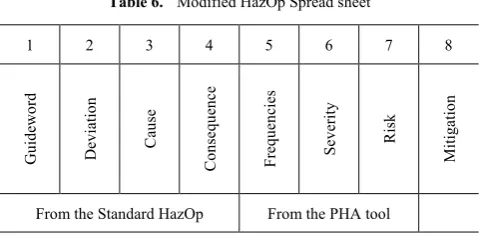
This modified HazOp should be build around the information (columns) presented in table 6. The first part of the analysis comes from a classic HazOp (columns 1 to 4), followed by the risk assessment originated from PHA (columns 4, 5 and 6). The last part is common to both classic utilization of HazOp and PHA: mitigations. However, in this case the mitigations can be put in order of relevance using the RAC.
Table 6. Modified HazOp Spread sheet
1 2 3 4 5 6 7 8
Gu
id
ewo
rd
Dev
iatio
n
Ca
use
C
ons
eque
nc
e
Fr
eq
uen
cies
Sev
er
ity
Ri
sk
M
itig
atio
n
From the Standard HazOp From the PHA tool Source: Authors
This risk categorization promotes experience sharing among staff members and standardizes the level of knowledge by generating useful information for subsequent analysis, especially for quantitative assessments of risk. In addition, it generates a better understanding of the unit functioning and awareness of the risk management importance since simple deviations can generate operational consequences of great magnitude.
Thus, it is possible to systematically identify the ways in which the equipment constituting the industrial process may fail or be improperly operated, which would lead to unwanted operating situations and categorize the risk in order to prioritize the measures.
4
. Conclusions
As a conclusion, this work provides a hybrid methodology between HazOp and the PHA. This risk assessment method combines the strengths of of both HazOp (systematic investigation of deviations, causes and effects) and PHA (possibility to determine an order of relevance for risks). The HazOp contributes with its structure, procedure and its systematic approach (mainly the use of nodes, keywords and deviations), while the use of risk matrix brings to this technique the capability to prioritize risks and deviations, in other to provide information to a more detailed implementation plan.
ACKNOWLEDGEMENTS
REFERENCES
[1] W. Hammer, Product safety management and engineering, 2nd ed. Amer Society of Safety Engineers, 1993, p. 311. [2] ISO, ISO 31.000 - Risk Management - Principles and
Guidelines, vol. 2009. Geneva, Switzerland: International Organisation for Standardization., 2009.
[3] E. Hollnagel, “Risk+barriers=safety?,” Saf. Sci., vol. 46, no. 2, pp. 221–229, Feb. 2008.
[4] Australian and N. Zeland, AS/NZS 4360:2004-Risk Management. Australian & New Zealand: Australian & New Zealand, 2004.
[5] J. C. H. Schuller, J. L. Brinkman, P. J. Van Gester, and R. W. Van Otterloo, “‘Red Book’ - CPR 12E - Methods for determiming and processing probabilities,” CPR 12 E - Committee for Prevention of Disasters, Netherlands, 1997. [6] D.-D. of Defence, MIL STD 882-C-SYSTEM SAFETY
PROGRAM REQUIREMENTS. 1993.
[7] D.-D. of Defence, MIL STD 882-D - Standard Practice for System Safety, no. January 1993. Washington, USA: USA, 2000.
[8] D.-D. of Defence, MIL STD 882-E - Standard Practice for System Safety, no. February 2000. Washington, USA: USA, 2012.
[9] R. Steen and T. Aven, “A risk perspective suitable for resilience engineering,” Saf. Sci., vol. 49, no. 2, pp. 292–297, Feb. 2011.
[10] T. Aven, “A risk concept applicable for both probabilistic and non-probabilistic perspectives,” Saf. Sci., vol. 49, no. 8–9, pp. 1080–1086, Oct. 2011.
[11] T. Aven, O. Renn, and E. a. Rosa, “On the ontological status of the concept of risk,” Saf. Sci., vol. 49, no. 8–9, pp. 1074–1079, Oct. 2011.
[12] T. Aven, “On the critique of Beck’s view on risk and risk analysis,” Saf. Sci., vol. 50, no. 4, pp. 1043–1048, Apr. 2012. [13] S. J. . J. Wakeman, P. W. H. . W. H. e Chung, P. M. . M. Heino, M. L. . L. Jefferson, S. A. . b McCoy, F. D. . Larkin, A. G. . Rushton, and F. P. . c Lees, “HAZID, a computer aid for hazard identification. 1. The STOPHAZ package and the HAZID code: An overview, the issues and the structure,” Process Saf. Environ. Prot. Trans. Inst. Chem. Eng. Part B, vol. 77, no. 6, pp. 317–327, 1999.
[14] S. A. . b McCoy, S. J. . Wakeman, F. D. . Larkin, P. W. H. . d Chung, A. G. . Rushton, F. P. . c Lees, U. Models, and M. Library, “HAZID, a computer aid for hazard identification. 2. Unit model system,” Process Saf. Environ. Prot. Trans. Inst. Chem. Eng. Part B, vol. 77, no. 6, pp. 328–334, 1999. [15] S. A. . b McCoy, S. J. . Wakeman, F. D. . Larkin, P. W. H. . e
Chung, A. G. . Rushton, F. P. . c Lees, and P. M. . Heino, “HAZID, a computer aid for hazard identification. 3. The fluid model and consequence evaluation systems,” Process Saf. Environ. Prot. Trans. Inst. Chem. Eng. Part B, vol. 77, no. 6, pp. 335–353, 1999.
[16] P. W. H. . W. H. c Chung, S. A. . A. McCoy, S. J. . J. Wakeman, F. D. . D. Larkin, A. G. . G. Rushton, F. P. . P. b Lees, L. Set, M. S. System, and O. Quality, “HAZID, a computer aid for hazard identification: 4. Learning set, main study system, output quality and validation trials,” Process Saf. Environ. Prot., vol. 78, no. 2, pp. 91–119, 2000. [17] S. A. . McCoy, S. J. . Wakeman, F. D. . Larkin, P. W. H. . c
Chung, A. G. . Rushton, and F. P. . b Lees, “HAZID, a computer aid for hazard identification: 5. Future development topics and conclusions,” Process Saf. Environ. Prot., vol. 78, no. 2, pp. 120–142, 2000.
[18] A. Haddad, E. Galante, R. Caldas, and C. Morgado, “Hazard Matrix Application in Health, Safety and Environmental Management Risk Evaluation,” in InTech, 2012.
[19] J. Dunjó, V. Fthenakis, J. a Vílchez, and J. Arnaldos, “Hazard and operability (HAZOP) analysis. A literature review.,” J. Hazard. Mater., vol. 173, no. 1–3, pp. 19–32, Jan. 2010. [20] T. Kletz, What Went Wrong?, Fifth Edition: Case Histories of
Process Plant Disasters and How They Could Have Been Avoided, 5th ed. Oxford, UK: Elsevier Inc., 2009.
[21] M. Rausand and A. Hoyland, HAZOP – Hazard and Operability Study. System Reliability Theory; Models, Statistical Methods and Applications, Second Edi. New York: John Wiley & Sons, 2011.
[22] T. Kletz, “Hazop—past and future,” Reliab. Eng. Syst. Saf., vol. 55, pp. 263–266, 1997.
[23] E. Galante and A. Haddad, “Risk analysis procedures for explosives manufact ...,” in Advances in Safety, Reliability and Risk Management - Proceedings of the European Safety and Reliability Conference, ESREL 2009, 2009, p. 2009. [24] Y. Shimada, T. Kitajima, and Y. Ling, “Integrated risk
management system based on IPL concept for chemical processes,” in 11th International Probabilistic Safety Assessment and Management Conference and the Annual European Safety and Reliability Conference 2012, PSAM11 ESREL 2012,, 2012, pp. 4657–4666.
[25] J. Labovský, Z. Švandová, J. Markoš, and L. Jelemenský, “Model-based HAZOP study of a real MTBE plant,” J. Loss Prev. Process Ind., vol. 20, no. 7, pp. 230–237, 2007. [26] F. Crawley, M. Preston, and B. Tyler, HAZOP: Guide to best
practice. Guidelines to best practice for the process and chemical industries. Institution of Chemical Engineers (Great Britain), European Process Safety Centre. United Kingdom: The Cromwell Press, 2000.
[27] K. Freeman, R. Lee, and T. Mcnamara, “Plan HAZOP studies with an expert system,” Chem. Eng. Prog., vol. 88, no. 8, pp. 28–32, 1992.
[28] F. I. Khan and S. A. Abbasi, “Tophazop: a knowledge-based software tool for conducting HAZOP in a rapid, efficient yet inexpensive manner,” J. Loss Prev. Process Ind., vol. 10, no. 5–6, pp. 333–343, 1997.