Mean Square Error of Blind Channel Estimation Using
a Constant Modulus Algorithm
Zachaeus K. Adeyemo
Department of Electronic and Electrical Engineering, Ladoke Akintola University of Technology, PMB 4000, Ogbomoso, NigeriaAyobami O. Fawole
Department of Electrical Engineering, The Polytechnic Ibadan, PMB 22, U.I. Post Office,Ibadan, Nigeria. Email of the corresponding author: [email protected]
Robert O. Abolade
Department of Electronic and Electrical Engineering, Ladoke Akintola University of Technology, PMB 4000, Ogbomoso, NigeriaAbstract – Channel Estimation (CE) in multicarrier system especially in Orthogonal Frequency Division Multiplexing (OFDM) systems has become an important technique in wireless communication to reduce the overall effect of high data rate and increase links performance. In wireless channel, which has frequency selective distribution, the transmitted signals are corrupted and resulted in high error at the receiver. However, the existing techniques in use such as Least Square Estimation (LSE), Minimum Mean Square Error (MMSE) are based on single carrier system with pilot symbols for channel estimation to reduce the error. Therefore, in this paper, investigation of the performance of blind channel estimation in sixteen (16) subcarriers OFDM system using a Constant Modulus Algorithm (CMA) is carried out. The system model for sixteen subcarriers OFDM incorporating CMA is developed over the frequency selective fading channel. OFDM system consists of the following signal processing techniques; sixteen channel demultiplexer, Inverse Fast Fourier transform (IFFT), Cyclic Prefix (CP), sixteen channels multiplexer and the Radio Frequency (RF) transmit antenna all at the transmitter. Also, at the receiver are RF receive antenna, sixteen channel demultiplexer, Fast Fourier transform (FFT), sixteen channel multiplexer, Cyclic Prefix (CP) removal and decoder. The input data are generated randomly, converted to bits and divided among the subcarriers to reduce overlapping of bits. The signal processing techniques at both the transmitter and receiver process the signal. The system model is simulated by MATLAB application package and evaluated using Mean Square Error (MSE). This is now compared with the LSE and MMSE estimation. The results obtained using 16-subcarrier OFDM with CMA give lower MSE than with LSE over frequency selective environment.
Keywords – OFDM, Subcarriers, IFFT, Pilots, Blind Channel.
I.
I
NTRODUCTIONWireless communications allow people to communicate without physical connection over long distances. The wireless channel consists of many objects such as building, mountains, foliages and moving cars. These objects served as obstruction to the transmitted signal by scattering resulting in multipath propagation. The overall effects of these are signal fading, Delay spread, and Doppler spread. These are used in the classification of channel in which frequency selective is identified due to high delay spread. So when high data rate is transmitted over the frequency selective channel, It resulted in high error at the receiver. In order to recover the transmitted bits, these channel effects need to be compensated for at
the receiver. Therefore, channel estimation is the process of obtaining the information about the channel which will be supplied to both transmitter and receiver for decoding [17],[10],[16],[14],[6],[13],[23].
According to [3], the channel state information can be obtained by using channel estimation at the receiver, because the OFDM system using coherent modulation needs channel state information to decode the transmitted signal at the receiver. Channel estimation is grouped into three categories namely: blind, semi-blind and non-blind techniques. The blind deals with getting the statistical information of the channel and the properties of transmitted signal, while the non-blind uses some portions of the transmitted signal, that is, pilot tones as training sequence. The pilot structures are classified into three groups namely: block type in which all the subcarriers are used as pilot tones in OFDM system and transmitted periodically, and secondly, a comb-type which has some of the subcarriers as pilot tones in each of the OFDM blocks. Thirdly is the lattice type in which the pilot tones are scattered in both time and frequency correlations of the channel while frequency correlation is used for low complexity estimators [4],[15],[20],[24],[7],[12].
Copyright © 2016 IJECCE, All right reserved
is evaluated using Mean Square Error
(MSE)[1],[2],[11],[5],[8],[9],[18],[19],[21],[22].
A. Constant Modulus Algorithm
According to [20] CMA minimizes the dispersion of the output around a circular contour and the cost function for faster convergence. The algorithm continues adjusting the filter coefficients to minimize the modulus error. It is used to reduce the error encountered in the channel. This error is as a result of distortion which is caused by band-limiting effect in the channel. These effects result in Intersymbol Interference (ISI). CMA maintains the output of adaptive filter to have constant amplitude. The following steps are carried out to achieve constant modulus algorithm using the CMA model shown in Figure 1. The CMA filter coefficient is initialized by setting
= 1 = 2 0 ℎ (1)
The incoming signal r(n) is filtered to give y(n) using y = r (2) This is then estimated using zero- memory non-linear estimator to give x that acts as the desired response. The estimation is carried out using
x = y1 + − || (3)
The error eis obtained by finding the difference between the estimation output and the filter output, that is, e = − (4) Then the filter coefficient is adjusted to update the filter coefficient. The whole process continues until stabilization or constant convergence is achieved.
Fig. 1. CMA estimation
B. Least Square Estimation
This is in form of coherent data detection in communication system. The transmitted and the received signal in vector form are expressed by [2] as
= , !, , " … … , , " − 1 (5)
= , "!, , " … … . , , " − 1 (6)
Where "!= 0, "= 1, "%= 2 … … … . . " = 15 are the numbers of subcarriers in an OFDM symbol.
The ratio of to gives the frequency response of the channel denoted by '
Therefore, the estimated frequency response of the channel
', " = (,)*,) , + " = 0,1,2, … . . " − 1 (7) The conjugate of the transmitted signal is ∗, "
The estimated channel frequency response ', " is given by [2] as
', " = , "∗, ", + " = 0,1, … … . .15 (8)
This indicates that the frequency response of the channel in each of 16 subcarriers OFDM is independent of each other. Though, LE estimation has low complexity and easy to implement but at the expense of large Mean Square Error (MSE).
In [3], LS channel method obtains channel estimate
' in such a way that the cost function is minimized
-. = /0 − 12/ (9) where;
2is the estimate of channel'", -. R is the received training signal Equation (9) becomes
3' = 0 − 120 − 12
Where. is Hermitian transpose (10)
3' = 00 − 0' − -.45 + -.44' (11)
36'7, "8;= ∑)<!);=|, " − ∑ '!:7;! 7 , "7, "| (12)
= ∑)<!);=|, " − ∑ ∑!:7;! )D<!7;= ℎ7, "> ?−@2A"B " C | (13)
where"= is the channel delay profiles
Finding the partial derivative with respect to ' and equate to zero
EF2
E2 = −210∗+ 2112 ∗
= 0 (14) But 1∗12 = 1∗0. GH ℎ I4 JℎKB K,
2LM= 11<! 10 = 1<N0 (15)
Therefore, according to [3], O4PLM= QRS
QTS where U
is
the variance of the noise, U* is the variance of the transmitted signal
C. Minimum Mean Square Estimation
This provides better performance in terms of MSE than LS estimator. The estimator makes use of several parameters such as Signal to Noise Ratio (SNR) as well as second-order statistics of the channel [1].
From the minimization of the LS cost function
'LM= 1<N0 (16)
When the weight matrix Vis considered and defined by
'WWMX = V'LM
That is,2WWMX= V4<!0 corresponds to OO4P. (17)
O4P of the channel estimate 'WWMX is given by [3] as MSEMMSE' = P‖‖= P6||' − 'WWMX8 (18)
where E[ ] is the expected value of ‘e’
II.
M
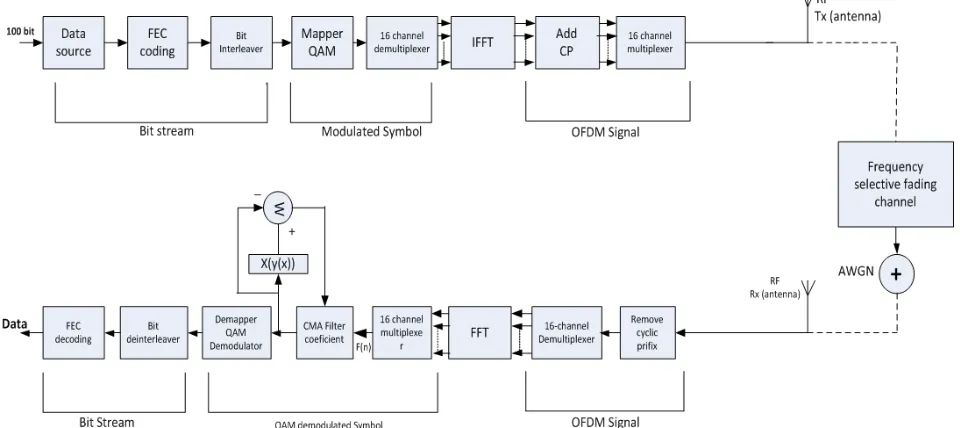
ETHODOLOGYconsists of bits stream, modulated symbol, OFDM signal and RF transmit antenna. The bit stream consists of general data, Forward Error Correction (FEC) and bit inter leaver. This serves as input to the QAM signaling scheme for up conversion to Radio Frequency (RF) signal. The QAM modulated signal is converted to 16 subcarriers or 16 channel by demultiplexer. This is, then, converted to time domain by the Inverse Fast Fourier Transform (IFFT) in which cyclic prefix is added to OFDM symbol time to have larger interval than the expected delay spread of the channel to eliminate ISI caused by the adjacent OFDM symbols. The OFDM signals at the transmitter consists of the addition of cyclic prefix, 16-channel multiplexer to convert to a single carrier for transmission through the RF transmit antenna. The OFDM signal passes through the frequency selective channel. The received signal through the RF receive antenna is demultiplexed into 16 subcarriers after cyclic removal. The 16 subcarriers are converted to digital signal and multiplexed by 16 channels multiplexer.
The signal is estimated using CMA by filtering, updating the filter coefficient until there is stabilization in
the amplitude. The estimated signal is demodulated using QAM to recover the transmitted signal, interleaved and decoded. Fig. 2 is the simulation model for estimation. The 16 subcarriers are used to overcome the frequency selectivity of the wideband channel due to single-carrier transmission. The model is simulated using MATLAB application package.
The OFDM signal in time varying channel is expressed by [3] as
= ∑!\);="Z[)R!: (19) where ] = 15, the corresponding signal received through a time varying wireless channel with L paths can be expressed by [3] as
= ∑L<!7;=ℎ7 − ^7 + ɳ (20) where ℎ7 is the impulse response.
^7 is the delay time for the `a path
( )
n
η
is the noiseTaking the Fast Fourier Transform (FFT) of equation (20) gives
Fig. 2. Simulation model for 16-subcarrier OFDM system incorporating CMA
" = !:!∑ > ?−@2A"
15 C
!\
;= (21)
" = ∑!\b;=∑ 'c<!7;= 7" − > ?−@2Ab C15 +
" (22) Where " is the FFT of
η
( )
n
'7"is the impulse response ℎ7 '7= !
!:∑!\;=ℎ7> ?−@2A" 15 C (23)
A.
Simulation Parameters
The simulation parameters used for the modeling are contained in Table 1
Table 1. Simulation Parameters
Parameters Specification
Channel Frequency selective channel
Modulation Scheme QAM
Noise AWGN
Serial to Parallel 16 Channel Demultiplexer Parallel to Serial 16 Channel Demultiplexer
SNR (dB) 5 (5) 30
Number of Subcarrier 16
Symbol Period 2.5ms
Maximum Excess delay 3.5ms CMA Algorithm step size 0.11
CMA filter order 11
Pilot Symbol 256
Copyright © 2016 IJECCE, All right reserved
III. R
ESULTS ANDD
ISCUSSIONThe performance of 16 subcarriers OFDM system with blind channel estimation especially ‘CMA’ has been evaluated using Mean Square Error (MSE), this is compared with the LS and MMSE under non-blind channel estimation adapted from [13] for comparison. The MSE values obtained for commonly used LS and MMSE are presented in Fig.3. At SNR of 5dB, the MSE value obtained for LSE and MMSE are 0.24 and 0.036 respectively, while at SNR of 20dB, 7.2 × 10<% and
2.6 × 10<% are the MSE values for LSE and MMSE
respectively. Fig.4 depicts the MSE results of 16 subcarriers OFDM incorporating CMA. At SNR of 10dB MSE of 2.010<% is obtained while at SNR of 20dB, MSE of 6.0 × 10<g is obtained. Fig. 5 shows the
simulation of MSE versus SNR for the combination of OFDM incorporating CMA, LSE and MMSE. From the Fig.5 at SNR of 10dB, the MSE values obtained are 2.0 ×
10<% , 7.2 × 10<, 1.7 × 10< for CMA, LSE and MMSE
respectively.
These results are justifiable in that the LS estimation assumes independent components of the frequency response which does not use the correlation properties of the channel making it sensitive to error. The transmission of efficiencies of LSE and MMSE are reduced because of the additive effect of training symbol such as pilot tones which transmitted with data symbol. The inclusion of weight makes MMSE to have reduced MSE. Though CMA is not commonly used with OFDM system but has the lowest MSE values indicating the best performance under the stated simulation parameters.
Fig. 3. Simulation of MSE versus SNR for LSE and MMSE adapted from [13] for comparison
Fig. 4. Simulation of MSE versus SNR for CMA
0.0001 0.001 0.01 0.1 1
5 10 15 20 25 30
M
S
E
SNR (dB)
Fig. 5. Simulation of MSE versus SNR for CMA, LSE and MMSE
IV. C
ONCLUSIONIn this paper, Mean Square Error (MSE) of blind channel estimation using a constant modulus algorithm in 16-subcarrier OFDM system over frequency selective fading channel has been investigated. The system model for 16-subcarrier OFDM inserted with pilot tones has been developed over frequency selective channel. The channel is properly estimated for LSE and MMSE. Then, the system model for 16-subcarrier OFDM incorporating CMA is also developed over the same channel. These system models are simulated and evaluated in term of MSE. The results obtained show that pilot tones are inserted at each subcarrier which reduces the transmission efficiency but the performance is worse than CMA under the parameters considered. The performance, in this paper, has shown that CMA can still be used with OFDM for proper channel estimation.
R
EFERENCES[1] F. A. Farzad, ‘‘Low-complexity and filter-tap memory optimized channel estimation in multi-mode and multi-standard OFDM systems’’, Thesis for the degree of Licentiate in Engineering,
Lund University, Lund, Sweden ,2011.
[2] B. S. Mumtaz, ‘‘Channel Estimation Techniques for single and Multiple Transmit Antenna Orthogonal Frequency Division Multiplexing (OFDM) Systems’’, Department of Electronic and
Computer Engineering, Naval Postgraduate School, Turkish,
2005.
[3] C. Yong, K. Jaekwon, Y. Y. Won and G. K. Chung,
‘‘MIMO-OFDM wireless communication with MATLAB, John Wiley and
son, Asia’’, 2010.
[4] K. Vidhya, K, and K. R. Shankar Kumar, ‘‘Pilot based channel estimation for MIMO-OFDM system’’, International Journal of
Computer Networks and Wireless communications, 2013, vol. 3,
no 2, pp. 97-101.
[5] P. A. Idd, “Channel Estimation in Mobile Wireless Systems”, M.Tech Thesis, Royal Institute of Technology Stockholm,
Sweden, 2012.
[6] G. Juhi, G. Kapil, and P. K. Ghosh, “Performance Analysis of MIMO wireless Communication over Fading Channel”,
International Journal of Advanced Research in Electrical, Electronics and Instrumentation Engineering, 2013, vol. 2,no.4,
pp. 1272-1302.
[7] R. K. Kahlon, G. S. Walia, and A. Sheetal, ‘‘Channel Estimation Techniques in MIMO-OFDM Systems”, International Journal of
Advanced Research in Computer and Communication Engineering, 2015,vol. 4, no. 5, pp 637-642
[8] P. K. Pradhan, S. K. Patra, O. Faust, and B.K. Chua, “Channel Estimation Algorithms for OFDM Systems”, International
Journal of Signal and Imaging Systems Engineering, 2012, vol.5,
no.4, pp. 267 – 273.
[9] O. Pragati, and K. G. Sharad, “Basics of OFDM and Characteristics of Mobile Radio Channel”, International Journal
of Engineering Research Online, 2015, vol. 3, no 4, pp 447- 452.
[10] Z. K. Adeyemo, and T. I. Raji, “Bit Error Rate Analysis for Wireless links using Adaptive Combining Diversity” Journal of
Theoretical and Applied Information Technology, 2010, 8(1):
58-66.
[11] J. Alam, and G. A. S. Shaha Mohammed, “Low Complexity Channel Estimation of OFDM systems based on LS and MMSE estimators”.M.Sc Thesis, Electrical Engineering, Blekinge
Institute of Technology, 2010.
[12] M. Ali, R. Elahi, A. Saljuk, and S. Bukhari, “Channel Estimation of MIMO OFDM Systems”. M.SC Thesis, Electrical
Engineering National University of Sciences and Technology, Rawalpindi, 2008.
[13] K. P. Anil, “Channel Estimation in OFDM Systems”, M.Tech.
Thesis, National Institute of Technology, Rourkela, 2007..
[14] S. Bernard, “Rayleigh Fading Channels in Mobile Digital Communication System”, IEEE Communication Magazine, 1997, vol. 48, no. 25, pp. 102-109
[15] L. Cao, and C.W. Chen, “A Trellis-based Technique for Blind Channel Estimation and Equalization”. Journal of Communication and Networks, 2003, vol. 30, no. 3, pp 1-7
[16] M. Gayatri, and A. Vamisidar, “Analysis of Multipath Fading Profile Provision in Multiple Access System Grids”, Journal of
Electronics and Communication Engineering, 2015, vol. 10,
no.5, pp 79-86.
[17] T. S. Rappaport, “Wireless Communication Principles and Practice”, second edition, upper saddle river, New jersey ,2002. [18] A. G. Sajjad, A. Sheraz, M. F. Sohail, and F. S. Asadali,
Copyright © 2016 IJECCE, All right reserved and MMSE Estimator”, International Journal of Computer and
Electronic Research, 2013, vol 2, no 1, pp 41- 46.
[19] P. Srishtansh, and S. Himanshu, “Channel Estimation of OFDM Systems in Slow and Fast Fading Channels”, International
Journal of Advances in Computing and Information Technology,
2012, vol. 1, no 6, pp 532-542
[20] V. Swathi, K. Rajani, and K. V. Padmaja, “Blind Equalization based on Modified Constant Algorithm”, International Journal
Advanced Research in Computer and Communication Engineering, 2014, vol 3, no 4, pp 6523-6525
[21] P. S. Varinder, and K. Abhishek, “Performance of Channel Estimation in MIMO-OFDM”, International Journal of
Engineering Research and Application, 2013, vol. 3, no. 3 pp.
1388-1393
[22] A. Tejasivi, and K. Suresh, ‘‘Pilot Symbol Estimation Techniques in OFDM System’’ International of Computational
Linguistics and Natural Languages processing, 2012,vol.3, no.4,
pp. 113-118
[23] S. Yushi and M. Ed “Channel Estimation in OFDM Systems”,
International Journal of Engineering Research and Application,
2006, vol 7, no. 5, pp 1-16.
[24] A. Zaier, and R. Bouallegue, “Blind Channel Estimation Enhancement for MIMO-OFDM Systems under High Mobility Conditions”, International Journal of Wireless and Mobile
Networks, 2012, vol. 4, no. 1, pp 207-214
A
UTHORS’
P
ROFILEAdeyemo, Zachaeus Kayode holds a B.Eng., M.Eng.
in Electrical Engineering from University of Ilorin, Ilorin, Nigeria. He obtained his Ph.D in Electronic and Electrical Engineering from Ladoke Akintola University of Technology, Ogbomoso, Nigeria. Dr. Adeyemo has been teaching Communication Engineering courses at both undergraduate and postgraduate levels for over Twenty years. He has been an external examiner for both undergraduate and postgraduate programmes to some Universities and an editorial member of some reputable journals. In addition, he has an administrative experience spanning over fifteen years. He is a Corporate Member of Nigerian Society of Engineers (CMNSE), Registered Member of Council for the Regulation of Engineering in Nigeria (COREN). His research areas are mobile wireless communications, mobile satellite communications, and antenna diversity.
Fawole, Ayobami Olatunde is an assistant Lecturer in
the department of Electrical Engineering at The Polytechnic Ibadan, Oyo State, Nigeria. He graduated from the Department of Electronic and Electrical Engineering, Ladoke Akintola University of Technology, Ogbomoso, Nigeria in 2010 (LAUTECH). He also finished his Master of Technology, M.Tech. (Electronic and Electrical Engineering) in 2016 and specializes in Mobile and Wireless Communication.
Engr. Dr. ABOLADE, Robert Oluwayimika is a