Designing a Spatial Adaptive Processor in Phase
Array Radar Application Emphasizing
Simplification of Hardware
Vajiheh. Mahjoorian
*and M.R. Moniri
Department of Electrical Electronics Engineering. Yadegar-e-Imam Khomeini (RAH) Shahre Rey Branch. Islamic Azad University, Tehran, Iran.
Date of publication (dd/mm/yyyy): 05/05/2019
Abstract – Technology is changing our world at an astonishing pace and this speed can sense more in all the telecommunication fields such as radar systems. At first smart antenna noticed because could cover all the requirements with using different techniques such as improving thereceived signal strength, weakening the interfering signal, and increasing totally SNR of the system. In This paper analyses and compares methods that cause improving radars system performance which are Least Mean Square (LMS), Sign and Sign-Sign algorithms. The comparisons are based on system performance improvement. In addition, radiation pattern obtained for the specified adaptive beam forming algorithm by providing system.
Keywords –Adaptive algorithms, LMS, SIGN, SIGN-SIGN.
I.
I
NTRODUCTIONIn the using smart antenna makes space processing of the signal rather than doppler processing, they are also considered for improving the performance of wireless communication in different field [7] [9]. Smart antenna is the combination of array antenna and signal processing in both space and time [12]. Spatial processing lets more degrees of freedom in system design, which helps in totally system performance improvement [11] [16]. Using these algorithms with smart antenna makes the overall price cost of system from construction of electronic circuits lower and lower. A smart antenna is a phased or adaptive array that adjusts to the environment. In adaptive arrays, the beam pattern changes by the desired user and interference movement and in the phased array the beam is steering or different beams are selecting with the movement desired signal.
According to previous studies, LMS algorithm was introduced for the first time by Widrow and Hoff [8], analysis LMS, RLS and SMI [18], approximate multiple in LMS [19], new variable step size [20], convergence analysis of Sign-Sign and LMS [21]. About using adaptive filter algorithm, it can be considered as a new reliable algorithm in different situation and application. These studies consist of improving radar performance over adaptive algorithm [1-10], the best algorithm in different AOA and application [17]. These studies consist of LMS algorithm [18].
It must be noted that the authors have already mentioned interesting feature and advantages of sign and sign-sign algorithm [17]. In this paper, we investigate LMS, Sign and Sign-Sign in new condition. We also use different adaptive filter.
II.
A
DAPTIVEB
EAMF
ORMINGA
LGORITHMScoefficients in the same time also with good filtering performance [10]. An adaptive algorithm used a set of recursive equations to adjust weight vector w(n) automatically to minimize the error signal e(n). In the process the weight vector convergence iteratively to the optimum solution w0 that accord with the bottom of the performance surface, the minimum MSE at Jmin and estimating the radiation pattern for given interesting signals [14].
A
. Least Mean Square (LMS) Algorithm
Actually, the simplest algorithm is the Least Mean Square (LMS) algorithm which has many advantages such as low complexity in computational and simplicity in implementation. Widrow and Hoff [8] developed the Least Mean Square (LMS) algorithm at first through their studies of pattern recognition. Then it has become one of the most widely used algorithms in adaptive filtering [7, 12]. The LMS algorithm is a type of adaptive filter known as stochastic gradient-based algorithms as utilizes gradient vector of the filter tap weights to converge on the optimal wiener solution. It is well known and widely used due to its computational simplicity [16]. This simplicity is the most advantages for use more than other adaptive algorithms. In term of hardware totally price is cheaper than others.
The LMS filtering equation is below: ( ) T( ) ( )
y n w n x n (1)
And the error equation is: ( ) ( ) ( )
e n d n y n (2)
W (n) is the tap-weight vector, x(n) input vector and d(n) desired output, ( )y n is output of filter, w n( 1)
tap-weight vector update.
Each iteration of the LMS algorithm, the filter weights of adaptive filter are updated according to the following equation.
( 1) ( ) 2 ( ) ( )
w n w n e n x n (3)
Minimum of error occurs, when the gradient is zero. So the solution for optimal tap- weight is wiener solution as given by:
1
opt xx
w R r (4)
Where, Rxx is the correlation matrix.
The convergence of the LMS algorithm is directly proportional to the step size parameter µ.
B
. SIGN Algorithm
This algorithm is derivational from conventional LMS recursion (3) by replacing e(n) with its sign. This leads to following recursion:
( 1) ( ) 2 ( ( )) ( )
w n w n sign e n x n
(5)
-cursion. Furthermore, the step-size parameter is usually selected to be a power of two, so that no multiplication would be required for implementing the recursion (3).
C
. Signed-Regressor Algorithm
This algorithm obtained from the conventional LMS algorithm recursion (3) by replacing the tap-input vector x(n) with the vector sign (x(n)), where the sign function is applied to the vector x(n) on element-by-element basis. The signed-regressor recursion is then:
( 1) ( ) 2 ( ) ( ( ))
w n w n e n sign x n (6)
D
. SIGN-SIGN Algorithm
The sign-sign algorithm, as may be understood from its name combines the sign and signed-regressor recursions together, resulting in the following recursion:
( 1) ( ) 2 ( ( )) ( ( ))
w n w n sign e n sign x n (7)
III. C
OMPARISON OFA
LGORITHMS ONB
ASIS OFD
IFFERENTP
ARAMETERThis section shows LMS, SIGN, SIGN-SIGN algorithms simulations, separately and comparison between three algorithms.
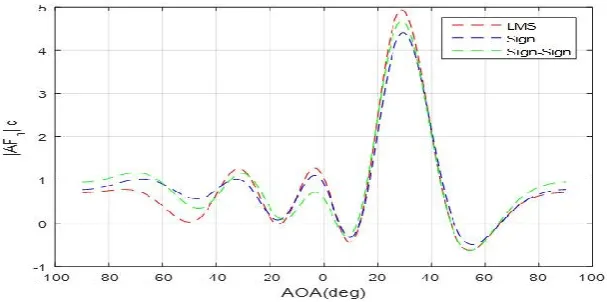
Fig.1 LMS, SIGN and SIGN-SIGN algorithms comparison in desired angle of arrival in 30 degree.
In figure.1 have compared desired angle of arrival in 30 degree for LMS,SIGN and SIGN-SIGN algorithms when the desired signal has been taken at 200 and interfere signal is taken at 500.
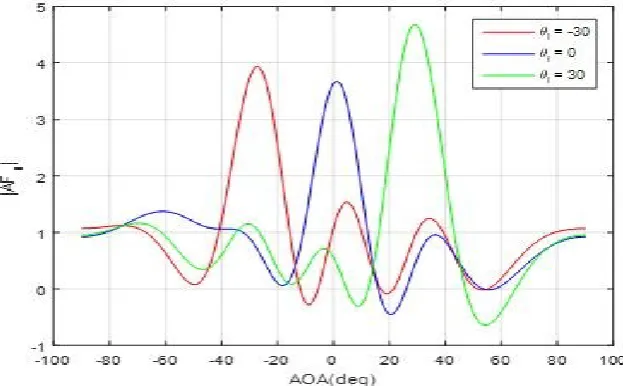
In figure.2 have compared desired angles of arrival in -30, 0, 30 degrees for LMS algorithm, when the desired signal has been taken at 200 and interfere signal is taken at 500.
Fig. 3. Weighted with SIGN algorithm with angles of arrival in degrees.
In figure.3 have compared desired angles of arrival in -30, 0, 30 degrees for SIGN algorithm, when the desired signal has been taken at 200 and interfere signal is taken at 500.
Fig. 4. Weighted with SIGN-SIGN algorithm with angles of arrival in degrees.
In figure.4 have compared SIGN-SIGN algorithm in desired angles of arrival 30, 0, - 30 in degrees, when the desired signal has been taken at 200 and interfere signal is taken at 500.
As you see in figure.1 the simulations of algorithm shows in the peaks they have low difference, that isn’t more than 2db. In other figures follow this model. It means that these differences not more than like figure.1.
So it seems that, due to the briefly hardware, again this hardware that achieve from this algorithm can be good suggestion.
IV.
C
ONCLUSIONThis paper has been presented with consideration of the simulation of algorithms (LMS, SIGN, and SIGN-SIGN) in the worst condition, amplitudes in the peak they have less than 2db. It is suggested to use LMS algorithm because it has simplicity in computation, implementation, so that it makes lower totally price. Then it is suggested to use SIGN algorithm, which is better than LMS algorithm. It means that also in the computation and implementation, is simpler. With use SIGN algorithm totally price is lower than LMS algorithm .In SIGN algorithm can be used comparator instead of A/D so it makes more economy too.
R
EFERENCES [1] R. Nitzberg, Radar Signal Processing and Adaptive Systems, Artech House, 1999. [2] Filipo. Neri, Introduction to Electronic Defense System,” 2001.[3] Alan J. Fenn, Donald H. Temme, William P. Delaney and William E. Counrtney, “The Development of Phased Array Radar Technology,” Lincoln LABRATORY Journal on, vol. 12, no.2, p. 162, 2000.
[4] M.I. Skolnik, ‘Introduction to radar systems,’ Boston, McGraw Hill, 2001.
[5] A. Farina, ‘Antenna-Based Signal Processing Techniques for Radar System,’ The Opportunity. Defense Technical Information Center, 2006.
[6] Dr. Ulrich Nickel, “Fundamental of Signal Processing for phase array Radar,” Educational Notes RTO-EN-SET086, paper, 2006. [7] Constantine A.balanis, “Antenna Theory Analysis and Design,”3/e 2005.
[8] Sergey Makarov and Chuch Fung,’Basic Antenna Theory and Application’, 2011. [9] Frank B.Gross,’Smart antenna for Wireless Communication with MATLAB’, 1/e 2006.
[10] T.Cover, A.el Gamal, ’Capacity Theorems for the Relay Channel ‘, IEEE Trans.on Information Theory, vol. IT-25, no.5, pp.572-584, September 1979.
[11] Ajoy Kumar Dey, Susmita Saha, “Adaptive Systems Simulation and Noise Analysis Toolbox (ASSNAT): The Open-Source Toolbox Developed with Newer Features for Adaptive System Simulation, “Universal Journal of Computer Science and Engineering Technology, 93-98, Nov. 2010 UniCSE, ISSN: 2219-2158.
[12] B.Widrow, “Adaptive Noise Canceling, “proc IEEE, vol .63, pp.1692-1716, Dec 1975.
[13] B. Widrow, J.R. Glover, Jr .J.M. McCool, J. Kaunitz, C.S. Williams R.H Hoboken. Hearn, J.R. Zeidler, E. Dong Jr. and R.C. Goodling, “Adaptive Noise Cancelling: Principles and applications, “Proc.of the IEEE, vol.63, no.12, pp.1692-1716, December 1975.
[14] A.Sayed, ’Fundamentals of Adaptive Filtering’, 1/e.John Wiley and Sons, NJ, 2003.
[15] B.Krstajic et al., ‘Combined Adaptive Filter with LMS Based Algorithms, ‘Urban and Fischer Verlag, International Journal of Electronics and Communication.
[16] V .J .Mathews and Z.Xie,’A Stochastic Gradient Adaptive Filter with Gradient Adaptive Step Size’, IEEE Trans.Signal Processing, vol.41, pp.20752087, June 1993.
[17] Behrouz Farhang-Broujeny, ’Adaptive Filters Theory and Application’, Second edition, 2013.
[18] Vijendra Mishra and Gaurav Chaitanya,’ Analysis of LMS, RLS and SMI Algorithm on the Basis of Physical Parameters for Smart Antenna’, 2014 Conference on IT in Business, Industry and Government (CSIBIG), IEEE 2014.
[19] Darjn Esposito, Gennaro Di Meo, Davide De Caro, Nicola Petra,Ettore Napoli, Antonio G.M.Strollo,’On the use of Approximate Multiple in LMS Adaptive Filter’, International Symposium on Circuits and Systems (ISCAS), Florance, Italy, IEEE 2018.
[20] Qun Niu, TianNing Chen,’A New Variable Step Size LMS Adaptive Algorithm,’ control and decision conference (CCDC), Shenyang, China, IEEE 2018.
[21] Byung-Eul JUN, Dong-Jo Park, Yon-Woon Kim, “Convergence Analysis of Sign-Sign LMS Algorithm for Adaptive Filters with Correlated Gaussian Data,” International Conference on Acoustics Speech and Signal Processing, Detroit, MI, USA, USA, 1995.
A
UTHORSP
ROFILE’
Vajiheh Mahjoorian was born in Shahr-e-Kord, IRAN in 1979. She received the B.Sc. degree in Electronics Engineering
from Tehran-Markaz Islamic Azad University, Tehran, IRAN in 2002 and M.Sc. student Communication Engineering from Shahr-e-Rey Islamic Azad University from 2012. Her main interests are Radar signal processing, Telecommunications.