This is an open access journal, and articles are distributed under the terms of the Creative Commons Attribution-Non Commercial-ShareAlike 4.0 License, which allows others to remix, tweak, and build upon the work non-commercially, as long as appropriate credit is given and the new creations are licensed under the identical terms.
© 2018 Journal of Advanced Pharmacy Education & Research | Published by SPER Publication
51
Photosynthesis of AgBr Doping TiO
2
Nanoparticles and
degradation of reactive red 120 dye
Zaid Hamid Mahmoud
1*, Marwa Sabbar Falih
2, Omaima Emad Khalaf
1, Mohammed Alwan Farhan
1,
Farah Kefah Ali
11 Chemistry Department, College of Science, University of Diyala, Iraq, 2 Chemistry Department, College of Science, Al-Mustansiriya University, Iraq.
Correspondence:Zaid Hamid Mahmoud, Chemistry Department, College of Science, University of Diyala, Iraq, Email:zaidhamid @ sciences.uodiyala.edu.iq
ABSTRACT
The nanocomposite of AgBr-TiO2 was prepared by a low temperature method (photolysis) with silver bromide and titanium chloride, and characterized using X-ray diffraction (XRD), energy dispersive spectra (EDS), transmission electron microscope (TEM), scanning electron microscope (SEM), atomic force microscope (AFM) and X-ray photoelectron microscope (XPS). Their ability to degrade dye was examined using UV-Vis microscope. The results from XRD, SEM, TEM and AFM confirmed the formation of nanoparticles with a range of 10-25 nm, and the result from XPS and XRD confirmed existence of Ag metal after irradiation. The AgBr-TiO2 showed high efficiency for degradation of azo dye (97%) in presence sunlight compared with TiO2.
Keywords:
Photosynthesis, XPS, nanocomposite, Azo dye, doped.
Introduction
The study of the decomposition of the Azo dyes has received great attention due to the high percentage of the industrial dyestuffs, and this play a great role in increasing the risk to the health of human and the environment [1, 2].
According to the estimation of green chemistry, decomposition processes of the dyes utilizing semiconductor materials like TiO2, are seen as favorable methods for perfect mineralization of Azo dyes [3]. However, a problem for TiO2 catalyst is that it absorbs ultraviolet ray spectrum only, which is a small part of the solar spectrum [4, 5]. Consequently, to reach a perfect decomposition for the dyes it is imperative to provide UV source, and this require high energy costs. To solve this problem, other compounds that have special properties can be used as doping materials for the catalyst to extend the absorption range to the visible region, and this causes reduction of the costs and effective use of light spectrum. The material modification strategy utilizing doped materials is used to resolve the absorption range problem, but creates another problem
because of the time, energy and formation of side products that conflicts with the principle of green chemistry [6-10].
One of doping materials that can be used in photocatalytic reaction is silver bromide, and it is photosensitive for light with direct band gap (4.29 eV) [11]. During photo reaction processes, Silver bromide absorbs the photon and generate an electron and a hole. These electrons and holes play a major role to maintain the reaction, the stability and activity of doping material. Because during the reaction, atoms of silver will be produced by combination of the interstitial ions and electrons, and this causes the inhibition of the process [12, 13]. In previous studies, silver bromide has been used as support material to increase the activity and stability of photolysis processes for decomposition of acetaldehyde solution under UV irradiation [14, 15]. The results confirmed the possibility of using silver bromide as a good filter for visible light photocatalyst. After solving the problem of absorption, another problem that appears to be inconsistent with green chemistry, is preparation of nanomaterials. Usually, most methods require high temperature (energy) during preparation, and this causes to form a product with impurities and large size. To overcome this problem, a new method (photolysis), which conforms to the principles of green chemistry, was used. Previous studies [16-19] have confirmed the importance of this method in the preparation of nanoparticles in small size and at very few costs. Photolysis method [20, 21] works according to the principle of producing nanomaterials (bottom to top), in which UV is used to prepare the small seeds of solution which in turn become very small nanoparticles. In this study, we aimed to synthesize silver Access this article online
Website: www.japer.in E-ISSN: 2249-3379
How to cite this article: Zaid Hamid Mahmoud, Marwa Sabbar Falih, Omaima Emad Khalaf, Mohammed Alwan Farhan, Farah Kefah Ali. Photosynthesis of AgBr Doping TiO2 Nanoparticles and degradation of reactive
red 120 dye. J Adv Pharm Edu Res 2018;8(4):51-55.
52 Journal of Advanced Pharmacy Education & Research | Oct-Dec 2018 | Vol 8 | Issue4
bromide-loaded Titanium oxide (AgBr-TiO2) using photolysis method without utilizing any surfactant.
Experimental Materials
Titanium chloride (TiCl3), silver nitrate (AgNO3) and potassium bromide (KBr) were prepared from Merck, Germany, and used as starting materials without any purification for preparing the nanoparticles (TiO2) and photosensitive material (AgBr), while sulfuric acid (H2SO4) and sodium hydroxide (NaOH) were used to adjust the pH of the dye (Red 120).
Synthesis of Ag
Br
-TiO
2nanocomposite
The catalyst AgBr-TiO2 nanocomposite was synthesized using photolysis method. Firstly, 1g of titanium chloride dissolved in 100 ml of distilled water and irradiated for two hours using the photolysis system (125W) till brown precipitates appeared. Then, AgNO3 and KBr were dissolved in ratio of 1:1 mole in 15 ml ethanol and, stirred the mixer for 1 hour until a yellow precipitate appeared. The product was filtered and washed using distilled water, chloroform and acetone several times. Finally, the yellow precipitate of AgBr was dissolved in 10 ml of ethanol, added to the fresh precipitate of TiO2, stirred for 30 min, and dried for 5 hours at 100 °C.
Irradiation experiment
All experiments of photocatalyic carried out under irradiation of the sun in August-September 2018 between 10 AM-13 PM. A 100 ml glass beaker was used as the reaction vessel. To investigate the equilibrium between AgBr-TiO2, the suspension was stirred magnetically at dark for 30 min with the presence of oxygen gas. The suspension was directly exposed to sunlight, and every 5 min, 5 ml of suspension was withdrawn, and centrifuged to remove the catalyst. After that, the absorption was measured at wavelength of 285 nm.
Result and Discussion
Fig. 1 shows the XRD spectrum of pure TiO2 (a), AgBr (b), AgBr-TiO2 (c) before and after irradiation (d). In section (c) of fig. 1, two peaks were observed at 30.87° and 44.27° corresponding to 200 and 220 cubic systems of AgBr (JCPDS-79-0149) [22]. After irradiation, new peak was observed at 38.16° assigned to silver metal (Ag) corresponding to 111 plane [23]. With the passage of time, the efficiency of catalyst decreased due to reduction of AgBr and formation of silver metal [24].
Figure 1. XRD spectrum of pure TiO2 (a), AgBr (b),
AgBr-TiO2 (c) before and after irradiation (d)
The study of morphology and the arrangement of the prepared particles is an important method to investigate their photoactivity. The SEM image AgBr-TiO2 was shown in fig 2. According to the results, the particles of TiO2 appeared as aggregates, and had irregular surfaces. While in case of composite, the small particles of AgBr overlapped with TiO2 particles, created pores with various dimensions, and this direct overlapping among them caused an increased activity of photocatalyic semiconductor materials [25]. The percentage and the presence of the elements inside the prepared compound was displayed using EDX spectrum. The results showed the presence of Ag and Br after doping (fig 3).
Journal of Advanced Pharmacy Education & Research | Oct-Dec 2018 | Vol 8 | Issue4 53
Figure 3. EDS of (a) TiO2, (B) AgBr-TiO2
The Figure 4 shows a TEM image of 25 wt% of the loaded sample. The image revealed many particles in the nano range as dark spots assigned to AgBr loaded on the particles of TiO2. All the results revealed the size of particles ranging from 10 to 25 nm, which was in agreement with crystalline size (17.8 nm) obtained from results of XRD.
Figure 4. TEM of AgBr-TiO2
Figure 5 a-b shows the morphology and topography with 2D and 3D images of AgBr-loaded TiO2, respectively. The results revealed that the particles of AgBr (yellow) interact with TiO2 particles, and the compound have an average size of 18.03 nm, which was in agreement with the results of TEM and XRD.
Figure 5. AFM of of AgBr-TiO2
54 Journal of Advanced Pharmacy Education & Research | Oct-Dec 2018 | Vol 8 | Issue4
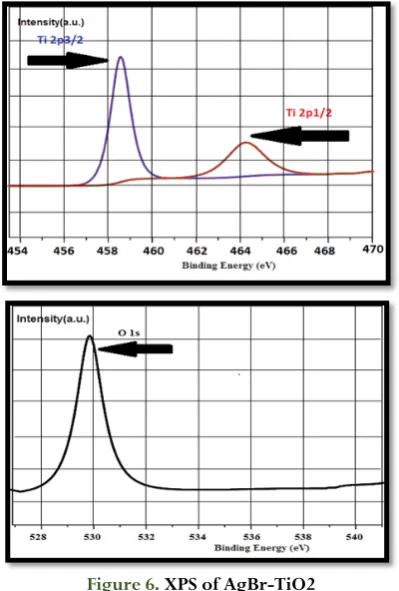
Figure 6. XPS of AgBr-TiO2
After determining the optimal conditions, experiments were carried out at the presence and absence of sunlight to investigate the photocatalytic activity of synthesized nanocomposite, and the results were presented in figure 7. To perform the equilibrium of absorption – desorption, the mixture stirred for 30 min in dark to remove the dispersions of air. The results showed the high efficiency of AgBr loaded TiO2 (97%) for degradation of dye in the presence of sunlight compare with TiO2 (62%). It was due to the ability of a nanocomposite compound to separate the electron-hole pair with higher efficiency compared with TiO2.
Figure 7. Percentage of dye RR 120 removal with passage of
time.
Conclusion
In summary, the Nano composite of AgBr loaded TiO2 was successfully synthesized using photolysis method. All the results confirmed production of particles in nano ranges. The
doping of AgBr on the TiO2 surface plays important role in the absorption of TiO2 at visible light spectrum, and this leads to an increase in the efficiency of degradation of dye under sunlight. XRD and XPS results confirmed formation of Ag metal after exposing the solution of catalyst and RR120 dye to UV irradiation, due to the reduction effect.
References
1. G.M. Liu, X.Z. Li, J.C. Zhao, Environ. Sci. Technol. 34, 3982 (2000)
2. M.H. Habibi, A. Hassanzadeh, S. Mahdavi, J. Photochem. Photobiol. A 172, 89 (2005)
3. C. Hu, X.X. Hu, L.S. Wang, J.H. Qu, A.M. Wang, Environ. Sci. Technol. 40, 7903 (2006)
4. M. Janus, A.W. Morawski, Appl. Catal. B 75, 118 (2007)
5. O. Carp, C.L. Huisman, A. Reller, Solid State Chem. 32, 33 (2004)
6. S. Usseglio, A. Damin, D. Scarano, S. Bordiga, A. Zecchina, C. Lamberti, J. Am. Chem. Soc. 129, 2822 (2007)
7. C. Hu, Y.Q. Lan, J.H. Qu, X.X. Hu, A.M. Wang, J. Phys. Chem. B 110, 4066 (2006)
8. M.R. Elahifard, S. Rahimnejad, S. Haghighi, M.R. Gholami, J. Am. Chem. Soc. 129, 9552 (2007)
9. Y. Zang, R. Farnood, Appl. Catal. B 79, 334 (2008) 10. S. Glaus, G. Calzaferri, Photochem. Photobiol. Sci. 2,
398 (2003)
11. J. Belloni, M. Treguer, H. Remita, R.D. Keyzer, Nature 402, 865 (1999)
12. H. Yamada, A.J. Bhattacharyya, J. Maier, Adv. Funct. Mater. 16, 525 (2006)
13. Y. Yamashita, N. Aoyama, J. Mol. Catal. A 150, 233 (1999)
14. S. Rodrigues, S. Uma, I.N. Martyanov, K.J. Klabunde, J. Catal. 233, 405 (2005)
15. N. Kakuta, N. Goto, H. Ohkita, T. Mizushima, J. Phys. Chem. B 103, 5917 (1999)
16. Zaid, H.M; Nuha, F.A; Aklas, A.A., Effect of Solvents on the Size of Copper Oxide Particles Fabricated using Photolysis Method Asian J. Chem., 30 (2018), 223-225. 17. Ahmed, N; Zaid, H.M., Synthesis of α-Fe2O3 Nano Powders by Novel UV Irradiation Method, DJPS., 14 (2018), 56-66.
18. Mohammed, A.F; Zaid, H.M; Marwa, S.F. Syntheses, characterization and studying TiO2/Au nanocomposite via UV-irradiation method and its effective to degradation of methylene blue, Asian J. Chem., 30 (2018), 1142-1146
Journal of Advanced Pharmacy Education & Research | Oct-Dec 2018 | Vol 8 | Issue4 55
20. Zaid H.M., Effect of Au doping on the Magnetic Properties of Fe3O4 NPs Prepared via Photolysis and co-Precipitation Methods, DJPS., 14 (2018), 136-146. 21. Zaid H.M., Synthesis of Bismuth oxide Nano powders
viaelectrolysis method and study the effect of change voltage on the size for it, Australian Journal of Basic and Applied Sciences, 11(7), 97-101 (2017)
22. Li Y, Zhang H, Guo Z, Han J, Zhao X, Zhao Q, Kim SJ: Highly efficient visible -Light-induced photocatalytic activity of nanostructured AgI/TiO2 photocatalyst. Langmuir 2008, 24:8351-8357.
23. F.B. Li, X.Z. Li, Chemosphere 48, 1103 (2002)
24. O. Akhavan, E. Ghaderi, Surf. Coat. Technol. 204, 3676 (2010)
25. Vinodgopal K, Bedja I, Kamat PV: Nanostructured semiconductor films for photocatalysis. photoelectrochemical behavior of SnO2/TiO2 composite systems and its role in photocatalytic degradation of a textile azo dye. Chem Mater 1996, 8:2180-2187.
26. P. Wang, B. Huang, X. Qin, X. Zhang, Y. Dai, M.H. Whangbo, Inorg. Chem. 48(2009) 10697–10702. 27. N. Kruse, S. Chenakin, Appl. Catal., A 391 (2011)