499
Information Technology and Control 2017/4/46
Flatness Based Control
of a HVAC System
ITC 4/46
Journal of Information Technology and Control
Vol. 46 / No. 4 / 2017 pp. 499-507
DOI 10.5755/j01.itc.46.4.17697 © Kaunas University of Technology
Flatness Based Control of a HVAC System
Received 2017/03/03 Accepted after revision 2017/10/31
http://dx.doi.org/10.5755/j01.itc.46.4.17697
Corresponding author: [email protected]
Arvo Kaldmäe, Ülle Kotta
Department of Software Science, Tallinn University of Technology, Akadeemia tee 21, 12618 Tallinn, Estonia e-mail: [email protected], [email protected]
This paper studies the flatness-based control of a nonlinear multi-input multi-output heating, ventilating and air conditioning (HVAC) system. First, a novel method for checking flatness property is used to verify that the given HVAC model is flat and that the flat outputs are the temperature and the humidity ratio of the thermal space. Since the flat outputs are also the variables, which one usually wants to control, it is relatively easy to construct a flatness-based feedforward control for the HVAC model. We define the appropriate trajectories for the flat outputs and then the controller is computed from the parametrization of system inputs in terms of flat outputs and their derivatives. The trajectories of flat outputs are chosen such that the temperature and the hu-midity ratio converge asymptotically from the initial values to the desired values. Simulations are made, which show the effectiveness of the approach.
KEYWORDS: Control systems, flatness, HVAC system, nonlinear systems, MIMO systems.
1. Introduction
Heating, ventilating and air conditioning (HVAC) systems are used to control the temperature and hu-midity ratio in buildings to offer more comfortable environment to the occupants. HVAC systems are also large energy consumers and thus improvements to classical techniques such as ON/OFF and PID con-trollers, which are not energy efficient, are necessary. Popular methods like PID control, LQR control etc. require linear models or linear approximations, but intrinsically HVAC systems are nonlinear [3, 21].
Dif-ferent control approaches have been used to achieve energy efficient control, but at the same time ensur-ing occupant comfort. For example, robust control [1], intelligent methods like neural networks [8], model predictive control (see [16] and references therein), adaptive control [5, 11].
Information Technology and Control 2017/4/46
500
viewed as system disturbances. After this a linear control law is designed, which also takes into con-sideration the estimates of thermal loads. In [17], a nonlinear controller is designed. First a nonlinear decoupling control scheme is developed to decou-ple temperature and relative humidity of thermal space. Then an outer-loop controller (a PD control-ler) is used for stabilization and control. The paper [5] applies the dynamic state feedback linearization techniques, after which the linearized system is con-trolled. Also, they design an adaptive controller to cope with the slowly time varying unknown thermal loads. Additionally, in [5] a switching mechanism is integrated to the system to keep the CO2 -concentra-tion in the system low. In the paper [18] the model is extended by adding valve dynamics and then it is partially linearized by static state feedback and state transformation. After linearization, as in [3], an ob-server is constructed to estimate the thermal loads and finally, a backstepping method is used to control the model. Lastly, in [12] the model is extended once more by adding dynamics to be able to regulate addi-tionally the CO2 concentration in the thermal space. Then the extended model is linearized by dynamic state feedback and an extended state transformation. The linearized system is controlled by design of pole placement control and linear quadratic regulator, which also minimizes the cost function, which rep-resents the performance characteristic requirements as well as the controller input limitations. In [11] a dif-ferent approach is used. Namely, an adaptive control is used to control the given HVAC model.
In this paper, first, we show that the model, given in [3], is flat with flat outputs being the temperature and the humidity ratio of the thermal space. Since flatness property allows to parametrize all the system trajec-tories by the flat outputs and a finite number of their derivatives, by specifying the trajectories for flat out-puts, one can compute the inputs needed for the flat outputs to follow the chosen trajectories from the trajectories of the flat outputs and their derivatives without solving any differential equations. We choose the trajectories for the flat outputs (i.e., for the tem-perature and the humidity ratio of the thermal space) such that they converge asymptotically from the ini-tial values to the desired values. Then the feedforward controller can be directly computed from the parame-trization of system inputs in terms of flat outputs and
their derivatives. This is the standard flatness based control design, see [9, 10, 14, 20]. Our feedforward controller depends only on the initial values, the de-sired values of the temperature and humidity ratio of thermal space and on the selected trajectories. Thus, one does not need to measure or estimate the system states, unlike in [3, 17, 5, 18, 12], where state feedback is used to either control the model or linearize the sys-tem equations before applying the controller for sta-bilization and control purposes. The downside of our feedforward controller (and flatness-based control in general) is that it does not react to possible distur-bances or modeling errors and thus the disturdistur-bances have to be included in the model and estimated or measured. In fact the same problem appears in the papers [17, 5, 18, 12], where the feedback linearization is used.
The results of this paper are remotely related to con-ference paper [4], where analysis of two HVAC mod-els were performed. It was shown that the model, considered also in this paper, is accessible and the dynamic state feedback was computed, together with extended state transformation, to linearize the model. The paper is organized as follows. In Section II the flatness property is introduced and some preliminary results on flatness are given. Also, the mathematical approach used to check flatness is described. The main results are described in Section III. First, the HVAC model is described and its flat outputs com-puted. Then, the feedforward controller is found. In Section IV we describe the simulation results and the paper ends with some conclusions.
2. Preliminaries
Consider a continuous-time system described as
�� = �(�, �), (1)(1)
where where �(�): � � � � �� is the vector of state variables, �(�): � � � � �� is the vector of input signals and �: � � � � � is real analytic function.
Below we briefly recall from [6] the algebraic formalism, which we use to describe the flatness property and to compute the flat outputs. Let � denote the field of meromorphic functions in finite number of the independent system variables, i.e., {�� �(�)� � � 0}. Then, the pair (�� ����) is the differential field, which usually is denoted simply by �. Over the differential field � one can define a vector space ℰ: = �����{���� ∈ �} spanned by the differentials of the elements from �.
Define for system (1) the non-increasing sequence ℋ� of subspaces of ℰ as follows [2, 6]
ℋ� = �����{��� ��}
ℋ� = {� ∈ ℋ������ ∈ ℋ���}� � � �� (2)
The sequence converges after a finite number of steps, i.e., there exists �∗∈ ℕ such that ℋ�∗= ℋ�∗��. Then we define ℋ�: = ℋ�∗. These subspaces play an important role in the study of flatness property of system (1), which is shortly discussed next.
2.1 Flatness
Flatness is a system property which is defined as existence of functions � = �(�� �� ��� � � �(�)), � ∈ ��, such that � and � can be expressed as functions of � and a finite number of the derivatives of �:
� = ��(�� ��� � � �(���))
� = ����� ��� � � �(�)�� (3)
It is well known, see for example [10], that for continuous-time systems the flatness property is equivalent to the possibility to linearize an accessible system by a dynamic state feedback
�� = �(�� �� �)
� = �(�� �� �) (4)
and an extended state transformation � = �(�� �).
Next we recall some special cases from [2], which are valid for control-affine systems.
Theorem 1 System (1) is linearizable by the static state feedback (i.e., by the feedback (4) where ��� � = 0) if and only if all the subspaces ℋ� are integrable and ℋ�= {0}.
Theorem 2 System (1) with � = � � � inputs is linearizable by dynamic state feedback (or equivalently, is flat) if and only if ℋ�= {0}.
Theorem 2 states that any accessible nonlinear system with one less input than states is flat.
is the vector of state vari-ables,
where �(�): � � � � �� is the vector of state variables, �(�): � � � � �� is the vector of input signals and �: � � � � � is real analytic function.
Below we briefly recall from [6] the algebraic formalism, which we use to describe the flatness property and to compute the flat outputs. Let � denote the field of meromorphic functions in finite number of the independent system variables, i.e., {�� �(�)� � � 0}. Then, the pair (�� ����) is the differential field, which usually is denoted simply by �. Over the differential field � one can define a vector space ℰ: = �����{���� ∈ �} spanned by the differentials of the elements from �.
Define for system (1) the non-increasing sequence ℋ� of subspaces of ℰ as follows [2, 6]
ℋ� = �����{��� ��}
ℋ� = {� ∈ ℋ������ ∈ ℋ���}� � � �� (2)
The sequence converges after a finite number of steps, i.e., there exists �∗∈ ℕ such that ℋ�∗= ℋ�∗��. Then we define ℋ�: = ℋ�∗. These subspaces play an important role in the study of flatness property of system (1), which is shortly discussed next.
2.1 Flatness
Flatness is a system property which is defined as existence of functions � = �(�� �� ��� � � �(�)), � ∈ ��, such that � and � can be expressed as functions of � and a finite number of the derivatives of �:
� = ��(�� ��� � � �(���))
� = ����� ��� � � �(�)�� (3)
It is well known, see for example [10], that for continuous-time systems the flatness property is equivalent to the possibility to linearize an accessible system by a dynamic state feedback
�� = �(�� �� �)
� = �(�� �� �) (4)
and an extended state transformation � = �(�� �).
Next we recall some special cases from [2], which are valid for control-affine systems.
Theorem 1 System (1) is linearizable by the static state feedback (i.e., by the feedback (4) where ��� � = 0) if and only if all the subspaces ℋ� are integrable and ℋ�= {0}.
Theorem 2 System (1) with � = � � � inputs is linearizable by dynamic state feedback (or equivalently, is flat) if and only if ℋ�= {0}.
Theorem 2 states that any accessible nonlinear system with one less input than states is flat.
is the vector of input signals and
where �(�): � � � � �� is the vector of state variables, �(�): � � � � �� is the vector of input signals and �: � � � � � is real analytic function.
Below we briefly recall from [6] the algebraic formalism, which we use to describe the flatness property and to compute the flat outputs. Let � denote the field of meromorphic functions in finite number of the independent system variables, i.e., {�� �(�)� � � 0}. Then, the pair (�� ����) is the differential field, which usually is denoted simply by �. Over the differential field � one can define a vector space ℰ: = �����{���� ∈ �} spanned by the differentials of the elements from �.
Define for system (1) the non-increasing sequence ℋ� of subspaces of ℰ as follows [2, 6]
ℋ� = �����{��� ��}
ℋ� = {� ∈ ℋ������ ∈ ℋ���}� � � �� (2)
The sequence converges after a finite number of steps, i.e., there exists �∗∈ ℕ such that ℋ�∗= ℋ�∗��. Then we define ℋ�: = ℋ�∗. These subspaces play an important role in the study of flatness property of system (1), which is shortly discussed next.
2.1 Flatness
Flatness is a system property which is defined as existence of functions � = �(�� �� ��� � � �(�)), � ∈ ��, such that � and � can be expressed as functions of � and a finite number of the derivatives of �:
� = ��(�� ��� � � �(���))
� = ����� ��� � � �(�)�� (3)
It is well known, see for example [10], that for continuous-time systems the flatness property is equivalent to the possibility to linearize an accessible system by a dynamic state feedback
�� = �(�� �� �)
� = �(�� �� �) (4)
and an extended state transformation � = �(�� �).
Next we recall some special cases from [2], which are valid for control-affine systems.
Theorem 1 System (1) is linearizable by the static state feedback (i.e., by the feedback (4) where ��� � = 0) if and only if all the subspaces ℋ� are integrable and ℋ�= {0}.
Theorem 2 System (1) with � = � � � inputs is linearizable by dynamic state feedback (or equivalently, is flat) if and only if ℋ�= {0}.
Theorem 2 states that any accessible nonlinear system with one less input than states is flat.
is real analytic function.
Below we briefly recall from [6] the algebraic formal-ism, which we use to describe the flatness property and to compute the flat outputs. Let
where �(�): � � � � �� is the vector of state variables, �(�): � � � � �� is the vector of input signals and �: � � � � � is real analytic function.
Below we briefly recall from [6] the algebraic formalism, which we use to describe the flatness property and to compute the flat outputs. Let � denote the field of meromorphic functions in finite number of the independent system variables, i.e., {�� �(�)� � � 0}. Then, the pair (�� ����) is the differential field, which usually is denoted simply by �. Over the differential field � one can define a vector space ℰ: = �����{���� ∈ �} spanned by the differentials of the elements from �.
Define for system (1) the non-increasing sequence ℋ� of subspaces of ℰ as follows [2, 6]
ℋ� = �����{��� ��}
ℋ� = {� ∈ ℋ������ ∈ ℋ���}� � � �� (2) The sequence converges after a finite number of steps, i.e., there exists �∗∈ ℕ such that ℋ�∗= ℋ�∗��. Then we define ℋ�: = ℋ�∗. These subspaces play an important role in the study of flatness property of system (1), which is shortly discussed next.
2.1 Flatness
Flatness is a system property which is defined as existence of functions � = �(�� �� ��� � � �(�)), � ∈ ��, such that � and � can be expressed as functions of � and a finite number of the derivatives of �:
� = ��(�� ��� � � �(���))
� = ����� ��� � � �(�)�� (3) It is well known, see for example [10], that for continuous-time systems the flatness property is equivalent to the possibility to linearize an accessible system by a dynamic state feedback
�� = �(�� �� �)
� = �(�� �� �) (4)
and an extended state transformation � = �(�� �).
Next we recall some special cases from [2], which are valid for control-affine systems.
Theorem 1 System (1) is linearizable by the static state feedback (i.e., by the feedback (4) where ��� � = 0) if and only if all the subspaces ℋ� are integrable and ℋ�= {0}.
Theorem 2 System (1) with � = � � � inputs is linearizable by dynamic state feedback (or equivalently, is flat) if and only if ℋ�= {0}.
Theorem 2 states that any accessible nonlinear system with one less input than states is flat.
in-501
Information Technology and Control 2017/4/46
dependent system variables, i.e.,
where �(�): � � � � �� is the vector of state variables, �(�): � � � � �� is the vector of input signals and �: � � � � � is real analytic function.
Below we briefly recall from [6] the algebraic formalism, which we use to describe the flatness property and to compute the flat outputs. Let � denote the field of meromorphic functions in finite number of the independent system variables, i.e., {�� �(�)� � � 0}. Then, the pair (�� ����) is the differential field, which usually is denoted simply by �. Over the differential field � one can define a vector space ℰ: = �����{���� ∈ �} spanned by the differentials of the elements from �.
Define for system (1) the non-increasing sequence ℋ� of subspaces of ℰ as follows [2, 6]
ℋ� = �����{��� ��}
ℋ� = {� ∈ ℋ������ ∈ ℋ���}� � � �� (2)
The sequence converges after a finite number of steps, i.e., there exists �∗∈ ℕ such that ℋ�∗= ℋ�∗��. Then we define ℋ�: = ℋ�∗. These subspaces play an important role in the study of flatness property of system (1), which is shortly discussed next.
2.1 Flatness
Flatness is a system property which is defined as existence of functions � = �(�� �� ��� � � �(�)), � ∈ ��, such that � and � can be expressed as functions of � and a finite number of the derivatives of �:
� = ��(�� ��� � � �(���))
� = ����� ��� � � �(�)�� (3)
It is well known, see for example [10], that for continuous-time systems the flatness property is equivalent to the possibility to linearize an accessible system by a dynamic state feedback
�� = �(�� �� �)
� = �(�� �� �) (4)
and an extended state transformation � = �(�� �).
Next we recall some special cases from [2], which are valid for control-affine systems.
Theorem 1 System (1) is linearizable by the static state feedback (i.e., by the feedback (4) where ��� � = 0) if and only if all the subspaces ℋ� are integrable and ℋ�= {0}.
Theorem 2 System (1) with � = � � � inputs is linearizable by dynamic state feedback (or equivalently, is flat) if and only if ℋ�= {0}.
Theorem 2 states that any accessible nonlinear system with one less input than states is flat.
Then, the pair
where �(�): � � � � �� is the vector of state variables, �(�): � � � � �� is the vector of input signals and �: � � � � � is real analytic function.
Below we briefly recall from [6] the algebraic formalism, which we use to describe the flatness property and to compute the flat outputs. Let � denote the field of meromorphic functions in finite number of the independent system variables, i.e., {�� �(�)� � � 0}. Then, the pair (�� ����) is the differential field, which usually is denoted simply by �. Over the differential field � one can define a vector space ℰ: = �����{���� ∈ �} spanned by the differentials of the elements from �.
Define for system (1) the non-increasing sequence ℋ� of subspaces of ℰ as follows [2, 6]
ℋ� = �����{��� ��}
ℋ� = {� ∈ ℋ������ ∈ ℋ���}� � � �� (2)
The sequence converges after a finite number of steps, i.e., there exists �∗∈ ℕ such that ℋ�∗= ℋ�∗��. Then we define ℋ�: = ℋ�∗. These subspaces play an important role in the study of flatness property of system (1), which is shortly discussed next.
2.1 Flatness
Flatness is a system property which is defined as existence of functions � = �(�� �� ��� � � �(�)), � ∈ ��, such that � and � can be expressed as functions of � and a finite number of the derivatives of �:
� = ��(�� ��� � � �(���))
� = ����� ��� � � �(�)�� (3) It is well known, see for example [10], that for continuous-time systems the flatness property is equivalent to the possibility to linearize an accessible system by a dynamic state feedback
�� = �(�� �� �)
� = �(�� �� �) (4)
and an extended state transformation � = �(�� �).
Next we recall some special cases from [2], which are valid for control-affine systems.
Theorem 1 System (1) is linearizable by the static state feedback (i.e., by the feedback (4) where ��� � = 0) if and only if all the subspaces ℋ� are integrable and ℋ�= {0}.
Theorem 2 System (1) with � = � � � inputs is linearizable by dynamic state feedback (or equivalently, is flat) if and only if ℋ�= {0}.
Theorem 2 states that any accessible nonlinear system with one less input than states is flat.
is the differential field, which usu-ally is denoted simply by
where �(�): � � � � �� is the vector of state variables, �(�): � � � � �� is the vector of input signals and �: � � � � � is real analytic function.
Below we briefly recall from [6] the algebraic formalism, which we use to describe the flatness property and to compute the flat outputs. Let � denote the field of meromorphic functions in finite number of the independent system variables, i.e., {�� �(�)� � � 0}. Then, the pair (�� ����) is the differential field, which usually is denoted simply by �. Over the differential field � one can define a vector space ℰ: = �����{���� ∈ �} spanned by the differentials of the elements from �.
Define for system (1) the non-increasing sequence ℋ� of subspaces of ℰ as follows [2, 6]
ℋ� = �����{��� ��}
ℋ� = {� ∈ ℋ������ ∈ ℋ���}� � � �� (2) The sequence converges after a finite number of steps, i.e., there exists �∗∈ ℕ such that ℋ�∗= ℋ�∗��. Then we define ℋ�: = ℋ�∗. These subspaces play an important role in the study of flatness property of system (1), which is shortly discussed next.
2.1 Flatness
Flatness is a system property which is defined as existence of functions � = �(�� �� ��� � � �(�)), � ∈ ��, such that � and � can be expressed as functions of � and a finite number of the derivatives of �:
� = ��(�� ��� � � �(���))
� = ����� ��� � � �(�)�� (3) It is well known, see for example [10], that for continuous-time systems the flatness property is equivalent to the possibility to linearize an accessible system by a dynamic state feedback
�� = �(�� �� �)
� = �(�� �� �) (4)
and an extended state transformation � = �(�� �).
Next we recall some special cases from [2], which are valid for control-affine systems.
Theorem 1 System (1) is linearizable by the static state feedback (i.e., by the feedback (4) where ��� � = 0) if and only if all the subspaces ℋ� are integrable and ℋ�= {0}.
Theorem 2 System (1) with � = � � � inputs is linearizable by dynamic state feedback (or equivalently, is flat) if and only if ℋ�= {0}.
Theorem 2 states that any accessible nonlinear system with one less input than states is flat.
. Over the differential field where �(�): � � � � �� is the vector of state variables, �(�): � � � � �� is the vector of
input signals and �: � � � � � is real analytic function.
Below we briefly recall from [6] the algebraic formalism, which we use to describe the flatness property and to compute the flat outputs. Let � denote the field of meromorphic functions in finite number of the independent system variables, i.e., {�� �(�)� � � 0}. Then, the pair (�� ����) is the differential field, which usually is denoted simply by �. Over the differential field � one can define a vector space ℰ: = �����{���� ∈ �} spanned by the differentials of the elements from �.
Define for system (1) the non-increasing sequence ℋ� of subspaces of ℰ as follows [2, 6]
ℋ� = �����{��� ��}
ℋ� = {� ∈ ℋ������ ∈ ℋ���}� � � �� (2) The sequence converges after a finite number of steps, i.e., there exists �∗∈ ℕ such that ℋ�∗= ℋ�∗��. Then we define ℋ�: = ℋ�∗. These subspaces play an important role in the study of flatness property of system (1), which is shortly discussed next.
2.1 Flatness
Flatness is a system property which is defined as existence of functions � = �(�� �� ��� � � �(�)), � ∈ ��, such that � and � can be expressed as functions of � and a finite number of the derivatives of �:
� = ��(�� ��� � � �(���))
� = ����� ��� � � �(�)�� (3) It is well known, see for example [10], that for continuous-time systems the flatness property is equivalent to the possibility to linearize an accessible system by a dynamic state feedback
�� = �(�� �� �)
� = �(�� �� �) (4)
and an extended state transformation � = �(�� �).
Next we recall some special cases from [2], which are valid for control-affine systems.
Theorem 1 System (1) is linearizable by the static state feedback (i.e., by the feedback (4) where ��� � = 0) if and only if all the subspaces ℋ� are integrable and ℋ�= {0}.
Theorem 2 System (1) with � = � � � inputs is linearizable by dynamic state feedback (or equivalently, is flat) if and only if ℋ�= {0}.
Theorem 2 states that any accessible nonlinear system with one less input than states is flat.
one can define a vector space
where �(�): � � � � �� is the vector of state variables, �(�): � � � � �� is the vector of input signals and �: � � � � � is real analytic function.
Below we briefly recall from [6] the algebraic formalism, which we use to describe the flatness property and to compute the flat outputs. Let � denote the field of meromorphic functions in finite number of the independent system variables, i.e., {�� �(�)� � � 0}. Then, the pair (�� ����) is the differential field, which usually is denoted simply by �. Over the differential field � one can define a vector space ℰ: = �����{���� ∈ �} spanned by the differentials of the elements from �.
Define for system (1) the non-increasing sequence ℋ� of subspaces of ℰ as follows [2, 6]
ℋ� = �����{��� ��}
ℋ� = {� ∈ ℋ������ ∈ ℋ���}� � � �� (2)
The sequence converges after a finite number of steps, i.e., there exists �∗∈ ℕ such that ℋ�∗= ℋ�∗��. Then we define ℋ�: = ℋ�∗. These subspaces play an important role in the study
of flatness property of system (1), which is shortly discussed next.
2.1 Flatness
Flatness is a system property which is defined as existence of functions � = �(�� �� ��� � � �(�)), � ∈ ��, such that � and � can be expressed as functions of � and a finite number of the derivatives of �:
� = ��(�� ��� � � �(���))
� = ����� ��� � � �(�)�� (3)
It is well known, see for example [10], that for continuous-time systems the flatness property is equivalent to the possibility to linearize an accessible system by a dynamic state feedback
�� = �(�� �� �)
� = �(�� �� �) (4)
and an extended state transformation � = �(�� �).
Next we recall some special cases from [2], which are valid for control-affine systems.
Theorem 1 System (1) is linearizable by the static state feedback (i.e., by the feedback (4) where ��� � = 0) if and only if all the subspaces ℋ� are integrable and ℋ�= {0}.
Theorem 2 System (1) with � = � � � inputs is linearizable by dynamic state feedback (or equivalently, is flat) if and only if ℋ�= {0}.
Theorem 2 states that any accessible nonlinear system with one less input than states is flat.
spanned by the differentials of the elements from
where �(�): � � � � �� is the vector of state variables, �(�): � � � � �� is the vector of input signals and �: � � � � � is real analytic function.
Below we briefly recall from [6] the algebraic formalism, which we use to describe the flatness property and to compute the flat outputs. Let � denote the field of meromorphic functions in finite number of the independent system variables, i.e., {�� �(�)� � � 0}. Then, the pair (�� ����) is the differential field, which usually is denoted simply by �. Over the differential field � one can define a vector space ℰ: = �����{���� ∈ �} spanned by the differentials of the elements from �.
Define for system (1) the non-increasing sequence ℋ� of subspaces of ℰ as follows [2, 6]
ℋ� = �����{��� ��}
ℋ� = {� ∈ ℋ������ ∈ ℋ���}� � � �� (2) The sequence converges after a finite number of steps, i.e., there exists �∗∈ ℕ such that ℋ�∗= ℋ�∗��. Then we define ℋ�: = ℋ�∗. These subspaces play an important role in the study of flatness property of system (1), which is shortly discussed next.
2.1 Flatness
Flatness is a system property which is defined as existence of functions � = �(�� �� ��� � � �(�)), � ∈ ��, such that � and � can be expressed as functions of � and a finite number of the derivatives of �:
� = ��(�� ��� � � �(���))
� = ����� ��� � � �(�)�� (3) It is well known, see for example [10], that for continuous-time systems the flatness property is equivalent to the possibility to linearize an accessible system by a dynamic state feedback
�� = �(�� �� �)
� = �(�� �� �) (4)
and an extended state transformation � = �(�� �).
Next we recall some special cases from [2], which are valid for control-affine systems.
Theorem 1 System (1) is linearizable by the static state feedback (i.e., by the feedback (4) where ��� � = 0) if and only if all the subspaces ℋ� are integrable and ℋ�= {0}.
Theorem 2 System (1) with � = � � � inputs is linearizable by dynamic state feedback (or equivalently, is flat) if and only if ℋ�= {0}.
Theorem 2 states that any accessible nonlinear system with one less input than states is flat.
. Define for system (1) the non-increasing sequence
where �(�): � � � � �� is the vector of state variables, �(�): � � � � �� is the vector of input signals and �: � � � � � is real analytic function.
Below we briefly recall from [6] the algebraic formalism, which we use to describe the flatness property and to compute the flat outputs. Let � denote the field of meromorphic functions in finite number of the independent system variables, i.e., {�� �(�)� � � 0}. Then, the pair (�� ����) is the differential field, which usually is denoted simply by �. Over the differential field � one can define a vector space ℰ: = �����{���� ∈ �} spanned by the differentials of the elements from �.
Define for system (1) the non-increasing sequence ℋ� of subspaces of ℰ as follows [2, 6]
ℋ� = �����{��� ��}
ℋ� = {� ∈ ℋ������ ∈ ℋ���}� � � �� (2)
The sequence converges after a finite number of steps, i.e., there exists �∗∈ ℕ such that ℋ�∗= ℋ�∗��. Then we define ℋ�: = ℋ�∗. These subspaces play an important role in the study of flatness property of system (1), which is shortly discussed next.
2.1 Flatness
Flatness is a system property which is defined as existence of functions � = �(�� �� ��� � � �(�)), � ∈ ��, such that � and � can be expressed as functions of � and a finite number of the derivatives of �:
� = ��(�� ��� � � �(���))
� = ����� ��� � � �(�)�� (3)
It is well known, see for example [10], that for continuous-time systems the flatness property is equivalent to the possibility to linearize an accessible system by a dynamic state feedback
�� = �(�� �� �)
� = �(�� �� �) (4)
and an extended state transformation � = �(�� �).
Next we recall some special cases from [2], which are valid for control-affine systems.
Theorem 1 System (1) is linearizable by the static state feedback (i.e., by the feedback (4) where ��� � = 0) if and only if all the subspaces ℋ� are integrable and ℋ�= {0}.
Theorem 2 System (1) with � = � � � inputs is linearizable by dynamic state feedback (or equivalently, is flat) if and only if ℋ�= {0}.
Theorem 2 states that any accessible nonlinear system with one less input than states is flat.
of subspaces of
where �(�): � � � � �� is the vector of state variables, �(�): � � � � �� is the vector of input signals and �: � � � � � is real analytic function.
Below we briefly recall from [6] the algebraic formalism, which we use to describe the flatness property and to compute the flat outputs. Let � denote the field of meromorphic functions in finite number of the independent system variables, i.e., {�� �(�)� � � 0}. Then, the pair (�� ����) is the differential field, which usually is denoted simply by �. Over the differential field � one can define a vector space ℰ: = �����{���� ∈ �} spanned by the differentials of the elements from �.
Define for system (1) the non-increasing sequence ℋ� of subspaces of ℰ as follows [2, 6]
ℋ� = �����{��� ��}
ℋ� = {� ∈ ℋ������ ∈ ℋ���}� � � �� (2)
The sequence converges after a finite number of steps, i.e., there exists �∗∈ ℕ such that ℋ�∗= ℋ�∗��. Then we define ℋ�: = ℋ�∗. These subspaces play an important role in the study
of flatness property of system (1), which is shortly discussed next.
2.1 Flatness
Flatness is a system property which is defined as existence of functions � = �(�� �� ��� � � �(�)), � ∈ ��, such that � and � can be expressed as functions of � and a finite number of the derivatives of �:
� = ��(�� ��� � � �(���))
� = ����� ��� � � �(�)�� (3)
It is well known, see for example [10], that for continuous-time systems the flatness property is equivalent to the possibility to linearize an accessible system by a dynamic state feedback
�� = �(�� �� �)
� = �(�� �� �) (4)
and an extended state transformation � = �(�� �).
Next we recall some special cases from [2], which are valid for control-affine systems.
Theorem 1 System (1) is linearizable by the static state feedback (i.e., by the feedback (4) where ��� � = 0) if and only if all the subspaces ℋ� are integrable and ℋ�= {0}.
Theorem 2 System (1) with � = � � � inputs is linearizable by dynamic state feedback (or equivalently, is flat) if and only if ℋ�= {0}.
Theorem 2 states that any accessible nonlinear system with one less input than states is flat.
as follows [2, 6]
ℋ� = s����{d�, d�}
ℋ� = {� ∈ ℋ���|�� ∈ ℋ���}, � ≥ 1. (2)
The sequence converges after a finite number of steps, i.e., there exists
where �(�): � � � � �� is the vector of state variables, �(�): � � � � �� is the vector of
input signals and �: � � � � � is real analytic function.
Below we briefly recall from [6] the algebraic formalism, which we use to describe the flatness property and to compute the flat outputs. Let � denote the field of meromorphic functions in finite number of the independent system variables, i.e., {�� �(�)� � � 0}. Then, the
pair (�� ����) is the differential field, which usually is denoted simply by �. Over the differential field � one can define a vector space ℰ: = �����{���� ∈ �} spanned by the
differentials of the elements from �.
Define for system (1) the non-increasing sequence ℋ� of subspaces of ℰ as follows [2,
6]
ℋ� = �����{��� ��}
ℋ� = {� ∈ ℋ������ ∈ ℋ���}� � � �� (2)
The sequence converges after a finite number of steps, i.e., there exists �∗∈ ℕ such that ℋ�∗= ℋ�∗��. Then we define ℋ�: = ℋ�∗. These subspaces play an important role in the study
of flatness property of system (1), which is shortly discussed next.
2.1 Flatness
Flatness is a system property which is defined as existence of functions � = �(�� �� ��� � � �(�)), � ∈ ��, such that � and � can be expressed as functions of � and a finite number of the
derivatives of �:
� = ��(�� ��� � � �(���))
� = ����� ��� � � �(�)�� (3)
It is well known, see for example [10], that for continuous-time systems the flatness property is equivalent to the possibility to linearize an accessible system by a dynamic state feedback
�� = �(�� �� �)
� = �(�� �� �) (4)
and an extended state transformation � = �(�� �).
Next we recall some special cases from [2], which are valid for control-affine systems.
Theorem 1 System (1) is linearizable by the static state feedback (i.e., by the feedback (4) where ��� � = 0) if and only if all the subspaces ℋ� are integrable and ℋ�= {0}.
Theorem 2 System (1) with � = � � � inputs is linearizable by dynamic state feedback (or equivalently, is flat) if and only if ℋ�= {0}.
Theorem 2 states that any accessible nonlinear system with one less input than states is flat.
such that
where �(�): � � � � �� is the vector of state variables, �(�): � � � � �� is the vector of input signals and �: � � � � � is real analytic function.
Below we briefly recall from [6] the algebraic formalism, which we use to describe the flatness property and to compute the flat outputs. Let � denote the field of meromorphic functions in finite number of the independent system variables, i.e., {�� �(�)� � � 0}. Then, the pair (�� ����) is the differential field, which usually is denoted simply by �. Over the differential field � one can define a vector space ℰ: = �����{���� ∈ �} spanned by the differentials of the elements from �.
Define for system (1) the non-increasing sequence ℋ� of subspaces of ℰ as follows [2, 6]
ℋ� = �����{��� ��}
ℋ� = {� ∈ ℋ������ ∈ ℋ���}� � � �� (2)
The sequence converges after a finite number of steps, i.e., there exists �∗∈ ℕ such that ℋ�∗= ℋ�∗��. Then we define ℋ�: = ℋ�∗. These subspaces play an important role in the study
of flatness property of system (1), which is shortly discussed next.
2.1 Flatness
Flatness is a system property which is defined as existence of functions � = �(�� �� ��� � � �(�)), � ∈ ��, such that � and � can be expressed as functions of � and a finite number of the derivatives of �:
� = ��(�� ��� � � �(���))
� = ����� ��� � � �(�)�� (3)
It is well known, see for example [10], that for continuous-time systems the flatness property is equivalent to the possibility to linearize an accessible system by a dynamic state feedback
�� = �(�� �� �)
� = �(�� �� �) (4)
and an extended state transformation � = �(�� �).
Next we recall some special cases from [2], which are valid for control-affine systems.
Theorem 1 System (1) is linearizable by the static state feedback (i.e., by the feedback (4) where ��� � = 0) if and only if all the subspaces ℋ� are integrable and ℋ�= {0}.
Theorem 2 System (1) with � = � � � inputs is linearizable by dynamic state feedback (or equivalently, is flat) if and only if ℋ�= {0}.
Theorem 2 states that any accessible nonlinear system with one less input than states is flat.
. Then we define
where �(�): � � � � �� is the vector of state variables, �(�): � � � � �� is the vector of input signals and �: � � � � � is real analytic function.
Below we briefly recall from [6] the algebraic formalism, which we use to describe the flatness property and to compute the flat outputs. Let � denote the field of meromorphic functions in finite number of the independent system variables, i.e., {�� �(�)� � � 0}. Then, the pair (�� ����) is the differential field, which usually is denoted simply by �. Over the differential field � one can define a vector space ℰ: = �����{���� ∈ �} spanned by the differentials of the elements from �.
Define for system (1) the non-increasing sequence ℋ� of subspaces of ℰ as follows [2, 6]
ℋ� = �����{��� ��}
ℋ� = {� ∈ ℋ������ ∈ ℋ���}� � � �� (2) The sequence converges after a finite number of steps, i.e., there exists �∗∈ ℕ such that
ℋ�∗= ℋ�∗��. Then we define ℋ�: = ℋ�∗. These subspaces play an important role in the study of flatness property of system (1), which is shortly discussed next.
2.1 Flatness
Flatness is a system property which is defined as existence of functions � = �(�� �� ��� � � �(�)),
� ∈ ��, such that � and � can be expressed as functions of � and a finite number of the derivatives of �:
� = ��(�� ��� � � �(���))
� = ����� ��� � � �(�)�� (3) It is well known, see for example [10], that for continuous-time systems the flatness property is equivalent to the possibility to linearize an accessible system by a dynamic state feedback
�� = �(�� �� �)
� = �(�� �� �) (4)
and an extended state transformation � = �(�� �).
Next we recall some special cases from [2], which are valid for control-affine systems.
Theorem 1 System (1) is linearizable by the static state feedback (i.e., by the feedback (4) where ��� � = 0) if and only if all the subspaces ℋ� are integrable and ℋ�= {0}.
Theorem 2 System (1) with � = � � � inputs is linearizable by dynamic state feedback (or equivalently, is flat) if and only if ℋ�= {0}.
Theorem 2 states that any accessible nonlinear system with one less input than states is flat.
These subspaces play an important role in the study of flatness property of sys-tem (1), which is shortly discussed next.
2.1 Flatness
Flatness is a system property which is defined as ex-istence of functions
where �(�): � � � � �� is the vector of state variables, �(�): � � � � �� is the vector of input signals and �: � � � � � is real analytic function.
Below we briefly recall from [6] the algebraic formalism, which we use to describe the flatness property and to compute the flat outputs. Let � denote the field of meromorphic functions in finite number of the independent system variables, i.e., {�� �(�)� � � 0}. Then, the pair (�� ����) is the differential field, which usually is denoted simply by �. Over the differential field � one can define a vector space ℰ: = �����{���� ∈ �} spanned by the differentials of the elements from �.
Define for system (1) the non-increasing sequence ℋ� of subspaces of ℰ as follows [2, 6]
ℋ� = �����{��� ��}
ℋ� = {� ∈ ℋ������ ∈ ℋ���}� � � �� (2) The sequence converges after a finite number of steps, i.e., there exists �∗∈ ℕ such that ℋ�∗= ℋ�∗��. Then we define ℋ�: = ℋ�∗. These subspaces play an important role in the study of flatness property of system (1), which is shortly discussed next.
2.1 Flatness
Flatness is a system property which is defined as existence of functions � = �(�� �� ��� � � �(�)), � ∈ ��, such that � and � can be expressed as functions of � and a finite number of the derivatives of �:
� = ��(�� ��� � � �(���))
� = ����� ��� � � �(�)�� (3)
It is well known, see for example [10], that for continuous-time systems the flatness property is equivalent to the possibility to linearize an accessible system by a dynamic state feedback
�� = �(�� �� �)
� = �(�� �� �) (4)
and an extended state transformation � = �(�� �).
Next we recall some special cases from [2], which are valid for control-affine systems.
Theorem 1 System (1) is linearizable by the static state feedback (i.e., by the feedback (4) where ��� � = 0) if and only if all the subspaces ℋ� are integrable and ℋ�= {0}.
Theorem 2 System (1) with � = � � � inputs is linearizable by dynamic state feedback (or equivalently, is flat) if and only if ℋ�= {0}.
Theorem 2 states that any accessible nonlinear system with one less input than states is flat.
where �(�): � � � � �� is the vector of state variables, �(�): � � � � �� is the vector of input signals and �: � � � � � is real analytic function.
Below we briefly recall from [6] the algebraic formalism, which we use to describe the flatness property and to compute the flat outputs. Let � denote the field of meromorphic functions in finite number of the independent system variables, i.e., {�� �(�)� � � 0}. Then, the pair (�� ����) is the differential field, which usually is denoted simply by �. Over the differential field � one can define a vector space ℰ: = �����{���� ∈ �} spanned by the differentials of the elements from �.
Define for system (1) the non-increasing sequence ℋ� of subspaces of ℰ as follows [2, 6]
ℋ� = �����{��� ��}
ℋ� = {� ∈ ℋ������ ∈ ℋ���}� � � �� (2) The sequence converges after a finite number of steps, i.e., there exists �∗∈ ℕ such that
ℋ�∗= ℋ�∗��. Then we define ℋ�: = ℋ�∗. These subspaces play an important role in the study of flatness property of system (1), which is shortly discussed next.
2.1 Flatness
Flatness is a system property which is defined as existence of functions � = �(�� �� ��� � � �(�)),
� ∈ ��, such that � and � can be expressed as functions of � and a finite number of the derivatives of �:
� = ��(�� ��� � � �(���))
� = ����� ��� � � �(�)�� (3) It is well known, see for example [10], that for continuous-time systems the flatness property is equivalent to the possibility to linearize an accessible system by a dynamic state feedback
�� = �(�� �� �)
� = �(�� �� �) (4)
and an extended state transformation � = �(�� �).
Next we recall some special cases from [2], which are valid for control-affine systems.
Theorem 1 System (1) is linearizable by the static state feedback (i.e., by the feedback (4) where ��� � = 0) if and only if all the subspaces ℋ� are integrable and ℋ�= {0}.
Theorem 2 System (1) with � = � � � inputs is linearizable by dynamic state feedback (or equivalently, is flat) if and only if ℋ�= {0}.
Theorem 2 states that any accessible nonlinear system with one less input than states is flat.
, such that x and u can be expressed as functions of y and a finite number of the derivatives of y:
� = ��(�, ��, … , �(���))
� = ����, ��, … , �(�)�. (3)
It is well known, see for example [10], that for contin-uous-time systems the flatness property is equivalent to the possibility to linearize an accessible system by
a dynamic state feedback
�� = �(�, �, �)
� = �(�, �, �) (4)
and an extended state transformation
� � ��(�� ��� � � �(���))
� � ����� ��� � � �(�)��� � (3)
�� � �(�� �� �)
� � �(�� �� �) (4)
and an extended state transformation � � �(�� �)..
Next we recall some special cases from [2], which are valid for control-affine systems.
Theorem 1. System (1) is linearizable by the static state feedback (i.e., by the feedback (4) where dim � = 0) if and only if all the subspaces
where �(�): � � � � �� is the vector of state variables, �(�): � � � � �� is the vector of input signals and �: � � � � � is real analytic function.
Below we briefly recall from [6] the algebraic formalism, which we use to describe the flatness property and to compute the flat outputs. Let � denote the field of meromorphic functions in finite number of the independent system variables, i.e., {�� �(�)� � � 0}. Then, the pair (�� ����) is the differential field, which usually is denoted simply by �. Over the differential field � one can define a vector space ℰ: = �����{���� ∈ �} spanned by the differentials of the elements from �.
Define for system (1) the non-increasing sequence ℋ� of subspaces of ℰ as follows [2, 6]
ℋ� = �����{��� ��}
ℋ� = {� ∈ ℋ������ ∈ ℋ���}� � � �� (2)
The sequence converges after a finite number of steps, i.e., there exists �∗∈ ℕ such that
ℋ�∗= ℋ�∗��. Then we define ℋ�: = ℋ�∗. These subspaces play an important role in the study of flatness property of system (1), which is shortly discussed next.
2.1 Flatness
Flatness is a system property which is defined as existence of functions � = �(�� �� ��� � � �(�)),
� ∈ ��, such that � and � can be expressed as functions of � and a finite number of the derivatives of �:
� = ��(�� ��� � � �(���))
� = ����� ��� � � �(�)�� (3)
It is well known, see for example [10], that for continuous-time systems the flatness property is equivalent to the possibility to linearize an accessible system by a dynamic state feedback
�� = �(�� �� �)
� = �(�� �� �) (4)
and an extended state transformation � = �(�� �).
Next we recall some special cases from [2], which are valid for control-affine systems.
Theorem 1 System (1) is linearizable by the static state feedback (i.e., by the feedback (4) where ��� � = 0) if and only if all the subspaces ℋ� are integrable and ℋ�= {0}.
Theorem 2 System (1) with � = � � � inputs is linearizable by dynamic state feedback (or equivalently, is flat) if and only if ℋ�= {0}.
Theorem 2 states that any accessible nonlinear system with one less input than states is flat.
are integrable and
where �(�): � � � � �� is the vector of state variables, �(�): � � � � �� is the vector of
input signals and �: � � � � � is real analytic function.
Below we briefly recall from [6] the algebraic formalism, which we use to describe the
flatness property and to compute the flat outputs. Let � denote the field of meromorphic
functions in finite number of the independent system variables, i.e., {�� �(�)� � � 0}. Then, the
pair (�� ����) is the differential field, which usually is denoted simply by �. Over the
differential field � one can define a vector space ℰ: = �����{���� ∈ �} spanned by the
differentials of the elements from �.
Define for system (1) the non-increasing sequence ℋ� of subspaces of ℰ as follows [2,
6]
ℋ� = �����{��� ��}
ℋ� = {� ∈ ℋ������ ∈ ℋ���}� � � �� (2)
The sequence converges after a finite number of steps, i.e., there exists �∗∈ ℕ such that
ℋ�∗= ℋ�∗��. Then we define ℋ�: = ℋ�∗. These subspaces play an important role in the study
of flatness property of system (1), which is shortly discussed next.
2.1 Flatness
Flatness is a system property which is defined as existence of functions � = �(�� �� ��� � � �(�)),
� ∈ ��, such that � and � can be expressed as functions of � and a finite number of the derivatives of �:
� = ��(�� ��� � � �(���))
� = ����� ��� � � �(�)�� (3)
It is well known, see for example [10], that for continuous-time systems the flatness property is equivalent to the possibility to linearize an accessible system by a dynamic state feedback
�� = �(�� �� �)
� = �(�� �� �) (4)
and an extended state transformation � = �(�� �).
Next we recall some special cases from [2], which are valid for control-affine systems.
Theorem 1 System (1) is linearizable by the static state feedback (i.e., by the feedback (4) where ��� � = 0) if and only if all the subspaces ℋ� are integrable and ℋ�= {0}.
Theorem 2 System (1) with � = � � � inputs is linearizable by dynamic state feedback (or equivalently, is flat) if and only if ℋ�= {0}.
Theorem 2 states that any accessible nonlinear system with one less input than states is flat.
.
Theorem 2. System (1) with m = n – 1 inputs is linear-izable by dynamic state feedback (or equivalently, is flat) if and only if
where �(�): � � � � �� is the vector of state variables, �(�): � � � � �� is the vector of
input signals and �: � � � � � is real analytic function.
Below we briefly recall from [6] the algebraic formalism, which we use to describe the flatness property and to compute the flat outputs. Let � denote the field of meromorphic
functions in finite number of the independent system variables, i.e., {�� �(�)� � � 0}. Then, the
pair (�� ����) is the differential field, which usually is denoted simply by �. Over the
differential field � one can define a vector space ℰ: = �����{���� ∈ �} spanned by the
differentials of the elements from �.
Define for system (1) the non-increasing sequence ℋ� of subspaces of ℰ as follows [2,
6]
ℋ� = �����{��� ��}
ℋ� = {� ∈ ℋ������ ∈ ℋ���}� � � �� (2)
The sequence converges after a finite number of steps, i.e., there exists �∗∈ ℕ such that
ℋ�∗= ℋ�∗��. Then we define ℋ�: = ℋ�∗. These subspaces play an important role in the study
of flatness property of system (1), which is shortly discussed next.
2.1 Flatness
Flatness is a system property which is defined as existence of functions � = �(�� �� ��� � � �(�)), � ∈ ��, such that � and � can be expressed as functions of � and a finite number of the derivatives of �:
� = ��(�� ��� � � �(���))
� = ����� ��� � � �(�)�� (3)
It is well known, see for example [10], that for continuous-time systems the flatness property is equivalent to the possibility to linearize an accessible system by a dynamic state feedback
�� = �(�� �� �)
� = �(�� �� �) (4)
and an extended state transformation � = �(�� �).
Next we recall some special cases from [2], which are valid for control-affine systems.
Theorem 1 System (1) is linearizable by the static state feedback (i.e., by the feedback (4) where ��� � = 0) if and only if all the subspaces ℋ� are integrable and ℋ�= {0}.
Theorem 2 System (1) with � = � � � inputs is linearizable by dynamic state feedback (or equivalently, is flat) if and only if ℋ�= {0}.
Theorem 2 states that any accessible nonlinear system with one less input than states is flat.
.
Theorem 2 states that any accessible nonlinear sys-tem with one less input than states is flat.
3. Flatness Based Control of HVAC
System
3.1 Model
The model of the HVAC system is taken from [3, 17] and described in Fig. 1.
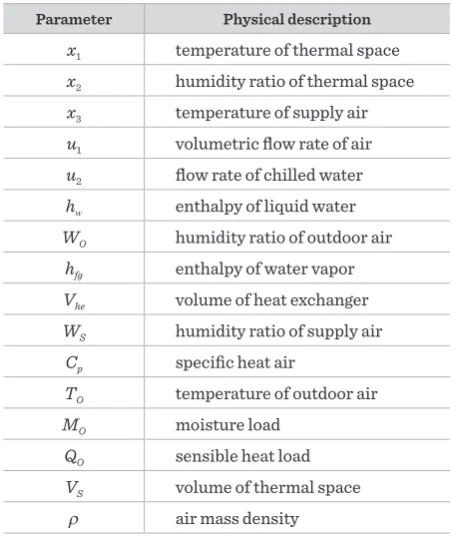
The differential equations describing the dynamics of the HVAC system can be derived from energy conser-vation principles as follows [3]
Figure 1