B. Siddartha
Asst. Professor, Malla Reddy College of Pharmacy, Maisammaguda, Dhulapally,
Secunderabad-500014. A.P., INDIA. Email id: [email protected]
Address for correspondence
Access this article online www.japer.in
Analytical method development and validation for simultaneous
estimation of mosapride and pantoprazole in bulk &
pharmaceutical dosage form by RP-HPLC method
INTRODUCTION
Chemically, Mosapride is (RS )-4-amino-5-chloro-2-ethoxy-N
-{[4-(4-fluorobenzyl)morpholin-2-yl]methyl}benzamide. The chemical formula is C21H25ClFN3O3. The molecular formula is 421 g/mol.
Mosapride is a gastroprokinetic agent that acts as a selective 5HT4 agonist. The major active metabolite of
mosapride, known as M1, additionally acts as a 5HT3 antagonist, which accelerates gastric
emptying throughout the whole of the gastrointestinal tract in humans, and is used for the treatment of gastritis, gastro-oesophageal reflux disease, functional dyspepsia and irritable bowel syndrome. It is recommended to be taken on an empty stomach (i.e. at least one hour before food or two hours after food)[1].
Pantoprazole is chemically, 6-(difluoromethoxy)-2-
{[(3,4-dimethoxypyridin-2-yl)methane]sulfinyl}-1H-1,3-benzodiazole. It is a proton pump inhibitor drug used for short-term treatment of erosion and ulceration of the esophagus caused by gastroesophageal reflux disease. The chemical formula is C16H15F2N3O4S. The molecular formula is 383.37
g/mol. Pantoprazole is a proton pump inhibitor (PPI) that suppresses the final step in gastric acid production by forming a covalent bond to two sites of the (H+,K+ )- ATPase enzyme system at the secretory
surface of the gastric parietal cell. This effect is dose- related and leads to inhibition of both basal and stimulated gastric acid secretion irrespective of the stimulus[2].
Different analytical methods have been reported in the literature for the assay of mosapride and pantoprazole in pharmaceuticals and include spectrophotometry, TLC, HPLC, HPTLC, LC-MS[3–12]. The present study was to establish a simple, sensitive and low cost RP-HPLC method for simultaneous estimation of mosapride and pantoprazole in bulk as well as in other dosage forms. The developed method was validated as per ICH guidelines [13, 14].
MATERIALS AND METHODS: Reagents
A simple, specific and accurate reverse phase high performance liquid chromatographic method was developed for the simultaneous determination mosapride and pantoprazole in pharmaceutical dosage form. The column used was Altima 150mm x 4.6 mm, 5 in isocratic mode, with mobile phase containing phosphate buffer and acetonitrile (55:45 v/v) adjusted to pH 3.0 with dilute ortho phosphoric acid solution. The flow rate was 1.1 ml/ min and effluents were monitored at 260 nm. The retention times of mosapride and pantoprazole were found to be 2.399 min and 3.191 min, respectively. The linearity for mosapride and pantoprazole were in the range of 7.5-45 µg/ml and 20-120 µg/ml respectively. The recoveries of mosapride and pantoprazole were found to be 99.22 to 100.09% and 98.02 to 99.98%, respectively. The proposed method was validated and successfully applied to the estimation of mosapride and pantoprazole in combined tablet dosage forms.
Key words: Validation, Mosapride, RP-HPLC, Dosage form ABSTRACT
B. Siddartha1*, I. Sudheer Babu2,
Ch. Ravichandra Gupta3, Uttam
Prasad Panigrahy1
1Department of Pharmaceutical
Analysis, Malla Reddy College of Pharmacy, Secunderabad.
2Sir C.R.Reddy College of
Pharmaceutical Sciences Eluru., WG Dist.
3Suven Life Sciences Limited
Patancheru (Mandal), Medak (Dist),
Mosapride and Pantoprazole were kindly supplied by Zydus Cadila Healthcare Ltd and Dr Reddy Laboratories Ltd. Acetonitrile, water (HPLC grade, Merck) and all the other reagents of AR grade were purchased from M R Enterprisers. A capsule Moza Plus (Intas Laboratories Pvt Ltd) containing 15mg of mosapride and 40mg of pantoprazole were used.
Instrumentation
The LC system consisted of a Waters model 515, PDA detector 2998 with 20 µL sample loop. The output signals were monitored and integrated using Empower 2 software.
Chromatographic conditions
The elution was isocratic and the mobile phase consisted of a mixture of buffer (accurately weighed and transferred 1.36gm of Potassium dihydrogen Orthophosphate in a 1000ml of volumetric flask add about 900ml of milli-Q water, add 1ml of triethylamine and degass to sonicate and finally make up the volume with water, then pH adjusted to 3.0 with dil. Ortho phosphoric acid solution) and acetonitrile (55 : 45 v/v). The mobile phase was filtered through a 0.45-µm (HVLP, Germany) membrane filter prior to use. A Altima 150mm x 4.6 mm, 5 was used for determination. The flow rate was 1.1 ml/min and the column was operated at ambient temperature (~30oC). The volume of sample injected
was 10 µL. Prior to injection of the solutions, column was equilibrated for at least 30min with mobile phase flowing through the system. The UV detector was set at wavelength of 260nm. A typical RP-HPLC chromatogram of mosapride and pantoprazole is shown in (Fig. 1).
Diluent: At first dissolved in methanol then diluted with Water and acetonitrile (50:50).
Standard Preparation
Accurately weighed and transferred 15mg of mosapride and 40mg of pantoprazole working Standards into a 100 ml clean dry volumetric flask, add 7ml of diluent, sonicated for 30 minutes and
make up to the final volume with diluent. From the above stock solution, 2ml was pipetted out in to a 10ml volumetric flask and then make up to the final volume with diluent.
Sample Preparation About
20 tablets were taken and their average weight was ca lculated. The tablets were crushed to a fine powder and drug equivalent to 15mg and 40mg were transferred to a 100ml volumetric flask, dissolved in diluent. Transfer 2ml from the above solution into 10ml volumetric flask and filtered through 0.45μ membrane filter to get concentration of 30μg/ml and 80μg/ml.
Method Validation
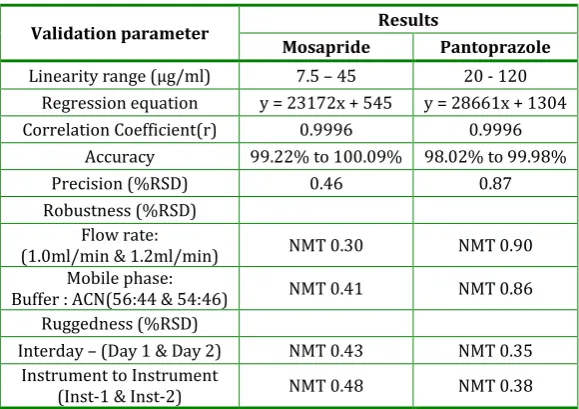
The developed method was validated as per ICH guidelines [13-14]for its accuracy, linearity, precision, specificity, robustness, ruggedness, limit of detection and limit of quantification by using the following procedures. The parameters are validated as shown in table 9.
System suitability
System suitability and chromatographic parameters w ere validated such as asymmetry factor, tailing factor and number of theoretical plates were calculated.
Linearity
Accuracy
Accuracy was performed in triplicate for various concentrations of mosapride and pantoprazole equivalent to 50%, 100% and 150% of the standard amount were injected into the HPLC system per the test procedure. The average % recovery was calculated. The data was given in table 2.
Precision
A) Method Repeatability
Six sample solutions of the same concentration (100%) were prepared and injected into the HPLC system as per test procedure. The results were given in table 3.
B) Intermediate Precision (Day to Day variability) Two days as per test method conducted the study. For Day-1 and Day-2, six sample solutions of the same concentration (100%) were prepared and injected into the HPLC system as per test procedure. The results were given in table 6.
Limit of detection and Limit of Quantification LOD and LOQ were calculated from the average slope and standard deviation from the calibration curve as per ICH guidelines. The LOD and LOQ of mosapride were found to be 0.292µg/ml and 0.885µg/ml respectively. The LOD and LOQ of pantoprazole were found to be 2.357µg/ml and 7.142µg/ml respectively.
Robustness and Ruggedness
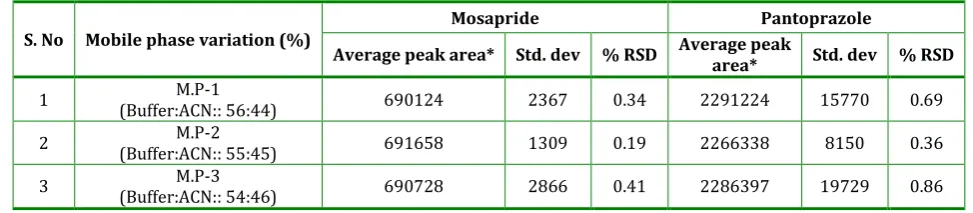
Robustness was done by small deliberate changes in the chromatographic conditions and retention time of mosapride and pantoprazole were noted. The factors selected were flow rate and variation in the mobile phase composition. The results remained unaffected by small variations in these parameters as shown in table 4 and 5.
Ruggedness of the method was checked by using different days and instruments. The relative standard deviation of the results obtained from different days and instruments was <2.0%.The results were given in table 6 and 7.
Assay
The assay and % purity were calculated for brands Moza Plus(Intas Laboratories Pvt Ltd) and Pantop-M(Aristo Pharmaceuticals Ltd) with label claim 15mg and 40mg. The observed value was compared with that of standard value without interference from the excipients used in the tablet dosage form. The results were given in table 8.
Fig 1: HPLC chromatogram of Mosapride and Pantoprazole in optimized chromatographic
conditions
Fig 2: Linearity of Mosapride in the range 7.5 to 45μg/ml.
Table 1: Linearity data of Mosapride and Pantoprazole
S. No Mosapride Pantoprazole
Conc(μg/ml) Rt(mins) Area Conc(μg/ml) Rt(mins) Area
1 7.5 2.427 175739 20 3.225 573452
2 15 2.431 358423 40 3.231 1158111
3 22.5 2.399 512205 60 3.191 1747546
4 30 2.426 690553 80 3.232 2255883
5 37.5 2.399 864055 100 3.184 2835958
6 45 2.426 1052470 120 3.225 3475785
r = 0.9996
y = 23172x + 545 y = 28661x + 1304 r = 0.9996
Table 2: Accuracy data
S. No
Mosapride Pantoprazole
Spiked level
Amount added (µg/ml)
Amount present (µg/ml)
Average %Recovery*
+ %RSD
Amount added (µg/ml)
Amount present (µg/ml)
Average %Recovery*
+ %RSD
1(n=6) 50% 15.00 14.89 99.29 + 1.05 40.00 39.89 99.74 + 0.15
2(n=6) 100% 29.99 29.84 99.49 + 0.24 79.96 79.77 99.77 + 0.67
3(n=6) 150% 44.98 44.90 99.37 + 0.76 119.94 119.72 99.82 + 1.07
*n=6 (Average of 6 determinations)
Table 3: Precision data of Nebivolol and Valsartan
S. No Mosapride Pantoprazole
Conc(μg/ml) Rt(mins) Area Conc(μg/ml) Rt(mins) Area
1 30 2.411 690990 80 3.212 2263191
2 30 2.399 685687 80 3.225 2298696
3 30 2.402 689721 80 3.197 2280396
4 30 2.435 693991 80 3.235 2254555
5 30 2.427 686081 80 3.193 2272845
6 30 2.344 687622 80 3.216 2305102
Mean 689015 2279131
Std.dev 3187 19781
%RSD 0.46 0.87
Table 4: Robustness data relating to change in flow rate (1.0ml/min)
S .No Mosapride Pantoprazole
Flow rate (ml/min) Average Peak Area* Std.dev %RSD Average Peak Area* Std.dev %RSD
1 1.0ml/min 691045 1834 0.27 2280986 15090 0.66
2 1.1ml/min 690636 973 0.14 2266273 10467 0.46
3 1.2ml/min 691959 2081 0.30 2277743 20415 0.90
*n=3 (Average of 3 determinations)
Table 5: Robustness data relating to change in mobile phase composition
S. No Mobile phase variation (%) Mosapride Pantoprazole
Average peak area* Std. dev % RSD Average peak area* Std. dev % RSD
1 (Buffer:ACN:: 56:44) M.P-1 690124 2367 0.34 2291224 15770 0.69
2 (Buffer:ACN:: 55:45) M.P-2 691658 1309 0.19 2266338 8150 0.36
3 (Buffer:ACN:: 54:46) M.P-3 690728 2866 0.41 2286397 19729 0.86
Table 6: Ruggedness data relating to change of day
S. No
Inter-day precision
Mosapride Pantoprazole
Peak area Peak area
Conc (µg/ml) Day-1 Day-2 Conc (µg/ml) Day-1 Day-2
1 30 689283 688272 80 2278484 2284747
2 30 690228 687333 80 2284747 2294847
3 30 692938 689374 80 2294847 2281163
4 30 693484 691837 80 2267484 2271726
5 30 688292 693838 80 2274847 2281711
6 30 687392 690387 80 2271821 2286483
Mean 690270 690174 2278705 2283446
SD 2475 2390 9852 7569
%RSD 0.36 0.35 0.43 0.33
Table 7: Ruggedness data relating to change of instrument
S. No
Instrument to Instrument
Mosapride Pantoprazole
Peak area Peak area
Conc (µg/ml) Day-1 Day-2 Conc (µg/ml) Day-1 Day-2
1 30 689737 687191 80 2264847 2285746
2 30 687828 689111 80 2285746 2294847
3 30 689227 693271 80 2294478 2284747
4 30 691273 692847 80 2271927 2271198
5 30 690282 690183 80 2271927 2294847
6 30 692847 691883 80 2281280 2289288
Mean 690199 690748 2278368 2286779
Std.dev 1729 2354 10847 8769
%RSD 0.25 0.34 0.48 0.38
Table 8: Results of analysis of laboratory samples (Assay)
S. No Sample Label Mosapride Pantoprazole
Amount found %Purity + RSD* Amount found %Purity + RSD*
1 (MOZA PLUS) Brand-1 15mg/40mg 14.98 99.73 + 0.12 39.87 99.56 + 0.48
2 (PANTOP-M) Brand-2 15mg/40mg 14.96 99.63 + 0.12 39.82 99.44 + 0.34
*n=3 (Average of 3 determinations)
Table 9: System suitability parameters
Validation parameter Results
Mosapride Pantoprazole
Linearity range (µg/ml) 7.5 – 45 20 - 120 Regression equation y = 23172x + 545 y = 28661x + 1304
Correlation Coefficient(r) 0.9996 0.9996
Accuracy 99.22% to 100.09% 98.02% to 99.98%
Precision (%RSD) 0.46 0.87
Robustness (%RSD) Flow rate:
(1.0ml/min & 1.2ml/min) NMT 0.30 NMT 0.90 Mobile phase:
Buffer : ACN(56:44 & 54:46) NMT 0.41 NMT 0.86 Ruggedness (%RSD)
Interday – (Day 1 & Day 2) NMT 0.43 NMT 0.35 Instrument to Instrument
RESULTS
A reverse-phase column procedure was proposed as a suitable method for the simultaneous estimation of mosapride and pantoprazole dosage form. The chromatographic conditions were optimized by changing the mobile phase composition. Different ratios were experimented to optimize the mobile phase. Finally, buffer and acetonitrile in the ratio 55:45v/v was used as mobile phase, which showed good resolution of mosapride and pantoprazole peak. The wavelength of detection selected was 260nm, as the drug showed optimized absorbance at this wavelength. By our proposed method the retention time of mosapride and pantoprazole were about 2.399mins and 3.191mins and none of the impurities were interfering in its assay.
DISCUSSION
The statistical analysis of data and the drug recovery data showed that the method was simple, rapid, economical, sensitive, precise and accurate. It can thereby easily adopt for routine quality control analysis. The results of this analysis confirmed that the proposed method was suitable for determination of drug in pharmaceutical formulation with virtually no interference of additives. Hence the proposed method can be successfully applied in simultaneous estimation of mosapride and pantoprazole in marketed formulation.
CONCLUSION
The proposed method is rapid, accurate and sensitive. It makes use of fewer amounts of solvents and change of set of conditions requires a short time. This method can be suitably analyzed for the routine analysis of mosapride and pantoprazole in bulk and its pharmaceutical dosage forms. It does not suffer from any interference due to common excipients present in pharmaceutical preparation and can be conveniently adopted for quality control analysis.
ACKNOWLEDGEMENTS
The authors are thankful to Mallareddy College of pharmacy, Secunderabad for providing all facilities to complete the work and Intax Laboratories Pvt Ltd for providing the mosapride and pantoprazole as gift sample.
REFERENCES
1. http://en.wikipedia.org/wiki/Mosapride 2. http://www.drugbank.ca/drugs/DB00213 3. Bhavesh H. Patel*, Bhanubhai N. Suhagia,
Madhabhai M. Patel, and Jignesh R. Patel, High-Performance Liquid Chromatography and Thin-Layer Chromatography for the Simultaneous Quantitation of Rabeprazole and Mosapride in Pharmaceutical Products, Journal of Chromatographic Science, January 2008, Vol. 46, 10-14.
4. Ramakrishna Yadav*, Avani Chokshi, Vijaykumar Parmar, Development and validation of spectrophotometric methods for simultaneous estimation of levosulpiride and pantoprazole sodium, International Journal of Pharmaceutical Frontier Research, Jan-Mar 2013, Vol 3, Issue 1, 54-62.
5. Darshan Gohil, Prachi Bhamre, Reshma Jain and Sadhana Rajput*, Simultaneous estimation of esomeprazole magnesium trihydrate, itopride hydrochloride and mosapride citrate by RP-HPLC method: optimization, development, validation and application to laboratory sample, International Journal of Pharmaceutical Sciences and Research, 2014, Vol 5, Issue 3, 907-912.
6. G. Manasa, N. Anusha*, Development and validation of RP-HPLC method for the simultaneous estimation of pantoprazole and mosapride in capsule dosage form, International Journal of Pharmacy and Pharmaceutical Sciences, 2012, Vol 4, Suppl 5, 293-299.
pantoprazole in a fixed-dose combination by uv spectrophotometric methods and RP-HPLC, International Journal of Pharmaceutical Studies and Research, 2011, Vol II, Issue II, 29-36. 8. Patel Keyur D*, Hasumati Raj, Sojitra Jatin R,
Kanani Nilesh, Simultaneous estimation of levosulpiride and pantoprazole sodium by first and second derivative spectroscopic methods in capsule dosage form, Universal Journal of Pharmacy, 2013, Vol 2, Issue 1, 160-167. 9. Y. S. R. Krishnaiah*, T. K. Murthy, D. G.Sankar
and V. Satyanarayana, A high performance liquid chromatographic assay for mosapride citrate, Asian Journal of Chemistry, 2003, Vol 15, Issue 1, 62-66.
10. Kareti Srinivasa Rao1*, Nargesh Kumar Keshar, Prasenjit Roy Choudhury and Ajay Kumar Pattnaik, RP-HPLC Method for the estimation of pantoprazole sodium, International Journal of Pharma Medicine and Biological Sciences, 2012 July, Vol. 1, Issue No. 1, 1-6.
11. Jitesh S. Jadhav, Swetal P. Vassa, Hemant Kumar Jain*, Development and validation of a RP-HPLC method for simultaneous determination of pantoprazole and cinitapride in antiulcer formulation, International Journal of Pharmacy
and Pharmaceutical Sciences, 2012, Vol 4, Suppl 4, 657-659.
12. Kampati Anil Kumar*, Sree.V. Janadharanan, Yarasi Surendranath Reddy, Vanam Naveen Kumar, method development and validation for simultaneous estimation of pantoprazole sodium and itopride hydrochloride in its bulk dosage forms by RP-HPLC, International Journal of Pharmacy and Pharmaceutical Sciences, 2013, Vol 5, Suppl 1, 190-194.
13. ICH validation of Analytical procedures: Text and Methodology Q2 (R1) in proceedings of International Conference on Harmonization; Geneva: Switzerland; 2005, 205-210.
14. ICH guidelines, Validation of Analytical procedures technical requirements for registration of Pharmaceuticals for Human use Text and Methodology Q2(R1), International Conference on Harmonization; Geneva: Switzerland; 2005, 325-340.
How to cite this article: B. Siddartha1*, I. Sudheer
Babu2, Ch. Ravichandra Gupta3, Uttam Prasad
Panigrahy1; Analytical method development and
validation for simultaneous estimation of mosapride and pantoprazole in bulk & pharmaceutical dosage form by RP-HPLC method; J. Adv. Pharm. Edu. & Res. 2014: 4(2): 186-192.
Source of Support: Nil, Conflict of Interest: Nil