I n t e r n a t i o n a l J o u r n a l o f E n g i n e e r i n g R e s e a r c h a n d S p o r t s S c i e n c e Page1
A.Sunitha Dept of Computer Science and Engineering –Dr.Sivathi Aditanar College of Engineering, Tiruchendur, India
V.B.Vintha Dept of Computer Science and Engineering –Dr.Sivathi Aditanar College of Engineering, Tiruchendur, India
ABSTRACT
Cloud computing is an internet based use of computer applications. It mainly used to share hardware and software resources over the network rather than the remote server. Load balancing techniques used to share the workload to the individual nodes of the system to improve both resource utilization and job response time while also avoiding a situation where some of the nodes are always busy while other nodes are idle or doing lower priority work. Load balancing problem can be balanced using the Load strategy method and create a multiple instances. Using the optimum scheduling algorithm, it schedule the task based on the deadline and cost based constraints which gives the minimum turn around time of the system. Load Strategy method use dynamic scheduling and to balancing the load and also reduce the execution time. And also consider the concept of Green computing that are used to reduce the energy consumption. Task consolidation is a method used to increase resource utilization and reduces energy consumption which can lead to freeing up of resources that can sit idling yet still drawing power.
__________________________________________________________________________________________________________
I. INTRODUCTION
Today, the most popular applications that millions of users are accessing the Internet services. Websites like Google, Yahoo and Facebook are receiving millions of clicks daily. It generates terabytes of invaluable data which can be used to improve online advertising strategies and user satisfaction. Real time capturing the data, storing the data and analysis or monitoring the data is common needs of all high-end online applications. To address these problems, a number of cloud computing technologies are recently emerged in last few years. The main purpose of Cloud Computing is to provide applications, data, and resources as services over the internet. Cloud computing is an on demand service in which they shared resources, information, software are provided according to the clients requirement at specific time. The customers are given access to resources are provided by a cloud vendor using Service Level Agreement (SLA). Clouds use virtualization concept in distributed data centers to allocate resources to customers as the user needs them. Generally, clouds are deployed to customers giving them three levels of service: Software-as-a-Service (SaaS), Platform-as-a-Service (PaaS), and Infrastructure-as-a-Platform-as-a-Service (IaaS). It has widely been adopted by the industry, though there are many existing issues like Load Balancing, Energy Management, Virtual Machine Migration and Server Consolidation. Load balancing is one of the central issue in cloud computing. A basic example of load balancing in our daily today life are related to websites that is accessing the resource in the internet. Without load balancing techniques the users are experience delays, timeouts and possible long responses time
in accessing the data. Load balancing is a mechanism used to share or distributed the dynamic workload evenly to all the nodes in the whole cloud in order to improve both resource utilization and job response time. It also used to achieve high user satisfaction and also improving the performance of the system while also avoiding a situation where some of the nodes are always busy while other nodes are idle or doing lower priority work. It helps in preventing bottlenecks of the system which may occur due to load imbalance. Load balancing can help in utilizing the available resources and minimizing the resource consumption. The remaining paper is organized as follows. The following section details the related work.
II. RELATED WORK
Presently there are a number of studies involving load balancing across distributed systems. Various strategies and algorithms have been proposed, implemented and classified in a number of studies. In [4] describes about the various existing load balancing techniques in cloud computing and also tell about the various metrics involved in cloud computing. Load balancing algorithms can be classified into two categories: static or dynamic. In static load balancing algorithms the tasks assignment to processors is done at compile time. The recent load status is not considered while assigning tasks. The current state of the system is not considered and the Prior knowledge of the system is needed. In [2] formulated the static load balancing problem in heterogeneous distributed systems as a non-cooperative game among user. The static load balancing problem can be solved by any one of the three approaches: global approach, cooperative approach or non-cooperative approach. And game theoretic approach proposed
A DYNAMIC LOAD BALANCING SCHEME FOR
ENERGY EFFICIENT RESOURCE UTILIZATION
IN CLOUD COMPUTING
COMPUTER SCIENCE
I n t e r n a t i o n a l J o u r n a l o f E n g i n e e r i n g R e s e a r c h a n d S p o r t s S c i e n c e Page2
by [1]. It solve the static load balancing problem for single class and multi-class or multi-user jobs in a distributed system the computers are connected by a communication network solve the static load balancing problem for single class and multi-class or multi-user jobs in a distributed system where the computers are connected by a communication network. In dynamic load balancing are decisions on load balancing are based on current state of the system. No prior knowledge is needed. The assignment of tasks to processors is mainly done in run time. The current load information of processors is used at the assigning tasks. In [3] discussed about the dynamic load balancing algorithm and also studied about the some of the issue in dynamic load balancing. In recent year Cloud computing has emerged as a global-infrastructure for applications by providing large scale services through the cloud servers. The service can be either storage service or computation services. Any applications in cloud environment are represented as workflow. The scheduling system in a cloud should overcome the failure which can be provided by fault tolerant scheduling algorithm by [5]. Schedule the workflow within the deadline in-spite of the many failure that occur in the environment. Fault tolerant workflow scheduling algorithm allows users to execute the workflows by satisfying deadline. In [6] scheduled the task by using fair completion time and rescheduled by using mean waiting time of each task to obtain load balance. DLB algorithm scheme tries to provide optimal solution so that it reduces the execution time and expected price for the execution of all the jobs in the grid system is minimized. In [7] proposed algorithm is to map tasks to resources in a way that balance out the load and improved utilization of resources. And [8] proposed an ant colony optimization to balance the load and also to minimize the execution time of the system.
III. MAIN FRAMEWORK OF THE PROPOSED DESIGN
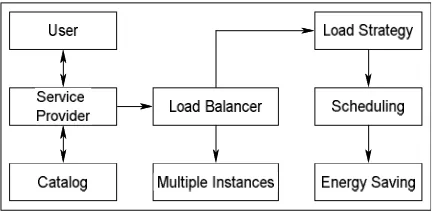
Fig 1 shows the architecture for the proposed work. The main objective of the work is to schedule the tasks based on the constraints to balance the workload of cloud nodes to maximize the resource utilization. And also to minimize the energy consumption of under loaded or low loaded resources by energy conservation. And also to balance the workload for the incoming request of the user application and also balance the running task in the processor.
Figure 1 Architecture of the proposed work
Cloud Load Management
Load management strategies typically involve numerous tasks including performance monitoring (response times, latency, uptime) compliance auditing and management and initiating and managing disaster and so on. Load can be classified by recovery and contingency plans. In Cloud there is numerous management to manage all the activities. In the cloud load management involves workload management, dynamic resource provisioning, scheduling the task for the appropriate users, monitoring the running task and upcoming task. In Cloud management main strategies is load balancing.
a. Catalog
Catalog that contains the available information about the cloud resources and it also contain the user information. The user information is how many user are asking the resources. In user information contain the user id, resource name, time, cost, priority and devices name. It contains the set of services that the end user request and also contain the service level agreement and terms and conditions for service provisioning. Based on SLA the user request are categorized It also contains the job information and resource information. The Resource information such as resource id, resource name and CPU speed, delay to reach the resource; number of hop count to reach the resource and the number of task remaining in resource are present.
b. Load Strategy
Load balancer identifies the how many nodes are available and also collect the load information of resources. The information is about the Load id, CPU Load, total number of memory, number of task run. To solve the load balancing nodes three categories they are heavily loaded nodes, lightly loaded nodes and moderate loaded nodes. For these use an algorithm are Dynamic Scheduling using Boundary value approach is used. In this algorithm the resources which has load greater than the value are said to be overloaded and the resources have the load lesser then it is called least loaded. If the load exceeds the given value then the load balancing applied. For this use a policies such as selection, information and location policy which are considered to migrate the job to other resources which are below the value. For selecting where the job, to migrate. First find out all the least loaded node and find out the completion time for all the least loaded then choose the minimum completion time of the job from the least loaded and then migrate the heavily loaded node to under loaded. This algorithm will get the resources load information from the cloud resources.
c. Scheduling
I n t e r n a t i o n a l J o u r n a l o f E n g i n e e r i n g R e s e a r c h a n d S p o r t s S c i e n c e Page3
scheduled accordingly. Priority determines the importance of which task should be executed first. Task scheduling in priority that determines the order of task scheduling based on the parameters undertaken for its computation. The deadline based tasks are prioritized on the basis of task deadline. The tasks with having a shorter deadline should be executed first. It has been given more priority in scheduling sequence. The task list that are rearranged in ascending order of deadline so that it may execute the task with minimum time constraint first. The cost based tasks that are prioritized on the basis of profit that are arranged in descending order. It is considerable as tasks with higher profit can be executed on minimum cost based machine to give maximum profit.
d. Multiple instances
In these method create an instances based on the request for the same resources. If the multiple user is request for the same resource then the create a instances for the resource. Create the instances by assuming a new data center so that the overloaded node is transfer to the new datacenter so that it minimizes the overload in the node.
e. Energy Saving
The energy consumption of under-utilized resources that are mainly in a cloud environment that used considerable amount of the actual energy that are used. Resource allocation strategy that mainly consider resource utilization that lead to better energy efficiency in clouds, extends further with virtualization technologies in that tasks can be easily consolidate. Task consolidation is an important method to increase resource utilization and also in turn reduces energy consumption. Task consolidation is used to the freeing up of resources that can sit idling yet still drawing power. The efforts have taken to reduce idle power draw, this may usually putting computer resources into some form of sleep or power saving mode. By using this method maximize resource utilization and take account in both active and idle energy consumption. Task consolidation is an effective means to manage resources particularly in clouds both in the short and long terms. In the short term case, incoming tasks can be “energy-efficiently” dealt with by reducing the number of active resources, and putting redundant resources into a power-saving mode or even turning off some idle resources systematically.
IV. RESULT ANALYSIS
Simulate the work and to produced a energy efficient load balancing in cloud. Some parameters are considered to simulate them. CloudAnalyst tool are used to simulate the work. It is support evaluation of social network tools according to geographic distribution of users and datacenter. CloudAnalyst is a GUI based tool that is developed on cloudsim Architecture. It allows the usert to do repeated simulation across the region. In the CloudAnalyst tool there are various configuration and parameter to set for the simulation.
A. GUI package
It allows the various user interfaces to configure the various parameters in easy way and better way.
Figure 2 GUI of Cloud Analyst
The GUI of the Cloud Analyst is shown in the fig 2. The various configuration of the Cloud Analyst are described below:
Figure 3 User base Configuration
B. User base Configuration
In this user base are used to represent the users who are deploying the application in the specific region. Fig 2 shows the user base configuration.
C. Data Center Configuration
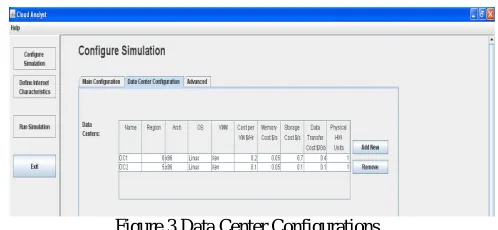
This configuration that are used to control the datacenter in the various regions. Fig 3 shows the Datacenter configuration.
Figure 3 Data Center Configurations
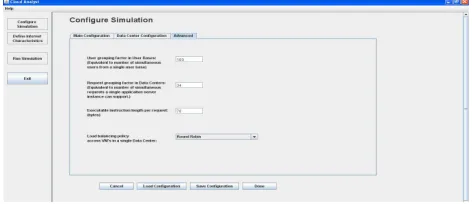
D. Advanced Configuration
I n t e r n a t i o n a l J o u r n a l o f E n g i n e e r i n g R e s e a r c h a n d S p o r t s S c i e n c e Page4 Figure 4 Advanced Configurations
E. Internet Characteristics
Fig 5 shows the Internet Characteristics. In these various internet characteristics are modeled for the simulation which include the amount of latency and bandwidth needed to assign across the region.
Figure 5 Internet Characteristics
F. Simulation Configuration
In order to analyze the load balancing in cloud. Set the parameter for the user, datacenter and application configuration. In these consider the number of user as 12, number of the datacenter present in them is 2 and it consists of 6 Region. One datacenter is located at Region 0 and the DC2 datacenter is located at Region 5. Figure shows the user configuration and data center configuration. In these set up the parameter that are used in the datacenter and user base configuration. After setting are done for the configuration in the Cloud Analyst for the load balancing policy. The result is calculated for response time, request processing time and cost.
a. Response time
Response time for each user and overall response time are calculated from the Cloud Analyst for the load balancing policy is Round Robin.
Table 1 Overall Response time Summary
Table 1 and 2 shows overall Response time summary and the Response time for the user for the region.
Table 2 Response Time For The User For The Region
b. Datacenter Requesting Service time
Datacenter Requesting Service time for each datacenter is calculated from the Cloud Analyst for the load balancing policy is Round Robin.
TABLE3: Datacenter Requesting Service time
c. Processing cost
Processing cost for each datacenter are calculated from the Cloud Analyst for the load balancing policy is Round Robin. Table 4 shows the overall summary for the Processing cost for the Datacenter.
Table 4: Processing cost for the datacenter
CONCLUSION
I n t e r n a t i o n a l J o u r n a l o f E n g i n e e r i n g R e s e a r c h a n d S p o r t s S c i e n c e Page5
REFERENCES
[1] Satish Penmatsa and Anthony T. Chronopoulos “Game-theoretic static load balancing for distributed systems” Journal of Parallel Distributed Computing, 2011, pp. 537-555.
[2] Daniel Grosu and Anthony T. Chronopoulos “Noncooperative load balancing in distributed systems” Journal of Parallel Distributed Computing, Vol. 65, 2005, pp.1022 – 1034.
[3] A. M. Alakeel, “A Guide to dynamic Load balancing in Distributed Computer Systems”, International Journal of Computer Science and Network Security, Vol. 10,No. 6, June 2010, pp. 153-160.
[4] Nidhi Jain Kansal and Inderveer Chana “Existing Load Balancing Techniques in Cloud Computing: A Systematic Review” Journal of Information Systems and Communication, Vol.3, Issue.1, 2012 pp. 87-91.
[5] Monica Choudhary and Sateesh kumar Peddoju “A Dynamic Optimization Algorithm for Task Scheduling in Cloud Environment” International Journal of Engineering Research and Application, Vol. 2, Issue. 3,2012 pp. 2564-2568.
[6] U.Karthick Kumar “A Dynamic Load Balancing Algorithm in Computational Grid Using Fair Scheduling” International Journal of Computer Science Issues, Vol. 8, Issue 5, No 1, September 2011. [7] Sandip Kumar Goyal et al. “Adaptive and Dynamic Load Balancing in Grid Using Ant Colony Optimization” International Journal of Engineering and Technology, Vol 4 No 4 Aug-Sep 2012, pp 167-174.