Munich Personal RePEc Archive
Influencing Factors of Profitability on the
Banking Industry : A case study of GCC
countries.
ULLAH, NAZIM
INTERNATIONAL CENTER FOR EDUCATION IN ISLAMIC
FINANCE(INCEIF), MALAYSIA
31 January 2016
Online at
https://mpra.ub.uni-muenchen.de/69124/
1
“
Influencing Factors of Profitability on the Banking Industry
: A case study of GCC countries.”
Nazim Ullah
1Abstract
Key words: Islamic Bank, Conventional Bank, Factors, Profitability, OLS, and GCC countries.
1MSc, International Centre for Education in Islamic Finance (INCEIF), Malaysia, Cell +601111363659, Mail
2
1.
Introduction
1.1Background of the study
GCC that consist of the many conventional and Islamic banks that plays an important role in the GDP. Although these banks still play remarkable role in economic growth of the country, there are still problems on the previous research on the performance analysis of the banking industry especially Islamic bank and conventional banks that should be improved. I shall try at my best level to draw the conclusion of the problems. Whereas, my purpose is to find out and see the impact of different factors on profitability and the situation of the profit between the Islamic bank and conventional bank of the GCC countries. I want to see the result on the basis of the three models firstly, general model, secondly, addition of the variables with the general model and thirdly, dummy variable with the existing model.
All GCC countries are large oil exporters with fixed exchange rate regimes which expose them to the vagaries of international oil prices. The similarities in economic structure imply common sources of strengths and vulnerabilities of their financial systems. Al Hassan (2010) said their financial system has vulnerability. This vulnerability place negative impact on the banking industry whereas with stable economy places great and important role in the banking sector of the GCC countries. It goes without saying that more stable economy the more positive the banking industry and higher performance of the bank.
Zeitun R. (2012) find, the banking sector in the GCC countries is largely owned by locals due to entry barriers and licensing restrictions for foreign ownership. The financial sectors have the important role on the overall performance of the country. Zeitun said, the financial systems in the GCC countries are generally dominated by the banking sector, while, the non-bank financial institutions have limited presence in the GCC countries. Among the financial institution, banking sector plays a main role in financing economic activities. Furthermore, GCC countries have two banking systems; the conventional banking system and the Islamic banking system, which operates according to Islamic law which are based on the Quran and the Sunnah. On the other hand conventional bank function on the basis of the man made laws.
3 1.2 Objective of the study
The objective of the study is to see the impact of the influencing factors on profitability and whether the differences of profitability of Islamic bank and the conventional bank in the GCC countries.
1.3 Methodology of the study
For the purpose of the evaluating and measuring the profitability of the six GCC countries, I use cross-sectional data and 72 observations combining 26 Islamic banks and 46 conventional banks for the year 2014.At first i collect many observation but due to unavailability of data i have to dropped many observations. By using bank-scope I collect required data on the specific variables and estimate all variables by using OLS method in different regression models.
1.4 Background of the GCC
The Gulf Cooperation council (GCC) consists of six countries located in the Middle East: Saudi Arabia, Kuwait, United Arab Emirates, Qatar, Oman and Bahrain. The GCC was founded in 1981 with the objective of coordinating policies of various political, economic, and social matters among its member states to have similar regulations. The GCC countries are independent governments with independent currencies. The total population of the GCC region is estimated to be approximately 34 million, which gives it third the population of the Arab world. The main religion is Islam. The GCC is wealthy in the natural resource oil: an important commodity around the world. For many of the GCC countries, oil was discovered in the 1940’s in the aftermath of World War II. Having the world’s largest oil reserves, the GCC depends heavily on oil exports.
4
2.
Literature review
Mentioned by Gul, S. et al. (2011), The Banking sector acts as the life blood of modern trade and commerce to provide them with a major source of finance. This increasing phenomenon of globalization has made the concept of efficiency more important both for the non-financial and financial institutions and banks are the part of them. Banks largely depends on competitive marketing strategy that determines their success and growth. The modalities of the banking operation have changed a lot in the new millennium compared to the way they used to be in the years bygone. The function of this banking operations to mention by Islam, M. M. (2003) a well developed efficient banking sector is an important prerequisite for saving and investment decisions for rapid economic growth. It is the system by which a country’s most profitable and efficient projects are systematically and continuously funded. A prominent line of research stresses the role of the financial institutions in economic growth.
Iqbal and Molyneux, (2005).Early banking in the GCC region experienced a lot of foreign ownership mostly by a bank named British Bank in the Middle East. This bank had branches across all six GCC countries. Other foreign banks were also popular as there were large revenues from oil trade. Local banks were not common as there was not sufficient experience. However, governments later adopted central banking systems to eliminate foreign involvement. Today, the Saudi banking system allows a maximum of forty percent foreign ownership and the other sixty percent must be local ownership. In other GCC countries however, foreign ownership is still permitted with no requirement of local ownership, but they must abide to the central banking rules and regulations.
Louati et al. (2015), Smaoui et al. (2011), Al-Hassan et al, (2010), Zeitum (2012) and (Al-Hassan et al. (2010) said the impact of the internal factors like bank’s size, He found that liquidity funds deposited into current accounts, total capital and reserves, and the percentage of profit-sharing between banks, depositors and capital adequacy influence on the performance of the bank. They also mention competitiveness of the both bank and the religious principles of the Islamic bank influence the performance of the bank. Whereas,
Zeitum (2012) said operational efficiency of the bank also influences the portability of the bank and According to the agency theory, ownership structure could be related to bank’s profitability. They found that foreign-owned banks were characterized by higher profitability followed by private counterparts on the other hand; Banks owned by government were found to be the lowest profitable. Some studies show a negative relationship between capitalization and banks’ profitability, it means that equity and bank financing acts as substitutes rather than complements. Mohd et al. (2013)said higher leverage and large loans to asset ratios, lead to higher profitability. He also reports that foreign-owned banks are more profitable that the domestic one. There is also evidence that taxation impacts negatively bank profitability. Performance of the bank is not only depending on the internal factors it also depend on the external factors.
5
Banks earned more than those which operate in a monopolistic market. Furthermore, interest rates, inflation and size have significant positive impact on the profits of both conventional and Islamic Banks.
Conventional bank that is fully manmade principles whereas the entire inventor gets the assurance of getting predetermined rate of the interest and getting back of the invested money. It is operated on the basis of the maximising profit without considering the welfare of the people of the society. in case of default , it impose penalty on client.
. Islamic banking literature is limited but research on commercial banks
profitability will be applicable. In general, Islamic banking operations are characterised by a high degree of financial risk since the interest factor is absent. Whereas, Islamic banks function on the basis of profit and loss sharing (PLS), so if the banks undertake risk then investors share part of the risk.
According to the Al-Kassim, (2005), Islamic Banks combine commercial banking activities and investment banking operations in order to generate acceptable rates of return that is on the basis of the benchmark for depositors but in compliance with Islamic rules and principles. Unlike conventional banks, where money is considered as a commodity that can be bought and sold, Islamic Banks treat money as a mean to facilitate transactions for trading purpose but sharing with the client that creates real value in the economy.
From the analysis Johnes, J. (2009), Found that Islamic bank is less cost efficient but more revenue and profit efficient then the counterpart conventional banks because the structure and the planning of the Islamic bank is totally different from the conational bank. Islamic banking is the large features of the financial sector mainly in the developing countries, and financial sector and growth are important for economic deployment and stability.
6
3. Model
3.1. Data
A cross-sectional data relating to the banks in (GCC) countries were employed in these study 72 observations combining 26 Islamic banks and 46 conventional banks for the year 2014 that derived from the Bankscope database. The major items of interest are: bank specific factors, macro factors and use dummy to see whether differences in terms profitability of the Islamic bank or conventional bank
Observations All banks Islamic bank Conventional bank
2014
72
26
46
3.2 sample
Total observations are 72, Out of the 72 observations 26 for the Islamic banks and 46 for the conventional banks for the year 2014. Due to the data problems i need to remove many banks from the observations.
3.3. Variables used in the study
In the banking literature, there are many profitability ratios that have been used by researchers in measuring bank performance. Olson, et al. (2011) and Iqbal et al. (2005) used ROE and ROA as a measurement of the bank profitability whereas, Houcem Smaoui et al. (2011) and Alkassim, F. A. (2005). Uses ROE, ROA and NIM as dependent variables for profitability and Efficiency: Cost to Income ratio (COSR), Asset Quality: Loan loss reserves to Gross loans (LLR), Capital: Equity to Asset ratio (EA), Liquidity: Net Loans/Total Assets (NLA), GDP growth, Inflation as a independent variables. and Total Assets (bank size), Total Equity to Total Assets, Total Loans to Total Assets, Deposits to Total Assets, Total Expenses to Total Assets and Non-Interest Expense to Total Expense as a independent variables. Finally, Gul S. and et al. (2011) Mention the factors considered for analysis include ROA, ROE, ROCE and NIM as dependent variables which each examine separately with same explanatory variables i.e., size, capital, deposits, loan, gdp, inf and MC. Whereas, Zeitun (2010) said The external determinants are the macroeconomic variables (such as interest rate, inflation, GDP, money supply and exchange rate) that affect the whole economy and considered as important determinants of performance.
7
3.3.1 Dependent variables
Return on Assets (ROA): ROA is the ratio of a bank's net after-tax income divided by its total assets. It measures how efficiently the management of the bank has been able to convert the bank's or institution's assets into profits.
Return on Equity (ROE): ROE is the ratio of a bank's net after-tax income divided by its total equity capital. It measures how effectively the management of the bank has been able to turn shareholders' equity into net profit.
3.3.2 Independent variables
Bank specific factors (Internal factors) -
Bank size: Total assets; the size of the bank indicates how much asset the bank has. The assets of the bank such as first, physical assets (building, land, furniture, and equipment), second, loans which is the primary source of the revenue of the bank, third, reserves indicates which bank uses for the daily transaction, and fourth investment securities. Hassan (2010) said, the asset quality of GCC banks has improved significantly over the past five years. The ratio of nonperforming loans (NPLs) to total loans has been on a declining trend since 2003. Whereas, Zeitun, R. (2012) said, provided evidence from Greek. They showed that banks with larger assets are more profitable but found that in his studied bank size also has certain limit on the profitability of the bank.
Capital adequacy: Equity to Asset ratio (EA); Equity to asset ratio (EA) measures the capital adequacy of the bank. It signals the overall shock absorbing capacity of a bank for potential loan asset losses. The higher the EA ratio, the stronger is the ability of the bank to withstand asset losses. Additionally, the greater the EA ratio, the lower is the need for external funding, hence the higher the profitability of the bank.
Liquidity: Net Loans/Total Assets (NLA); NLA is a liquidity ratio measuring the portion of the bank’s assets tied up in loans. Higher NLA ratios could reduce the liquidity of the bank and increase the number of defaulting borrowers. However, higher NLA ratios may be indicative of better bank performance because of increases in interest income. Thus, its effect on bank performance is ambiguous. Zeitun, R. (2012). Suggested that there is a positive relationship between liquidity and profitability of the bank. Nevertheless, some studies illustrate that smaller amount of funds put in liquid investments can result in higher profitability.
Macro economic factors (External factors)-
8
manifesting in the business cycles. Consequently, movements in general activity level are expected to generate direct impacts on profitability of banks.
Inflation; The importance of inflation on the performance of banks primarily due to the inflation on the sources and users of banks’ financial resources. In particular, inflation affects companies’ pricing behaviour. For instance, if companies expect general inflation to be higher in the future, they may believe that they can increase their prices without suffering a drop in demand for their output. In this scenario, upon the condition that expected inflation will be equal to actual inflation, there will be no decrease in business activities and no negative effect on banks’ performance.
Hypothesis
In order to test hypotheses, I use five independent variables, namely bank size (total assets), capital adequacy, liquidity, efficiency, and inflation and gdp. The dependant variables are bank profitability, proxies by return on equity (ROE) and return on assets (ROA).
Total asset (bank size)
H1: bank size is positively related to profitability.
Equity to Assets (EA) ratio is a measure of capital adequacy. H1: Equity to Assets ratio (EA) is positively related to profitability
Net Loans to Assets ratio (NLA) is a measure of liquidity
H1: Net Loan to Assets ratio (NLA) is negatively related to profitability
High inflation rates are generally associated with high interest rates on loans H1: Inflation has a positive relationship with bank profitability
Gross domestic product (GDP)
H1:
GDP is positively related to profitability.3.4 Empirical Model
9
Return on asset (ROA)
Model-1: General model
This is the normal regression model by taking the bank specific characteristics (internal factors) to see the impact of the internal factors on the ROA.
= + + + + ...1 Model -2 Model with additional variables
In addition to the existing model i want to two more macro variables namely, GDP and the inflation to see the robustness of the model under when it is ROA.
= + + + + + + ...2
Model -3 Dummy variables
With the existing model i want to add one additional dummy variable of the conventional bank to see the impact on the ROA. D1 = 1, ISLAMIC BANK, O Otherwise.
= + + + + + + + ...3
Return on equity (ROE)
Model-4: General modelThis is the normal regression model by taking the bank specific characteristics (internal factors) to see the impact of the internal factors on the ROE.
= + + + + ...4
Model -5 Model with additional variables
In addition to the existing model i want to two more macro variables namely, GDP and the inflation to see the robustness of the model under when it is ROE.
10 Model -6 Dummy variables
With the existing model i want to add one additional dummy variable of the conventional bank to see the impact on the ROA. D1 = 1, ISLAMIC BANK, O, Otherwise.
= + + + + + + + ...6
Where,
ROA and ROE represent as explained variables, Return on Assets and Return on Equity. On other hand there are four explanatory variables namely, BS; represents size of the bank (total asset.), CA; represent capital adequacy (total equity over total asset), LDT; represent liquidity of the bank asset (total loan over total asset), INF; represents inflation, GDP ; represent gross domestic product. α ; represents alpha (constant), i ;cross sectional , L ; represents natural logarithm, D1; represent Islamic bank dummy , ; represent error term
4
Data and Result
11
Table 1.
OLS estimation
Return on equity (ROE)
Variables
(1)
(2)
(3)
Constant -0.784290
(0.2128 ) -0.642631 (0.4419) -0.262311 (0.7441)
Bank size 0.11768**
(0.0325) 0.110584* (0.0734) 0.076794 (0.1971)
Capital adequacy -0.009032
(0.9614) -0.019622 (0.9204) -0.030550 (0.8699)
Liquidity 0.557883***
(0.0007) 0.554958*** (0.0009) 0.515900*** (0.0013)
GDP - -0.165682
(0.7950) -0.301506 (0.6199)
Inflation - 0.070351
(0.8288) 0.299108 (0.3506)
Dummy Islamic bank - - -0.188351***
(0.0058)
0.288202 0.289006 0.368197
Adjusted 0.256799 0.235182 0.309877
F value 9.177575
(0.000035) (0.000337) 5.365549 (0.000029) 6.313371
Number of observation 72 72 72
12
Result interpretation
I begin my analysis by determining the variables that are relevant in explain the variation in the profitability (proxies ROE) for my sample. I use ordinary least square (OLS) for all the estimations. The result is reported in the table 1. Column (1) - (3) are results from cross-section regression where the variables are taken for the year 2014. On the basis of the above OLS estimation i see R square 0.368197 in the model (3) that indicates that 36.8197% variation in the ROE explained by the model that means explained variables have the changes on the variation of the ROE. In that case R square indicates model (3) is the better model than among the models. Whereas F value that significance at p<0.01 further indicates that explanatory variables have the significance on the explaining the variation on the ROE.
The coefficient of the bank size 0.11768 and 0.110584 in the model (1) and (2) are statistically significance at p<0.05 and p<0.1 respectively. That means, every one percent changes in the bank size ROE would increase to 11.77% and 11.06% respectively. One interesting thing is that we see the robustness between model (1) and model (2). Whereas in model (3) it becomes insignificance.
Moreover, the coefficient of the liquidity 0.557883, 0.554958 and 0.515900 in the model (1), (2) and (3) respectively are statistically significant at P<0.01 that means every one percent change in the liquidity ROE would increase to 55.7883%, 55.4958% and 51.59% respectively. We also see the robustness in the models.
On the other hand, the coefficient of the capital adequacy in model (1), GDP and inflation in the model (2) and (3) are not statistically significance.
13
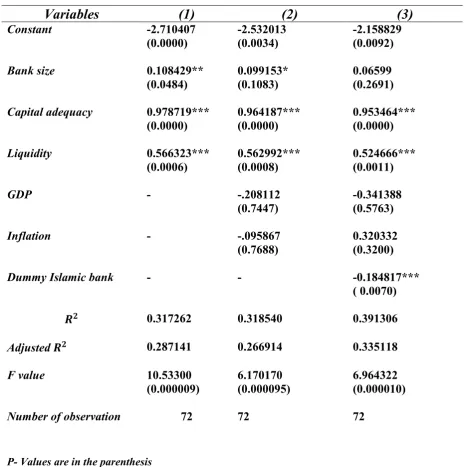
Table 2.
OLS estimation
Return on asset (ROA)
Variables
(1)
(2)
(3)
Constant -2.710407
(0.0000) -2.532013 (0.0034) -2.158829 (0.0092)
Bank size 0.108429**
(0.0484) 0.099153* (0.1083) 0.06599 (0.2691)
Capital adequacy 0.978719***
(0.0000) 0.964187*** (0.0000) 0.953464*** (0.0000)
Liquidity 0.566323***
(0.0006) 0.562992*** (0.0008) 0.524666*** (0.0011)
GDP - -.208112
(0.7447) -0.341388 (0.5763)
Inflation - -.095867
(0.7688) 0.320332 (0.3200)
Dummy Islamic bank - - -0.184817***
( 0.0070)
0.317262 0.318540 0.391306
Adjusted 0.287141 0.266914 0.335118
F value 10.53300
(0.000009) 6.170170 (0.000095) 6.964322 (0.000010)
Number of observation 72 72 72
14
Result interpretation
In table -2 OLS estimation, there is a remarkable change in the significance of the coefficient of the variables. From the above estimation we see the coefficient R square 0.391306, indicates that 39.1306% variation in the ROA can be explained by the model. F values that significance at p<0.01 further indicates the variables are significance in explaining the variation in the ROA
The coefficient of the bank size 0.108429 and 0.099153 that statistically significance in the model (1) and (2) at P<0.05 and p<0.1, that means every one percent changes in the bank size ROA would lead to increase 10.8429% and 9.9153% respectively. In that case we see the robustness between the models. Whereas in the model (3) bank size is not significance. Moreover, the coefficient of the capital adequacy 0.978719, 0.964187 and 0.953464 in the model (1), (2) and (3) respectively are statistically significance at p<0.01, that means every one percent change in the capital adequacy ROA would lead to increase 97.87%, 96.42% and 95.53% accordingly. In that case we see the robustness in among the three models.
In addition, the coefficient of the liquidity 0.566323, 562992 and 524466 are statistically significance at p<0.01, that means every one percent change in the liquidity ROA would lead to increase 56.63%, 56.30% and 52.44% in the model (1), (2) and (3) accordingly. It is further indicates that it has the robustness among the models.
On the other hand, the coefficient of the GDP and inflation are not statistically significance in the model (2) and (3).
Finally, in the model (3), I use Islamic bank dummy to see the differences of the Islamic bank and the conventional bank. The coefficient of the Islamic bank dummy is -0.184817 that is statistically significance at p<0.01, that means the difference of the profitability of the Islamic bank is 18.48% less than of the conventional bank.
Overall observation
From the overall observation of the two models under the OLS estimation the second OLS estimation is the best.
15
Diagnostic test and result interpretation
Return on equity (ROE)
Normality
Ho: Error term is normally distributed H1: Error term is not normally distributed
The above graph shows the normality problems. After removing three outliers still i see there is a normality problem. Since Jarque- Bera is significance at the level p<0.01, we fail to accept null hypothesis that error term is normally distributed.
Mis-specification
Ho: No model mis-specification H1: Model mis-specification
Value df Probability
t-statistic 1.043940 64 0.3004
F-statistic 1.089811 (1, 64) 0.3004
Likelihood ratio 1.215716 1 0.2702
From the statement of the RESET test above, I see the value F is 1.089811 that is not significance at p>0.1 level, that means we cannot reject the null hypothesis. This indicates that there is no model misspecification.
0 2 4 6 8 10 12 14
-0.6 -0.4 -0.2 0.0 0.2 0.4
Series: Residuals Sample 1 72 Observations 72
Mean 6.65e-16 Median 0.050412 Maximum 0.465677 Minimum -0.732274 Std. Dev. 0.241568 Skewness -1.244807 Kurtosis 4.767823
16
Autocorrelation
Ho: error term is not autocorrelated H1: error term is auticirrelated
Breusch-Godfrey Serial Correlation LM Test:
F-statistic 0.146980 Prob. F(2,57) 0.8636
Obs*R-squared 0.369413 Prob. Chi-Square(2) 0.8313
From the above LM test i see F-statistics 0.146980 is not significance at p> 0.1, that means hull hypothesis not rejected that indicated that error term is not autocorrelated.
Heteroskedasticity
Ho: variance is constant H1: variance is not constantHeteroskedasticity Test: White
F-statistic 2.186547 Prob. F(25,46) 0.0106
Obs*R-squared 39.09836 Prob. Chi-Square(25) 0.0360
Scaled explained SS 56.04553 Prob. Chi-Square(25) 0.0004
From the above white test i see Obs*R squared 39.09836 that is significance at p<0.05, that means there is a hetero problem because of rejecting the hull hypothesis. For this reason i do the following White variance – covariance matrix as a remedies of the heteroskedasticity.
Before correction After correction
Variable Coefficient Std. Error Coefficient Std. Error
C -0.262311 0.800159 -0.262311 1.036189
LLID 0.5159 0.15293 0.5159 0.167987
LBS 0.076794 0.058931 0.076794 0.069321
LETA -0.03055 0.185797 -0.03055 0.302265
LGDP -0.301506 0.605027 -0.301506 0.496101
INF 0.299108 0.318133 0.299108 0.237269
DUMMY -0.188351 0.065988 -0.188351 0.077925
17
Structural stability
Ho: no structural break H1: structural break
From the above structural stability (CUSUM ) I see the line stay within the range, there is no structural break.
Diagnostic test and result interpretation
Return on asset (ROA)
Normality
Ho: Error term is normally distributed H1: Error term is not normally distributed
The above graph shows the normality problems. After removing three outliers still i see there is a normality problem. Since Jarque- Bera is significance at the level p<0.05, we fail to accept null hypothesis that error term is normally distributed.
-15 -10 -5 0 5 10 15
48 50 52 54 56 58 60 62 64 66 68 70 72
CUSUM 5% Signific ance
0 4 8 12 16 20 24
-0.5 -0.4 -0.3 -0.2 -0.1 0.0 0.1 0.2 0.3 0.4
Series: Residuals Sample 1 72 Observations 72
Mean 1.38e-16
Median 0.002104
Maximum 0.407988
Minimum -0.513413
Std. Dev. 0.156432 Skewness -0.406504 Kurtosis 4.341759
18
Mis-specification
Ho: No model mis-specification H1: Model mis-specification
Ramsey RESET Test Equation: UNTITLED
Specification: LROA C LLID LBS LETA LGDP INF DUMMY Omitted Variables: Squares of fitted values
Value df Probability
t-statistic 2.088472 64 0.0407
F-statistic 4.361716 (1, 64) 0.0407
Likelihood ratio 4.746952 1 0.0294
From the above table i see that the F-statistics value test 4.361716 that is significance at p<0.05, that means we can reject the null hypothesis that means model mis-speficifcation.
Autocorrelation
Ho: error term is not autocorrelated H1: error term is auticirrelated
Breusch-Godfrey Serial Correlation LM Test:
F-statistic 0.300526 Prob. F(2,63) 0.7415
Obs*R-squared 0.680424 Prob. Chi-Square(2) 0.7116
The table shows that F statistics is 0.30526 and prob. is 0.7415 that is not significance at p>0.1, that means we cannot reject the null hypothesis which indicates the error term is not autocorrected.
Heteroskedasticity
Ho: variance is constant H1: variance is not constantHeteroskedasticity Test: White
F-statistic 1.790837 Prob. F(25,46) 0.0429
Obs*R-squared 35.51255 Prob. Chi-Square(25) 0.0793
19
The above white test indicates Obs*R squared is 35.51255 that is significance at p<0.1, implies that variance is not constant. I need to do test White variance – covariance matrix
as remedies of the heteriskedasticity.
After White variance covariance matrix i find the following correct term of the standard error.
Before correction After correction Variable Coefficient Std. Error Coefficient Std. Error
C -2.158829 0.803964 -2.158829 1.036088 LLID 0.524666 0.153657 0.524666 0.168437 LBS 0.065997 0.059211 0.065997 0.069134 LETA 0.953464 0.186681 0.953464 0.298299 LGDP -0.341388 0.607904 -0.341388 0.506719 INF 0.320332 0.319646 0.320332 0.242429 DUMMY -0.184817 0.066301 -0.184817 0.078822
From the above table i see after doing the White variance covariance matrix standard errors become the change.
Structural stability
Ho: there is no structural break H1: there is structural break
From the graph we see there is no structural break because the line stays between the lone. -15
-10 -5 0 5 10 15
48 50 52 54 56 58 60 62 64 66 68 70 72
20
4.1 Findings
From the OLS estimation the coefficient of the two macro variables GDP and the inflation are not statistically significance that means these variables have no relation with the ROA and ROE as well. Dummy of the Islamic bank is negatively but significance related with the ROA and ROE. In the other hand, in Diagnostic test I found there are the problems of the normality and heteroskedasticity. In case of the normality problems I remove three outliers but there is still normality problem whereas in case of removing hetero problem I use the hetero remediesWhite variance – covariance matrix to solve the problem.
5.
Conclusion
21
6.
References
Alkassim, F. A. (2005). The profitability of Islamic and conventional banking in the GCC countries: A comparative study. Journal of Review of Islamic Economics, 13(1), 5-30
Al-Hassan, Abdullah, Nada Oulidi, and May Khamis. "The GCC banking sector: Topography and analysis." IMF Working Papers (2010):
.
Gul, S., Irshad, F., & Zaman, K. (2011). Factors affecting bank profitability in Pakistan. The Romanian Economic Journal, 39(14), 61-89.
Islam, M. M. (2003). Development and performance of domestic and foreign banks in GCC countries. Managerial Finance, 29(2/3), 42-72.
Johnes, J., Izzeldin, M., & Pappas, V. (2009). The efficiency of Islamic and conventional banks in the Gulf Cooperation Council (GCC) countries: An analysis using financial ratios and data envelopment analysis (No. 1026).
Louati, S., & Boujelbene, Y. (2015). Banks’ stability-efficiency within dual banking system: a stochastic frontier analysis. International Journal of Islamic and Middle Eastern Finance and Management, 8(4), 472-490.
Mohd. Yusof, R., & Bahlous, M. (2013). Islamic banking and economic growth in GCC & East Asia countries: A panel cointegration analysis. Journal of Islamic Accounting and Business Research, 4(2), 151-172.
Olson, D., & Zoubi, T. A. (2011). Efficiency and bank profitability in MENA countries.
Emerging markets review, 12(2), 94-110.
Smaoui, H., & Salah, I. B. (2011). Profitability of islamic banks in the GCC region. In
Annual Paris Conference on Money, Economy and Management.