Simple Algorithms for Complex Relation Extraction
with Applications to Biomedical IE
Ryan McDonald1 Fernando Pereira1 Seth Kulick2 1CIS and2IRCS, University of Pennsylvania, Philadelphia, PA
{ryantm,pereira}@cis.upenn.edu, [email protected]
Scott Winters Yang Jin Pete White
Division of Oncology, Children’s Hospital of Pennsylvania, Philadelphia, PA {winters,jin,white}@genome.chop.edu
Abstract
A complex relation is any n-ary relation in which some of the arguments may be be unspecified. We present here a simple two-stage method for extracting complex relations between named entities in text. The first stage creates a graph from pairs of entities that are likely to be related, and the second stage scores maximal cliques in that graph as potential complex relation instances. We evaluate the new method against a standard baseline for extracting genomic variation relations from biomed-ical text.
1 Introduction
Most research on text information extraction (IE) has focused on accurate tagging of named entities. Successful early named-entity taggers were based on finite-state generative models (Bikel et al., 1999). More recently, discriminatively-trained models have been shown to be more accurate than generative models (McCallum et al., 2000; Lafferty et al., 2001; Kudo and Matsumoto, 2001). Both kinds of mod-els have been developed for tagging entities such as people, places and organizations in news mate-rial. However, the rapid development of bioinfor-matics has recently generated interest on the extrac-tion of biological entities such as genes (Collier et al., 2000) and genomic variations (McDonald et al., 2004b) from biomedical literature.
The next logical step for IE is to begin to develop methods for extracting meaningful relations
involv-ing named entities. Such relations would be ex-tremely useful in applications like question answer-ing, automatic database generation, and intelligent document searching and indexing. Though not as well studied as entity extraction, relation extraction has still seen a significant amount of work. We dis-cuss some previous approaches at greater length in Section 2.
Most relation extraction systems focus on the spe-cific problem of extracting binary relations, such as the employee of relation or proteprotein
in-teraction relation. Very little work has been done
in recognizing and extracting more complex rela-tions. We define a complex relation as any n-ary relation among n typed entities. The relation is defined by the schema (t1, . . . , tn) where ti ∈ T are entity types. An instance (or tuple) in the rela-tion is a list of entities(e1, . . . , en)such that either type(ei) = ti, orei =⊥indicating that theith ele-ment of the tuple is missing.
For example, assume that the entity types are T = {person,job,company} and we are interested in the ternary relation with schema (person,job,company) that relates a person to their job at a particular company. For the sentence “John Smith is the CEO at Inc.
Corp.”, the system would ideally extract the
tu-ple (John Smith,CEO,Inc. Corp.). However, for the sentence “Everyday John Smith goes to his
office at Inc. Corp.”, the system would extract
incomplete instances.
We present here several simple methods for ex-tracting complex relations. All the methods start by recognized pairs of entity mentions, that is, binary relation instances, that appear to be arguments of the relation of interest. Those pairs can be seen as the edges of a graph with entity mentions as nodes. The algorithms then try to reconstruct complex relations by making tuples from selected maximal cliques in the graph. The methods are general and can be ap-plied to any complex relation fitting the above def-inition. We also assume throughout the paper that the entities and their type are known a priori in the text. This is a fair assumption given the current high standard of state-of-the-art named-entity extractors.
A primary advantage of factoring complex rela-tions into binary relarela-tions is that it allows the use of standard classification algorithms to decide whether particular pairs of entity mentions are related. In ad-dition, the factoring makes training data less sparse and reduces the computational cost of extraction. We will discuss these benefits further in Section 4.
We evaluated the methods on a large set of anno-tated biomedical documents to extract relations re-lated to genomic variations, demonstrating a consid-erable improvement over a reasonable baseline.
2 Previous work
A representative approach to relation extraction is the system of Zelenko et al. (2003), which attempts to identify binary relations in news text. In that system, each pair of entity mentions of the correct types in a sentence is classified as to whether it is a positive instance of the relation. Consider the bi-nary relation employee of and the sentence “John
Smith, not Jane Smith, works at IBM”. The pair
(John Smith,IBM) is a positive instance, while the pair (Jane Smith,IBM) is a negative instance. In-stances are represented by a pair of entities and their position in a shallow parse tree for the containing sentence. Classification is done by a support-vector classifier with a specialized kernel for that shallow parse representation.
This approach — enumerating all possible en-tity pairs and classifying each as positive or nega-tive — is the standard method in relation extraction. The main differences among systems are the choice
of trainable classifier and the representation for in-stances.
For binary relations, this approach is quite tractable: if the relation schema is(t1, t2), the num-ber of potential instances isO(|t1| |t2|), where|t|is the number of entity mentions of typet in the text under consideration.
One interesting system that does not belong to the above class is that of Miller et al. (2000), who take the view that relation extraction is just a form of probabilistic parsing where parse trees are aug-mented to identify all relations. Once this augmen-tation is made, any standard parser can be trained and then run on new sentences to extract new re-lations. Miller et al. show such an approach can yield good results. However, it can be argued that this method will encounter problems when consid-ering anything but binary relations. Complex re-lations would require a large amount of tree aug-mentation and most likely result in extremely sparse probability estimates. Furthermore, by integrating relation extraction with parsing, the system cannot consider long-range dependencies due to the local parsing constraints of current probabilistic parsers. The higher the arity of a relation, the more likely it is that entities will be spread out within a piece of text, making long range dependencies especially important.
Roth and Yih (2004) present a model in which en-tity types and relations are classified jointly using a set of global constraints over locally trained classi-fiers. This joint classification is shown to improve accuracy of both the entities and relations returned by the system. However, the system is based on con-straints for binary relations only.
always associated with a verb in the sentence that specifies the relation type. Though this system is very general, it is limited by the fact that the design ignores relations not expressed by a verb, as the
em-ployee of relation in“John Smith, CEO of Inc. Corp., announced he will resign”.
Most relation extraction systems work primarily on a sentential level and never consider relations that cross sentences or paragraphs. Since current data sets typically only annotate intra-sentence relations, this has not yet proven to be a problem.
3 Definitions
3.1 Complex Relations
Recall that a complexn-ary relation is specified by a schema(t1, . . . , tn)whereti ∈T are entity types. Instances of the relation are tuples (e1, . . . , en) where either type(ei) = ti, orei =⊥(missing ar-gument). The only restriction this definition places on a relation is that the arity must be known. As we discuss it further in Section 6, this is not required by our methods but is assumed here for simplicity. We also assume that the system works on a single rela-tion type at a time, although the methods described here are easily generalizable to systems that can ex-tract many relations at once.
3.2 Graphs and Cliques
An undirected graph G = (V, E)is specified by a set of vertices V and a set of edges E, with each edge an unordered pair (u, v) of vertices. G0 = (V0, E0) is a subgraph of Gif V0 ⊆ V and E0 =
{(u, v) :u, v∈V0,(u, v)∈E}. A cliqueCofGis a subgraph ofGin which there is an edge between every pair of vertices. A maximal clique of Gis a clique C = (VC, EC) such that there is no other cliqueC0 = (VC0, EC0)such thatVC ⊂VC0.
4 Methods
We describe now a simple method for extracting complex relations. This method works by first fac-toring all complex relations into a set of binary re-lations. A classifier is then trained in the standard manner to recognize all pairs of related entities. Fi-nally a graph is constructed from the output of this classifier and the complex relations are determined from the cliques of this graph.
a. All possible relation instances
(John,CEO,Inc. Corp.) (John,⊥,Inc. Corp.) (John,CEO,Biz. Corp.) (John,⊥,Biz. Corp.) (John,CEO,⊥) (Jane,CEO,Inc. Corp.) (Jane,⊥,Inc. Corp.) (Jane,CEO,Biz. Corp.) (Jane,⊥,Biz. Corp.) (Jane,CEO,⊥) (⊥,CEO,Inc. Corp.) (⊥,CEO,Biz. Corp.)
b. All possible binary relations
(John,CEO) (John,Inc. Corp.) (John,Biz. Corp.) (CEO,Inc. Corp.) (CEO,Biz. Corp.) (Jane,CEO) (Jane,Inc. Corp.) (Jane,Biz. Corp.)
Figure 1: Relation factorization of the sentence:
John and Jane are CEOs at Inc. Corp. and Biz. Corp. respectively.
4.1 Classifying Binary Relations
Consider again the motivating example of the (person,job,company) relation and the sentence
“John and Jane are CEOs at Inc. Corp. and Biz. Corp. respectively”. This sentence contains two people, one job title and two companies.
One possible method for extracting the rela-tion of interest would be to first consider all 12 possible tuples shown in Figure 1a. Using all these tuples, it should then be possible to train a classifier to distinguish valid instances such as (John,CEO,Inc. Corp.) from invalid ones such as (Jane,CEO,Inc. Corp.). This is analogous to the approach taken by Zelenko et al. (2003) for binary relations.
Instead of trying to classify all possible relation instances, in this work we first classify pairs of en-tities as being related or not. Then, as discussed in Section 4.2, we reconstruct the larger complex rela-tions from a set of binary relation instances.
Factoring relations into a set of binary decisions has several advantages. The set of possible pairs is much smaller then the set of all possible complex relation instances. This can be seen in Figure 1b, which only considers pairs that are consistent with the relation definition. More generally, the num-ber of pairs to classify is O((P
i|ti|)2) , which is far better than the exponentially many full relation instances. There is also no ambiguity when label-ing pairs as positive or negative when constructlabel-ing the training data. Finally, we can rely on previous work on classification for binary relation extraction to identify pairs of related entities.
To train a classifier to identify pairs of related entities, we must first create the set of all positive and negative pairs in the data. The positive in-stances are all pairs that occur together in a valid tuple. For the example sentence in Figure 1, these include the pairs (John,CEO), (John,Inc. Corp.), (CEO,Inc. Corp.),(CEO,Biz. Corp.),(Jane,CEO) and (Jane,Biz. Corp.). To gather negative in-stances, we extract all pairs that never occur to-gether in a valid relation. From the same exam-ple these would be the pairs (John,Biz. Corp.) and (Jane,Inc. Corp.).
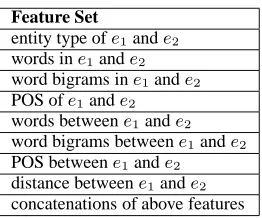
This leads to a large set of positive and negative binary relation instances. At this point we could em-ploy any binary relation classifier and learn to iden-tify new instances of related pairs of entities. We use a standard maximum entropy classifier (Berger et al., 1996) implemented as part of MALLET (Mc-Callum, 2002). The model is trained using the fea-tures listed in Table 1.
This is a very simple binary classification model. No deep syntactic structure such as parse trees is used. All features are basically over the words sepa-rating two entities and their part-of-speech tags. Of course, it would be possible to use more syntactic information if available in a manner similar to that of Zelenko et al. (2003). However, the primary pur-pose of our experiments was not to create a better binary relation extractor, but to see if complex re-lations could be extracted through binary
factoriza-Feature Set
entity type ofe1ande2 words ine1ande2 word bigrams ine1ande2 POS ofe1ande2 words betweene1ande2 word bigrams betweene1ande2 POS betweene1ande2 distance betweene1ande2 concatenations of above features
Table 1: Feature set for maximum entropy binary relation classifier.e1ande2 are entities.
a. Relation graphG
J ohn J ane
CEO
Inc. Corp. Biz. Corp.
b. Tuples fromG
[image:4.612.362.493.51.160.2](John,CEO,⊥) (John,⊥,Inc. Corp.) (John,⊥,Biz. Corp.) (Jane,CEO,⊥) (⊥,CEO,Inc. Corp.) (⊥,CEO,Biz. Corp.) (John,CEO,Inc. Corp.) (John,CEO,Biz. Corp.)
Figure 2: Example of a relation graph and tuples from all the cliques in the graph.
tion followed by reconstruction. In Section 5.2 we present an empirical evaluation of the binary relation classifier.
4.2 Reconstructing Complex Relations
4.2.1 Maximal Cliques
Having identified all pairs of related entities in the text, the next stage is to reconstruct the complex re-lations from these pairs. LetG= (V, E)be an undi-rected graph where the vertices V are entity men-tions in the text and the edges E represent binary relations between entities. We reconstruct the com-plex relation instances by finding maximal cliques in the graphs.
The simplest approach is to create the graph so that two entities in the graph have an edge if the binary classifier believes they are related. For example, consider the binary factoriza-tion in Figure 1 and imagine the classifier identified the following pairs as being related: (John,CEO),(John,Inc. Corp.),(John,Biz. Corp.), (CEO,Inc. Corp.), (CEO,Biz. Corp.) and (Jane,CEO). The resulting graph can be seen in Figure 2a.
construct-ing complex relations would be to consider all the cliques in the graph that are consistent with the def-inition of the relation. This is equivalent to having the system return only relations in which the binary classifier believes that all of the entities involved are pairwise related. All the cliques in the example are shown in Figure 2b. We add⊥fields to the tuples to be consistent with the relation definition.
This could lead to a set of overlapping cliques, for instance (John,CEO,Inc. Corp.) and (John,CEO,⊥). Instead of having the system re-turn all cliques, our system just rere-turns the maximal cliques, that is, those cliques that are not subsets of other cliques. Hence, for the example under con-sideration in Figure 2, the system would return the one correct relation, (John,CEO,Inc. Corp.), and two incorrect relations,(John,CEO,Biz. Corp.)and (Jane,CEO,⊥). The second is incorrect since it does not specify the company slot of the relation even though that information is present in the text.
It is possible to find degenerate sentences in which perfect binary classification followed by maximal clique reconstruction will lead to errors. One such sentence is, “John is C.E.O. and C.F.O. of Inc. Corp.
and Biz. Corp. respectively and Jane vice-versa”.
However, we expect such sentences to be rare; in fact, they never occur in our data.
The real problem with this approach is that an ar-bitrary graph can have exponentially many cliques, negating any efficiency advantage over enumerating all n-tuples of entities. Fortunately, there are algo-rithms for finding all maximal cliques that are effi-cient in practice. We use the algorithm of Bron and Kerbosch (1973). This is a well known branch and bound algorithm that has been shown to empirically run linearly in the number of maximal cliques in the graph. In our experiments, this algorithm found all maximal cliques in a matter of seconds.
4.2.2 Probabilistic Cliques
The above approach has a major shortcom-ing in that it assumes the output of the bi-nary classifier to be absolutely correct. For instance, the classifier may have thought with probability 0.49, 0.99 and 0.99 that the fol-lowing pairs were related: (Jane,Biz. Corp.), (CEO,Biz. Corp.) and (Jane,CEO) respectively. The maximal clique method would not produce the
tuple(Jane,CEO,Biz. Corp.)since it never consid-ers the edge between Jane and Biz. Corp. However, given the probability of the edges, we would almost certainly want this tuple returned.
What we would really like to model is a belief that on average a clique represents a valid relation instance. To do this we use the complete graph G = (V, E) with edges between all pairs of entity mentions. We then assign weight w(e) to edge e equal to the probability that the two entities ineare related, according to the classifier. We define the weight of a cliquew(C) as the mean weight of the edges in the clique. Since edge weights represent probabilities (or ratios), we use the geometric mean
w(C) =
Y
e∈EC w(e)
1/|EC|
We decide that a cliqueCrepresents a valid tuple if w(C) ≥ 0.5. Hence, the system finds all maximal cliques as before, but considers only those where w(C)≥0.5, and it may select a non-maximal clique if the weight of all larger cliques falls below the threshold. The cutoff of0.5is not arbitrary, since it ensures that the average probability of a clique rep-resenting a relation instance is at least as large as the average probability of it not representing a rela-tion instance. We ran experiments with varying lev-els of this threshold and found that, roughly, lower thresholds result in higher precision at the expense of recall since the system returns fewer but larger tuples. Optimum results were obtained for a cutoff of approximately0.4, but we report results only for w(C)≥0.5.
The major problem with this approach is that there will always be exponentially many cliques since the graph is fully connected. However, in our experiments we pruned all edges that would force any containing cliqueC to havew(C) <0.5. This typically made the graphs very sparse.
probabili-ties, but there is no guarantee that those probability values will be well calibrated.
5 Experiments
5.1 Problem Description and Data
We test these methods on the task of extracting ge-nomic variation events from biomedical text (Mc-Donald et al., 2004b). Briefly, we define a varia-tion event as an acquired genomic aberravaria-tion: a spe-cific, one-time alteration at the genomic level and described at the nucleic acid level, amino acid level or both. Each variation event is identified by the re-lationship between a type of variation, its location, and the corresponding state change from an
initial-state to an altered-initial-state. This can be formalized as
the following complex schema
(var-type,location,initial-state,altered-state) A simple example is the sentence
“At codons 12 and 61, the occurrence of point mutations from G/A to T/G were observed”
which gives rise to the tuples
(point mutation, codon 12, G, T) (point mutation, codon 61, A, G)
Our data set consists of 447 abstracts selected from MEDLINE as being relevant to populating a database with facts of the form: gene X with
vari-ation event Y is associated with malignancy Z.
Ab-stracts were randomly chosen from a larger corpus identified as containing variation mentions pertain-ing to cancer.
The current data consists of 4691 sentences that have been annotated with4773entities and1218 re-lations. Of the1218 relations, 760have two ⊥ ar-guments, 283 have one ⊥ argument, and 175 have no⊥arguments. Thus,38%of the relations tagged in this data cannot be handled using binary relation classification alone. In addition,4%of the relations annotated in this data are non-sentential. Our sys-tem currently only produces sentential relations and is therefore bounded by a maximum recall of 96%. Finally, we use gold standard entities in our exper-iments. This way we can evaluate the performance of the relation extraction system isolated from any kind of pipelined entity extraction errors. Entities in this domain can be found with fairly high accuracy (McDonald et al., 2004b).
It is important to note that just the presence of two entity types does not entail a relation between them. In fact,56%of entity pairs are not related, due either to explicit disqualification in the text (e.g. “... the
lack of G to T transversion ...”) or ambiguities that
arise from multiple entities of the same type.
5.2 Results
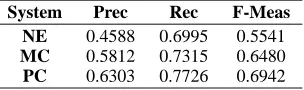
Because the data contains only1218examples of re-lations we performed 10-fold cross-validation tests for all results. We compared three systems:
• MC: Uses the maximum entropy binary
classi-fier coupled with the maximal clique complex relation reconstructor.
• PC: Same as above, except it uses the
proba-bilistic clique complex relation reconstructor.
• NE: A maximum entropy classifier that naively
enumerates all possible relation instances as described in Section 4.1.
In training system NE, all incomplete but correct instances were marked as positive since we found this had the best performance. We used the same pairwise entity features in the binary classifier of the above two systems. However, we also added higher order versions of the pairwise features. For this system we only take maximal relations,that is, if(John,CEO,Inc. Corp.)and(John,⊥,Inc. Corp.) are both labeled positive, the system would only re-turn the former.
Table 2 contains the results of the maximum en-tropy binary relation classifier (used in systems MC and PC). The 1218 annotated complex relations pro-duced 2577 unique binary pairs of related entities. We can see that the maximum entropy classifier per-forms reasonably well, although performance may be affected by the lack of rich syntactic features, which have been shown to help performance (Miller et al., 2000; Zelenko et al., 2003).
ACT PRD COR
2577 2722 2101
Prec Rec F-Meas
0.7719 0.8153 0.7930
Table 2: Binary relation classification results for the maximum entropy classifier. ACT: actual number of related pairs, PRD: predicted number of related pairs and COR: correctly identified related pairs.
System Prec Rec F-Meas
NE 0.4588 0.6995 0.5541
MC 0.5812 0.7315 0.6480
PC 0.6303 0.7726 0.6942
Table 3: Full relation classification results. For a relation to be classified correctly, all the entities in the relation must be correctly identified.
First we observe that the maximal clique method combined with maximum entropy (system MC) re-duces the relative error rate over naively enumer-ating and classifying all instances (system NE) by 21%. This result is very positive. The system based on binary factorization not only is more efficient then naively enumerating all instances, but signifi-cantly outperforms it as well. The main reason naive enumeration does so poorly is that all correct but incomplete instances are marked as positive. Thus, even slight correlations between partially correct en-tities would be enough to classify an instance as cor-rect, which results in relatively good recall but poor precision. We tried training only with correct and complete positive instances, but the result was a sys-tem that only returned few relations since negative instances overwhelmed the training set. With fur-ther tuning, it may be possible to improve the per-formance of this system. However, we use it only as a baseline and to demonstrate that binary factoriza-tion is a feasible and accurate method for extracting complex relations.
Furthermore, we see that using probabilistic cliques (system PC) provides another large im-provement, a relative error reduction of 13% over using maximal cliques and 31% reduction over enumeration. Table 4 shows the breakdown of relations returned by type. There are three types of relations, 2-ary, 3-ary and 4-ary, each with 2, 1 and 0 ⊥ arguments respectively, e.g.
System 2-ary 3-ary 4-ary
NE 760:1097:600 283:619:192 175:141:60
MC 760:1025:601 283:412:206 175:95:84
[image:7.612.111.263.182.227.2]PC 760:870:590 283:429:223 175:194:128
Table 4: Breakdown of true positive relations by type that were returned by each system. Each cell contains three numbers, Actual:Predicted:Correct, which represents for each arity the actual, predicted and correct number of relations for each system.
(point mutation,codon 12,⊥,⊥)is a2-ary relation. Clearly the probabilistic clique method is much more likely to find larger non-binary relations, veri-fying the motivation that there are some low proba-bility edges that can still contribute to larger cliques.
6 Conclusions and Future Work
We presented a method for complex relation extrac-tion, the core of which was to factorize complex re-lations into sets of binary rere-lations, learn to identify binary relations and then reconstruct the complex re-lations by finding maximal cliques in graphs that represent relations between pairs of entities. The primary advantage of this method is that it allows for the use of almost any binary relation classifier, which have been well studied and are often accu-rate. We showed that such a method can be suc-cessful with an empirical evaluation on a large set of biomedical data annotated with genomic varia-tion relavaria-tions. In fact, this approach is both signifi-cantly quicker and more accurate then enumerating and classifying all possible instances. We believe this work provides a good starting point for contin-ued research in this area.
et al. (2004) argued that local learning actually out-performs global learning in cases when local deci-sions can easily be learnt by the classifier. Hence, it is reasonable to assume that our binary factorization method will perform well when binary relations can be learnt with high accuracy.
As for future work, there are many things that we plan to look at. The binary relation classifier we em-ploy is quite simplistic and most likely can be im-proved by using features over a deeper representa-tion of the data such as parse trees. Other more pow-erful binary classifiers should be tried such as those based on tree kernels (Zelenko et al., 2003). We also plan on running these algorithms on more data sets to test if the algorithms empirically generalize to dif-ferent domains.
Perhaps the most interesting open problem is how to learn the complex reconstruction phase. One pos-sibility is recent work on supervised clustering. Let-ting the edge probabilities in the graphs represent a distance in some space, it may be possible to learn how to cluster vertices into relational groups. How-ever, since a vertex/entity can participate in one or more relation, any clustering algorithm would be re-quired to produce non-disjoint clusters.
We mentioned earlier that the only restriction of our complex relation definition is that the arity of the relation must be known in advance. It turns out that the algorithms we described can actually handle dynamic arity relations. All that is required is to remove the constraint that maximal cliques must be consistent with the structure of the relation. This represents another advantage of binary factorization over enumeration, since it would be infeasible to enumerate all possible instances for dynamic arity relations.
Acknowledgments
The authors would like to thank Mark Liberman, Mark Mandel and Eric Pancoast for useful discus-sion, suggestions and technical support. This work was supported in part by NSF grant ITR 0205448.
References
A. L. Berger, S. A. Della Pietra, and V. J. Della Pietra. 1996. A maximum entropy approach to natural lan-guage processing. Computational Linguistics, 22(1).
D.M. Bikel, R. Schwartz, and R.M. Weischedel. 1999. An algorithm that learns what’s in a name. Machine Learning Journal Special Issue on Natural Language Learning, 34(1/3):221–231.
C. Bron and J. Kerbosch. 1973. Algorithm 457: finding all cliques of an undirected graph. Communications of the ACM, 16(9):575–577.
N. Collier, C. Nobata, and J. Tsujii. 2000. Extracting the names of genes and gene products with a hidden Markov model. In Proc. COLING.
D. Gildea and D. Jurafsky. 2002. Automatic labeling of semantic roles. Computational Linguistics.
Taku Kudo and Yuji Matsumoto. 2001. Chunking with support vector machines. In Proc. NAACL.
J. Lafferty, A. McCallum, and F. Pereira. 2001. Con-ditional random fields: Probabilistic models for seg-menting and labeling sequence data. In Proc. ICML.
A. McCallum and B. Wellner. 2003. Toward
condi-tional models of identity uncertainty with application to proper noun coreference. In IJCAI Workshop on In-formation Integration on the Web.
A. McCallum, D. Freitag, and F. Pereira. 2000. Maxi-mum entropy Markov models for information extrac-tion and segmentaextrac-tion. In Proc. ICML.
A. K. McCallum. 2002. MALLET: A machine learning for language toolkit.
D.M. McDonald, H. Chen, H. Su, and B.B. Marshall. 2004a. Extracting gene pathway relations using a hy-brid grammar: the Arizona Relation Parser. Bioinfor-matics, 20(18):3370–78.
R.T. McDonald, R.S. Winters, M. Mandel, Y. Jin, P.S. White, and F. Pereira. 2004b. An entity tagger for recognizing acquired genomic variations in cancer lit-erature. Bioinformatics, 20(17):3249–3251.
S. Miller, H. Fox, L.A. Ramshaw, and R.M. Weischedel. 2000. A novel use of statistical parsing to extract in-formation from text. In Proc. NAACL.
V. Punyakanok, D. Roth, W. Yih, and D. Zimak. 2004. Learning via inference over structurally constrained output. In Workshop on Learning Structured with Out-put, NIPS.
Barbara Rosario and Marti A. Hearst. 2004. Classifying semantic relations in bioscience texts. In ACL.
D. Roth and W. Yih. 2004. A linear programming formu-lation for global inference in natural language tasks. In Proc. CoNLL.