A Second-Order Hidden Markov Model for Part-of-Speech
Tagging
S c o t t M . T h e d e a n d M a r y P . H a r p e r
School of Electrical a n d C o m p u t e r E n g i n e e r i n g , P u r d u e U n i v e r s i t y West Lafayette, IN 47907
{ thede, harper} @ecn.purdue.edu
A b s t r a c t
This paper describes an extension to the hidden Markov model for part-of-speech tagging using second-order approximations for both contex- tual and lexical probabilities. This model in- creases the accuracy of the tagger to state of the art levels. These approximations make use of more contextual information than standard statistical systems. New methods of smoothing the estimated probabilities are also introduced to address the sparse d a t a problem.
1 I n t r o d u c t i o n
Part-of-speech tagging is the act of assigning each word in a sentence a
tag
t h a t describes how t h a t word is used in the sentence. Typ- ically, these tags indicate syntactic categories, such as noun or verb, and occasionally include additional feature information, such as number (singular or plural) and verb tense. The Penn Treebank documentation (Marcus et al., 1993) defines a commonly used set of tags.Part-of-speech tagging is an i m p o r t a n t re- search topic in Natural Language Processing (NLP). Taggers are often preprocessors in NLP systems, making accurate performance espe- cially important. Much research has been done to improve tagging accuracy using several dif- ferent models and methods, including: hidden Markov models (HMMs) (Kupiec, 1992), (Char- niak et al., 1993); rule-based systems (Brill, 1994), (Brill, 1995); memory-based systems (Daelemans et al., 1996); maximum-entropy systems (Ratnaparkhi, 1996); path voting con- straint systems (Tiir and Oflazer, 1998); linear separator systems (Roth and Zelenko, 1998); and majority voting systems (van Halteren et al., 1998).
This paper describes various modifications to an HMM tagger t h a t improve the perfor- mance to an accuracy comparable to or better than the best current single classifier taggers.
175
This improvement comes from using second- order approximations of the Markov assump- tions. Section 2 discusses a basic first-order hidden Markov model for part-of-speech tagging and extensions to t h a t model to handle out-of- lexicon words. The new second-order HMM is described in Section 3, and Section 4 presents experimental results and conclusions.
2 H i d d e n M a r k o v M o d e l s
A hidden Markov model (HMM) is a statistical construct t h a t can be used to solve classification problems t h a t have an inherent state sequence representation. The model can be visualized as an interlocking set of
states.
These states are connected by a set oftransition probabili-
ties,
which indicate the probability of traveling between two given states. A process begins in some state, then at discrete time intervals, the process "moves" to a new state as dictated by the transition probabilities. In an HMM, the exact sequence of states t h a t the process gener- ates is unknown (i.e.,hidden).
As the process enters each state, one of a set ofoutput symbols
is emitted by the process. Exactly which symbol is emitted is determined by a probability distri- bution t h a t is specific to each state. The o u t p u t of the HMM is a sequence of o u t p u t symbols.2.1 B a s i c D e f i n i t i o n s a n d N o t a t i o n According to (Rabiner, 1989), there are five el- ements needed to define an HMM:
1. N, the number of distinct states in the model. For part-of-speech tagging, N is the number of tags t h a t can be used by the system. Each possible tag for the system corresponds to one state of the HMM.
3. A = {a/j}, the state transition probabil- ity distribution. The probability aij is the probability t h a t the process will move from state i to state j in one transition. For part-of-speech tagging, the states represent the tags, so
aij
is the probability t h a t the model will move from tag ti totj - -
in other words, the probability t h a t tagtj
follows ti. This probability can be estimated using d a t a from a training corpus.4. B = {bj(k)),
the observation symbol prob- ability distribution. The probabilitybj(k)
is the probability t h a t the k-th o u t p u t sym- bol will be emitted when the model is in state j . For part-of-speech tagging, this is the probability t h a t the wordWk
will be emitted when the system is at tagtj
(i.e.,P(wkltj)).
This probability can be esti- mated using d a t a from a training corpus.5. 7r = {Tri}, the initial state distribution. 7ri is the probability t h a t the model will start in state i. For part-of-speech tagging, this is the probability t h a t the sentence will be- gin with tag ti.
When using an HMM to perform part-of- speech tagging, the goal is to determine the most likely sequence of tags (states) t h a t gen- erates the words in the sentence (sequence of o u t p u t symbols). In other words, given a sen- tence V, calculate the sequence U of tags t h a t maximizes
P(VIU ).
The Viterbi algorithm is a common m e t h o d for calculating the most likely tag sequence when using an HMM. This algo- rithm is explained in detail by Rabiner (1989) and will not be repeated here.2.2 C a l c u l a t i n g P r o b a b i l i t i e s for U n k n o w n W o r d s
In a standard HMM, when a word does not occur in the training data, the emit probabil- ity for the unknown word is 0.0 in the B ma- trix (i.e.,
bj(k)
= 0.0 ifwk
is unknown). Be- ing able to accurately tag unknown words is important, as they are frequently encountered when tagging sentences in applications. Most work in the area of unknown words and tagging deals with predicting part-of-speech informa- tion based on word endings and affixation infor- mation, as shown by work in (Mikheev, 1996), (Mikheev, 1997), (Weischedel et al., 1993), and (Thede, 1998). This section highlights a method devised for HMMs, which differs slightly from previous approaches.To create an HMM to accurately tag unknown words, it is necessary to deter- mine an estimate of the probability
P(wklti)
for use in the tagger. The probabil- ity P ( w o r d containssjl
tag is ti) is estimated, wheresj
is some "suffix" (a more appropri- ate term would beword ending,
since the sj's are not necessarily morphologically significant, but this terminology is unwieldy). This new probability is stored in a matrix C ={cj(k)),
wherecj(k)
= P ( w o r d has suffixski
tag istj),
replacesbj(k)
in the HMM calculations for un- known words. This probability can be esti- mated by collecting suffix information from each word in the training corpus.In this work, suffixes of length one to four characters are considered, up to a m a x i m u m suf- fix length of two characters less than the length of the given word. An overall count of the num- ber of times each suffix/tag pair appears in the training corpus is used to estimate emit prob- abilities for words based on their suffixes, with some exceptions. When estimating suffix prob- abilities, words with length four or less are not likely to contain any word-ending information t h a t is valuable for classification, so they are ignored. Unknown words are presumed to be open-class, so words t h a t are not tagged with an open-class tag are also ignored.
When constructing our suffix predictor, words t h a t contain hyphens, are capitalized, or contain numeric digits are separated from the main calculations. Estimates for each of these categories are calculated separately. For ex- ample, if an unknown word is capitalized, the probability distribution estimated from capital- ized words is used to predict its part of speech. However, capitalized words at the beginning of a sentence are not classified in this w a y - - the initial capitalization is ignored. If a word is n o t capitalized and does not contain a hy- phen or numeric digit, the general distribution is used. Finally, when predicting the possible part of speech for an unknown word, all possible matching suffixes are used with their predictions smoothed (see Section 3.2).
3 T h e S e c o n d - O r d e r M o d e l for
P a r t - o f - S p e e c h T a g g i n g
amount of the contextual information than is available. Most of the best statistical taggers use a t r i g r a m model, which replaces the bigram transition probability aij = P ( r p = tjITp_ 1 -~ ti) with a trigram probability aijk : P(7"p =
t k l r p _ l = t j , rp-2 = ti). This section describes a new type of tagger that uses trigrams not only for the context probabilities but also for the lex- ical (and suffix) probabilities. We refer to this new model as a f u l l s e c o n d - o r d e r hidden Markov model.
3.1 D e f i n i n g N e w P r o b a b i l i t y D i s t r i b u t i o n s
The full second-order HMM uses a notation similar to a standard first-order model for the probability distributions. The A matrix con- tains state transition probabilities, the B matrix contains output symbol distributions, and the C matrix contains unknown word distributions. The rr matrix is identical to its counterpart in the first-order model. However, the definitions of A, B, and C are modified to enable the full second-order HMM t o use more contextual in- formation to model part-of-speech tagging. In the following sections, there are assumed to be P words in the sentence with rp and Vp being the p-th tag and word in the sentence, respectively. 3.1.1 C o n t e x t u a l P r o b a b i l i t i e s
The A matrix defines the contextual probabil- ities for the part-of-speech tagger. As in the trigram model, instead of limiting the context to a first-order approximation, the A matrix is defined as follows:
A = { a i j k ) , where"
a i j a = P(rp = tklrp_l = tj, rp-2 = tl), 1 < p < P
Thus, the transition matrix is now three dimen- sional, and the probability of transitioning to a new state depends not only on the current state, but also on the previous state. This al- lows a more realistic context-dependence for the word tags. For the boundary cases of p = 1 and p = 2, the special tag symbols NONE and SOS
are used.
3.1.2 L e x i e a l a n d S u f f i x P r o b a b i l i t i e s The B matrix defines the lexical probabilities for the part-of-speech tagger, while the C ma- trix is used for unknown words. Similarly to the trigram extension to the A matrix, the approx- imation for the lexical and suffix probabilities can also be modified to include second-order in- formation as follows:
B = { b i j ( k ) ) and C = { v i i ( k ) } , where
= =
P ( v p = wklrp = r p - 1 = t i )
P(vp has suffix sklrp = tj, rp-1 = tl) f o r l < p < P
In these equations, the probability of the model emitting a given word depends not only on the current state but also on the previous state. To our knowledge, this approach has not been used in tagging. SOS is again used in the p = 1 case.
3.2 S m o o t h i n g I s s u e s
While the full second-order HMM is a more pre- cise approximation of the underlying probabil- ities for the model, a problem can arise from sparseness of data, especially with lexical esti- mations. For example, the size of the B ma- trix is T 2 W , which for the WSJ corpus is ap- proximately 125,000,000 possible t a g / t a g / w o r d combinations. In an a t t e m p t to avoid sparse d a t a estimation problems, the probability esti- mates for each distribution is smoothed. There are several methods of smoothing discussed in the literature. These methods include the ad- ditive method (discussed by (Gale and Church, 1994)); the Good-Turing method (Good, 1953); the Jelinek-Mercer method (Jelinek and Mercer, 1980); and the Katz method (Katz, 1987).
These methods are all useful smoothing al- gorithms for a variety of applications. However, they are not appropriate for our purposes. Since we are smoothing trigram probabilities, the ad- ditive and Good-Turing methods are of limited usefulness, since neither takes into account bi- gram or unigram probabilities. Katz smooth- ing seems a little too granular to be effective in our application--the broad spectrum of possi- bilities is reduced to three options, depending on the number of times the given event occurs. It seems t h a t smoothing should be based on a function of the number of occurances. Jelinek- Mercer accommodates this by smoothing the n-gram probabilities using differing coefficients (A's) according to the number of times each n- gram occurs, but this requires holding out train- ing d a t a for the A's. We have implemented a model that smooths with lower order informa- tion by using coefficients calculated from the number of occurances of each trigram, bigram, and unigram without training. This method is explained in the following sections.
3.2.1 S t a t e T r a n s i t i o n P r o b a b i l i t i e s To estimate the state transition probabilities, we want to use the most specific information.
However, t h a t information m a y not always be available. R a t h e r t h a n using a fixed smooth- ing technique, we have developed a new m e t h o d t h a t uses variable weighting. This m e t h o d at- taches more weight to triples t h a t occur more often.
T h e
tklrp-1
P = k a
formula for t h e e s t i m a t e /3 of P ( r p = = tj, rp-2 = tl) is:
Na + (1 - ka)k2 N2 + (1 - k3)(1 -- k2). N:
c ,
Yoo
which depends on the following numbers:
g l =
N 2 --~
N3 = Co =
C : - -
C o =
number of times tk occurs
number of times sequence tjta occurs number of times sequence titjtk occurs total number of tags that appear number of times
tj
o c c u r snumber of times sequence titj occurs
where:
log(N2 + 1) + 1 k~. = log(Ng. + 1) + 2'
log(Na +
I)
+ 1 and ka = log(Na + 1) + 2T h e formulas for k2 and k3 a r e chosen so t h a t the weighting for each element in the equation f o r / 3 changes based on how often t h a t element occurs in the training data. Notice t h a t the sum of the coefficients of t h e probabilities in the equation f o r / 3 sum to one. This guarantees t h a t the value r e t u r n e d f o r / 3 is a valid probability. After this value is calculated for all tag triples, the values are normalized so t h a t ~ /3 -- 1,
tkET
creating a valid probability distribution. T h e value of this smoothing technique be- comes clear when t h e triple in question occurs very infrequently, if at all. Consider calculating /3 for the tag triple C D R B VB. T h e informa- tion for this triple is:
N1 = 33,277 (number of times VB appears) N2 = 4,335 (number of times R B VB appears) Na = 0 (number of times CD R B VB appears) Co = 1,056,892 (total number of tags)
C: = 46,994 (number of times R B appears) C2 = 160 (number of times CD R B appears)
Using these values, we calculate t h e coeffi- cients k2 and k3:
log(4,335 + 1) + 1 4.637
k2 = - - - - 0 . 8 2 3
log(4,335 + 1) + 2 5.637
ka = l o g ( 0 + l ) + l =-1 =0.500 log(0 + 1) + 2 2
Using these values, we calculate the probability
/3:
15 = k3 • ~-~-N3 q_ (1 - ka)k2 • -~lN° q_ (1 - k3)(1 - k 2 ) . NxC.._o
= 0.500 • 0.000 Jr 0.412 • 0.092 + 0.088 • 0.031
= 0.041
If smoothing were not applied, the probabil- ity would have been 0.000, which would create problems for tagger generalization. Smoothing allows tag triples t h a t were not encountered in the training d a t a to be assigned a probability of occurance.
3 . 2 . 2 L e x i c a l a n d S u f f i x P r o b a b i l i t i e s For the lexical and suffix probabilities, we do something s o m e w h a t different t h a n for context probabilities. Initial experiments t h a t used a formula similar to t h a t used for the contextual estimates performed poorly. This poor perfor- mance was t r a c e d to t h e fact t h a t smoothing al- lowed too m a n y words to be incorrectly tagged with tags t h a t did not occur with t h a t word in the training d a t a (over-generalization). As an alternative, we calculated the s m o o t h e d proba- b i l i t y / 3 for words as follows:
(log(N3 + i) + i. N3 1 N2
t5 __ "log(N3 + 1) + 2)C-22 + (log(N3 + 1) + 2)C-T
where:
N2 = number of times word wk occurs with tag tj
N3 = number of times word wk occurs with tag tj preceded by tag tl
C1 = number of times tj occurs
C2 = number of times sequence titj occurs
In addition to choosing the above approach for smoothing the C matrix for unknown words, there is an additional issue of choosing which suffix to use when predicting the part of speech. There are many possible answers, some of which are considered by (Thede, 1998): use the longest matching suffix, use an entropy measure to de- termine the "best" affix to use, or use an av- erage. A voting technique for c i j ( k ) was deter- mined t h a t is similar to t h a t used for contextual smoothing but is based on different length suf- fixes.
Let s4 be the length four suffix of the given word. Define s 3 , s 2 , and sl to be the length three, two, and one suffixes respectively. If the length of the word is six or more, these four suf- fixes are used. Otherwise, suffixes up to length n - 2 are used, where n is the length of the word. Determine the longest suffix of these t h a t matches a suffix in the training data, and cal- culate the new smoothed probability:
~
/ ( g k ) e ~ , ( s k ) + ( 1 - - f ( Y * ) ) P ~ j ( s k - , ) , 1 < k < 4where:
log(~+l/+l
• / ( x ) = log( +lj+2
• Ark = the number of times the suffix s k o c -
curs in the training data.
• ~ i j ( S k ) - - the estimate of
Cij(8k)
from the previous lexical smoothing.After calculating/5, it is normalized. Thus, suf- fixes of length four are given the most weight, and a suffix receives more weight the more times it appears. Information provided by suffixes of length one to four are used in estimating the probabilities, however.
3.3 T h e N e w V i t e r b i A l g o r i t h m
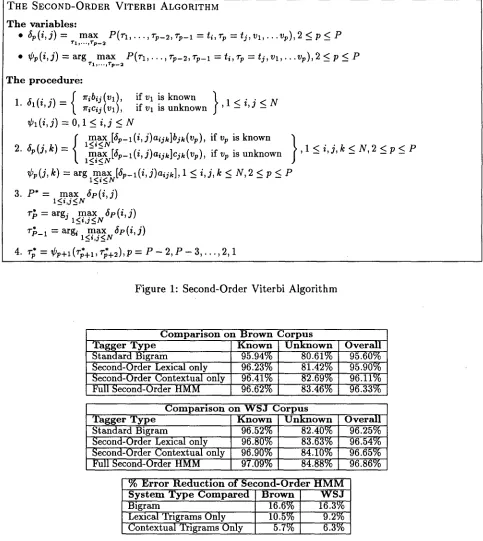
Modification of the lexical and contextual probabilities is only the first step in defining a full second-order HMM. These probabilities must also be combined to select the most likely sequence of tags t h a t generated the sentence. This requires modification of the Viterbi algo- rithm. First, the variables ~ and ¢ from (Ra- biner, 1989) are redefined, as shown in Figure 1. These new definitions take into account the added dependencies of the distributions of A, B, and C. We can then calculate the most likely tag sequence using the modification of the
Viterbi algorithm shown in Figure 1. The run- ning time of this algorithm is O (NT3), where N is the length of the sentence, and T is the num- ber of tags. This is asymptotically equivalent to the running time of a standard trigram tagger t h a t maximizes the probability of the entire tag sequence.
4 E x p e r i m e n t a n d C o n c l u s i o n s
The new tagging model is tested in several different ways. The basic experimental tech- nique is a 10-fold cross validation. The corpus in question-is randomly split into ten sections with nine of the sections combined to train the tagger and the tenth for testing. The results of the ten possible training/testing combinations are merged to give an overall accuracy mea- sure. The tagger was tested on two c o r p o r a - - the Brown corpus (from the Treebank II CD- ROM (Marcus et al., 1993)) and the Wall Street Journal corpus (from the same source). Com- paring results for taggers can be difficult, es- pecially across different researchers. Care has been taken in this paper that, when comparing two systems, the comparisons are from experi- ments t h a t were as similar as possible and that differences are highlighted in the comparison.
First, we compare the results on each corpus of four different versions of our HMM tagger: a standard (bigram) HMM tagger, an HMM us- ing second-order lexical probabilities, an HMM using second-order contextual probabilities (a standard trigram tagger), and a full second- order HMM tagger. The results from both cor- pora for each tagger are given in Table 1. As might be expected, the full second-order HMM had the highest accuracy levels. The model us- ing only second-order contextual information (a standard trigram model) was second best, the model using only second-order lexical informa- tion was third, and the standard bigram HMM had the lowest accuracies. The full second- order HMM reduced the number of errors on known words by around 16% over bigram tag- gers (raising the accuracy about 0.6-0.7%), and by around 6% over conventional trigram tag- gets (accuracy increase of about 0.2%). Similar results were seen in the overall accuracies. Un- known word accuracy rates were increased by around 2-3% over bigrams.
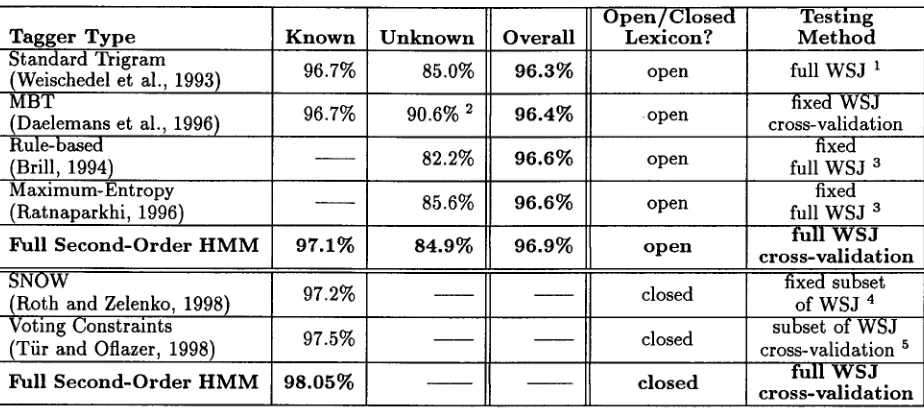
The full second-order HMM tagger is also compared to other researcher's taggers in Ta- ble 2. It is i m p o r t a n t to note t h a t both SNOW, a linear separator model (Roth and Zelenko,
THE SECOND-ORDER VITERBI ALGORITHM
T h e variables:
• gp(i,j)=
maxP(rl,...,rp-2, rp-1 =ti, r p = t j , v l , . . . v p ) , 2 < p < P
Tl ~...rTp--2
• Cp(i,j) = arg max
P(rl,...,rp-2, rp-1
=ti,rp = tj,vl,...vp),2
< p < PTl~...iTp--2
T h e p r o c e d u r e :
1. 6,(i,j) = { ~ribij(vl),
i f v l i s k n o w n }?ricij
(Vl) , if vl is unknown ,1 _< i, j < N¢l(i,j) = O, 1 < i,j < N
{ lma<xN[Jp-l(i,j)aljk]bjk(vp), if vp is known
}
2. ~p(j,
k) =
m~xN[Jp_~(i,j)ai~k]c~k(v,),
ifvp
is unknown ,1 <i,j, k < N, 2 < p < P
Cp (j, k) = arg
l~_ia<_Xg[Sp_l
(i, j)aijk], 1 < i, j, k < N, 2 g p < P
3. P* = max
6p(i,j)
l <i,j<_N
rt~ = argj max
6p(i,j)
l <i,j<N
r],_ 1 = arg i max
Jp(i,j)
l<_i,j<N
4. r; = Cp+l (r~+l, r;+2),p =
P - 2 , P - 3 , . . . , 2 , 1Figure 1: Second-Order Viterbi Algorithm
C o m p a r i s o n on B r o w n T a g g e r T y p e K n o w n
Standard Bigram 95.94%
Second-Order Lexical only 96.23% Second-Order Contextual only 96.41% Full Second-Order HMM 96.62%
C o r p u s
U n k n o w n O v e r a l l 80.61% 95.60% 81.42% 95.90% 82.69% 96.11% 83.46% 96.33%
C o m p a r i s o n on W S J C o r p u s T a g g e r T y p e K n o w n U n k n o w n
Standard Bigram 96.52% 82.40%
Second-Order Lexical only 96.80% 83.63% Second-Order Contextual only 96.90% 84.10% Full Second-Order HMM 97.09% 84.88%
O v e r a l l 96.25% 96.54% 96.65% 96.86%
% E r r o r R e d u c t i o n o f S e c o n d - O r d e r H M M S y s t e m T y p e C o m p a r e d B r o w n W S J
Bigram 16.6% 16.3%
Lexical Trigrams Only 10.5% 9.2% Contextual Trigrams Only 5.7% 6.3%
Table 1: Comparison between Taggers on t h e Brown and W S J C o r p o r a
1998), and the voting constraint tagger (Tiir and Oflazer, 1998) used training d a t a t h a t con- t a i n e d full lexical information (i.e., no unknown words), as well as training and testing d a t a t h a t did not cover the entire WSJ corpus. This use of
[image:6.612.75.558.79.620.2] [image:6.612.157.464.399.614.2]T a g g e r Type Standard Trigram (Weischedel et al., 1993) MBT
(Daelemans et al., 1996) Rule-based
(Brill, 1994) Maximum-Entropy (Ratnaparkhi, 1996)
Full S e c o n d - O r d e r H M M
SNOW
(Roth and Zelenko, 1998) Voting Constraints (Tiir and Oflazer, 1998)
Full S e c o n d - O r d e r H M M
Known Unknown O v e r a l l
O p e n / C l o s e d L e x i c o n ?
96.7% 85.0% 96.3% open
96.7% 90.6% 2 96.4% open
82.2% 96.6% open
97.1%
97.2%
85.6%
84.9%
97.5%
96.6%
96.9%
98.05%
open
o p e n
closed
closed
c l o s e d
Testing Method
full WSJ 1 fixed WSJ cross-validation
fixed full WSJ 3
fixed full WSJ 3
full W S J c r o s s - v a l i d a t i o n
fixed subset of WSJ 4 subset of WSJ cross-validation 5
full W S J c r o s s - v a l i d a t i o n
Table 2: Comparison between Full Second-Order H M M and Other Taggers
did not include numbers in the lexicon, which accounts for the inflated accuracy on unknown words. Table 2 compares the accuracies of the taggers on known words, unknown words, and overall accuracy. The table also contains two additional pieces of information. The first indi- cates if the corresponding tagger was tested us- ing a closed lexicon (one in which all words ap- pearing in the testing d a t a are known to the t a g - ger) or an open lexicon (not all words are known to.the system). The second indicates whether a hold-out m e t h o d (such as cross-validation) was used, and whether the tagger was tested on the entire W S J corpus or a reduced corpus.
T w o cross-validation tests with the full second-order H M M were run: the first with an open lexicon (created from the training data), and the second where the entire W S J lexicon was used for each test set. These two tests al- low more direct comparisons between our sys- tem and the others. As shown in the table, the full second-order H M M has improved overall ac- curacies on the W S J corpus to state-of-the-art
1The full WSJ is used, but the paper does not indicate whether a cross-vaiidation was performed.
2MBT did not place numbers in the lexicon, so all numbers were treated as unknown words.
aBoth the rule-based and maximum-entropy models use the full WSJ for training/testing with only a single test set.
4SNOW used a fixed subset of WSJ for training and testing with no cross-validation.
5The voting constraints tagger used a subset of WSJ for training and testing with cross-validation.
levels--96.9% is the greatest accuracy reported on the full W S J for an experiment using an open lexicon. Finally, using a closed lexicon, the full second-order H M M achieved an accuracy of 98.05%, the highest reported for the W S J cor- pus for this t y p e of experiment.
The accuracy of our system on unknown words is 84.9%. This accuracy was achieved by creating s e p a r a t e classifiers for capitalized, hy- phenated, and numeric digit words: tests on the Wall Street Journal corpus with the full second- order H M M show t h a t the accuracy rate on un- known words w i t h o u t separating these types of words is only 80.2%. 6 This is below the perfor- mance of our bigram tagger t h a t separates the classifiers. Unfortunately, unknown word accu- racy is still below some of the other systems. This m a y be due in part to experimental dif- ferences. It should also be noted t h a t some of these other s y s t e m s use hand-crafted rules for unknown word rules, whereas our system uses only statistical data. Adding additional rules to our system could result in comparable per- formance. Improving our model on unknown words is a m a j o r focus of future research.
In conclusion, a new statistical model, the full second-order H M M , has been shown to improve part-of-speech tagging accuracies over current models. This model makes use of second-order approximations for a hidden Markov model and
8Mikheev (1997) also separates suffix probabilities into different estimates, but fails to provide any data illustrating the implied accuracy increase.
[image:7.612.68.530.80.285.2]improves the state of the art for taggers with no increase in asymptotic running time over tra- ditional trigram taggers based on the hidden Markov model. A new smoothing method is also explained, which allows the use of second-order statistics while avoiding sparse data problems.
R e f e r e n c e s
Eric Brill. 1994. A report of recent progress in transformation-based error-driven learn-
ing.
Proceedings of the Twelfth National Con-
ference on Artifical Intelligence,
pages 722- 727.Eric Brill. 1995. Transformation-based error- driven learning and natural language process- ing: A case study in part of speech tagging.
Computational Linguistics,
21(4):543-565. Eugene Charniak, Curtis Hendrickson, Neil Ja-cobson, and Mike Perkowitz. 1993. Equa-
tions for part-of-speech tagging.
Proceedings
of the Eleventh National Conference on Arti-
ficial Intelligence,
pages 784-789.Walter Daelemans, Jakub Zavrel, Peter Berck, and Steven Gillis. 1996. MBT: A memory-
based part of speech tagger-generator.
Pro-
ceedings of the Fourth Workshop on Very
Large Corpora,
pages 14-27.William A. Gale and Kenneth W. Church. 1994.
What's wrong with adding one? In
Corpus-
Based Research into Language.
Rodolpi, Am- sterdam.I. J. Good. 1953. The population frequencies of species and the estimation of population
parameters.
Biometrika,
40:237-264.Frederick Jelinek and Robert L. Mercer. 1980. Interpolated estimation of markov source pa-
rameters from sparse data.
Proceedings of the
Workshop on Pattern Recognition in Prac-
tice.
Salva M. Katz. 1987. Estimation of probabili- ties from sparse data for the language model
component of a speech recognizer.
IEEE
Transactions on Acoustics, Speech and Signal
Processing,
35 (3) :400-401.Julian Kupiec. 1992. Robust part-of-speech
tagging using a hidden Markov model.
Com-
puter Speech and Language,
6(3):225-242.Mitchell Marcus, Beatrice Santorini, and
Mary Ann Marcinkiewicz. 1993. Building a large annotated corpus of English: The
Penn Treebank.
Computational Linguistics,
19(2):313-330.
Andrei Mikheev. 1996. Unsupervised learning
of word-category guessing rules.
Proceedings
of the 34th Annual Meeting of the Association
for Compuatational Linguistics,
pages 327-334.
Andrei Mikheev. 1997. Automatic rule induc-
tion for unknown-word guessing.
Computa-
tional Linguistics,
23 (3) :405-423.Lawrence R. Rabiner. 1989. A tutorial on
hidden Markov models and selected applica-
tions in speech recognition.
Proceeding of the
IEEE,
pages 257-286.Adwait Ratnaparkhi. 1996. A maximum en-
tropy model for part-of-speech tagging.
Pro-
ceedings of the Conference on Empirical
Methods in Natural Language Processing,
pages 133-142.
Dan Roth and Dmitry Zelenko. 1998. Part of speech tagging using a network of linear sep-
arators.
Proceedings of COLING-ACL '98,
pages 1136-1142.
Scott M. Thede. 1998. Predicting part-of-
speech information about unknown words
using statistical methods.
Proceedings of
COLING-ACL '98,
pages 1505-1507.GSkhan Tiir and Kemal Oflazer. 1998. Tagging
English by path voting constraints.
Proceed-
ings of COLING-ACL '98,
pages 1277-1281. Evelyne Tzoukermann and Dragomir R. Radev. 1996. Using word class for part-of-speechdisambiguation.
Proceedings of the Fourth
Workshop on Very Large Corpora,
pages 1- 13.Hans van Halteren, Jakub Zavrel, and Wal- ter Daelemans. 1998. Improving data driven wordclass tagging by system combination.
Proceedings of COLING-A CL '98,
pages 491- 497.Ralph Weischedel, Marie Meeter, Richard Schwartz, Lance Ramshaw, and Jeff Pal- mucci. 1993. Coping with ambiguity and unknown words through probabilitic models.