Proceedings of the 47th Annual Meeting of the ACL and the 4th IJCNLP of the AFNLP, pages 914–922,
A non-contiguous Tree Sequence Alignment-based Model for
Statistical Machine Translation
Jun Sun
1,2Min Zhang
1Chew Lim Tan
21
Institute for Infocomm Research
2School of Computing, National University of Singapore
[email protected] [email protected] [email protected]
Abstract
The tree sequence based translation model al-lows the violation of syntactic boundaries in a rule to capture non-syntactic phrases, where a tree sequence is a contiguous sequence of sub-trees. This paper goes further to present a trans-lation model based on non-contiguous tree se-quence alignment, where a non-contiguous tree sequence is a sequence of sub-trees and gaps. Compared with the contiguous tree sequence-based model, the proposed model can well han-dle non-contiguous phrases with any large gaps by means of non-contiguous tree sequence alignment. An algorithm targeting the non-contiguous constituent decoding is also proposed. Experimental results on the NIST MT-05 Chi-nese-English translation task show that the pro-posed model statistically significantly outper-forms the baseline systems.
1
Introduction
Current research in statistical machine translation (SMT) mostly settles itself in the domain of either phrase-based or syntax-based. Between them, the phrase-based approach (Marcu and Wong, 2002; Koehn et al, 2003; Och and Ney, 2004) allows lo-cal reordering and contiguous phrase translation. However, it is hard for phrase-based models to learn global reorderings and to deal with non-contiguous phrases. To address this issue, many syntax-based approaches (Yamada and Knight, 2001; Eisner, 2003; Gildea, 2003; Ding and Palmer, 2005; Quirk et al, 2005; Zhang et al, 2007, 2008a; Bod, 2007; Liu et al, 2006, 2007; Hearne and Way, 2003) tend to integrate more syntactic information to enhance the non-contiguous phrase modeling. In general, most of them achieve this goal by intro-ducing syntactic non-terminals as translational equivalent placeholders in both source and target sides. Nevertheless, the generated rules are strictly required to be derived from the contiguous transla-tional equivalences (Galley et al, 2006; Marcu et al, 2006; Zhang et al, 2007, 2008a, 2008b; Liu et al,
2006, 2007). Among them, Zhang et al. (2008a) acquire the non-contiguous phrasal rules from the
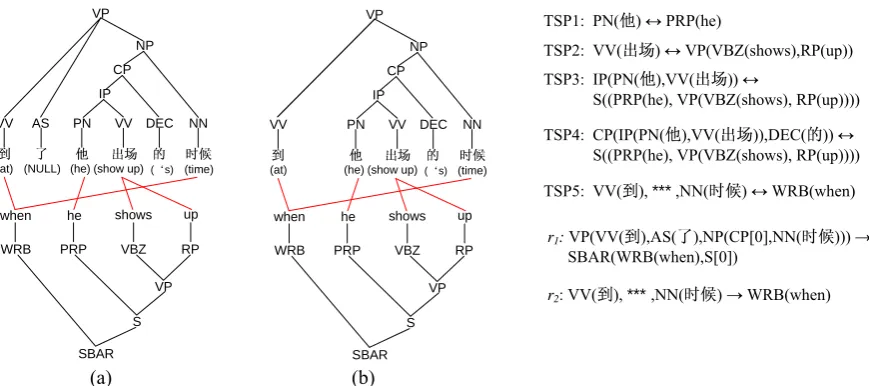
contiguous tree sequence pairs1, and find them use-less via real syntax-based translation systems. However, Wellington et al. (2006) statistically re-port that discontinuities are very useful for transla-tional equivalence analysis using binary branching structures under word alignment and parse tree constraints. Bod (2007) also finds that discontinues phrasal rules make significant improvement in lin-guistically motivated STSG-based translation model. The above observations are conflicting to each other. In our opinion, the non-contiguous phrasal rules themselves may not play a trivial role, as reported in Zhang et al. (2008a). We believe that the effectiveness of non-contiguous phrasal rules highly depends on how to extract and utilize them. To verify the above assumption, suppose there is only one tree pair in the training data with its alignment information illustrated as Fig. 1(a) 2. A test sentence is given in Fig. 1(b): the source sen-tence with its syntactic tree structure as the upper tree and the expected target output with its syntac-tic structure as the lower tree. In the tree sequence alignment based model, in addition to the entire tree pair, it is capable to acquire the contiguous tree sequence pairs: TSP (1~4) 3 in Fig. 1. By means of the rules derived from these contiguous tree sequence pairs, it is easy to translate the conti-guous phrase “ /he /show up /’s”. As for the
non-contiguous phrase “ /at, ***, /time”, the
only related rule is r1 derived from TSP4 and the
entire tree pair. However, the source side of r1 does
not match the source tree structure of the test sen-tence. Therefore, we can only partially translate the illustrated test sentence with this training sample.
1
A tree sequence pair in this context is a kind of translational equivalence comprised of a pair of tree sequences.
2
We illustrate the rule extraction with an example from the tree-to-tree translation model based on tree sequence align-ment (Zhang et al, 2008a) without losing of generality to most syntactic tree based models.
3 We only list the contiguous tree sequence pairs with one
single sub-tree in both sides without losing of generality.
As discussed above, the problem lies in that the non-contiguous phrases derived from the conti-guous tree sequence pairs demand greater reliance on the context. Consequently, when applying those rules to unseen data, it may suffer from the data sparseness problem. The expressiveness of the model also slacks due to their weak ability of gene-ralization.
To address this issue, we propose a syntactic translation model based on non-contiguous tree sequence alignment. This model extracts the translation rules not only from the contiguous tree sequence pairs but also from the non-contiguous
tree sequence pairs where a non-contiguous tree sequence is a sequence of sub-trees and gaps. With the help of the non-contiguous tree sequence, the proposed model can well capture the non-contiguous phrases in avoidance of the constraints of large applicability of context and enhance the non-contiguous constituent modeling. As for the above example, the proposed model enables the non-contiguous tree sequence pair indexed as TSP5 in Fig. 1 and is allowed to further derive r2
from TSP5. By means of r2 and the same
processing to the contiguous phrase “ /he
/show up /’s” as the contiguous tree sequence
based model, we can successfully translate the en-tire source sentence in Fig. 1(b).
We define a synchronous grammar, named Syn-chronous non-contiguous Tree Sequence Substitu-tion Grammar (SncTSSG), extended from syn-chronous tree substitution grammar (STSG: Chiang, 2006) to illustrate our model. The pro-posed synchronous grammar is able to cover the previous proposed grammar based on tree (STSG, Eisner, 2003; Zhang et al, 2007) and tree sequence (STSSG, Zhang et al, 2008a) alignment. Besides, we modify the traditional parsing based decoding
algorithm for syntax-based SMT to facilitate the non-contiguous constituent decoding for our model. To the best of our knowledge, this is the first attempt to acquire the translation rules with rich syntactic structures from the non-contiguous Translational Equivalences (non-contiguous tree sequence pairs in this context).
The rest of this paper is organized as follows: Section 2 presents a formal definition of our model with detailed parameterization. Sections 3 and 4 elaborate the extraction of the non-contiguous tree sequence pairs and the decoding algorithm respec-tively. The experiments we conduct to assess the effectiveness of the proposed method are reported in Section 5. We finally conclude this work in Sec-tion 6.
2
Non-Contiguous Tree sequence
Align-ment-based Model
In this section, we give a formal definition of SncTSSG and accordingly we propose the align-ment based translation model. The details of prob-abilistic parameterization are elaborated based on the log-linear framework.
2.1 Synchronous non-contiguous TSSG
(SncTSSG)
Extended from STSG (Shiever, 2004), SncTSSG can be formalized as a quintuple G = < , , ,
, R
>, where:x and are source and target terminal alphabets (words) respectively, and
x and are source and target non-terminal alphabets (linguistically syntactic tags, i.e. NP, VP) respectively; as well as the
non-terminal to denote a gap,
VP
NP
AS
VV PN
IP CP
NN DEC VV
SBAR VP
S RP VBZ PRP WRB
up shows he
when
TSP1: PN( ) PRP(he)
r1: VP(VV( ),AS( ),NP(CP[0],NN( )))
SBAR(WRB(when),S[0])
TSP5: VV( ), ***,NN( ) WRB(when)
TSP3: IP(PN( ),VV( ))
S((PRP(he), VP(VBZ(shows), RP(up)))) TSP2: VV( ) VP(VBZ(shows),RP(up))
r2: VV( ), *** ,NN( ) WRB(when)
TSP4: CP(IP(PN( ),VV( )),DEC( ))
S((PRP(he), VP(VBZ(shows), RP(up)))) (at) (NULL) (he) (show up) (þs) (time)
VP
NP
VV PN
IP CP
NN DEC VV
SBAR VP
S RP VBZ PRP WRB
up shows he
when
(at) (he) (show up) (þs) (time)
[image:2.595.86.521.65.258.2](a) (b)
can represent any syntactic or non-syntactic tree sequences, and
x
R
is a production rule set consisting of rules derived from corresponding contiguous or non-contiguous tree sequence pairs, where a rule is a pair of contiguous ornon-contiguous tree sequence with alignment re-lation between leaf nodes across the tree se-quence pair.
A non-contiguous tree sequence translation rule
r
R
can be further defined as a triple, where:
x is a non-contiguous source tree sequence, covering the span set
in , where
which means each subspan has non-zero width and which means there is a non-zero gap between each pair of consecutive intervals. A gap of interval [ ] is denoted as , and
x is a non-contiguous target tree sequence, covering the span set
in , where
which means each subspan has non-zero width and which means there is a non-zero gap between each pair of consecutive intervals. A gap of interval [ ] is denoted as , and
x are the alignments between leaf nodes of the source and target non-contiguous tree sequences, satisfying the following conditions :
,
where and
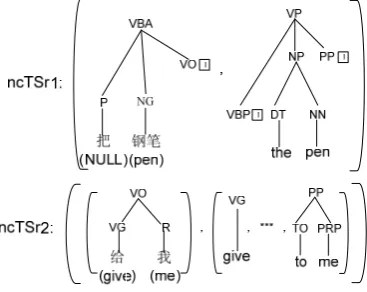
[image:3.595.102.247.68.264.2]In SncTSSG, the leaf nodes in a non-contiguous tree sequence rule can be either non-terminal symbols (grammar tags) or terminal symbols (lexical words) and the non-terminal symbols with the same index which are subsumed simultaneously are not required to be contiguous. Fig. 4 shows two examples of non-contiguous tree sequence rules (“non-contiguous rule” for short in the following context) derived from the non-contiguous tree sequence pair (in Fig. 3) which is extracted from the bilingual tree pair in Fig. 2. Between them, ncTSr1 is a tree rule with internal nodes non-contiguously subsumed from a contiguous tree sequence pair (dashed in Fig. 2) while ncTSr2 is a non-contiguous rule with a contiguous source side and a non-contiguous target side. Obviously, the non-contiguous tree sequence rule ncTSr2 is more flexible by neglecting the context among the gaps of the tree sequence pair while capturing all aligned counterparts with the corresponding syntactic structure information. We
Figure 2: A word-aligned parse tree pair
[image:3.595.112.236.311.430.2]Figure 3: A non-contiguous tree sequence pair
Figure 4: Two examples of non-contiguous
[image:3.595.75.259.478.624.2]expect these properties can well address the issues of non-contiguous phrase modeling.
2.2 SncTSSG based Translation Model
Given the source and target sentence and , as well as the corresponding parse trees
and , our approach directly approximates the
posterior probability based on
the log-linear framework:
‡š’
In this model, the feature function hm is
log-linearly combined by the corresponding parameter (Och and Ney, 2002). The following features are utilized in our model:
1) The bi-phrasal translation probabilities
2) The bi-lexical translation probabilities
3) The target language model
4) The # of words in the target sentence
5) The # of rules utilized
6) The average tree depth in the source side of the rules adopted
7) The # of non-contiguous rules utilized
8) The # of reordering times caused by the utilization of the non-contiguous rules
Feature 1~6 can be applied to either STSSG or SncTSSG based models, while the last two targets SncTSSG only.
3
Tree Sequence Pair Extraction
In training, other than the contiguous tree sequence pairs, we extract the non-contiguous ones as well. Nevertheless, compared with the contiguous tree sequence pairs, the non-contiguous ones suffer more from the tree sequence pair redundancy
problem that one non-contiguous tree sequence pair can be comprised of two or more unrelated and nonadjacent contiguous ones. To model the contiguous phrases, this problem is actually trivial, since the contiguous phrases stay adjacently and share the related syntactic constraints; however, as for non-contiguous phrase modeling, the cohesion of syntactically and semantically unrelated tree sequence pairs is more likely to generate noisy rules which do not benefit at all. In order to minim-ize the number of redundant tree sequence pairs, we limit the # of gaps of non-contiguous tree
se-quence pairs to be 0 in either source or target side. In other words, we only allow one side to be non-contiguous (either source or target side) to partially reserve its syntactic and semantic cohesion4. We further design a two-phase algorithm to extract the tree sequence pairs as described in Algorithm 1.
For the first phase (line 1-11), we extract the contiguous tree sequence pairs (line 3-5) and the non-contiguous ones with contiguous tree se-quence in the source side (line 6-9). In the second phase (line 12-19), the ones with contiguous tree sequence in the target side and non-contiguous tree sequence on the source side are extracted.
4
Wellington et al. (2006) also reports that allowing gaps in one side only is enough to eliminate the hierarchical alignment failure with word alignment and one side parse tree constraints. This is a particular case of our definition of non-contiguous tree sequence pair since a non-contiguous tree sequence can be considered to overcome the structural constraint by neglecting the structural information in the gaps.
Algorithm 1: Tree Sequence Pair Extraction Input: source tree and target tree
Output: the set of tree sequence pairs
Data structure:
p[j1, j2] to store tree sequence pairs covering source
span[j1, j2]
1: foreach source span [j1, j2], do
2: find a target span [i1,i2] with minimal length
cov-ering all the target words aligned to [j1, j2]
3: if all the target words in [i1,i2] are aligned with
source words only in [j1, j2], then
4: Pair each source tree sequence covering [j1, j2]
with those in target covering [i1,i2] as a
conti-guous tree sequence pair 5: Insert them into p[j1, j2]
6: else
7: create sub-span set s([i1,i2]) to cover all the
tar-get words aligned to [j1, j2]
8: Pair each source tree sequence covering [j1, j2]
with each target tree sequence covering s([i1,i2]) as a non-contiguous tree sequence pair
9: Insert them into p[j1, j2]
10: end if
11:end do
12: foreach target span [i1,i2], do
13: find a source span [j1, j2] with minimal length
covering all the source words aligned to [i1,i2]
14: if any source word in [j1, j2] is aligned with
tar-get words outside [i1,i2], then
15: create sub-span set s([j1, j2]) to cover all the
source words aligned to [i1,i2]
16: Pair each source tree sequence covering s([j1,
j2]) with each target tree sequence covering
[i1,i2] as a non-contiguous tree sequence pair
17: Insert them into p[j1, j2]
18: end if
The extracted tree sequence pairs are then uti-lized to derive the translation rules. In fact, both the contiguous and non-contiguous tree sequence pairs themselves are applicable translation rules; we denote these rules as Initial rules. By means of the Initial rules, we derive the Abstract rules simi-larly as in Zhang et al. (2008a).
Additionally, we develop a few constraints to limit the number of Abstract rules. The depth of a tree in a rule is no greater than h. The number of non-terminals as leaf nodes is no greater than c. The tree number is no greater than d. Besides, the number of lexical words at leaf nodes in an Initial
rule is no greater than l. The maximal number of gaps for a non-contiguous rule is no greater than .
4
The Pisces decoder
We implement our decoder Pisces by simulating the span based CYK parser constrained by the rules of SncTSSG. The decoder translates each span iteratively in a bottom up manner which guar-antees that when translating a source span, any of its sub-spans is already translated.
For each source span [j1, j2], we perform a
three-phase decoding process. In the first three-phase, the source side contiguous translation rules are utilized as described in Algorithm 2. When translating us-ing a source side contiguous rule, the target tree sequence of the rule whether contiguous or non-contiguous is directly considered as a candidate translation for this span (line 3), if the rule is an
Initial rule; otherwise, the non-terminal leaf nodes are replaced with the corresponding sub-spans’ translations (line 5).
In the second phase, the source side non-contiguous rules5 for [j1, j2] are processed. As for
5
A source side non-contiguous translation rules which cover a list of n non-contiguous spans s([ , ], i=1,…,n) is consi-dered to cover the source span [j1, j2] if and only if = j1 and
= j2.
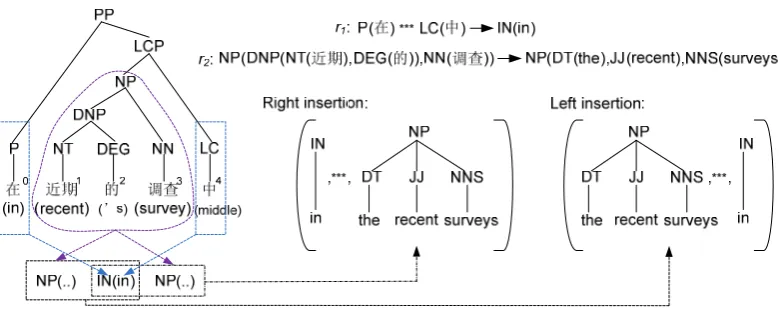
the ones with non-terminal leaf nodes, the re-placement with corresponding spans’ translations is initially performed in the same way as with the contiguous rules in the first phase. After that, an operation specified for the source side non-contiguous rules named “Source gap insertion” is performed. As illustrated in Fig. 5, to use the non-contiguous rule r1, which covers the source span
set ([0,0], [4,4]), the target portion “IN(in)” is first attained, then the translations to the gap span [1,3] is acquired from the previous steps and is inserted either to the right or to the left of “IN(in)”. The insertion is rather cohesion based but leaves a gap
<***> for further “Target tree sequence reordering” in the next phase if necessary.
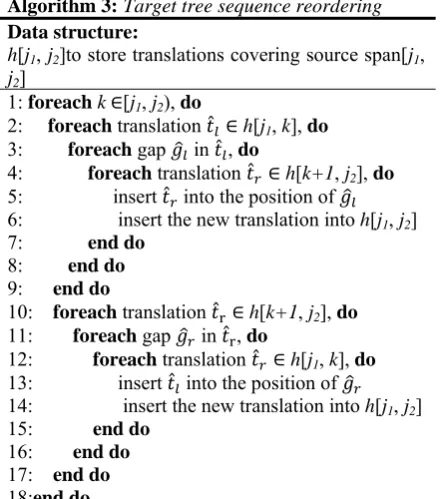
In the third phase, we carry out the other non-contiguous rule specific operation named “Target tree sequence reordering”. Algorithm 3 gives an overview of this operation. For each source span, we first binarize the span into the left one and the right one. The translation hypothesis for this span is generated by firstly inserting the candidate trans-lations of the right span to each gap in the ones of the left span respectively (line 2-9) and then re-peating in the alternative direction (line10-17). The gaps for the insertion of the tree sequences in the target side are generated from either the
inherit-Figure 5: Illustration of “Source gap insertion”
Algorithm 2: Contiguous rule processing
Data structure:
h[j1, j2]to store translations covering source span[j1, j2]
1: foreach rule r contiguous in source span [j1, j2], do
2: ifr is an Initial rule, then 3: insert r into h[j1, j2]
4: else //Abstract rule
5: generate translations by replacing the non-terminal leaf nodes of r with their correspond-ing spans’ translation
6: insert the new translation into h[j1, j2]
7: end if
[image:5.595.96.486.67.222.2]ance of the target side non-contiguous tree se-quence pairs or the production of the previous op-erations of “Source gap insertion”. Therefore, the insertion for target gaps helps search for a better order of the non-contiguous constituents in the tar-get side. On the other hand, the non-contiguous tree sequences with rich syntactic information are reordered, nevertheless, without much considera-tion of the constraints of the syntactic structure. Consequently, this distortional operation, like phrase-based models, is much more flexible in the order of the target constituents than the traditional syntax-based models which are limited by the syn-tactic structure. As a result, “Target tree sequence reordering” enhances the reordering ability of the model.
To speed up the decoder, we use several thre-sholds to limit the searching space for each span. The maximal number of the rules in a source span is no greater than . The maximal number of trans-lation candidates for a source span is no greater than . On the other hand, to simplify the compu-tation of language model, we only compute for source side contiguous translational hypothesis, while neglecting gaps in the target side if any.
5
Experiments
5.1 Experimental Settings
In the experiments, we train the translation model on FBIS corpus (7.2M (Chinese) + 9.2M (English) words) and train a 4-gram language model on the Xinhua portion of the English Gigaword corpus (181M words) using the SRILM Toolkits (Stolcke,
2002). We use these sentences with less than 50 characters from the NIST MT-2002 test set as the development set and the NIST MT-2005 test set as our test set. We use the Stanford parser (Klein and Manning, 2003) to parse bilingual sentences on the training set and Chinese sentences on the devel-opment and test set. The evaluation metric is case-sensitive BLEU-4 (Papineni et al., 2002). We base on the m-to-n word alignments dumped by GI-ZA++ to extract the tree sequence pairs. For the MER training, we modify Koehn’s version (Koehn, 2004). We use Zhang et al’s implementation (Zhang et al, 2004) for 95% confidence intervals significant test.
We compare the SncTSSG based model against two baseline models: the phrase-based and the STSSG-based models. For the phrase-based model, we use Moses (Koehn et al, 2007) with its default settings; for the STSSG and SncTSSG based mod-els we use our decoder Pisces by setting the
fol-lowing parameters: , , , ,
, . Additionally, for STSSG we set , and for SncTSSG, we set .
[image:6.595.64.285.72.322.2]5.2 Experimental Results
Table 1 compares the performance of different models across the two systems. The proposed SncTSSG based model significantly outperforms (p < 0.05) the two baseline models. Since the SncTSSG based model covers the STSSG based model in its modeling ability and obtains a superset in rules, the improvement empirically verifies the effectiveness of the additional non-contiguous rules.
System Model BLEU
Moses cBP 23.86
Pisces STSSG 25.92
SncTSSG 26.53
Table 1: Translation results of different models (cBP refers to contiguous bilingual phrases without syntactic
structural information, as used in Moses)
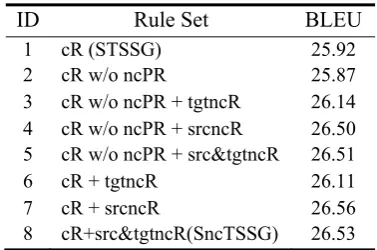
Table 2 measures the contribution of different combination of rules. cR refers to the rules derived from contiguous tree sequence pairs (i.e., all STSSG rules); ncPR refers to non-contiguous phrasal rules derived from contiguous tree se-quence pairs with at least one non-terminal leaf node between two lexicalized leaf nodes (i.e., all non-contiguous rules in STSSG defined as in Zhang et al. (2008a)); srcncR refers to source side non-contiguous rules (SncTSSG rules only, not STSSG rules); tgtncR refers to target side non-contiguous rules (SncTSSG rules only, not STSSG rules) and src&tgtncR refers non-contiguous rules
Algorithm 3:Target tree sequence reordering
Data structure:
h[j1, j2]to store translations covering source span[j1,
j2]
1: foreachk [j1, j2), do
2: foreach translation h[j1, k], do
3: foreach gap in , do
4: foreach translation h[k+1, j2], do
5: insert into the position of 6: insert the new translation into h[j1, j2]
7: end do 8: end do 9: end do
10: foreach translation h[k+1, j2], do
11: foreach gap in , do
12: foreach translation h[j1, k], do
13: insert into the position of
14: insert the new translation into h[j1, j2]
15: end do 16: end do 17: end do
with gaps in either side (srcncR+ tgtncR). The last three kinds of rules are all derived from non-contiguous tree sequence pairs.
1) From Exp 1 and 2 in Table 2, we find that non-contiguous phrasal rules (ncPR) derived from contiguous tree sequence pairs make little impact on the translation performance which is consistent with the discovery of Zhang et al. (2008a). How-ever, if we append the non-contiguous phrasal rules derived from non-contiguous tree sequence pairs, no matter whether non-contiguous in source or in target, the performance statistically signifi-cantly (p < 0.05) improves (as presented in Exp 2~5), which validates our prediction that the non-contiguous rules derived from non-non-contiguous tree sequence pairs contribute more to the performance than those acquired from contiguous tree sequence pairs.
2) Not only that, after comparing Exp 6,7,8 against Exp 3,4,5 respectively, we find that the ability of rules derived from non-contiguous tree sequence pairs generally covers that of the rules derived from the contiguous tree sequence pairs, due to the slight change in BLEU score.
[image:7.595.80.269.63.188.2]3) The further comparison of the non-contiguous rules from non-non-contiguous spans in Exp. 6&7 as well as Exp 3&4, shows that non-contiguity in the target side in Chinese-English translation task is not so useful as that in the source side when constructing the non-contiguous phrasal rules. This also validates the findings in Welling-ton et al. (2006) that varying the gaps on the Eng-lish side (the target side in this context) seldom reduce the hierarchical alignment failures.
Table 3 explores the contribution of the non-contiguous translational equivalence to phrase-based models (all the rules in Table 3 has no grammar tags, but a gap <***> is allowed in the last three rows). tgtncBP refers to the bilingual phrases with gaps in the target side; srcncBP refers to the bilingual phrases with gaps in the source side; src&tgtncBP refers to the bilingual phrases with gaps in either side.
System Rule Set BLEU
Moses cBP 23.86
Pisces
cBP 22.63 cBP + tgtncBP 23.74
cBP + srcncBP 23.93 cBP + src&tgtncBP 24.24
Table 3: Performance of bilingual phrasal rules
1) As presented in Table 3, the effectiveness of the bilingual phrases derived from non-contiguous tree sequence pairs is clearly indicated. Models adopting both tgtncBP and srcncBP sig-nificantly (p < 0.05) outperform the model adopt-ing cBP only.
2) Pisces underperforms Moses when utiliz-ing cBPs only, since Pisces can only perform mo-notonic search with cBPs.
3) The bilingual phrase model with both tgtncBP and srcncBP even outperforms Moses. Compared with Moses, we only utilize plain fea-tures in Pisces for the bilingual phrase model (Fea-ture 1~5 for all phrases and additional 7, 8 only for non-contiguous bilingual phrases as stated in Sec-tion 2.2; None of the complex reordering features or distortion features are employed by Pisces while Moses uses them), which suggests the effective-ness of the non-contiguous rules and the advantag-es of the proposed decoding algorithm.
Table 4 studies the impact on performance when setting different maximal gaps allowed for either side in a tree sequence pair (parameter ) and the relation with the quantity of rule set.
Significant improvement is achieved when al-lowing at least one gap on either side compared with when only allowing contiguous tree sequence pairs. However, the further increment of gaps does not benefit much. The result exhibits the accor-dance with the growing amplitude of the rule set filtered for the test set, in which the rule size in-creases more slowly as the maximal number of gaps increments. As a result, this slow increase against the increment of gaps can be probably at-tributed to the small augmentation of the effective
ID Rule Set BLEU
1 cR (STSSG) 25.92
2 cR w/o ncPR 25.87
3 cR w/o ncPR + tgtncR 26.14 4 cR w/o ncPR + srcncR 26.50 5 cR w/o ncPR + src&tgtncR 26.51
6 cR + tgtncR 26.11
7 cR + srcncR 26.56
[image:7.595.332.508.63.148.2]8 cR+src&tgtncR(SncTSSG) 26.53
Table 2: Performance of different rule combination
Max gaps allowed Rule # BLEU source target
0 0 1,661,045 25.92
1 1 +841,263 26.53
2 2 +447,161 26.55
3 3 +17,782 26.56
’ +8,223 26.57
[image:7.595.319.522.633.733.2]non-contiguous rules.
In order to facilitate a better intuition to the abil-ity of the SncTSSG based model against the STSSG based model, we present in Table 5, two translation outputs produced by both models.
In the first example, GIZA++ wrongly aligns the idiom word “ /confront at court” to a
non-contiguous phrase “confront other countries at court *** leisurely manner” in training, in which only the first constituent “confront other countries at court” is reasonable, indicated from the key rules of SncTSSG leant from the training set. The STSSG or any contiguous translational equiva-lence based model is unable to attain the corres-ponding target output for this idiom word via the non-contiguous word alignment and consider it as an out-of-vocabulary (OOV). On the contrary, the SncTSSG based model can capture the non-contiguous tree sequence pair consistent with the word alignment and further provide a reasonable target translation. It suggests that SncTSSG can easily capture the non-contiguous translational candidates while STSSG cannot. Besides, SncTSSG is less sensitive to the error of word alignment when extracting the translation candi-dates than the contiguous translational equivalence based models.
In the second example, “ /in /recent /’s
/survey /middle” is correctly translated into “in the recent surveys” by both the STSSG and SncTSSG based models. This suggests that the short non-contiguous phrase “ /in *** /middle”
is well handled by both models. Nevertheless, as for the one with a larger gap, “ /will ***
/continue” is correctly translated and well reorder-ing into “will continue” by SncTSSG but failed by
STSSG. Although the STSSG is theoretically able to capture this phrase from the contiguous tree se-quence pair, the richer context in the gap as in this example, the more difficult STSSG can correctly translate the non-contiguous phrases. This exhibits the flexibility of SncTSSG to the rich context among the non-contiguous constituents.
6
Conclusions and Future Work
In this paper, we present a non-contiguous tree se-quence alignment model based on SncTSSG to enhance the ability of non-contiguous phrase mod-eling and the reordering caused by non-contiguous constituents with large gaps. A three-phase decod-ing algorithm is developed to facilitate the usage of non-contiguous translational equivalences (tree sequence pairs in this work) which provides much flexibility for the reordering of the non-contiguous constituents with rich syntactic structural informa-tion. The experimental results show that our model outperforms the baseline models and verify the effectiveness of non-contiguous translational equi-valences to non-contiguous phrase modeling in both syntax-based and phrase-based systems. We also find that in Chinese-English translation task, gaps are more effective in Chinese side than in the English side.
Although the characteristic of more sensitive-ness to word alignment error enables SncTSSG to capture the additional non-contiguous language phenomenon, it also induces many redundant non-contiguous rules. Therefore, further work of our studies includes the optimization of the large rule set of the SncTSSG based model.
Output & References
Source /only
/pass /null /five years /two people /null /confront at court
Reference after only five years the two confronted each other at court
STSSG only in the five years , the two candidates would
SncTSSG the two people can confront other countries at court leisurely manner only in the five years
key rules VV( )! VB(confront)NP(JJ(other),NNS(countries))IN(at) NN(court) JJ(leisurely)NN(manner)
Source
"#
/Euro $ /’s %'& /substantial () /appreciation * /will + /in ,- /recent $ /’s ./ /survey 0 /middle 12 /continue
/for 34 /economy 56 /confidence 78 /produce 9': /impact
Reference substantial appreciation of the euro will continue to impact the economic confidence in the recent surveys
STSSG substantialappreciation of the euro has continued to have an impact on confidence in the economy , in the re-cent surveys will
SncTSSG substantial appreciation of the euro will continue in the recent surveys have an impact on economic confidence
key rules AD(* ) VV(12 ) ! VP(MD(will),VB(continue))
[image:8.595.39.562.85.264.2]P(+ ) LC(0 ) ! IN(in)
References
Rens Bod. 2007. Unsupervised Syntax-Based Machine Translation: The Contribution of Discontinuous Phrases. MT-Summmit-07. 51-56.
David Chiang. 2006. An Introduction to Synchronous Grammars. Tutorial on ACL-06
Yuan Ding and Martha Palmer. 2005. Machine transla-tion using probabilistic synchronous dependency in-sert grammars. ACL-05. 541-548
Jason Eisner. 2003. Learning non-isomorphic tree map-pings for machine translation. ACL-03.
Michel Galley, J. Graehl, K. Knight, D. Marcu, S. De-Neefe, W. Wang and I. Thayer. 2006. Scalable Infe-rence and training of context-rich syntactic transla-tion models. COLING-ACL-06. 961-968
Daniel Gildea. 2003. Loosely Tree-Based Alignment for Machine Translation. ACL-03. 80-87.
Mary Hearne and Andy Way. 2003. Seeing the wood for the trees: data-oriented translation. MT Summit IX, 165-172.
Dan Klein and Christopher D. Manning. 2003. Accurate Unlexicalized Parsing. ACL-03. 423-430.
Philipp Koehn, Franz J. Och and Daniel Marcu. 2003. Statistical phrase-based translation. HLT-NAACL-03. 127-133
Philipp Koehn, Hieu Hoang, Alexandra Birch, Chris Callison-Burch, Marcello Federico, Nicola Bertoldi, Brooke Cowan, Wade Shen, Christine Moran, Ri-chard Zens, Chris Dyer, Ondrej Bojar, Alexandra Constantin and Evan Herbst. 2007. Moses: Open Source Toolkit for Statistical Machine Translation. ACL-07. 77-180.
Yang Liu, Qun Liu and Shouxun Lin. 2006. Tree-to-String Alignment Template for Statistical Machine Translation. ACL-06, 609-616
Yang Liu, Yun Huang, Qun Liu and Shouxun Lin. 2007. Forest-to-String Statistical Translation Rules. ACL-07. 704-711.
Daniel Marcu and William Wong. 2002. A phrase-based, joint probability model for statistical machine translation. EMNLP-02, 133-139
Daniel Marcu, W. Wang, A. Echihabi and K. Knight. 2006. SPMT: statistical machine translation with syn-tactified target language phrases. EMNLP-06. 44-52.
Franz J. Och and Hermann Ney. 2004. The alignment template approach to statistical machine translation. Computational Linguistics, 30(4):417-449
Kishore Papineni, Salim Roukos, ToddWard and WeiJ-ing Zhu. 2002. BLEU: a method for automatic evalu-ation of machine translevalu-ation. ACL-02. 311-318. Chris Quirk, Arul Menezes and Colin Cherry. 2005.
Dependency treelet translation: syntactically in-formed phrasal SMT. ACL-05. 271-279.
S. Shieber. 2004. Synchronous grammars as tree trans-ducers. In Proceedings of the Seventh International Workshop on Tree Adjoining Grammar and Related Formalisms
Andreas Stolcke. 2002. SRILM - an extensible language modeling toolkit. ICSLP-02. 901-904.
Benjamin Wellington, Sonjia Waxmonsky and I. Dan Melamed. 2006. Empirical Lower Bounds on the Complexity of Translational Equivalence. ACL-06. 977-984
Kenji Yamada and Kevin Knight. 2001. A syntax-based statistical translation model. ACL-01. 523-530 Min Zhang, Hongfei Jiang, AiTi Aw, Jun Sun, Sheng Li
and Chew Lim Tan. 2007. A tree-to-tree alignment-based model for statistical machine translation. MT-Summit-07. 535-542.
Min Zhang, Hongfei Jiang, AiTi Aw, Haizhou Li, Chew Lim Tan and Sheng Li. 2008a. A tree sequence alignment-based tree-to-tree translation model. ACL-08. 559-567.
Min Zhang, Hongfei Jiang, Haizhou Li, Aiti Aw, Sheng Li. 2008b. Grammar Comparison Study for Transla-tional Equivalence Modeling and Statistical Machine Translation. COLING-08. 1097-1104.