Classifying Arguments by Scheme
Vanessa Wei Feng
Department of Computer Science University of Toronto Toronto, ON, M5S 3G4, Canada
Graeme Hirst
Department of Computer Science University of Toronto Toronto, ON, M5S 3G4, Canada
Abstract
Argumentation schemes are structures or tem-plates for various kinds of arguments. Given the text of an argument with premises and con-clusion identified, we classify it as an instance of one of five common schemes, using features specific to each scheme. We achieve accura-cies of 63–91% in one-against-others classifi-cation and 80–94% in pairwise classificlassifi-cation (baseline=50% in both cases).
1 Introduction
We investigate a new task in the computational anal-ysis of arguments: the classification of arguments by theargumentation schemesthat they use. An ar-gumentation scheme, informally, is a framework or structure for a (possibly defeasible) argument; we will give a more-formal definition and examples in Section 3. Our work is motivated by the need to de-termine the unstated (or implicitly stated) premises that arguments written in natural language normally draw on. Such premises are calledenthymemes.
For instance, the argument in Example 1 consists of one explicit premise (the first sentence) and a con-clusion (the second sentence):
Example 1 [Premise:] The survival of the entire world is at stake.
[Conclusion:] The treaties and covenants aiming for a world free of nuclear arsenals and other con-ventional and biological weapons of mass destruc-tion should be adhered to scrupulously by all na-tions.
Another premise is left implicit — “Adhering to those treaties and covenants is a means of realizing survival of the entire world”. This proposition is an enthymeme of this argument.
Our ultimate goal is to reconstruct the en-thymemes in an argument, because determining these unstated assumptions is an integral part of un-derstanding, supporting, or attacking an entire argu-ment. Hence reconstructing enthymemes is an im-portant problem in argument understanding. We be-lieve that first identifying the particular argumenta-tion scheme that an argument is using will help to bridge the gap between stated and unstated proposi-tions in the argument, because each argumentation scheme is a relatively fixed “template” for arguing. That is, given an argument, we first classify its ar-gumentation scheme; then we fit the stated proposi-tions into the corresponding template; and from this we infer the enthymemes.
In this paper, we present an argument scheme classification system as a stage following argument detection and proposition classification. First in Sec-tion 2 and SecSec-tion 3, we introduce the background to our work, including related work in this field, the two core concepts of argumentation schemes and scheme-sets, and the Araucaria dataset. In Section 4 and Section 5 we present our classification system, including the overall framework, data preprocessing, feature selection, and the experimental setups. In the remaining section, we present the essential ap-proaches to solve the leftover problems of this paper which we will study in our future work, and discuss the experimental results, and potential directions for future work.
2 Related work
Argumentation has not received a great deal of at-tention in computational linguistics, although it has been a topic of interest for many years. Cohen (1987) presented a computational model of argu-mentative discourse. Dick (1987; 1991a; 1991b) veloped a representation for retrieval of judicial de-cisions by the structure of their legal argument — a necessity for finding legal precedents independent of their domain. However, at that time no corpus of ar-guments was available, so Dick’s system was purely theoretical. Recently, the Araucaria project at Uni-versity of Dundee has developed a software tool for manual argument analysis, with a point-and-click in-terface for users to reconstruct and diagram an ar-gument (Reed and Rowe, 2004; Rowe and Reed, 2008). The project also maintains an online repos-itory, called AraucariaDB, of marked-up naturally occurring arguments collected by annotators world-wide, which can be used as an experimental corpus for automatic argumentation analysis (for details see Section 3.2).
Recent work on argument interpretation includes that of George, Zukerman, and Nieman (2007), who interpret constructed-example arguments (not natu-rally occurring text) as Bayesian networks. Other contemporary research has looked at the automatic detection of arguments in text and the classification of premises and conclusions. The work closest to ours is perhaps that of Mochales and Moens (2007; 2008; 2009a; 2009b). In their early work, they fo-cused on automatic detection of arguments in legal texts. With each sentence represented as a vector of shallow features, they trained a multinomial na¨ıve Bayes classifier and a maximum entropy model on the Araucaria corpus, and obtained a best average accuracy of 73.75%. In their follow-up work, they trained a support vector machine to further classify each argumentative clause into a premise or a con-clusion, with anF1measure of 68.12% and 74.07%
respectively. In addition, their context-free grammar for argumentation structure parsing obtained around 60% accuracy.
Our work is “downstream” from that of Mochales and Moens. Assuming the eventual success of their, or others’, research program on detecting and clas-sifying the components of an argument, we seek to
determine how the pieces fit together as an instance of an argumentation scheme.
3 Argumentation schemes, scheme-sets,
and annotation
3.1 Definition and examples
Argumentation schemes are structures or templates for forms of arguments. The arguments need not be deductive or inductive; on the contrary, most argu-mentation schemes are forpresumptiveordefeasible
arguments (Walton and Reed, 2002). For example,
argument from cause to effect is a commonly used scheme in everyday arguments. A list of such argu-mentation schemes is called ascheme-set.
It has been shown that argumentation schemes are useful in evaluating common arguments as falla-cious or not (van Eemeren and Grootendorst, 1992). In order to judge the weakness of an argument, a set of critical questions are asked according to the par-ticular scheme that the argument is using, and the argument is regarded as valid if it matches all the requirements imposed by the scheme.
Walton’s set of 65 argumentation schemes (Wal-ton et al., 2008) is one of the best-developed scheme-sets in argumentation theory. The five schemes de-fined in Table 1 are the most commonly used ones, and they are the focus of the scheme classification system that we will describe in this paper.
3.2 Araucaria dataset
One of the challenges for automatic argumentation analysis is that suitable annotated corpora are still very rare, in spite of work by many researchers. In the work described here, we use the Araucaria database1, an online repository of arguments, as our experimental dataset. Araucaria includes approxi-mately 660 manually annotated arguments from var-ious sources, such as newspapers and court cases, and keeps growing. Although Araucaria has sev-eral limitations, such as rather small size and low agreement among annotators2, it is nonetheless one of the best argumentative corpora available to date.
1http://araucaria.computing.dundee.ac.uk/doku.php#
araucaria argumentation corpus
2The developers of Araucaria did not report on
Argument from example
Premise: In this particular case, the individuala
has propertyFand also propertyG.
Conclusion: Therefore, generally, if x has prop-ertyF, then it also has propertyG.
Argument from cause to effect
Major premise: Generally, ifAoccurs, thenBwill (might) occur.
Minor premise: In this case, Aoccurs (might oc-cur).
Conclusion: Therefore, in this case, B will (might) occur.
Practical reasoning
Major premise: I have a goalG.
Minor premise: Carrying out actionAis a means to realizeG.
Conclusion: Therefore, I ought (practically speaking) to carry out this actionA.
Argument from consequences
Premise: IfAis (is not) brought about, good (bad) consequences will (will not) plausibly occur.
Conclusion: Therefore,Ashould (should not) be brought about.
Argument from verbal classification
Individual premise:ahas a particular propertyF.
Classification premise: For allx, ifxhas property
F, then xcan be classified as having property
G.
Conclusion: Therefore,ahas propertyG.
Table 1: The five most frequent schemes and their defini-tions in Walton’s scheme-set.
Arguments in Araucaria are annotated in a XML-based format called “AML” (Argument Markup Language). A typical argument (see Example 2) consists of several AU nodes. Each AU node is a complete argument unit, composed of a conclusion proposition followed by optional premise proposi-tion(s) in a linked or convergent structure. Each of these propositions can be further defined as a hier-archical collection of smaller AUs. INSCHEME is the particular scheme (e.g., “Argument from Con-sequences”) of which the current proposition is a member; enthymemes that have been made explicit
are annotated as “missing=yes”.
Example 2 Example of argument markup from Araucaria
<TEXT>If we stop the free creation of art, we will stop the free viewing of art.</TEXT>
<AU>
<PROP identifier="C" missing="yes"> <PROPTEXT offset="-1">
The prohibition of the free creation of art should not be brought about.</PROPTEXT>
<INSCHEME scheme="Argument from Consequences" schid="0" />
</PROP> <LA>
<AU>
<PROP identifier="A" missing="no"> <PROPTEXT offset="0">
If we stop the free creation of art, we will stop the free viewing of art.</PROPTEXT> <INSCHEME scheme="Argument from Consequences"
schid="0" /> </PROP> </AU> <AU>
<PROP identifier="B" missing="yes"> <PROPTEXT offset="-1">
The prohibition of free viewing of art is not acceptable.</PROPTEXT>
<INSCHEME scheme="Argument from Consequences" schid="0" />
</PROP> </AU> </LA> </AU>
There are three scheme-sets used in the anno-tations in Araucaria: Walton’s scheme-set, Katzav and Reed’s (2004) scheme-set, and Pollock’s (1995) scheme-set. Each of these has a different set of schemes; and most arguments in Araucaria are marked up according to only one of them. Our experimental dataset is composed of only those arguments annotated in accordance with Walton’s scheme-set, within which the five schemes shown in Table 1 constitute 61% of the total occurrences.
4 Methods
4.1 Overall framework
Detecting argumentative text
ARGUMENTATIVE SEGMENT
Premise / conclusion
classifier
CONCLUSION
PREMISE #1
PREMISE #2
Scheme classifier TEXT
ARGUMENTATION SCHEME
Argument template fitter
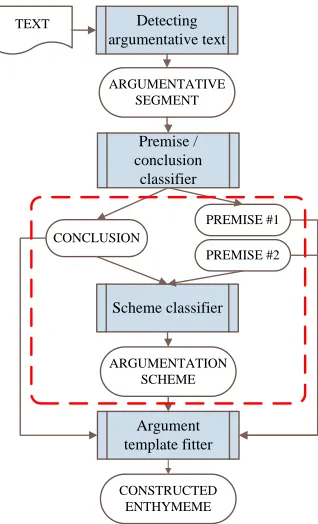
[image:4.612.106.265.59.321.2]CONSTRUCTED ENTHYMEME
Figure 1: Overall framework of this research.
overall framework: its input is the extracted con-clusion and premise(s) determined by an argument detector, followed by a premise/conclusion classi-fier, given an unknown text as the input to the entire system. And the portion below the dashed round-rectangle represents our long-term goal — to recon-struct the implicit premise(s) in an argument, given its argumentation scheme and its explicit conclusion and premise(s) as input. Since argument detection and classification are not the topic of this paper, we assume here that the input conclusion and premise(s) have already been retrieved, segmented, and classi-fied, as for example by the methods of Mochales and Moens (see Section 2 above). And the scheme tem-plate fitter is the topic of our on-going work.
4.2 Data preprocessing
From all arguments in Araucaria, we first ex-tract those annotated in accordance with Walton’s scheme-set. Then we break each complex AU node into several simple AUs where no conclusion or premise proposition nodes have embedded AU nodes. From these generated simple arguments, we extract those whose scheme falls into one of the five most frequent schemes as described in Table 1.
Fur-thermore, we remove all enthymemes that have been inserted by the annotator and ignore any argument with a missing conclusion, since the input to our pro-posed classifier, as depicted in Figure 1, cannot have any access to unstated argumentative propositions.
The resulting preprocessed dataset is composed of 393 arguments, of which 149, 106, 53, 44, and 41 respectively belong to the five schemes in the order shown in Table 1.
4.3 Feature selection
The features used in our work fall into two cat-egories: general features and scheme-specific fea-tures.
4.3.1 General features
General features are applicable to arguments belong-ing to any of the five schemes (shown in Table 2).
For the features conLoc, premLoc, gap, and
lenRat, we have two versions, differing in terms of their basic measurement unit: sentence-based and token-based. The final feature,type, indicates whether the premises contribute to the conclusion in a linked or convergent order. Alinked argument
(LA) is one that has two or more inter-dependent premise propositions, all of which are necessary to make the conclusion valid, whereas in a conver-gent argument (CA) exactly one premise proposi-tion is sufficient to do so. Since it is observed that there exists a strong correlation between type and the particular scheme employed while arguing, we believetypecan be a good indicator of argumenta-tion scheme. However, although this feature is avail-able to us because it is included in the Araucaria an-notations, its value cannot be obtained from raw text as easily as other features mentioned above; but it is possible that we will in the future be able to deter-mine it automatically by taking advantage of some scheme-independent cues such as the discourse re-lation between the conclusion and the premises.
4.3.2 Scheme-specific features
conLoc: the location (in token or sentence) of the conclusion in the text.
premLoc: the location (in token or sentence) of the first premise proposition.
conFirst: whether the conclusion appears before the first premise proposition.
gap: the interval (in token or sentence) between the conclusion and the first premise proposi-tion.
lenRat: the ratio of the length (in token or sen-tence) of the premise(s) to that of the conclu-sion.
numPrem: the number of explicit premise propo-sitions (PROP nodes) in the argument.
type: type of argumentation structure, i.e., linked or convergent.
Table 2: List of general features.
the features for any particular scheme are used only when it is the subject of a particular task. For ex-ample, when we classify argument from example
in a one-against-others setup, we use the scheme-specific features of that scheme for all arguments; when we classify argument from example against
argument from cause to effect, we use the scheme-specific features of those two schemes.
For the first three schemes (argument from ex-ample, argument from cause to effect, and practi-cal reasoning), the scheme-specific features are se-lected cue phrases or patterns that are believed to be indicative of each scheme. Since these cue phrases and patterns have differing qualities in terms of their precision and recall, we do not treat them all equally. For each cue phrase or pattern, we compute “confi-dence”, the degree of belief that the argument of in-terest belongs to a particular scheme, using the dis-tribution characteristics of the cue phrase or pattern in the corpus, as described below.
For each argumentA, a vectorCV ={c1,c2,c3}
is added to its feature set, where each ci indicates the “confidence” of the existence of the specific fea-tures associated with each of the first three schemes,
schemei. This is defined in Equation 1:
ci = 1
N
mi
X
k=1
(P(schemei|cpk)·dik) (1)
Argument from example
8 keywords and phrases including for example,
such as,for instance, etc.; 3 punctuation cues: “:”, “;”, and “—”.
Argument from cause to effect
22 keywords and simple cue phrases including re-sult, related to, lead to, etc.; 10 causal and non-causal relation patterns extracted from WordNet (Girju, 2003).
Practical reasoning
28 keywords and phrases includingwant,aim, ob-jective, etc.; 4 modal verbs: should,could,must, andneed; 4 patterns including imperatives and in-finitives indicating the goal of the speaker.
Argument from consequences
The counts of positive and negative propositions in the conclusion and premises, calculated from theGeneral Inquirer2.
Argument from verbal classification
The maximal similarity between thecentral word
pairs extracted from the conclusion and the premise; the counts ofcopula,expletive, and neg-ative modifier dependency relations returned by the Stanford parser3 in the conclusion and the premise.
2http://www.wjh.harvard.edu/∼inquirer/
3http://nlp.stanford.edu/software/lex-parser.shtml
Table 3: List of scheme-specific features.
Here mi is the number of scheme-specific cue phrases designed forschemei;P(schemei|cpk) is the prior probability that the argument A actually be-longs to schemei, given that some particular cue phrase cpk is found in A; dik is a value indicat-ing whether cpk is found inA; and the normaliza-tion factor N is the number of scheme-specific cue phrase patterns designed for schemei with at least one support (at least one of the arguments belonging to schemei contains that cue phrase). There are two ways to calculatedik,Booleanandcount: inBoolean mode,dikis treated as 1 ifAmatchescpk; incount mode,dik equals to the number of timesAmatches
Forargument from consequences, since the arguer has an obvious preference for some particular con-sequence, sentiment orientation can be a good in-dicator for this scheme, which is quantified by the counts of positive and negative propositions in the conclusion and premise.
Forargument from verbal classification, there ex-ists a hypernymy-like relation between some pair of propositions (entities, concepts, or actions) located in the conclusion and the premise respectively. The existence of such a relation is quantified by the max-imal Jiang-Conrath Similarity (Jiang and Conrath, 1997) between the “central word” pairs extracted from the conclusion and the premise. We parse each sentence of the argument with the Stanford depen-dency parser, and a word or phrase is considered to be a central word if it is the dependent or governor of several particular dependency relations, which basi-cally represents the attribute or the action of an en-tity in a sentence, or the enen-tity itself. For example, if a word or phrase is the dependent of the depen-dency relationagent, it is therefore considered as a “central word”. In addition, an arguer tends to use several particular syntactic structures (copula, exple-tive, andnegative modifier) when using this scheme, which can be quantified by the counts of those spe-cial relations in the conclusion and the premise(s).
5 Experiments
5.1 Training
We experiment with two kinds of classification: one-against-others and pairwise. We build a pruned C4.5 decision tree (Quinlan, 1993) for each different classification setup, implemented by Weka Toolkit 3.65(Hall et al., 2009).
One-against-others classification A one-against-others classifier is constructed for each of the five most frequent schemes, using the general features and the scheme-specific features for the scheme of interest. For each classifier, there are two possi-ble outcomes: target schemeand other; 50% of the training dataset is arguments associated with tar-get scheme, while the rest is arguments of all the other schemes, which are treated as other. One-against-other classification thus tests the eff
ective-5http://cs.waikato.ac.nz/ml/weka
ness of each scheme’s specific features.
Pairwise classification A pairwise classifier is constructed for each of the ten possible pairings of the five schemes, using the general features and the scheme-specific features of the two schemes in the pair. For each of the ten classifiers, the train-ing dataset is divided equally into arguments be-longing to scheme1 and arguments belonging to
scheme2, where scheme1 and scheme2 are two
dif-ferent schemes among the five. Only features asso-ciated withscheme1andscheme2are used.
5.2 Evaluation
We experiment with different combinations of gen-eral features and scheme-specific features (discussed in Section 4.3). To evaluate each experiment, we use the average accuracy over 10 pools of randomly sampled data (each with baseline at 50%6) with 10-fold cross-validation.
6 Results
We first present the best average accuracy (BAA) of each classification setup. Then we demonstrate the impact of the featuretype(convergent or linked ar-gument) on BAAs for different classification setups, since we believe type is strongly correlated with the particular argumentation scheme and its value is the only one directly retrieved from the annotations of the training corpus. For more details, see Feng (2010).
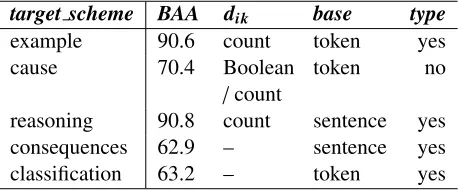
6.1 BAAs of each classification setup
target scheme BAA dik base type
example 90.6 count token yes cause 70.4 Boolean
/count
token no
[image:6.612.311.540.515.610.2]reasoning 90.8 count sentence yes consequences 62.9 – sentence yes classification 63.2 – token yes
Table 4: Best average accuracies (BAAs) (%) of one-against-others classification.
6We also experiment with using general features only, but
example cause reason-ing
conse-quences
cause 80.6
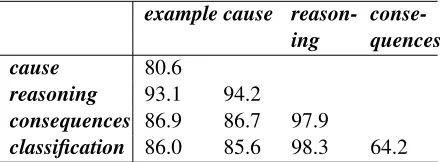
reasoning 93.1 94.2
consequences 86.9 86.7 97.9
[image:7.612.76.296.61.142.2]classification 86.0 85.6 98.3 64.2
Table 5: Best average accuracies (BAAs) (%) of pairwise classification.
Table 4 presents the best average accuracies of one-against-others classification for each of the five schemes. The subsequent three columns list the particular strategies of features incorporation under which those BAAs are achieved (the complete set of possible choices is given in Section 4.3.):
• dik: Booleanor count— the strategy of
com-bining scheme-specific cue phrases or patterns using eitherBooleanorcountfordik.
• base: sentenceortoken— the basic unit of ap-plying location- or length-related general fea-tures.
• type: yesorno— whethertype(convergent or linked argument) is incorporated into the fea-ture set.
As Table 4 shows, one-against-others classifica-tion achieves high accuracy for argument from ex-ampleand practical reasoning: 90.6% and 90.8%. The BAA of argument from cause to effect is only just over 70%. However, with the last two schemes (argument from consequences and argument from verbal classification), accuracy is only in the low 60s; there is little improvement of our system over the majority baseline of 50%. This is probably due at least partly to the fact that these schemes do not have such obvious cue phrases or patterns as the other three schemes which therefore may require more world knowledge encoded, and also because the available training data for each is relatively small (44 and 41 instances, respectively). The BAA for each scheme is achieved with inconsistent choices of base anddik, but the accuracies that resulted from different choices vary only by very little.
Table 5 shows that our system is able to correctly differentiate between most of the different scheme pairs, with accuracies as high as 98%. It has poor
performance (64.0%) only for the pair argument from consequencesandargument from verbal clas-sification; perhaps not coincidentally, these are the two schemes for which performance was poorest in the one-against-others task.
6.2 Impact of type on classification accuracy
As we can see from Table 6, for one-against-others classifications, incorporating type into the feature vectors improves classification accuracy in most cases: the only exception is that the best average ac-curacy of one-against-others classification between
argument from cause to effectandothersis obtained without involving type into the feature vector — but the difference is negligible, i.e., 0.5 percent-age points with respect to the averpercent-age difference.
Typealso has a relatively small impact onargument from verbal classification(2.6 points), compared to its impact onargument from example(22.3 points),
practical reasoning(8.1 points), andargument from consequences(7.5 points), in terms of the maximal differences.
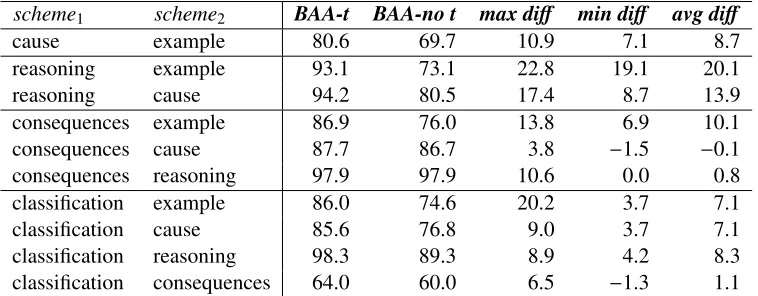
Similarly, for pairwise classifications, as shown in Table 7,typehas significant impact on BAAs, es-pecially on the pairs of practical reasoning versus
argument from cause to effect (17.4 points), prac-tical reasoningversusargument from example(22.6 points), andargument from verbal classification ver-sus argument from example (20.2 points), in terms of the maximal differences; but it has a relatively small impact on argument from consequences ver-sus argument from cause to effect (0.8 point), and
argument from verbal classificationversusargument from consequences(1.1 points), in terms of average differences.
7 Future Work
In future work, we will look at automatically clas-sifyingtype(i.e., whether an argument is linked or convergent), as typeis the only feature directly re-trieved from annotations in the training corpus that has a strong impact on improving classification ac-curacies.
target scheme BAA-t BAA-no t max diff min diff avg diff
example 90.6 71.6 22.3 10.6 14.7
cause 70.4 70.9 −0.5 −0.6 −0.5
reasoning 90.8 83.2 8.1 7.5 7.7
consequences 62.9 61.9 7.5 −0.6 4.2
[image:8.612.124.485.61.143.2]classification 63.2 60.7 2.6 0.4 2.0
Table 6: Accuracy (%) with and withouttypein one-against-others classification.BAA-tis best average accuracy with
type, andBAA-no tis best average accuracy withouttype.max diff,min diff, andavg diff are maximal, minimal, and average differences between each experimental setup withtypeand withouttypewhile the remaining conditions are the same.
scheme1 scheme2 BAA-t BAA-no t max diff min diff avg diff
cause example 80.6 69.7 10.9 7.1 8.7
reasoning example 93.1 73.1 22.8 19.1 20.1
reasoning cause 94.2 80.5 17.4 8.7 13.9
consequences example 86.9 76.0 13.8 6.9 10.1
consequences cause 87.7 86.7 3.8 −1.5 −0.1
consequences reasoning 97.9 97.9 10.6 0.0 0.8
classification example 86.0 74.6 20.2 3.7 7.1
classification cause 85.6 76.8 9.0 3.7 7.1
classification reasoning 98.3 89.3 8.9 4.2 8.3 classification consequences 64.0 60.0 6.5 −1.3 1.1
Table 7: Accuracy (%) with and withouttypein pairwise classification. Column headings have the same meanings as in Table 6.
personal opinions or judgments. So for this task, we will initially focus on arguments that are (or at least seem to be) empirical or objective rather than value-based. It will also be non-trivial to deter-mine whether an argument is convergent or linked — whether the premises are independent of one an-other or not. Cue words and discourse relations be-tween the premises and the conclusion will be one helpful factor; for example, besidesgenerally flags an independent premise. And one premise may be regarded as linked to another if either would become an enthymeme if deleted; but determining this in the general case, without circularity, will be difficult.
We will also work on the argument template fitter, which is the final component in our overall frame-work. The task of the argument template fitter is to map each explicitly stated conclusion and premise into the corresponding position in its scheme tem-plate and to extract the information necessary for en-thymeme reconstruction. Here we propose a syntax-based approach for this stage, which is similar to
tasks in information retrieval. This can be best ex-plained by the argument in Example 1, which uses the particular argumentation scheme practical rea-soning.
We want to fit thePremiseand theConclusionof this argument into theMajor premise and the Con-clusionslots of the definition ofpractical reasoning
(see Table 1), and construct the following conceptual mapping relations:
1. Survival of the entire world−→a goalG
2. Adhering to the treaties and covenants aiming for a world free of nuclear arsenals and other conventional and biological weapons of mass destruction−→actionA
Thereby we will be able to reconstruct the missing
[image:8.612.115.494.211.359.2]weapons of mass destructionis a means of real-izingsurvival of the entire world.
8 Conclusion
The argumentation scheme classification system that we have presented in this paper introduces a new task in research on argumentation. To the best of our knowledge, this is the first attempt to classify argumentation schemes.
In our experiments, we have focused on the five most frequently used schemes in Walton’s scheme-set, and conducted two kinds of classification: in one-against-others classification, we achieved over 90% best average accuracies for two schemes, with other three schemes in the 60s to 70s; and in pair-wise classification, we obtained 80% to 90% best average accuracies for most scheme pairs. The poor performance of our classification system on other experimental setups is partly due to the lack of train-ing examples or to insufficient world knowledge.
Completion of our scheme classification system will be a step towards our ultimate goal of recon-structing the enthymemes in an argument by the pro-cedure depicted in Figure 1. Because of the signifi-cance of enthymemes in reasoning and arguing, this is crucial to the goal of understanding arguments. But given the still-premature state of research of ar-gumentation in computational linguistics, there are many practical issues to deal with first, such as the construction of richer training corpora and improve-ment of the performance of each step in the proce-dure.
Acknowledgments
This work was financially supported by the Natu-ral Sciences and Engineering Research Council of Canada and by the University of Toronto. We are grateful to Suzanne Stevenson for helpful comments and suggestions.
References
Robin Cohen. 1987. Analyzing the structure of ar-gumentative discourse. Computational Linguistics, 13(1–2):11–24.
Judith Dick. 1987. Conceptual retrieval and case law. InProceedings, First International Conference on
Ar-tificial Intelligence and Law, pages 106–115, Boston, May.
Judith Dick. 1991a. A Conceptual, Case-relation Repre-sentation of Text for Intelligent Retrieval. Ph.D. thesis, Faculty of Library and Information Science, Univer-sity of Toronto, April.
Judith Dick. 1991b. Representation of legal text for con-ceptual retrieval. InProceedings, Third International Conference on Artificial Intelligence and Law, pages 244–252, Oxford, June.
Vanessa Wei Feng. 2010. Classifying argu-ments by scheme. Technical report, Depart-ment of Computer Science, University of Toronto, November. http://ftp.cs.toronto.edu/pub/ gh/Feng-MSc-2010.pdf.
Sarah George, Ingrid Zukerman, and Michael Niemann. 2007. Inferences, suppositions and explanatory exten-sions in argument interpretation. User Modeling and User-Adapted Interaction, 17(5):439–474.
Roxana Girju. 2003. Automatic detection of causal re-lations for question answering. InProceedings of the ACL 2003 Workshop on Multilingual Summarization and Question Answering, pages 76–83, Morristown, NJ, USA. Association for Computational Linguistics. Mark Hall, Eibe Frank, Geoffrey Holmes, Bernhard
Pfahringer, Peter Reutemann, and Ian H. Witten. 2009. The WEKA data mining software: an update.
SIGKDD Explorations Newsletter, 11(1):10–18. Jay J. Jiang and David W. Conrath. 1997. Semantic
similarity based on corpus statistics and lexical taxon-omy. InInternational Conference Research on Com-putational Linguistics (ROCLING X), pages 19–33. Joel Katzav and Chris Reed. 2004. On argumentation
schemes and the natural classification of arguments.
Argumentation, 18(2):239–259.
Raquel Mochales and Marie-Francine Moens. 2008. Study on the structure of argumentation in case law. In
Proceedings of the 2008 Conference on Legal Knowl-edge and Information Systems, pages 11–20, Amster-dam, The Netherlands. IOS Press.
Raquel Mochales and Marie-Francine Moens. 2009a. Argumentation mining: the detection, classification and structure of arguments in text. InICAIL ’09: Pro-ceedings of the 12th International Conference on Arti-ficial Intelligence and Law, pages 98–107, New York, NY, USA. ACM.
Raquel Mochales and Marie-Francine Moens. 2009b. Automatic argumentation detection and its role in law and the semantic web. In Proceedings of the 2009 Conference on Law, Ontologies and the Semantic Web, pages 115–129, Amsterdam, The Netherlands. IOS Press.
of arguments in legal texts. InICAIL ’07: Proceed-ings of the 11th International Conference on Artificial Intelligence and Law, pages 225–230, New York, NY, USA. ACM.
John L. Pollock. 1995. Cognitive Carpentry: A Blueprint for How to Build a Person. Bradford Books. The MIT Press, May.
J. Ross Quinlan. 1993. C4.5: Programs for machine learning.Machine Learning, 16(3):235–240.
Chris Reed and Glenn Rowe. 2004. Araucaria: Software for argument analysis, diagramming and representa-tion. International Journal of Artificial Intelligence Tools, 14:961–980.
Glenn Rowe and Chris Reed. 2008. Argument diagram-ming: The Araucaria project. InKnowledge Cartog-raphy, pages 163–181. Springer London.
Frans H. van Eemeren and Rob Grootendorst. 1992.
Argumentation, Communication, and Fallacies: A Pragma-Dialectical Perspective. Routledge.
Douglas Walton and Chris Reed. 2002. Argumenta-tion schemes and defeasible inferences. InWorkshop on Computational Models of Natural Argument, 15th European Conference on Artificial Intelligence, pages 11–20, Amsterdam, The Netherlands. IOS Press. Douglas Walton, Chris Reed, and Fabrizio Macagno.