Statistical Input Method
based on a Phrase Class
n
-gram Model
Hirokuni M aeta
1Shinsuke M ori
1(1) Graduate School of Informatics, Kyoto University, Yoshida Honmachi, Sakyo-ku, Kyoto, Japan
[email protected], [email protected]
A
BSTRACTWe propose a method to construct a phrase classn-gram model for Kana-Kanji Conversion by combining phrase and class methods. We use a word-pronunciation pair as the basic prediction unit of the language model. We compared the conversion accuracy and model size of a phrase class bi-gram model constructed by our method to a tri-gram model. The conversion accuracy was measured by F measure and model size was measured by the vocabulary size and the number of non-zero frequency entries. The F measure of our phrase class bi-gram model was 90.41%, while that of a word-pronunciation pair tri-gram model was 90.21%. In addition, the vocabulary size and the number of non-zero frequency entries in the phrase class bi-gram model were 5,550 and 206,978 respectively, while those of the tri-gram model were 22,801 and 645,996 respectively. Thus our method makes a smaller, more accurate language model.
1 Introduction
Japanese input methods are an essential technology for Japanese computing. Japanese has over 6,000 characters, which is much larger than the number of keys in a keyboard. It is impossible to map each Japanese character to a key. So an alternate input method for Japanese characters is needed. This is done by inputting a pronunciation sequence and converting it to an output sequence of words. Here, the input sequence of pronunciation is a sequence ofkanacharacters and the output sequence of words is a mixture ofkanaandkanjicharacters. So this conversion is calledKana-Kanji Conversion(KKC).
The noisy channel model approach has been successfully applied to input methods (Chen and Lee, 2000; Mori et al., 1999). In KKC, a word sequence is predicted from a pronunciation sequence. The system is composed of two modules: a language model, which measures the likelihood of a word sequence in the language and a word-pronunciation model, which describes a relationship between a word sequence and a pronunciation sequence. Thus, the conversion accuracy of KKC depends on the language model and the word-pronunciation model. The language model is, however, more important since it describes the context and it is larger in size than the word-pronunciation model.
We focus on how to improve the language model for KKC. Ann-gram model is generally used for many tasks. In KKC, considering the need for the conversion speed and the size of the language model, bi-gram models are often used. However, bi-gram models can not refer to a long history. A tri-gram model, which is also popular for many tasks, can refer a longer history but the size of tri-gram models is larger than that of bi-gram models. There have been many attempts at improving language models. A classn-gram model (Brown et al., 1992; Kneser and Ney, 1993; Mori et al., 1998), which groups words of similar behavior into a single class, and a phrasen-gram model (Deligne and Bimbot, 1995; Ries et al., 1996; Mori et al., 1997) which replaces some word sequences by single tokens, are known to be practical in speech recognition community.
In this paper, we propose a method to construct a smaller, more accurate language model for KKC. It is often thought that accurate models are larger and that small models are less accurate. However, we successfully built a smaller, more accurate language model. This is done by combining phrase and class methods. First, we collect phrases and construct a phrase sequence corpus. By changing the prediction unit from a word to a word sequence, the model can use a longer history. Then we perform word clustering to restrict the growth of the model size. As a result, we obtain a phrase classn-gram model. This model is small and expected to be accurate because it uses a history as long as those used by higher ordern-gram models.
2 Statistical Input Method
In this section we give a brief explanation of a statistical input method and a word-pronunciation pairn-gram model, which is applied as the language model to KKC in the subsequent sections.
2.1 Input Method based on a Word
n
-gram Model
We explain a statistical approach to an input method based on the noisy channel model (Chen and Lee, 2000; Mori et al., 1999). This approach uses a word as the prediction unit of a language model.
Letx=x1x2· · ·xlbe a pronunciation sequence andw=w1w2· · ·wmbe a word sequence.
Givenxas input, the goal of the input method is to outputwˆthat maximizes the probability
p(w|x)as follows:
ˆ
w=argmax
w p(w|x). By Bayes’ theorem,
p(w|x) =p(x|pw)p(w) (x) .
Sincep(x)is independent ofw, we have
ˆ
w = argmax w p(w|x)
= argmax
w
p(x|w)p(w)
p(x) = argmax
w p(x|w)p(w).
Here, the problem is divided into two parts.p(w)is a language model and we callp(x|w)a word-pronunciation model.
A language modelp(w)outputs the probability of a word sequencew. First the probability
p(w)is assumed to be expressed as a product of a set of conditional probabilities
p(w) = p(w1w2· · ·wm)
=
m Y
i=1
p(wi|w1w2· · ·wi−1). (1)
Thenp(wi|w1· · ·wi−1)is approximated ask-order Markov process p(wi|w1w2· · ·wi−1)≈p(wi|wi−kwi−k+1· · ·wi−1),
wherek=n−1.
The other part, the word-pronunciation modelp(x|w), outputs the probability of the pronunci-ation sequencexgiven the word sequencew. This probability is assumed to be decomposed as follows:
p(x|w) =
m Y
i=1 p(xi|wi),
詰め/tsu-me 将棋/sho-u-gi の/no 本/ho-n を/wo
買/ka っ/ttsu て/te き/ki ま/ma し/shi た/ta 。/.
Figure 1: An example of a word-pronunciation pair sentence.
2.2 A Word-pronunciation Pair
n
-gram Model
In this paper we use a word-pronunciation pairn-gram model. A word-pronunciation pair
n-gram model takes a pair of a word and its pronunciation as the prediction unit. Thus we can model a word and its pronunciation at the same time. This is because some Japanese kanji characters have the same pronunciation. So it is expected to be better to predict both a word and its pronunciation than predicting a word only.
Figure 1 shows an example of a corpus for training a word-pronunciation pairn-gram model. Units are separated with a white space. The left hand side of the slash in a unit is a word and right hand side is its pronunciation.
First we change the mathematics of the input method.
ˆ
w = argmax w p(w|x)
= argmax w
p(w,x)
p(x) = argmax
w p(w,x). (2)
Here, the problem isp(w,x)only. Then we expressp(w,x)by a word-pronunciation pair
n-gram model as follows:
p(w,x) =p(〈w1,x1〉〈w2,x2〉 · · · 〈wm,xm〉),
where〈wi,xi〉denotes a pair of a wordwiand its pronunciationxi. The character subsequences x1,x2, . . . ,xmsatisfy that
x=x1x2· · ·xm. (3)
A word-pronunciation pairn-gram model outputs the probability of a word-pronunciation pair sequence〈w1,x1〉〈w2,x2〉 · · · 〈wm,xm〉. Like wordn-gram models, this probability is expressed
as a product of a set of conditional probabilities and approximated ask-order Markov process, wherek=n−1
p(〈w1,x1〉〈w2,x2〉 · · · 〈wm,xm〉)
=
m Y
i=1
p(〈wi,xi〉|〈w1,x1〉〈w2,x2〉 · · · 〈wi−1,xi−1〉), p(〈wi,xi〉|〈w1,x1〉〈w2,x2〉 · · · 〈wi−1,xi−1〉)
2.3 Parameter Estimation
The probabilityp(〈wi,xi〉|〈wi−k,xi−k〉〈wi−k+1,xi−k+1〉 · · · 〈wi−1,xi−1〉)is defined by maximum
likelihood from a training corpus
p(〈wi,xi〉|〈wi−k,xi−k〉〈wi−k+1,xi−k+1〉 · · · 〈wi−1,xi−1〉) de f.
= N(〈Nwi−k,xi−k〉〈wi−k+1,xi−k+1〉 · · · 〈wi−1,xi−1〉〈wi,xi〉) (〈wi−k,xi−k〉〈wi−k+1,xi−k+1〉 · · · 〈wi−1,xi−1〉)
,
whereN(〈w,x〉 · · ·)is the number of times that the word-pronunciation pair sequence occurs in the corpus. The word segmentation and pronunciation tagging of the training corpus should be accurate.
2.4 Interpolation
There are data-sparseness problems such that a zero-probability problem. In order to avoid these problems, we use a linear interpolation (Brown et al., 1992).
p0(〈w
i,xi〉|〈wi−k,xi−k〉〈wi−k+1,xi−k+1〉 · · · 〈wi−1,xi−1〉)
=
k X
j=0
λjp(〈wi,xi〉|〈wi−j,xi−j〉〈wi−j+1,xi−j+1〉 · · · 〈wi−1,xi−1〉),
where 0≤λj≤1,Pkj=0λj=1.
2.5 Unknown Word Model
The probabilityp(w,x)in Equation (2) equals to 0 if the input character sequence xcan not be expressed as a sequence of characters in the vocabulary. In other words, in this case, the system can not find〈w1,x1〉〈w2,x2〉 · · · 〈wm,xm〉that satisfies Equation (3). So we need
a model that gives the probability larger than 0 for these character sequences. This model is called an unknown word model.
An unknown word modelp(x)outputs the probability of a character sequencexand it should
give a higher probability if the character sequence is likely a word not in a vocabulary of the language model.
As wordn-gram models are often used to predict a word sequence, charactern-gram models are often used to predict a character sequence of an unknown word. Sop(x)is easily trained from the words in a training corpus that are not in the vocabulary.
3 Language Model Improvement
3.1 Class
n
-gram Model
We use ann-gram model as the language model for KKC. Ann-gram model predicts thei-th word referring to the lastn−1 words. Although ann-gram model works well, the model size is often the serious problem.
One of the solutions to this problem is grouping similar words together. By assigning words to its class, we can obtain the language model of less states. Letf be a function that maps a wordwinto its classc. Given the mapf, aclass n-gram modelpredicts thei-th class referring to the lastk=n−1 classes and thei-th word referring to thei-th class. Therefore we define
p(wi|wi−kwi−k+1· · ·wi−1)in Equation (1) as follows: p(wi|wi−kwi−k+1· · ·wi−1)
de f.
= p(ci|ci−kci−k+1· · ·ci−1)p(wi|ci),
wherec∗=f(w∗). With the mapf,p(ci|ci−kci−k+1· · ·ci−1)andp(wi|ci)are defined by
maxi-mum likelihood from a training corpus.
p(ci|ci−kci−k+1· · ·ci−1)de f.=
N(ci−kci−k+1· · ·ci−1ci) N(ci−kci−k+1· · ·ci−1)
p(wi|ci)de f.= NN(wi) (ci),
whereN(c· · ·)is the number of times that the class sequence occurs in the corpus.
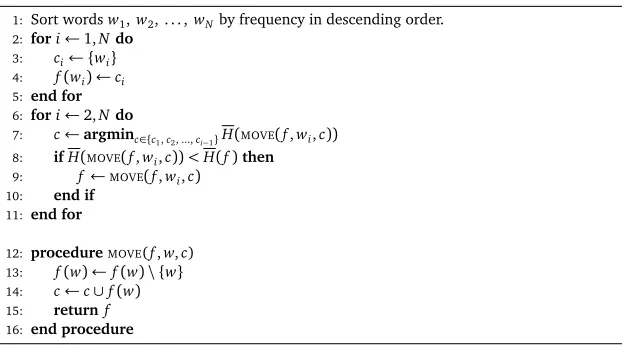
The problem is how to determine the mapf. In other words, how to doword clustering. Of course it should be done carefully, or the language model would get worse.
There are some methods for word clustering. Here we follow (Mori et al., 1998)’s clustering method, where the criterion is the average cross-entropy of sub corpora. Because of this criterion, this method is expected not to increase the cross-entropy of language models. In the method, first the training corpus is split intoksub corporaC1, C2, . . . , Ck. Then
{C1,C2, . . . ,Ck} \ {Ci}is used to estimate the model parameters andCiis used to evaluate the
objective function fori=1, 2,· · ·,k. The objective function is the average cross-entropy
H(f)de f.= 1k
k X
i=1
H(Mi(f),Ci),
whereMi(f)is a classn-gram model constructed fromf, which maps a word into its class, and
sub corpora{C1,C2, . . . ,Ck} \ {Ci}. ThusH(Mi(f),Ci)is the cross-entropy of the corpusCiby
the modelMi(f)andH(f)is their average. The lowerH(f)is, the betterf is expected to be.
This is just like evaluating a language model.
Therefore the best mapfˆis the one that minimizesH(f). Namely,
ˆ
f =argmin f H(f).
1: Sort wordsw1,w2, . . . ,wNby frequency in descending order. 2: fori←1,Ndo
3: ci← {wi} 4: f(wi)←ci 5: end for 6: fori←2,Ndo
7: c←argminc∈{c1,c2, ...,ci−1}H(MOVE(f,wi,c))
8: ifH(MOVE(f,wi,c))<H(f)then 9: f ←MOVE(f,wi,c)
10: end if 11: end for
12: procedureMOVE(f,w,c) 13: f(w)←f(w)\ {w}
14: c←c∪f(w)
[image:7.420.62.373.70.244.2]15: returnf 16: end procedure
Figure 2: Clustering algorithm
3.2 Phrase
n
-gram Model
Here we explain the other language model improvement. We saw two kinds ofn-gram models so far: a wordn-gram model and a classn-gram model. Both models predict the next word referring to the lastn−1 words. In other words, each of the prediction units of the models is a word. Actually, language models whose prediction unit is a word does not always have the best performance. Aphrase n-gram model, whose prediction unit is a word sequence, can treat a word sequence that co-occurs frequently as a single word. Thus we can expect that it improves
n-gram models.
The mathematics of a phrasen-gram model is the same as that of a wordn-gram model except for the prediction unit because of the definition of the phrase model.
Letw=w1w2· · ·wmbe the input sequence of words. In a phrasen-gram model, the word
sequencewis converted to the phrase sequenceγ=γ1γ2· · ·γm0and the phrase sequenceγis predicted,
p(w)de f.= p(γ).
A phraseγi is a token that represents a word sequence. Soγbecomesw if each phrase is replaced by its words.
Thenp(γ)is calculated like wordn-gram models,
p(γ) = p(γ1γ2· · ·γm0)
=
m0 Y
i=1
p(γi|γ1· · ·γi−1),
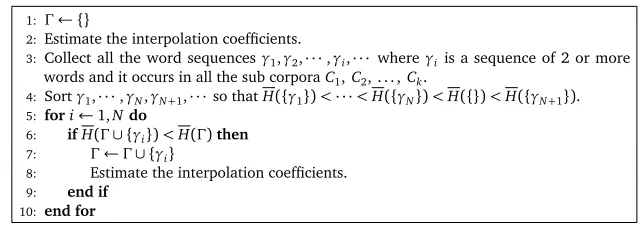
1: Γ← {}
2: Estimate the interpolation coefficients.
3: Collect all the word sequencesγ1,γ2,· · ·,γi,· · · whereγi is a sequence of 2 or more
words and it occurs in all the sub corporaC1,C2, . . . ,Ck.
4: Sortγ1,· · ·,γN,γN+1,· · ·so thatH({γ1})<· · ·<H({γN})<H({})<H({γN+1}). 5: fori←1,Ndo
6: ifH(Γ∪ {γi})<H(Γ)then 7: Γ←Γ∪ {γi}
8: Estimate the interpolation coefficients. 9: end if
[image:8.420.41.361.70.185.2]10: end for
Figure 3: Algorithm for finding phrases
wherek=n−1. p(γi|γi−kγi−k+1· · ·γi−1)is defined by maximum likelihood from a training
corpus
p(γi|γi−kγi−k+1· · ·γi−1) de f.
= NN(γi−kγi−k+1· · ·γi−1γi) (γi−kγi−k+1· · ·γi−1) ,
whereN(γ· · ·)is the number of times that the phrase sequence occurs in the corpus. Phrasen-gram models require a phrase sequence corpus that can be obtained by collecting sequences of words for phrases and replacing each of those sequences in the original corpus by a single token. Sequences of words should be collected so that, by treating each of them as a single token, a phrasen-gram model has less cross-entropy.
Here we follow (Mori et al., 1997), where sequences of words are collected so that the average cross-entropy of sub corpora becomes less by the replacement of those sequences by tokens. This method find a sequence of greater than or equal to two words and it is expected to decrease the cross-entropy of language models because of the criterion.
The method of finding phrases is similar to that of word clustering. Here the training corpus is split intoksub corporaC1,C2, . . . ,Ck.{C1,C2, . . . ,Ck} \ {Ci}is used to estimate the model
parameters andCiis used to evaluate the objective function fori=1, 2,· · ·,k. The objective
function is the average cross-entropy
H(Γ)de f.= 1k
k X
i=1
H(Mi(Γ),Ci),
whereMi(Γ)is a phrasen-gram model constructed from a set of word sequences for phrasesΓ
and sub corpora{C1,C2, . . . ,Ck} \ {Ci}. ThusH(Mi(Γ),Ci)is the cross-entropy of the corpus Ciby the modelMi(Γ)andH(Γ)is their average. The lowerH(Γ)is, the betterΓis expected to
be.
Therefore the best set of word sequencesˆΓis the one that minimizesH(Γ). Namely,
ˆΓ =argmin Γ
H(Γ).
1: For the given training corpus, find the optimal set of word sequencesˆΓusing the algorithm in Figure 3.
2: Build the phrase sequence corpus from ˆΓacquired in step 1 by replacing the word
sequence with its phrase.
[image:9.420.136.298.448.511.2]3: For this phrase sequence corpus, find the optimal mapfˆusing the algorithm in Figure 2. Figure 4: Combining the phrase and class methods.
4 Statistical Input Method based on a Phrase Class
n
-gram Model
In this section, we propose a method of combining the two language model improvements in the section 3 and construct aphrase class n-gram modelso that we can realize the compact but accurate system. In addition, we also explain how to integrate the phrase classn-gram model into the statistical input method.4.1 Combining the Phrase and Class Methods
A phrase model has less cross-entropy than a word model (Mori et al., 1997). Phrase modeling makes a more accurate language model. However the vocabulary size of phrase models is larger than that of word models, because some word sequences for phrases are added to the vocabulary of the phrase models. As a result, phrase models are often larger than word models. This problem is solved by the method of class modeling. A class model is smaller than a word model (Brown et al., 1992; Kneser and Ney, 1993; Mori et al., 1998). A vocabulary size of a phrase model can be decreased by clustering the words and phrases in the vocabulary using the algorithm in Figure 2. Figure 4 shows our procedure of combining the two methods. As shown in this procedure, the clustering algorithm is applied to the phrase sequence corpus used for a phrase model.
4.2 Phrase Class
n
-gram Model
We can construct a phrase classn-gram model using a phrase sequence corpus and a functionf
that maps a phrase into its class. Because the phrase classn-gram model is made by combining the phrase and class methods, the mathematics of the phrase classn-gram model is also the combination of the mathematics of the two models.
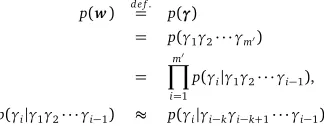
Letw=w1w2· · ·wmbe an input sequence of words andf be a function that maps a phrase γinto its classc. In a phrase class model, like phrase models,wis converted to the phrase
sequenceγ=γ1γ2· · ·γm0, which is corresponding tow, and the phrase sequenceγis predicted. p(w) de f=. p(γ)
= p(γ1γ2· · ·γm0)
=
m0 Y
i=1
p(γi|γ1γ2· · ·γi−1), p(γi|γ1γ2· · ·γi−1) ≈ p(γi|γi−kγi−k+1· · ·γi−1).
lastk=n−1 classes and thei-th phrase referring to thei-th class.
p(γi|γi−kγi−k+1· · ·γi−1)de f=.p(ci|ci−kci−k+1· · ·ci−1)p(γi|ci), (4)
wherec∗=f(γ∗).p(ci|ci−kci−k+1· · ·ci−1)andp(γi|ci)are defined by maximum likelihood from
a training corpus.
p(ci|ci−kci−k+1· · ·ci−1) de f.
= NN(ci−kci−k+1· · ·ci−1ci)
(ci−kci−k+1· · ·ci−1), (5) p(γi|ci)
de f.
= NN(γi)
(ci). (6)
The prediction unit of the phrase classn-gram model constructed here is a word. We can construct in the same way a phrase classn-gram model whose basic prediction unit is a word-pronunciation pair, and it can be applied to the input method in the section 2.2. In that case,γ∗
in this section represents a word-pronunciation pair sequence.
4.3 Input Method based on a Phrase Class
n
-gram Model
We integrate the phrase classn-gram model, where the basic prediction unit is a word-pronunciation pair, and the unknown word model described in the section 2.5.
Given a pronunciation sequencexas an input, the goal of the input method is to outputwˆ
that maximizes the likelihoodp(w,x) =p(〈w1,x1〉〈w2,x2〉 · · · 〈wm,xm〉), as we explained in
the section 2.2. We use a phrase classn-gram model whose basic prediction unit is a word-pronunciation pair to calculatep(〈w1,x1〉〈w2,x2〉 · · · 〈wm,xm〉). In the phrase classn-gram
model, first〈w1,x1〉〈w2,x2〉 · · · 〈wm,xm〉is converted to the phrase sequenceγ=γ1γ2· · ·γm0,
where the phraseγirepresents a word-pronunciation pair sequence, and thenp(γ)is calculated
as follows:
p(〈w1,x1〉〈w2,x2〉 · · · 〈wm,xm〉) de f.= p(γ)
= p(γ1γ2· · ·γm0)
=
m0 Y
i=1
p(γi|γ1γ2· · ·γi−1),
p(γi|γ1γ2· · ·γi−1) ≈ p(γi|γi−kγi−k+1· · ·γi−1).
Ifγiis in the vocabulary of the phrase classn-gram model, by Equations (4), (5) and (6) we
have
p(γi|γi−kγi−k+1· · ·γi−1) =
N(ci−kci−k+1· · ·ci−1ci) N(ci−kci−k+1· · ·ci−1)
N(γi)
N(ci).
Otherwise, we approximatep(γi|γi−kγi−k+1· · ·γi−1)using the unknown word modelp(x)in
the section 2.5 as follows:
p(γi|γi−kγi−k+1· · ·γi−1)≈p(x0i),
usage #sentences #words #chars training 53,424 1,258,805 1,813,135 test 6,350 137,642 201,477
Table 1: Corpora.
5 Experiments
In order to test the effectiveness of combining the phrase and class methods, we constructed phrase class bi-gram using our method and compared the conversion accuracy and the model size of our model to other language models. In this section we show the experimental results and discuss them.
5.1 Experimental Settings
We used the core corpus of the Balanced Corpus of Contemporary Written Japanese (BCCWJ) (Maekawa, 2008) for the experiments. The BCCWJ is composed of two corpora, the BCCWJ-CORE corpus and the BCCWJ-NON-BCCWJ-CORE corpus, and we used the BCCWJ-BCCWJ-CORE. A sentence of the BCCWJ-CORE corpus is a sequence of pairs of a word and its pronunciation as shown in Figure 1. The word segmentation and pronunciation tagging were done manually.
We split the BCCWJ-CORE into two parts: one is for training language models and the other is for the test of them. Table 1 shows the specifications of the corpora.
We constructed language models and a vocabulary from the training corpus of the BCCWJ. The vocabulary was constructed according to (Mori et al., 1998) and (Mori et al., 1997). The following is a list of language models we compared.
1. Word-pronunciation pair bi-gram model
2. Class bi-gram model (Prediction unit: Word-pronunciation pair)
3. Phrase bi-gram model
4. Phrase class bi-gram model (Prediction unit: Phrase)
5. Word-pronunciation pair tri-gram model
5.2 Criterions
One of the criterions we took in this paper is conversion accuracy. The conversion accuracy is measured by F measure, which is the harmonic mean of precisionPand recallR. LetNCW J
be the number of characters of a sentence in the BCCWJ for the test,NSY Sbe the number of
characters of a sentence that KKC outputs, andNLCSbe the number of characters of the longest
common subsequence. The precisionPis defined asNLCS/NSY Sand the recallRis defined as NLCS/NCW J. Hence F measure is1/P+12 /R.
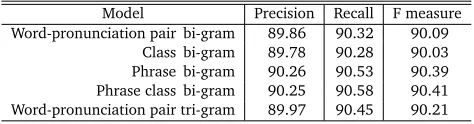
Model Precision Recall F measure Word-pronunciation pair bi-gram 89.86 90.32 90.09
[image:12.420.85.322.71.133.2]Class bi-gram 89.78 90.28 90.03 Phrase bi-gram 90.26 90.53 90.39 Phrase class bi-gram 90.25 90.58 90.41 Word-pronunciation pair tri-gram 89.97 90.45 90.21
Table 2: Conversion accuracy
Model Vocabulary size #non-zero frequency entries Word-pronunciation pair bi-gram 22,801 264,336
Class bi-gram 4,245 141,482
Phrase bi-gram 25,056 339,574
[image:12.420.64.348.159.219.2]Phrase class bi-gram 5,550 206,978 Word-pronunciation pair tri-gram 22,801 645,996
Table 3: Model size
5.3 Results
Table 2 shows the conversion accuracies of the bi-gram models and the tri-gram model. Comparing the conversion accuracies of the word-pronunciation pair bi-gram model and the phrase bi-gram model, it can be said that phrase modeling makes better language models. Class modeling does not have a significant effect on the conversion accuracy by comparing the conversion accuracies of the word-pronunciation pair bi-gram model and the class bi-gram model. The phrase class model, which was constructed by our method, has the best F measure. Table 3 shows the model sizes of the bi-gram models and the tri-gram model. The vocabulary size of the phrase bi-gram model is larger than that of the word-pronunciation pair bi-gram model. Generally, the vocabulary size of a phrase model is larger than that of a word model since the phrase model adds some phrases to its vocabulary. We see that word clustering or phrase clustering makes smaller language models. As the result of phrase clustering, the size of our phrase class bi-gram model is smaller than that of the word-pronunciation pair bi-gram model and the word-pronunciation pair tri-gram model.
5.4 Evaluation on Large Training Data
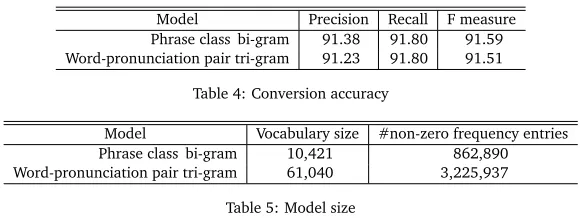
We performed another more practical experiment. In this experiment, we also constructed a phrase class bi-gram model and a word-pronunciation pair tri-gram model. We used the training corpus that has about 360,000 sentences mainly from BCCWJ-NON-CORE. The results are in table 4 and 5. We see that the phrase class bi-gram model is smaller and it has the comparable conversion accuracy as the word-pronunciation pair tri-gram model.
6 Conclusion
Model Precision Recall F measure Phrase class bi-gram 91.38 91.80 91.59 Word-pronunciation pair tri-gram 91.23 91.80 91.51
Table 4: Conversion accuracy
[image:13.420.70.362.124.172.2]Model Vocabulary size #non-zero frequency entries Phrase class bi-gram 10,421 862,890 Word-pronunciation pair tri-gram 61,040 3,225,937
Table 5: Model size
conversion accuracy than that of the word-pronunciation pair tri-gram model. Therefore our method of combining the improvements of phrase and class modeling makes a smaller, more accurate language model for KKC.
Acknowledgments
This work was partially supported by Microsoft CORE 8 Project.
References
Brown, P. F., Pietra, V. J. D., deSouza, P. V., Lai, J. C., and Mercer, R. L. (1992). Class-based
n-gram models of natural language.Computational Linguistics, 18(4):467–479.
Chen, Z. and Lee, K.-F. (2000). A new statistical approach to Chinese pinyin input. In
Proceedings of the 38th Annual Meeting of the Association for Computational Linguistics, pages 241–247.
Deligne, S. and Bimbot, F. (1995). Language modeling by variable length sequences: Theoreti-cal formulation and evaluation of multigrams. InProceedings of the International Conference on Acoustics, Speech, and Signal Processing, pages 169–172.
Kneser, R. and Ney, H. (1993). Improved clustering techniques for class-based statistical language modelling. InProceedings of the Third European Conference on Speech Communication and Technology, pages 973–976.
Maekawa, K. (2008). Balanced corpus of contemporary written Japanese. InProceedings of the 6th Workshop on Asian Language Resources, pages 101–102.
Mori, S., Masatoshi, T., Yamaji, O., and Nagao, M. (1999). Kana-kanji conversion by a stochastic model.Transactions of Information Processing Society of Japan, 40(7):2946–2953. (in Japanese).
Mori, S., Nishimura, M., and Itoh, N. (1998). Word clustering for a word bi-gram model. In
Proceedings of the Fifth International Conference on Speech and Language Processing. Mori, S., Yamaji, O., and Nagao, M. (1997). An improvement ofn-gram model by a change of the prediction unit. InIPSJ SIG Technical Reports, 97-SLP-19-14, pages 87–94. (In Japanese).
Ries, K., Buø, F. D., and Waibel, A. (1996). Class phrase models for language modeling. In