Munich Personal RePEc Archive
Portfolio Choice with
Information-Processing Limits
Batchuluun, Altantsetseg and Luo, Yulei and Young, Eric
National University of Mongolia, University of Hong Kong,
University of Virginia
2014
Online at
https://mpra.ub.uni-muenchen.de/58538/
Portfolio Choice with Information-Processing Limits
Altantsetseg Batchuluuny
National University of Mongolia
Yulei Luoz
University of Hong Kong
Eric R. Youngx
University of Virginia
September 13, 2014
Abstract
In this paper, we examine the joint consumption-portfolio decision of an agent with limited information-processing capacity (rational inattention or RI) in the sense of Sims (2003) within a non-linear-quadratic (non-LQ) setting. Our model predicts that, as processing capacity falls, agents choose to hold less of their savings in the form of risky assets on average; however, they still choose to hold substantial risky assets with some positive probability. Low capacity causes households to act as if they are more risk averse and more willing to substitute consumption intertemporally.
JELClassi…cation Numbers: D53, D81, G11.
Keywords: Rational Inattention, Optimal Consumption Saving, Portfolio Choice.
We thank helpful conversations with Ken Judd and Chris Sims, without implicating them in any errors.
Batchu-luun and Young acknowledge the …nancial support of the Bankard Fund for Political Economy. Luo thanks the
Hong Kong General Research Fund (GRF: #HKU749900) for …nancial support.
yDepartment of Economics, National University of Mongolia. E-mail:
zFaculty of Business and Economics, University of Hong Kong, Hong Kong. Email: [email protected]. xDepartment of Economics, University of Virginia, Charlottesville, VA 22904. E-mail:
1
Introduction
Standard models of portfolio choice typically make two predictions inconsistent with data – they
predict essentially a100percent participation rate and also a 100percent portfolio share of risky assets. Even casual observations using US data show these predictions are far o¤; as noted in
Guvenen (2009), the participation rate in equity markets is no greater than 50 percent (and historically has been quite a bit smaller), and as noted in Gabaix and Laibson (2002) the total
share of risky assets in total wealth is around22 percent.
One approach to this inconsistency is to introduce …xed costs of participation in equity markets
(see Gomes and Michaelides 2008 for an example and references). These models imply that poor households will typically avoid the equity market, while rich ones will enter (Krusell and Smith
1997 obtain a similar result without …xed costs). However, these models typically imply that an agent, once in the equity market, will still hold a portfolio almost entirely composed of risky assets.
We study this issue in a model with rational inattention (Sims 2003). The literature on ratio-nal inattention is now quite large, so we refrain from a lengthy citation list and only discuss the
papers that deal directly with the issue at hand (Luo 2010 and Luo and Young 2014).1 Luo (2010) solves a linear-quadratic-Gaussian portfolio problem with rational inattention and …nds that the
model can rationalize the low portfolio shares observed in the data, provided the constraint on information ‡ow is su¢ciently tight. When agents cannot learn immediately from signals, they
are exposed to “long run risk” and therefore demand more compensation to bear it – that is, they appear “more risk averse” than their preferences would indicate. The problem with Luo (2010)
is that the required information ‡ow limit is so tight that it may render the LQ approximation highly inaccurate (see Sims 2005, 2006).
Luo and Young (2014) address this problem by introducing recursive utility and parameterizing
preferences such that agents have a preference for early resolution of uncertainty. In the presence of long-run risk, households who dislike late resolution will demand even more compensation
1Other papers that study limited information and …nance include Gennotte (1986), Gabaix and Laibson (2001),
Peng and Xiong (2006), Huang and Liu (2007), Lundtofte (2008), Wang (2009), Mondria (2010), and van
for bearing it than expected utility households (who are indi¤erent to the timing of uncertainty
resolution); this e¤ect ampli…es the enhanced risk aversion and thus matching portfolio shares can be done at higher information ‡ow limits (roughly double those in Luo 2010). However, one would
still worry that the LQ-Gaussian approximation is inaccurate, and neither model can address the limited participation rate.
Our goal here is to study the portfolio problem with rational inattention in its full nonlinear generality. In general this problem is intractable, even numerically. First, the choice variable for
the agents is the joint distribution of states and controls, which is typically very high-dimensional. As shown in Matejka and Sims (2011) and Saint-Paul (2011), the optimal distribution is
typi-cally discrete and has “holes”, meaning it cannot be described or even approximated by a low-dimensional object; the LQ-Gaussian setup avoids the curse of low-dimensionality because the optimal
distribution is Gaussian (see Sha…eepoorfard and Raginsky 2013). To combat this problem one either solves a model with only one shock (Tutino 2012) or a very short horizon (Sims 2006,
Lewis 2009). Since background risk plays an important role in portfolio, the …rst approach is undesirable, so we adopt the second and study only a two-period portfolio problem.
Our main result is that the nonlinear RI model can replicate the two key facts, namely in-complete participation and low shares conditional on participation, provided the ‡ow constraint
is tight enough (unfortunately we cannot compare the ‡ow constraint to those in Luo 2010 and Luo and Young 2014, due to the short horizon). More interesting is that we obtain signi…cant
heterogeneity in portfolio holdings, despite all agents beingex ante identical. Since it is not opti-mal to choose a distribution that is degenerate unless information ‡ow is unconstrained, ex post
the agents can “receive” di¤erent portfolios from nature – the key is that the agents are willing to instruct nature to pick from a distribution that puts positive mass on three very di¤erence
portfolio weights (roughly 0, 30 percent, and 80 percent). Since most of the mass is on the 30 percent share, the average portfolio share is only 37 percent, a bit too large relative to the data
but de…nitely in the ballpark; the model does not replicate the observed 50percent participation rate, but we could introduce a …xed cost of participation to potentially resolve this inconsistency.
Our results are driven by two factors. First, rational inattention enhances risk aversion, as noted above. However, rational inattention also appears to enhance the willingness of households
future consumption is larger as information ‡ow capacity falls. The combination is precisely the
con…guration of preferences that the long-run risk literature (see Bansal and Yaron 2004) needs to generate realistic asset prices. Thus, our results indicate that rational inattention could be a
method for reconciling the high IES needed to match asset market facts with the apparent low estimate evident from consumption data.
This paper is organized as follows. Section 2 presents a full-information rational expecta-tions (FI-RE) two-period model with consumption and portfolio choice. Section 3 introduces
information-processing constraint into this otherwise standard model and discusses how to solve the model numerically. Section 4 presents the main results. Section 5 concludes.
2
A Standard FI-RE Two-Period Portfolio Choice Model
Our main interest in this paper lies with the portfolio problem under limited information-processing
capacity. However, it is convenient to draw distinctions between solutions with and without these limitations, so here we present a standard two-period portfolio problem; Samuelson (1969) and Merton (1969) provide complete analyses of this problem in the case of HARA-class utility
func-tions in continuous-time. Consider an agent with an iso-elastic utility functionu(c) = c11 , where 0 is the coe¢cient of relative risk aversion (CRRA). This agent faces stochastic current
incomee1 and stochastic future income e2with distributions of g1 e1 and g2 e2 , respectively. There are two tradable …nancial assets available to the household, one risky and one risk-free.
The return on the risk free asset is rf and the return on the risky asset over the period is re.
We consider the risky asset to be a market portfolio of equities with return distribution '(re).
Lettingr be the one period gross return to invested wealth, we obtain
r =sred+ (1 s)rf =s red rf +rf;
wheres is the proportion of wealth invested in the risky asset. In period 1, wealth w1 is simply
e1 as the initial wealth is assumed to be0 and saving (borrowing) ise1 c1. In period2, wealth consists of the return on savings and future income w1 c1 r+e2. Following Sims (2006), we assume that second period consumption is equal to wealth.2 For reasons we will elaborate on
2In the standard model this assumption is without loss of generality provided utility is increasing in consumption.
more completely later, we discretize both the state and control space.
The maximization problem for this agent can be written as:
max
fc(w1
i)g;fs(w1i)g I i=1 8 < : PI
i=1u c w1i g1 e1i + PI
i=1
PD d=1
PJ
j=1u e1i c w1i s wi1 red rf +rf +e2j '(red)g1 e1i g2 e2j 9 =
;:
In period 1, before income is realized the agent makes a contingent plan for consumption and savings that depends on the realization of e1. This speci…cation is equivalent to the usual timing in which the agent makes consumption-savings plan after the realization of e1, but it will turn out to be easier to formulate the rational inattention model with this timing. The plan for period 1then determines consumption in period 2 based on the realizations ofe2 and re.
We assume that agents can borrow and that consumption in each date and state must be nonnegative:
c w1i 0; (1)
e1i c w1i s wi1 rde rf +rf +e2j 0; (2)
for8i= 1; :::; I,8j= 1; :::; J, and8d= 1; :::; D. Since this problem has a continuous and concave objective function and a convex opportunity set, the following …rst-order conditions are necessary and su¢cient:
c1 w1i = D X d=1 J X j=1 n
e1i c wi1 hs w1i rde rf +rfi+e2jo hs wi1 rde rf +rfi'(red)g2 e2j ;
0 = D X d=1 J X j=1 0 @ n
e1i c1 wi1 s w1i red rf +rf +e2j o
e1i c1 wi1 rde rf '(red)g2 e2j
1
A;
for 8i = 1; :::; I. The …rst condition is the condition on optimal consumption over time: the discounted marginal utilities are equalized. The second condition is the condition for optimal
(additional) risk taking. We cannot get a closed-form solution to this problem except in special cases that are not of interest to us (e.g., quadratic or CARA utility). As shown in Merton (1969)
are uncertain about their exact wealth. Adding a consumption choice in the second period is computationally costly
and Samuelson (1969), one expects the following properties would hold: (i) optimal portfolio
choice s is decreasing in , (ii) second period consumption and s are higher when rf is low
relative to , and (iii) a mean-preserving spread in the risky asset return decreases s .
As in the literature, we can also use a log-linearization method to solve the FI-RE problem. However, because that method does not work when information-processing constraints are
im-posed, we solve this problem numerically. In the next section, we introduce these constraints and study the portfolio decisions of agents with rational inattention.
3
Introducing Information-Processing Constraints
We now assume agents have limited information processing capacity in the sense of Sims (2003). Agents choose the optimal joint probability distribution of consumption, portfolio allocation, and
wealth to maximize their expected lifetime utility. Hence the choice variables with respect to which we maximize is the joint probability distribution functionf( ) of consumptionc1 and the share of savings held in the risky assets with current incomee1. The objective function for the agent is
max
ff(sk;c1r;e1i)g 8 < : K X k=1 N X r=1 I X i=1 0
@u c1r +
D X d=1 J X j=1
u c2i;r;k;d;j '(rde)g2 e2j 1
Af sk; c1r; w1i
9 =
; (3)
where
c2i;r;k;d;j = wi1 c1r h
sk rde rf +rf i
+e2j
is second-period consumption.
As in the FI-RE case, we assume that agents can borrow and the consumption in each period must be nonnegative. Budget constraints in this model enforce the nonnegativity requirement;
they are satis…ed automatically if agents are saving (c1r < w1i for grid points r and i) but im-pose restrictions whenever agents are borrowing (c1
r > w1i). In the borrowing case the budget
constraints for period2 take the form
f sk; c1r; e1i = 0 if w1i c1r h
sk(red rf) +rf i
+e2j 0, (4)
for 8d = 1; :::; D, 8r = 1; :::; N, 8i = 1; :::; I, 8j = 1; :::; J, 8k = 1; :::K. The choice set is also restricted by the requirement that the probability density must be well-de…ned:
where k = 1; :::; K, r = 1; :::; N, and i = 1; :::; I. Since income is exogenous, the marginal probability ofw1 chosen by the household must be equal to the probability distribution function ofe1:
K X k=1 N X r=1
f sk; c1r; w1i =g1 e1i ; (6)
where i = 1; :::; I. The …nal constraint is the information processing constraint (IPC). To formulate the IPC we need to de…ne the mutual information between random variables. The mutual information between current consumption c1, the share of the risky asset s, and current incomee1, is de…ned as
I w1;c1; s =H w1 +H s; c1 H s; c1; w1 ;
whereI w1;c1; s measures the reduction in uncertainty aboutw1 made possible by observingc1 and s, and is always nonnegative. The assumption of limited information processing capacity requires mutual information not exceed …nite capacity; that is, I w1;c1; s . Therefore, the IPCis given by the nonlinear inequality
K X k=1 N X r=1 I X i=1
f sk; c1r; w1i log f sk; c1r; w1i
I X
i=1
g1 e1i log g1 e1i (7)
I X i=1 K X k=1 N X r=1
f c1r; sk; wi1 log q c1r; sk ;
where the marginal distribution of consumption in period1is q c1; s and de…ned by
I X
i=1
f sk; c1r; w1i =q c1r; sk ; (8)
wherer= 1; :::; N andk= 1; :::; K. (See Appendix 6.1 for the derivation of (7).) It is easy to see that this constraint always binds. The following proposition is straightforward.
Proposition 1 The objective function is continuous and concave and the constraint set is com-pact. Therefore,(3) has a solution.
The problem for the information-constrained household is to maximize (3) with respect to (4)-(7). (See Appendix 6.2 for the derivation of the …rst-order conditions.) For many points in
meaning that (3) is a highly-nonlinear problem; furthermore, even for relatively coarse
discretiza-tions the number of choice variables and constraints is very large. Linearization techniques are not applicable, so we solve the problem directly through a “brute force” method (albeit a highly
sophisticated one). Before proceeding to the numerical solutions we examine a special case: = 0. A second special case, =1, is equivalent to the standard FI-RE model solved in the previous
section. We note also that the Theorem of the Maximum and the Envelope Theorem apply to our model, so that we can state the following results.
Proposition 2 The policy function for (3) is continuous in 0.
Proposition 3 The value function for (3) is di¤erentiable in >0 and satis…es Dv( )>0.
3.1 Zero Information-Processing Capacity Case
We now consider the = 0 case. As noted above, I w1;s; c1 measures the reduction in uncer-tainty of w1after observing c1and s, and it is always nonnegative. In other words, knowledge about c1; s cannot increase uncertainty ofw1:
I w1;s; c1 =H w1 H w1jc1; s 0:
On the other hand, zero information processing capacity requires
I w1;s; c1 =H w1 H w1jc1; s 0:
Combining these two inequalities yields:
I w1;s; c1 =H w1 H w1jc1; s = 0;
which implies that zero information processing capacity requires that current wealth be indepen-dent of current consumption and the risky asset share:
f sk; c1r; wi1 =q sk; c1r g e1i :
Agents cannot condition the distribution of the current wealth on the realization of current
Proposition 4 When = 0, the distribution of w1 and the joint distribution of c1; s are
independent.
This case illustrates that households with low processing capacity will separate their actions
from their state, leading to a kind of “inertia” (see Tutino 2012 for a dynamic illustration of this inertial e¤ect); in a model with a longer horizon, household decisions will appear sticky as they
do not respond to changes in the state. Note that this collapse looks very much like increased risk aversion, wherein consumption does not vary much across states of the world. We will see
this e¤ect manifest itself at positive as well.3 Using the continuity of the solution we note that this case is the limit as !0.
3.2 Computation
Our computational method is similar to those used in Sims (2005) and Lewis (2006). As noted above, we discretize the state and outcome spaces and permit the agent to attach probabilities
to each of those outcomes, subject to the appropriate restrictions; the choice of probabilities is continuous. We assume that …rst period income has16 grid points with values ranging from0:01 to0:16 and second period income has 4grid points ranging from 0:02 to0:08. The risky return has 8 grid points ranging from 0:79 to 1:35. For simplicity we assume that both second period income and the risky return are uniform, and the distribution of …rst period incomes normal with mean0:085and standard deviation is0:023. We also assume no correlation between labor income and the risky return in the second period; aggregate data shows little correlation between stock
returns and wages at business cycle frequencies, so this assumption seems a natural benchmark.4 For the outcome space, current consumption has32grid points between[0:005;0:16]and the risky asset share has41 grid points between [0;1]. The risk-free rate isrf = 1:02, the expected excess
return is 0:05, and the standard deviation of the risky return is 19:6 percent; these values are
3Luo and Young (2014) stress a di¤erent manifestation of rational inattention as enhanced risk aversion when
agents have a preference for early resolution of uncertainty – since rational inattention delays the resolution of
consumption risk, it is unappealing to an agent who prefers to learn early rather than late.
4Heaton and Lucas (2000) study how the presence of background risks in‡uences portfolio allocations. They
…nd that labor income is the most important source of wealth and labor income risk is weakly positively correlated
with equity returns. Our results are quite similar when the correlation is close to but not exactly equal to zero;
consistent with the premium of US equities over T-bills. We set = 0:97 and consider several di¤erent values for .5
The resulting problem has a large number of choice variables and a large number of constraints,
many of which are equality constraints. To solve this problem, we use theAMPL programming en-vironment as a gateway to theKNITROsolver.6 We then upload our program to the NEOS Server
for Optimization, a publicly-available resource that implements the AMPL-KNITRO program (it greatly increases the size of the problem that we can consider as it uses idle supercomputer
re-sources).7 In total, our problem features14;226choice variables,1328linear equality constraints, and 1nonlinear inequality constraint.
4
Main Findings
In this section, we will …rst solve the FI-RE model numerically and then solve the model with
limited information processing capacity (IPC).
4.1 Standard FI-RE model
In a standard FI-RE model agents observe the realization of current wealth with certainty; since their objective functions are strictly concave, their decisions become deterministic functions of this
realization. For comparability reasons we solve the FI-RE models using same numerical approach that we apply to the limited information-processing settings.
Figure 1 shows the risky asset share over the grid of current period wealth. Agents choose to invest all their savings in the risky asset at the states with relatively high wealth and choose to
borrow at the risk-free rate at the states with relatively low wealth. The resulting decision rule is essentially discontinuous; a related but (slightly) less-extreme result can be found in Krusell and
Smith (1997) that is driven by the absence of insurance markets. The expected risky asset share is0:95 for the agent with = 0:5 and 0:97 for the agent with = 2.
5The value for guarantees that agents will save in some parts of the state space and borrow in others. The
value of plays no important role here.
6TheKNITROsolver is a commercial solver used for large nonlinear problems that combines automatic
di¤eren-tiation with sophisticated Newton-based iterations and active set methods to handle the constraints.
Table 1 presents expected (average) consumption in each period for both = 0:5and = 2. The di¤erence between …rst and second period consumption is smaller for the agent who is less risk averse ( = 0:5). Figure 2 shows optimal consumption on the grid points for current period wealth. First period consumption increases as current period wealth increases for both types of agent. However, = 0:5agent chooses slightly larger consumption at lower wealth than the = 2 agent and chooses slightly lower consumption mass at higher current wealth.
The more risk-averse agent is more concerned about the states with very low consumption
in the future, and therefore chooses to borrow in a smaller portion of the current wealth space and receives lower current consumption than the less risk-averse agent does. At the states with
borrowing, both types of agents choose to minimize borrowing costs by setting the risky asset share to be0, and both types of agents choose to invest all their savings in risky asset (to maximize
the return) at the states with savings. Hence, the choice of risky asset share is discrete with values of 0 and 1 depending on whether the saving is positive or negative. The overall probability of
borrowing is 0:03 for = 2 agent and 0:05 for = 0:5 agent, which is why the = 2 agent appears to hold a higher share of risky assets.
4.2 Joint Distribution of Current Wealth and Current Consumption
Note that as ! 1 the rational inattention model converges to the FI-RE model; we therefore expect that the benchmark model will accurately represent choices of households whose capacity
constraints are large. How much capacity is su¢cient is model-dependent. For the benchmark model, the exogenous distribution for the current income is centered on its mean0:085, with the entropy of this process beingH(e1) = PIi=1g1(ei) log(g1(ei)) = 2:074nats.8 From the de…nition
of mutual information we know that the knowledge of current consumption and share of risky asset can decrease the uncertainty about current wealth at most by this amount. Hence for
2:074nats the model gives nearly identical results as the model with unlimited information processing capacity.
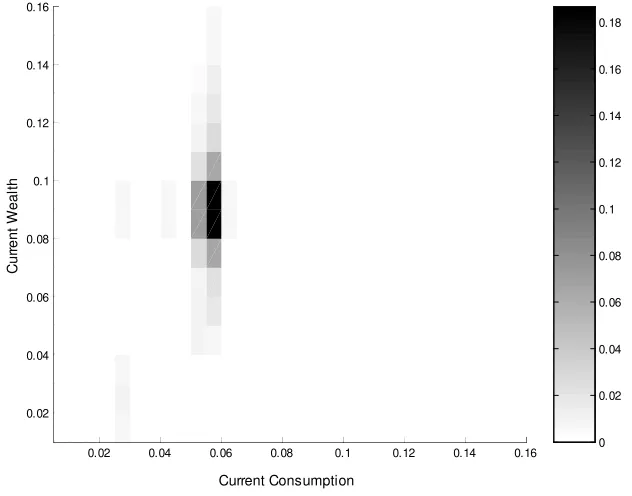
Shaded plots of the joint densities ofc1 and w1 are shown in Figures 3 and 4. The darker the
8A ‘nat’ is the unit of information ‡ow when entropy is measured relative to the natural logarithm function.
Other measures include the ‘bit’ for base2logarithms and the ‘dit’ or ‘hartley’ for base10. Throughout the paper
box, the higher the probability weight placed on the corresponding grid point. For su¢ciently large
, Figure 3 shows that the agent chooses a distribution with perfect correlation between current wealth and current consumption and places positive probability only on the FI-RE solutions.
However, as decreases the agent allocates probability on fewer grid points with low consumption. Small does not allow the agent to learn every realization of the current wealth. Thus he wants
to be well informed about the grids with lower wealth to prevent future consumption close to zero. Figure 4 shows the joint probability distribution ofc1andw1of an agent with = 0:1, which allows him to resolve only about5 percent of the total uncertainty in current wealth. The agent puts probability on fewer grid points with low consumption and puts probability0:64 on the grid point with consumption of 0:055; this collapse of the distribution is a re‡ection of the inertial e¤ects (enhanced risk aversion) discussed already for the = 0 case. Note that the correlation
betweenc1 andw1 is1 under FI-RE and only 0:36 when = 0:1.
4.3 Expected Current and Future Consumption
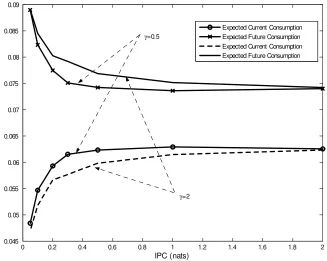
Figure 5 presents expected current and future consumption across two values of . The key result
here is that the “gap” between current and future average consumption is decreasing in . This gap is a measure of the intertemporal elasticity of substitution, as it re‡ects the willingness to
let consumption vary deterministically across time. Thus, households who have low capacity will appear to be more willing to intertemporally substitute than standard FI-RE agents.
In the previous section, we observed that the agent with limited information processing capac-ity allocates positive mass to fewer grid points with low values, resulting in a smoother
consump-tion distribuconsump-tion; for example, when <0:2 the conditional expectation of consumption is low and almost ‡at across di¤erent values of wealth (see Figure 6). As a result of the consumption smoothing over the current states with higher wealth, the expected “precautionary saving”, the
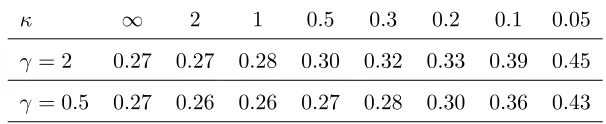
di¤erence between the expected current income and the expected current consumption, increases substantially with smaller . Table 2 shows the saving rate, ratio of the expected saving and the
expected current income; as gets smaller the saving rate increases substantially, leading to high future consumption on average. Note that the increase in future consumption will be smaller for
4.4 Optimal Share of the Risky Asset
When information processing capacity is large the agent has a lot of information about current wealth, and thus his decision rule is very similar to the FI-RE one – allocate positive mass only to “zero risky share, borrow” and “risky share equal to one, save”. There is only a small change
in distribution of the risky asset share in response to a reduction in until it gets very small. To choose the optimal distribution of the risky asset share the agent would like to know if the
current wealth is higher or lower than the threshold level that triggers the switch from saving to borrowing. This information is available until becomes very small. When becomes too small
this information cannot be obtained and the agent responds by allocating probabilities over grid points with a low risky asset share to decrease the probability of borrowing at a high interest rate;
at the same time the agent does not want to forego the excess return entirely, so some probability is still attached to saving with a positive risky share.9
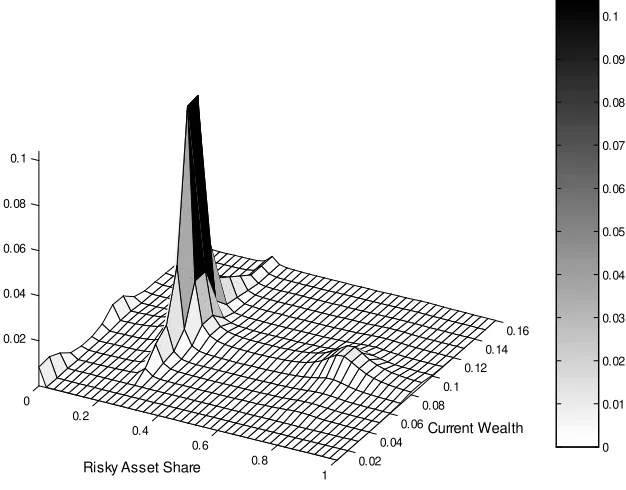
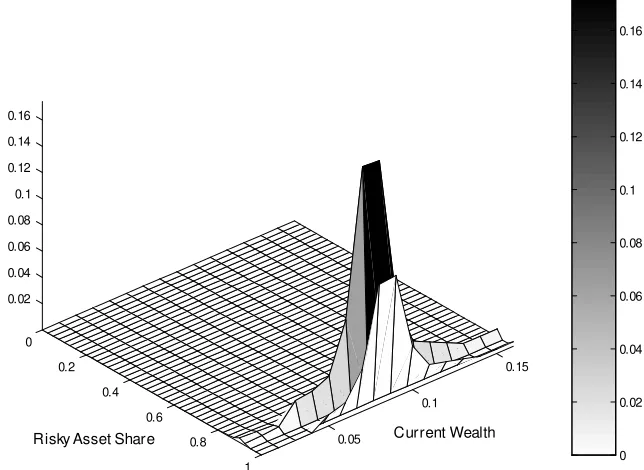
Figures 7 and 8 present the joint distribution of the risky asset share and the current wealth for information processing capacity of 2and 0:1, respectively. At the capacity = 0:1, the expected risky asset share is0:37, which is not that far from the average share cited in Gabaix and Laibson (2002) and Luo and Young (2014), while for = 2 the agent is putting all of his savings into
equities (note the small mass at zero associated with borrowing). Of particular interest is that, with = 0:1, there is a lot of heterogeneity – the agent puts positive mass in three regions corresponding to nonparticipation (s= 0), modestly-risky portfolios (arounds= 0:3), and highly risky portfolios (arounds= 0:8); if we suppose that this agent is one of in…nitely-many identical agents in an economy (and a suitable law of large numbers applies), then this distribution will also be the cross-sectional distribution, so the model can reproduce both incomplete participation
in equity markets and low holdings conditional on participation.10
Figure 9 shows the expected value of the optimal share of the risky asset for di¤erent levels
of information processing capacities. As noted already, with high the risky asset share is very high (E[s] = 0:975); because the agent borrows in a small fraction of states, it is below 1. When
9This result is consistent with that obtained in Luo (2010), in which less capacity leads to greater long-run risk
and thus reduces the optimal share invested in the risky asset. Luo and Young (2014) …nd that low shares can be
sustained with higher if agents are averse to late resolution of uncertainty.
1 0Models that drive limited participation through …xed costs generally imply that, once the household enters the
gets low enough (below roughly = 0:2) the average share drops o¤ quickly (for = 2). The level of risk aversion matters a lot when is low, which we can see in Figure 9 (the share does not decline signi…cantly until gets very small if = 0:5) and Figure 10 (all the mass is placed on a single high value forsinstead of being spread across several lower values as when = 2).
We want to mention here brie‡y that the average shareE[s]depends on the initial distribution of labor income. If we introduce a distribution with more entropy (higher variance), then the curve in Figure 9 shifts down at every value of . Higher entropy means more uncertainty about the
current state, which translates into more uncertainty about future events and therefore more desire to insure via the risk-free asset. Details of this experiment are available upon request.
4.5 Welfare Implications of RI
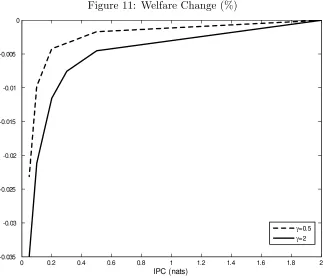
Proposition 3 shows that expected welfare is decreasing in the tightness of the constraint. Figure 11 puts some numbers to this welfare decrease. The welfare costs here can be signi…cant, on the
order of 0:03 percent of consumption, if is very small and is large, but generally are modest for relatively high values of . Of course, one must take the numbers from a two-period model
with some caution, but they indicate that the general result from the LQ-Gaussian literature that the costs of RI are small (see Luo and Young 2010) may be missing a crucial piece of the picture.
Since the large welfare losses come when is small, they only arise for parameterizations in which the optimal decisions are decidedly non-Gaussian, and are therefore excluded from the existing
studies. However, the large costs also arise precisely in the region of the parameter space where portfolio decisions look most like the data, so we should consider whether they hold up in more
general environments.
5
Conclusion
We have studied the role of rational inattention – limited information-processing capacity – in a
standard two-period portfolio choice problem. Our model is capable of producing an empirically-reasonable share of risky assets in a portfolio for modest levels of risk aversion; in addition, it
across values of current wealth, an e¤ect similar to an increase in risk aversion. Second, the high
precautionary savings that rational inattention generates leads to a large gap between expected current and expected future consumption, making households look like they have high elasticities
of intertemporal substitution. The combination therefore reproduces the parameter combination identi…ed as crucial for generating resolutions to the equity premium puzzle.
In this paper, for simplicity, we implicitly assumed the uncertainty to be fully resolved in the future; consequently it may have dampened the e¤ects of rational inattention. To fully
understand the impact of RI on individual’s and macroeconomic behavior we need a more general model with multiple periods. We are currently exploring the possibility of using “approximate
dynamic programming” tools – see Powell (2007) – to break the severe curse(s) of dimensionality that RI problems pose and explore longer horizon problems.
6
Online Appendix (Not for Publication)
6.1 Quick Review of Information Theory and Derivation of IPC
The size of the information produced by the stochastic process is measured by its entropyH( ), following Shannon (1948). H(X), the entropy of a discrete random processX(which is a measure of the expected uncertainty in X), is de…ned by
H(X) = X
xp(x) log (p(x)):
Entropy measures the information provided by a random process about itself.11 Entropy has the
following properties:
H(X) log (n) with equality if and only if p(x) = 1=n for allx (that is, uniform random variables have maximum entropy);
H(X) 0with equality if and only ifX is deterministic (that is, all nondegenerate random variables have positive entropy);
The conditional entropy of the jointly-distributedX; Y is denoted
H(XjY) =E[ log (p(XjY))] =X
yH(XjY =y)p(y):
H(XjY) H(X)with equality if and only ifXandY are independent (that is, conditioning on a second random variable can never increase entropy);
H(X; Y) =H(X) +H(YjX) =H(Y) +H(XjY) H(X) +H(Y) with equality if and only ifX andY are independent (the joint entropy of two random variables is highest when they provide no information about each other).
Mutual information is a measure of the information contained in one process regarding another
process. Suppose fX; Yg is a random process. The average mutual information betweenX and
Y is de…ned by
I(X;Y) =H(X) +H(Y) H(X; Y)
We can also write the mutual information in a more intuitive way using the conditional entropy as
I(X;Y) =H(X) H(XjY) =H(Y) H(YjX):
Both de…nitions are equivalent. Mutual information between the current consumption, savings
and the random vector of income in period1 is given by
I e1;c1; s =H e1 H e1jc1; s
or equivalently
I e1;c1; s =H e1 +H c1; s H e1; c1; s :
According to the last property, the entropy of independent random variables is equal to the sum of the entropy of each random variable. Thus we get
I e1;c1; s =H e1 +H c1; s H e1; c1; s :
Writing the entropy explicitly yields
K X
k=1
N X
r=1
I X
i=1
f sk; c1r; e1i log f sk; c1r; e1i
I X
i=1
g1 e1i log g1 e1i (9)
K X
k=1
N X
r=1
q c1r; sk log q c1r; sk :
6.2 Deriving First-order Conditions
The …rst-order conditions forf( )2(0;1)are
Ukri vi
1 + log f(sk;c1r;w1i) q(c1
r;sk)
f(sk;c1r;w1i) q(c1
r;sk)
= Umns vs
1 + log f(sm;c1n;w1s) q(c1
n;sm)
f(sm;c1n;w1s) q(c1
n;sm)
for8k= 1; :::; K,r = 1; :::; N, and i= 1; :::; I, where
Ukri =u c1r + D X d=1 J X j=1
u w1i c1r h
sk red rf +rf i
+e2j '(rde)g2 e2j
is the expected lifetime utility at the state with consumption c1r, the risky asset share sk, and
wealthw1
i. The agent chooses optimal probabilities over di¤erent states such that the utility per
marginal mutual information are equated across di¤erent states.
Proposition 5 The agent allocates higher relative probability over the states with higher expected
utility ifvi =vs.
Supposevi =vs and Ukri > Umns. Then
f sk; c1r; wi1
q(c1
r; sk)
log f sk; c 1
r; wi1
q(c1
r; sk) !
< f sm; c
1
n; ws1
q(c1
n; sm)
log f sm; c 1
n; ws1
q(c1
n; sm) !
:
Let'(x) =x log (x). ThenD'(x)<0 if0< x <1, so f(sk;c1r;wi1) q(c1
r;sk) >
f(sm;c1n;w1s) q(c1
References
[1] Bansal, Ravi and Amir Yaron (2004), “Risks for the Long Run: A Potential Resolution of
Asset Pricing Puzzles,” Journal of Finance 59, 1481-1509.
[2] Gabaix, Xavier and David Laibson (2001), “The 6D Bias and the Equity-Premium Puzzle,”
NBER Macroeconomic Annual 2001, 257-330.
[3] Gennotte, Gerard (1986), “Optimal Portfolio Choice under Incomplete Information,”Journal of Finance 41, 733–749.
[4] Gomes, Francisco and Alexander Michaelides (2008), “Asset Pricing with Limited Risk
Shar-ing and Heterogeneous Agents,” Review of Financial Studies 21(1), 415-448.
[5] Guvenen, Fatih (2009), “A Parsimonious Macroeconomic Model for Asset Pricing,” Econo-metrica 77(6), 1711-1750.
[6] Heaton, John and Deborah Lucas (2000), “Portfolio Choice in the Presence of Background
Risk,” Economic Journal 110: 1-26.
[7] Huang, Lixin and Hong Liu (2007), “Rational Inattention and Portfolio Selection,” Journal of Finance 62(4), 1999-2040.
[8] Krusell, Per and Anthony A. Smith, Jr. (1997), “Income and Wealth Heterogeneity, Portfolio
Choice, and Equilibrium Asset Returns,” Macroeconomic Dynamics 1(2), 387-422.
[9] Lewis, Kurt F. (2009), “The Two-Period Rational Inattention Model: Accelerations and Analyses,” Computational Economics 33(1), 79-97.
[10] Lundtofte, Frederik (2008), “Expected Life-time Utility and Hedging Demands in a Partially Observable Economy,” European Economic Review 52(6), 1072-1096.
[11] Luo, Yulei (2010), “Rational Inattention, Long-run Consumption Risk, and Portfolio Choice,”
Review of Economic Dynamics 13(4), 843-860.
[13] Luo, Yulei and Eric R. Young (2014), “Long-run Consumption Risk and Asset Allocation
under Recursive Utility and Rational Inattention,” manuscript.
[14] Matejka, Filip and Christopher A. Sims (2010), “Discrete Actions in Information-Constrained
Tracking Problems,” manuscript.
[15] Merton, Robert C. (1969), “Lifetime Portfolio Selection under Uncertainty: The Continuous Time Case,” Review of Economics and Statistics 51(1), 247-257.
[16] Mondria, Jordi (2010), “Portfolio Choice, Attention Allocation, and Price Comovement,”
Journal of Economic Theory 145(5), 1837–1864.
[17] Peng, Lin and Wei Xiong (2006), “Investor Attention, Overcon…dence and Category Learn-ing,”Journal of Financial Economics 80(3), 563-602.
[18] Powell, Warren B. (2007), Approximate Dynamic Programming: Solving the Curses of
Di-mensionality, Wiley Series in Probability and Statistics, John Wiley and Sons.
[19] Samuelson, Paul A. (1969), “Lifetime Portfolio Selection by Dynamic Stochastic Program-ming,” Review of Economics and Statistics 51(3), 239-46.
[20] Sha…eepoorfard, Ehsan and Maxim Raginsky (2013), “Rational Inattention in Scalar LQG Control,” Proceedings of the IEEE Conference on Decision and Control 52, 5733-5739.
[21] Shannon, Claude (1948), “A Mathematical Theory of Communication,” The Bell System
Technical Journal 27, 623-56.
[22] Sims, Christopher A. (2003), “Implications of Rational Inattention,” Journal of Monetary Economics 50(3), 665-90.
[23] Sims, Christopher A. (2005), “Rational Inattention: A Research Agenda,” Technical Report,
Princeton University.
[24] Sims, Christopher A. (2006), “Rational Inattention: Beyond the Linear-Quadratic Case,”
American Economic Review 96(2), 158-163.
[26] Wang, Neng (2009), “Optimal Consumption and Assets Allocation with Unknown Income
Growth,” Journal of Monetary Economics 56(4), 524-34.
Table 1: Expected Current and Future Consumption
= 0:5 = 2
E[c1] 0:0633 0:0624
E[c2] 0:0732 0:0742
Table 2: The Saving Rate under RI
[image:22.612.157.460.280.342.2]Figure 1: The Share Invested in the Risky Asset (FI-RE)
0 0.02 0.04 0.06 0.08 0.1 0.12 0.14 0.16 0
0.1 0.2 0.3 0.4 0.5 0.6 0.7 0.8 0.9 1
Current Wealth
R
is
ky
a
sse
t
sh
a
re
[image:23.612.143.475.426.711.2]γ=2 γ=0.5
Figure 2: Optimal Consumption under FI-RE
0.02 0.04 0.06 0.08 0.1 0.12 0.14 0.16 0.02
0.03 0.04 0.05 0.06 0.07 0.08 0.09 0.1
Current Wealth
C
ons
um
pti
on
Figure 3: Joint Probability Distribution of Current Wealth and Current Consumption ( large)
0.02 0.04 0.06 0.08 0.1 0.12 0.14 0.16 0.02
0.04 0.06 0.08 0.1 0.12 0.14 0.16
Current Consumption
C
ur
ren
t W
e
al
th
0 0.05 0.1 0.15 0.2 0.25
Figure 4: Joint Probability Distribution of Current Wealth and Current Consumption ( = 0:1)
0.02 0.04 0.06 0.08 0.1 0.12 0.14 0.16
0.02 0.04 0.06 0.08 0.1 0.12 0.14 0.16
Current Consumption
C
ur
rent W
eal
th
[image:24.612.154.470.467.715.2]Figure 5: Expected Current Consumption and Expected Future Consumption
0 0.2 0.4 0.6 0.8 1 1.2 1.4 1.6 1.8 2 0.045 0.05 0.055 0.06 0.065 0.07 0.075 0.08 0.085 0.09 IPC (nats) γ=0.5 γ=2
[image:25.612.142.475.439.710.2]Expected Current Consumption Expected Future Consumption Expected Current Consumption Expected Future Consumption
Figure 6: Conditional Expectation of Current Consumption
Figure 7: Joint Distribution of Current Wealth and Portfolio Choice, = 2
0
0.2
0.4
0.6
0.8
1 0.02 0.04
0.06 0.08
0.1 0.12
0.14 0.16 0.05
0.1 0.15 0.2 0.25
Current Wealth Risky Asset Share
Figure 8: Joint Distribution of Current Wealth and Portfolio Choice, = 0:1
0 0.2
0.4 0.6
0.8 1
0.02 0.04
0.06 0.08
0.1 0.12
0.14 0.16 0.02
0.04 0.06 0.08 0.1
Current Wealth
Risky Asset Share
[image:26.612.164.477.471.716.2]Figure 9: Expected Value of the Risky Asset Share
0 0.2 0.4 0.6 0.8 1 1.2 1.4 1.6 1.8 2 0.1 0.2 0.3 0.4 0.5 0.6 0.7 0.8 0.9 1 IPC (nats) E x pec ted R is k y As s et S har e γ=2 γ=0.5
Figure 10: Joint Marginal Probability of Current Wealth and Risky Asset Share ( = 0:5; = 0:1)
0 0.2 0.4 0.6 0.8 1 0.05 0.1 0.15 0.02 0.04 0.06 0.08 0.1 0.12 0.14 0.16 Current Wealth Risky Asset Share
[image:27.612.158.480.475.710.2]Figure 11: Welfare Change (%)
0 0.2 0.4 0.6 0.8 1 1.2 1.4 1.6 1.8 2 -0.035
-0.03 -0.025 -0.02 -0.015 -0.01 -0.005 0
IPC (nats)