DEPFIX: A System for Automatic Correction of Czech MT Outputs
∗Rudolf Rosa, David Mareˇcek and Ondˇrej Duˇsek
Charles University in Prague, Faculty of Mathematics and Physics Institute of Formal and Applied Linguistics
Malostransk´e n´amˇest´ı 25, Prague
{rosa,marecek,odusek}@ufal.mff.cuni.cz
Abstract
We present an improved version of DEPFIX (Mareˇcek et al., 2011), a system for auto-matic rule-based post-processing of English-to-Czech MT outputs designed to increase their fluency. We enhanced the rule set used by the originalDEPFIXsystem and measured the performance of the individual rules.
We also modified the dependency parser of McDonald et al. (2005) in two ways to adjust it for the parsing of MT outputs. We show that our system is able to improve the quality of the state-of-the-art MT systems.
1 Introduction
The today’s outputs of Machine Translation (MT) often contain serious grammatical errors. This is particularly apparent in statistical MT systems (SMT), which do not employ structural linguistic rules. These systems have been dominating the area in the recent years (Callison-Burch et al., 2011). Such errors make the translated text less fluent and may even lead to unintelligibility or misleading statements. The problem is more evident in lan-guages with rich morphology, such as Czech, where morphological agreement is of a relatively high im-portance for the interpretation of syntactic relations. The DEPFIX system (Mareˇcek et al., 2011) at-tempts to correct some of the frequent SMT
sys-∗
This research has been supported by the European Union Seventh Framework Programme (FP7) under grant agree-ment n◦ 247762 (Faust), and by the grants GAUK116310, GA201/09/H057 (Res-Informatica), and LH12093.
tems’ errors in English-to-Czech translations.1 It an-alyzes thetargetsentence (the SMT output in Czech language) using a morphological tagger and a de-pendency parser and attempts to correct it by apply-ing several rules which enforce consistency with the Czech grammar. Most of the rules use the source
sentence (the SMT input in English language) as a source of information about the sentence structure. Thesourcesentence is also tagged and parsed, and word-to-word alignment with thetarget sentence is determined.
In this paper, we present DEPFIX 2012, an im-proved version of the originalDEPFIX2011 system. It makes use of a new parser, described briefly in Section 3, which is adapted to handle the generally ungrammaticaltargetsentences better. We have also enhanced the set of grammar correction rules, for which we give a detailed description in Section 4. Section 5 gives an account of the experiments per-formed to evaluate the DEPFIX 2012 system and compare it to DEPFIX 2011. Section 6 then con-cludes the paper.
2 Related Work
Our approach can be regarded as converse to the more common way of using an SMT system to auto-matically post-edit the output of a rule-based transla-tion system, as described e.g. in (Simard et al., 2007) or (Lagarda et al., 2009).
The DEPFIX system is implemented in the
1
Although we apply theDEPFIXsystem just to SMT systems in this paper as it mainly targets the errors induced by this type of MT systems, it can be applied to virtually any MT system (Mareˇcek et al., 2011).
TectoMT/Treex NLP framework (Popel and ˇ
Zabokrtsk´y, 2010),2using the Morˇce tagger (Spous-tov´a et al., 2007) and the MST parser (McDonald et al., 2005) trained on the CoNLL 2007 Shared Task English data (Nivre et al., 2007) to analyze the
source sentences. Thesourceandtarget sentences are aligned using GIZA++ (Och and Ney, 2003).
3 Parsing
TheDEPFIX2011 system used the MST parser (Mc-Donald et al., 2005) with an improved feature set for Czech (Nov´ak and ˇZabokrtsk´y, 2007) trained on the Prague Dependency Treebank (PDT) 2.0 (Hajiˇc and others, 2006) to analyze the target sentences. DEPFIX 2012 uses a reimplementation of the MST parser capable of utilizing parallel features from the
sourceside in the parsing of thetargetsentence. Thesourcetext is usually grammatical and there-fore is likely to be analyzed more reliably. The
sourcestructure obtained in this way can then pro-vide hints for thetargetparser. We use local features projected through the GIZA++ word alignment – i.e. for eachtargetword, we add features computed over its alignedsourceword, if there is one.
To address the differences between the gold stan-dard training data and SMT outputs, we “worsen” the treebank used to train the parser, i.e. introduce errors similar to those found in target sentences: The trees retain their correct structure, only the word forms are modified to resemble SMT output.
We have computed a “part-of-speech tag er-ror model” on parallel sentences from the Prague Czech-English Dependency Treebank (PCEDT) 2.0 (Bojar et al., 2012), comparing the gold standard Czech translations to the output of an SMT system (Koehn et al., 2007) and estimating the Maximum Likelihood probabilities of errors for each part-of-speech tag. We then applied this error model to the Czech PCEDT 2.0 sentences and used the resulting “worsened” treebank to train the parser.
4 Rules
DEPFIX 2012 uses 20 hand-written rules, address-ing various frequent errors in MT output. Each rule takes an analyzed target sentence as its in-put, often together with its analyzed source
sen-2http://ufal.mff.cuni.cz/treex
tence, and attempts to correct any errors found – usually by changing morphosyntactic categories of a word (such as number, gender, case, person and dependency label) and regenerating the correspond-ing word form if necessary, more rarely by deletcorrespond-ing superfluous particles or auxiliary words or changing thetarget dependency tree structure. However, nei-ther word order problems nor bad lexical choices are corrected.
Many rules were already present inDEPFIX2011. However, most were modified in DEPFIX 2012 to achieve better performance (denoted as modified), and new rules were added (new). Rules not modified sinceDEPFIX2011 are denoted asreused.
The order of rule application is important as there are dependencies among the rules, e.g. FixPrepo-sitionNounAgreement (enforcing noun-preposition congruency) depends on FixPrepositionalCase (fix-ing incorrectly tagged prepositional case). The rules are applied in the order listed in Table 2.
4.1 Analysis Fixing Rules
Analysis fixing rules try to detect and rectify tagger and parser errors. They do not change word forms and are therefore invisible on the output as such; however, rules of other types benefit from their cor-rections.
FixPrepositionalCase(new)
This rule corrects part-of-speech-tag errors in prepositional phrases. It looks for all words that de-pend on a preposition and do not match its part-of-speech tag case. It tries to find and assign a com-mon morphological case fitting for both the word form and the preposition. Infrequent preposition-case combinations are not considered.
FixReflexiveTantum(new)
If the word form ‘se’ or ‘si’ is classified as reflex-ive tantum particle by the parser, but does not be-long to an actual reflexive tantum verb (or a dever-bative noun or an adjective), its dependency label is changed to a different value, based on the context.
FixNounNumber(reused)
sourcenumber and thetarget word form, changing thetargetcase if necessary.
FixPrepositionWithoutChildren(reused)
Atargetpreposition with no child nodes is clearly an analysis error. This rule tries to find children for childless prepositions by projecting the children of the alignedsourcepreposition to thetargetside.
FixAuxVChildren(new)
Since auxiliary verbs must not have child nodes, we rehang all their children to the governing full verb.
4.2 Agreement Fixing Rules
These rules relate to morphological agreement re-quired by Czech grammar, which they try to enforce in case it is violated. Czech grammar requires agree-ment in morphological gender, number, case and person where applicable.
These rules typically use thesourcesentence only for confirmation.
FixRelativePronoun(new)
The Czech word relative pronoun ‘kter´y’ is as-signed gender and number identical to the closest preceding noun or pronoun, if the source analysis confirms that it depends on this noun/pronoun.
FixSubject(modified)
The subject (if the subject dependency label is confirmed by thesourceanalysis) will have its case set to nominative; the number is changed if this leads to the word form staying unchanged.
FixVerbAuxBeAgreement(modified)
If an auxiliary verb is a child of an infinitive, the auxiliary verb receives the gender and number of the subject, which is a child of the infinitive (see also FixAuxVChildren).
FixSubjectPredicateAgreement(modified)
An active verb form receives the number and per-son from its subject (whose relation to the verb must be confirmed by thesource).
FixSubjectPastParticipleAgreement(modified)
A past participle verb form receives the number and gender from its subject (confirmed by thesource
analysis).
FixPassiveAuxBeAgreement(modified)
An auxiliary verb ‘b´yt’ (‘to be’) depending on a passive verb form receives its gender and number.
FixPrepositionNounAgreement(modified)
A noun or adjective depending on a preposition receives its case. The dependency must be con-firmed in thesource.
FixNounAdjectiveAgreement(modified)
An adjective (or an adjective-like pronoun or nu-meral) preceding its governing noun receives its gender, number and case.
4.3 Translation Fixing Rules
The following rules detect and correct structures of-ten mistranslated by SMT systems. They usually de-pend heavily on thesourcesentence.
FixBy(new)
English preposition ‘by’ is translated to Czech us-ing the instrumental case (if modifyus-ing a verb, e.g. ‘built by David’: ‘postaveno Davidem’) or using the genitive case (if modifying a noun, e.g. ‘songs by David’: ‘p´ısnˇe Davida’).
FixPresentContinuous(modified)
If thesourcesentence is in a continuous tense (e.g. ‘Ondˇrej isn’t experimenting.’), the auxiliary verb ‘to be’ must not appear on the output, which is often the case (e.g. *‘Ondˇrej nen´ı experimentovat.’). This rule deletes the auxiliary verb intargetand transfers its morphological categories to the main verb (e.g. ‘Ondˇrej neexperimentuje.’).
FixVerbByEnSubject(new)
If the subject of thesourcesentence is a personal pronoun, its following morphological categeries are propagated to thetargetpredicate:
• person
• number (except for ‘you’, which does not ex-hibit number)
• gender (only in case of ‘he’ or ‘she’, which ex-hibit the natural gender)
FixOf(new)
FixAuxT(reused)
Reflexive tantum particles‘se’ or ‘si’ not belong-ing to any verb or adjective are deleted. This situa-tion usually occurs when the meaning of thesource
verb/adjective is lost in translation and only the par-ticle is produced.
4.4 Other Rules
VocalizePrepos(reused)
Prepositions ‘k’, ‘s’, ‘v’, ‘z’ are vocalized (i.e. changed to ‘ke’, ‘se’, ‘ve’, ‘ze’) where neces-sary. The vocalization rules in Czech are similar to ‘a’/‘an’ distinction in English.
FixFirstWordCapitalization(new)
If the first word of sourceis capitalized and the first word oftargetis not, this rule capitalizes it.
5 Experiments and Results
For parameter tuning, we used datasets from the WMT10 translation task and translations by ON -LINEB andCU-BOJARsystems.
5.1 Manual Evaluation
Manual evaluation of both DEPFIX 2011 andDEP -FIX 2012 was performed on the WMT113 test set translated by ONLINEB. 500 sentences were ran-domly selected and blind-evaluated by two indepen-dent annotators, who were presented with outputs of ONLINEB, DEPFIX 2011 and DEPFIX 2012. (For 246 sentences, at least one of the DEPFIX setups modified theONLINEB translation.) They provided us with a pairwise comparison of the three setups, with the possibility to mark the sentence as “indef-inite” if translations were of equal quality. The re-sults are given in Table 1.
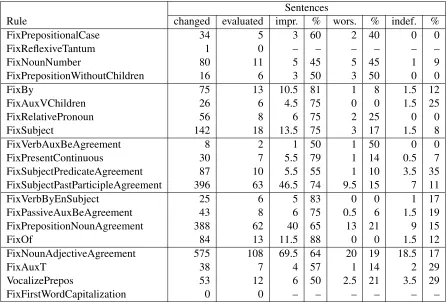
In Table 2, we use the manual evaluation to mea-sure the performance of the individual rules inDEP -FIX2012. For each rule, we ranDEPFIX2012 with this rule disabled and compared the output to the output of the full DEPFIX 2012. The number of affected sentences on the whole WMT11 test set, given as “changed”, represents the impact of the rule. The number of affected sentences selected for manual evaluation is listed as “evaluated”. Finally, the annotators’ ratings of the “evaluated” sentences
3http://www.statmt.org/wmt11
A / B Setup 1 Setup 2 Indefinite better better
Setup 1 better 55% 1% 11% Setup 2 better 1% 8% 4%
[image:4.612.324.528.53.115.2]Indefinite 3% 2% 15%
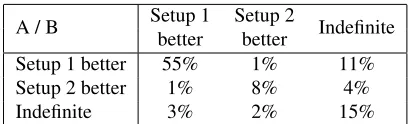
Table 3: Inter-annotator agreement matrix forONLINEB +DEPFIX2012 as Setup 1 andONLINEB as Setup 2.
(suggesting whether the rule improved or worsened the translation, or whether the result was indefinite) were counted and divided by the number of anno-tators to get the average performance of each rule. Please note that the lower the “evaluated” number, the lower the confidence of the results.
The inter-annotator agreement matrix for com-parison of ONLINEB + DEPFIX 2012 (denoted as Setup 1) with ONLINEB (Setup 2) is given in Ta-ble 3. The results for the other two setup pairs were similar, with the average inter-annotator agreement being 77%.
5.2 Automatic Evaluation
We also performed several experiments with auto-matic evaluation using the standard BLEU metric (Papineni et al., 2002). As the effect ofDEPFIX in terms of BLEU is rather small, the results are not as confident as the results of manual evaluation.4
In Table 4, we compare the DEPFIX 2011 and DEPFIX2012 systems and measure the contribution of parser adaptation (Section 3) and rule improve-ments (Section 4). It can be seen that the com-bined effect of applying both system modifications is greater than when they are applied alone. The im-provement ofDEPFIX 2012 overONLINEB without DEPFIXis statistically significant at 95% confidence level.
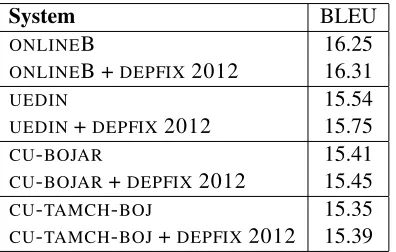
The effect ofDEPFIX2012 on the outputs of some of the best-scoring SMT systems in the WMT12 Translation Task5 is shown in Table 5. Although DEPFIX2012 was tuned only onONLINEB andCU -BOJARsystem outputs, it improves the BLEU score of all the best-scoring systems, which suggests that
4
As already noted by Mareˇcek et al. (2011), BLEU seems not to be very suitable for evaluation ofDEPFIX. See (Kos and Bojar, 2009) for a detailed study of BLEU performance when applied to evaluation of MT systems with Czech as the target language.
Setup 1 Setup 2 Differing Annotator Setup 1 Setup 2 Indefinite
sentences better better
ONLINEB
ONLINEB 169 A 58% 13% 29%
+DEPFIX2011 B 47% 11% 42%
ONLINEB
ONLINEB 234 A 65% 14% 21%
+DEPFIX2012 B 59% 11% 30%
ONLINEB ONLINEB
148 A 54% 24% 22%
[image:5.612.99.516.88.200.2]+DEPFIX2012 +DEPFIX2011 B 56% 22% 22%
Table 1: Manual pairwise comparison on 500 sentences from WMT11 test set processed byONLINEB,ONLINEB + DEPFIX2011 andONLINEB +DEPFIX2012. Evaluated by two independent annotators.
Sentences
Rule changed evaluated impr. % wors. % indef. %
FixPrepositionalCase 34 5 3 60 2 40 0 0
FixReflexiveTantum 1 0 – – – – – –
FixNounNumber 80 11 5 45 5 45 1 9
FixPrepositionWithoutChildren 16 6 3 50 3 50 0 0
FixBy 75 13 10.5 81 1 8 1.5 12
FixAuxVChildren 26 6 4.5 75 0 0 1.5 25
FixRelativePronoun 56 8 6 75 2 25 0 0
FixSubject 142 18 13.5 75 3 17 1.5 8
FixVerbAuxBeAgreement 8 2 1 50 1 50 0 0
FixPresentContinuous 30 7 5.5 79 1 14 0.5 7
FixSubjectPredicateAgreement 87 10 5.5 55 1 10 3.5 35
FixSubjectPastParticipleAgreement 396 63 46.5 74 9.5 15 7 11
FixVerbByEnSubject 25 6 5 83 0 0 1 17
FixPassiveAuxBeAgreement 43 8 6 75 0.5 6 1.5 19
FixPrepositionNounAgreement 388 62 40 65 13 21 9 15
FixOf 84 13 11.5 88 0 0 1.5 12
FixNounAdjectiveAgreement 575 108 69.5 64 20 19 18.5 17
FixAuxT 38 7 4 57 1 14 2 29
VocalizePrepos 53 12 6 50 2.5 21 3.5 29
FixFirstWordCapitalization 0 0 – – – – – –
[image:5.612.83.530.309.611.2]DEPFIXsetup BLEU
withoutDEPFIX 19.37
DEPFIX2011 19.41
DEPFIX2011 + new parser 19.42 DEPFIX2011 + new rules 19.48
[image:6.612.103.273.52.139.2]DEPFIX2012 19.56
Table 4: Performance ofONLINEB and various DEPFIX setups on the WMT11 test set.
System BLEU
ONLINEB 16.25
ONLINEB +DEPFIX2012 16.31
UEDIN 15.54
UEDIN+DEPFIX2012 15.75
CU-BOJAR 15.41
CU-BOJAR+DEPFIX2012 15.45
CU-TAMCH-BOJ 15.35
CU-TAMCH-BOJ+DEPFIX2012 15.39 Table 5: Comparison of BLEU of baseline system output and corrected system output on WMT12 test set.
it is able to improve the quality of various SMT systems when applied to their outputs. (The im-provement on UEDIN is statistically significant at 95% confidence level.) We submitted theONLINEB + DEPFIX 2012 system to the WMT12 Translation Task asCU-DEPFIX.
6 Conclusion
We have presented two improvements to DEPFIX, a system of rule-based post-editing of English-to-Czech Machine Translation outputs proven by man-ual and automatic evaluation to improve the qman-ual- qual-ity of the translations produced by state-of-the-art SMT systems. First, improvements in the existing rules and implementation of new ones, which can be regarded as an additive, evolutionary change. Sec-ond, a modified dependency parser, adjusted to pars-ing of SMT outputs by trainpars-ing it on a parallel tree-bank with worsened word forms on the Czech side. We showed that both changes led to a better perfor-mance of the new DEPFIX 2012, both individually and combined.
In future, we are planning to incorporate deeper analysis, devising rules that would operate on the
deep-syntactic, or tectogrammatical, layer. The Czech and English tectogrammatical trees are more similar to each other, which should enable us to ex-ploit more information from the source sentences. We also hope to be able to perform more complex corrections, such as changing the part of speech of a word when necessary.
Following the success of our modified parser, we would also like to modify the tagger in a similar way, since incorrect analyses produced by the tagger of-ten hinder the correct function of our rules, some-times leading to a rule worsening the translation in-stead of improving it.
As observed e.g. by Groves and Schmidtke (2009) for English-to-German and English-to-French trans-lations, SMT systems for other language pairs also tend to produce reoccurring grammatical errors. We believe that these could be easily detected and cor-rected in a rule-based way, using an approach similar to ours.
References
Ondˇrej Bojar, Jan Hajiˇc, Eva Hajiˇcov´a, Jarmila Panevov´a, Petr Sgall, Silvie Cinkov´a, Eva Fuˇc´ıkov´a, Marie Mikulov´a, Petr Pajas, Jan Popelka, Jiˇr´ı Semeck´y, Jana ˇSindlerov´a, Jan ˇStˇep´anek, Josef Toman, Zdeˇnka Ureˇsov´a, and Zdenˇek ˇZabokrtsk´y. 2012. Announc-ing Prague Czech-English Dependency Treebank 2.0. InProceedings of LREC 2012, Istanbul, Turkey, May. ELRA, European Language Resources Association. In print.
Chris Callison-Burch, Philipp Koehn, Christof Monz, and Omar Zaidan. 2011. Findings of the 2011 work-shop on statistical machine translation. InProceedings of the Sixth Workshop on Statistical Machine Transla-tion, pages 22–64, Edinburgh, Scotland, July. Associ-ation for ComputAssoci-ational Linguistics.
Declan Groves and Dag Schmidtke. 2009. Identification and analysis of post-editing patterns for MT. Proceed-ings of MT Summit XII, pages 429–436.
Jan Hajiˇc et al. 2006. Prague Dependency Treebank 2.0. CD-ROM, Linguistic Data Consortium, LDC Catalog No.: LDC2006T0 1, Philadelphia.
[image:6.612.89.287.187.313.2]Association for Computational Linguistics Companion Volume Proceedings of the Demo and Poster Sessions, pages 177–180, Prague, Czech Republic, June. Asso-ciation for Computational Linguistics.
Kamil Kos and Ondˇrej Bojar. 2009. Evaluation of ma-chine translation metrics for czech as the target lan-guage. The Prague Bulletin of Mathematical Linguis-tics, 92(-1):135–148.
Antonio L. Lagarda, Vicent Alabau, Francisco Casacu-berta, Roberto Silva, and Enrique Diaz-de Liano. 2009. Statistical post-editing of a rule-based ma-chine translation system. In Proceedings of Human Language Technologies: The 2009 Annual Confer-ence of the North American Chapter of the Associa-tion for ComputaAssocia-tional Linguistics, Companion Vol-ume: Short Papers, pages 217–220. Association for Computational Linguistics.
David Mareˇcek, Rudolf Rosa, Petra Galuˇsˇc´akov´a, and Ondˇrej Bojar. 2011. Two-step translation with gram-matical post-processing. In Proceedings of the Sixth Workshop on Statistical Machine Translation, pages 426–432. Association for Computational Linguistics. Ryan McDonald, Fernando Pereira, Kiril Ribarov, and
Jan Hajiˇc. 2005. Non-projective dependency parsing using spanning tree algorithms. InHLT ’05: Proceed-ings of the conference on Human Language Technol-ogy and Empirical Methods in Natural Language Pro-cessing, pages 523–530, Vancouver, British Columbia, Canada.
Joakim Nivre, Johan Hall, Sandra K¨ubler, Ryan Mc-Donald, Jens Nilsson, Sebastian Riedel, and Deniz Yuret. 2007. The CoNLL 2007 shared task on de-pendency parsing. InProceedings of the CoNLL 2007 Shared Task. Joint Conf. on Empirical Methods in Nat-ural Language Processing and Computational NatNat-ural Language Learning (EMNLP-CoNLL), June.
V´aclav Nov´ak and Zdenˇek ˇZabokrtsk´y. 2007. Feature engineering in maximum spanning tree dependency parser. In V´aclav Matouˇsek and Pavel Mautner, edi-tors,Lecture Notes in Artificial Intelligence, Proceed-ings of the 10th I nternational Conference on Text, Speech and Dialogue, Lecture Notes in Computer Sci-ence, pages 92–98, Pilsen, Czech Republic. Springer Science+Business Media Deutschland GmbH. Franz Josef Och and Hermann Ney. 2003. A Systematic
Comparison of Various Statistical Alignment Models. Computational Linguistics, 29(1):19–51.
Kishore Papineni, Salim Roukos, Todd Ward, and Wei-Jing Zhu. 2002. BLEU: a Method for Automatic Eval-uation of Machine Translation. InACL 2002, Proceed-ings of the 40th Annual Meeting of the Association for Computational Linguistics, pages 311–318, Philadel-phia, Pennsylvania.
Martin Popel and Zdenˇek ˇZabokrtsk´y. 2010. TectoMT: modular NLP framework. InProceedings of the 7th international conference on Advances in natural lan-guage processing, IceTAL’10, pages 293–304, Berlin, Heidelberg. Springer-Verlag.
Michel Simard, Cyril Goutte, and Pierre Isabelle. 2007. Statistical phrase-based post-editing. InHuman Lan-guage Technologies 2007: The Conference of the North American Chapter of the Association for Com-putational Linguistics; Proceedings of the Main Con-ference, pages 508–515, Rochester, New York, April. Association for Computational Linguistics.