Retrieving Correct Semantic Boundaries in Dependency Structure
Jinho D. Choi
Department of Computer Science University of Colorado at Boulder
Martha Palmer
Department of Linguistics University of Colorado at Boulder [email protected]
Abstract
This paper describes the retrieval of cor-rect semantic boundaries for predicate-argument structures annotated by depen-dency structure. Unlike phrase structure, in which arguments are annotated at the phrase level, dependency structure does not have phrases so the argument labels are associated with head words instead: the subtree of each head word is assumed to include the same set of words as the an-notated phrase does in phrase structure. However, at least in English, retrieving such subtrees does not always guarantee retrieval of the correct phrase boundaries. In this paper, we present heuristics that retrieve correct phrase boundaries for se-mantic arguments, called sese-mantic bound-aries, from dependency trees. By apply-ing heuristics, we achieved an F1-score of 99.54% for correct representation of semantic boundaries. Furthermore, error analysis showed that some of the errors could also be considered correct, depend-ing on the interpretation of the annotation.
1 Introduction
Dependency structure has recently gained wide terest because it is simple yet provides useful in-formation for many NLP tasks such as sentiment analysis (Kessler and Nicolov, 2009) or machine translation (Gildea, 2004). Although dependency structure is a kind of syntactic structure, it is quite different from phrase structure: phrase structure gives phrase information by grouping constituents whereas dependency structure gives dependency relations between pairs of words. Many depen-dency relations (e.g., subject, object) have high correlations with semantic roles (e.g., agent, pa-tient), which makes dependency structure
suit-able for representing semantic information such as predicate-argument structure.
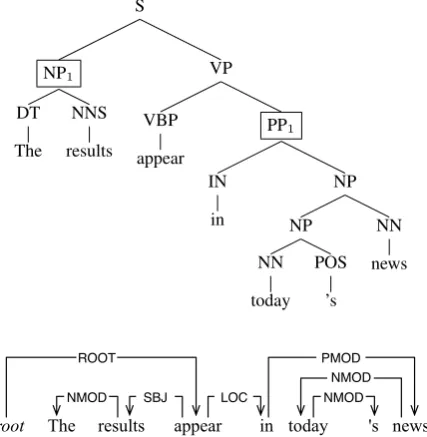
In 2009, the Conference on Computational Nat-ural Language Learning (CoNLL) opened a shared task: the participants were supposed to take de-pendency trees as input and produce semantic role labels as output (Hajiˇc et al., 2009). The depen-dency trees were automatically converted from the Penn Treebank (Marcus et al., 1993), which con-sists of phrase structure trees, using some heuris-tics (cf. Section 3). The semantic roles were ex-tracted from the Propbank (Palmer et al., 2005). Since Propbank arguments were originally anno-tated at the phrase level using the Penn Treebank and the phrase information got lost during the con-version to the dependency trees, arguments are an-notated on head words instead of phrases in depen-dency trees; the subtree of each head word is as-sumed to include the same set of words as the an-notated phrase does in phrase structure. Figure 1 shows a dependency tree that has been converted from the corresponding phrase structure tree.
S
NP1
DT The
NNS results
VP
VBP appear
PP1
IN in
NP
NP NN today
POS ’s
NN news
The results appear in today 's news
root
NMOD SBJ LOC NMOD
NMOD
[image:1.595.311.525.517.736.2]ROOT PMOD
Figure 1: Phrase vs. dependency structure
In the phrase structure tree, arguments of the verb predicate appear are annotated on the phrases: NP1 asARG0 and PP1 asARGM-LOC. In the
de-pendency tree, the arguments are annotated on the head words instead: resultsas theARG0andinas
theARGM-LOC. In this example, both PP1and the
subtree ofinconsist of the same set of words{in,
today, ’s, news} (as is the case for NP1 and the
subtree of results); therefore, the phrase bound-aries for the semantic arguments, called semantic boundaries, are retrieved correctly from the depen-dency tree.
Retrieving the subtrees of head words usually gives correct semantic boundaries; however, there are cases where the strategy does not work. For example, if the verb predicate is a gerund or a past-participle, it is possible that the predicate becomes a syntactic child of the head word annotated as a semantic argument of the predicate. In Figure 2, the head wordplantis annotated as ARG1 of the
verb predicate owned, whereownedis a child of
plantin the dependency tree. Thus, retrieving the subtree of plant would include the predicate it-self, which is not the correct semantic boundary for the argument (the correct boundary would be only{The,plant}).
The plant owned by Mark
[image:2.595.310.531.541.733.2]NMOD NMOD LGS PMOD
Figure 2: Past-participle example
For such cases, we need some alternative for re-trieving the correct semantic boundaries. This is an important issue that has not yet been thoroughly addressed. In this paper, we first show how to con-vert the Penn Treebank style phrase structure to dependency structure. We then describe how to annotate the Propbank arguments, already anno-tated in the phrase structure, on head words in the dependency structure. Finally, we present heuris-tics that correctly retrieve semantic boundaries in most cases. For our experiments, we used the en-tire Penn Treebank (Wall Street Journal). Our ex-periments show that it is possible to achieve an F1-score of 99.54% for correct representation of the semantic boundaries.
2 Related work
Ekeklint and Nivre (2007) tried to retrieve seman-tic boundaries by adding extra arcs to dependency trees, so the structure is no longer a tree but a
graph. They experimented with the same cor-pus, the Penn Treebank, but used a different de-pendency conversion tool, Penn2Malt.1 Our work is distinguished from theirs because we keep the tree structure but use heuristics to find the bound-aries. Johansson (2008) also tried to find seman-tic boundaries for evaluation of his semanseman-tic role labeling system using dependency structure. He used heuristics that apply to general cases whereas we add more detailed heuristics for specific cases.
3 Converting phrase structure to dependency structure
We used the same tool as the one used for the CoNLL’09 shared task to automatically convert the phrase structure trees in the Penn Treebank to the dependency trees (Johansson and Nugues, 2007). The script gives several options for the con-version; we mostly used the default values except for the following options:2
• splitSlash=false: do not split slashes. This option is taken so the dependency trees pre-serve the same number of word-tokens as the original phrase structure trees.
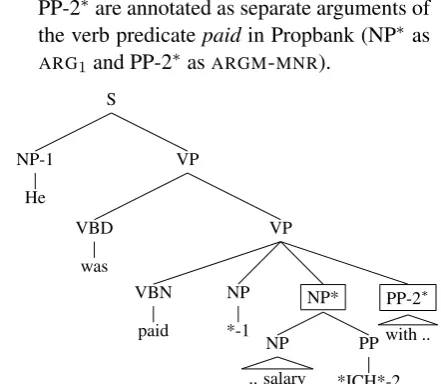
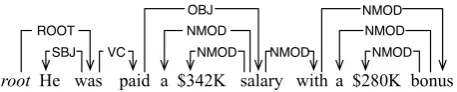
• noSecEdges=true: ignore secondary edges if present. This option is taken so all sib-lings of verb predicates in phrase structure become children of the verbs in dependency structure regardless of empty categories. Fig-ure 3 shows the converted dependency tree, which is produced when the secondary edge (*ICH*) is not ignored, and Figure 4 shows the one produced by ignoring the secondary edge. This option is useful because NP∗ and PP-2∗are annotated as separate arguments of the verb predicatepaidin Propbank (NP∗ as ARG1and PP-2∗ asARGM-MNR).
S
NP-1 He
VP
VBD was
VP
VBN paid
NP *-1
NP*
NP .. salary
PP *ICH*-2
PP-2∗ with ..
1http://stp.lingfil.uu.se/ nivre/research/Penn2Malt.html 2
paid He was root
SBJ NMOD
ROOT NMOD
$342K
a salary with
VC NMOD
NMOD
$280K
a bonus
OBJ
NMOD
[image:3.595.73.302.62.108.2]NMOD
Figure 3: When the secondary edge is not ignored
paid He was root
SBJ NMOD
ROOT NMOD
$342K
a salary with
VC NMOD
NMOD
$280K
a bonus
OBJ NMOD
[image:3.595.307.507.103.287.2]ADV
Figure 4: When the secondary edge is ignored
Total 49,208 dependency trees were converted from the Penn Treebank. Although it was pos-sible to apply different values for other options, we found them not helpful in finding correct se-mantic boundaries of Propbank arguments. Note that some of non-projective dependencies are re-moved by ignoring the secondary edges. However, it did not make all dependency trees projective; our methods can be applied for either projective or non-projective dependency trees.
4 Adding semantic roles to dependency structure
4.1 Finding the head words
For each argument in the Propbank annotated on a phrase, we extracted the set of words belonging to the phrase. Let this set beSp. In Figure 1, PP1
is the ARGM-LOC ofappear so Sp is {in, today,
’s, news}. Next, we found a set of head words, saySd, whose subtrees cover all words inSp(e.g.,
Sd= {in} in Figure 1). It would be ideal if there
existed one head word whose subtree covers all words inSp, but this is not always the case. It is
possible thatSdneeds more than one head word to
cover all the words inSp.
Figure 5 shows an algorithm that finds a set of head wordsSdwhose subtrees cover all words in
Sp. For each wordwinSp, the algorithm checks
ifw’s subtree gives the maximum coverage (ifw’s subtree contains more words than any other sub-tree); if it does, the algorithm adds w toSd,
re-moves all words inw’s subtree fromSp, then
re-peats the search. The search ends when all words inSpare covered by some subtree of a head word
inSd. Notice that the algorithm searches for the
minimum number of head words by matching the maximum coverages.
Input:Sp= a set of words for each argument
in the Propbank
Output:Sd= a set of head words whose
subtrees cover all words inSp Algorithm:getHeadWords(Sp)
1
Sd={}
2
whileSp6=∅do
3
max=None
4
foreachw∈Spdo
5
if|subtree(w)|>|subtree(max)|
6
then
max=w
7
end 8
Sd.add(max)
9
Sp.removeAll(subtree(max))
10
end 11
returnSd
12
Figure 5: Finding the min-set of head words
The algorithm guarantees to find the min-set Sd
whose subtrees cover all words inSp. This gives
100% recall forSdcompared toSp; however, the
precision is not guaranteed to be as perfect. Sec-tion 5 illustrates heuristics that remove the over-generated words so we could improve the preci-sion as well.
4.2 Ignoring empty categories
As described in Figures 3 and 4, dependency trees do not include any empty categories (e.g., null elements, traces, PRO’s): the empty categories are dropped during the conversion to the depen-dency trees. In the Penn Treebank, 11.5% of the Propbank arguments are annotated on empty cat-egories. Although this is a fair amount, we de-cided to ignore them for now since dependency structure is not naturally designed to handle empty categories. Nonetheless, we are in the process of finding ways of automatically adding empty cate-gories to dependency trees so we can deal with the remaining of 11.5% Propbank arguments.
4.3 Handling disjoint arguments
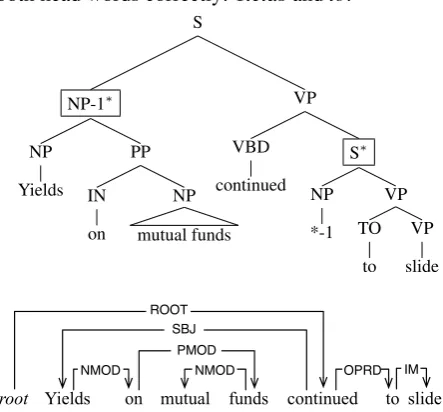
Some Propbank arguments are disjoint in the phrase structure so that they cannot be represented as single head words in dependency trees. For ex-ample in Figure 6, both NP-1∗and S∗areARG1of
[image:3.595.74.297.149.203.2]handles this kind of disjoint arguments. Although words inSp are not entirely consecutive ({Yields,
on, mutual, funds, to, slide}), it iteratively finds both head words correctly:Yieldsandto.
S
NP-1∗
NP Yields
PP
IN on
NP mutual funds
VP
VBD continued
S∗
NP *-1
VP TO
to VP slide
Yields on mutual to
root
NMOD NMOD OPRD
PMOD ROOT
SBJ
funds continued slide
IM
Figure 6: Disjoint argument example
5 Retrieving fine-grained semantic boundaries
There are a total of 292,073 Propbank arguments in the Penn Treebank, and only 88% of them map to correct semantic boundaries from the depen-dency trees by taking the subtrees of head words. The errors are typically caused by including more words than required: the recall is still 100% for the error cases whereas the precision is not. Among several error cases, the most critical one is caused by verb predicates whose semantic arguments are the parents of themselves in the dependency trees (cf. Figure 2). In this section, we present heuris-tics to handle such cases so we can achieve preci-sion nearly as good as the recall.
5.1 Modals
In the current dependency structure, modals (e.g.,
will,can,do) become the heads of the main verbs. In Figure 7,willis the head of the verb predicate
remainin the dependency tree; however, it is also an argument (ARGM-MOD) of the verb in Prop-bank. This can be resolved by retrieving only the head word, but not the subtree. Thus, onlywillis retrieved as theARGM-MODofremain.
Modals can be followed by conjuncts that are also modals. In this case, the entire coordination is retrieved as ARGM-MOD (e.g., {may, or, may,
not}in Figure 8).
They will remain on the list SBJ
root
VC PRD NMOD
[image:4.595.74.296.114.320.2]PRD ROOT
Figure 7: Modal example 1
He may or read the book
root
SBJ COORD ADV NMOD
OBJ ROOT
may not
CONJ
COORD
Figure 8: Modal example 2
5.2 Negations
Negations (e.g., not, no longer) are annotated as ARGM-NEG in Propbank. In most cases, nega-tions do not have any child in dependency trees, so retrieving only the negations themselves gives the correct semantic boundaries for ARGM-NEG, but there are exceptions. One is where a negation comes after a conjunction; in which case, the nega-tion becomes the parent of the main verb. In Fig-ure 9,notis the parent of the verb predicatecopy
although it is theARGM-NEGof the verb.
You may come but not
root
SBJ COORD
ROOT
to read
PRP
copy
VC IM CONJ COORD
Figure 9: Negation example 1
The other case is where a negation is modified by some adverb; in which case, the adverb should also be retrieved as well as the negation. In Fig-ure 10, bothnoandlongershould be retrieved as theARGM-NEGof the verb predicateoppose.
They no longer the legislation
root
SBJ
NMOD OBJ
oppose
[image:4.595.314.519.538.593.2]AMOD TMP ROOT
Figure 10: Negation example 2
5.3 Overlapping arguments
Propbank does not allow overlapping arguments. For each predicate, if a word is included in one argument, it cannot be included in any other argu-ment of the predicate. In Figure 11, burdensand
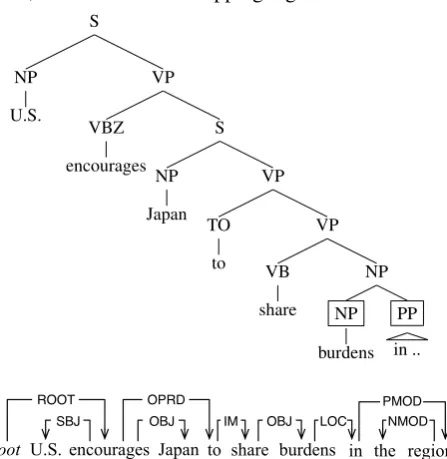
inbecame the child ofburdensduring the conver-sion, so the subtree ofburdensincludes the subtree ofin, which causes overlapping arguments.
S
NP U.S.
VP
VBZ encourages
S
NP Japan
VP
TO to
VP
VB share
NP
NP burdens
PP in ..
U.S. encourages Japan in
root share
LOC OPRD
to burdens the region NMOD PMOD OBJ
IM OBJ SBJ
[image:5.595.78.302.102.332.2]ROOT
Figure 11: Overlapping argument example 1
When this happens, we reconstruct the depen-dency tree soinbecomes the child ofshareinstead of burdens(Figure 12). By doing so, taking the subtrees ofburdensandinno longer causes over-lapping arguments.3
U.S. encourages Japan in
root share
OPRD
to burdens the region
NMOD PMOD OBJ
IM OBJ SBJ
ROOT LOC
Figure 12: Overlapping argument example 2
5.4 Verb predicates whose semantic arguments are their syntactic heads
There are several cases where semantic arguments of verb predicates become the syntactic heads of the verbs. The modals and negations in the previ-ous sections are special cases where the seman-tic boundaries can be retrieved correctly with-out compromising recall. The following sec-tions describe other cases, such as relative clauses (Section 5.4.2), gerunds and past-participles (Sec-tion 5.4.3), that may cause a slight decrease in re-call by finding more fine-grained semantic bound-aries. In these cases, the subtree of the verb predi-cates are excluded from the semantic arguments.
3This can be considered as a Treebank/Propbank dis-agreement, which is further discussed in Sectino 6.2.
5.4.1 Verb chains
Three kinds of verb chains exist in the current dependency structure: auxiliary verbs (including modals andbe-verbs), infinitive markers, and con-junctions. As discussed in Section 5.1, verb chains become the parents of their main verbs in depen-dency trees. This indicates that when the subtree of the main verb is to be excluded from semantic arguments, the verb chain needs to be excluded as well. This usually happens when the main verbs are used within relative clauses. In addition, more heuristics are needed for retrieving correct seman-tic boundaries for relative clauses, which are fur-ther discussed in Section 5.4.2.
The following figures show examples of each kind of verb chain. It is possible that multiple verb chains are joined with one main verb. In this case, we find the top-most verb chain and exclude its entire subtree from the semantic argument. In Fig-ure 13,partis annotated asARG1of the verb
pred-icategone, chained with the auxiliary verbbe, and again chained with the modalmay. Sincemayis the top-most verb chain, we exclude its subtree so onlya partis retrieved as theARG1ofgone.
a part that be
NMOD
may gone
PRD VC DEP NMOD
Figure 13: Auxiliary verb example
Figure 14 shows the case of infinitive markers.
thoseis annotated as ARG0 of the verb predicate leave, which is first chained with the infinitive markertothen chained with the verbrequired. By excluding the subtree ofrequired, onlythoseis re-trieved as theARG0ofleave.
rules are tough
root those
ROOT
on required SBJ
to AMOD
leave PRD PMOD APPO OPRD IM
Figure 14: Infinitive marker example
Figure 15 shows the case of conjunctions. people
is annotated asARG0of the verb predicateexceed,
which is first chained withor then chained with
meet. By excluding the subtree ofmeet, only peo-pleis retrieved as theARG0 ofexceed.
people who meet exceed NMOD
or the
DEP NMOD
OBJ
expectation CONJ
[image:6.595.80.284.62.98.2]COORD
Figure 15: Conjunction example
ARG1of the verb predicateexpected. By excluding
the subtree ofexpected, the object complementto occurwould be excluded as well; however, Prop-bank annotation requires keeping the object com-plement as the part of the argument. Thus,a dis-tribution to occuris retrieved as the ARG1 of ex-pected.
a distribution expected to occur
[image:6.595.357.476.253.298.2]NMOD APPO OPRD IM
Figure 16: Object complement example
5.4.2 Relative clauses
When a verb predicate is within a relative clause, Propbank annotates both the relativizer (if present) and its antecedent as part of the argument. For ex-ample in Figure 15,peopleis annotated as ARG0
of bothmeetandexceed. By excluding the subtree ofmeet, the relativizerwhois also excluded from the semantic argument, which is different from the original Propbank annotation. In this case, we keep the relativizer as part of theARG0; thus, peo-ple whois retrieved as theARG0 (similarly,a part thatis retrieved as theARG0ofgonein Figure 13).
It is possible that a relativizer is headed by a preposition. In Figure 17,climateis annotated as ARGM-LOC of the verb predicate made and the relativizerwhich is headed by the preposition in. In this case, both the relativizer and the preposi-tion are included in the semantic argument. Thus,
the climate in whichbecomes the ARGM-LOC of made.
the climate in the decisions was PMOD
made which
NMOD NMOD
LOC DEP
[image:6.595.322.512.471.507.2]VC
Figure 17: Relativizer example
5.4.3 Gerunds and past-participles
In English, when gerunds and past-participles are used without the presence ofbe-verbs, they often function as noun modifiers. Propbank still treats them as verb predicates; however, these verbs be-come children of the nouns they modify in the
de-pendency structure, so the heuristics discussed in Section 5.4 and 5.4.1 need to be applied to find the correct semantic boundaries. Furthermore, since these are special kinds of verbs, they require even more rigorous pruning.
When a head word, annotated to be a seman-tic argument of a verb predicate, comes after the verb, every word prior to the verb predicate needs to be excluded from the semantic argument. In Figure 18, group is annotated as ARG0 of the
verb predicatepublishing, so all words prior to the predicate (the Dutch) need to be excluded. Thus, onlygroupis retrieved as theARG0ofpublishing.
the Dutch publishing group NMOD NMOD NMOD
Figure 18: Gerund example
When the head word comes before the verb pred-icate, the subtree of the head word, excluding the subtree of the verb predicate, is retrieved as the se-mantic argument. In Figure 19,correspondenceis annotated as ARG1 of the verb predicate mailed,
so the subtree of correspondence, excluding the subtree ofmailed, is retrieved to be the argument. Thus,correspondence about incomplete 8300s be-comes theARG1ofmailed.
correspondence mailed about NMOD
NMOD
incomplete 8300s NMOD PMOD
Figure 19: Past-participle example 1
When the subtree of the verb predicate is imme-diately followed by comma-like punctuation (e.g., comma, colon, semi-colon, etc.) and the head word comes before the predicate, every word after the punctuation is excluded from the semantic ar-gument. In Figure 20,fellowis annotated asARG1
of the verb predicatenamed, so both the subtree of the verb (named John) and every word after the comma (, who stayed for years) are excluded from the semantic argument. Thus, onlya fellowis re-trieved as theARG1ofnamed.
5.5 Punctuation
[image:6.595.88.271.593.638.2]a fellow named John , who stayed for years
NMOD APPO OPRD
P
DEP TMP PMOD
[image:7.595.78.285.62.109.2]NMOD
Figure 20: Past-participle example 2
needs to be annotated in either Treebank or Prop-bank; because of that, annotation for punctuation is not entirely consistent, which makes it hard to evaluate. Second, although punctuation gives use-ful information for obtaining semantic boundaries, it is not crucial for semantic roles. In fact, some of the state-of-art semantic role labeling systems, such as ASSERT (Pradhan et al., 2004), give an option for omitting punctuation from the output. For these reasons, our final model ignores punctu-ation for semantic boundaries.
6 Evaluations
6.1 Model comparisons
The following list describes six models used for the experiments. Model I is the baseline approach that retrieves all words in the subtrees of head words as semantic boundaries. Model II to VI use the heuristics discussed in the previous sections. Each model inherits all the heuristics from the pre-vious model and adds new heuristics; therefore, each model is expected to perform better than the previous model.
• I - all words in the subtrees (baseline)
• II - modals + negations (Sections 5.1, 5.2)
• III - overlapping arguments (Section 5.3)
• IV - verb chains + relative clauses (Sec-tions 5.4.1, 5.4.2)
• V - gerunds + past-participles (Section 5.4.3)
• VI - excluding punctuations (Section 5.5)
The following list shows measurements used for the evaluations. gold(arg) is the gold-standard set of words for the argument arg. sys(arg) is the set of words forargproduced by our system.
c(arg1, arg2) returns 1 ifarg1 is equal toarg2;
otherwise, returns 0. T is the total number of ar-guments in the Propbank.
Accuracy = 1
T · X
∀arg
c(gold(arg), sys(arg))
P recision = 1 T ·
X
∀arg
|gold(arg)∩sys(arg)| |sys(arg)|
Recall = 1
T · X
∀arg
|gold(arg)∩sys(arg)| |gold(arg)|
F1 = 2·P recision·Recall P recision+Recall
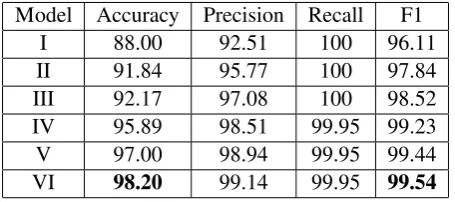
Table 1 shows the results from the models us-ing the measurements. As expected, each model shows improvement over the previous one in terms of accuracy and F1-score. The F1-score of Model VI shows improvement that is statisti-cally significant compared to Model I usingt-test (t = 149.00, p < 0.0001). The result from the final model is encouraging because it enables us to take full advantage of dependency structure for semantic role labeling. Without finding the correct semantic boundaries, even if a semantic role label-ing system did an excellent job findlabel-ing the right head words, we would not be able to find the ac-tual chunks for the arguments. By using our ap-proach, finding the correct semantic boundaries is no longer an issue for using dependency structure for automatic semantic role labeling.
Model Accuracy Precision Recall F1
I 88.00 92.51 100 96.11
II 91.84 95.77 100 97.84
III 92.17 97.08 100 98.52 IV 95.89 98.51 99.95 99.23 V 97.00 98.94 99.95 99.44
[image:7.595.310.530.87.218.2]VI 98.20 99.14 99.95 99.54
Table 1: Model comparisons (in percentage)
6.2 Error analysis
[image:7.595.306.534.484.585.2]con-junctions. For example in Figure 8, instead of an-notatingmay or may notas theARGM-MOD, some annotations include onlymayandmay notbut not the conjunctionor. Since our system consistently included the conjunctions, they appeared to be dif-ferent from the gold-standard, but are not errors.
For Model III, Treebank annotation was not done consistently for adverbs modifying nega-tions. For example in Figure 10, longeris some-times (but rarely) annotated as an adjective where it is supposed to be an adverb. Furthermore,
longer sometimes becomes a child of the verb predicateoppose(instead of being the child ofno). Such annotations made our system excludelonger
as a part of ARGM-NEG, but it would have found them correctly if the trees were annotated consis-tently.
There are a few cases that caused errors in Mod-els IV and V. The most critical one is caused by PP (prepositional phrase) attachment. In Figure 21,
enthusiasmis annotated asARG1of the verb
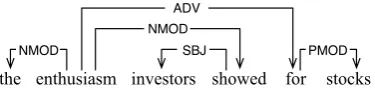
pred-icateshowed, so our system retrieved the subtree of enthusiasm, excluding the subtree of showed, as the semantic boundary for the ARG1 (e.g., the enthusiasm). However, Propbank originally an-notated boththe enthusiasmandfor stocksas the ARG1 in the phrase structure tree (so the
preposi-tional phrase got lost in our system).
the enthusiasm investors showed for stocks
NMOD
NMOD
SBJ ADV PMOD
Figure 21: PP-attachment example 1
This happens when there is a disagreement be-tween Treebank and Propbank annotations: the Treebank annotation attached the PP (for stocks) to the verb (showed) whereas the Propbank anno-tation attached the PP to the noun (enthusiasm). This is a potential error in the Treebank. In this case, we can trust the Propbank annotation and re-construct the tree so the Treebank and Propbank annotations agree with each other. After the re-construction, the dependency tree would look like one in Figure 22.
the enthusiasm investors showed for stocks
NMOD
NMOD
SBJ PMOD
[image:8.595.88.276.691.736.2]ADV
Figure 22: PP-attachment example 2
7 Conclusion and future work
We have discussed how to convert phrase struc-ture trees to dependency trees, how to find the minimum-set of head words for Propbank argu-ments in dependency structure, and heuristics for retrieving fine-grained semantic boundaries. By using our approach, we correctly retrieved the se-mantic boundaries of 98.2% of the Propbank ar-guments (F1-score of 99.54%). Furthermore, the heuristics can be used to fix some of the incon-sistencies in both Treebank and Propbank annota-tions. Moreover, they suggest ways of reconstruct-ing dependency structure so that it can fit better with semantic roles.
Retrieving correct semantic boundaries is im-portant for tasks like machine translation where not only the head words but also all other words matter to complete the task (Choi et al., 2009). In the future, we are going to apply our approach to other corpora and see how well the heuristics work. In addition, we will try to find ways of auto-matically adding empty categories to dependency structure so we can deal with the full set of Prop-bank arguments.
Acknowledgments
Special thanks are due to Professor Joakim Nivre of Uppsala University and Claire Bonial of the University of Colorado at Boulder for very helpful insights. We gratefully acknowledge the support of the National Science Foundation Grants CISE-CRI-0551615, Towards a Comprehensive Lin-guistic Annotation and CISE-CRI 0709167, Col-laborative: A Representational and Multi-Layered Treebank for Hindi/Urdu, and a grant from the Defense Advanced Research Projects Agency (DARPA/IPTO) under the GALE pro-gram, DARPA/CMO Contract No. HR0011-06-C-0022, subcontract from BBN, Inc. Any opinions, findings, and conclusions or recommendations ex-pressed in this material are those of the authors and do not necessarily reflect the views of the National Science Foundation.
References
Susanne Ekeklint and Joakim Nivre. 2007. A dependency-based conversion of propbank. In
Proceedings of NODALIDA workshop on Building Frame Semantics Resources for Scandinavian and Baltic Languages (FRAME’07), pages 19–25.
Daniel Gildea. 2004. Dependencies vs. constituents for tree-based alignment. In Proceedings of the Conference on Empirical Methods in Natural Lan-guage Processing (EMNLP’04), pages 214–221.
Jan Hajiˇc, Massimiliano Ciaramita, Richard Johans-son, Daisuke Kawahara, Maria Ant`onia Mart´ı, Llu´ıs M`arquez, Adam Meyers, Joakim Nivre, Sebastian Pad´o, Jan ˇStˇep´anek, Pavel Straˇn´ak, Mihai Surdeanu, Nianwen Xue, and Yi Zhang. 2009. The conll-2009 shared task: Syntactic and semantic dependencies in multiple languages. InProceedings of the 13th Con-ference on Computational Natural Language Learn-ing (CoNLL’09), pages 1–18.
Richard Johansson and Pierre Nugues. 2007. Ex-tended constituent-to-dependency conversion for en-glish. InProceedings of the 16th Nordic Conference of Computational Linguistics (NODALIDA’07).
Richard Johansson. 2008. Dependency-based Seman-tic Analysis of Natural-language Text. Ph.D. thesis, Lund University.
Jason S. Kessler and Nicolas Nicolov. 2009. Targeting sentiment expressions through supervised ranking of linguistic configurations. InProceedings of the 3rd International AAAI Conference on Weblogs and So-cial Media (ICWSM’09).
Mitchell P. Marcus, Mary Ann Marcinkiewicz, and Beatrice Santorini. 1993. Building a large anno-tated corpus of english: The penn treebank. Compu-tational Linguistics, 19(2):313–330.
Martha Palmer, Daniel Gildea, and Paul Kingsbury. 2005. The proposition bank: An annotated cor-pus of semantic roles. Computational Linguistics, 31(1):71–106.