Proceedings of the NAACL HLT 2010 Fifth Workshop on Innovative Use of NLP for Building Educational Applications, pages 10–18,
Enhancing Authentic Web Pages for Language Learners
Detmar Meurers1, Ramon Ziai1,
Luiz Amaral2, Adriane Boyd3, Aleksandar Dimitrov1, Vanessa Metcalf3, Niels Ott1
1 Universit¨at T¨ubingen
2University of Massachusetts Amherst
3 The Ohio State University
Abstract
Second language acquisition research since the 90s has emphasized the importance of supporting awareness of language categories and forms, and input enhancement techniques have been proposed to make target language features more salient for the learner.
We present an NLP architecture and web-based implementation providing automatic vi-sual input enhancement for web pages. Learn-ers freely choose the web pages they want to read and the system displays an enhanced ver-sion of the pages. The current system supports visual input enhancement for several language patterns known to be problematic for English language learners, as well as fill-in-the-blank and clickable versions of such pages support-ing some learner interaction.
1 Introduction
A significant body of research into the effectiveness of meaning-focused communicative approaches to foreign language teaching has shown that input alone is not sufficient to acquire a foreign lan-guage, especially for older learners (cf., e.g., Light-bown and Spada, 1999). Recognizing the important role of consciousness in second-language learning (Schmidt, 1990), learners have been argued to ben-efit from (Long, 1991) or even require (Lightbown, 1998) a so-calledfocus on formto overcome incom-plete or incorrect knowledge of specific forms or regularities. Focus on form is understood to be “an occasional shift of attention to linguistic code fea-tures” (Long and Robinson, 1998, p. 23).
In an effort to combine communicative and struc-turalist approaches to second language teaching, Rutherford and Sharwood Smith (1985) argued for the use of consciousness raising strategies drawing the learner’s attention to specific language proper-ties. Sharwood Smith (1993, p. 176) coined the term input enhancementto refer to strategies highlighting the salience of language categories and forms.
Building on this foundational research in second language acquisition and foreign language teaching, in this paper we present an NLP architecture and a system for automatic visual input enhancement of web pages freely selected by language learners. We focus on learners of English as a Second Language (ESL), and the language patterns enhanced by the system include some of the well-established diffi-culties: determiners and prepositions, the distinction between gerunds andto-infinitives,wh-question for-mation, tense in conditionals, and phrasal verbs.
already functionally living in the second language environment, but often stagnate in their second lan-guage acquisition and lack access or motivation to engage in language classes or other explicit lan-guage learning activities. Nevertheless, they do use the web to obtain information that is language-based and thus can be enhanced to also support language acquisition while satisfying information needs.
In terms of paper organization, in section 2 we first present the system architecture and in 2.1 the language phenomena handled, before considering the issues involved in evaluating the approach in 2.2. The context of our work and related approaches are discussed in section 3, and we conclude and discuss several avenues for future research in section 4.
2 The Approach
The WERTi system (Working with English Real Texts interactively) we developed follows a client-server paradigm where the client-server is responsible for fetching the web page and enriching it with annota-tions, and the client then receives the annotated web page and transforms it into an enhanced version. The client here is a standard web browser, so on the learner’s side no additional software is needed.
The system currently supports three types of input enhancement: i) color highlighting of the pattern or selected parts thereof, ii) a version of the page sup-porting identification of the pattern through clicking and automatic color feedback, and iii) a version sup-porting practice, such as a fill-in-the-blank version of the page with automatic color feedback.
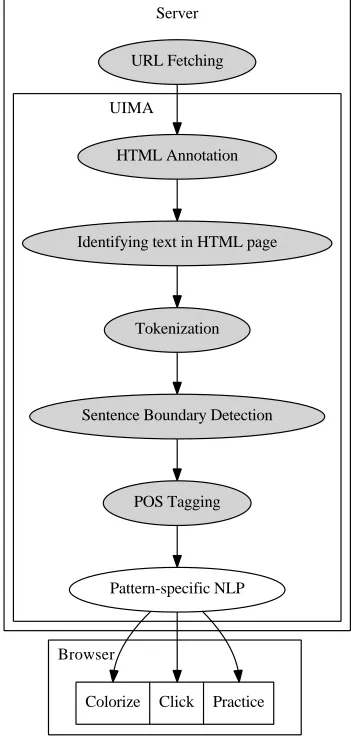
The overall architecture is shown in Figure 1. Essentially, the automated input enhancement pro-cess consists of the following steps:
1. Fetch the page.
2. Find the natural language text portions in it. 3. Identify the targeted language pattern.
4. Annotate the web page, marking up the lan-guage patterns identified in the previous step. 5. Transform the annotated web page into the
out-put by visually enhancing the targeted pattern or by generating interaction possibilities.
Steps 1–4 take place on the server side, whereas step 5 happens in the learner’s browser.1 As NLP is only involved in step 3, we here focus on that step.
1
As an alternative to the server-based fetching of web pages,
Server
UIMA
Browser URL Fetching
HTML Annotation
Identifying text in HTML page
Tokenization
Sentence Boundary Detection
POS Tagging
Pattern-specific NLP
[image:2.612.338.514.79.448.2]Colorize Click Practice
Figure 1: Overall WERTi architecture. Grey components are the same for all patterns and activities, cf. section 2.1.
While the first prototype of the WERTi system2 presented at CALICO (Amaral, Metcalf and Meur-ers, 2006) and EUROCALL (Metcalf and MeurMeur-ers, 2006) was implemented in Python, the current sys-tem is Java-based, with all NLP being integrated in the UIMA framework (Ferrucci and Lally, 2004). UIMA is an architecture for the management and analysis of unstructured information such as text, which is built on the idea of referential annotation and can be seen as an NLP analysis counterpart to current stand-off encoding standards for anno-tated corpora (cf., e.g., Ide et al. 2000). The input
we are developing a Firefox plugin, leaving only the NLP up to the server. This increases compatibility with web pages using dynamically generated contents and special session handling.
2
can be monotonically enriched while passing from one NLP component to the next, using a flexible data repository common to all components (G¨otz and Suhre, 2004). Such annotation-based processing is particularly useful in the WERTi context, where keeping the original text intact is essential for dis-playing it in enhanced form.
A second benefit of using the UIMA framework is that it supports a flexible combination of individual NLP components into larger processing pipelines. To obtain a flexible approach to input enhancement in WERTi, we need to be able to identify and an-alyze phenomena from different levels of linguistic analysis. For example, lexical classes can be iden-tified by a POS tagger, whereas other patterns to be enhanced require at least shallow syntactic chunk-ing. The more diverse the set of phenomena, the less feasible it is to handle all of them within a single processing strategy or formalism. Using the UIMA framework, we can re-use the same basic processing (e.g., tokenizing, POS tagging) for all phenomena and still be able to branch into pattern-specific NLP in a demand-driven way. Given that NLP components in UIMA include self-describing meta-information, the processing pipeline to be run can dynamically be obtained from the module con-figuration instead of being hard-wired into the core system. The resulting extensible, plugin-like archi-tecture seems particularly well-suited for the task of visual input enhancement of a wide range of hetero-geneous language properties.
Complementing the above arguments for the UIMA-based architecture of the current WERTi sys-tem, a detailed discussion of the advantages of an annotation-based, demand-driven NLP architecture for Intelligent Computer-Assisted Language Learn-ing can be found in Amaral, Meurers, and Ziai (To Appear), where it is employed in an Intelligent Lan-guage Tutoring System.
2.1 Implemented Modules
The modules implemented in the current system handle a number of phenomena commonly judged as difficult for second language learners of English. In the following we briefly characterize each mod-ule, describing the nature of the language pattern, the required NLP, and the input enhancement results, which will be referred to asactivities.
Lexical classes
Lexical classes are the most basic kind of linguis-tic category we use for input enhancement. The in-ventory of lexical categories to be used and which ones to focus on should be informed by second language acquisition research and foreign language teaching needs. The current system focuses on func-tional elements such as prepositions and determiners given that they are considered to be particularly dif-ficult for learners of English (cf. De Felice, 2008 and references therein).
We identify these functional elements using the LingPipe POS tagger (http://alias-i.com/
lingpipe) employing the Brown tagset (Francis
and Kucera, 1979). As we show in section 2.2, the tagger reliably identifies prepositions and determin-ers in native English texts such as those expected for input enhancement.
[image:3.612.314.542.437.686.2]The input enhancement used for lexical classes is the default set of activities provided by WERTi. In the simplest case,Color, all automatically identified instances in the web page are highlighted by color-ing them; no learner interaction is required. This is illustrated by Figure 2, which shows the result of en-hancing prepositions in a web page from the British
Figure 2: Screenshot of color activity for prepositions, cf.
newspaper The Guardian.3
In this and the following screenshots, links al-ready present in the original web page appear in light blue (e.g.,Vauban in Germany). This raises an im-portant issue for future research, namely how to de-termine the best visual input enhancement for a par-ticular linguistic pattern given a specific web page with its existing visual design features (e.g., bold-facing in the text or particular colors used to indicate links), which includes the option of removing or al-tering some of those original visual design features. A more interactive activity type is Click, where the learner during reading can attempt to identify in-stances of the targeted language form by clicking on it. Correctly identified instances are colored green by the system, incorrect guesses red.
Thirdly, input can be turned intoPractice activi-ties, where in its simplest form, WERTi turns web pages into fill-in-the-blank activities and provides immediate color coded feedback for the forms en-tered by the learner. The system currently accepts only the form used in the original text as correct. In principle, alternatives (e.g., other prepositions) can also be grammatical and appropriate. The ques-tion for which cases equivalence classes of target an-swers can automatically be determined is an interest-ing question for future research.4
Gerunds vs.to-infinitives
Deciding when a verb is required to be realized as ato-infinitive and when as a gerund-ingform can be difficult for ESL learners. Current school grammars teach students to look for certain lexical clues that reliably indicate which form to choose. Examples of such clues are prepositions such asafterandof, which can only be followed by a gerund.
In our NLP approach to this language pattern, we use Constraint Grammar rules (Karlsson et al., 1995) on top of POS tagging, which allow for straightfor-ward formulation of local disambiguation rules such as: “If an-ingform immediately follows the prepo-sitionby, select the gerund reading.” Standard POS
3Given the nature of the input enhancement using colors, the
highlighting in the figure is only visible in a color printout.
4
The issue bears some resemblance to the task of identify-ing paraphrases (Androutsopoulos and Malakasiotis, 2009) or classes of learner answers which differ in form but are equiva-lent in terms of meaning (Bailey and Meurers, 2008).
tagsets for English contain a single tag for all -ing forms. In order to identify gerunds only, we in-troduce all possible readings for all-ing forms and wrote 101 CG rules to locally disambiguate them. The to-infinitives, on the other hand, are relatively easy to identify based on the surface form and re-quire almost no disambiguation.
For the implementation of the Constraint Gram-mar rules, we used the freely available CG3 system.5 While simple local disambiguation rules are suffi-cient for the pattern discussed here, through iterative application of rules, Constraint Grammar can iden-tify a wide range of phenomena without the need to provide a full grammatical analysis.
The Coloractivity resulting from input enhance-ment is similar to that for lexical classes described above, but the system here enhances both verb forms and clue phrases. Figure 3 shows the system high-lighting gerunds in orange, infinitives in purple, and clue phrases in blue.
Figure 3: Color activity for gerunds vs.to-infinitives, cf.
http://purl.org/icall/werti-color-ex2
For the Click activity, the web page is shown with colored gerund andto-infinitival forms and the learner can click on the corresponding clue phrases. For thePracticeactivity, the learner is presented with a fill-in-the-black version of the web page, as in the screenshot in Figure 4. For each blank, the learner needs to enter the gerund or to-infinitival form of the base form shown in parentheses.
Wh-questions
Question formation in English, with its particu-lar word order, constitutes a well-known challenge for second language learners and has received sig-nificant attention in the second language
acquisi-5
Figure 4: Practice activity for gerunds vs.to-infinitives, cf.http://purl.org/icall/werti-cloze-ex
tion literature (cf., e.g., White et al., 1991; Spada and Lightbown, 1993). Example (1) illustrates the use ofdo-support and subject-aux inversion inwh -questions as two aspects challenging learners.
(1) Whatdoyouthink it takes to be successful?
In order to identify thewh-question patterns, we employ a set of 126 hand-written Constraint Gram-mar rules. The respectivewh-word acts as the lex-ical clue to the question as a whole, and the rules then identify the subject and verb phrase based on the POS and lexical information of the local context. Aside from theColoractivity highlighting the rel-evant parts of a wh-question, we adapted the other activity types to this more complex language pattern. TheClickactivity prompts learners to click on either the subject or the verb phrase of the question. The Practiceactivity presents the words of awh-question in random order and requires the learner to rearrange them into the correct one.
Conditionals
English has five types of conditionals that are used for discussing hypothetical situations and possible outcomes. The tenses used in the different condi-tional types vary with respect to the certainty of the outcome as expressed by the speaker/writer. For ex-ample, one class of conditionals expresses high cer-tainty and uses present tense in theif-clause and fu-ture in the main clause, as in example (2).
(2) Ifthe raincontinues, wewillreturn home.
The recognition of conditionals is approached us-ing a combination of shallow and deep methods. We first look for lexical triggers of a conditional, such as
the wordif at the beginning of a sentence. This first pass serves as a filter to the next, more expensive processing step, full parsing of the candidate sen-tences using Bikel’s statistical parser (Bikel, 2002). The parse trees are then traversed to identify and mark the verb forms and the trigger word.
For the input enhancement, we color all relevant parts of a conditional, namely the trigger and the verb forms. TheClick activity for conditionals re-quires the learner to click on exactly these parts. The Practiceactivity prompts users to classify the condi-tional instances into the different classes.
Phrasal verbs
Another challenging pattern for English language learners are phrasal verbs consisting of a verb and either a preposition, an adverb or both. The meaning of a phrasal verb often differs considerably from that of the underlying verb, as in (3) compared to (4).
(3) Heswitchedthe glasses without her noticing.
(4) Heswitched off the light before he went to bed.
This distinction is difficult for ESL learners, who often confuse phrasal and non-phrasal uses.
Since this is a lexical phenomenon, we ap-proached the identification of phrasal verbs via a database lookup in a large online collection of verbs known to occur in phrasal form.6In order to find out about noun phrases and modifying adverbs possibly occurring in between the verb and its particles, we run a chunker and use this information in specifying a filter for such intervening elements.
The visual input enhancement activities targeting phrasal verbs are the same as for lexical classes, with the difference that for thePracticeactivity, learners have to fill in only the particle, not the particle and the main verb, since otherwise the missing contents may be too difficult to reconstruct. Moreover, we want the activity to focus on distinguishing phrasal from non-phrasal uses, not verb meaning in general.
2.2 Evaluation issues
The success of a visual input enhancement approach such as the one presented in this paper depends on a number of factors, each of which can in principle
be evaluated. The fundamental but as far as we are aware unanswered question in second language ac-quisition research is for which language categories, forms, and patterns input enhancement can be effec-tive. As Lee and Huang (2008) show, the study of visual input enhancement sorely needs more experi-mental studies. With the help of the WERTi system, which systematically produces visual input enhance-ment for a range of language properties, it becomes possible to conduct experiments in a real-life foreign language teaching setting to test learning outcomes7 with and without visual input enhancement under a wide range of parameters. Relevant parameters in-clude the linguistic nature of the language property to be enhanced as well as the nature of the input en-hancement to be used, be it highlighting through col-ors or fonts, engagement in different types of activi-ties such as clicking, entering fill-in-the-blank infor-mation, reordering language material, etc.
A factor closely related to our focus in this pa-per is the impact of the quality of the NLP analysis.8 For a quantitative evaluation of the NLP, one signif-icant problem is the mismatch between the phenom-ena focused on in second language learning and the available gold standards where these phenomena are actually annotated. For example, standard corpora such as the Penn Treebank contain almost no ques-tions and thus do not constitute a useful gold stan-dard for wh-question identification. Another prob-lem is that some grammatical distinctions taught to language learners are disputed in the linguistic liter-ature. For example, Huddleston and Pullum (2002, p. 1120) eliminate the distinction between gerunds and present participles, combining them into a class called “gerund-participle”. And in corpus annota-tion practice, gerunds are not identified as a class by the tagsets used to annotate large corpora, making it unclear what gold standard our gerund identification component should be evaluated against.
While the lack of available gold standards means that a quantitative evaluation of all WERTi mod-ules is beyond the scope of this paper, the deter-miner and preposition classes focused on in the lex-ical classes module can be identified using the
stan-7Naturally, online measures of noticing, such as eye tracking
or Event-Related Potentials (ERP) would also be relevant.
8The processing time for the NLP analysis as other relevant
aspect is negligible for most of the activities presented here.
dard CLAWS-7 or Brown tagsets, for which gold-standard corpora are available. We thus decided to evaluate this WERTi module against the BNC Sampler Corpus (Burnard, 1999), which contains a variety of genres, making it particularly appro-priate for evaluating a tool such as WERTi, which learners are expected to use with a wide range of web pages as input. The BNC Sampler corpus is annotated with the fine-grained CLAWS-7 tagset9 where, e.g., prepositions are distinguished from sub-ordinating conjunctions. By mapping the relevant POS tags from the CLAWS-7 tagset to the Brown tagset used by the LingPipe tagger as integrated in WERTi, it becomes possible to evaluate WERTi’s performance for the specific lexical classes focused on for input enhancement, prepositions and deter-miners. For prepositions, precision was 95.07% and recall 90.52% while for determiners, precision was 97.06% with a recall of 94.07%.
The performance of the POS tagger on this refer-ence corpus thus seems to be sufficient as basis for visual input enhancement, but the crucial question naturally remains whether identification of the target patterns is reliable in the web pages that language learners happen to choose. For a more precise quan-titative study, it will thus be important to try the sys-tem out with real-life users in order to identify a set of web pages which can constitute an adequate test set. Interestingly, which web pages the users choose depends on the search engine front-end we provide for them. As discussed under outlook in section 4, we are exploring the option to implicitly guide them towards web pages containing enough instances of the relevant language patterns in text at the appro-priate reading difficulty.
3 Context and related work
Contextualizing our work, one can view the auto-matic visual input enhancement approach presented here as an enrichment of Data-Driven Learning (DDL). Where DDL has been characterized as an “attempt to cut out the middleman [the teacher] as far as possible and to give the learner direct access to the data” (Boulton 2009, p. 82, citing Tim Johns), in visual input enhancement the learner stays in
trol, but the NLP uses ‘teacher knowledge’ about rel-evant and difficult language properties to make those more prominent and noticeable for the learner.
In the context of Intelligent Computer-Assisted Language Learning (ICALL), NLP has received most attention in connection with Intelligent Lan-guage Tutoring Systems, where NLP is used to ana-lyze learner data and provide individual feedback on that basis (cf. Heift and Schulze, 2007). Demands on such NLP are high given that it needs to be able to handle learner language and provide high-quality feedback for any sentence entered by the learner.
In contrast, visual input enhancement makes use of NLP analysis of authentic, native-speaker text and thus applies the tools to the native language they were originally designed and optimized for. Such NLP use, which we will refer to as Authentic Text ICALL (ATICALL), also does not need to be able to correctly identify and manipulate all instances of a language pattern for which input enhancement is intended. Success can be incremental in the sense that any visual input enhancement can be beneficial, so that one can focus on enhancing those instances which can be reliably identified in a text. In other words, for ATICALL, precision of the NLP tools is more important than recall. It is not necessary to identify and enhance all instances of a given pattern as long as the instances we do identify are in fact correct, i.e., true positives. As the point of our sys-tem is to enhance the reading experience by raising language awareness, pattern occurrences we do not identify are not harmful to the overall goal.10
We next turn to a discussion of some interest-ing approaches in two closely related fields, exercise generation and reading support tools.
3.1 Exercise Generation
Exercise generation is widely studied in CALL re-search and some of the work relates directly to the input enhancement approach presented in this paper. For instance, Antoniadis et al. (2004) describe the plans of the MIRTO project to support “gap-filling” and “lexical spotting” exercises in combination with a corpus database. However, MIRTO seems to
fo-10
While identifying all instances of a pattern indeed is not crucial in this context, representativeness remains relevant to some degree. Where only a skewed subset of a pattern is high-lighted, learners may not properly conceptualize the pattern.
cus on a general architecture supporting instructor-determined activity design. Visual input enhance-ment or language awareness are not enhance-mentioned. The VISL project (Bick, 2005) offers games and visual presentations in order to foster knowledge of syntac-tic forms and rules, and its KillerFiller tool can cre-ate slot-filler exercises from texts. However, Killer-Filler uses corpora and databases as the text base and it presents sentences in isolation in a testing setup. In contrast to such exercise generation systems, we aim at enhancing the reader’s second language input using the described web-based mash-up approach.
3.2 Reading Support Tools
Another branch of related approaches consists of tools supporting the reading of texts in a foreign lan-guage. For example, the Glosser-RuG project (Ner-bonne et al., 1998) supports reading of French texts for Dutch learners with an online, context-dependent dictionary, as well as morphological analysis and ex-amples of word use in corpora. A similar system, focusing on multi-word lexemes, was developed in the COMPASS project (Breidt and Feldweg, 1997). More recently, the ALPHEIOS project11 has pro-duced a system that can look up words in a lexi-con and provide aligned translations. While such lexicon-based tools are certainly useful to learners, they rely on the learner asking for help instead of enhancing specific structures from the start and thus clearly differ from our approach.
Finally, the REAP project12 supports learners in searching for texts that are well-suited for provid-ing vocabulary and readprovid-ing practice (Heilman et al., 2008). While it differs in focus from the visual input enhancement paradigm underlying our approach, it shares with it the emphasis on providing the learner with authentic text in support of language learning.
4 Conclusion and Outlook
In this paper we presented an NLP architecture and a concrete system for the enhancement of authen-tic web pages in order to support language aware-ness in ESL learners. The NLP architecture is flexi-ble enough to integrate any processing approach that lends itself to the treatment of the language
phe-11
http://alpheios.net 12
nomenon in question, without confining the devel-oper to a particular formalism. The WERTi system illustrates this with five language patterns typically considered difficult for ESL learners: lexical classes, gerunds vs. to-infinitives, wh-questions, condition-als and phrasal verbs.
Looking ahead, we already mentioned the funda-mental open question where input enhancement can be effective in section 2.2. A system such as WERTi, systematically producing visual input enhancement, can help explore this question under a wide range of parameters in a real-life language teaching setting. A more specific future research issue is the auto-matic computation of equivalence classes of target forms sketched in section 2.1. Not yet mentioned but readily apparent is the goal to integrate more language patterns known to be difficult for language learners into WERTi (e.g., active/passive, tense and aspect distinctions, relative clauses), and to explore the approach for other languages, such as German.
A final important avenue for future research con-cerns the starting point of the system, the step where learners search for a web page they are interested in and select it for presentation with input enhance-ment. Enhancing of patterns presupposes that the pages contain instances of the pattern. The less frequent the pattern, the less likely we are to find enough instances of it in web pages returned by the standard web search engines typically used by learn-ers to find pages of interest to them. The issue is re-lated to research on providing learners with texts at the right level of reading difficulty (Petersen, 2007; Miltsakaki and Troutt, 2008), but the focus for us is on ensuring that texts which include instances of the specific language pattern targeted by a given in-put enhancement are ranked high in the search re-sults. Ott (2009) presents a search engine prototype which, in addition to the content-focused document-term information and traditional readability mea-sures, supports indexing based on a more general no-tion of a text model into which the patterns relevant to input enhancement can be integrated – an idea we are exploring further (Ott and Meurers, Submitted).
Acknowledgments
We benefited from the feedback we received at CALICO 06, EUROCALL 06, and the ICALL
course13 at ESSLLI 09, where we discussed our work on the Python-based WERTi prototype. We would like to thank Chris Hill and Kathy Corl for their enthusiasm and encouragement. We are grateful to Magdalena Leshtanska, Emma Li, Iliana Simova, Maria Tchalakova and Tatiana Vodolazova for their good ideas and WERTi module contribu-tions in the context of a seminar at the University of T¨ubingen in Summer 2008. Last but not least, the paper benefited from two helpful workshop reviews.
References
Luiz Amaral, Vanessa Metcalf, and Detmar Meur-ers. 2006. Language awareness through re-use of NLP technology. Presentation at the CALICO Workshop on NLP in CALL – Computational and Linguistic Challenges, May 17, 2006. University
of Hawaii. http://purl.org/dm/handouts/
calico06-amaral-metcalf-meurers.pdf.
Luiz Amaral, Detmar Meurers, and Ramon Ziai.
To Appear. Analyzing learner language:
To-wards a flexible NLP architecture for intelligent language tutors. Computer-Assisted Language Learning. http://purl.org/dm/papers/
amaral-meurers-ziai-10.html.
Ion Androutsopoulos and Prodromos Malakasiotis. 2009. A survey of paraphrasing and textual entailment methods. Technical report, NLP Group, Informatics Dept., Athens University of Economics and Business,
Greece.http://arxiv.org/abs/0912.3747.
Georges Antoniadis, Sandra Echinard, Olivier Kraif, Thomas Lebarb´e, Mathieux Loiseau, and Claude Pon-ton. 2004. NLP-based scripting for CALL activities. InProceedings of the COLING Workshop on eLearn-ing for CL and CL for eLearneLearn-ing, Geneva.
Stacey Bailey and Detmar Meurers. 2008. Diagnosing meaning errors in short answers to reading compre-hension questions. In (Tetreault et al., 2008), pages 107–115.
Eckhard Bick. 2005. Grammar for fun: IT-based gram-mar learning with VISL. In P. Juel, editor,CALL for the Nordic Languages, pages 49–64. Samfundslitter-atur, Copenhagen.
Daniel M. Bikel. 2002. Design of a multi-lingual, parallel-processing statistical parsing engine. In Pro-ceedings of the Second Int. Conference on Human Language Technology Research, San Francisco. Alex Boulton. 2009. Data-driven learning: Reasonable
fears and rational reassurance. Indian Journal of Ap-plied Linguistics, 35(1):81–106.
13
Elisabeth Breidt and Helmut Feldweg. 1997. Accessing foreign languages with COMPASS. Machine Transla-tion, 12(1–2):153–174.
L. Burnard, 1999. Users Reference Guide for the BNC Sampler. Available on the BNC Sampler CD.
Rachele De Felice. 2008. Automatic Error Detection in Non-native English. Ph.D. thesis, St Catherine’s Col-lege, University of Oxford.
Catherine Doughty and J. Williams, editors. 1998. Fo-cus on form in classroom second language acquisition. Cambridge University Press, Cambridge.
David Ferrucci and Adam Lally. 2004. UIMA: an ar-chitectural approach to unstructured information pro-cessing in the corporate research environment. Natu-ral Language Engineering, 10(3–4):327–348.
W. Nelson Francis and Henry Kucera, 1979. Brown cor-pus manual. Dept. of Linguistics, Brown University. Thilo G¨otz and Oliver Suhre. 2004. Design and
im-plementation of the UIMA Common Analysis System.
IBM Systems Journal, 43(3):476–489.
Trude Heift and Mathias Schulze. 2007. Errors and In-telligence in Computer-Assisted Language Learning: Parsers and Pedagogues. Routledge.
Michael Heilman, Le Zhao, Juan Pino, and Maxine Eske-nazi. 2008. Retrieval of reading materials for vocab-ulary and reading practice. In (Tetreault et al., 2008), pages 80–88.
Rodney Huddleston and Geoffrey K. Pullum. 2002. The Cambridge Grammar of the English Language. Cam-bridge University Press.
Nancy Ide, Patrice Bonhomme, and Laurent Romary. 2000. XCES: An XML-based encoding standard for linguistic corpora. InProceedings of the 2nd Int. Con-ference on Language Resources and Evaluation. Tim Johns. 1994. From printout to handout: Grammar
and vocabulary teaching in the context of data-driven learning. In T. Odlin, editor,Perspectives on Pedagog-ical Grammar, pages 293–313. CUP, Cambridge. Fred Karlsson, Atro Voutilainen, Juha Heikkil¨a, and
Arto Anttila, editors. 1995. Constraint Grammar: A Language-Independent System for Parsing Unre-stricted Text. Mouton de Gruyter, Berlin, New York. Sang-Ki Lee and Hung-Tzu Huang. 2008. Visual
in-put enhancement and grammar learning: A meta-analytic review. Studies in Second Language Acqui-sition, 30:307–331.
Patsy M. Lightbown and Nina Spada. 1999. How lan-guages are learned. Oxford University Press, Oxford. Patsy M. Lightbown. 1998. The importance of timing in focus on form. In (Doughty and Williams, 1998), pages 177–196.
Michael H. Long and Peter Robinson. 1998. Focus on form: Theory, research, and practice. In (Doughty and Williams, 1998), pages 15–41.
M. H. Long. 1991. Focus on form: A design feature in language teaching methodology. In K. De Bot, C. Kramsch, and R. Ginsberg, editors, Foreign lan-guage research in cross-cultural perspective, pages 39–52. John Benjamins, Amsterdam.
Vanessa Metcalf and Detmar Meurers. 2006.
Generating web-based English preposition
exercises from real-world texts.
Presenta-tion at EUROCALL, Sept. 7, 2006. Granada,
Spain. http://purl.org/dm/handouts/
eurocall06-metcalf-meurers.pdf.
Eleni Miltsakaki and Audrey Troutt. 2008. Real time web text classification and analysis of reading diffi-culty. In (Tetreault et al., 2008), pages 89–97. John Nerbonne, Duco Dokter, and Petra Smit. 1998.
Morphological processing and computer-assisted lan-guage learning. Computer Assisted Language Learn-ing, 11(5):543–559.
Niels Ott and Detmar Meurers. Submitted. Information retrieval for education: Making search engines
lan-guage aware. http://purl.org/dm/papers/
ott-meurers-10.html.
Niels Ott. 2009. Information retrieval for language learn-ing: An exploration of text difficulty measures. Mas-ter’s thesis, International Studies in Computational Linguistics, University of T¨ubingen.
Sarah E. Petersen. 2007. Natural Language Processing Tools for Reading Level Assessment and Text Simplifi-cation for Bilingual EduSimplifi-cation. Ph.D. thesis, Univer-sity of Washington.
William E. Rutherford and Michael Sharwood Smith. 1985. Consciousness-raising and universal grammar.
Applied Linguistics, 6(2):274–282.
Richard W. Schmidt. 1990. The role of conscious-ness in second language learning. Applied Linguistics, 11:206–226.
Michael Sharwood Smith. 1993. Input enhancement in instructed SLA: Theoretical bases. Studies in Second Language Acquisition, 15:165–179.
Nina Spada and Patsy M. Lightbown. 1993. Instruction and the development of questions in l2 classrooms.
Studies in Second Language Acquisition, 15:205–224. Joel Tetreault, Jill Burstein, and Rachele De Felice, ed-itors. 2008. Proceedings of the Third Workshop on Innovative Use of NLP for Building Educational Ap-plications. ACL, Columbus, Ohio, June.