Performance Enhancement of RMPA
Parameters Using Circular shaped Split Ring
Resonator with Rectangular Cross Strips
Metamaterial Structure at 2 GHz
Ram Kishor Sharma1, Mahendra Kumar Pandey2, Sandeep Kumar Agrawal3Research Scholar, Dept. of Electronics and Communication Engineering, RJIT, Gwalior, India1
Assistant Professor, Dept. of Electronics and Communication Engineering, RJIT, Gwalior, India2
Assistant Professor, Dept. of Electronics and Communication Engineering, RJIT, Gwalior, India3
ABSTRACT: In this paper, Rectangular Microstrip Patch Antenna (RMPA) along with metamaterial which has circular Split Ring Resonator and Horizontal & Vertical Rectangular Strips structure is proposed at height of 3.2 mm from the ground plane. The RMPA with proposed metamaterial structure is designed to resonate at 2 GHz frequency. Here in this paper we mainly focused on increasing the potential parameters of microstrip patch antenna. Proposed metamaterial structure is significantly reduced the return loss and increased the bandwidth and directivity of the antenna with compare to RMPA alone. These improvements are due to the Double-Negative (DNG) properties of metamaterial structure that acts as a lens when placed in front of the RMPA. All the simulation work is done by using CST-MWS Software.
KEYWORDS: Rectangular Micro strip Patch Antenna, Metamaterial, Bandwidth, and Return Loss.
I.INTRODUCTION
A Microstrip or Patch Antenna [1][2] is a low profile Antenna that has a number of advantages over other antennas it is lightweight, inexpensive, and easy to integrate with accompanying electronics. While the antenna can be 3D in structure (wrapped around an object, for example), the elements are usually flat, hence their other name, Planner Antennas. A Planner Antenna is not always a patch antenna [3]. But use of Rectangular Microstrip Patch Antenna alone is very difficult because of its low gain and narrow bandwidth. So to overcome these problems an artificial material called Metamaterial [4] is incorporates. Metamaterial [5] are an artificial material engineered to provide properties which are not readily available in nature. We have utilized the Metamaterial Structure on the Rectangular Microstrip Patch Antenna to improve its performance.
II. DESIGN SPECIFICATION
a) FORMULA USED TO DESIGNING RMPA
The Rectangular micro strip patch antenna parameters are calculated from the formulas given below:
Calculation of Width (W)
w = = Where, c = free space velocity of light (1)
εr = Dielectric constant of substrate f = Relative Frequency
The actual length of the Patch (L)
L=Leff- 2ΔL (2)
Where Leff = & ε = +
Calculation of Length Extension
∆ = 0.412( . ) .
( . ) . (3)
Calculation of VSWR
VSWR=S= | || | Where Γ = Reflection Co-efficent (4)
Calculation of Return Loss
Return Loss=20log |Γ| (5)
Calculation of Band Width (BW)
b) ANALYSIS OF RECTANGULAR MICRO STRIP PATCH ANTENNA
Parameter Dimension Unit
Dielectric Constant 4.3 -
Loss Tangent 0.02 -
Thickness 1.6 mm
Operating Frequency 2 GHz
Length 35.44 mm
Width 45.64 mm
Cut Width 5 mm
Cut Depth 10 mm
Path Length 35.99 mm
Feed Width 3 mm
TABLE I: RMPA SPECIFICATIONS
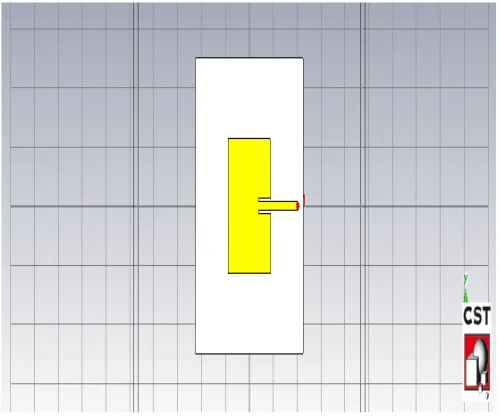
The physical parameters of rectangular micro strip patch antenna are W=45.64 mm, L=35.44 mm, length of transmission line feed= 35.99 mm, with width of the feed= 3 mm. The rectangular micro strip patch antenna designed on one side of glass/epoxy structure with εr = 4.3 and height from the ground plane d= 1.6 mm.
Fig2: Simulated Result of Rectangular micro strip patch antenna showing Return Loss of -11 dB and Bandwidth [6] of 22.5 MHz
Fig4: Directivity of the rectangular micro strip patch antenna at 2 GHz
III. PROPOSED STRUCTURE OF CIRCULAR SHAPED SPLIT RING RESONATOR WITH RECTANGULAR CROSS STRIPS USING METAMATERIAL.
Fig6: Rectangular micro strip patch antenna with proposed Meta material structure.
Fig 8: Radiation pattern of proposed antenna showing Directivity of 7.839 dBi.
Directivity is the figure of merits from an antenna it measure the power density the antenna radiate in that direction.
Fig9: Smith chart of RMPA with proposed meta material structure.
IV.
SIMULATION RESULTS AND THEIR COMPARATIVE ANALYSIS
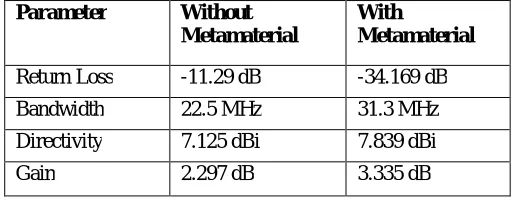
In this section, the simulated results are presented and compare with the basic RMPA. From the simulated results we can easily say that the proposed design gives better results in term of antenna parameters like return loss, bandwidth, directivity and gain as shown below in the table II.
Parameter Without
Metamaterial
With
Metamaterial
Return Loss -11.29 dB -34.169 dB
Bandwidth 22.5 MHz 31.3 MHz
Directivity 7.125 dBi 7.839 dBi
Gain 2.297 dB 3.335 dB
TABLE II: RMPA SPECIFICATIONS with and without metamaterial
From the simulated results of the RMPA along with proposed Meta material cover we found that the potential parameters of the proposed antenna increases significantly in comparison to RMPA alone. The return loss of the RMPA along with proposed Meta material cover is reduced by -34.16 dB.
V. CONCLUSION
The microstrip antenna is simple to fabricate, easy to replacement, low profile and highly efficient. The use of this type of antenna is highly preferred into satellite communication and wireless communication. This antenna gives high gain due to huge reduction in return-loss. The use of Metamaterial provides a large advancement into the parameters of RMPA.In this proposed work we present the advancements into the antenna parameters after the use of meta-material structure at a height of 3.2 mm. The proposed work shows that integration of meta-material design over rectangular patch antenna gives amelioration to the antenna factors like directivity, bandwidth and return loss. These antennas are highly used in mobile and wireless communication the simulated rectangular micro strip patch antenna results in Return Loss of -11.29 dB & 22.5 MHz Bandwidth while when it is designed with Meta material structure at 3.2 mm from the ground plane, it shows Return Loss of -34 .16dB & 31.3 MHz Bandwidth which shows improvement of bandwidth and significant reduction in return loss.
REFERENCES
[1] Anisha Susan Thomas, Prof.A.K. Prakash “A survey on microstrip patch antenna by using Metamaterial” Vol.2, 2278-8875, 2013. [2] V.G. Veselago “The electrodynamics of substances with simultaneously negative value” Sov. Phys. Uspekekhy.10 (4), 509-514, 1968. [3] W.L. Stutzman, G.A. Thiele “Antenna Theory and design” John Wiley & Sons, 2nd Ed., New York, 1998.
[4] J.B. Pendry, A.J. Holden, D.J. Robbins, W.J. Stewart, “magnetism from conductors and enhanced nonlinear phenomena” IEEE Trans. Micro Tech. vol.47 no.11, pp.2075-2081, Nov.1999.
[5] Ayoub, A. F. A., "Analysis of rectangular microstrip antennas with air substrates," Journal of Electromagnetic Waves and Applications, Vol. 17, No. 12, 1755-1766, 2003.
[6] David M. Polar, “Microwave Engineering”, 3rd Edition, John Wiley & Sons, 2004.