http://www.scirp.org/journal/gep ISSN Online: 2327-4344
ISSN Print: 2327-4336
DOI: 10.4236/gep.2018.61007 Jan. 30, 2018 99 Journal of Geoscience and Environment Protection
Assessment of the Acoustic Impact of Wind
Farm Projects: Methodology and Case
Jose Molina-Ruiz
1*, Mari Luz García-Lorenzo
2, Carmen Pérez-Sirvent
3,
María José Martínez-Sánchez
3, Diego Gallego
41Department of Geography, Faculty of Geography, University of Murcia, Murcia, Spain
2Department of Mineralogy and Petrology, Faculty of Geology, University Complutense of Madrid, Madrid, Spain 3Department of Agricultural Chemistry, Geology and Pedology, Faculty of Chemistry, University of Murcia, Murcia, Spain 4Diego Gallego Cambronero Departamento Ecologia, Faculty of Sciences, University of Alicante, Alicante, Spain
Abstract
Wind energy is a clean renewable and its benefits are considered greater than the disadvantages. However, even though wind farms represent environmen-tally friendly projects, they frequently generate public resistance. Wind tur-bines are socially controversial because of their visual and acoustic impacts. The aim of this work was to design a methodology for the preliminary evalua-tion of potential acoustic impact of wind farms. Three steps have been pro-posed: identification, characterization and assessment of the acoustic impact during the construction, operation and decommissioning phase. Obtained results in the studied area suggested that at a maximum power, at 500 meters of wind turbines, noise level is lower than the reference level established in the legislation. In summary, proposed methodology could help to determine and to evaluate the best location for new wind farm projects. Proposed methodol-ogy could help to determine and to evaluate the best location for new wind farm projects. Moreover, this method could be used as a consulting tool for public organizations and private institutions, being quick, concise and clear. Obtained results for the studied wind farm project suggested that almost all the area showed noise levels lower than established background noise level.
Keywords
Wind Turbine, Environmental Impact Assessment, Acoustic Impact, Wind Farm
1. Introduction
Renewable energies, and specially wind energy, have received a big impulse in
How to cite this paper: Molina-Ruiz, J., García-Lorenzo, M.L., Pérez-Sirvent, C., Martínez-Sánchez, M.J. and Gallego, D. (2018) Assessment of the Acoustic Impact of Wind Farm Projects: Methodology and Case. Jour-nal of Geoscience and Environment Pro-tection, 6, 99-110.
https://doi.org/10.4236/gep.2018.61007
Received: November 13, 2017 Accepted: January 27, 2018 Published: January 30, 2018 Copyright © 2018 by authors and Scientific Research Publishing Inc. This work is licensed under the Creative Commons Attribution International License (CC BY 4.0).
http://creativecommons.org/licenses/by/4.0/
DOI: 10.4236/gep.2018.61007 100 Journal of Geoscience and Environment Protection the last decades. The 2009/28/EC Directive on the promotion of the use of ener-gy from renewable sources sets the objective of reaching at least 20% of the EU’s final energy consumption through renewable energy sources by 2020. The Span-ish National Renewable Energy Action Plan (NREAP) splits the overall 20% re-newable energy target into 40.2% rere-newable electricity, 18.9% rere-newable heating and cooling and 13.6% into renewable transport [1].
Among them, wind energy has had the fastest growth rate among the renewa-ble sources of energy over the past few decades due to its competitive price and mature technology. This has resulted in the widespread deployment of wind tur-bines in rural communities [2]. Even if this energy has a “clean” image, it is not difficult to find unfavourable positions regarding the installation of wind farms
[3] [4]. Opposition is mainly based on a combination of visual intrusion, bird-kill and noise impact [5] [6] [7]. Noise can have an effect on the environment, and can be therefore a material consideration in the determination of planning ac-tions.
The Environmental Impact Assessment (EIA) of projects is a legal-administrative procedure for information collection, analysis and forecasting designed to fore-see, prevent and correct the possible effects, both direct and indirect, of the ex-ecution of a particular project on the environment. As regards the legal frame-work, the European Community approved Directive 85/337/EEC, dated 27 June 1985, on assessing the environmental impacts of certain public and private works
[8].
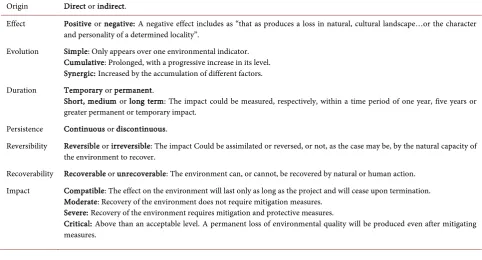
European legislation on Environmental Impact Assessment has been incor-porated into Spanish law through the Legislative Royal Decree 1302/1986, dated 28 June, on Environmental Impact Assessment, and the rules for its application approved by the Royal Decree 1131/1988, dated 30 September [9]. A definition and classification of impact types is included in Annex I of this Royal Decree (Table 1).
In the last few years, from the publication EU “Green Book” about future pol-icies against noise until the directive 2002/49/CE appeared on July 25th 2002 [9], with the resulting transpositions to National Laws, as occurs in Spain with the publication of Law 37/2003, Noise Control Law [10], the result of this has been that both government authorities as well as the enterprises have begun to carry out new studies about the problem of environmental noise and also the study of new methods for assessing it. This law does not establish values, simply provid-ing definitions and deadlines for the execution of noise maps.
Some regional bodies have their own rules regarding noise pollution because establishment of allowed maximum values is a regional competence. In the par-ticular case of Murcia Region is the Decree 48/1998, of 30 July, of the Autonomous Region of Murcia on the Protection of the Environment against noise [11]. In this rule it is established that for natural reserves, the allowed maximum limit is established in 60 dB (A) during the day and 50 dB (A) at night.
evalua-DOI: 10.4236/gep.2018.61007 101 Journal of Geoscience and Environment Protection tion of potential acoustic impact of wind farms. For this aim three steps have been proposed: identification, characterization and assessment of the acoustic impact during the construction, operation and decommissioning phase.
In addition, the proposed methodology was applied to a particular case in Mur-cia Region (SE, Spain).
2. Methodology
In order to establish the methodology to identify, to characterise and to assess the acoustic impact of a wind farm it has been considered that operations could be grouped in three phases: construction, operation and decommissioning phase.
2.1. Identification of Acoustic Impact
2.1.1. Construction PhaseThroughout wind energy project construction, the entire area would be tempo-rarily impacted by site preparation activities, such as clearing, construction of access and on-site roads, preparation and use of material and equipment lay-down areas, erection of turbines, construction of the electrical substation, central control facil-ity and ancillary facilities, and installation of power and signal cables.
The acoustic impact in this phase has a punctual character and is mainly pro-duced by heavy machinery. This impact could affect negatively to the fauna and to residents of close towns.
2.1.2. Operation Phase
No land-disturbing activities and associated impacts are expected during the oper-ation phase. Routine operoper-ations include wind-driven operoper-ations of the turbines to produce power, and regular monitoring and maintenance activities to ensure safe and consistent operation.
Even if these impacts have a punctual character, since wind turbines are sepa-rated more than 100 metres and its effects are not summed, they could affect nega-tively to the fauna and to inhabitants of close towns.
2.1.3. Decommissioning Phase
Decommissioning of a wind farm would include removal of turbines, buildings, concrete pads, and foundations, and the excavation and removal of buried com-ponents. The acoustic impact in this phase has a punctual character and is mainly produced by heavy machinery. This impact could affect negatively to the fauna and to residents of close towns.
2.2. Characterization of Acoustic Impact
2.2.1. Construction PhaseDOI: 10.4236/gep.2018.61007 102 Journal of Geoscience and Environment Protection
Table 1. Types of impacts established in the annex I, royal decree 1131/1988.
Origin Direct or indirect.
Effect Positive or negative: A negative effect includes as “that as produces a loss in natural, cultural landscape…or the character and personality of a determined locality”.
Evolution Simple: Only appears over one environmental indicator. Cumulative: Prolonged, with a progressive increase in its level. Synergic: Increased by the accumulation of different factors. Duration Temporary or permanent.
Short, medium or long term: The impact could be measured, respectively, within a time period of one year, five years or greater permanent or temporary impact.
Persistence Continuous or discontinuous.
Reversibility Reversible or irreversible: The impact Could be assimilated or reversed, or not, as the case may be, by the natural capacity of the environment to recover.
Recoverability Recoverable or unrecoverable: The environment can, or cannot, be recovered by natural or human action. Impact Compatible: The effect on the environment will last only as long as the project and will cease upon termination.
Moderate: Recovery of the environment does not require mitigation measures. Severe: Recovery of the environment requires mitigation and protective measures.
Critical: Above than an acceptable level. A permanent loss of environmental quality will be produced even after mitigating measures.
2.2.2. Operation Phase
During this phase the acoustic impact is direct, negative, simple, temporary (short term for vehicles and long term for wind turbines), continuous, reversible, reco-verable and compatible (Table 1).
2.2.3. Decommissioning Phase
Acoustic impact in this phase is similar to those in construction phase, that is, direct, negative, simple, temporary (short term), discontinuous, reversible, reco-verable and compatible (Table 1).
2.3. Assessment of Acoustic Impact
In order to assess the acoustic impact, we propose to evaluate three different pos-sibilities: minimum power, intermediate power and maximum power. Obtained results from these situations allow establishing noise maps, taking into account the effect of distance in noise mitigation.
Distance mitigation is calculated as follows:
(
2)
10 log 2
p w
L =L − × πr (1)
where:
Lp = resulting noise level (dB),
Lw = noise level in emission source (dB),
r = Euclidean distance between wind turbine and point (m).
DOI: 10.4236/gep.2018.61007 103 Journal of Geoscience and Environment Protection follows:
( )
(
0.1 1 2)
2 10 log 1 10
L L t
L =L + × + − (2)
where:
Lt = resulting noise level (dB) in each pixel,
Li= partial noise level (dB) in each pixel.
Obtained results allow estimating noise generation for the simultaneous activ-ity of all wind turbines.
In order to assess the acoustic impact, it is necessary to consider the back-ground noise level. In this case, wind is the main backback-ground noise source. Wind turbines will generate more noise when increasing wind power, that is, crease of wind turbine noise is directly correlated with background noise in-crease. For this reason, background noise should be considered in its possible variations.
Calculation of background noise levels at different wind speeds is a difficult question since, even at low wind speed (4 m/s), the sound level meter could be saturated registering wrong data. For this reason, some estimated indicative thresholds could be considered, as a function of average wind speed. Once back-ground noise is estimated, a backback-ground noise map could be made, with a con-stant value for each considered power in the studied area.
3. Application of Established Methodology to a Wind Farm
Located in Murcia Region
The studied wind farm is located in Murcia Region, with a surface of 171 hec-tares and 16 wind turbines with a rated power of 32 MW and 2480 equivalent hours.
The calculation of noise levels was made bearing in mind three possibilities: minimum power (60.9 dB (A)), intermediate power (68 dB (A)) and maximum power (75.3 dB (A)), taking into account wind turbine manufacturer informa-tion.
A noise map was made for each wind turbine, considering the effect of tance in noise mitigation. For this study, 3400 sampling points, randomly dis-tributed were selected, and, by way of kriging interpolation, results were extra-polated to the rest of the study area. At last, maps were added to obtain a final noise map.
Background noise level was also incorporated, considering that this level is a constant value for all the study area for each considered operation power.
DOI: 10.4236/gep.2018.61007 104 Journal of Geoscience and Environment Protection Noise levels lower than background noise level could appear during the extra-polation process. This error could be corrected in the map legend, establishing that the maximum value of the first interval should be the background noise lev-el. In our case, 6 intervals were established: (0-background noise level), (background noise level-60), (60 - 65), (65 - 70), (70 - 75) and (>75).
3.1. Construction Phase
Produced noise level during construction of access roads and concrete pads was determined.
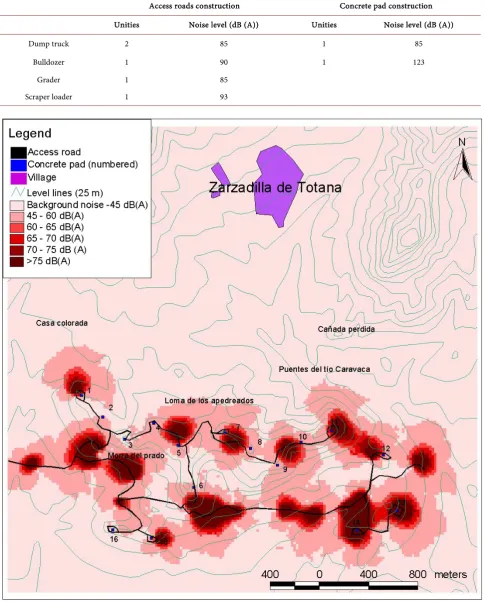
• Access road construction: during this operation employed machinery and its noise level is summarised in Table 2, and result map has been calculated as a sum of noise maps for all the machinery working at the same time (maxi-mum possible noise) (Figure 1). For this calculation, wind speed has been considered in 7 m/s and background noise level is 45 dB (A). Almost all the studied area showed noise level lower than established background noise. Allowed maximum levels (>75 dB (A)) were exceeded in 15 hectares (Table 3).
The study area is not located in none of noise categories established in the Decree 48/1998 [12], and there is no applicable regulation.
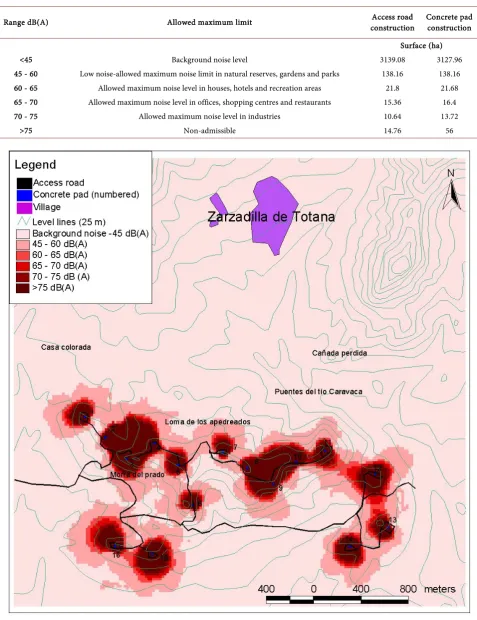
• Concrete pad construction: employed machinery and its noise level is sum-marised in Table 2. Result map taking into account the maximum possible noise situation (Figure 2) showed that noise level ranged from 45 to 60 dB(A) for almost all the territory. Allowed maximum values were exceeded in 56 hectares (Table 3), corresponding to the concrete pad location.
3.2. Operation Phase
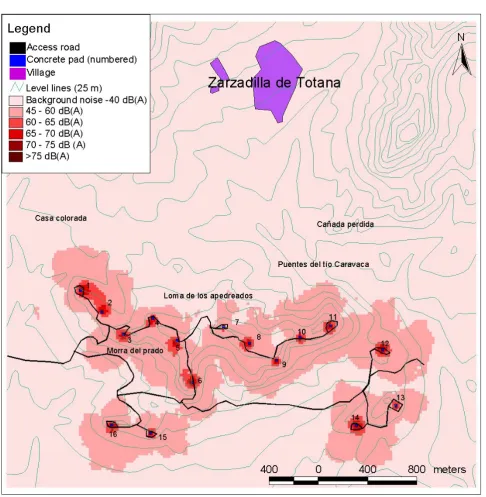
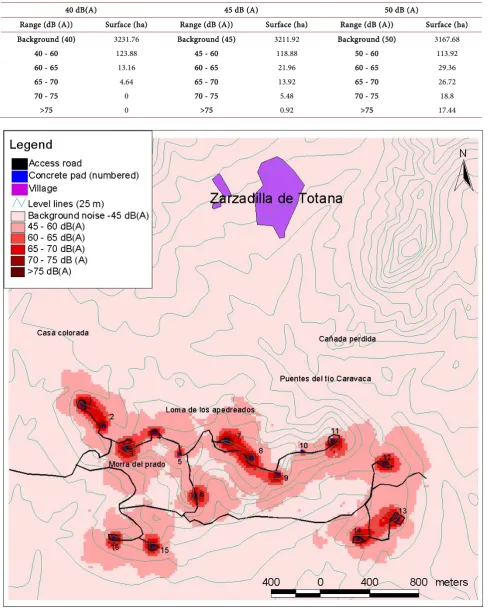
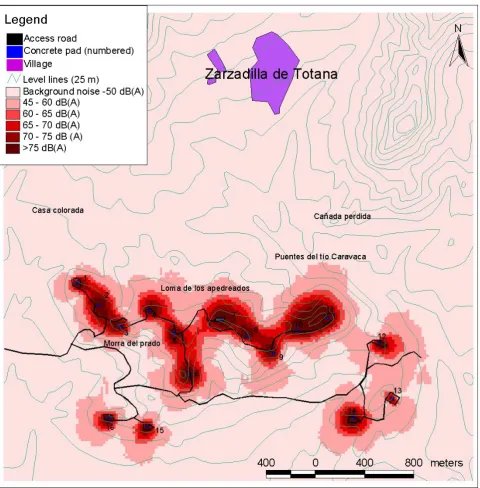
Noise level has been determined at 10, 50, 100 and 500 metres of the wind tur-bine, taking into account wind turbine manufacturer information (Table 4). Af-fected surface for each noise interval is summarized in Table 5, bearing in mind the 3 wind speed possibilities and the background noise level (Figures 3-5). For the three conditions, almost all the study area showed noise levels lower than background level.
The study zone does not present any figure of protection and is not located close to towns or cities (the most restrictive situations in the current legislation). Noise impact is slight in this phase and the admissible maximum value is only surpassed in 0.92 and 17.44 hectares, for 7 m/s and 21 m/s wind speed, respec-tively. In addition, it is important to consider that wind turbines are equipped with and automatic stop when wind speed is higher than 21 m/s after 30 mi-nutes. Therefore, noise under these conditions will show a temporary and low term character.
3.3. Decommissioning Phase
DOI: 10.4236/gep.2018.61007 105 Journal of Geoscience and Environment Protection
Table 2. Estimated noise level for machinery used in the construction phase.
Access roads construction Concrete pad construction Unities Noise level (dB (A)) Unities Noise level (dB (A)) Dump truck 2 85 1 85
Bulldozer 1 90 1 123 Grader 1 85
Scraper loader 1 93
DOI: 10.4236/gep.2018.61007 106 Journal of Geoscience and Environment Protection
Table 3. Surface included in each established noise category.
Range dB(A) Allowed maximum limit construction Access road Concrete pad construction Surface (ha)
<45 Background noise level 3139.08 3127.96 45 - 60 Low noise-allowed maximum noise limit in natural reserves, gardens and parks 138.16 138.16 60 - 65 Allowed maximum noise level in houses, hotels and recreation areas 21.8 21.68 65 - 70 Allowed maximum noise level in offices, shopping centres and restaurants 15.36 16.4 70 - 75 Allowed maximum noise level in industries 10.64 13.72
>75 Non-admissible 14.76 56
DOI: 10.4236/gep.2018.61007 107 Journal of Geoscience and Environment Protection
Table 4. Noise specifications for different power levels and distance from wind turbine (offered by wind turbine manufacturer).
Wind speed (m/s) Power (kW) Noise (dB)
[image:9.595.58.545.198.696.2]10 m 50 m 100 m 500 m 4 73.3 60.9 47.0 40.9 27.0 7 483.7 69.1 55.2 59.1 35.2 21 2000 75.3 61.3 55.3 41.3
DOI: 10.4236/gep.2018.61007 108 Journal of Geoscience and Environment Protection
Table 5. Surface included in each established noise category.
40 dB(A) 45 dB (A) 50 dB (A)
Range (dB (A)) Surface (ha) Range (dB (A)) Surface (ha) Range (dB (A)) Surface (ha) Background (40) 3231.76 Background (45) 3211.92 Background (50) 3167.68
40 - 60 123.88 45 - 60 118.88 50 - 60 113.92 60 - 65 13.16 60 - 65 21.96 60 - 65 29.36 65 - 70 4.64 65 - 70 13.92 65 - 70 26.72 70 - 75 0 70 - 75 5.48 70 - 75 18.8
>75 0 >75 0.92 >75 17.44
DOI: 10.4236/gep.2018.61007 109 Journal of Geoscience and Environment Protection
Figure 5. Noise map in operation phase: maximum power.
4. Conclusions
Proposed methodology for acoustic impact evaluation is a clear and objective technique, which considers the effect of distance in noise mitigation and the background noise level. It’s not necessary to consider the attenuation effect of topographic barriers given that at low distances a noise attenuation takes place. That is, in the studied area and at a maximum power, at 500 meters of wind tur-bines, noise level is lower than the reference level established in the legislation.
influ-DOI: 10.4236/gep.2018.61007 110 Journal of Geoscience and Environment Protection ence region, being a useful instrument in the analysis and management process, offering successful results. Proposed methodology could help to determine and evaluate the best location for wind farms and other industrial activities which could generate acoustic impact.
For the studied wind farm and during the three established phases (construc-tion, operation and decommission), almost all the area showed noise level lower than established background noise level. Even if noise levels do not exceed the allowed maximum limit for almost all the surface, best available methodology should be used.
References
[1] EU Roadmap (2011) Mapping Renewable Energy Pathways towards 2020. EREC. [2] Sedaghatizadeh, N., Arjomandi, M., Cazzolato, B. and Kelso, R. (2017) Wind Farm
Noises: Mechanisms and Evidence for Their Dependency on Wind Direction. Re-newable Energy, 109, 311-322. https://doi.org/10.1016/j.renene.2017.03.046
[3] Hurtado, J.P., Fernández, J., Parrondo, J.L. and Blanco, E. (2004) Spanish Method of Visual Impact Evaluation in Wind Farms. Renewable and Sustainable Energy Re-views, 8, 483-491. https://doi.org/10.1016/j.rser.2003.12.009
[4] Molina-Ruiz, J., Martínez-Sánchez, M.J., Pérez-Sirvent, C., Tudela Serrano, M.L. and García Lorenzo, M.L. (2011) Developing and Applying a GIS-Assisted Approach to Evaluate Visual Impact in Wind Farms. Renewable Energy, 36, 1125-1132.
https://doi.org/10.1016/j.renene.2010.08.041
[5] Tsoutsos, T., Tsouchlaraki, A., Tsiropoulos, M. and Serpetsidakis, M. (2009) Visual Impact Evaluation of a Wind Park in a Greek Island. Applied Energy, 86, 546-553.
https://doi.org/10.1016/j.apenergy.2008.08.013
[6] Maslov, N., Claramunt, C., Wang, T. and Tang, T. (2017) Method to Estimate the Visual Impact of an Offshore Wind Farm. Applied Energy, 204, 1422-1430.
https://doi.org/10.1016/j.apenergy.2017.05.053
[7] Sklenicka, P. and Zouhara, J. (2018) Predicting the Visual Impact of Onshore Wind Farms via Landscape Indices: A Method for Objectivizing Planning and Decision Processes. Applied Energy, 209, 445-454.
https://doi.org/10.1016/j.apenergy.2017.11.027
[8] European Commission (1985) Council Directive 85/337/EEC of 27 June 1985 on the Assessment of the Effects of Certain Public and Private Projects on the Environ-ment.
[9] Royal Decree 1131/1988, of 30 September, Establishing the Regulations of the Per-form of the Royal Decree 1302/1986, of 28 June, of Environmental Impact Assess-ment.
[10] Directive 2002/49/EC of the European Parliament and of the Council of 25 June 2002 Relating to the Assessment and Management of Environmental Noise. Official Journal L 189; 18/07/2002.
[11] Law 37/2003, Noise Control Law of 17 November. 18/11/2003 BOE.