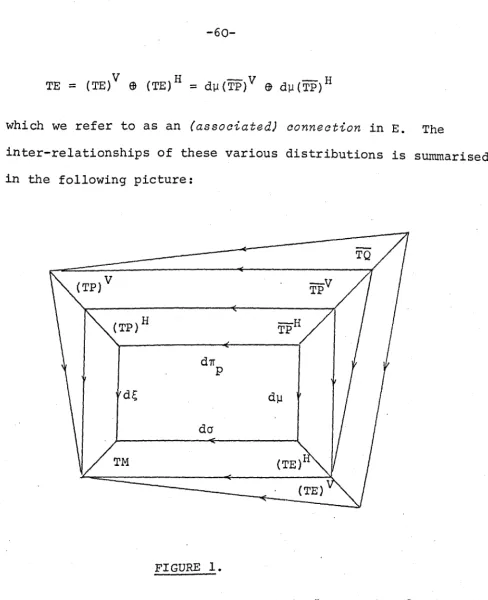
warwick.ac.uk/lib-publications
Permanent WRAP URL:http://wrap.warwick.ac.uk/78846 Copyright and reuse:
This thesis is made available online and is protected by original copyright. Please scroll down to view the document itself.
Please refer to the repository record for this item for information to help you to cite it. Our policy information is available from the repository home page.
SOME ENERGY - RELATED YillIC,rIONALS , AND THEIR VERTICAL VARIATIONAL THEDRY
by
Christopher M. ~[ood
Thesis submitted for the degree of Doctor of Philosophy.
Mathematics Institute
University of Warwick
In memory of our brother, Tim.
" lord, you establish peace for me;
all that I have accomplished, you have: done for me."
ACICOt~LEDGEMENTS
I would like to express my deepest gratitude to my supervisor,
Professor Jim Eells, \"lhose powers of inspiration and encouragement were
at all times a sufficient catalyst for my researching and writing this
thesis.
My special thanks go also to my family for their constant sympathy and support, whilst at times wondering what on earth I was upto.
Of all my many contemporaries at the University of Warwick Maths
Institute, I would particularly like to th~~ Peter Hall, Howard Sealey,
and Michael Weiss, for the elucidation which, probably unbeknown to them,
they helped to provide.
I am grateful to the Science Research CounCil, as it was then known,
for financial support during the period 1978 - 1981 •
Illy final thanks go to Terri Moss for resolutely typing a manuscript which would have otherwise severely taxed the limited typographic skills
The energy and volume of a mapping of Riemannian manifolds are
linked by a discrete family of functionals, indexed by the elementary
symmetric polynomials. We explore the variational properties of members
of this family; in particular, their tension fields, stress-energy tensors,
~~d Jacobi operators.
When one Riemannian manifold fibres over another, applying the
conventional theory of harmonic maps to sections neglects the additional
structure supplied by the fibering. We give an alternative definition
for harmonicity of sections which overcomes this deficiency, and is
closely- enough linked to the conventional theory to share many of the
qualitative properties of harmonic maps. Such "harmonic sections"
arise as solutions to a variational problem, one consequence of which
is to allow the proof of a reduction theorem for harmonic sections of
a Riemannian vector bundle.
The "Gauss section" of an isometrically immersed submanifold
extends the idea of "Gauss map" to ambient spaces of arbitrary curvature.
We prove a non-trivial identity relating Gauss map to second fundamental
form, and generalize to the Gauss section. This leads to a
character-ization of immersions with harmonic Gauss section, and to a further
identity involving a suitably generalized notion of "third fundamental"
form". We are also able to characterize those Riemannian foliations of
(i)
INI'RODUCTION
Given an m-dimensional,. smooth, oriented. Riemannian manifold (H,g), a
symmetric function o:;JRm-lR, and a diagonalisable tensor field B on lit of type (1,1), we may form the O"-integral associated to B by evaluating 0 on
the spectrum of 3 and integrating over (M,g). This construction is
mentioned at the beginning of [E-SJ, where it is also !1oted that when
cp: (£f,g) - (W,h) : is a mapping of Riemannian
manifolds:-(i) The energy of cP is the Cj1/2 - integral,
(ii) The volume of cP is closely related to the Cjm-integral ,
where the or-integral in question is that associated to the (1,1) tensor
*
obtained (by "raising an index" ) from the pulled-back metric cP h , and the rth elementary symmetric polynomial (1r. Since then,R.Reilly has
worlced-out the variational theory for the (1 -integrals associated to the shape
r
operator of an immersed hypersurface ([Rei]), fundamental to the mechanics
of which are certain divergence-free Newton tensors. Inspired by his
exa~ple, and undeterred by the fact that the relevant Newton tensors are
no longer divergence-free, Chapter 1 of this.thesis attempts to do the
same for the fclJ"nily of energy-related (1r-integrals. We begin by laying
out with som~ care the tools of the variational trade - for these are to be redeployed in Chapter 3 where slightl~ more subtlety is involved -and proceed to investigate the critical points of ( j under variations of
r '.
the two independent para..lleters of map CP, and domain metric g. In analogy
wi th the theory for 0"1 ' we have called the corresponding Euler-Lagrange
operators higher-power tension fields, and stress-energy tensors,
respectively. ?ne qualitative picture is much as one would expect. Fbr
instance, on ascending the ladder (whose bottom and top rungs are the
energy and volume functionals respectively), the class of "trivially
higher rank. This is reflected in the quasi-linearity,of the
higher-power tension fields and Jacobi operators, with consequent complications
regarding their ellipticity. There is also a generalization to
even-dimensional manifolds of the conformal invariance and volume-majorizing
properties of the energy functional on maps of surfaces - a natural idea
here is that of r-conformalitl of a map, generalizing weak conformality.
On accolL~t of this, it is tempting to look for nice links between properties
of r-harmonic maps of 2r-manifolds, and the complex geometry of any
holo-morphic structures which may be imposable. HOwever, there is evidence to
suggest that the "bottom rung" may be somewhat special in this respect;
notably that, when r 1, any r-conformal, r-harmonic map of a 2r-manifold
is necessarily homothetic (or r-trivial
J (
Propositions 1.7.2 and 1 .1 .3 )No such thing is true for weakly conformal harmonic maps of a surface, although in this case much is owed to the remarkable properties of
Riemann surfaces. We conclude Chapter 1 with a calculation of the
Euler-Lagrange equations for the volume functional, making .use of higher-power
stress-energy.
Chapter 2 is a catalogue of various results in the geometry of fibre
bundles, for later use, but recorded here to establish notation and
allow the expositions of later results to proceed unhindered. Sections 3
and 4
,
which are referred to in Chapter.
4, deal with the geometry of fibre products and endomorphism bundles, and are almost self-evident. So alsois our brief account of connections in vector bundles from the viewpoint
of connection maps ( §6
J,
which seems the most appropriate for the discussion of Chapter 3 §3. Section 2 is a useful decomposition resultfor curves in a bundle with connection, and is the lynchpin for the proof
(iii)
results concerning Riemannian immersions and submersions. Besides being
of interest in itself, this result is used throughout the thesis.
The title of Chapter 3 is perhaps a little misleading, for the idea of
"harmonic sections it is to generalize the grap~ of a harmonic map rather than to look at bundle cross-sections which are. themselves har~onic maps.
Thus, we are interested not simply in sections "lhose tension field.,
vanishes, but those with vanishing vertical tension fie~~. In the first
instance, the generalization from graphs to sections of non-trivial fibre
bundles is made by looking at the associated .equivariant maps. We then
introduce the (higher-power) vertical energy functionals and examine their
variational theory. It is not surprising that the two notions of harmonic
section thus arising coincide. HOwever, it is interesting to note that
the apparently greater degPee of generality permitted by the variational
viewpoint (namely, loosening "fibre bundle" to any submersion of Riemannian manifolds ~ and "section" to any map) . cannot be fully allowed if there is
to be any hope of computing the Euler-Lagrange equations. Indeed, we are
tlforced" into considering the restricted variational problem of varying a
section through sections, and placing (fairly natural) geometrical
constraints on the submersion itself .
.
Having hitherto worked vIi th the entire range of energy-related
functionals, we now discard the higher-povler energies and look at the
1-harmonic sections of vector bundles. From the variational point of
view it is natural to consider Riemannian vector bundles (Lemma 3.3.3)
and compactly-supported sections (more generally, sections of finite;
vertical enert;!), in which case linearity permits the reduction of the
second order vertical tension field to a first order system. This is
seen as a generalization of the fact that every harmonic map of finite
Chapter by rephrasing for harmonic sections the existence and unique
continuation properties of harmonic maps.
In Chapter 4 we exploit the theory of harmonic sections to study the
geometry of isometrically immersed submanifolds. ~vhen the ambient
space is Euclidean, or more generally of constant curvature, it is
possible to define an associated Gauss map, which takes its values in
an appropriate Grassmannian. The geometry of the Gauss map is then •
nicely related to, the geometry of the immersion (cf
[a-v],
[C-G] , [Oba] ,[Ish]). By replacing the Gauss map with the Gauss section (of the
appropriate Grassmann bundle), it is possible. to obtain a complete
generalization which places no restrictions on the ambient space, and
has correspondingly richer geometrical content. At the heart of the
matter is a connection-preserving vector bundle fibre isometry
(!)
which identifies the 2nd
f~damental
form of the immersion with thevertical differential of its Gauss section (Proposition 4.2.4). Having
obtained this identity, we find ourselves on level ground. On one hand,
applying the Codazzi equation gives an instant generalization of the
theorem of Ruh-Vilms; ; 'on the other, after making a suitable definition
of the third fundamental form, an.~:.application of the Gauss equation gives
an identity of quadratic differentials extending that of M.Obata ( [R-VJ,
[Oba]). Through the consideration of a couple of examples, we are lead
to the idea of an Einsteinian immersion, in which case the generalized.
version of Ruh-Vilms theorem simplifies to a virtual facsimile of its
original. Being fulfilled whenever the ambient space has constant
curvature "Einsteinian" is also the extra condition required for the
,
theorems of Obata's paper to find their place in our more general setting(Corollary 4.2.6 ).
(v)
of the case when the ambient space is Euclidean, for which we offer the
following three justifications. The first is simply to fill a gap in
the literature, previous expositions (e.g. [R-V] , [C-G] ) having omitted
to supply details of their implicit geometrical identifications ( see
Propositions 4.1.1 , 4.1.3, and 4.1.4 below). However, when the ambient
space is flat, it is in these very identifications that all the geometry
lies! Secondly, the properties of one of the identifications (Proposition
4.1.3 ) are needed to prove the "vertical part" of its subsequent
general-ization (Proposition 4.2.3). And thirdly, the proof of Proposition 4.2.4
is directly motivated by that of Proposition 4.1.4.
Our original motivation for a generalization of Ruh-Vilms' theorem
came from the study of the Gauss section of a Riemannian foliation - in
particular, the question "When is the Gauss section harmonic? II (following
a tentative conjecture
ap~earing
on the last page of [KT2] ) - and theconcluding section of Chapter 4 returns to this. Of course, the question
is well-posed for foliations of arbitrary codimension, but in choosing
to approach the problem by piecing together the Gauss sections of
individual leaves matters are considerably simplified in co dimension
,
one. The basic reason for this is that a co dimension one Riemannian
foliation is invariant under parallel translation along normal geodesics,
with the consequence that there is no normal contribution to the vertical
tension field of the full GausS section. It also happens that in
codim~
ension one the generalized Ruh-Vil~s theorem also simplifies, so that
the final result (Theorem 4.3.1 ) is fairly succint. Even so, the explicit
appearance of curvature shows the conjecture of [KT2] to be rather over.
optimistic. As a particularly nice example, we cite the isoparametric
hypersurface foliation of a space form (after removing focal varieties),
Chapter 1 A FAMILY OF ENERGY FUNCTIONALS 2 3 4
5
6 7 8Product manifolds
Induced vector bundles
Variations
Newton polynomials and Newton tensors
Higher - power energy
The first variation 0 f Er (cpt ,g) - tension fields
The second variation of Er (cpt ,g) - Jacobi operators
The first variation of Er (cp,~ ) - stres's-energy tensors
Chapter 2
1 Generalities
2 Horizontal! vertical decomposition of paths
3 Fibre products
4 Hom - bundles
5 Partial connections
6 Connection maps
Chapter 3 Il'AR.MJ NIC SECTro 1:5
1
2
3
4
Graphs of r-harmonic maps
Vertical energies
Harmonic sections of a Riemannian vector bundle
Existence and unique continuation of harmonic sections
Chapter 4 THE GAUSS SECTro N
1 The Ruh-Vilms theorem
2 The Gauss section of a Riemannian immersion
3 The Gauss section of a Riemannian foliation
NOTATION
For the most part, our notation agrees with that of
Kobayashi and Nomizu([K-N]), including their choice of sign
for the curvature tensor. Points at vlhich we may diverge are
usually due to the influence of Spivak ([Spi]); for example:
If a:E + M is a (smooth) fibre bundle, then the space of
(smooth) sections of a is denoted by teE).
Ifa:E + M is a vector bundle, with dual bundle a*:E* + M,
then we ai:>oreviate the tensor bundle E* €;) ••• €;) E* €;) E €;) ••• €I E + M
'"-.... _ - -... . . - - - ' # \.. • . /
to
~~(a) :'~(E)
+ M, and write teE)when a =TM:TM + M,. we abbreviate
=
ij}k,i=1
t~(TM)
tok
.t
k
~ i (E) • In particular,
~~
(H) •The Lie algebra of a Lie group is, on the whole, denoted
by the corresponding lower case Gothic character. For the
classical groups, this is only partially true; for example,
O(n) has Lie algebra a(n).
The summation convention is taken to be in force, unless
otherwise indicated.
As regards cross-referencing, each Remark, Lemma,
Proposition, Theorem and Corollar~r is numbered with respect to the section (§) in which it appears. If mentioned elsewhere
in the same chapter, this nUliwer is preceded by the relevant
section number; if referred to in another chapter, a further
§1. PRODUCT MANIFOLDS
Let TIp (resp. TI Q) denote the projection from the product P x Q of two smooth manifolds onto P (resp. Q), and, for each
(x,y) E P x Q, let
iy:P + P x Qi x ~ (x,y), jx: Q + P x Qi Y ~ (x,y)
be the corresponding inclusions. The tangent bundles
l' p: TP + P and 1'Q:TQ + Q may be "spread out" over P x Q by
defining vector bundles:
R
(x, y)di (T" P) etc.
y x
,
-so that T(P x Q} is isomorphic to TP
e
TQ. Any vector fieldon P (or Q) may then be extended to P x Qi for'example, if
X E t(TP}, define
X
E t(TP} byX
o i=
diY Y o X. A product
fieZd on P x Q is any of the form
X
+ Y, where X E t(TP} andY E t(TQ}; by writing (v,w) for di (v) Y , x + dj (w) E T( x,y } (P x Q)
(where v E TxP and w E TyQ) we have that
X
=
(X,O),Y
=
(O,Y),and
X
+Y
=
(X,Y). Conversely, starting with a vector fieldZ on P x Q and restricting to fibres of TIp (resp. TIQ) produces
a family of vector fields on P (resp. Q):
c t (TP) • "
Say that Z is Q-invariant if Z
=
Z for all y~ E Q. ProductY1 Y2 ...
fields are clearly both p-invariant and Q-invariant - they are
-2-Through the existence of local product frame fields in
T(P x Q), product fields are sufficient to characterise
geometry in P x Q. Thus, if (P,k) and (Q,i) are Riemannian
manifolds, P x Q has the product metric:
k x i«X,Y), (X',Y'))
=
k(X,X') + i(Y,Y')w.r.t. which TP and TQ are orthogonal, and each of rrp' rrQ
a Riemannian submersion. Also:
Proposition
The Levi-Civita connection for (p x Q, k x i) is
charact-erised by:
PXQ~ (X' Y')
=
(p~xX" Q~yY.') (X, Y) ,for all X, X, E C(TP) and Y, Y' E C(TQ).
Proof. Such a connection in T(P x Q) is metric and
torsion-free. c
§2. INDUCED VECTOR BUNDLES
Let rr:E ~ N be a vector bundle, and ¢:P ~ N. Write
' f \ ,
¢-1 rr :¢-1 E ~ P for the vector bundle induced by ¢, and ¢ for
~-1E
=
{(p,e) E P x Ei TI(e)=
~(p)}
IV
>
E.
,
~(p,e)=
eIn
P
>
NCorresponding to any section a of TI is .the pullbaok seotion
-1 -1
~ a of ~ TI:
f -1 ~
Remark 1. I ~
=
TIp:P x Q -+ P, then TIp (TP) TP and-1
TIp (X) ++ X for any X E t(TP).
Since pullback sections provide local fibre bases for
~-1TI'
they are sufficient to characterise geometry in~-1E.
Thus, if TI has fibre metric g, $-1 TI has the pullbaok metrio
-1 ~ g:
1 -1 -1 (
<P~ g(~ a,~ 13)
=
g(a,I3), for a~l a, 13 E t E).Similarly, if TI has connection V,
~-1TI
has the pullbaokoonneotion ~-1V:
Remark 2. If (E,g,V) is a Riemannian vector bundle, so is
-1 -1 -1
(~ E,~ g,~ V).
A morphism TP
2->
E..j- TI
N
-4-section of T*P
~
¢-1 E• The A-torsion of V (see [KT2] is-I-P
-1
then that ¢ E-valued 2-form on P:
for all Z,Z' E C(TP). If D is any connection in TP, the
covariant derivative of A (tensor product connection) is
referred to (c.f. [ViI]) as the fundamentaZ form seA) of A
(w.r.t. D and V):
Proposition 1
TV,A(Z,Z')
=
seA) (Z',Z)-S(A) (Z,Z') + A(TD(Z,Z'»Where TO is the usual torsion of D. In particular, if D is
torsion-free and A has symmetric fundamental form, then TV,A
=
O.Proof.
=
SeA) (Z' ,Z) + A(DZZ') - seA) (Z,Z') - A(DZ'Z) - A[Z,Z']=
seA) (Z',Z) - seA) (Z,Z') + A(TD(Z,Z'». o·In anticipation of Chapter 3, §1, let ~:P + M, and
1jJ -1 (ni) ,II/!
>
TM ; I1jJ (p,v)=
di (1jJ(p»(v) <j,(p).} .}
P
>
M x N1jJ x ep
for any pEP and v E T1jJ(p)M.
Proposition 2.
(ii) If (M,g), (N,h) are Riemannian manifolds, then I1jJ and Iep
are connection-preserving fibre isometries.
Proof. Let X E C(TM} and Z E C(TP). We observe that:
(i) Firstly, I1jJ
°
d1jJ(Z) + Iep°
dep(Z)=
d1jJ(Z) + dep(Z)=
(d1jJ(Z), dep(Z». Now, TIM
°
(1jJ x ep) ,=
1jJ and TI N°
(1jJ x ep) = tf.,'t'
so that, for any pEP:
For any (x,y) E M x N, iy
°
TIM projects M x N onto M x {y},so that d(iyOTIM) (x,y) is the projection of T(x,y) (M x' N) onto
TM(x,y) along TN(x,y)'
(ii) We show that I1jJ commutes with covariant differentiation
-6--1 I1jJ (V'z1jJ X)
=
-1
=
(1jJx¢) (V'd1jJ(Z)X,O), by Proposition 1.1.§3. VARIATIONS
~ . l,;
Suppose initially that M ---) Q ---) N, and that E is a
vector bundle over N. Then (l,; o~) -1 E is isomorphic to
~-1l,;-1E,
an isomorphism being:Il,;,~:(q,e) -+ (q,(~(q),e», for 1T(e)
=
l,; 0 ~(q).Moreover, (l,; 0 ~)-1E and ~-1l,;-1E are geometrically
indist-inguisable:
Proposition 1
If E has a connection and fibre metric, then I ~ is a
l,;,<"
connection-preserving isometry.
Proof. We check that I ~ commutes with covariant
l,;,<"
differentiation as pullback sections. If a E teE) and
WEt (TQ) :
-1 -1 -1 -1 -1
V'W(Il,;,~(l,;o~) a)
=
V'w(~ l,; a)=
~ (V'd~(W)(l,; a»-1 -1 - 1 ·
=
~ l,; (V'dl,;od~ (W)a)=
Il,;,~ «l,;0~) V'd (l,;o~) (W)a)-1
=
Il,;,~(V'W(l,;o~) a)where V' denotes the connection in E along with its various
pullbacks, as appropriate. CI
A variation of ¢:M -+ N is a smooth q,:M x JR -+ N with
q,(x,O)
=
¢(x) for all x E M. Then, replacing Q by M x JR gives the following example of the above:y,~~l(TN)
I
i ~ 1 q,-1 (TN)· /~~_/_'V----> q, -1 (TN)
1 ,//
i t1
-...,.'V-->
q,
TN
1
M
--->
M x JR---->
NBy virtue of Proposition 1, we need make no further distinction
between
¢~1
(TN) . andi~1q,-1
(TN). If ;t denotes the productfield (0,
d~)
on M x JR, define the variation fie Zd of q, bya
-1v = dcp 0 at E C (q, (TN) ); for each t E JR, . put
.-1 -1 -1
v t
=
~t v E C(¢t (TN». Conversely, any sectionVo
E t(¢ (TN» determines a variation ¢t(x)=
exp t vO(x) (subject to a choiceof connection in TN) whose variation field agrees with
Vo
att
=
O.Concerning variations of tensor fields on M, for each
,.
t E JR let it: ~ (M x JR) -+ ~(M) be the extension to ~(M x JR) of:
,.
t (T (M x JR) ) it(Z) = Zt' for all Z E
'" i~n,for all n E t (T* (M x JR» • it W) =
For any B E
C([~(M
x JR», let Bt=
itB EC(l~(M»,
and define dBt k
-8-Proposition 2
dB
tj
dt s 1/
. -a
a
t B .Proof. We prove the case k = 2, i = O. If X,Y E C(TM), then:
Now,
Thus:
(1/
a
B)<x,y)
=at
1/
a
at
(B(X,y» ..:. B(I/
a
X,y)at
A
a
--=
at B(X,Y) B(I/(O ~)(X,O),Y) 'dt=
:t B(X,y), by Proposition 1.1.B (di (X), di (Y» s s
B(X,I/ (0 ~) (Y,O»
'dt
=
B(X,Y)oi • s( is 1/
a
B) (X, Y)=
(1/ a B) (X,Y)
ois=
a~
B (X,Y)
ois atat
=
l' ~m -1 {B(X,y) t-+O t0
i s +t - B(X,y) 0 is}
l' 1 {B t(X,Y) - B (X,Y)} dB
tl
=
~m - = dt s (X, y) • [Jt-+O t s+ s
If h is a Riemannian metric on N, and ~ a variation of ¢:M -+ N
with variation field v, then ~*h is a variation of ¢*h with
proposition 3
where
{Ei}~
is any local frame field in M with dual{ei}~,
and Sym denotes "syrnrnetrisation".Proof. By Proposition 2:
"
*
d¢thl =" is
dt s ¢*h
"
=
(i iJ sa
at
i ¢*h)(E.,E.) e
~ J
(i iJ
s
a
¢*h)(E.,E.) ~ J=
(iJ "I 0 ¢*h)(E.,E.)oi ~ J s=
~t
• ¢*h(E.,E.)oi
ot: l. J S
at
at
by Proposition 1.1.
NOw, since (¢-1 (TN), ¢-1 h , ¢-1NiJ) is a Riemannian vector
bundle (Remark 2.2):
=
h(Va
(d¢OEi),d¢(E j»
+ h(d¢(Ei ), iJa
(d¢OEj»~at
at
We note that d¢ has symmetric fundamental form ([ViI]'>, V is
torsion-free, and [E
i , :t]
=
0, so that by Proposition 2.1:a
-_.¢*h(E.,E.)
at
~ Ja
-
-
a
=
h (iJ - (d¢ o,crt) ,d¢ (E.) ) +h (d¢ (E. ) , VE- (d¢ 0 "ITt»E. J ~.
-10-Now
d¢
(E . )
0 i = d¢ 0 di 0 E. = d<p (E.)J s s J s J
and
v) is -1 -1 'VE v
('V- 0 = i ('V
E
v) = 'VE(i v) =Ei s ~ . ~ . s ~ . s
,
so that:
o i = h('V
E v ,ei<p (E.» + h(d<P (E.) ''VE v ). s . s s J s ~ . s
~ J
o
Increasing the number of parameters in a variation gives
rise to higher order variation fields. In particular, if <P s, t
is a 2-parameter variation of <P:M -+ (N,h) with variation fields
a¢ a¢ nd
v
=
as
and w=
at' then the 2 order variation fields of ¢*h are given by:Proposition 4.
at as
=
2 Sym {h"(RN(W,d<P(Ei»V + 'VE. 'V a v,d<P(E
j » ~
at
+ h('VE.v,'VE.w)}
e
i @e
j •~ J
(Omitting subscript (s,t) for notational clarity) •
Proof. (cf. [Smi] Proposition 1.1)
,..
=
i s,t 'V.... 'V"-a a
at
as
4l*h) (E.,E.)e i ® ej
~ J
=
(IJa
IJa
at
as
4l*h)
(E.,E.)
oi ei®ej~ J s,t
=
IJ d [IJ d (4l*h(Ei ,Ej »] 0 is,t ei
® ej , by Proposition 1.1.
at
as
As in the proof of Proposition 3:
IJ "I (4l*h(E.,E.»
=
(J ~ J
as
so that
NOw,
and
h(IJE.v, d4l(E.» + h(d4l(E.),IJ
E- v),
~ J ~.
J
+ h(IJE.w,IJE.v) + h(d4l(E i ),1J d IJE.v).
~ J
at
JN
-R (w,d4l(E.»v
~
[
d~'
E
i ]
=
0, from which the result follows. c§4. NEWTON POLYNOMIALS AND NEWTON TENSORS
-12-(J (x 1'···,x) l: ef" 7 0 "4 ,;> ~"
=
x. . .. x.r m
i 1<···<ir ~1 ~ r
P (x1'···,x)
=
xr r 1 +...
+ xmr m
f r (x1" " ' x ) m
r
=
(_1)r l:k=1 x. • •• x. ~1 ~k
(For example,
f1
=
x 1 'f2
=
x2 1 - x 2 'Lemma 1. ( [Wae] p. 8 1 )
Lemma 2.
=
f3 f4 r l: p=O=
=
3 x 1 4 x 1 -2x1x2 + x3
2
-
3x1x2 + 2x1x3
x
r-p f P
=
O.2
+ x
2 - x 4 )·
[J
[J
Suppose B is a diagonalisable endomorphism of an
m-dimensional real vector space.Let (Jr(B) and Pr(B) denote
the corresponding polynomials in the eigenvalues of B, and
let fr (B)
=
fr (0'1 (B), ••• ,am (B».In the polynomial ring
~[xJ,define
the rth Newton polynomialof B by:
XB,r (x) = r
p () p .( r r r-1 r
r
(-1) 0r_p B x = -1) {x -01 (B)x + ... +(-1) Or (B)p=O
~k 2. If XB(x) = det (xl -B), the characteristic polynomial
m
of B, then XB,m = (-1) XB•
The Newton polynomials of B satisfy the following recurrence
relation:
Lemma 3.
XB,r (x) =Or (B) - x XB,r-1 (x) • o
We may use the fr(B) to "invert" the Newton polynomials:
Proposition 1.
r r
x
=
r
(-1)P f (B)XB (x) ==0 r-p ,p
r
(-1) {XB,r (x)
+ ••• -t
Proof. By induction on r.
Firstly, x = -(01 (B) - x) + 01 (B) = -XB,1 (x) -t f1 (B).
Now, by the induction hypothesis:
r+1
x = (-1)r{XX r
B,r(x)-f1 (B)xXB,r-1 (x)+ ••• +(-1) fr(B)x}
= (_1)r+1{X (x)-f (B)X (x)+ ••• +(-1)rfr (B)XB 1(x)}
B,r+1 1 B,r ,
r + (_1)r{Or+1 (B)-f
1 (B)Or(B)+ ••• +(-1) f·r (B)01 (B)}, by Lemma 3.
By Lemma 2, the second summand is just fr+1 (B), which completes
-14-Since~r(B) is a polynomial in B, the two endomorphisms
I
have the same eigenspaces. Say the eigenvalues of Bare
~ 1 ' ••• ,jJm E JR, and set:
a r,l. . (B)
=
a . r,l. -(jJ1,···,jJ ) .m = ar (jJ1,···,Gl.·,···,jJm)(i.e., delete jJ.) • . l.
Lemma 4.
For each i, a r,l. . (B)
eigenvalue ofX~ (B).
o,r
Proof. Induction on r.
Thus, a r,l. . (B) is the
a1 . ,l. (B)
=
1:1 1 + ••• + '" jJ i + ••• + 1:1m = a 1 (B) -jJ i =. X B , 1 (jJ i )=
ar+1 (B) - 1:1i XB,r(l!i)' by the induction hypothe~is
[]
From Lemma 4, we have that ar,i(B)
r
= .
r
(-1)Pa (B)jJ pr-p i ·
p=O
We now define
a . . (B)
=
r,l.,J
r
r
(-1)P a . (B)jJr:' r-p,l. -J p=Oproposition 2.
(i) Or l' • (B) =
° .
(B) - ).1. Or 1 . . (B) •, ,J r,1 J - ,1,J
(ii)
° . .
r,1,J (B) =° . .
r,J,1 (B) •(iii)
Proof.
(ii) We have that
° . .
(B)=
r,1,Jr
E (-1)Po (B)
p=o r-p
which is symmetric in i,j.
(iii) Induction on r.
01 . . (B)
=
01 (B) -).1. -).1 .,1,J 1 J
=
°1().11'···'~·'···'~·'···'W)
. 1 J rn°+
r 1 ,,1,
J .(B) =°
r + 1 , i (B) - 11 j Or, i , j (B), by ( i)=
0r+ 1 ().11 ' ••• , ~ . , ••• , ~ . , ••• ,).1 ), by the1 . ] rn
induction hypothesis. c
th
We shall abbreviate XB (B) to X (B), the r Newton tensor
,r r
of B.
Proposition 3.
Proof.
-16-r{ r
=
(-1) Pr (B) -0'1 (B) Pr-1 (B) + ••• + (-1) mar (B)}, by Remark 1
=
(_1)r{(-1)r(m-r)a (B)}, by Lemma 1r
Let {B
t } be a 1-parameter family of diagonalisable endomorphisms. The variations produced in the associated
elementary symmetric polynomials and Newton tensors have the
following variation fields:
Lemma 5. ([Rei] Lemma A)
Lemma 6.
E p+q=r
Proof. An easy induction using Lemma 3. [J
Applying proposition 1 to Lemma 6:
Lemma 7.
[J
§5. HIGHER-POWER ENERGY
Let V be an m-dimensional real vector space with inner
product g, and B a bilinear form on V. Identifying V* @ V* with Hom (V,V*) and noting that the non-degeneracy of g
provides an inverse g-1 E Hom (V*,V), we construct the
endo--1
morphism g B of V.
Lemma 1.
g{g-1 B (v),w)
=
B(v,w), for all v,w E V. CJIf now (M,g) is a compact, oriented, boundaryless, m-dimensional
Riemannian manifold and ¢:(M,g) ~ (N,h), we may form the (1,1)
-1
tensor g ¢*h.
Proposition 1.
Trace g-1¢*h
=
2e(¢), where e(¢)=
!
Ild¢112 is the energydensity of
¢.
Proof. If {E. }m is a g-orthonormal frame:
1 1
Trace g-1¢*h = E g(g tp*h(E.),E.) -1 = E ¢*h(E.,E.),
i 1 1 i 1 1
=
E h(d¢(Ei),d¢(E i ))=
IId¢[[2. CJ iby Lemma
Accordingly, we apply the algebra of §4 to each tangent
th
space of M and define the r energy density of ¢ by:
a (¢) = a (¢,g) = a (g-1¢*h)
r r r
The rth energy of ¢ is then:
-18-=
I
(J (CP,g)vM r g
where Vg is the volume element of (M,g).
Remark 1. If {Ei } is a g-orthonormal frame which is
cp*h-orthogonal, then:
-1
r
g(g CP*h(E.),E.)E.=
j ~ J J
r
j CP*h(E.,E.)E., ~J Jby Lemma 1
=
cp*h(E.,E.)E: = h(dcp(E.),d,l,(E.))E .•~ ~ ~ ~ ~ ~ ~
Thus, {Ei } is a frame of eigenvectors of g-1cp*h, with
corresponding eigenvalues {
II
dcp (Ei ) 112 }. In particular, the
the higher-power energy densities are non-negative.
Proposition 2
Thus,
Proof.
(Jr(CP) (x)
=
0 iff rank dCP(x) < r, for all x E M.E (CP)
=
0 iff rank cp < r.. r
-1
Since all the eigenvalues of g CP*h are non-negative:
=
0 iff g-1cp*h(X) has at most r-1 non-zero eigenvaluesiff rank dcp(x) < r, by Remark 1. c
It is well known that when n
=
2 the energy functionalis conformally invariant i.e. invariant under conformal changes
of metric on M ([E-SJ p. 126). This property generalises to
the higher-power energies, where it is seen to be dependent on
Lemma 2.
If g and g' are Riemannian metrics on M, then:
-1 1
V
=
det (g g')~v.g' g
Note. The (1,1) tensor g . g' has positive eigenvalues -1
(cf. Remark 1), and therefore admits a square root.
Proof. The volume element of g' is characterised as that
unique m-form v , satisfying v ,(E
1', •.. ,E')
=
1, for anyg g m
positively oriented g'-orthonormal·frame {E~}. By Lemma 1:
~
-1
=
g(g g'E~,E!)=
g'(E~,E!)=
c ..
~ J ~ J ~J
so that {(g-1 g ')'E!} is a positively oriented g-orthonormal
~
frame. The result now follows from the transformation law
([Spi] vol. 1, Ch. 7, Thm. 5):
for m-forms wand (1,1) tensors P. c
Proposition 3
E (¢) is conformally invariant iff m
=
2r, or rank ¢ < r.r
Proof. By proposition 2, rank ¢ < r i f f Er(¢,g)
=
0 for anymetric g, in which case Er(¢) is certainly conformally invariant.
-20-Conversely, if Er(~} is conformally invariant, then,
for any strictly positive smooth A:M
+m,
it follows fromLemma 2 that:
Thus,
J
M or( }(
~,g ,m/2-r1) A - Vg=
'0.Assume that Er(~)
f
0, so that 0r(~} is somewhere positive(and nowhere negative).
If
m > 2r (resp.m < 2r), then choosingA
< 1 (resp.A
> 1) gives a contradiction, so that m=
2r. c Define the voZume density of ~: (M,g) + (N,h) by:and the voZume of~ by:
Vol (~)
=
Vol (~,g) vol (~}v • gRemark 2., vol (~) is the factor through which ~ alters
infinitesimal m-dimensional volume. For, if {E.} is a g-ortho-1.
normal frame (hence spanning a parallelopiped of unit volume in
Volume of parallelopiped spanned by
In particular, Vol (~)
=
0 unless ~ at some pOint attainsmaximal rank.
It is well known that when m
=
2 the energy densitymajorises the volume density, equality cOinciding with weak
conformality ([E-S1 p. 126; [Lem]). To generalise this say
that ~:(M,g) ~ (N,h) is r-conformaZ if ~ is conformal on an
open subset (possibly empty),away from which rank ~ < r.
Remark 3. 1-conformality is equivalent to weak conformality.
proposition 4.
Suppose that m
=
2r. Then, crr(~)>
(~) vol (~), withequality precisely when ~ is r-conformal.
Proof. Let {E.} be a g-orthonormal frame diagonalising l.
g-1~*h,
and put Ai=
IId~(Ei)
/I.
By Remark 1:2
o
-< .
L (A (1)· •• 1.' ('r) - A" (r+1)· ··\.dm»'l!ES
m J,.l II ....
If ~ is r-conformal, then either ~*h(x)
=
A(x)g(x) (sothat 1.1 (x)
= ... =
Arn(x)=
A(x», or rank d~(x) < r (so that at
-22-Al-d1) ••• \dr) - \dr+1) ..• \dm)
m
that ar(~)
=
(r) vol (~).=
a for all ~ E S , so mconversely, if ar(~)
of equations:
m
=
(r) vol (~), we have the systemA~(1) ... A~(r) -A~(r+1)···All(m)
=
0, for all ~ E Sm.If one of the A. (x) vanishes, then so do at least r others.
~
On the other hand, if no A. (x) vanishes, they are all equal.
~
Thus, ~ is r-conformal. c
§6. THE FIRST VARIATION OF Er(~t,g) - TENSION FIELDS
Lemma 1. ("Integration by Parts")
Let (E,V,<,» be a Riemannian vector bundle over (M,g)
(compact). If a E teE) and S E t(T*M @ E), then:
f
M <Va,S>v g= - f
M <a, Trace VS>v • gProof. The exterior differential (d) and codifferential (d*)
on E-valued differential forms act on a-forms a, and 1-forms S,
as follows ([E-L] Ch. 1):
da = Va, d*S = 7 Trace
VB·
d th L2 d" f
But, d* is characterise as e -a Jo~nt 0 d. c
Applying the algebra of §4 to each tangent space of M,
Now, let ¢t be a variation of ¢, with variation field v.
If <,> denotes the tensor product metric on T*M@ ¢-1 (TN):
Lemma 2.
Proof. Let {Ei } be a g-orthonormal frame. By Proposition
3.3 and Lemma 4.5:
If in addition {E.} is chosen ¢*h-orthogonal, then {E
i }
1 s .
diagonalises both g-1¢;h and Xr -1 (¢s), so that
[J
-24-Proof.
by Lemma 2
=
-2IM
h (Trace V(dcp 0 X 1(~
)),v )vs r- ~s s g'
by Lemma 1. 0
Define the rth tension fieZd of cp (w.r.t.g) by:
Theorem 1.
cp is a critical pOint of Er w.r.t.g iff Lr(CP,g)
=
O. 0Say that cp is r-harmonic (w.r.t.g) whenever Lr(CP,g)
=
O.Remark. 1-harmonicity is equivalent to harmonicitYi for
Xo (cp, g) = 1 TM so that L 1 (cp) = L (cp) (the usual tension field of cpl.
By proposition 5.2, if rank cp < r then (cp,g) is a minimum
for E
r • Thus: • ii,
Corollary 1.
If rank cp < r, then cp is r-harmonic w.r.t. any metric
on M. 0
With respect to coordinates (xi) in M and (ya) in N,
we have (cf. [E-L] p. 27):
L
r +1<CP,g)Y
=
gij{~(CP~ Xr(CP)~)
ax
- cpIXr(CP)~ Mr~j
a Q ()R. Nr~Q}.
The vanishing of Tr+1 (¢,g) thus determines a symmetric,
second order, quasi-linear system of n equations (n
=
dim N),which we may write in the form:
+ F (¢) =
o.
y
Here, each prinaipaZpart PYS(¢,d) is a homogeneous polynomial
of degree two in the partial
coefficients, along with the
differentials d1, ••• ,dm, whose
F (¢), are functions of the ¢a
y
and their first derivatives. The differential operator Tr+1
is said to be eZZiptia on some submanifold $
~
C2(M,N) if then
associated quadratic forms PyS(¢'v) on
m
are non-degenerate, mfor all vEE
'{OJ
and ¢ E $. (cf. [Hor] p. 268). It is well known that T1 is elliptic on the whole of C2(M,N).i
Henceforward, suppose that (x ) has been chosen such
that
{~I
}m is a g-orthonormal frame which is also¢*h-dXl. x 1
orthogonal, for some x E M.
i
re-order the x so that A1
>
Write·A.
=
l.
II
d¢ ( d iI )
/I
and dX x2
then Ai is the ith
-1 .
eigenvalue of g ¢*h(x) (Remark 5.1). If rank d¢(x)
=
p,define F.
=
XL
d¢(~1
) forl. i dXl. x
1
<
i < p, and extend to an'.
n
h-orthonormal frame {F
a}1 at ¢(x). Now let (ya) be the normal coordinate chart determined by {Fa~·
Lemma 3.
-26-q1 ••• q P1
E r B
P1" 'Pr q1
...
where the generaZised Kronecker symboZs are defined:
(
q1··· q
r\
= s gn )' if the p ~ are distinct and the q. permute the p.
P 1 " , P r ' " 1 1
=
0, otherwise.( q1···q
r\
In our chosen coordinates, evaluating at x forces=
\p
1 ···Pr )identity. Thus:
P
aB 1 aBPr
L { P1 2 2 2 2 Pr
1
= A ••• A + ••• +A ••• A
i P2 Pr · P1 Pr ax i
xI
P1<"'<Pr ax x
=
L crr -1 p(¢)ail
P , ax x
c
Lemma 4.
)
~I (g-1tf,*h)~.
- cr 1 . k(¢ ~ If' Jr- ,J, ax x
Proof. Induction on r.
•
a
I
-1 k -1 k=
--r
{Trace (g ¢*h)o, - (g ¢*h) ,}ax x J J
k NOw, by Lemma 4.3, Xr +1(¢)j
=
Thus:
_a_j X i r+1 (,;,)k - _a_l 0 (,;,) l'k (,;,)
-L;I
(g-1';'*h)k,'I' j - i r+1 'I' Uj - or J' 'I' .... 'I'
ax x ax x ' ax x J
by Lemma 3 and the induction hypothesis. Plugging-in the
recurrence relation of proposition 4.2 completes the induction. c
The matrix of principal parts of Tr+1 (¢) is now given by:
Proof. By Lemma 4:
__ a
__
1 ~y (~)k=
.. i 'l'k Xr 'I' j
3x x
-28-Now, (g ¢*h). -1 k
J =h
as
~~ ~S 'l'J 'l'i g ik so that: ,a i
I
(g -1 ¢ *h)~
=
L: (¢~ a2~a +¢~
a2~a i k • i )ax x J a J ax ax axl.axJ
Thus,
a
I
y k a2~y <Jr,j (¢) axi x ¢k Xr(¢)j=
axiaxj+ lower order terms.
The leading term of Tr+1(¢)Y
=
0 is.L: from which:
i
+
+ 2
+'
r
ar-1,i,j(~){2~r~~
-
~y~~
+2~Y~~
-~y~~} a . a .i<j J 1. J 1. 1. J 1. J
=
- r
r
ar-1,i,k(~)~~ ~~
aia ii k#i
Corollary 2.
(a) When either of y, 13 > P
:-pys(~,a)(x) ;:: 0 (y # '13)
P (~,a)(x) =
r
ar,i (~)aiaiyy i
(b) When both y, 13
-<
p:-pys(~,a)(x)
=
a -1 Q(~)A AQa aQ (Y # 13)r 'Y'IJ Y IJ Y IJ
P
(~,a)
(x)=
a(~)
A2a a +r
ar 1.'(~)a.a.
yy r-1,y,y y y Y i " y 1. 1.
Proof.
(b) P (~,a)(x)
=
YY
2
r
(ar +1.· (~)-A ar -1 i (~»a1..a1.' + ar (~)a ai#y y , ,y ,y y y
= r a . (~) a. a. + a
r (~) a a , by Proposition 4.2 (i) l#Y r,1.,y 1. 1. ,y Y Y
2
=
r
a . (~) a. a. + ar 1 (~)A a a , by Proposition 4.2(i).
-30-Now, for any v E ~m the quadratic form PYS(~,v) (x) has matrix:
A(~,v) = AI (~,v) + A" (~,v)
o
p...
,....
,... .
.
o
• D(~,v) n-pp n-p
where
AI(~,V) = diag { L or . 1 ( ~) v. , ••• , L 2
° . (
~) v. } 2i ,~, ~ i r,~, p ~
D ( ~,v) = diag { L or . (~) v. , ••• , 2 L
° .
(~) v. }. 2i ,~~ ~ . r,~ ~
Clearly, PYS(~,v) (x) is non-degenerate iff A(~,v) is non-degenerate
iff det A(~,v) f O.
If P < r+1, then A(~,v) = O. Moreover, when p = r+1 we have:
AI (~,v)
A"(~,V)
det A(~,v) v2 1 + L
i>r+1
·
·
•
·
2 v.
~
2 2
v2 + L v.
i>r+1 ~
2 2
V 1+ L v
so that, for example, det A(CP, (v1' ••• ,v
r +1,O, ••• ,O»
=
0.When r=2, we observe that the diagonal elements of
A(CP,v) may be re-written:
A (CP, v) yy
=
r
°
1 , (cp)v. + 01 2 (cp)v 2 (y-<
p)i~y ,1,y 1 ,y Y
r
(A2 "'2 "'2 A2)v~=
1 +. .
.
+ A1 +. . .
+ A +.
..
+i Y m 1
r
2 2 ",2V~)
A~
II~iIl2
=
Ai (v1 + ••• +v. + ••• +
=
r
i~y 1 i~y 1
'" E JRm is the vector (v
1 '···,v. 1'O,v. 1""'v ).
where v. Thus:
1 1- 1+ m
A(CP,v) =
A
A
v v"p-1 p p-1 p
.
.
. .
.
.
.
A" A v v p-1 p p-1 pWe recall the expansion of a determinant in terms of principal
minors:
Lemma 5.
Let A E M (R), for some commutative ring R, and write pxp
A
=
AI + A", where AI=
diag {a 11 , ••• ,app }' If1
<
i1 < ••• < ik
<
p, write A. 11· · · 1. k for the principal minor-32- .
\
In the permutation group Sp,write Sp,k for the subgroup
of all shufftes of length k (cf. [Spi] vol. 1, Ch. 7). Then:
det A
=
P
L
k=1
L
11ES p, k
AI A"
11 (1) ·.·11 (k) 11 (k+1) ••. 11 (p) •
Corollary 3.
Let A , ••• ,A w1, ..• w E R. Then:
1 p , . P
A1 w1w2
...
w1wp= A1 A w
1w2
p
w p-1 p w p
c
" + L (_1)k-1 (k-1)
L
A1 .••
A.
••• A. w1wp...
w p-1 p w A p k=2 1<i1< .•• <~~P ~1 ~2 2
••• A w .••. w.
~1 ~
P k.
c
Corollary 4.
In the polynomial .ring ~[X1'···'Xp]' write
A·
X i = x + + x~· + ••• + xp. Then:
1 • • • •
A-p
= . L (k-1)
k=2 1 ~ i1 < •••
x, .. . x .. ..• x .... x
x . • • . x. !< i
k ~ P l.1 l.k P l.1 l.k !
Proof. Put xi = wi· 2 Then by Corollary 3:
P p-k k-1 '" "
(-nPx1 ••• Xp +·L (-1) (-1) (k-1) X1···Xi •.• Xi
k=2 1~i 1<' •• < ik~P 1 · k
••• X x . . . . x.
P ~1 l.k
=
-x
1...
w p-1 p w
-x
p=
0 •o
Now, let $r
={~
E C2(M,N)manifold of C2(M,N).
rank ~ > r}, an open
sub-Theorem 2.
L2 is elliptic on $2.
Proof. Write
w.
=
A.v.,a.1. 1. 1. 1.
Then:
A(~,v) =
2 A 2
=
A.II
v.\I ,
and A.=
1. 1. 1.
.
.
w p-1 p w
so that, by Corollary 3:
+ a.
1. + ••• + ape
A A 2 2
det A(~,v)
=
A1 •.• Ap - i<j L A1"·· .A .••• A ...• A wi w1 . " ] P J'
-34-If ~
~
./. J', th 2 2II
A 112II
A 112 hr en Vi Vj
<
Vi Vj , wit equality precisely2 2
when v
=
(O, .•• ,vi'···,V)., ..• ,O). Thus, w.w.-<
a.a., so that:~ J ~ )
with strict inequality for every v E mm,{O} precisely when
rank d~(x)
>
3. NOw, by Corollary 4:+ P k-1 A A 2 2
L (-1) (k-1) L A
1 ••• A .••• A . . • • A w .••• w.
k -3 - ~ . 1 ••• < ' <~k ~ 1 ~k P ~ 1 ~1 l'
2 2
>
0, since a. . •• a.>
w. • •• w.~1 ~k ~1 ~k
Thus, det A(~,v) > 0 for all v E mm,{O} iff rank d~(x)
>
3so that, L2(~)
=
0 is elliptic iff rank ~ > 2. []. Conjecture
Lr is elliptic on $r. []
§7. THE SECOND VARIATION OF Er(~t,g)
Byway of comparison with [Smi] , we calculate the Hessian
of the r-th energy, and the corresponding Jacobi operator.
The r-th Newton tensor is a positive operator (Remark 5.1,
-1
r-th LapZacian of
¢:
and the r-the Ricci tensors of ¢:
Ric~ (v,w) =h(Ric~ (v),w) E C(M x m)
~,r ~,r
for all v,w E C(¢-1 (TN). Now, suppose that ¢ is (r+1)-harmonic,
and let 4l be a 2-parameter variation of ¢ with variation fields
a4l a4l
as
= v and at = w. Let H¢,r+1 (v,w) denote the Hessian of Er+1 (¢) (evaluated at (v,w». Then:Theorem 1.
H¢,r+1 (v,w) = 2
J
M {h(lJvoX (¢)!,lJwoX r r(~)!)-RiC~
~,r +1(v,w)}v g+
I
(_1)Up+q+u=r-1
- Trace [H
v 0 Xp(¢) 0 H w 0 X q (¢)]}v g
where
a¢* .
hI
H" = -1 s,t E C(T*M ® TM) (cf. Proposition 3.3).
v
g as (0,0) Proof.2
a Er+1 (¢s,t)
I
_
H¢,r+1 (v,w) = at as (0,0)-By repeated application .of Lemma 4.5, bearing in mind that
pl0
Trace = 01:
I
;I
'I
jI
j(1)
-36-a<p* h
=
a
T {g-1 s,t at race asLet {E.} be a g-orthonormal frame diagonalising
~
g-1<p*h. Then, by proposition 3.4:
a2<p* h 1 {g-1 s,t
2
Trace at asi + h(V'E. v , V' w)}X (<p).
~ E. r ~
~
1 1
= Ric¢,r+1 (v,w)+h(V'voXr(¢)l,V'w~Xr(¢)l)+I:t(V'V'
a
v, d<p ° Xr (¢))·dt
On integrating by parts, the third summand vanishes, since <p
is (r+1)-harmonic.
(2) By Lemma 4.7 and Lemma 4.5:
- X ( <p ) ° Hw ° X ( <P) }
o q p 0
=
I
(-1)U f (<p){Trace[H oOXp(<P)]xq(<p)-xq(<p)oH ox (<P)}u w w P
p+q+u=r-1
I
i!
•
)
i
I
I
i
I
, If
a¢*
h Trace {g-1 s,tas
Theorem 1 shows thatH,f.. (v,w) is symmetric, but does 't',r
not readily reveal the corresponding Jacobi operator. For
this, we approach the calculation of H,f.. from a slightly 't',r
different angle:
Theorem 2.
H¢,r+1 (v,w) h(Ric,f.. 't',r+ 1 (w)
Proof.
By
Proposition 3.1:Thus, by the (r+1)-harmonicity of ¢:
Let {E.} be a g-orthonormal frame diagonalising g-1¢*h, chosen
l.
+
v
a
dt
-38-=
~
{VE.
Va d4l(X (<P)(E.),O) + RN(w,d<P(E.»d<P(x (<P)(E.»1. 1.
Tt
r 1. 1. r . 1.noting that [TR, TM]
=
0, and applying Proposition 1.1.=
Ric~ 1 (w) + Trace V(d<P 'I',r+by Proposition 2.1 (cf. the proof of proposition 3.3).
=
Ric<P,r+1 (w) +~<p,r+1
(w) + div (d<P 0d~
Xr(<P t».
DLet us define the rth Jacobi operator of <P (on sections
for any variation ~t of ~ with variation field v. By
Theorem 1, J is self-adjoint w.r.t. h.
~,r
Remark. When r =1, the divergence term. vanishes, so that
J 1 is indeed the Jacobi operator for a harmonic map ~ (cf.
~,
[Smi] ) •
'0 -:S~
In the light of Theorem 6.2, we expect J to be I
~/r
elliptic precisely when rank ~ > r '. at least in the case
r = 2. The equation J~,r(v) =0 determines a semi-Zinear
2nd order system of n equations, which we write in the form
(cf. §6):
where F (v) is of first order. Working with the same
y
coordinates as in §6, we have:
Proposition.
If rank d~(x)
=
p, the, for any X €mm, the symbol ofJ~,2 evaluated at X is:
where:
D(X)
=
diag0:
01 . (~)X. 2 ,,~ ~
i
2
, L 01 . (~) X. }
,~ ~
-40-...
A (X) =A A X X
p-1 p p-1 p
...
A A X Xp-1 p p-1 p 'J. l:
A~
~ IIx.jj2 ~~iP
A A
(X. ~
=
(X1' ••• 'X" ••• ,X )). ~ mProof. Terms of 2 nd order in the v Y arise from the divergence nd
term, and 2 Laplacian.
\7v
=
(v! + va¢~
~ ~
\713. \7v a 2 vY dxi
=
axiaxj Jl!.¢,r(v)Y
=
l: O"r-1,i(¢)i
®
l: \7 a \7v (a . ) (j 1 . (¢)
i i ~ r-,~
Nr~l3)dxi
® _13_ ayYa
- - + lower order terms
ayY
a2vY
+ lower order terms. i i
ax ax
(2) From Lemma 4.6 and Proposition 6.1, we have:
div(d¢ 0
d~
X1 (¢t))=
div (d¢ 0 (2<d¢,\7v> - Hv))= l: \7
a. [d¢o(2<d¢,\7v> - Hv)] (a"i)
i ~
=
2 d¢ grad <d¢,\7v> - d¢ div Hv + lower order terms.i
(a) <d¢,'Vv> = g ij a ¢. (v. S +
vY¢~
fyo)haS Sl. ] J
grad <d¢,'Vv>
I
¢~
a2v S a
+ lower order terms =
dXiaX j axj i,j,S l.
(d¢ grad <d¢,'Vv»y
I
¢~¢~
a2v S + lower
= order terms.
i,j,S ] l. axiaxj
m a2vB = l: 1yA(3
axSaxY
+ lower order terms.
S=1
(b) By proposition 3.3:
2 S Q ,,2 S ' "
{ '" (3 a v , + '" 1-', 0 V } dxl. ~ _ 0 _ ,
H = l: ~ ~ k ' ~ + lower order terms
v S iaxkax] J ax axl. -ax]
div H v
(d¢ div H ) Y
v
order terms
+ lower order
,2
-a
2vYA , , } + lower order terms.
y axl.axl.
Now, for any X E mm and y,S
<
p:(y
'f
S)L
it-y
2 " 2 A, l.
II
x.
l.II .
c; ! i
: i
: i
-42-We saw in the proof of Theorem 6.2 that:
det A(X) > 0 for all X E mm,{O} iff rank d¢(x)
>
3.Thus:
Theorem 3.
J¢,2 is elliptic iff rank ¢ > 2. 0
Conjecture.
If r > 2, then A(X) and D(X) have the same form as their
counterparts in §6, and:
J¢,r is elliptic iff rank ¢ > r.
§8. THE FIRST VARIATION OF Er(p,gt) - STRESS-ENERGY TENSORS
Let,gt be a variation of the Riemannian metric g, with
variation field K. Then, for small enough t, gt is also a
Riemannian metric, and K
t non-degenerate.
Lemma 1.
For all vector fields X, 1-forms 8, and sufficiently
small s:
Proof.
S
.... ~nce g-1g t t -- 1TM for small t, we have:-1
dgt
I
=
dt s gs
_g-1 dg
tl
s dt s i.e.
-1
By Lemma 5.1,
c
Proposition 1
Proof.
Let {Ei}~ be a gs-orthonormal frame. Then:
(b)
d~ls
v = gt=
-1
=Eg.(K o </>*hoX 1(</>,g)(E.),E.)
i S S r- S ~ ~
= - E gs (</>*h oXr_1 (</>,gs) (Ei ) ,KS (Ei
»,
by Ierram 1i
d~ls
-1!
by Lemma 5.2 det (gs gt) Vg ,s
1 -1
-!
dI
det -1
-44-1 -1
=
2 Trace [gs 0 KS 0 Xm-1 (1 TM}1
vg , by Lemma 4.5, noting s
that det
=
(Jm
K (E.),E.}v ,
s ~ ~ g
s
since
Define the rth stress-energy tensor of (¢,g) by:
Remark 1. S1 (¢,g)
of ¢ (cf. [B-E]).
e(¢)g - ¢*h, the stress-energy tensor
Theorem 1.
[J
Remark 2. Lowering an index and plugging-in the recurrence
relation of Lemma 4.3, we have that:
Corollary 1~
If rank ¢
<
r,then Sr(¢,g)=
0 for any metric g.Proof. If rank ¢ < r, then (Jr(¢,g)
=
0 for any g (Proposition5.2) so that g-1¢*h has at most (r-1) non-zero eigenvalues.
But then all the eigenvalues of Xr(¢) vanish (Lemma 4.4), so
that Sr(¢)
=
0, By Remark 2. [JThe vanishing of Sr(¢,g) is completely characterized in
the following:
. 1
·1
,
Proposition 2 (cf. [B-E] Example 3 • 3)
Sr(¢,g) = 0 iff ¢ is r-conformal and either
(i) rank ¢ < r
or (ii)m = 2r.
'Proof. Let {E
i } be a g-orthonormal frame diagonalising
g-1¢*h, and put Ai =lld¢(Ei)
II.
(1) Sr(¢,g) ~o
-
¢is r~conformalIf Sr(¢,g) = 0, then (by Remark 2) all the eigenvalues of
Xr (¢) are the same; a ,'(¢) = 21 a (¢) = a ,(¢) for all i,J'
r,~ r r,]
(Lemma 4.4). By Proposition 4.2: rllt
ar ,( ¢ ) = A 2J' a 1 ' ,( ¢ ) +. a , ,( ¢), so that
,~ r- ,~,J r,~,]
ar,i (¢) = ar,j (¢) iff
(A~
-A~)ar_1,i,j
(¢) = O.The following possibilities exist:
(a) Rank d¢(x) = m. Then a 1 ' ,(¢) ~ 0 so that
r- ,~,J
'
Ai(x) = A, (x) = A(X) say, for all i,j: thus ¢*h(x) =
,J
(b) Rank d¢(x) < m. Say that Ai(x) = O. Then:
o
= 1:A~(x)a
1 ' ,(¢) (x) =j J r - , ~, J ra r,~ ,(¢) (x)
so that rank d¢(x) < r (Proposition 5.2).
2
A (x) g (x) •
Note. r a (¢) = 1: A2 a 1 ,(¢) (a particular case of an r , i r - , ~
~
identity in the elementary symmetric polynomials). Thus, by
Proposition 4.2 (iii)
ra r, -I (¢)
=
1: A~
a 1 ' ,( ¢) •
-46-Consequently, ~ is r-conformal.
(2} Si(~,9) ~ 0 and rank ~~ r
=>
m=
2rIf Sr(~,g)
=
0, then:~. (m-r)a r (~) - m a (~)
I f ' . 2 r If' , by proposition 4.3
=!
2 (m-2r)a r(~).
If' •
So, if ar(~) does not vanish identically (proposition 5.2)·,
then m
=
2r.(3) ~ r-conformal and m
=
2r=>
Sr
(p,g)=
0There are two possibilities to consider:
(a) Rank dcp(x)
<
r. Then, by Corollary 1, Sr (~,g) (x)=
o.
(b) Rank dcp(x)
=
m. Then ll(x)= ...
=
lm(x)=
X{x), say,so that:
Xr (cp, g) (x) 8i 0. E
'0' i
=
..l.
(m) {m-2r} X{x) 2r 8i @ E. =o.
02m r ~
We now consider those (¢,g) which are critical for both
&:-
(¢t?J andEx-
(¢,gt). For this, we make use of variations ofcp which fix ¢(M) i.e. those variation fields v which factor
through dcp:
j
I
~!
!