Abstract—A novel iterative learning control scheme is proposed for control of the end point quality in batch processes.
This new method is based on two-step multi-way partial least squares (MPLS) models. The first-step MPLS model, called the quality MPLS, is used to relate the final qualities with the on-line measurements; the second one, called the measurement MPLS, can relate the on-line measurements with both the manipulated variables and the prior measured variables.
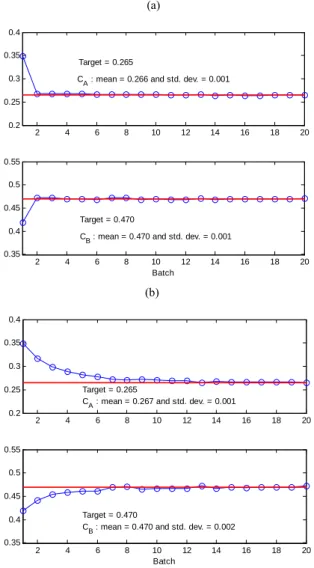
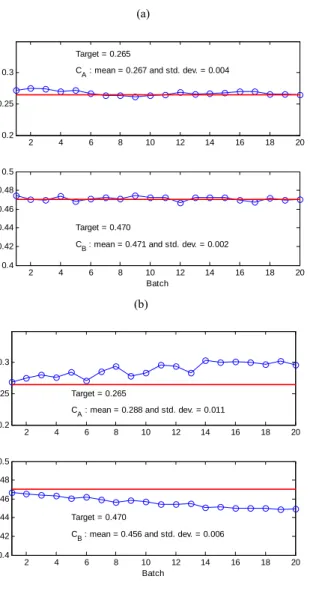
Because the standard MPLS model embeds all process variables into a single input data block, the input variables can be adjusted based on target qualities at the end point. The adjusted inputs in the latent model are fixed when on-line batch control is applied. Thiswillhinderthesystem’squick responsefrom the required changes at each time point. With the proposed method, the desired on-line measured variables along the time axis can be computed using the quality MPLS; then the operating input variables in the latent model can be appropriately adjusted using the measurement MPLS to match the desired on-line measured variables at each time point and finally get the target qualities at the end time point. The applications are discussed through a typical batch reactor to demonstrate the advantages of the proposed method in comparison with the conventional methods.
Index Terms— Batch Processes; Iterative Learning Control;
Multiway Partial Least Squares; Optimization
I. INTRODUCTION
The need to efficiently operate the complexity of industrial semi-batch or batch processes has motivated the development of the new control techniques over the past few years. This especially rings true in the batch processes mainly involved in the production of high-value-added specialty chemicals, such as polymer reaction systems, pharmaceutical manufactures, biochemical and semiconductor processes. The operation of the batch process is quite different from that of the continuous process, because the former, as the name indicates, is characterized by prescribed processing of raw materials as a discrete entity for finite amount of time when producing a finished product. It is transient in nature with their state changed with time so that the operating trajectories of the manipulated variables can have significant effects on the final
This work was sponsored in part by National Science Council, R.O.C., and in part by the Ministry of Economic, R.O.C.
J. Chen is with R & D Center for Membrane Technology, Department of Chemical Engineering, Chung-Yuan Christian University, Chung-Li, Taiwan 320, Republic of China (corresponding author to provide fax:
886-3-265-4199; e-mail: jason@ wavenet.cycu.edu.tw).
K.-C.. Lin was with Department of Chemical Engineering, Chung-Yuan Christian University, Chung-Li, Taiwan 320, Republic of China. He is now with Nanya Technology Corp., Hwa-Ya Technology Park, Taoyuan, Taiwan, Republic of China.
product characteristics.
The control design of batch process has both dynamic and static constraints, so it falls into the class of dynamic optimization problem [1]. When the parameters are associated with the models that are accurate and truly representative of the original batch process, the mathematical model can be used in the optimization methods [2]. However, such accurate models are seldom available in reality, especially for batch processes. Parameters involved with modeling, kinetics and thermodynamics of a reaction, for instance, are not completely established for most of the batch processes. Their dynamic nature is also not very well understood. Some research in the past focused on building empirical models, such as neural networks and fuzzy logic, because of rich information of the operating data. Zhao, et al.
used a multi-layer feedforward neural network to model the batch polypropylene reactor and controlled it by an intelligent compound system consisted of bang-bang control, fuzzy control and traditional PID control [3]. A trained feedforward artificial neural network was proposed to estimate the heat generation term and control the temperature by the feedforward/feedback control algorithm [4]. The batch-to-batch iterative control strategy based on the neural network model was also proposed [5]. Their trained neural network model was refined using the data from the previous batch run. However, the nonlinear predictive control design based on neural network models was computationally demanding.
Recently, data-driven multivariable statistical techniques, such as multi-way principal component analysis and multi-way partial least squares (MPLS), have been widely used to handle high dimensional and coupled data. They attracted lots of interest in involving profile tracking control in batch processes [6, 7]. Because the standard MPLS model embeds the entire batch data in a single data block, the adjusted input variables in the latent space cannot be changed during each batch run.Thiswillhinderthesystem’squick response from fixing the disturbance at each time point. In this paper, the two-step MPLS models are developed to reflect the direct correlation between manipulated variables and measured variables and to improve the performance of the batch process monitoring and quality control. The scheme first divides the process data into two parts. In the first part, a quality MPLS model is constructed to relate the final qualities with the on-line measurements; a measurement MPLS model is used for the second part to relate the on-line measurements with both the manipulated variables and the prior measured variables. With the quality MPLS, the desired on-line measured variables at each time point can be estimated from
Two-Step MPLS-Based Iterative Learning Control for Batch Processes
J. Chen, Member, IAENG and K.-C. Lin
the end point target qualities. The measurement MPLS can then appropriately adjust the manipulated variable profiles to reach the desired on-line measured variables at each time point along the time axis. Because of the model-plant mismatches and unmeasured disturbances, the calculated optimal trajectories may not be optimal when they are implemented onto the actual batch unit. An iterative learning control method is developed to calculate and adjust a recipe.
The remainder of this paper is organized as follows: The second section defines the design problem of the end point quality control. The two-step MPLS models are developed in Section III. In Section IV, the batch-to-batch control is derived based on the two-step MPLS models. The effectiveness of the proposed method is demonstrated through a simulation benchmark of a batch reactor in Section V. This example investigates the performance of the proposed method.
A comparison with the conventional algorithms is also made.
Finally, concluding remarks are made.
II. END-POINTQUALITYCONTROL
The batch control design aims at seeking appropriate manipulated variables (xc) to make the final product qualities (y(tf)) match the desired qualities (ysp) when the batch is finished. It can be mathematically formulated as
) ( 2min
1
f sp
c t
J y y
x
(1)
subject to
) , , (
0 ), , , (
c f m
f c
f m
m t t
x x x h y
x x x g x
and Lxc(t)U
(2)
where y( M1 ) and ysp( M1 ) are the actual and the desired product of M quality variables respectively.
However, y(tf)(1M) can only be measured after the batch run is finished. tfis the duration of each batch run. (1 m)
m J
x
is a vector with Jm on-line measured variables at each sampling point. (1 f)
f J
x is a vector with Jf off-line collected measurements before running the batch. (1 c)
c J
x
is Jc profiles of the manipulated variables at each sampling point. U and L are the lower and upper bounds of the manipulated trajectory, respectively. Although g and h give the description of the dynamic model of the batch process, it is highly difficult to get a reliable process model. Here a data-driven approach is used to construct the model. When there are more than one manipulated variable (Jc 1) and quality variable (M 1), a set of I number of historical batch data over K time intervals can be constructed into three-way arrays and two-way arrays shown in Fig. 1. The two two-way data matrices ( f)
f IJ
X and Y(IM) are defined. The two three-way data matrices are Xm(IJmK) and Xc(IJcK).
Y
Loadings
Scores
I
1
I
Scores
Loadings X
f J f
x f
x1,11,
xf
0 1
Variables1 I Batches Xf
1 Time 1
1 K
I
Xc
1 1
Time 1
1 K
I
Xm
1 , 1
xc xc1,K
xc
…………
0
I
Scores
Loadings 0
xm
Xm 1
, 1m
x ……… x1m,K
Measurement MPLS
Quality MPLS
Jf Jc
Jm
N1
N2
M
Fig. 1. Data structure for modeling a batch process.
III. TWO-STEPMPLS MODELING
The given process data are divided into three blocks, a quality block (Y), an on-line measured block (Xm) and a manipulated block ( X). Y block with a two-way array (IM) summarizes the I runs and the M final properties (or responses). Xm(IN1) block is constructed by unfolding
) (I Jm K
m
X shown in Fig. 1, where (1 m)
m J
x at each
time point are separately filled in the rest of columns of the Xm block along the time axis andN1JmK. X block with a two-way array ( IN2 ) organizes ( f)
f IJ
X and
) (I Jc K
c
X , where N2Jf JcK. In Fig. 1, the first Jf
columns of the X block are the off-line measured data.
) 1
( c
c J
x at each time point are separately filled in the rest of columns of the X block along the time axis. After Xm, X and Y are scaled and mean centered, similar as in the standard MPLS, the MPLS algorithm is separately applied to {X, Xm} and {Xm, Y}. The two outer models are:
Quality MPLS
q T qq T q q q m
F Q U Y
E W T X
(3)
and Measurement MPLS
m
m T mm
T m m m
F Q U X
E W T X
(4)
where
qT I qT i qT
q Rq I q
r I q
I
q Rq i q
r i q
i
q Rq q
r q
q
u u
u
u u
u
u u
u
u u u
U
1
, ,
1 ,
, ,
1 ,
, 1 ,
1 1
, 1
(5)
1,1 1, 1, 1
,1 , ,
,1 , ,
m T
m m m
r Rm
m m m T
m m
i i r i Rm i
m m m
m T
I I r I Rm
I
u u u
u u u
u u u
u
U u
u
(6)
q T I q T i q T
q Rq I q
r I q
I
q Rq i q
r i q
i
q Rq q
r q
q
t t
t
t t
t
t t
t
t t t
T
1
, ,
1 ,
, ,
1 ,
, 1 ,
1 1
, 1
(7)
1,1 1, 1, 1
,1 , ,
,1 , ,
m T
m m m
r Rm
m m m T
m m
i i r i Rm i
m m m
m T
I I r I Rm
I
t t t
t t t
t t t
t
T t
t
(8)
Rqq
q
q w1 w
W and
qRq
q
q q q
Q 1 are the
loading matrices which show the influence of Xm and Y. Eq and Fq are the residual matrices that are not useful for describing Xm and Y respectively. For the measurement MPLS model, similar definitions can be used to explain the relationship between X and Xm. Rq and Rm are the number of principal components. The inner relationships between Xm and Y and between X and Xmare separately given as:
Quality MPLS
q q
q B T
U (9)
Measurement MPLS
m m
m B T
U (10)
) ( 1
q Rq q
qdiagb b
B and ( 1 )
m Rm m
m diagb b
B are
diagonal matrices containing the regression coefficients (brq
and brm) of the score model, respectively. Now, after the MIMO regression process is calculated by MPLS, the data blocks ({X, Xm} and {Xm, Y}) are broken into a series of univariate regression processes (Fig. 2).
(a)
Wq
q R q
bq
b
1
T q) (Q
T pre
q )
(V, i
y
m
xi q
ti uiq
On-line Measured
Output Rotation Quality Output
Rotation
q,post
V
(b)
Wm
m R m
bm
b
1
T m) (Q
T pre
m )
(V,
m
xi
xi m
ti umi
Input
Rotation On-line Measured
Output Rotation
m,post
V
Fig. 2. Diagonalize the batch process: (a) on-line measured outputs and quality outputs; (b) inputs and on-line measured outputs.
In Fig. 2, Vq,post and Vq,preWq are the post-multiplied and the pre-multiplied operators for Xm and Y. Vm,post and
m pre
m W
V , are the post-multiplied and the pre-multiplied operators for X and Xm . After projection, the transformations of input
imK
m i m
i x,1 x,
x and output
i iM
iy,1 y,
y at the batch run i are expressed
respectively,
qi T pre q miV t
x , ,
qi T postq
iV u
y ,
(11) The projection of output
imK
m i m
i x,1 x,
x and input
ciK
c i f i
i x x,1 x,
x at the batch run i can be
represented respectively,
im T pre miV t
x , ,
im T postm m
iV u
x , (12)
As a result, the transformed inputs and outputs for tiq and
q
ui and for tmi and uim are completely decoupled (Fig. 2).
Output Setpoint
Disturbance
Output
Updated Process Parameters
T pre
m )
(V,
m R m
Mm
M1
m R m
Cm
C1
m,sp
u
um
x
y
m R m
dEWMAm
dEWMA1
+
tm m,sp
x
Batch Process xm
Updated Process Parameters
q R q
Mq
M1
q R q
dEWMAq
dEWMA1
+
tq
q R q
Cq
C1
m,post
V
q,sp
u ysp
T pre
q )
(V,
uq
Batch-to-Batch Iterative Learning Control
q,post
V
m,post
V
q,post
V
Measurements
Fig. 3. The structure ILC design using two-step MPLS models.
IV. TWO-STEPMPLS-BASEDITERATIVELEARNING CONTROLDESIGN
The goal of the iterative learning control (ILC) design is to seek appropriate control input profiles xic that yield the product quality yi at the next batch run i to match the desired targets ysp. The block diagram of the two-step MPLS based ILC system is shown in Fig. 3.
A. Computing the Desired On-line Measured Variables using Quality MPLS
ysp and yi are decomposed into the lower dimensional space spPLS qsp
sp y f ,
y and yi yPLS,ifiq. The end point of the control objective ((1)) can be represented as