Typed Tensor Decomposition of Knowledge Bases for Relation Extraction
Kai-Wei Chang†∗ Wen-tau Yih\ Bishan Yang‡∗ Christopher Meek\
†University of Illinois, Urbana, IL 61801, USA ‡Cornell University, Ithaca, NY 14850, USA \Microsoft Research, Redmond, WA 98052, USA
Abstract
While relation extraction has traditionally been viewed as a task relying solely on textual data, recent work has shown that by taking as input existing facts in the form of entity-relation triples from both knowl-edge bases and textual data, the perfor-mance of relation extraction can be im-proved significantly. Following this new paradigm, we propose a tensor decompo-sition approach for knowledge base em-bedding that is highly scalable, and is es-pecially suitable for relation extraction. By leveraging relational domain knowl-edge about entity type information, our learning algorithm is significantly faster than previous approaches and is better able to discover new relations missing from the database. In addition, when plied to a relation extraction task, our ap-proach alone is comparable to several ex-isting systems, and improves the weighted mean average precision of a state-of-the-art method by 10 points when used as a subcomponent.
1 Introduction
Identifying the relationship between entities from free text, relation extraction is a key task for ac-quiring new facts to increase the coverage of a structured knowledge base. Given a pre-defined database schema, traditional relation extraction approaches focus on learning a classifier using tex-tual data alone, such as patterns between the oc-currences of two entities in documents, to deter-mine whether the entities have a particular rela-tion. Other than using the existing known facts to label the text corpora in a distant supervision setting (Bunescu and Mooney, 2007; Mintz et al.,
∗Work conducted while interning at Microsoft Research.
2009; Riedel et al., 2010; Ritter et al., 2013), an existing knowledge base is typically not involved in the process of relation extraction.
However, this paradigm has started to shift re-cently, as researchers showed that by taking exist-ing facts of a knowledge base as an integral part of relation extraction, the model can leverage richer information and thus yields better performance. For instance, Riedel et al. (2013) borrowed the idea ofcollective filtering and constructed a ma-trix where each row is a pair of entities and each column is a particular relation. For a true entity-relation triple(e1, r, e2), either from the text
cor-pus or from the knowledge base, the correspond-ing entry in the matrix is 1. A previously unknown fact (i.e., triple) can be discovered through ma-trix decomposition. This approach can be viewed as creating vector representations of each relation and candidate pair of entities. Because each entity does not have its own representation, relationships of any unpaired entities cannot be discovered. Al-ternatively, Weston et al. (2013) created two types of embedding – one based on textual similarity and the other based on knowledge base, where the lat-ter maps each entity and relation to the same d -dimensional vector space using a model proposed by Bordes et al. (2013a). They also showed that combining these two models results in a signif-icant improvement over the model trained using only textual data.
To make such an integrated strategy work, it is important to capture all existing entities and rela-tions, as well as the known facts, from both tex-tual data and large databases. In this paper, we propose a new knowledge base embedding model, TRESCAL, that is highly efficient and scalable,
with relation extraction as our target application. Our work is built on top of RESCAL (Nickel et al., 2011), which is a tensor decomposition method that has proven its scalability by factoring YAGO (Biega et al., 2013) with 3 million entities
and 41 million triples (Nickel et al., 2012). We improve the tensor decomposition model with two technical innovations. First, we exclude the triples that do not satisfy the relational constraints (e.g., both arguments of the relation spouse-of need to be person entities) from the loss, which is done by selecting sub-matrices of each slice of the ten-sor during training. Second, we introduce a math-ematical technique that significantly reduces the computational complexity in both time and space when the loss function contains a regularization term. As a consequence, our method is more than four times faster than RESCAL, and is also more accurate in discovering unseen triples.
Our contributions are twofold. First, compared to other knowledge base embedding methods de-veloped more recently, it is much more efficient to train our model. As will be seen in Sec. 5, when applied to a large knowledge base created using NELL (Carlson et al., 2010) that has 1.8M entity-relation triples, our method finishes training in 4 to 5 hours, while an alternative method (Bor-des et al., 2013a) needs almost 3 days. Moreover, the prediction accuracy of our model is competi-tive to others, if not higher. Second, to validate its value to relation extraction, we apply TRESCALto
extracting relations from a free text corpus along with a knowledge base, using the data provided in (Riedel et al., 2013). We show that TRESCAL
is complementary to existing systems and signif-icantly improves their performance when using it as a subcomponent. For instance, this strategy im-proves the weighted mean average precision of the best approach in (Riedel et al., 2013) by 10 points (47% to 57%).
The remainder of this paper is organized as fol-lows. We survey most related work in Sec. 2 and provide the technical background of our approach in Sec. 3. Our approach is detailed in Sec. 4, fol-lowed by the experimental validation in Sec. 5. Fi-nally, Sec. 6 concludes the paper.
2 Related Work
Our approach of creating knowledge base em-bedding is based on tensor decomposition, which is a well-developed mathematical tool for data analysis. Existing tensor decomposition models can be categorized into two main families: the CP and Tucker decompositions. The CP (CAN-DECOMP/PARAFAC) decomposition (Kruskal, 1977; Kiers, 2000) approximates a tensor by a sum
of rank-one tensors, while the Tucker decompo-sition (Tucker, 1966), also known as high-order SVD (De Lathauwer et al., 2000), factorizes a ten-sor into a core tenten-sor multiplied by a matrix along each dimension. A highly scalable distributional algorithm using the Map-Reduce architecture has been proposed recently for computing CP (Kang et al., 2012), but not for the Tucker decomposition, probably due to its inherently more complicated model form.
Matrix and tensor decomposition methods have been applied to modeling multi-relational data. For instance, Speer et al. (2008) aimed to cre-ate vectors of lcre-atent components for representing concepts in a common sense knowledge base us-ing SVD. Franz et al. (2009) proposed TripleRank to model the subject-predicate-object RDF triples in a tensor, and then applied the CP decomposition to identify hidden triples. Fol-lowing the same tensor encoding, Nickel et al. (2011) proposed RESCAL, a restricted form of Tucker decomposition for discovering previously unknown triples in a knowledge base, and later demonstrated its scalability by applying it to YAGO, which was encoded in a 3M×3M×38 tensor with 41M triples (Nickel et al., 2012).
Methods that revise the objective function based on additional domain information have been proposed, such as MrWTD, a multi-relational weighted tensor decomposition method (London et al., 2013), coupled matrix and tensor fac-torization (Papalexakis et al., 2014), and col-lective matrix factorization (Singh and Gordon, 2008). Alternatively, instead of optimizing for the least-squares reconduction loss, a non-parametric Bayesian approach for 3-way tensor decomposi-tion for modeling reladecomposi-tional data has also been pro-posed (Sutskever et al., 2009). Despite the exis-tence of a wide variety of tensor decomposition models, most methods do not scale well and have only been tested on datasets that are much smaller than the size of real-world knowledge bases.
Multi-relational data can be modeled by neural-network methods as well. For instance, Bordes et al. (2013b) proposed the Semantic Matching En-ergy model (SME), which aims to have the same d-dimensional vector representations for both en-tities and relations. Given the vectors of enen-tities e1, e2 and relation r. They first learn the latent
representations of (e1, r) and(e2, r). The score
of the vectors of (e1, r) and (e2, r). Later, they
proposed a more scalable method called translat-ing embeddtranslat-ings (TransE) (Bordes et al., 2013a). While both entities and relations are still repre-sented by vectors, the score of(e1, r, e2)becomes
the negative dissimilarity measure of the corre-sponding vectors−kei +rk−ejk, motivated by
the work in (Mikolov et al., 2013b; Mikolov et al., 2013a). Alternatively, Socher et al. (2013) pro-posed a Neural Tensor Network (NTN) that repre-sents entities ind-dimensional vectors created sep-arately by averaging pre-trained word vectors, and then learns ad×d×mtensor describing the inter-actions between these latent components in each of the m relations. All these methods optimize for loss functions that are more directly related to the true objective – the prediction accuracy of cor-rect entity-relation triples, compared to the mean-squared reconstruction error in our method. Nev-ertheless, they typically require much longer train-ing time.
3 Background
In this section, we first describe how entity-relation triples are encoded in a tensor. We then introduce the recently proposed tensor decompo-sition method, RESCAL (Nickel et al., 2011) and explain how it adopts an alternating least-squares method, ASALSAN (Bader et al., 2007), to com-pute the factorization.
3.1 Encoding Binary Relations in a Tensor Suppose we are given a knowledge base with n entities and m relation types, and the facts in the knowledge base are denoted as a set of entity-relation triples T = {(ei, rk, ej)}, where
i, j ∈ {1,2,· · ·n} and k ∈ {1,2,· · ·m}. A triple (ei, rk, ej) simply means that the i-th
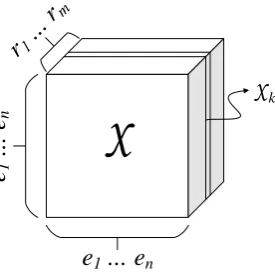
en-tity and the j-th entity have the k-th relation. Following (Franz et al., 2009), these triples can naturally be encoded in a 3-way tensor X ∈ {0,1}n×n×m, such that Xi,j,k = 1 if and only if
the triple (ei, rk, ej) ∈ T1. The tensor can be
viewed as consisting ofmslices, where each slice is ann×nsquare matrix, denoting the interactions of the entities of a particular relation type. In the remainder of this paper, we will useXkto refer to
thek-th slice of the tensorX. Fig. 1 illustrates this representation.
1This representation can easily be extended for a proba-bilistic knowledge base by allowing nonnegative real values.
e
1e
ne
1e
nχ
[image:3.595.351.489.84.221.2]χ
kFigure 1: A tensor encoding ofm binary relation types andnentities. A sliceXkdenotes the entities
having thek-th relation.
3.2 RESCAL
In order to identify latent components in a ten-sor for collective learning, Nickel et al. (2011) proposed RESCAL, which is a tensor decomposi-tion approach specifically designed for the multi-relational data described in Sec. 3.1. Given a ten-sorXn×n×m, RESCAL aims to have a rank-r
ap-proximation, where each sliceXkis factorized as
Xk ≈ARkAT. (1)
Ais ann×r matrix, where thei-th row denotes therlatent components of thei-th entity.Rkis an
asymmetricr ×r matrix that describes the inter-actions of the latent components according to the k-th relation. Notice that whileRkdiffers in each
slice,Aremains the same.
A and Rk are derived by minimizing the loss
function below.
min
A,Rkf(A,Rk) +λ·g(A,Rk), (2)
where f(A,Rk) = 12 PkkXk−ARkATk2F
is the mean-squared reconstruction error and g(A,Rk) = 12 kAk2F +
P
kkRkk2F
is the regu-larization term.
RESCAL is a special form of Tucker decom-position (Tucker, 1966) operating on a 3-way ten-sor. Its model form (Eq. (1)) can also be regarded as a relaxed form of DEDICOM (Bader et al., 2007), which derives the low-rank approximation as: Xk ≈ ADkRDkAT. To compare RESCAL
The optimization problem in Eq. (2) can be solved using the efficient alternating least-squares (ALS) method. This approach alternatively fixes
Rk to solve for A and then fixes A to solve
Rk. The whole procedure stops untilf(kX kA,R2k)
F
con-verges to some small thresholdor the maximum number of iterations has been reached.
By finding the solutions where the gradients are 0, we can derive the update rules ofAandRk as
below.
A←
" X
k
XkARTk+XkTARk #"
X
k
Bk+Ck+λI #−1
,
whereBk=RkATARTk andCk =RTkATARk.
vec(Rk)← ZTZ+λI−1ZT vec(Xk), (3)
where vec(Rk) is the vectorization ofRk, Z =
A⊗Aand the operator⊗is the Kronecker prod-uct.
Complexity Analysis Following the analysis in (Nickel et al., 2012), we assume that eachXkis a
sparse matrix, and letpbe the number of non-zero entries2. The complexity of computing X
kARTk
andXT
kARk isO(pr+nr2). EvaluatingBkand
Ck requiresO(nr2) and the matrix inversion
re-quiresO(r3). Therefore, the complexity of
updat-ingAisO(pr+nr2)assumingnr. The
updat-ing rule ofRk involves inverting an r2×r2
ma-trix. Therefore, directly computing the inversion requires time complexity O(r6) and space
com-plexityO(r4). Although Nickel et al. (2012)
con-sidered using QR decomposition to simplify the updates, it is still time consuming with the time complexityO(r6+pr2). Therefore, the total time
complexity isO(r6+pr2)and the step of updating
Rk is the bottleneck in the optimization process.
We will describe how to reduce the time complex-ity of this step toO(nr2+pr)in Section 4.2.
4 Approach
We describe how we leverage the relational do-main knowledge in this section. By removing the incompatible entity-relation triples from the loss
2Notice that we use a slightly different definition ofp from the one in (Nickel et al., 2012). The time complexity of multiplying ann×nsparse matrixXk withpnon-zero
entries by ann×rdense matrix isO(pr)assumingnr.
function, training can be done much more effi-ciently and results in a model with higher pre-diction accuracy. In addition, we also introduce a mathematical technique to reduce the compu-tational complexity of the tensor decomposition methods when taking into account the regulariza-tion term.
4.1 Applying Relational Domain Knowledge In the domain of knowledge bases, the notion of entitytypesis the side information that commonly exists and dictates whether some entities can be legitimate arguments of a given predicate. For instance, suppose the relation of interest is born-in, which denotes the birthlocationof a person. When asked whether an incompatible pair of en-tities, such as twoperson entities like Abraham Lincoln and John Henry, having this rela-tion, we can immediately reject the possibility. Al-though the type information and the constraints are readily available, it is overlooked in the pre-vious work on matrix and tensor decomposition models for knowledge bases (Riedel et al., 2013; Nickel et al., 2012). Ignoring the type information has two implications. Incompatible entity-relation triples still participate in the loss function of the optimization problem, which incurs unnecessary computation. Moreover, by choosing values for these incompatible entries we introduce errors in training the model that can reduce the quality of the model.
Based on this observation, we propose Typed -RESCAL, or TRESCAL, which leverages the
en-tity type information to improve both the effi-ciency of model training and the quality of the model in term of prediction accuracy. We em-ploy a direct and simple approach by excluding the triples of the incompatible entity types from the loss in Eq. (2). For each relation, let Lk and
Rkbe the set of entities with a compatible type to
thek-th relation. That is,(ei, rk, ej)is a feasible
triple if and only ifei ∈Lkandej ∈Rk. For
no-tational convenience, we useAkl,Akr to denote
the sub-matrices ofA that consists of rows asso-ciated withLkandRk, respectively. Analogously,
let Xklr be the sub-matrix ofXk that consists of
only the entity pairs compatible to thek-th rela-tion. The rows and columns ofXklr map to the
en-tities inAklandAkr, respectively. In other words,
entries ofXkbut not inXklrdo not satisfy the type
~
~
χ
k AAT
Rk
Akl
Akr T
χ
klre Lk
[image:5.595.81.292.74.155.2]e Rk
Figure 2: The construction of TRESCAL. Suppose
the k-th relation is born-in. Lk is then a set of personentities andRkis a set oflocationentities.
Only the sub-matrix corresponds to the compati-ble entity pairs (i.e.,Xklr) and the sub-matrices of
the associated entities (i.e.,Akl andATkr) will be
included in the loss.
Fig. 2 illustrates this construction.
TRESCAL solves the following optimization
problem:
min
A,Rkf 0(A,R
k) +λ·g(A,Rk), (4)
wheref0(A,R
k) = 12PkkXklr−AklRkATkrk2F
andg(A,Rk) =21 kAk2F +PkkRkk2F
. Similarly, A and Rk can be solved using the
alternating least-squares method. The update rule ofAis
A←
" X
k
XklrAkrRTk +XkTlrAklRk
#
×
" X
k
Bkr+Ckl+λI
#−1 ,
where Bkr = RkATkrAkrRTk and Ckl =
RT
kATklAklRk.
The update ofRkbecomes:
vec(Rk)← ATkrAkr ⊗ATklAkl+λI
−1×
vec(AklTXklrAkr),
(5)
Complexity Analysis Let ¯n be the average number of entities with a compatible type to a relation. Follow a similar derivation in Sec. 3.2, the time complexity of updatingAisO(pr+ ¯nr2)
and the time complexity of updating Rk remains
to beO(r6+pr2).
4.2 Handling Regularization Efficiently Examining the update rules of both RESCAL and TRESCAL, we can see that the most
time-consuming part is the matrix inversions. For RESCAL, this is the term(ZTZ+λI)−1in Eq. (3),
whereZ=A⊗A. Nickel et al. (2011) made the observation that ifλ= 0, the matrix inversion can be calculated by
(ZTZ)−1 = (ATA)−1A⊗(ATA)−1A.
Then, it only involves an inversion of anr×r ma-trix, namelyATA. However, ifλ > 0, directly
calculating Eq. (3) requires to invert an r2 ×r2
matrix and thus becomes a bottleneck in solving Eq. (2).
To reduce the computational complexity of the update rules of Rk, we compute the
inver-sion ZTZ+λI−1 by applying singular value
decomposition (SVD) to A, such that A =
UΣVT, whereUandVare orthogonal matrices
andΣis a diagonal matrix. Then by using proper-ties of the Kronecker product we have:
ZTZ+λI−1
= λI+VΣ2VT ⊗VΣ2VT−1
= λI+ (V⊗V)(Σ2⊗Σ2)(V⊗V)T−1 = (V⊗V) λI+Σ2⊗Σ2−1(V⊗V)T.
The last equality holds because V ⊗ V is also an orthogonal matrix. We leave the de-tailed derivations in Appendix A. Notice that λI+Σ2⊗Σ2−1 is a diagonal matrix.
There-fore, the inversion calculation is trivial.
This technique can be applied to TRESCAL
as well. By applying SVD to both Akl
and Akr, we have Akl =UklΣklVTkl and
Akr =UkrΣkrVTkr, respectively. The
computa-tion of AT
krAkr ⊗ATklAkl+λI
−1
of Eq. (5) thus becomes:
(Vkl⊗Vkr) λI+Σ2kl⊗Σ2kr
−1
(Vkl⊗Vkr)T.
The procedure of updatingRis depicted in Al-gorithm 1.
Complexity Analysis For RESCAL, V and Σ can be computed by finding eigenvectors ofATA.
Therefore, computing SVD of Acosts O(nr2 +
r3) =O(nr2). Computing Step 4 in Algorithm 1
[image:5.595.75.288.461.654.2]Algorithm 1UpdatingRin TRESCAL Require: X,A, and entity setsRk,Lk,∀k
Ensure: Rk,∀k. 1: for k= 1. . . mdo
2: [Ukl,Σ2kl,Vkl]←SVD(ATklAkl).
3: [Ukr,Σ2kr,Vkr]←SVD(ATkrAkr). 4: M1 ←VTklATklXklrAkrVkr.
5: M2 ←diag(Σ2kl) diag(Σ2kr)T +λ1.
(1 is a matrix of all ones. Function diag
converts the diagonal entries of a matrix to a vector. )
6: Rk←Vkl(M1./M2)VTkr.
(The operator “./” is element-wise divi-sion.)
7: end for
O(r2) andO(r3), respectively. The overall time
complexity of updatingRkbecomesO(nr2+pr).
Using a similar derivation, the time complex-ity of updating Rk in TRESCAL isO(¯nr2 +pr).
Therefore, the total complexity of each iteration is O(¯nr2+pr).
5 Experiments
We conduct two sets of experiments. The first evaluates the proposed TRESCAL algorithm on
inferring unknown facts using existing relation– entity triples, while the second demonstrates its application to relation extraction when a text cor-pus is available.
5.1 Knowledge Base Completion
We evaluate our approach on a knowledge base generated by the CMU Never Ending Language Learning (NELL) project (Carlson et al., 2010). NELL collects human knowledge from the web and has generated millions of entity-relation triples. We use the data generated from version 165 for training3, and collect the new triples gen-erated between NELL versions 166 and 533 as the development set and those generated between ver-sion 534 and 745 as the test set4. The data statistics of the training set are summarized in Table 1. The numbers of triples in the development and test sets are 19,665 and 117,889, respectively. Notice that this dataset is substantially larger than the datasets used in recent work. For example, the Freebase data used in (Socher et al., 2013) and (Bordes et
3http://www.cs.cmu.edu/˜nlao/ 4http://bit.ly/trescal
NELL
# entities 753k
# relation types 229
# entity types 300
[image:6.595.348.488.63.131.2]# entity-relation triples 1.8M
Table 1: Data statistics of the training set from NELL in our experiments.
al., 2013a) have 316k and 483k5 triples, respec-tively, compared to 1.8M in this dataset.
In the NELL dataset, the entity type informa-tion is encoded in a specific relainforma-tion, called Gen-eralization. Each entity in the knowledge base is assigned to at least one category presented by the Generalization relationship. Based on this infor-mation, the compatible entity type constraint of each relation can be easily identified. Specifically, we examined the entities and relations that occur in the triples of the training data, and counted all the types appearing in these instances of a given relation legitimate.
We implement RESCAL and TRESCAL in
MATLAB with the Matlab tensor Toolbox (Bader et al., 2012). With the efficient implementation described in Section 4.2, all experiments can be conducted on a commodity PC with 16 GB mem-ory. We set the maximal number of iterations of both RESCAL and TRESCALto be 10, which we
found empirically to be enough to generate a sta-ble model. Note that Eq. (4) is non-convex, and the optimization process does not guarantee to con-verge to a global minimum. Therefore, initial-izing the model properly might be important for the performance. Following the implementation of RESCAL, we initializeAby performing singular value decomposition overX¯ = Pk(Xk+XkT),
such that X¯ = UΣVT and setA = U. Then,
we apply the update rule ofRkto initialize{Rk}.
RESCAL and TRESCALhave two types of
param-eters: (1) the rankrof the decomposed tensor and (2) the regularization parameter λ. We tune the rank parameter on development set in a range of
{100, 200, 300, 400} and the regularization pa-rameter in a range of{0.01, 0.05, 0.1, 0.5, 1}.
For comparison, we also use the code released by Bordes et al. (2013a), which is implemented using Python and the Theano library (Bergstra et al., 2010), to train a TransE model using the
Entity Retrieval Relation Retrieval TransE RESCAL TRESCAL TransE RESCAL TRESCAL
w/o type checking 51.41%‡ 51.59% 54.79% 75.88% 73.15%† 76.12%
[image:7.595.88.511.61.119.2]w/ type checking 67.56% 62.91%‡ 69.26% 70.71%‡ 73.08%† 75.70%
Table 2: Model performance in mean average precision (MAP) onentity retrievalandrelation retrieval.
†and‡indicate the comparison to TRESCALin the same setting is statistically significant using a
paired-t paired-tespaired-t on average precision of each query, wipaired-th p < 0.01 andp < 0.05, respectively. Enforcing type constraints during test time improves entity retrieval substantially, but does not help in relation retrieval.
same NELL dataset. We reserved randomly 1% of the training triples for the code to evaluate the model performance in each iteration. As sug-gested in their paper, we experiment with sev-eral hyper-parameters, including learning rate of
{0.01, 0.001}, the latent dimension of{50, 100}
and the similarity measure of{L1, L2}. In addi-tion, we also adjust the number of batches of{50, 100, 1000}. Of all the configurations, we keep the models picked by the method, as well as the fi-nal model after 500 training iterations. The fifi-nal model is chosen by the performance on our devel-opment set.
5.1.1 Training Time Reduction
We first present experimental results demonstrat-ing that TRESCAL indeed reduces the time
re-quired to factorize a knowledge database, com-pared to RESCAL. The experiment is conducted on NELL with r = 300 and λ = 0.1. When λ6= 0, the original RESCAL algorithm described in (Nickel et al., 2011; Nickel et al., 2012) cannot handle a larger, because updating matrices{Rk}
requiresO(r4)memory. Later in this section, we
will show that in some situation a large rankr is necessary for achieving good testing performance. Comparing TRESCAL with RESCAL, each
it-eration of TRESCAL takes 1,608 seconds, while
that of RESCAL takes 7,415 seconds. In other words, by inducing the entity type information and constraints, TRESCALenjoys around 4.6 times
speed-up, compared to an improved regularized version of RESCAL. When updatingAand{Rk}
TRESCALonly requires operating on sub-matrices
ofA,{Rk}and{Xk}, which reduces the
compu-tation substantially. In average, TRESCAL filters
96% of entity triples that have incompatible types. In contrast, it takes TransE at least 2 days and 19 hours to finish training the model (the default 500 iterations)6, while TRESCAL finishes the training
6It took almost 4 days to train the best TransE model that
in roughly 4 to 5 hours7.
5.1.2 Test Performance Improvement
We consider two different types of tasks to evalu-ate the prediction accuracy of different models –
entity retrievalandrelation retrieval.
Entity Retrieval In the first task, we collect a set of entity-relation pairs {(ei, rk)} and aim at
predicting ej such that the tuple (ei, rk, ej) is a
recorded triple in the NELL knowledge base. For each pair(ei, rk), we collect triples{(ei, rk, e∗j)}
from the NELL test corpus as positive samples and randomly pick 100 entriese0
jto form negative
samples {ei, rk, e0j}. Given A and Rk from the
factorization generated by RESCAL or TRESCAL,
the score assigned to a triple {ei, rk, e0j} is
com-puted by aT
i Rkaj where ai and aj are the i-th
andj-th rows of A. In TransE, the score is de-termined by the negative dissimilarity measures of the learned embeddings:−d(ei, rk, e0j) =−kei+
rk−e0jk22.
We evaluate the performance using mean aver-age precision (MAP), which is a robust and sta-ble metric (Manning et al., 2008). As can be observed in Table 2 (left), TRESCAL achieves
54.79%, which outperforms 51.59% of RESCAL and 51.41% of TransE. Adding constraints during test time by assigning the lowest score to the en-tity triples with incompatible types improves re-sults of all models – TRESCAL still performs the
best (69.26%), compared to TransE (67.56%) and RESCAL (62.91%).
Relation Retrieval In the second task, given a relation typerk, we are looking for the entity pairs (ei, ej)that have this specific relationship. To
gen-erate test data, for each relation type, we collect
is included in Table 2.
gold entity pairs from the NELL knowledge base as positive samples and randomly pick a set of en-tity pairs as negative samples such that the number of positive samples are the same as negative ones. Results presented in Table 2 (right) show that TRESCAL achieves 76.12%, while RESCAL and
TransE are 73.15% and 75.88%, respectively. Therefore, incorporating the type information in training seems to help in this task as well. Enforc-ing the type constraints durEnforc-ing test time does not help as in entity retrieval. By removing incom-patible entity pairs, the performance of TRESCAL,
RESCAL and TransE drop slightly to 75.70%, 73.08% and 70.71% respectively. One possible explanation is that the task ofrelation retrievalis easier thanentity retrieval. The incorrect type in-formation of some entities ends up filtering out a small number of entity pairs that were retrieved correctly by the model.
Notice that TRESCAL achieves different levels
of performance on various relations. For example, it performs well on predicting AthletePlaysSport
(81%) andCoachesInLeague(88%), but achieves suboptimal performance on predicting Works-For (49%) and BuildingLocatedInCity (35%). We hypothesize that it is easier to gener-alize entity-relation triples when the relation has several related relations. For examples,
AthletePlaysForTeam and TeamPlaysSport may help discover entity-relation triples of Ath-letePlaysSport.
5.1.3 Sensitivity to Parameters
We also study if TRESCALis sensitive to the rank
parameter r and the regularization parameter λ, where the detailed results can be found in Ap-pendix B. In short, we found that increasing the rank r generally leads to better models. Also, while the model is not very sensitive to the value of the regularization parameterλ, tuningλis still necessary for achieving the best performance. 5.2 Relation Extraction
Next, we apply TRESCAL to the task of
extract-ing relations between entities, jointly from a text corpus and a structured knowledge base. We use a corpus from (Riedel et al., 2013) that is cre-ated by aligning the entities in NYTimes and Free-base. The corpus consists of a training set and a test set. In the training set, a list of entity pairs are provided, along with surface patterns extracted from NYTimes and known relations obtained from
Freebase. In the test set, only the surface patterns are given. By jointly factoring a matrix consist-ing of the surface patterns and relations, Riedel et al. (2013) show that their model is able to capture the mapping between the surface patterns and the structured relations and hence is able to extract the entity relations from free text. In the following, we show that TRESCALcan be applied to this task.
We focus on the 19 relations listed in Table 1 of (Riedel et al., 2013) and only consider the surface patterns that co-occur with these 19 re-lations. We prune the surface patterns that oc-cur less than 5 times and remove the entities that are not involved in any relation and surface pat-tern. Based on the training and test sets, we build a 80,698×80,698×1,652 tensor, where each slice captures a particular structured relation or a surface pattern between two entities. There are 72 fine types extracted from Freebase assigned to 53,836 entities that are recorded in Freebase. In addition, special types, PER, LOC, ORG and MISC, are assigned to the remaining 26,862 enti-ties based on the predicted NER tags provided by the corpus. A type is considered incompatible to a relation or a surface pattern if in the training data, none of the argument entities of the relation be-longs to the type. We user = 400andλ= 0.1in TRESCALto factorize the tensor.
We compare the proposed TRESCAL model to
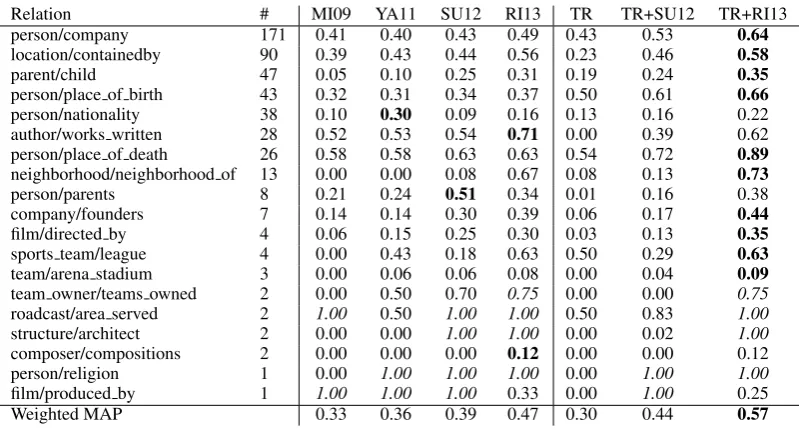
RI13 (Riedel et al., 2013), YA11 (Yao et al., 2011), MI09 (Mintz et al., 2009) and SU12 (Surdeanu et al., 2012)8. We follow the protocol used in (Riedel et al., 2013) to evaluate the results. Given a re-lation as query, the top 1,000 entity pairs output by each system are collected and the top 100 ones are judged manually. Besides comparing individ-ual models, we also report the results of combined models. To combine the scores from two models, we simply normalize the scores of entity-relation tuples to zero mean and unit variance and take the average. The results are summarized in Table 3.
As can been seen in the table, using TRESCAL
alone is not very effective and its performance is only compatible to MI09 and YA11, and is sig-nificantly inferior to RI13. This is understandable because the problem setting favors RI13 as only entity pairs that have occurred in the text or the database will be considered in RI13, both during model training and testing. In contrast, TRESCAL
Relation # MI09 YA11 SU12 RI13 TR TR+SU12 TR+RI13
person/company 171 0.41 0.40 0.43 0.49 0.43 0.53 0.64
location/containedby 90 0.39 0.43 0.44 0.56 0.23 0.46 0.58
parent/child 47 0.05 0.10 0.25 0.31 0.19 0.24 0.35
person/place of birth 43 0.32 0.31 0.34 0.37 0.50 0.61 0.66
person/nationality 38 0.10 0.30 0.09 0.16 0.13 0.16 0.22
author/works written 28 0.52 0.53 0.54 0.71 0.00 0.39 0.62 person/place of death 26 0.58 0.58 0.63 0.63 0.54 0.72 0.89
neighborhood/neighborhood of 13 0.00 0.00 0.08 0.67 0.08 0.13 0.73
person/parents 8 0.21 0.24 0.51 0.34 0.01 0.16 0.38
company/founders 7 0.14 0.14 0.30 0.39 0.06 0.17 0.44
film/directed by 4 0.06 0.15 0.25 0.30 0.03 0.13 0.35
sports team/league 4 0.00 0.43 0.18 0.63 0.50 0.29 0.63
team/arena stadium 3 0.00 0.06 0.06 0.08 0.00 0.04 0.09
team owner/teams owned 2 0.00 0.50 0.70 0.75 0.00 0.00 0.75
roadcast/area served 2 1.00 0.50 1.00 1.00 0.50 0.83 1.00
structure/architect 2 0.00 0.00 1.00 1.00 0.00 0.02 1.00
composer/compositions 2 0.00 0.00 0.00 0.12 0.00 0.00 0.12
person/religion 1 0.00 1.00 1.00 1.00 0.00 1.00 1.00
film/produced by 1 1.00 1.00 1.00 0.33 0.00 1.00 0.25
[image:9.595.99.499.60.275.2]Weighted MAP 0.33 0.36 0.39 0.47 0.30 0.44 0.57
Table 3: Weighted Mean Average Precisions. The # column shows the number of true facts in the pool. Bold faced are winners per relation, italics indicate ties based on a sign test.
predicts all the possible combinations between en-tities and relations, which makes the model less fit to the task. However, when combining TRESCAL
with a pure text-based method, such as SU12, we can clearly see TRESCAL is complementary
to SU12 (0.39 to 0.44 in weighted MAP score), which makes the results competitive to RI13.
Interestingly, although both TRESCALand RI13
leverage information from the knowledge base, we find that by combining them, the performance is improved quite substantially (0.47 to 0.57). We suspect that the reason is that in our construc-tion, each entity has its own vector representa-tion, which is lacked in RI13. As a result, the new triples that TRESCALfinds are very different
from those found by RI13. Nevertheless, com-bining more methods do not always yield an im-provement. For example, combining TR, RI13 and SU12 together (not included in Table 3) achieves almost the same performance as TR+RI13.
6 Conclusions
In this paper we developed TRESCAL, a tensor
decomposition method that leverages relational domain knowledge. We use relational domain knowledge to capture which triples are potentially valid and found that, by excluding the triples that are incompatible when performing tensor decom-position, we can significantly reduce the train-ing time and improve the prediction performance as compared with RESCAL and TransE.
More-over, we demonstrated its effectiveness in the ap-plication of relation extraction. Evaluated on the dataset provided in (Riedel et al., 2013), the per-formance of TRESCALalone is comparable to
sev-eral existing systems that leverage the idea of dis-tant supervision. When combined with the state-of-the-art systems, we found that the results can be further improved. For instance, the weighted mean average precision of the previous best ap-proach in (Riedel et al., 2013) has been increased by 10 points (47% to 57%).
There are a number of interesting potential ex-tensions of our work. First, while the experiments in this paper are on traditional knowledge bases and textual data, the idea of leveraging relational domain knowledge is likely to be of value to other linguistic databases as well. For instance, part-of-speech tags can be viewed as the “types” of words. Incorporating such information in other tensor de-composition methods (e.g., (Chang et al., 2013)) may help lexical semantic representations. Sec-ond, relational domain knowledge goes beyond entity types and their compatibility with specific relations. For instance, the entity-relation triple (e1, child-of, e2) can be valid only ife1.type = person∧e2.type = person∧e1.age < e2.age.
in-ference tasks to better support semantic parsing and question answering.
Acknowledgments
We thank Sebastian Riedel for providing the data for experiments. We are also grateful to the anony-mous reviewers for their valuable comments.
References
Brett W Bader, Richard A Harshman, and Tamara G Kolda. 2007. Temporal analysis of semantic graphs using ASALSAN. InICDM, pages 33–42. IEEE. Brett W. Bader, Tamara G. Kolda, et al. 2012. Matlab
tensor toolbox version 2.5. Available online, Jan-uary.
James Bergstra, Olivier Breuleux, Fr´ed´eric Bastien, Pascal Lamblin, Razvan Pascanu, Guillaume Des-jardins, Joseph Turian, David Warde-Farley, and
Yoshua Bengio. 2010. Theano: a CPU and
GPU math expression compiler. In Proceedings of the Python for Scientific Computing Conference (SciPy), June. Oral Presentation.
Joanna Biega, Erdal Kuzey, and Fabian M Suchanek. 2013. Inside YOGO2s: a transparent information extraction architecture. InWWW, pages 325–328. A. Bordes, N. Usunier, A. Garcia-Duran, J. Weston,
and O. Yakhnenko. 2013a. Translating Embeddings for Modeling Multi-relational Data. InAdvances in Neural Information Processing Systems 26.
Antoine Bordes, Xavier Glorot, Jason Weston, and Yoshua Bengio. 2013b. A semantic matching en-ergy function for learning with multi-relational data.
Machine Learning, pages 1–27.
Razvan Bunescu and Raymond Mooney. 2007. Learn-ing to extract relations from the web usLearn-ing mini-mal supervision. InProceedings of the 45th Annual Meeting of the Association of Computational Lin-guistics, pages 576–583, Prague, Czech Republic, June. Association for Computational Linguistics. Andrew Carlson, Justin Betteridge, Bryan Kisiel, Burr
Settles, Estevam R. Hruschka Jr., and Tom M. Mitchell. 2010. Toward an architecture for never-ending language learning. InAAAI.
Kai-Wei Chang, Wen-tau Yih, and Christopher Meek. 2013. Multi-relational latent semantic analysis. In
Proceedings of the 2013 Conference on Empirical Methods in Natural Language Processing, pages 1602–1612, Seattle, Washington, USA, October. Association for Computational Linguistics.
Lieven De Lathauwer, Bart De Moor, and Joos Vande-walle. 2000. A multilinear singular value decompo-sition. SIAM journal on Matrix Analysis and Appli-cations, 21(4):1253–1278.
Thomas Franz, Antje Schultz, Sergej Sizov, and Steffen Staab. 2009. Triplerank: Ranking semantic web data by tensor decomposition. InThe Semantic Web-ISWC 2009, pages 213–228. Springer.
U Kang, Evangelos Papalexakis, Abhay Harpale, and Christos Faloutsos. 2012. Gigatensor: scaling ten-sor analysis up by 100 times-algorithms and discov-eries. InKDD, pages 316–324. ACM.
Henk AL Kiers. 2000. Towards a standardized nota-tion and terminology in multiway analysis. Journal of chemometrics, 14(3):105–122.
Tamara G. Kolda and Brett W. Bader. 2009. Ten-sor decompositions and applications. SIAM Review, 51(3):455–500, September.
Joseph B Kruskal. 1977. Three-way arrays: rank and uniqueness of trilinear decompositions, with appli-cation to arithmetic complexity and statistics. Lin-ear algebra and its applications, 18(2):95–138. Alan J Laub, 2005. Matrix analysis for scientists and
engineers, chapter 13, pages 139–150. SIAM. Ben London, Theodoros Rekatsinas, Bert Huang, and
Lise Getoor. 2013. Multi-relational learning using weighted tensor decomposition with modular loss. Technical report, University of Maryland College Park. http://arxiv.org/abs/1303.1733.
C. Manning, P. Raghavan, and H. Schutze. 2008.
Introduction to Information Retrieval. Cambridge University Press.
T. Mikolov, I. Sutskever, K. Chen, G. Corrado, and J. Dean. 2013a. Distributed representations of words and phrases and their compositionality. In
Advances in Neural Information Processing Systems 26.
Tomas Mikolov, Wen-tau Yih, and Geoffrey Zweig. 2013b. Linguistic regularities in continuous space word representations. InProceedings of the 2013 Conference of the North American Chapter of the Association for Computational Linguistics: Human Language Technologies, pages 746–751, Atlanta, Georgia, June. Association for Computational Lin-guistics.
Mike Mintz, Steven Bills, Rion Snow, and Daniel Ju-rafsky. 2009. Distant supervision for relation ex-traction without labeled data. InProceedings of the Joint Conference of the 47th Annual Meeting of the ACL and the 4th International Joint Conference on Natural Language Processing of the AFNLP, pages 1003–1011, Suntec, Singapore, August. Association for Computational Linguistics.
Maximilian Nickel, Volker Tresp, and Hans-Peter Kriegel. 2012. Factorizing YAGO: scalable ma-chine learning for linked data. InWWW, pages 271– 280.
Evangelos E Papalexakis, Tom M Mitchell, Nicholas D Sidiropoulos, Christos Faloutsos, Partha Pratim Talukdar, and Brian Murphy. 2014. Turbo-smt: Accelerating coupled sparse matrix-tensor factoriza-tions by 200x. InSDM.
Sebastian Riedel, Limin Yao, and Andrew McCallum. 2010. Modeling relations and their mentions with-out labeled text. In Proceedings of ECML/PKDD 2010. Springer.
Sebastian Riedel, Limin Yao, Andrew McCallum, and Benjamin M. Marlin. 2013. Relation extraction with matrix factorization and universal schemas. In
NAACL, pages 74–84.
Alan Ritter, Luke Zettlemoyer, Mausam, and Oren Et-zioni. 2013. Modeling missing data in distant su-pervision for information extraction. Transactions of the Association for Computational Linguistics, 1:367–378, October.
Ajit P Singh and Geoffrey J Gordon. 2008. Relational learning via collective matrix factorization. In Pro-ceedings of the 14th ACM SIGKDD international conference on Knowledge discovery and data min-ing, pages 650–658. ACM.
Richard Socher, Danqi Chen, Christopher D. Manning, and Andrew Y. Ng. 2013. Reasoning With Neural Tensor Networks For Knowledge Base Completion. InAdvances in Neural Information Processing Sys-tems 26.
Robert Speer, Catherine Havasi, and Henry Lieberman. 2008. Analogyspace: Reducing the dimensionality of common sense knowledge. InAAAI, pages 548– 553.
Mihai Surdeanu, Julie Tibshirani, Ramesh Nallapati, and Christopher D. Manning. 2012. Multi-instance multi-label learning for relation extraction. In Pro-ceedings of the Conference on Empirical Methods in Natural Language Processing and Computational Natural Language Learning (EMNLP-CoNLL). Ilya Sutskever, Joshua B Tenenbaum, and Ruslan
Salakhutdinov. 2009. Modelling relational data us-ing Bayesian clustered tensor factorization. InNIPS, pages 1821–1828.
Ledyard R Tucker. 1966. Some mathematical notes on three-mode factor analysis. Psychometrika, 31(3):279–311.
Jason Weston, Antoine Bordes, Oksana Yakhnenko, and Nicolas Usunier. 2013. Connecting language and knowledge bases with embedding models for re-lation extraction. In Proceedings of the 2013 Con-ference on Empirical Methods in Natural Language Processing, pages 1366–1371, Seattle, Washington,
USA, October. Association for Computational Lin-guistics.
Limin Yao, Aria Haghighi, Sebastian Riedel, and An-drew McCallum. 2011. Structured relation dis-covery using generative models. InProceedings of the 2011 Conference on Empirical Methods in Nat-ural Language Processing, pages 1456–1466, Edin-burgh, Scotland, UK., July. Association for Compu-tational Linguistics.
Appendix A Detailed Derivation
We first introduce some lemmas that will be useful for our derivation. Lemmas 2, 3 and 4 are the basic properties of the Kronecker product. Their proofs can be found at (Laub, 2005).
Lemma 1. Let V be an orthogonal matrix and
Σ a diagonal matrix. Then(I+VΣVT)−1 =
V(I+Σ)−1VT.
Proof.
(I+VΣVT)−1 = (VIVT +VΣVT)−1 =V(I+Σ)−1VT
Lemma 2. (A⊗B)(C⊗D) =AC⊗BD.
Lemma 3. (A⊗B)T =AT ⊗BT.
Lemma 4. If AandB are orthogonal matrices, thenA⊗Bwill also be an orthogonal matrix.
Let Z = A ⊗ A and apply singular value decomposition to A = UΣVT. The term
ZTZ+λI−1 can be rewritten as:
ZTZ+λI−1
= λI+ (AT ⊗AT)(A⊗A)−1 (6)
= λI+ATA⊗ATA−1 (7)
= λI+VΣ2VT ⊗VΣ2VT−1 (8)
= λI+ (V⊗V)(Σ2⊗Σ2)(V⊗V)T−1
(9)
= (V⊗V) λI+Σ2⊗Σ2−1(V⊗V)T
(10)
Figure 3: Prediction performance of TRESCAL
[image:12.595.74.292.267.412.2]and RESCAL with different rank (r).
Figure 4: Prediction performance of TRESCAL
with different regularization parameter (λ).
Appendix B Hyper-parameter Sensitivity
We study if TRESCAL is sensitive to the rank
parameter r and the regularization parameter λ. We use the task of relation retrieval and present the model performance on the development set. Fig. 3 shows the performance of TRESCAL and
RESCAL with different rank (r) values while fix-ingλ = 0.01. Results show that both TRESCAL
and RESCAL achieve better performance whenr is reasonably large. TRESCAL obtains a
bet-ter model with smaller r than RESCAL, because TRESCALonly needs to fit the triples of the
com-patible entity types. Therefore, it allows to use smaller number of latent variables to fit the train-ing data.
Fixingr = 400, Fig. 4 shows the performance of TRESCALat different values of the