ZORE: A Syntax-based System for Chinese Open Relation Extraction
Likun Qiu and Yue Zhang
Singapore University of Technology and Design, Singapore
[email protected], yue [email protected]
Abstract
Open Relation Extraction (ORE) over-comes the limitations of traditional IE techniques, which train individual extrac-tors for every single relation type. Sys-tems such as ReVerb, PATTY, OLLIE, and Exemplar have attracted much attention on English ORE. However, few studies have been reported on ORE for languages beyond English. This paper presents a syntax-based Chinese (Zh) ORE system, ZORE, for extracting relations and seman-tic patterns from Chinese text. ZORE identifies relation candidates from auto-matically parsed dependency trees, and then extracts relations with their semantic patterns iteratively through a novel double propagation algorithm. Empirical results on two data sets show the effectiveness of the proposed system.
1 Introduction
Traditional Information Extraction (IE) system-s train extractorsystem-s for pre-system-specified relationsystem-s (Kim and Moldovan, 1993). This approach cannot scale to the web, where target relations are not defined in advance. Open Relation Extraction (ORE) at-tempts to solve this problem by shallow-parsing-based, syntax-based or semantic-role-based pat-tern matching without pre-defined relation types, and has achieved great success on open-domain corpora ranging from news to Wikipedia (Banko et al., 2007; Wu and Weld, 2010; Nakashole et al., 2012; Etzioni et al., 2011; Moro and Nav-igli, 2013). Many NLP and IR applications, in-cluding selectional preference learning, common-sense knowledge and entailment rule mining, have benefited from ORE (Ritter et al., 2010). Howev-er, most existing ORE systems focus on English, and little research has been reported on other lan-guages. In addition, existing ORE techniques are
mainly concerned with the extraction of textual re-lations, without trying to give semantic analysis, which is the advantage of traditional IE.
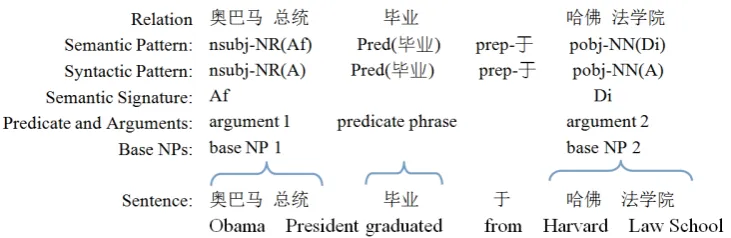
Our goal in this paper is to present a syntax-based Chinese (Zh) ORE system, ZORE, which extracts relations by using syntactic dependen-cy patterns, while associating them with explic-it semantic information. An example is shown is Figure 1, where the relation (c nê
(Oba-ma)oÚ(President) , Pred[.’(graduate)],M
à (Harvard) {Æ (Law School)) is extract-ed from the given sentence “cnê (Obama)o
Ú (President) .’ (graduate) u (from) MÃ
(Harvard) {Æ (Law School)”, and general-ized into the syntactic-semantic pattern {nsubj-NR(Af) Pred[.’ (graduate)] prep-u (from) pobj-NN(Di)}. Here, AfandDi stand for human and institution, respectively, according to a Chi-nese taxonomyExtended Cilin(Che et al., 2010).
Rather than extracting binary relations and then generalizing them into semantic patterns, which most previous work does (Mausam et al., 2012; Nakashole et al., 2012; Moro and Navigli, 2012; Moro and Navigli, 2013), we develop a novel method that extracts relations and patterns simul-taneously. A double propagation algorithm is used to make relation and pattern information reinforce each other, so that negative effects from automatic syntactic and semantic analysis errors can be miti-gated. In this way, semantic pattern information is leveraged to improve relation extraction.
We manually annotate two sets of data, from news text and Wikipedia, respectively. Experi-ments on both data sets show that the double prop-agation algorithm gives better precision and recall compared to the baseline. To our knowledge, we are one of the first to report empirical results on Chinese ORE. The ZORE system, together with the two sets of test data we annotated, and the sets of 5 million relations and 344K semantic patterns extracted from news and Wikipedia, is freely
Figure 1: A sample sentence analyzed by ZORE.
leased1.
2 Basic Definitions for Open Information Extraction
ZORE is applied to web text to extract general re-lations and their semantic types. Our definition of relations follow previous work on ORE (Moro and Navigli, 2013), but with language-specific ad-justments. In this section, we use the sentence in Figure 1 as an instance to describe the basic defi-nitions for ZORE.
Definition 1 (predicate phrase) A predicate phraseis a sequence of words that contains at least one verb or copula, and governs one or more noun phrases syntactically. For instance, a predicate phrase for the sentence in Figure 1 is “.’ (grad-uate)”. Following Fader et al. (2011), Mausam et al. (2012) and Nakashole et al. (2012), in case of light verb constructions, the verb and its direct ob-ject jointly serve as predicate phrase. We do not include prepositions into the predicate phrases.
Definition 2(argument) Anargumentis a base noun phrase governed by a predicate phrase direct-ly orindirectly with a preposition. For instance, “cnê (Obama) oÚ (President)” and “MÃ
(Harvard) {Æ (Law School)” are two
argu-ments of the predicate phrase “.’(graduate)”. Definition 3 (relation) A binary relation is a triple that consists of the predicate phrase Pred and its two arguments x andy. Accordingly, an n-ary relationcontainsnarguments. For instance, the sentence in Figure 1 contains the binary rela-tion(cnê(Obama)oÚ(President), Pred[.
’ (graduate)], MÃ (Harvard) {Æ (Law School)). In English, the two arguments of a bi-nary relation are usually positioned on the left and right of Pred, respectively. Hence, shallow pat-terns are highly useful for English relation
extrac-1https://sourceforge.net/projects/zore/
tion (Banko et al., 2007). In Chinese, however, the two arguments can be both on the left, both on the right or one on the left and one on the right of the predicate, and the resulting binary relation can be either(x, y, Pred),(Pred, x, y)and(x, Pred, y), de-pending on the sentence. This makes the detection of relation phrases more complicated.
Definition 4(syntactic pattern) Asyntactic pat-ternis the syntactic abstraction of a relation. A re-lation can be generalized into the combination of words, POS-tags and syntactic dependency labels (Nakashole et al., 2012). For instance, the syntac-tic pattern of the sentence in Figure 1 is {nsubj-NR(A) Pred[.’] prep-u pobj-NN(A)}. It con-sists of four sub-patterns. The first, nsubj-NR(A), denotes that the current phrase acts as the sub-ject of the predicate phrase with the POS-tagNR (proper nouns). Here, “(A)” means that the phrase is an argument of the extracted relation. The sec-ond sub-pattern denotes that the predicate phrase of the example is “.’ (graduate)”. Note that the words between the predicate and arguments (e.g.,prep-u) are included into the pattern direct-ly (Nakashole et al., 2012; Mausam et al., 2012).
Definition 5 (semantic signature) The seman-tic signatureof a relation consists of the semantic categories of the arguments. The semantic signa-ture of Figure 1 is(Af, Di), whereAfand Di de-noteshumanandinstitute, respectively.
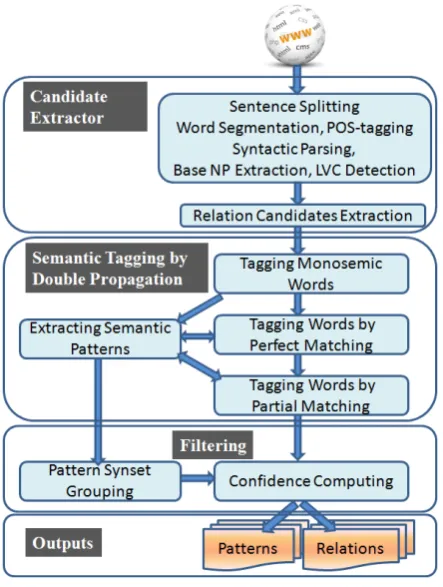
Figure 2: Architecture of ZORE.
Figure 3: Parsing result of the example sentence in Figure 1, in Stanford dependencies.
3 ZORE
The architecture of ZORE is shown in Figure 2. It consists of three components. The first is a relation candidate extractor, which consumes input tex-t and performs sentex-tence segmentex-tatex-tion, word seg-mentation, POS tagging, syntactic parsing, base NP extraction, light verb structure (LVC) detection and relation candidate extraction. The output is a set of relation candidates. The second component tags relations and extracts semantic patterns by a double propagation algorithm. In the third compo-nent, extracted patterns are grouped into synsets, and relations are filtered by confidence scores.
3.1 Extracting Relation Candidates 3.1.1 Parsing and Base NP Extraction
ZORE analyzes the syntactic structures of input texts by applying a pipeline of NLP tools. Each sentence is segmented into a list of words by using the Stanford segmenter (Chang et al., 2008), and parsed by using ZPar (Zhang and Clark, 2011), with POS tags and constituent structures by the CTB standard (Xue et al., 2005). The result-ing constituent trees are transformed into projec-tive trees with Stanford dependencies by using the Stanford parser (Chang et al., 2009). Figure 4 shows the parse tree of the sentence in Figure 1.
Next, base noun phrases (NPs) are extracted from the dependency tree. Here a base NP is a maximum phrase whose words can only have POS from the first row of Table 1. The head word of a base NP can be either a noun, a pronoun, a num-ber or a measure word (the second row of Table 1). The dependency labels within a base NP can only be from the third row of Table 1. Obviously, a base NP does not contain other base NPs, and is also not contained by any other base NP.
3.1.2 Detecting Light Verb Constructions In linguistics, alight verb is a verb that has little semantic content of its own, and typically form-s a predicate with a noun (Butt, 2003). Exam-ple predicates by light verb constructions (LVC) include “is a capital of” and “claim responsibil-ity for”, where “is” and “claim” are light verbs. Improper handling of LVC can cause a significan-t problem by uninformasignifican-tive exsignifican-tracsignifican-tions (Esignifican-tzioni esignifican-t al., 2011). For example, if “is” and “claim” are ex-tracted as predicates, the resulting relations (such as (Hamas, claimed, responsibility) from the sen-tence “Hamas claimed responsibility for the Gaza attack”) might not bare useful information. Re-Verb (Etzioni et al., 2011) handles this problem by hard syntactic constraints, taking the noun phrase (e.g., responsibility) between a verb phrase (e.g., “claim”) and a preposition (e.g., “for”) as a part of the predicate phrase rather than an argument, lead-ing to the relation(Hamas, claimed responsibility for, the Gaza attack).
Labels
Base NP modifier NN (common noun), M (measure word), CD (cardinal number), OD (ordinal number), PN (pronoun), NR (proper noun), NT (temporal noun), JJ (other noun-modifier), or PU (punctuation)
Base NP head NN (common noun), M (measure word), CD (cardinal number), OD (ordinal number), PN (pronoun), NR (proper noun), NT (temporal noun)
Labels in base NPs nn (noun compound modifier), conj (conjunct), nummod (number modifier), cc (coordinating conjunction), clf (classifier modifier), det (determiner), ordmod (ordinal number modifier), punct (punctuation), dep (other dependencies), or amod (adjectival modifier)
Labels from base NPs to predicate phrase
nsubj (nominal subject), conj (conjunct), dobj (direct object), advmod (adverbial modifier), prep (preposi-tional modifier), pobj (preposi(preposi-tional object), lobj (localizer object), range (dative object that is a quantifier phrase), tmod (temporal modifier), plmod (localizer modifier of a preposition), attr (attributive), loc (local-izer), top (topic), xsubj (controlling subject), ba (“ba” construction), nsubjpass (nominal passive subject) Table 1: Constraints on POS-tags and dependency labels. Labels in the top three rows are used for base NP extraction, while labels in the last row for traversing from a base NP to the predicate phrase.
In Chinese, prepositions acting as the modifier of a verb can be on both the left and right of the ver-b. For instance, the sentence “cnê(Obama)o
Ú(President)u (from)MÃ(Harvard){Æ (Law School).’(graduate)” is a paraphrase of the sentence in Figure 1, with the prepositionu (from)on the left of the predicate phrase.
Chinese LVCs can be classified into two types, which we refer to as dummy-LVCs and common LVCs, respectively. For the first type, the predi-cate is a dummy verb such as “?1(do)” and “ƒ ±(give)”, which has a noun phrase as its object. Since dummy verbs in Chinese are a closed set, we detect this type of LVCs (such as“?1(do)¬! (talk)”) by finding the dummy verb from a lexi-con. For the second type of LVCs, the predicate is a common verb, which has a nominalized structure or a common noun as its object. For instance, “Ð
m (launch) N (investigation)” belongs to this
type of construction.
Common LVCs are more difficult to detect than dummy-LVCs. We detect common LVCs by the context. Besides the NPs in the LVC itself, a com-mon LVC typically governs two NPs, with the lat-ter being connected to the predicate phrase by an LVC-related preposition such as “é (for), éu
(for), é(for),• (to),Ó (with),†(with),Ú (with) ”. Based on the observation, a basic idea of identifying common LVCs is to find verb-object structures that frequently co-occur with a LVC-related preposition in a large-scale corpus parsed automatically. For a given verb-objectv, letfvand
fpdenote the frequency ofvand the frequency ofv
co-occurring with an LVC-related preposition, re-spectively. We define the statistical strength ofv to be an LVC as the ratio fp/fv. If the statistical
strength ofvexceeds a thresholdtlvc, we identifyv
as a LVC. Table 2 illustrates some high-frequency
LVCs extracted by the method automatically.
3.1.3 Extracting Relation Candidates
ZORE tries to extract relation candidates from sentences that contain two or more base NPs. Giv-en two base NPs, we traverse the depGiv-endGiv-ency tree to obtain the shortest path that connects them. The path can contain only dependency labels in the fourth row of Table 1, and should contain at least one of the labels from “nsubj” and “dobj” to en-sure that a predicate phrase is included in the path. If such a path is acquired, other base NPs governed by the same predicate phrase are included into the target relation, resulting in an-ary relation candi-dates with each base NP being an argument. Ac-cording to the predicate phrase, relation candidates can be classified into the following classes.
Common and dummy LVC relations. In this type of relations, the predicate phrase of the path is an LVC (e.g., a light verb and a nominal ob-ject). The two base NPs can be the subject or prepositional object of the light verb. For instance, in the sentence “¿&Z (Houdini) é (to)· (my)¯’(career)k(have)éŒ(big)K• (in-fluence)”, “k (have)”and “K• (influence)” are combined into a common LVC and taken as the predicate phrase, resulting the relation (¿&Z (Houdini), Pred[k(have)K•(influence)],· (my)¯’(career)). In the corresponding English sentence, the predicate phrase “be a big influence in” is also an LVC structure.
Verb relations. In this type of relations, a verb acts as the predicate phrase. For instance, the rela-tion(cnê(Obama)oÚ(President), Pred[.
’ (graduate)], MÃ (Harvard) {Æ (Law School)) extracted from the sentence in Figure 1 is a typical verb relation.
Verb Noun
?1(do) (*) u1(distribution),©Û(analysis),Â8(collection),?U(modification),–¯(visit),?v(punishment) k(have) (*) K•(effect), z(contribution),, (interest),•Ï(help),@£(understanding),Ï"(expectation)
)(generate) (**) K•(effect),, (interest),~¦(doubt),ÀÂ(shock),Ða(good feeling),™ê(fear) E¤(cause) (**) K•(effect),»€(destruction),ú³(harm),% (threat),Øå(pressure),Z6(distraction) L«(express) (**) ÷¿(satisfaction),•H(welcome),ƒ-(respect),úb(worry),H (mourning),a (gratitude)
Ðm(launch) (**) N (investigation),ôÂ(attack),ô³(offensive),1µ(criticism),1 (negotiation),Šz(lawsuit)
Table 2: Instances of dummy-LVCs (*) and common LVCs (**). A verb in the left column is combined with a noun in the right column to form an LVC, which serves as the predicate phrase.
relation, the head word is a noun, modified by an relative clause, but acting as an argument of the predicate of the relative clause semantically. The sentence “.’ (graduate) u (from) MÃ
(Harvard){Æ (Law School) (de, an aux-iliary word) cnê (Obama) oÚ (president)” is a paraphrase of the sentence in Figure 1, with the same predicate phrase and arguments. How-ever, the relation extracted from this phrase is an relative-clause relation (Pred[.’ (graduate)], MÃ (Harvard) {Æ (Law School), c nê
(Obama)oÚ (president)), which belongs to the same pattern synset as the relation of Figure 1.
3.2 Semantic Tagging by Double Propagation The basic idea of our approach is to identify rela-tions and patterns iteratively through semantical-ly tagging the head words of arguments in rela-tion candidates. Given a set of relarela-tion candidates and a semantic taxonomy, the propagation consist-s of three consist-stepconsist-s. In Step 1, monoconsist-semic argumentconsist-s in candidate relations are tagged with a seman-tic category, such as AfandDi, to obtain seman-tic patterns. In Step 2 and Step 3, untagged am-biguous and unknown words are tagged by perfect matching and partial matching, respectively. In the end of each step, semantic patterns are generalized from extracted and tagged relations, and then used to help relation tagging in the next step. Because of the two-way information exchange, we call this methoddouble propagation. The method can also be treated as similar to bootstrapping (Yangarber et al., 2000; Qiu et al., 2009).
3.2.1 Step 1: Tagging Monosemic Arguments Each argument in a relation candidate is a base N-P. Since base NPs are endocentric, we can take the semantic category of the head word of a base NP as the semantic category of the base NP. In a tax-onomy, each word is associated with one or more semantic categories. In this step, however, only monosemic words are tagged, while both
ambigu-ous words and unknown words are left untagged. Most named entities are not included in the taxonomy. However, after POS-tagging, most of them are detected as NR (proper noun). As a re-sult, they are taken as ambiguous words that can be person names, organization names or location names. The named entities that are not included in the taxonomy are tagged in Steps 2 and 3.
After this step, all the arguments in some re-lation candidates have been tagged with semantic categories. We refer to these relation candidates as tagged relation candidates, and the remaining re-lation candidates asuntagged relation candidates. Tagged relation candidate are generalized into se-mantic patterns, consisting of syntactic patterns and semantic signatures, as illustrated in Figure 1 and Section 2. We call the set of resulting seman-tic patterns SetSemP at.
3.2.2 Step 2: Tagging by Perfect Pattern Matching
In this step, the arguments in the untagged relation candidates are tagged by semantic pattern match-ing. Given an untagged relation candidate r, we acquire a set of possible semantic categories for each argument with anambiguoushead word. For the arguments withunknownhead words, we ac-quire a set ofpossiblesemantic categories accord-ing to their characters. Qiu et al. (2011) demon-strate that 98% Chinese words have at least one synonym, which shares at least one character. For Chinese nouns, the set of synonyms usually shares the last one or two characters. According to this, our strategy for acquiring possible semantic cate-gories for an unknown word is as follows.
Given an unknown wordwu, if we find a known
wordwkthat shares the last two character withwu,
the semantic categories ofwk will be used as the
possible semantic categories ofwu. Otherwise, if
we find a known wordwk that share the last one
character withwu, the semantic categories of wk
We then acquire possible semantic signatures of untagged relation candidates, of which all the ar-guments are tagged with possible semantic cate-gories. As in Step 1, we generalize relation r in-to a syntactic pattern patsyn, and then combine
patsyn with each possible semantic signature of
r to generatepossible semantic patterns. In case one or more possible semantic patterns of r ex-ist inSetSemP at, if the highest frequency of these
patterns is above a thresholdtsem, the
correspond-ing pattern will be taken as the semantic pattern ofr, from which we infer the semantic signature forr and then the semantic category for the head word of each argument of r. After this step, the frequency of each semantic pattern in SetSemP at
is updated according to the newly tagged relation candidates.
3.2.3 Step 3: Tagging by Partial Pattern Matching
In this step, we tag the ambiguous and unknown words by partial matching rather than perfec-t maperfec-tching of perfec-the whole semanperfec-tic paperfec-tperfec-tern. This can be treated as a back-off of the last step.
We first split n-ary semantic patterns in SetSemP atinto binary semantic patterns, and
cal-culate their frequencies. Second, we split each untagged relation candidate r into several binary sub-relations and then search for the correspond-ing semantic patterns as in Step 2 — for each bi-nary sub-relation, we obtain a bibi-nary semantic sig-nature with the highest frequency. By combining the binary semantic signatures, we obtain one n -ary semantic signature for r, based on which all the unknown and ambiguous words can be tagged with a semantic categories. If all the arguments of a relation candidaterare tagged,ris treated as tagged. Finally, according to the newly tagged re-lations, statistics inSetSemP atare updated.
3.3 Grouping Patterns into Synsets
In this step, we group semantic patterns from SetSemP at into pattern synsets, based on a
single-pass clustering process (Papka and Allan, 1998). Given two semantic patternsSemPati and
SemPatj, we refer to their corresponding
syntac-tic pattern, semansyntac-tic signature and predicate phras-es asSynPati andSynPatj, SemSigi andSemSigj,
PrediandPredj, respectively. Not taking the
pred-icate phrase into account,SynPatiandSynPatjare
[image:6.595.322.507.61.213.2]identical, and we call themloosely identical(≈). The algorithm in Figure 4 is used to group
Figure 4: Algorithm for pattern synset grouping.
Type Feature Weight
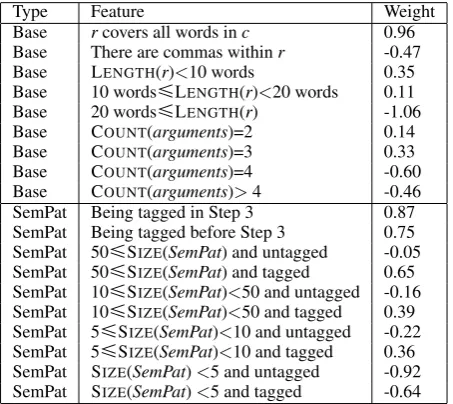
Base rcovers all words inc 0.96 Base There are commas withinr -0.47 Base LENGTH(r)<10 words 0.35 Base 10 words[LENGTH(r)<20 words 0.11 Base 20 words[LENGTH(r) -1.06 Base COUNT(arguments)=2 0.14 Base COUNT(arguments)=3 0.33 Base COUNT(arguments)=4 -0.60 Base COUNT(arguments)>4 -0.46 SemPat Being tagged in Step 3 0.87 SemPat Being tagged before Step 3 0.75 SemPat 50[SIZE(SemPat) and untagged -0.05 SemPat 50[SIZE(SemPat) and tagged 0.65 SemPat 10[SIZE(SemPat)<50 and untagged -0.16 SemPat 10[SIZE(SemPat)<50 and tagged 0.39 SemPat 5[SIZE(SemPat)<10 and untagged -0.22 SemPat 5[SIZE(SemPat)<10 and tagged 0.36 SemPat SIZE(SemPat)<5 and untagged -0.92 SemPat SIZE(SemPat)<5 and tagged -0.64 Table 3: Features of the logistic regression classi-fier with weights trained on Wiki-500 dataset.
patterns, where ARGCOUNT(SynPatj) denotes the
number of arguments inSemPati, SEMCAT(arg1)
indicates the semantic category of the first ar-gument, and ISSYNONYM (Predi, Predj)
return-s whether two predicatereturn-s are return-synonymreturn-s. In similarity-based single-pass clustering, the topic excursion problem is common (Papka and Allan, 1998). But since our similarity measure is sym-metric, we do not suffer from this problem.
[image:6.595.307.534.250.452.2]Dataset Source #Sen #Rel Wiki-500 Chinese Wikipedia 500 561 Sina-500 Sina News 500 707
Table 4: Annotated relation datasets.
clause, relation, arguments in a relation, and se-mantic pattern, respectively. LENGTH(r), COUN -T(arguments) and SIZE(SemPat) indicate the
num-ber of words in r, the number of arguments in r, and the number of relations that belong to the same semantic patternSemPat asr. Because se-mantic patterns from the double propagation al-gorithm are used as features in the classifier, they participate in relation extraction also. Their effect on relation extraction can directly demonstrate the effectiveness of double propagation.
4 Experiments
4.1 Experimental Setup
We run ZORE on two difference corpora: the Chi-nese edition of Wikipedia (Wiki), which contain-s 4.3 million contain-sentencecontain-s (acontain-s of March 29, 2014), and a corpus from the Sina News archive (Sina News), which includes 6.1 million sentences from January 2013 to May 2013. The sentences that do not end with punctuations are filtered. The Chi-nese taxonomyExtended Cilin2(Cilin) (Che et al., 2010) is used to give semantic categories for each word. Cilin contains 77,492 Chinese words, or-ganized into a five-level hierarchy. There are 12 categories in the top level, 94 in the second and 1492 in the third. In this paper, the second level is used for semantic categories. We create two test sets, containing 500 sentences from Wiki and 500 sentences from Sina News, respectively (see Table 4), annotated by two independent annotators us-ing the annotation strategy of Fader et al. (2011). The thresholdstlvcandtsem for pattern matching
are set as 0.4 and 5, tuned on 100 sentences from Wiki-500 dataset, respectively.
4.2 Evaluation of Relation Extraction
First, we compare ZORE with a baseline system to illustrate the effectiveness of the double prop-agation algorithm. The baseline system does not have the double propagation tagging component in Figure 2, using the logistic regression classifier in Section 3.4.1 with the 9 base features to filter extracted relation candidates. It is similar to the architecture of ReVerb (Fader et al., 2011). We
[image:7.595.311.522.66.199.2]2http://ir.hit.edu.cn/demo/ltp/Sharing Plan.htm
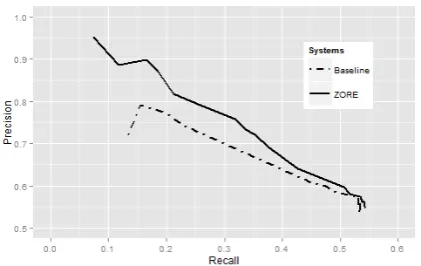
[image:7.595.313.522.251.382.2]Figure 5: Performance on Wiki.
Figure 6: Performance on Sina News.
measure the precision and recall of the extracted relations. An extracted relation is considered cor-rect only when the predicate phrase and all the ar-guments match the the gold set. On each data set, we perform 5-fold cross-validation test and take the average as the final precision and recall.
Figures 5 and 6 show the comparison of the two systems on Wiki and Sina News, respectively. On Wiki, ZORE has higher precision than the baseline at all levels of recall. When the recall is 0.3, the precision of ZORE is 0.77, 0.11 higher than the baseline. The result on Sina News is similar. The second column of Table 3 shows the weights of all features trained on the Wiki data set, which indi-cates that the semantic pattern features can give a positive effect on relation filtering.
Sentences Step 1 Step 2 Step 3
P R F1 P R F1 P R F1
[image:8.595.130.471.61.183.2]10K 0.947 0.032 0.062 0.960 0.043 0.082 0.933 0.075 0.139 50K 0.894 0.075 0.138 0.922 0.105 0.189 0.907 0.139 0.241 100K 0.897 0.093 0.169 0.924 0.130 0.228 0.909 0.160 0.272 200K 0.901 0.114 0.202 0.926 0.157 0.268 0.892 0.191 0.315 500K 0.891 0.146 0.251 0.909 0.196 0.322 0.860 0.230 0.363 1M 0.860 0.164 0.275 0.885 0.219 0.351 0.842 0.248 0.383 2M 0.797 0.182 0.296 0.819 0.250 0.383 0.788 0.278 0.411 3M 0.784 0.187 0.302 0.802 0.253 0.385 0.778 0.282 0.414 4M 0.739 0.178 0.287 0.801 0.258 0.390 0.778 0.287 0.419 5M 0.779 0.189 0.304 0.798 0.260 0.392 0.768 0.289 0.420
Table 5: Accuracies on different numbers Wiki sentences.
a significant boost of recall, together with a lit-tle improvement in precision. In particular, Step 2 can extract about 20% relations with relatively high precision (about 90%). The result of Step 3 is better to that of Step 2 in terms of F1-measure, with the highest F1-measure achieved by this step.
4.3 Evaluation of Patterns
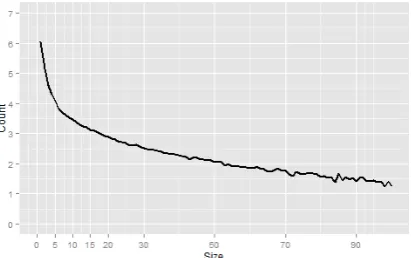
ZORE acquires 122K and 222K patterns from Wi-ki and Sina News, clustered into 59K and 118K pattern synsets, respectively. The frequency distri-bution of the Wiki patterns is shown in Figure 7, which conforms to Zipf’s law.
To assess the accuracy of pattern extraction, we rank the extracted patterns by the size, and eval-uated the precision of the top 100 and a random set of 100 pattern synsets. Two annotators were shown a pattern synset with its semantic signature and a few example relations, and then asked to judge whether it indicates a valid semantic rela-tion or not. The results are shown in Table 6. The averaged precision is 92% for the top 100 set, and 85% for the random 100 set.
The patterns in a pattern synset can be taken as paraphrases (Barzilay and Lee, 2003). We ob-serve that two synonymous patterns might differ in three aspects. First, two patterns can differ by the predicates, which are synonyms. For in-stance, the verbs “ú?, , ?, Ñ?, •, ‰” are synonyms, meaning “to hold the appointment of”. Second, two patterns in the same synset can belong to different syntactic patterns, and there-fore are paraphrases in the syntactic level. For in-stance, the semantic patterns of the two sentences “.’(graduate)u(from)MÃ(Harvard){Æ (Law School) (de, an auxiliary word)cn ê(Obama)oÚ(president)” and “cnê
(Oba-ma)oÚ(president)l(from)MÃ(Harvard){
Æ (Law School).’(graduate)” are both syn-onymous to that of the sentence in Figure 1;
al-l the three patterns are found in the same synset obtained by ZORE. Third, two patterns can dif-fer only by the POS-tag. For instance, “cnê
(Obama)l(from)MÃ (Harvard){Æ (Law School).’ (graduate)” and “@‡(That)Æ“ (attorney)l(from)MÃ(Harvard){Æ (Law School) .’ (graduate)” are synonyms with d-ifferent POS-tags for the first argument (i.e. N-R and NN). According to the grouping algorithm in Section 3.3, all the three types of paraphrases are grouped in a pattern synset, which makes some synsets very large. The largest synset contains 110 patterns, while the top 100 synsets contain more than 20 patterns.
4.4 Error analysis
We analyze the incorrect extractions (precision loss) and missed correct relations (recall loss) re-turned by Step 2, running on 500K sentences. Ta-ble 7 summarizes the types of correct relations that are missed by ZORE. 40% missed relations are due to the minimum frequency constraint on se-mantic patterns, which is used for a balance be-tween precision and recall. Another main source of failure is the incorrect identification of the pred-icate phrase due to parsing errors, which account for 37% of the total errors. Other sources of fail-ures include redundant arguments and segmenta-tion errors. Most redundant arguments are related to prepositions such as “Uì(according to)” and
“Šâ(on the basis of)”. For instance, in the
sen-tence “Uì(according to)ù‡(the)*:(point of view) § (,) Š (fundamental) ¯K (prob-lem) ´ (is)”, an incorrect binary relation (ù‡ (the)*: (point of view),Š (fundamental)¯ K(problem), Pred[´(is)])is extracted, because the prepositional object “ù‡ (the) *: (point of view)” is tagged as an argument of the predi-cate phrase “´(is)”.
incor-Corpus Patterns Synsets Top100 Random100 Wiki 122,723 59,298 0.93 0.87 Sina 222,773 118,923 0.91 0.83
Table 6: Precision of pattern synsets.
40% Relations filtered by semantic pattern constraint 37% Could not identify correct predicates because of
preprocessing errors
[image:9.595.314.520.169.298.2]12% Too many arguments because of parsing errors 11% Segmentation and POS tagging errors
Table 7: Relations missed by ZORE.
rect relations, 56% of which were caused by pars-ing errors, and 34% of which were due to word segmentation and POS tagging errors. Although many errors have been filtered by ZORE, the biggest source of errors is still syntactic analysis, which is very important for high quality of ORE.
5 Related Work
English has been the major language on which ORE research has been conducted. Previous work on English ORE has evolved from shallow-syntactic (Banko et al., 2007; Fader et al., 2011; Merhav et al., 2012) to full-syntactic (Nakashole et al., 2012; Mausam et al., 2012; Moro and Nav-igli, 2013; Xu et al., 2013) and semantic (Johans-son and Nugues, 2008) systems.
It has been shown that a full-syntactic system based on dependency grammar can give signif-icantly better results than shallow syntactic sys-tems based on surface POS-patterns, yet enjoy higher efficiency compared with semantic system-s (Mesystem-squita et al., 2013). Our invesystem-stigation on Chinese ORE takes root in full dependency syntax and is hence able to identify patterns that involve long-range dependencies. Considering the charac-teristics of the Chinese language, such as the lack of morphology and function words, and the high segmentation and word sense ambiguities, we in-corporate semantic ontology information into the design of the system to improve the output quality without sacrificing efficiency.
The state-of-the-art systems most closely relat-ed to our approach are PATTY (Nakashole et al., 2012) and the system of Moro and Navigli (2013). Both, however, extract relations first, and then de-fines patterns based on extracted relations. This paper differs in that patterns and relations are ex-tracted in a simultaneous process and so they can improve each other. Previous studies show that pattern generalization benefit from relation
extrac-56% Parsing errors 17% Segmentation errors 17% POS tagging errors 6% Redundant arguments
6% Other, including base NP extraction errors
Table 8: Incorrect extractions by ZORE.
Figure 7: The frequency distribution of patterns extracted from Wiki. Size and Count denote the number of relations that belong to a semantic tern and the logarithmic number of semantic pat-terns that have the same size, respectively.
tion (Nakashole et al., 2012; Moro and Navigli, 2013), and relation extraction can benefit from pattern generalization (Mausam et al., 2012). By using double propagation, not only can we make relation and pattern extraction benefit from each other, but we can also tag relations and patterns with semantic categories in a joint process.
6 Conclusion and Future Work
We presented a Chinese ORE system that inte-grates relation extraction with semantic pattern generalization by double propagation. Experimen-tal results on two datasets demonstrated the ef-fectiveness of the proposed algorithm. We make the ZORE system, together with the large scale relations and pattern synsets extracted by ZORE, freely available at (https://sourceforge.
net/projects/zore/). Another version of
ZORE (ZORE-PMT), which is based on the de-pendency tagset from PMT1.0 (Qiu et al., 2014), is also provided.
Our error analysis demonstrates that the quali-ty of syntactic parsing is crucial to the accuracy of syntax-based Chinese ORE. Improvements to syn-tactic analysis is likely to lead to improved ORE. In addition, the idea of double propagation can be generalized into information propagation between relation extraction and syntactic analysis. We plan to investigate the use of ORE in improving syntac-tic analysis in future work.
Acknowledgments
We gratefully acknowledge the invaluable assis-tance of Ji Ma, Wanxiang Che and Yijia Liu. We also thank the anonymous reviewers for their con-structive comments, and gratefully acknowledge the support of the Singapore Ministry of Educa-tion (MOE) AcRF Tier 2 grant T2MOE201301, the start-up grant SRG ISTD 2012 038 from Singapore University of Technology and Design, the National Natural Science Foundation of Chi-na (No. 61103089), NatioChi-nal High Technolo-gy Research and Development Program of Chi-na (863 Program) (No. 2012AA011101), Ma-jor National Social Science Fund of China (No. 12&ZD227), Scientific Research Foundation of Shandong Province Outstanding Young Scientist Award (No. BS2013DX020) and Humanities and Social Science Projects of Ludong University (No. WY2013003).
References
Michele Banko, Michael J Cafarella, Stephen Soder-land, Matthew Broadhead, and Oren Etzioni. 2007. Open information extraction for the web. InIJCAI, volume 7, pages 2670–2676.
Regina Barzilay and Lillian Lee. 2003. Learn-ing to paraphrase: an unsupervised approach usLearn-ing
multiple-sequence alignment. InProceedings of the 2003 Conference of the North American Chapter of the Association for Computational Linguistics on Human Language Technology-Volume 1, pages 16– 23. Association for Computational Linguistics. Miriam Butt. 2003. The light verb jungle. In
Work-shop on Multi-Verb Constructions, pages 1–28. Pi-Chuan Chang, Michel Galley, and Christopher D
Manning. 2008. Optimizing Chinese word segmen-tation for machine translation performance. In Pro-ceedings of the Third Workshop on Statistical Ma-chine Translation, pages 224–232. Association for Computational Linguistics.
Pi-Chuan Chang, Huihsin Tseng, Dan Jurafsky, and Christopher D Manning. 2009. Discriminative re-ordering with Chinese grammatical relations fea-tures. InProceedings of the Third Workshop on Syn-tax and Structure in Statistical Translation, pages 51–59. Association for Computational Linguistics. WX Che, Jianmin Jiang, Zhong Su, Yue Pan, and
T-ing Liu. 2005. Improved-edit-distance kernel for Chinese relation extraction. InIJCNLP, pages 132– 137.
Wanxiang Che, Zhenghua Li, and Ting Liu. 2010. Ltp: A Chinese language technology platform. In Pro-ceedings of the 23rd International Conference on Computational Linguistics: Demonstrations, pages 13–16. Association for Computational Linguistics. Oren Etzioni, Anthony Fader, Janara Christensen,
Stephen Soderland, and Mausam Mausam. 2011. Open information extraction: The second genera-tion. In Proceedings of the Twenty-Second inter-national joint conference on Artificial Intelligence-Volume Intelligence-Volume One, pages 3–10. AAAI Press. Anthony Fader, Stephen Soderland, and Oren
Etzion-i. 2011. Identifying relations for open informa-tion extracinforma-tion. In Proceedings of the Conference on Empirical Methods in Natural Language Pro-cessing, pages 1535–1545. Association for Compu-tational Linguistics.
Richard Johansson and Pierre Nugues. 2008.
Dependency-based semantic role labeling of prop-bank. InProceedings of the Conference on Empiri-cal Methods in Natural Language Processing, pages 69–78. Association for Computational Linguistics. Jun-Tae Kim and Dan I Moldovan. 1993. Acquisition
of semantic patterns for information extraction from corpora. In Artificial Intelligence for Application-s, 1993. Proceedings., Ninth Conference on, pages 171–176. IEEE.
Dandan Liu, Zhiwei Zhao, Yanan Hu, and Longhua Qian. 2013. Incorporating lexical semantic simi-larity to tree kernel-based Chinese relation extrac-tion. In Chinese Lexical Semantics, pages 11–21. Springer.
Michael Schmitz Mausam, Robert Bart, Stephen Soderland, and Oren Etzioni. 2012. Open language learning for information extraction. pages 523–534.
Yuval Merhav, Filipe Mesquita, Denilson Barbosa, Wai Gen Yee, and Ophir Frieder. 2012. Extracting information networks from the blogosphere. ACM Transactions on the Web (TWEB), 6(3):11.
Filipe Mesquita, Jordan Schmidek, and Denilson Bar-bosa. 2013. Effectiveness and efficiency of open relation extraction.New York Times, 500:150.
Andrea Moro and Roberto Navigli. 2012. Wisenet: Building a wikipedia-based semantic network with ontologized relations. In Proceedings of the 21st ACM international conference on Information and knowledge management, pages 1672–1676. ACM.
Andrea Moro and Roberto Navigli. 2013. Integrating syntactic and semantic analysis into the open infor-mation extraction paradigm. In Proceedings of the Twenty-Third international joint conference on Arti-ficial Intelligence, pages 2148–2154. AAAI Press.
Ndapandula Nakashole, Gerhard Weikum, and Fabi-an SuchFabi-anek. 2012. PATTY: a taxonomy of rela-tional patterns with semantic types. InProceedings of the 2012 Joint Conference on Empirical Methods in Natural Language Processing and Computational Natural Language Learning, pages 1135–1145. As-sociation for Computational Linguistics.
Ron Papka and James Allan. 1998. On-line new event detection using single pass clustering. University of Massachusetts, Amherst.
Guang Qiu, Bing Liu, Jiajun Bu, and Chun Chen. 2009. Expanding domain sentiment lexicon through double propagation. In IJCAI, volume 9, pages 1199–1204.
Likun Qiu, Yunfang Wu, and Yanqiu Shao. 2011. Combining contextual and structural information for supersense tagging of Chinese unknown words. In
Computational Linguistics and Intelligent Text Pro-cessing, pages 15–28. Springer.
Likun Qiu, Yue Zhang, Peng Jin, and Houfeng Wang. 2014. Multi-view Chinese treebanking. In Proceed-ings of COLING 2014, pages 257–268.
Alan Ritter, Oren Etzioni, et al. 2010. A latent dirich-let allocation method for selectional preferences. In
Proceedings of the 48th Annual Meeting of the As-sociation for Computational Linguistics, pages 424– 434. Association for Computational Linguistics.
Yuen-Hsien Tseng, Lung-Hao Lee, Shu-Yen Lin, Bo-Shun Liao, Mei-Jun Liu, Hsin-Hsi Chen, Oren Et-zioni, and Anthony Fader. 2014. Chinese open rela-tion extracrela-tion for knowledge acquisirela-tion. InEACL 2014, pages 12–16.
Fei Wu and Daniel S Weld. 2010. Open information extraction using wikipedia. In Proceedings of the 48th Annual Meeting of the Association for Compu-tational Linguistics, pages 118–127. Association for Computational Linguistics.
Ying Xu, Mi-Young Kim, Kevin Quinn, Randy Goebel, and Denilson Barbosa. 2013. Open information extraction with tree kernels. In Proceedings of NAACL-HLT, pages 868–877.
Naiwen Xue, Fei Xia, Fu-Dong Chiou, and Martha Palmer. 2005. The penn Chinese treebank: Phrase structure annotation of a large corpus. Natural lan-guage engineering, 11(2):207–238.
Roman Yangarber, Ralph Grishman, Pasi Tapanainen, and Silja Huttunen. 2000. Automatic acquisition of domain knowledge for information extraction. In
Proceedings of the 18th conference on Computation-al linguistics-Volume 2, pages 940–946. Association for Computational Linguistics.
Yue Zhang and Stephen Clark. 2011. Syntactic pro-cessing using the generalized perceptron and beam search. Computational Linguistics, 37(1):105–151. Min Zhang, Jie Zhang, Jian Su, and Guodong Zhou.
2006. A composite kernel to extract relations be-tween entities with both flat and structured features. InProceedings of the 21st International Conference on Computational Linguistics and the 44th annual meeting of the Association for Computational Lin-guistics, pages 825–832. Association for Computa-tional Linguistics.