Title Something Old, Something New, Something Borrowed, Something Blue: Aspects of Interdisciplinary Knowledge Transfer from a Translation Studies Perspective
Author Mara Götz
Publication FORUM: University of Edinburgh Postgraduate Journal of Culture and the Arts Issue Number 15
Issue Date Autumn 2012 Publication Date 12/12/2012
Editors James Leveque & Lizzie Stewart
FORUM claims non-exclusive rights to reproduce this article electronically (in full or in part) and to publish this work in any such media current or later developed. The author retains all rights, including the right to be identified as the author wherever and whenever this article is published, and the right to use all or part of the article and abstracts, with or without revision or modification in compilations or other publications. Any latter publication shall recognise FORUM as the original publisher.
University of Edinburgh
Something Old, Something New, Something Borrowed,
Something Blue: Aspects of Interdisciplinary Knowledge
Transfer from a Translation Studies Perspective
Mara Götz
University of Edinburgh
This article sets out to investigate points of contact and pathways of interdisciplinary knowledge diffusion from a translation studies point of view. For this purpose, notions of innovation, memes, aspects of idea transmission, sociological network theories, and diffusion of knowledge in networks are discussed against the backdrop of network studies theories from the discipline of sociology.
L’originalité n’est rien d’autre qu’une imitation judicieuse.
Originality is nothing but judicious imitation.
-Voltaire-
Introduction
In the preface to Translators through History, Jean-François Joly writes that “[p]eople have translated since time immemorial. Long before FIT [Fédération international des traducteurs], translators served as vital links in the vast chain through which knowledge was transmitted among groups of people separated by language barriers” (XIX). He is drawing on the intrinsically challenging and double-edged task of translators as “import-export workers”, transporting ideas and knowledge across linguistic, spatial,and cultural boundaries (XXI).
multicultural, and multidisciplinary learning community like translation studies (TS), is considered not only beneficial, but vital for coherence in research and academic thought.
This attempt to gain a more detailed understanding of the migratory pathways of adopted knowledge and the implications for interdisciplinary learning as imitation and borrowing of ideas might also be of high interest to other fields, since hardly any academic discipline is not to some extent entangled in interdisciplinary work nowadays: “Since the 1950s, many disciplines have become more porous and multi or inter-disciplinary in character” (Klein 83). The discipline of TS has been described as an “inter-discipline” before1, and recent developments suggest that the interdisciplinarity of TS is only ever getting stronger. In addition, general interest in interdisciplinary studies is clearly on the increase within a Higher Education context, as well as on secondary education levels.2 However, the structures of an interdisciplinary epistemic network have so far remained largely excluded from research. This article sets out from the perspective of TS and attempts a first step towards closing this gap, thus contributing to a more detailed understanding of the pathways along which interdisciplinary knowledge networks and knowledge spread occurs.
In the following section, aspects of learning, innovation, and knowledge diffusion will be discussed. This will serve at the same time as an introduction to the topic of network structure analysis.
Innovation and Learning
In their seminal work Social Learning and Imitation, Neal E. Millar and John Dollard suggest that learning, andalso interdisciplinary learning and the exchange of knowledge, constitutes an act of imitation. A lot of problem-solving effectivelys consists of people doing what they have seen others do. They furthermore point out that we learn to imitate high-prestige people rather than those of low prestige (84). Examples of this can be seen in the frequent adoption of ideas formulated by “big names”, whose theories are often automatically perceived to be of higher relevance to the field. Imitation therefore also indicates a perceived status of the respective person(s) or discipline(s): we often borrow what we recognise as valid, trusted, high-profile, and en vogue.
While this section considers innovation as an aspect of interdisciplinary learning and knowledge diffusion, two basic notions first have to be brought to attention.
First, no matter how good or necessary an innovation is, there is no guarantee that it will be adopted, spread, and established. Even advantageous innovations do not sell and spread themselves. In fact, Everett M. Rogers points out that most innovations diffuse at a disappointingly slow rate, and are not imitated even when proven successful (7).3 A famous example for a delayed process of knowledge adaptation and imitation is the well-documented search for a cure for scurvy in the British Navy (see e.g. Rogers 7-8; Abrahamson & Rosenkopf 290).
adopted on other journeys by the British Navy, despite the fact that many sailors died during ship journeys in these days, and that a cure was being urgently sought. The imitation of this clearly advantageous practice could have saved many lives. About 150 years later, a British Navy physician, James Lind, conducted the same experiment with the same clear results, and yet the practice was still virtually ignored.
In 1795, almost another 50 years later, the British Navy eventually adopted this innovation. The case demonstrates that even good innovations that are proven to be advantageous are not necessarily imitated and/or diffused readily and automatically. There is no clear explanation as to why this is so, but Rogers suggests that because the physicians involved in the initial studies were not prominent figures in the British Navy, their views may have not been given much attention, and their means of publication were limited (8). This corresponds also with Millar and Dollard’s comments on imitation of high-profile figures versus lower-profile sources.
The second point is of a terminological nature. Intellectual and information networks were in existence a long time before Facebook came along. As David Singh Grewal points out, diffusions and exchange of innovation via networks on a political, economic and cultural level are much older than globalisation. He suggests a remarkable “compression of space” (4) that is particularly reinforced by the phenomenon of modern globalisation and modern means of communication. This article discusses transfer and input points in networks of researchers and scholars of the disciplines of TS and sociology. It does not discuss implications of IT-based “social networks” or other characteristics of IT networks.
Nonetheless, it is important to bear in mind that communication across countries and whole continents is very different now. Communicative exchange and spread of information was never easier or faster than it is today. With the internet, people can exchange and publish their ideas more easily than ever. It leads to the question as to whether imitation and exchange of knowledge, and especially new input, have shifted to the online world. This issue will be taken up and discussed later in the conclusion, where the findings from the data sample of this article will also be presented.
The present study sets out to trace the migration pattern of sociological theories and concepts from the discipline of sociology into TS. The “sociological turn” is a relatively recent development within TS, having gained relevance within the discipline’s discourse since the turn of the millennium (cf. Wolf & Fukari 6).
Networks, Memes, and Diffusion
This section will introduce network models that have been found to be appropriate for the analysis of knowledge exchange, borrowing and imitation, as well as some aspects of the diffusion of knowledge. It will also discuss the topics of memes as a vehicle for cultural transfer and innovation, and will introduce the concepts of “links” and “bridges” within a network.
In an earlier stage of this research, the concept of “memes” was considered as a possible framework, as the discipline of memetics appeared opportune for a study on epistemic networks and knowledge diffusion. The concept of memes was introduced by Richard Dawkins in his book The Selfish Gene, in which he defined them as “unit[s] of cultural transmission, or […] of imitation” (192). The meme metaphor, as established by Dawkins, was later picked up and applied to the discipline of TS by Andrew Chesterman in Memes of Translation. Evidently, memes as replicators could still be of potential relevance, particularly for a discipline that is by its nature concerned with the transfer of ideas (Chesterman 5). The interest in memes and memetics spiked from the mid to late 1990s, and coincided with the start of the publication of the electronic Journal of Memetics in 1997.4 Memetics was further popularized by Susan Blackmore’s popular science book The Meme Machine. Even though memetics has also received a fair share of criticism by scholars (cf. e.g. Aunger), the study of memes enjoys ongoing popularity, not only within its “traditional” socio-biologist framework, but also in relation to cultural and media studies.
[image:5.595.86.223.574.753.2]Today, memes are to be found everywhere, especially on the internet, and they are getting more and more academic attention. In all likelihood, the most popular meme is currently the LOL cats phenomenon. It is probably safe to say that cats have contributed enormously to the popularity of memes among a broader audience. Recently, the phenomenon of LOL cats has become the explicit subject of academic interest, when Kate Miltner, a Master student at the London School of Economics, submitted a dissertation with the title "SRSLY PHENOMENAL: An Investigation Into The Appeal Of LOLCATS" (fig. 1). Miltner analyses the rise of participatory culture and user-generated content in a Web 2.0 context.
Initially, memetics seemed an appropriate framework for investigating the spread of ideas. However, with an attempt to analyse in more detail when and how ideas crossed over from one discipline to the other, the meme metaphor started to cause more problems than it solved. Especially problematic was the lack of consensus among memeticists on conceptual clarity, i.e. what the concept of memes does and does not include, or whether memes are actually a concept or merely a meme in themselves. As Robert Augner concludes, there is as of yet no evidence that memes even exist (206). This lack of conceptual and theoretical soundness and of clarity when it comes to the most basic notions, e.g. “If memes are the answer, what is the question?” (Kuper 175), is another issue often pointed out by critics of meme theory and memetics. Neither, furthermore, does meme theory seem to account for dormant memes (dormant on a larger scale or within one person’s mind). It was found that sociological models of epistemic network structures and the diffusion of knowledge via network links provided a more valid framework for this study. Therefore, despite the fact that it has inspired a number of highly interesting thoughts, the adoption and discussion of memes as a framework has been abandoned. Instead aspects and functions of network structures and knowledge diffusion will be discussed in relation to sociological and network studies in the following section.
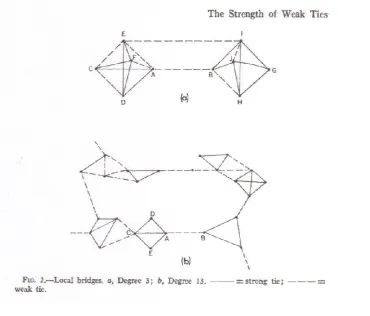
In 1973, the American sociologist and network scholar Mark S. Granovetter wrote a paper entitled “The Strength of Weak Ties”, which looked at models of diffusion and information spread. Granovetter was the first to introduce the general notion of classifying network links on the basis of the degree to which they convey information. He was studying how people in the Boston area found new jobs, and collated data from 282 people. He found that most of the people had heard about their new positions from people who they were not very close with, or who they did not even know well at all (1371-1372). Whereas closer contacts would appear to be a better provider for information, he concluded that weak ties are so much more important than strong network links, because an individual’s close friends or colleagues rarely know much that the individual does not also know already. For Granovetter, an ingrown system is a very poor net in which to catch new information. As he argues, “those to whom we are weakly tied are more likely to move in circles different from our own and will thus have access to information different from that which we receive” (1371). Weak ties connect separate clusters and are as such often bridging links. This weak-versus-strong-ties dimension is more precisely defined as “communication proximity” which constitutes the degree to which two individuals in a network have overlapping personal communication networks.
this practice is still being exerted, particularly in traditional German crafts (fig. 2). A higher degree of diversity is beneficial for the diffusion of ideas through social and epistemic networks.
Fig. 2, Craftsmen on the road.
Fig. 3, The Strength of Weak Ties: Local bridges. _______ = strong tie; _ _ _ _ _ = weak tie.
The weak ties are actually the stronger connectors in these two settings, since they act as bridging links between different networks or clusters, and are therefore more influential when it comes to the spread of information.
By investigating diffusion, Rogers found that most individuals do not actually evaluate an innovation on the basis of scientific study, but instead most people depend mainly on a subjective evaluation from other individuals. He concluded that diffusion is a very social process, and can even change the structure of a social system: “Diffusion is a kind of social change, defined as the process by which alteration occurs in the structure and function of a social system. When new ideas are invented, diffused and are adopted or rejected, leading to certain consequences, social change occurs.” (6)
A further qualification of bridging links and their role in the diffusion of innovations is given by Thomas W. Valente and Kayo Fujimoto, who continued Granovetter’s insight into links as structural bridges. They suggest that:
This relates to Rogers’ findings on diffusion paths via peer networks rather than via established authorities on the respective subject’s output. Despite this wealth in both theoretical frameworks and conceptualizations, as well as case studies drawing on what can be massive sets of data, the actual knowledge transfer and input points are still quite elusive and difficult to pinpoint. In the next section, a closer analysis of the sample data set including methodology will be undertaken, and the migration of ideas from the discipline of sociology into the discipline of TS will be evaluated. The subsequent conclusion will also address questions that are of a wider cross-disciplinary interest. Methodology and Data
The data consulted for this paper has been gathered from two journals, Target and New Voices, both of which are available in electronic format. New Voices is an online journal co-sponsored by the International Association for Translation and Intercultural Studies (IATIS) and the Centre for Translation and Textual Studies (CTTS) at Dublin City University. The first issue was published in 2005. Target is an international journal of TS and forms an imprint of John Benjamins, an independent publisher headquartered in Amsterdam, which specialises mainly in the humanities, particularly linguistics and TS.
This research focuses on recent developments in the academic debate. It has therefore been decided to select the 01/01/2001 as a starting point for the selection of data, with a cut-off point at 31/12/2011, allowing for a temporal scope of exactly ten years. This decision was influenced by the scope of this research project, which calls for a concise set of data that still allows for a tracing of developments over time.
An initial test run with full text analysis of the collated articles revealed that almost every paper from 1990 onwards showed at least between one and three instances of the lemma “sociology”, including “socio-“, “sociological” and “social”. Upon closer analysis, these were often either part of direct or indirect quotes, or appeared in the bibliography. However, the vast majority of these articles had neither a sociological approach nor outlook, and the “positive hits” had no bearing on the line of enquiry of this research project. The full text analysis did not bring up results (i.e. articles) that showed an explicit use of a sociological approach, nor an awareness of social notions within TS. The search parameters for articles were therefore adapted, and it was only abstracts that were searched for the designated lemma.
The positive hits were then further investigated for the degree of relevance to which they implemented sociological methodologies and/or frameworks, and the results were further refined. The individual authors of those contributions that made the “final cut” were then contacted, and asked for their “input links”. This method of tracing inter-personal chains has to be treated with some wariness, since it relies on subjective memories of people. Considering the scope of the present article, however, a discussion of any hermeneutic or philosophical implications will be excluded.
Despite the small size of the sample, some interesting conversion points can be identified between the theories that were outlined earlier and the set of data taken for this paper, and a number of examples from the preliminary findings will be presented and discussed below.
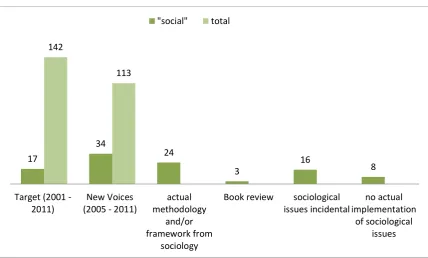
[image:10.595.73.502.281.539.2]First, an analysis and breakdown of the data set by source and year was undertaken (fig.4).
Fig. 4, Papers & Thesis Abstracts in Target and New Voices, 2001 – 2011 (2005 – 2011).
Between 2001 and 2011, Target published a total of 142 articles. 17 of these had a positive hit in the keyword search in the abstract and/or keyword section. New Voices published a total of 113 articles and thesis abstracts between 2005 and 2011. Of these, 34 articles or thesis abstracts came up as a positive hit in the keyword search.
When the initial search results were further refined, it was found that the number of papers and thesis abstracts that were actually incorporating sociological theories, methodologies, and/or frameworks was actually as low as 24. A further three were actually book reviews, 16 mentioned sociological issues incidentally and were negligible, and eight showed no actual implementation of any
17 34 24 3 16 8 142 113
Target (2001 -2011)
New Voices (2005 - 2011)
actual methodology
and/or framework from
sociology
Book review sociological
theories or frameworks from sociology. It is evident that the total number of articles which were strongly and consciously implementing sociological theories is just under 10%.
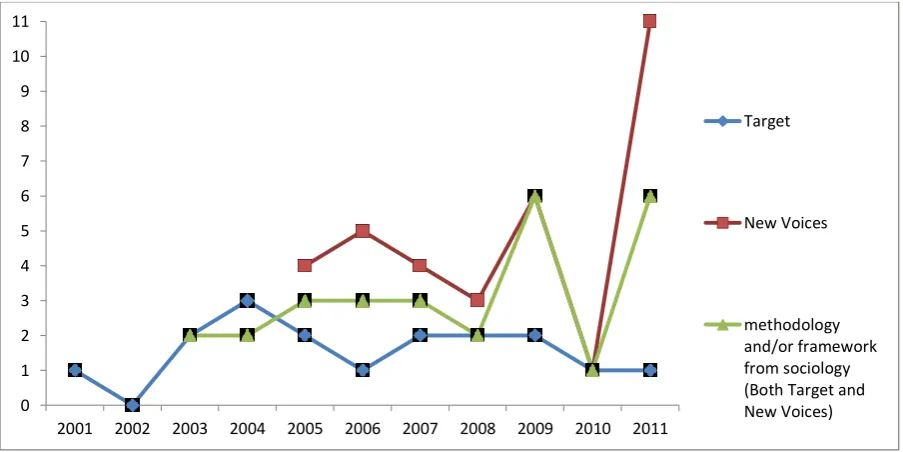
[image:11.595.72.524.208.434.2]The analysis of the diffusion of papers across time (fig. 5) also produced interesting results. There is a rather low but constant number of publications in Target, slightly declining from 2009 onwards. On the other hand, a much higher engagement from the start is present in New Voices, with spikes in the 2009 and the 2011 issues.5
Fig. 5, Publications in Target and New Voices by year, 2001 – 2011.
Conclusion
After the initial data analysis, further investigation was undertaken as to where the individual authors got their inspiration for the “social” approach. During this investigation, it turned out that interdisciplinary input happened in almost all cases via a link that was not part of the individuals’ immediate (closer) network at the time. This is an exact reflection of Granovetter’s Strong-Weak-Tie theory. It also suggests that it might be worth conducting further research to look into this pattern of knowledge diffusion and its further transferability to TS, as well as other disciplines in the humanities. It was also found that interdisciplinary input bridges were mainly not between translation scholar and sociologist, but between translation scholar and translation scholar. Considering that terminological usage tends to differ between specialists and non-specialists, this may serve as a reminder to encourage more direct contact with the respective loan discipline, in order to prevent misdirected research questions and/or outcomes in the borrowing discipline.
0 1 2 3 4 5 6 7 8 9 10 11
2001 2002 2003 2004 2005 2006 2007 2008 2009 2010 2011
Target
New Voices
A particularly interesting result was that a clear majority of the responses that were received acknowledged the importance of personal meetings with their “input links”, for example in conferences or research seminars. Hardly any respondents claimed their input was via a non-personal encounter, e.g. the internet. This seems to suggest that even in an age of near-constant electronic communication, the personal meeting is still indispensable for idea input, development, and innovation diffusion.
Further Issues and Outlook
In conclusion, there seem to be very useful theories from the fields of network studies and knowledge diffusion in particular, which fit in with the preliminary findings from the initial probe of data. In particular, Granovetter’s theory of the strength of weak ties with regard to innovation diffusion appears promising when it comes to analysing and explaining interdisciplinary knowledge exchange and diffusion. It remains to be seen whether this will still hold true when a larger and more complex data set, covering a wider range of the respective loan/borrow disciplines in question, is subjected to analysis.
Diversity is a necessary ingredient for innovation, and the discipline of TS possesses by its nature an inherent diversity. This study has aimed to highlight some aspects of epistemic network structures and dynamics regarding the exchange and diffusion of knowledge across academic disciplines. With particular regard to the inherent quality of diversity and interdisciplinarity of TS, it remains to be investigated whether these qualities affect the “adoption behaviour” of TS when it comes to innovation and diffusion of knowledge. Furthermore, it would be interesting to investigate to what extent these findings are transferable to other disciplines within the humanities.
1Cf. for example Translation Studies: An Interdiscipline. Selected papers from the Translation Studies Congress,
Vienna, 1992. Edited by Mary Snell-Hornby, Franz Pöchhacker and Klaus Kaindl. 1995.
2 Education Scotland designated interdisciplinary learning as an important element of the learning experience in
the 2010 curriculum manifesto : “Interdisciplinary studies, […], can provide relevant, challenging and enjoyable learning experiences and stimulating contexts to meet the varied needs of children and young people” www.educationscotland.gov.uk/images/InterdisciplinaryLearning_tcm4-620626.pdf, last accessed on 20/09/2012.
3A counter argument here is brought forward by Shenkar (2010), who suggests that since the onset of
globalization the process of imitation of advantageous knowledge has accelerated. It has to be noted, though, that Shenkar is writing from a more economic perspective, where companies compete with each other about access to the latest technologies and expertise in order to outsell their competitors.
4http://pcp.vub.ac.be/jom-emit/index.html,last accessed on 20/09/2012.
5In the editorial of 2011 issue, the editors explain that this issue has expanded considerably compared to the