Compositional Matrix-Space Models for Sentiment Analysis
Ainur Yessenalina Dept. of Computer Science
Cornell University Ithaca, NY, 14853 [email protected]
Claire Cardie Dept. of Computer Science
Cornell University Ithaca, NY, 14853 [email protected]
Abstract
We present a general learning-based approach for phrase-level sentiment analysis that adopts an ordinal sentiment scale and is explicitly compositional in nature. Thus, we can model the compositional effects required for accu-rate assignment of phrase-level sentiment. For example, combining an adverb (e.g., “very”) with a positive polar adjective (e.g., “good”) produces a phrase (“very good”) with in-creased polarity over the adjective alone. In-spired by recent work on distributional ap-proaches to compositionality, we model each word as a matrix and combine words us-ing iterated matrix multiplication, which al-lows for the modeling of both additive and multiplicative semantic effects. Although the multiplication-based matrix-space framework has been shown to be a theoretically ele-gant way to model composition (Rudolph and Giesbrecht, 2010), training such models has to be done carefully: the optimization is non-convex and requires a good initial starting point. This paper presents the first such al-gorithm forlearninga matrix-space model for semantic composition. In the context of the phrase-level sentiment analysis task, our ex-perimental results show statistically signifi-cant improvements in performance over a bag-of-words model.
1 Introduction
Sentiment analysis has been an active research area in recent years. Work in the area ranges from iden-tifying the sentiment of individual words to deter-mining the sentiment of phrases, sentences and
doc-uments (see Pang and Lee (2008) for a survey). The bulk of previous research, however, models just pos-itive vs. negative sentiment, collapsing pospos-itive (or negative) words, phrases and documents of differ-ing intensities into just one positive (or negative) class. For word-level sentiment, therefore, these methods would not recognize a difference in senti-ment between words like “good” and “great”, which have the same direction of polarity (i.e., positive) but different intensities. At the phrase level, the methods will fail to register compositional effects in sentiment brought about by intensifiers like “very”, “absolutely”, “extremely”, etc. “Happy” and “very happy”, for example, will both be considered sim-ply “positive” in sentiment. In real-world settings, on the other hand, sentiment values extend across a polarity spectrum — from very negative, to neutral, to very positive. Recent research has shown, in par-ticular, that modeling intensity at the phrase level is important for real-world natural language process-ing tasks includprocess-ing question answerprocess-ing and textual entailment (de Marneffe et al., 2010).
This paper describes a general approach for phrase-level sentiment analysis that takes these real-world requirements into account: we adopt a five-level ordinal sentiment scale and present a learning-based method that assigns ordinal sentiment scores to phrases.
Importantly, our approach will also be explicitly
compositional1in nature so that it can accurately
ac-count for critical interactions among the words in
1ThePrinciple of Compositionalityasserts that the meaning
of a complex expression is a function of the meanings of its constituent expressions and the rules used to combine them.
each sentiment-bearing phrase. Consider, for exam-ple, combining an adverb like “very” with a polar adjective like “good”. “Good” has ana priori posi-tive sentiment, so “very good” should be considered
morepositive even though “very”, on its own, does not bear sentiment. Combining “very” with a nega-tive adjecnega-tive, like “bad”, produces a phrase (“very bad”) that should be characterized as more negative than the original adjective. Thus, it is convenient to think of the effect of combining an intensifying adverb with a polar adjective as being multiplica-tivein nature, if we assume the adjectives (“good” and “bad”) to have positive and a negative sentiment scores, respectively.
Next, let us consider adverbial negators like “not” combined with polar adjectives. When model-ing only positive and negative labels for sentiment, negators are generally treated as flipping the polar-ity of the adjective it modifies (Choi and Cardie, 2008; Nakagawa et al., 2010). However, recent work (Taboada et al., 2011; Liu and Seneff, 2009) sug-gests that the effect of the negator when ordinal sen-timent scores are employed is more akin to damp-ening the adjective’s polarity rather than flipping it. For example, if “perfect” has a strong positive sen-timent, then the phrase “not perfect” is still positive, though to a lesser degree. And while “not terrible” is still negative, it is less negative than “terrible”. For these cases, it is convenient to view “not” as shift-ing polarity to the opposite side of polarity scale by some value.
There are, of course, more interesting examples of compositional semantic effects on sentiment: e.g.,
prevent cancer, ease the burden. Here, the verbs
preventandeaseact as content-word negators (Choi and Cardie, 2008) in that they modify the negative sentiment of their direct object arguments so that the phrase as a whole is perceived as somewhat positive. Nonetheless, the vast majority of methods for phrase- and sentence-level sentiment analysis do not tackle the task compositionally: they, instead, em-ploy a bag-of-words representation and, at best, in-corporate additional features to account for nega-tors, intensifiers, and for contextual valence shifters, which can change the sentiment over neighboring words (e.g., Polanyi and Zaenen (2004), Wilson et al. (2005) , Kennedy and Inkpen (2006), Shaikh et al. (2007)).
One notable exception is Moilanen and Pulman (2007), who propose a compositional semantic ap-proach to assign a positive or negative sentiment to newspaper article titles. However, their knowledge-based approach presupposes the existence of a sen-timent lexicon and a set of symbolic compositional rules.
But learning-based compositional approaches for sentiment analyis also exist. Choi and Cardie (2008), for example, propose an algo-rithm for phrase-based sentiment analysis that learns proper assignments of intermediate sentiment anal-ysis decision variables given thea priori (i.e., out of context) polarity of the words in the phrase and the (correct) phrase-level polarity. As in Moilianen and Pulman (2007), semantic inference is based on (a small set of) hand-written compositional rules. In contrast, Nakagawa et. al (2010) use a dependency parse tree to guide the learning of compositional ef-fects. Each of the above, however, uses a binary rather than an ordinal sentiment scale.
In contrast, our proposed method for phrase-level sentiment analysis is inspired by recent work on distributional approaches to compositionality. In particular, Baroni and Zamparelli (2010) tackle adjective-noun compositions using a vector repre-sentation for nouns andlearninga matrix represen-tation for each adjective. The adjective matrices are then applied as functions over the meanings of nouns — via matrix-vector multiplication — to derive the meaning of adjective-noun combinations. Rudolph and Giesbrecht (2010) show theoretically, that mul-tiplicative matrix-space models are a general case of vector-space models and furthermore exhibit de-sirable properties for semantic analysis: they take into account word order and are algebraically, neuro-logically and psychoneuro-logically plausible. This work, however, does not present an algorithm for learning such models; nor does it provide empirical evidence in favor of matrix-space models over vector-space models.
ma-trix multiplication. To predict an ordinal scale sen-timent value, we employ Ordered Logistic Regres-sion, introducing a novel training algorithm to ac-commodate our compositional matrix-space repre-sentations (Section 2). To our knowledge, this is the first such algorithm for learning matrix-space mod-els for semantic composition. We evaluate the ap-proach on a standard sentiment corpus (Wiebe et al., 2005) (Section 3), making use of its manually anno-tated phrase-level annotations for polarity and inten-sity, and compare our approach to the more com-monly employed bag-of-words model. We show (Section 4) that our matrix-space model significantly outperforms a bag-of-words model for the ordinal scale sentiment prediction task.
2 The Model for Ordinal Scale Sentiment Prediction
As described above, our task is to predict an ordi-nal scale sentiment value for a phrase. To this end, we employ a sentiment scale with five ordinal val-ues: VERY NEGATIVE,NEGATIVE,NEUTRAL,POS -ITIVE and VERY POSITIVE. Given a set of
phrase-level training examples with their gold-standard or-dinal sentiment value, we then use an Ordered Lo-gistic Regression (OLogReg) model for prediction. Unfortunately, our matrix-space representation pre-cludes doing this directly.
We have chosen OLogReg, as opposed to say PRanking (Crammer and Singer, 2001), because op-timization of the former is more attractive: the ob-jective (likelihood) is smooth and the gradients are continuous. As will become clear shortly, learn-ing our models is not trivial and it is important to use sophisticated off-the-shelf optimizers such as L-BFGS.
For a bag-of-words model, OLogReg learns one weight for each word and a set of thresholds by max-imizing the likelihood of the training data. Typically, this is accomplished by using an optimizer like L-BFGS whose interface needs the value and gradient of the likelihood with respect to the parameters at their current values. In the next subsections, we in-stantiate OLogReg for our sentiment prediction task using a matrix-space word model (2.1 and 2.2) and a bag-of-words model (2.3). The learning formula-tion of bag-of-words OLogReg is convex therefore
we will get the global optimum; in contrast, the op-timization problem for matrix-space model is non-convex, it is important to initialize the model well. Initialization of the matrix-space model is discussed in Section 2.4.
2.1 Notation
In the subsequent subsections we will use the following notation. Letnbe the number of phrases
in the training set and letdbe the number of words
in the dictionary. Letxi be the i-th phrase and yi would be the label ofxi, whereyi takesr different
values yi ∈ {0, . . . , r−1}. Then |xi|will denote
the length of the phrase xi, and the words in i-th phrase are: xi = xi1, xi2, . . . , xi|xi|;xij,1≤j ≤ |xi|
is thej-th word ofi-th phrase; wherexij is from the
dictionary:1≤xi j ≤d.
In the case of the bag-of-words model, Φ(xi) ∈
Rdis the representation of the i-th phrase. Φ j(xi) counts the number of times thej-th word from the
dictionary appears in thei-th phrase. Given aw ∈
Rdit assigns a scoreξ
ito a phrasexiby
ξi=wTΦ(xi) =
|xi|
X
j=1 wxi
j (1)
In the case of the matrix-space model theΦ(xi)∈ R|xi|×d
is the representation of the i-th phrase. Φjk(xi)is 1, ifxij is thek-th word in the dictionary, and zero otherwise. Givenu, v ∈ Rm and a set of matrices{Wp ∈ Rm×m}dp=1, one for each word, it
assigns a scoreξito a phrasexiby
ξi = uT
|xi|
Y
j=1 d
X
k=1
WkΦjk(xi)
v
= uT
|xi|
Y
j=1 Wxi
j
v (2)
whereQ|jx=1i| Wxi
j = Wxi1Wx2i · · ·Wxi|xi| inexactly this order. We choose to map matrices to the real numbers by using vectors u andv fromRm×1; so
thatξ = uTM v, whereM ∈Rm×m, which is
sen-sitive to the order of matrices2 , i.e. uTM
1M2v 6=
uTM2M1v.
Modeling composition.Am×mmatrix,
represent-ing a word, can be considered as a linear function, mapping fromRmtoRm. Composition of words is modeled by function composition, in our case com-position of linear functions, i.e. matrix multipli-cation. Note, that unlike bag-of-words model, the matrix-space model takes word order into account, since matrix multiplication is not commutative op-eration.
2.2 Ordered Logistic Regression
Now we will describe our objective function for OLogReg and its derivatives. OLogReg has r −
1 thresholds (κ0, . . . κr−2), so introducing κ−1 =
−∞andκr−1 = ∞leads to the unified expression
for posterior probabilities for all values ofk:
P(yi=k|x) = P(κk−1< ξi≤κk)
= F(κk−ξi)−F(κk−1−ξi)
F(x)is an inverse-logit function
F(x) = e
x
1 +ex this is its derivative:
dF(x)
dx =F(x)(1−F(x))
Therefore the negative loglikelihood of the training data will look like the following (Hardin and Hilbe, 2007):
L=−
n
X
i=1
r−1
X
k=0
ln(F(κk−ξi)−F(κk−1−ξi))I(yi=k)
where r is the number of ordinal classes,ξi is the score ofi-th phrase,I is the indicator function that
is equal to 1 – whenyi=k, and zero otherwise. We
need to minimize the objectiveLwith respect to the
following constraints:
κk−1 ≤κk, 1≤k≤r−2 (3) number. For example, one other way to map matrices to the real numbers is to use the determinant of a matrix; however, the determinant is not sensitive to the word order:det(M1M2) =
det(M1)det(M2) =det(M2M1); which is not desirable for a
model that needs to account for word order.
(The constraints are similar to the ones in PRank al-gorithm). For ease of optimization we parametrize our model viaκ0, andτj,1≤j≤r−2:
κ−1=−∞, κ0,
κ1 =κ0+τ1, κ2 =κ0+P2j=1τj, . . . ,
κr−2 =κ0+Prj=1−2τj κr−1 =∞,
whereτ1,. . .,τr−2are non-negative values, that
rep-resent how far the corresponding thresholds are from each other. Then the constraints (3) would be:
τj ≥0, 1≤j≤r−2 (4) To simplify the equations we can rewrite the nega-tive loglikelihood as follows:
L=−
n
X
i=1
r−1
X
k=0
ln(Aik−Bik)I(yi =k) (5)
where
Aik= (
F(κ0+Pkj=1τj−ξi), ifk= 0, . . . , r−2
1, ifk=r−1
Bik= (
0, ifk= 0
F(κ0+Pkj=1−1τj−ξi), ifk= 1, . . . , r−1
Let’s introduceLik = −ln(Aik −Bik)I(yi = k) and then the derivative ofLikwith respect toκ0will
be: ∂Lik
∂κ0
= −[Aik(1−Aik)−Bik(1−Bik)]
Aik−Bik I(y i=k)
= (Aik+Bik−1)I(yi=k)
Forj =yi:
∂Lik ∂τj =
−Aik(1−Aik)
Aik−Bik I(y i=k)
For allj < yi:
∂Lik
∂τj = (Aik+Bik−1)I(y i=k)
For allj > yi: ∂Lik
∂τj = 0.
The derivative with respect to the scoreξiis:
∂Lik ∂ξi
2.2.1 Matrix-Space Word Model
Here we show the derivatives with respect to a word. For the OLogReg model with matrix-space word representations, we have:
∂L ∂Wxi
j
= ∂L ∂ξi ·
∂ξi ∂Wxi
j
The expression for ∂L
∂ξi is given in (6); we will derive
∂ξi
∂Wxi
j
from (2). In the case of the Matrix-Space word model each word is represented as anm×maffine
matrixW:
W =
A b 0 1
(7)
We choose the class of affine matrices since for affine matrices matrix multiplication represents both operations: linear transformation and translation. Linear transformation is important for modeling changes in sentiment - translation is also useful (we make use of a translation vector during initialization, see Section 2.4). In this work we considerm ≥ 3
since we want the matrix A from (7) to represent
rotation and scaling. Applying the affine transfor-mationW to vector[x,1]T is equivalent to applying
linear transformationAand translationbtox. 3
Though vectors u and v can be learned together
with word matricesWj, we choose to fixuand v. The main intuition behind fixing u and v is to re-duce the degrees of freedom of the model: differ-ent assignmdiffer-ents of u, v and Wj-s can lead to the same score ξ, i.e. there exist uˆ ˆv and Wˆj-s dif-ferent from u, v and Wj-s respectively, such that ξ(u, v, W)would be equal toξ(ˆu,ˆv,Wˆ). 4
3
„ A b
0 1
« „ x
1
«
=
„ Ax+b
1
«
whereAis a linear transformation,bis a translation vector.
Also the product of affine matrices is an affine matrix.
4The specific choice ofuandvleads to an equivalent model
for alluˆandvˆsuch thatuˆ=MTu,ˆv=M−1v, whereM is
any invertible transformation (i.e.u,ˆ vˆare derived fromu,vby
applying linear transformationsMT,M−1respectively):
uTW1W2v = (uTM)(M−1W1M)(M−1W2M)(M−1v) = uˆTWˆ1Wˆ2vˆ
The derivative of the phraseξiwith respect toj-th wordWj would be (for brevity we drop the phrase index andWj refers toWxi
jandprefers to|xi|):
∂ξi ∂Wj
=
∂uTW1W2. . . Wpv ∂Wj
=(uTW1. . . Wj−1)T(Wj+1. . . Wpv)T
=(WjT−1. . . W1T)(uvT)(WpT. . . WjT+1)
(see Peterson and Pederson(2008)).
In case if a certain word appears multiple times in the phrase, the derivative with respect to that word would be a sum of derivatives with respect to each appearance of a word, while all other appearances are fixed. For example,
∂uTW W1W v ∂W
=u(W1W v)T + (uTW W1)TvT
where W is a representation of a word that is
re-peated.
So given the expression (6) for ∂L
∂ξi, the derivative
with respect to each word can be computed. Notice that the update for thej-th word in a sentence
de-pends on the order words, which is in line with our desire to account for word order.
2.2.2 Optimization
The goal of training procedure is for the i-th
phrase withp wordsx1x2. . . xp to learn word ma-tricesW1,W2,. . .,Wpsuch that resultingξi-s will lead to the lowest negative loglikelihood. The goal of training procedure is to find word matricesW1, W2, . . . Wp and thresholds κ0, τ1, . . . τr−2 such
that the negative loglikelihood is minimized. So, given the negative loglikelihood and the derivatives with respectκ0 andτj-s and word matrices W, we optimize objective (5) subject toτj ≥0. We use L-BFGS-B (Large-scale Bound-constrained Optimiza-tion) by Byrd et al. (1995) as an optimizer.
2.2.3 Regularization in Matrix-Space Model
In order to make sure that the L-BFGS-B updates do not cause numerical issues we perform the fol-lowing regularization to the resulting matrices. An
mbymmatrixWj that can be represented as:
Wj =
A11 a12 aT
where A11 ∈ Rm−1×m−1, a12, a21 ∈ Rm−1×1, a22 ∈ R. First make the matrix affine by updating
the last row, then the updated matrix will look like:
ˆ Wj =
A11 a12
0 1
It can be proven that such a projection returns the closest affine matrix in Frobenius norm.
However, we also want to regularize the model to avoid ill-conditioned matrices. Ill-conditioned ma-trices represent transformations whose output is very sensitive to small changes in the input and therefore they have a similar effect to having large weights in a bag-of-words model. To perform such a reg-ularization we ”shrink” the singular values of A11
towards one. More specifically, we first use the Singular Value Decomposition (SVD) of the A11: UΣVT = A
11, whereU andV are orthogonal
ma-trices,Σis a matrix with singular values on the
diag-onal. Then we update singular values in the follow-ing way to getΣ˜:Σ˜ii= Σh
ii, wherehis a parameter between 0 and 1. If h = 1 then Σii remains the same. In the extreme caseh = 0thenΣhii = 1. For
intermediate values ofhthe singular values ofA11
would be brought closer to one. Finally, we recom-puteA˜11:A˜11=UΣ˜VT. So,W
j would be :
˜ Wj =
˜
A11 a12
0 1
2.2.4 Learning in the Matrix-Space Model
We use Algorithm 1 to learn the matrix-space model. What essentially happens is that we iter-ate two steps: optimizing theW matrices using
L-BFGS-B and the projection step. L-L-BFGS-B returns a solution that is not necessarily an affine matrix. After projecting to the space of affine matrices we start L-BFGS-B from a better initial point. In prac-tice, the first few iterations lead to large decrease in negative loglikelihood.
2.3 Bag-Of-Words Model
In the bag-of-words model the score of the i-th
phrase is given in (1). Therefore, the partial deriva-tive with respect toj-th word ini-th phrase ∂ξi
∂wxi
j
is
equal to the numbercjof timesxji appears inxi, so: ∂L
∂wxi j
= ∂L ∂ξi ·
cj
Algorithm 1 Training Algorithm for Matrix-Space OLogReg
1: Input:{(x1, y1), . . . ,(xn, yn)}//training data
2: Input:h//projection parameter
3: Input:T//number of iterations
4: Input:W,κ0andτj//initial values
5: for t= 1, . . . , T do
6: (W,κ0,τj)=minimizeLusing L-BFGS-B
7: for i= 1, . . . , ddo 8: Wi=Project(Wi, h) 9: end for
10: end for
11: ReturnW,κ0,τj
Optimization.We minimize negative loglikelihood using L-BFGS-B subject toτj ≥0.
Regularization. To prevent overfitting for bag-of-words model we regularize w. TheL2-regularized
negative loglikelihood will consist of the expression in (5) and an additional term λ
2||w||22, where|| · ||2
is the L2-norm of a vector. The derivative of the
additional term with respect towwill be:
∂λ2||w||2 2 ∂w =λw
Hence the partial derivative with respect towxi j will
have an additional termλwxi j.
2.4 Initialization
Initialization of bag-of-words OLogReg. We ini-tialize the weight for each word with zero and κ0
with a random number and τj-s with non-negative random numbers. Since the learning problem for bag-of-words OLogReg is convex, we will get the global optimum.
transformation, while vectorb represents a
transla-tion. Since matrix-space model can encode a vector-space model (Rudolph and Giesbrecht, 2010), we can initialize the matrices to exactly mimic the bag-of-words model. In order to do that we place the weight, learned by the bag-of-words model in the first component ofb. Let’s assume thatwx1 andwx2
are the weights learned for two distinct wordsx1and x2 respectively. To compute the polarity score of
a phrase x1, x2 the bag-of-words model sums the
weights of these two words: wx1 andwx2. Now we
want to have the same effect in matrix-space model. Here we assumem= 3.
Z =
1 0 wx1 0 1 0 0 0 1
1 0 wx2 0 1 0 0 0 1
=
1 00 1 wx1+0 wx2
0 0 1
Finally, there is a step of mapping matrix Z to a
number using u and v, such that ξ(Z) = wx1 +
wx2.We also want vectoruandvto be such that:
uT
1 0 wx1 +wx2
0 1 0
0 0 1
v=wx1 +wx2 (8)
The last equation can help us construct u andv.
We also set u and v to be orthogonal: uTv = 0.
So, we arbitrarily choose two orthogonal vectors for which equation (8) holds: u= [1,√2,1]T andv =
[1,−√2,1]T.5
3 Experimental Methodology
For experimental evaluation of the proposed method we use the publicly available Multi-Perspective Question Answering (MPQA)6corpus (Wiebe et al.,
2005) version 1.2, which contains 535 newswire documents that are manually annotated with phrase-level subjectivity and intensity. We use the expression-level boundary markings in MPQA to extract phrases. We evaluate on positive, negative and neutral opinion expressions that have intensities
5Ifm >3,uandvcan be set using the same intuition. 6http://www.cs.pitt.edu/mpqa/
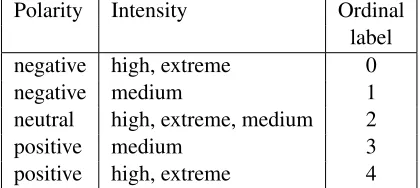
Polarity Intensity Ordinal label negative high, extreme 0
negative medium 1
neutral high, extreme, medium 2
positive medium 3
[image:7.612.322.532.45.139.2]positive high, extreme 4
Table 1: Mapping of combination of polarities and inten-sities from MPQA dataset to our ordinal sentiment scale.
“medium”, “high” or “extreme”.7 The schematic
mapping of phrase polarity and intensity values on ordinal sentimental scale is shown in Table 1.
3.1 Training Details
We perform 10-fold cross-validation on phrases ex-tracted from the MPQA corpus: eight folds for train-ing; one as a validation set; and one as test set. In total there were 8022 phrases. Before training, we extract lemmas for each word. For evaluation we use Ranking Loss: 1
n
P
i|yˆi−yi|, where yˆi is the prediction.
Choice of dimensionality m. The reported
ex-periments are done by settingm = 3. Preliminary experiments with higher values ofm(5, 20, 50), did
not lead to a better performance and increased the training time; therefore we did not use those values in our final experiments.
3.2 Methods
PRank.For each of the folds, we run 500 iterations of PRank and choose an early stopping iteration us-ing a model that led to the lowest rankus-ing loss on the validation set; afterwards report the average perfor-mance of on a test set.
Bag-of-words OLogReg.To prevent overfitting we search for the best regularization parameter among the following values of λ: 10i, from 10−4 to104.
The lowest negative log-likelihood value on the val-idation set is attained for8λ= 0.1. With this value
ofλfixed, the final model is the one with the lowest
negative loglikelihood on the training set.
7We ignored low-intensity phrases similar to (Choi and
Cardie, 2008; Nakagawa et al., 2010).
8We pick singleλthat gives best average validation set
Method Ranking loss
PRank 0.7808
[image:8.612.315.541.44.208.2]Bag-of-words OLogReg 0.6665 Matrix-space OLogReg+RandInit 0.7417 Matrix-space OLogReg+BowInit 0.6375†
Table 2: Ranking loss for vector-space Ordered Logistic Regression and Matrix-Space Logistic Regression. † Stands for a significant difference w.r.t. the Bag-Of-Words OLogReg model with p-value less than 0.001 (p <0.001)
Matrix-space OLogReg+RandInit. First, we ini-tialized matrices with with random numbers from normal distributionN(0,0.1)and setu andv as in
section 2.4,T is set to 25. We run with two different
random seeds and three different values for the pa-rameterh: [0.1, 0.5, 0.9] and report the performance
of the model that had the lowest likelihood on the validation set. The setting ofhthat lead to the best
model was0.9.
Matrix-space OLogReg+BowInit. For the matrix-space models we initialize the model with the out-put of the regularized Bag-of-words OLogReg as de-scribed in Section 2.4,T is set to 25. Then we use the training procedure of Algorithm 1. We consider three different values for the parameter h[0.1, 0.5,
0.9] and choose as the model with the lowest valida-tion set negative log-likelihood. The best setting of
hwas0.1.
4 Results and Discussion
We report Ranking Loss for the four models in Ta-ble 2. The worst performance (denoted by the high-est ranking loss value) is obtained by PRank, fol-lowed by matrix-space OLogReg with random ini-tialization. Bag-of-words OLogReg obtains quite good performance, and matrix-space OLogReg, ini-tialized using the bag-of-words model performs the best, showing statistically significant improvements over the bag-of-words OLogReg model according to a paired t-test. .
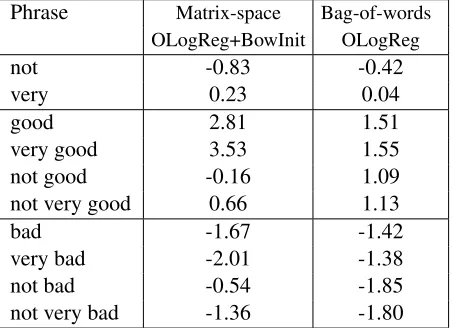
To see what the bag-of-word and matrix-space models are learning we performed inference on a few examples. In Table 3 we show the sentiment scores of the best performing bag-of-words OLo-gReg model and the best performing model based
Phrase Matrix-space Bag-of-words OLogReg+BowInit OLogReg
not -0.83 -0.42
very 0.23 0.04
good 2.81 1.51
very good 3.53 1.55
not good -0.16 1.09
not very good 0.66 1.13
bad -1.67 -1.42
very bad -2.01 -1.38
not bad -0.54 -1.85
not very bad -1.36 -1.80
Table 3: Phrase and the sentiment scores of the phrase for 2 models Matrix-space OLogReg+BowInit and Bag-of-words OLogReg respectively. Notice thatrelative rank-ing order what matters
on matricesMatrix-space OLogReg+BowInit. By sentiment score, we mean equation (1) of Bag-of-words OLogReg and equation (2) of Matrix-space OLogReg+BowInit.
Here we choose two popular adjectives like ‘good’ and ‘bad’ that appeared in the training data, and examine the effect of applying the intensifier ‘very’ on the sentiment score. As we can see, the matrix-space model learns a matrix that inten-sifies both ‘bad’ and ‘good’ in the correct sentiment scale, i.e., ξ(good) < ξ(very good)andξ(bad) < ξ(very bad), while the bag-of-words model gets the
sentiment of ‘very bad’ wrong: it is more positive than ‘bad’. We also looked at the effect of combin-ing ‘not’ with these adjectives. The matrix-space model correctly encodes the effect of the negator for both positive and negative adjectives, such that
ξ(not good) < ξ(good) andξ(bad) < ξ(not bad).
For the interesting case of applying a negator to a phrase with an intensifier, ξ(not good) should be
less than ξ(not very good) and ξ(not very bad)
should be less thanξ(not bad).9 As shown in
Ta-ble 3, these are predicted correctly by the matrix-space model, which the matrix-matrix-space model gets right, but the bag-of-words model misses in the case of “bad”.
Also notice that since in the matrix-space model
9See the detailed discussion in Taboada et al. (2011) and Liu
each word is represented as a function, more specif-ically a linear operator, and the function composi-tion defined as matrix multiplicacomposi-tion, we can think of ”not very” being an operator itself, that is a com-position of operator ”not” and operator ”very”.
5 Related Work
Sentiment Analysis. There has been a lot of research in determining the sentiment of words and constructing polarity dictionaries (Hatzivas-siloglou and McKeown, 1997; Wiebe, 2000; Rao and Ravichandran, 2009; Mohammad et al., 2009; Velikovich et al., 2010). Some recent work is try-ing to identify the degree of sentiment of adjectives and adverbs from text using co-occurrence statistics. Work by Taboada et. al (2011) and Liu and Sen-eff (2009), suggest ways of computing the sentiment of adjectives from data, and computing the effect of combining adjective with adverb as multiplica-tive effect and combining adjecmultiplica-tive with negation as additive effect. However these models require the knowledge of a part of speech of given words and the list of negators (since the negator is an adjective as well). In our work we propose a single unified model for handling all words of any part of speech.
On the other hand, there has been some research in trying to model compositional effects for senti-ment at the phrase- and sentence-level. Choi and Cardie (2008) hand-code compositional rules in or-der to model compositional effects of combining dif-ferent words in the phrase. The hand-coded rules are based on domain knowledge and used to learn
the effects of combining words in the phrase. An-other recent work that tries to model the compo-sitional semantics of combining different words is Nakagawa et. al. (2010), which proposes a model that learns the effects of combining different words using phrase/sentence dependency parse trees and an initial polarity dictionary. They present a learning method that employs hidden variables for sentiment classification: given the polarity of a sentence and the a prioripolarities of its words, they learn how to model the interactions between words with head-modifier relations in the dependency tree.
Some of the previous work looked at MPQA phrase-level classification. Wilson et al. (2004) tack-les the problem of classifying clauses according to
their subjective strength but not polarity; Wilson et al. (2005) classifies phrases according to their po-larity/sentiment but not strength. Our task is differ-ent: we classify phrases according to a single ordinal scale that combines both polarity and strength.
Task of predicting document-level star ratings was considered in (Pang and Lee, 2005; Goldberg and Zhu, 2006). In the current work we look at fine-grained sentiment analysis, more specifically we study word representations for use in true compo-sitional semantic settings.
Distributional Semantics and Compositional-ity. Research in the area of distributional seman-tics in NLP and Cognitive Science has looked at different word representations and different ways of combining words. Mitchell and Lapata (2010) pro-pose a framework for vector-based semantic com-position. They define composition as an additive or multiplicative function of two vectors and show that compositional approaches generally outperform non-compositional approaches that treat the phrase as the union of single lexical items.
Work by Baroni and Zamparelli (2010) models nouns as vectors in some semantic space and ad-jectives as matrices. It shows that modeling adjec-tives as linear transformations and applying those linear transformations to nouns results in final vec-tors for adjective-noun compositions that are close in semantic space to other similar phrases. The authors argue that modeling adjectives as a linear transformation is a better idea than using additive vector-space models. In this work, a separate ma-trix for each adjective is learned using the Par-tial Least Squares method in a completely unsuper-vised way. The recent paper by Rudolph and Gies-brecht (2010), described in the introduction, argues formultiplicative matrix-spacemodels. In contrast to other work in this area, our work is concerned with a specific dimension of word meaning — sen-timent. Our techniques, however, are quite general and should be applicable to other problems in lexical semantics.
6 Conclusions and Future work
model learns a matrix for each word; the composi-tion of words is modeled as iterated matrix multi-plication. The matrix-space framework with iterated matrix multiplication defines an elegant framework for modeling composition; it is also quite general. We use the matrix-space framework in the context of sentiment prediction, a domain where interesting compositional effects can be observed. The main fo-cus of this work was to study word representations (represent as a single weight vs. as a matrix) for use in true compositional semantic settings. One of the benefits of the proposed approach is that by learn-ing matrices for words, the model can handle unseen word compositions (e.g. unseen bigrams) when the unigrams involved have been seen.
However, it is not trivial to learn a matrix-space model. Since the final optimization problem is non-convex, the initialization has to be done carefully. Here the weights learned in bag-of-words model come to rescue and provide good initial point for op-timization procedure. The final model outperforms the bag-of-words based model, which suggests that this research direction is very promising.
Though in our model the order of composition is the same as the word order, we believe that a linguis-tically informed order of composition can give us further performance gains. For example, one can use the output of a dependency parser to guide the order of composition, similar to Nakagawa et al. (2010). Another possibility for improvement is to use the in-formation about the scope of negation. In the current work we assume the scope of negation to be the ex-pression following the negation; in reality, however, determining the scope of negation is a complex lin-guistic phenomenon (Moilanen and Pulman, 2007). So the proposed model can benefit from identify-ing the scope of negation, similar to (Councill et al., 2010).
Also we plan to consider other ways to initialize the matrix-space model. One interesting direction to explore might be to use non-negative matrix factor-ization (Lee and Seung, 2001), co-clustering tech-niques (Dhillon, 2001) to better initialize words that share similar contexts. The other possible direction is to use existing sentiment lexicons and employ-ing a “curriculum learnemploy-ing” strategy (Bengio et al., 2009; Kumar et al., 2010) for our learning problem.
Acknowledgments
This work was supported in part by National Science Foundation Grants BCS-0904822, BCS-0624277, IIS-0968450; and by a gift from Google. We thank the anonymous reviewers, and David Bindel, Nikos Karampatziakis, Lillian Lee and Cornell NLP group for useful suggestions and insightful discussions.
References
Marco Baroni and Roberto Zamparelli. 2010. Nouns are vectors, adjectives are matrices: representing adjective-noun constructions in semantic space. In
Proceedings of the 2010 Conference on Empirical Methods in Natural Language Processing, EMNLP ’10, pages 1183–1193, Morristown, NJ, USA. Asso-ciation for Computational Linguistics.
Yoshua Bengio, J´erˆome Louradour, Ronan Collobert, and Jason Weston. 2009. Curriculum learning. In Pro-ceedings of the 26th Annual International Conference on Machine Learning, ICML ’09. ACM.
R. H. Byrd, P. Lu, and J. Nocedal. 1995. A limited memory algorithm for bound constrained optimiza-tion. SIAM Journal on Scientific and Statistical Com-puting, pages 1190–1208.
Yejin Choi and Claire Cardie. 2008. Learning with com-positional semantics as structural inference for subsen-tential sentiment analysis. InEmpirical Methods in Natural Language Processing (EMNLP).
Isaac G. Councill, Ryan McDonald, and Leonid Ve-likovich. 2010. What’s great and what’s not: learn-ing to classify the scope of negation for improved sen-timent analysis. InProceedings of the Workshop on Negation and Speculation in Natural Language Pro-cessing, NeSp-NLP ’10, Stroudsburg, PA, USA. As-sociation for Computational Linguistics.
Koby Crammer and Yoram Singer. 2001. Pranking with ranking. InAdvances in Neural Information Process-ing Systems 14, pages 641–647. MIT Press.
Marie-Catherine de Marneffe, Christopher D. Manning, and Christopher Potts. 2010. Was it good? It was provocative. learning the meaning of scalar adjectives. InProceedings of the 48th Annual Meeting of the Asso-ciation for Computational Linguistics, Uppsala, Swe-den, July 11–16. ACL.
I. S. Dhillon. 2001. Co-clustering documents and words using bipartite spectral graph partitioning. InKDD. Andrew B. Goldberg and Jerry Zhu. 2006. Seeing
stars when there aren’t many stars: Graph-based semi-supervised learning for sentiment categorization. In
James W. Hardin and Joseph Hilbe. 2007. Generalized Linear Models and Extensions. Stata Press.
Vasileios Hatzivassiloglou and Kathleen R. McKeown. 1997. Predicting the semantic orientation of adjec-tives. InEACL, pages 174–181.
Alistair Kennedy and Diana Inkpen. 2006. Sentiment classification of movie reviews using contextual va-lence shifters. Computational Intelligence, 22(2, Spe-cial Issue on Sentiment Analysis)):110–125.
M. Pawan Kumar, Benjamin Packer, and Daphne Koller. 2010. Self-paced learning for latent variable models. In Advances in Neural Information Processing Sys-tems 23. NIPS.
D. Lee and H. Seung. 2001. Algorithms for non-negative matrix factorization. InNIPS.
Jingjing Liu and Stephanie Seneff. 2009. Review sen-timent scoring via a parse-and-paraphrase paradigm. In Proceedings of the 2009 Conference on Empiri-cal Methods in Natural Language Processing, pages 161–169, Singapore, August. Association for Compu-tational Linguistics.
Jeff Mitchell and Mirella Lapata. 2010. Composition in distributional models of semantics. Cognitive Science, 34(8):1388–1429.
Saif Mohammad, Cody Dunne, and Bonnie Dorr. 2009. Generating high-coverage semantic orientation lexi-cons from overtly marked words and a thesaurus. In Proceedings of the 2009 Conference on Empiri-cal Methods in Natural Language Processing, pages 599–608, Singapore, August. Association for Compu-tational Linguistics.
Karo Moilanen and Stephen Pulman. 2007. Sentiment composition. In Proceedings of Recent Advances in Natural Language Processing (RANLP 2007), pages 378–382, September 27-29.
Tetsuji Nakagawa, Kentaro Inui, and Sadao Kurohashi. 2010. Dependency tree-based sentiment classification using crfs with hidden variables. InConference of the North American Chapter of the Association for Com-putational Linguistics (NAACL).
Bo Pang and Lillian Lee. 2005. Seeing stars: Exploiting class relationships for sentiment categorization with respect to rating scales. InProceedings of the ACL, pages 115–124.
Bo Pang and Lillian Lee. 2008. Opinion mining and sentiment analysis. Foundations and Trends in Infor-mation Retrieval, 2(1-2):1–135.
K. B. Petersen and M. S. Pedersen. ”2008”. The Matrix Cookbook. ”Technical University of Denmark”, ”oct”. ”Version 20081110”.
Livia Polanyi and Annie Zaenen. 2004. Contextual lexical valence shifters. In Proceedings of the AAAI Spring Symposium on Exploring Attitude and Affect in Text: Theories and Applications.
Delip Rao and Deepak Ravichandran. 2009. Semi-supervised polarity lexicon induction. InProceedings of the 12th Conference of the European Chapter of the ACL (EACL 2009), pages 675–682, Athens, Greece, March. Association for Computational Linguistics. Sebastian Rudolph and Eugenie Giesbrecht. 2010.
Com-positional matrix-space models of language. In Pro-ceedings of the 48th Annual Meeting of the Association for Computational Linguistics, ACL ’10, pages 907– 916, Morristown, NJ, USA. Association for Computa-tional Linguistics.
Mostafa Shaikh, Helmut Prendinger, and Ishizuka Mit-suru. 2007. Assessing sentiment of text by semantic dependency and contextual valence analysis.
Maite Taboada, Julian Brooke, Milan Tofiloskiy, and Kimberly Vollz. 2011). Lexicon-based methods for sentiment analysis. InComputational Linguistics. Leonid Velikovich, Sasha Blair-Goldensohn, Kerry
Han-nan, and Ryan McDonald. 2010. The viability of web-derived polarity lexicons. InHuman Language Tech-nologies: The 2010 Annual Conference of the North American Chapter of the Association for Computa-tional Linguistics, pages 777–785, Los Angeles, Cal-ifornia, June. Association for Computational Linguis-tics.
Janyce Wiebe, Theresa Wilson, and Claire Cardie. 2005. Annotating expressions of opinions and emotions in language. Language Resources and Evaluation (for-merly Computers and the Humanities), 39(2/3):164– 210.
Janyce M. Wiebe. 2000. Learning subjective adjectives from corpora. InIn AAAI, pages 735–740.
Theresa Wilson, Janyce Wiebe, and Rebecca Hwa. 2004. Just how mad are you? InAAAI. AAAI.