Decoding with Large-Scale Neural Language Models
Improves Translation
Ashish Vaswani
University of Southern California Department of Computer Science
Yinggong Zhao
Nanjing University, State Key Laboratory for Novel Software Technology
Victoria Fossum and David Chiang University of Southern California
Information Sciences Institute {vfossum,chiang}@isi.edu
Abstract
We explore the application of neural language models to machine translation. We develop a new model that combines the neural proba-bilistic language model of Bengio et al., rec-tified linear units, and noise-contrastive esti-mation, and we incorporate it into a machine translation system both by reranking k-best lists and by direct integration into the decoder. Our large-scale, large-vocabulary experiments across four language pairs show that our neu-ral language model improves translation qual-ity by up to 1.1 Bleu.
1 Introduction
Machine translation (MT) systems rely upon lan-guage models (LMs) during decoding to ensure flu-ent output in the target language. Typically, these
LMs are n-gram models over discrete
representa-tions of words. Such models are susceptible to data
sparsity–that is, the probability of an n-gram
ob-served only few times is difficult to estimate
reli-ably, because these models do not use any informa-tion about similarities between words.
To address this issue, Bengio et al. (2003) pro-pose distributed word representations, in which each word is represented as a real-valued vector in a high-dimensional feature space. Bengio et al. (2003) introduce a feed-forward neural probabilistic LM (NPLM) that operates over these distributed repre-sentations. During training, the NPLM learns both a distributed representation for each word in the
vo-cabulary and ann-gram probability distribution over
words in terms of these distributed representations. Although neural LMs have begun to rival or even
surpass traditional n-gram LMs (Mnih and
Hin-ton, 2009; Mikolov et al., 2011), they have not yet been widely adopted in large-vocabulary applica-tions such as MT, because standard maximum like-lihood estimation (MLE) requires repeated summa-tions over all words in the vocabulary. A variety of strategies have been proposed to combat this issue, many of which require severe restrictions on the size of the network or the size of the data.
In this work, we extend the NPLM of Bengio et al. (2003) in two ways. First, we use rectified lin-ear units (Nair and Hinton, 2010), whose activa-tions are cheaper to compute than sigmoid or tanh units. There is also evidence that deep neural net-works with rectified linear units can be trained suc-cessfully without pre-training (Zeiler et al., 2013). Second, we train using noise-contrastive estimation or NCE (Gutmann and Hyv¨arinen, 2010; Mnih and Teh, 2012), which does not require repeated summa-tions over the whole vocabulary. This enables us to
efficiently build NPLMs on a larger scale than would
be possible otherwise.
We then apply this LM to MT in two ways. First,
we use it to rerank thek-best output of a
hierarchi-cal phrase-based decoder (Chiang, 2007). Second, we integrate it directly into the decoder, allowing the neural LM to more strongly influence the model. We
achieve gains of up to 0.6 Bleutranslating French,
German, and Spanish to English, and up to 1.1 Bleu
on Chinese-English translation.
u1 u2
input words
input embeddings
hidden
h1 hidden
h2 output
P(w|u)
D0
M
C1 C2
[image:2.612.79.293.73.249.2]D
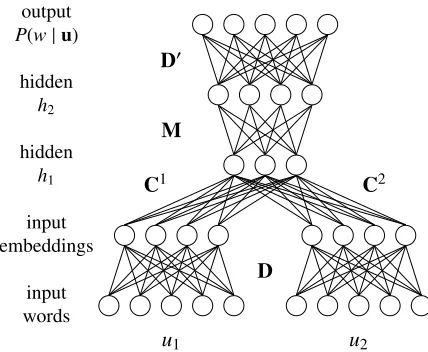
Figure 1: Neural probabilistic language model (Bengio et al., 2003).
2 Neural Language Models
Let V be the vocabulary, and n be the order of
the language model; leturange over contexts, i.e.,
strings of length (n−1), andwrange over words. For
simplicity, we assume that the training data is a sin-gle very long string,w1· · ·wN, wherewNis a special stop symbol,</s>. We writeui forwi−n+1· · ·wi−1,
where, fori≤0,wiis a special start symbol,<s>.
2.1 Model
We use a feedforward neural network as shown in Figure 1, following Bengio et al. (2003). The input to the network is a sequence of one-hot
represen-tations of the words in context u, which we write
uj (1 ≤ j ≤ n−1). The output is the probability
P(w | u) for each wordw, which the network
com-putes as follows.
The hidden layers consist of rec-tified linear units (Nair and Hinton, 2010), which use the activation func-tion φ(x) = max(0,x) (see graph at right).
The output of the first hidden layerh1is
h1=φ
n−1 X
j=1 CjDuj
(1)
where D is a matrix of input word embeddings
which is shared across all positions, theCj are the
context matrices for each word inu, andφis applied
elementwise. The output of the second layerh2is
h2=φ(Mh1),
where M is the matrix of connection weights
be-tween h1and h2. Finally, the output layer is a
soft-max layer,
P(w|u)∝exp D0h2+b
(2)
whereD0is the output word embedding matrix andb
is a vector of biases for every word in the vocabulary.
2.2 Training
The typical way to train neural LMs is to maximize the likelihood of the training data by gradient ascent. But the softmax layer requires, at each iteration, a summation over all the units in the output layer, that is, all words in the whole vocabulary. If the vocabu-lary is large, this can be prohibitively expensive.
Noise-contrastive estimation or NCE (Gutmann and Hyv¨arinen, 2010) is an alternative estimation principle that allows one to avoid these repeated summations. It has been applied previously to log-bilinear LMs (Mnih and Teh, 2012), and we apply it here to the NPLM described above.
We can write the probability of a wordwgiven a
contextuunder the NPLM as
P(w|u)= 1
Z(u)p(w|u)
p(w|u)=exp D0h2+b
Z(u)=X w0
p(w0|u) (3)
wherep(w|u) is theunnormalizedoutput of the unit
corresponding to w, and Z(u) is the normalization
factor. Letθstand for the parameters of the model.
One possibility would be to treatZ(u), instead of
being defined by (3), as an additional set of model
parameters which are learned along withθ. But it is
easy to see that we can make the likelihood arbitrar-ily large by making theZ(u) arbitrarily small.
In NCE, we create a noise distribution q(w).
For each example uiwi, we add k noise samples
¯
variableCwhich is 1 for training examples and 0 for noise samples:
P(C=1,w|u)= 1 1+k ·
1
Z(u)p(w|u)
P(C=0,w|u)= k
1+k ·q(w).
We then train the model to classify examples as
training data or noise, that is, to maximize the
con-ditionallikelihood,
L=
N
X
i=1
logP(C=1|uiwi)+
k
X
j=1
logP(C=0|uiw¯i j)
!
with respect to bothθandZ(u).
We do this by stochastic gradient ascent. The
gra-dient with respect toθturns out to be
∂L ∂θ =
N
X
i=1
P(C=0|uiwi)
∂
∂θlogp(wi |ui)−
k
X
j=1
P(C=1|uiw¯i j)
∂
∂θlogp( ¯wi j|ui)
!
and similarly for the gradient with respect toZ(u).
These can be computed by backpropagation. Unlike before, theZ(u) will converge to a value that normal-izes the model, satisfying (3), and, under appropriate conditions, the parameters will converge to a value that maximizes the likelihood of the data.
3 Implementation
Both training and scoring of neural LMs are compu-tationally expensive at the scale needed for machine translation. In this section, we describe some of the techniques used to make them practical for transla-tion.
3.1 Training
During training, we compute gradients on an en-tire minibatch at a time, allowing the use of matrix-matrix multiplications instead of matrix-matrix-vector mul-tiplications (Bengio, 2012). We represent the inputs as a sparse matrix, allowing the computation of the input layer (1) to use sparse matrix-matrix multi-plications. The output activations (2) are computed
only for the word types that occur as the positive ex-ample or one of the noise sex-amples, yielding a sparse matrix of outputs. Similarly, during backpropaga-tion, sparse matrix multiplications are used at both the output and input layer.
In most of these operations, the examples in a minibatch can be processed in parallel. However, in the sparse-dense products used when updating the
parameters D and D0, we found it was best to
di-vide the vocabulary into blocks (16 per thread) and to process the blocks in parallel.
3.2 Translation
To incorporate this neural LM into a MT system, we
can use the LM to rerank k-best lists, as has been
done in previous work. But since the NPLM scores
n-grams, it can also be integrated into a phrase-based
or hierarchical phrase-based decoder just as a
con-ventionaln-gram model can, unlike a RNN.
The most time-consuming step in computing n
-gram probabilities is the computation of the
nor-malization constantsZ(u). Following Mnih and Teh
(2012), we set all the normalization constants to one during training, so that the model learns to produce approximately normalized probabilities. Then, when applying the LM, we can simply ignore normaliza-tion. A similar strategy was taken by Niehues and
Waibel (2012). We find that a singlen-gram lookup
takes about 40µs.
The technique, described above, of grouping
ex-amples into minibatches works for scoring ofk-best
lists, but not while decoding. But caching n-gram
probabilities helps to reduce the cost of the many lookups required during decoding.
A final issue when decoding with a neural LM is that, in order to estimate future costs, we need
to be able to estimate probabilities of n0-grams for
n0 < n. In conventional LMs, this information is
readily available,1but not in NPLMs. Therefore, we
defined a special word<null>whose embedding is
the weighted average of the (input) embeddings of all the other words in the vocabulary. Then, to esti-mate the probability of ann0-gramu0w, we used the probability ofP(w|<null>n−n0u0).
1However, in Kneser-Ney smoothed LMs, this information
setting dev 2004 2005 2006
baseline 38.2 38.4 37.7 34.3
reranking 38.5 38.6 37.8 34.7
[image:4.612.95.279.70.122.2]decoding 39.1 39.5 38.8 34.9
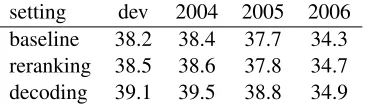
Table 1: Results for Chinese-English experiments, with-out neural LM (baseline) and with neural LM for rerank-ing and integrated decodrerank-ing. Rerankrerank-ing with the neural LM improves translation quality, while integrating it into the decoder improves even more.
4 Experiments
We ran experiments on four language pairs – Chi-nese to English and French, German, and Spanish to English – using a hierarchical phrase-based MT
system (Chiang, 2007) and GIZA++(Och and Ney,
2003) for word alignments.
For all experiments, we used four LMs. The base-lines used conventional 5-gram LMs, estimated with modified Kneser-Ney smoothing (Chen and Good-man, 1998) on the English side of the bitext and the 329M-word Xinhua portion of English Gigaword (LDC2011T07). Against these baselines, we tested systems that included the two conventional LMs as well as two 5-gram NPLMs trained on the same datasets. The Europarl bitext NPLMs had a vocab-ulary size of 50k, while the other NPLMs had a vo-cabulary size of 100k. We used 150 dimensions for
word embeddings, 750 units in hidden layerh1, and
150 units in hidden layerh2. We initialized the
net-work parameters uniformly from (−0.01,0.01) and
the output biases to−log|V|, and optimized them by
10 epochs of stochastic gradient ascent, using mini-batches of size 1000 and a learning rate of 1. We drew 100 noise samples per training example from the unigram distribution, using the alias method for
efficiency (Kronmal and Peterson, 1979).
We trained the discriminative models with MERT (Och, 2003) and the discriminative rerankers on 1000-best lists with MERT. Except where noted, we ran MERT three times and report the average score.
We evaluated using case-insensitive NIST Bleu.
4.1 NIST Chinese-English
For the Chinese-English task (Table 1), the training data came from the NIST 2012 constrained track, excluding sentences longer than 60 words. Rules
Fr-En De-En Es-En
setting dev test dev test dev test
baseline 33.5 25.5 28.8 21.5 33.5 32.0
reranking 33.9 26.0 29.1 21.5 34.1 32.2
[image:4.612.312.537.70.136.2]decoding 34.12 26.12 29.3 21.9 34.22 32.12
Table 2: Results for Europarl MT experiments, without neural LM (baseline) and with neural LM for reranking and integrated decoding. The neural LM gives improve-ments across three different language pairs. Superscript 2 indicates a score averaged between two runs; all other scores were averaged over three runs.
without nonterminals were extracted from all train-ing data, while rules with nonterminals were ex-tracted from the FBIS corpus (LDC2003E14). We ran MERT on the development data, which was the NIST 2003 test data, and tested on the NIST 2004– 2006 test data.
Reranking using the neural LM yielded
improve-ments of 0.2–0.4 Bleu, while integrating the neural
LM yielded larger improvements, between 0.6 and 1.1 Bleu.
4.2 Europarl
For French, German, and Spanish translation, we used a parallel text of about 50M words from Eu-roparl v7. Rules without nonterminals were ex-tracted from all the data, while rules with nonter-minals were extracted from the first 200k words. We ran MERT on the development data, which was the WMT 2005 test data, and tested on the WMT 2006 news commentary test data (nc-test2006).
The improvements, shown in Table 2, were more modest than on Chinese-English. Reranking with the neural LM yielded improvements of up to 0.5
Bleu, and integrating the neural LM into the decoder
yielded improvements of up to 0.6 Bleu. In one
case (Spanish-English), integrated decoding scored higher than reranking on the development data but
lower on the test data – perhaps due to the diff
er-ence in domain between the two. On the other tasks, integrated decoding outperformed reranking.
4.3 Speed comparison
10 20 30 40 50 60 70
0
1
,
000
2
,
000
3
,
000
4
,
000
Vocabulary size (×1000)
T
raining
time
(s)
[image:5.612.78.296.66.280.2]CSLM NCEk=1000 NCEk=100 NCEk=10
Figure 2: Noise contrastive estimation (NCE) is much faster, and much less dependent on vocabulary size, than MLE as implemented by the CSLM toolkit (Schwenk, 2013).
lines (5.2M words) of the Xinhua portion of Giga-word and timed one epoch of training, for various
values of k and |V|, on a dual hex-core 2.67 GHz
Xeon X5650 machine. For these experiments, we used minibatches of 128 examples. The timings are plotted in Figure 2. We see that NCE is considerably faster than MLE; moreover, as expected, the MLE
training time is roughly linear in |V|, whereas the
NCE training time is basically constant.
5 Related Work
The problem of training with large vocabularies in NPLMs has received much attention. One strategy has been to restructure the network to be more hi-erarchical (Morin and Bengio, 2005; Mnih and Hin-ton, 2009) or to group words into classes (Le et al., 2011). Other strategies include restricting the
vocab-ulary of the NPLM to ashortlistand reverting to a
traditional n-gram LM for other words (Schwenk,
2004), and limiting the number of training examples using resampling (Schwenk and Gauvain, 2005) or selecting a subset of the training data (Schwenk et
al., 2012). Our approach can be efficiently applied
to large-scale tasks without limiting either the model or the data.
NPLMs have previously been applied to MT, most notably feed-forward NPLMs (Schwenk, 2007; Schwenk, 2010) and RNN-LMs (Mikolov, 2012). However, their use in MT has largely been limited
to rerankingk-best lists for MT tasks with restricted
vocabularies. Niehues and Waibel (2012) integrate a RBM-based language model directly into a decoder, but they only train the RBM LM on a small amount of data. To our knowledge, our approach is the first to integrate a large-vocabulary NPLM directly into a decoder for a large-scale MT task.
6 Conclusion
We introduced a new variant of NPLMs that com-bines the network architecture of Bengio et al. (2003), rectified linear units (Nair and Hinton, 2010), and noise-contrastive estimation (Gutmann and Hyv¨arinen, 2010). This model is dramatically faster to train than previous neural LMs, and can be trained on a large corpus with a large vocabulary and directly integrated into the decoder of a MT system. Our experiments across four language pairs
demon-strated improvements of up to 1.1 Bleu. Code for
training and using our NPLMs is available for down-load.2
Acknowledgements
We would like to thank the anonymous reviewers for their very helpful comments. This research was sup-ported in part by DOI IBC grant D12AP00225. This work was done while the second author was
visit-ing USC/ISI supported by China Scholarship
Coun-cil. He was also supported by the Research Fund for the Doctoral Program of Higher Education of China (No. 20110091110003) and the National Fundamen-tal Research Program of China (2010CB327903).
References
Yoshua Bengio, R´ejean Ducharme, Pascal Vincent, and Christian Jauvin. 2003. A neural probabilistic lan-guage model. Journal of Machine Learning Research. Yoshua Bengio. 2012. Practical recommendations for gradient-based training of deep architectures. CoRR, abs/1206.5533.
Stanley F. Chen and Joshua Goodman. 1998. An empir-ical study of smoothing techniques for language
eling. Technical Report TR-10-98, Harvard University Center for Research in Computing Technology. David Chiang. 2007. Hierarchical phrase-based
transla-tion. Computational Linguistics, 33(2):201–228. Michael Gutmann and Aapo Hyv¨arinen. 2010.
Noise-contrastive estimation: A new estimation principle for unnormalized statistical models. In Proceedings of AISTATS.
Kenneth Heafield, Philipp Koehn, and Alon Lavie. 2012. Language model rest costs and space-efficient storage. InProceedings of EMNLP-CoNLL, pages 1169–1178. Richard Kronmal and Arthur Peterson. 1979. On the alias method for generating random variables from a discrete distribution. The American Statistician, 33(4):214–218.
Hai-Son Le, Ilya Oparin, Alexandre Allauzen, Jean-Luc Gauvain, and Franc¸ois Yvon. 2011. Structured output layer neural network language model. InProceedings of ICASSP, pages 5524–5527.
Tom´aˇs Mikolov, Anoop Deoras, Stefan Kombrink, Luk´aˇs Burget, and Jan “Honza” ˇCernock´y. 2011. Em-pirical evaluation and combination of advanced lan-guage modeling techniques. In Proceedings of IN-TERSPEECH, pages 605–608.
Tom´aˇs Mikolov. 2012. Statistical Language Models Based on Neural Networks. Ph.D. thesis, Brno Uni-versity of Technology.
Andriy Mnih and Geoffrey Hinton. 2009. A scalable hierarchical distributed language model. InAdvances in Neural Information Processing Systems.
Andriy Mnih and Yee Whye Teh. 2012. A fast and sim-ple algorithm for training neural probabilistic language models. InProceedings of ICML.
Frederic Morin and Yoshua Bengio. 2005. Hierarchical probabilistic neural network language model. In Pro-ceedings of AISTATS, pages 246–252.
Vinod Nair and Geoffrey E. Hinton. 2010. Rectified lin-ear units improve restricted Boltzmann machines. In
Proceedings of ICML, pages 807–814.
Jan Niehues and Alex Waibel. 2012. Continuous space language models using Restricted Boltzmann Machines. InProceedings of IWSLT.
Franz Josef Och and Hermann Ney. 2003. A system-atic comparison of various statistical alignment mod-els.Computational Linguistics, 29(1):19–51.
Franz Josef Och. 2003. Minimum error rate training in statistical machine translation. InProceedings of ACL, pages 160–167.
Holger Schwenk and Jean-Luc Gauvain. 2005. Training neural network language models on very large corpora. InProceedings of EMNLP.
Holger Schwenk, Anthony Rousseau, and Mohammed Attik. 2012. Large, pruned or continuous space lan-guage models on a GPU for statistical machine trans-lation. InProceedings of the NAACL-HLT 2012 Work-shop: Will We Ever Really Replace the N-gram Model? On the Future of Language Modeling for HLT, pages 11–19.
Holger Schwenk. 2004. Efficient training of large neural networks for language modeling. In Proceedings of IJCNN, pages 3059–3062.
Holger Schwenk. 2007. Continuous space language models. Computer Speech and Language, 21:492– 518.
Holger Schwenk. 2010. Continuous-space language models for statistical machine translation. Prague Bul-letin of Mathematical Linguistics, 93:137–146. Holger Schwenk. 2013. CSLM - a modular open-source
continuous space language modeling toolkit. In Pro-ceedings of Interspeech.