Paraphrasing 4 Microblog Normalization
Wang Ling Chris Dyer Alan W Black Isabel Trancoso
L2F Spoken Systems Lab, INESC-ID, Lisbon, Portugal
Language Technologies Institute, Carnegie Mellon University, Pittsburgh, PA, USA Instituto Superior T´ecnico, Lisbon, Portugal
{lingwang,cdyer,awb}@cs.cmu.edu
Abstract
Compared to the edited genres that have played a central role in NLP research, mi-croblog texts use a more informal register with nonstandard lexical items, abbreviations, and free orthographic variation. When confronted with such input, conventional text analysis tools often perform poorly. Normalization — replacing orthographically or lexically id-iosyncratic forms with more standard variants — can improve performance. We propose a method for learning normalization rules from machine translations of a parallel corpus of microblog messages. To validate the utility of our approach, we evaluate extrinsically, show-ing that normalizshow-ing English tweets and then translating improves translation quality (com-pared to translating unnormalized text) using three standard web translation services as well as a phrase-based translation system trained on parallel microblog data.
1 Introduction
Microblogs such as Twitter, Sina Weibo (a popular Chinese microblog service) and Facebook have re-ceived increasing attention in diverse research com-munities (Han and Baldwin, 2011; Hawn, 2009, in-ter alia). In contrast to traditional text domains that use carefully controlled, standardized language, mi-croblog content is often informal, with less adher-ence to conventions regarding punctuation, spelling, and style, and with a higher proportion of dialect or pronouciation-derived orthography. While this diversity itself is an important resource for study-ing, e.g., sociolinguistic variation (Eisenstein et al.,
2011; Eisenstein, 2013), it poses challenges to NLP applications developed for more formal domains. If retaining variation due to sociolinguistic or phono-logical factors is not crucial,text normalizationcan improve performance on downstream tasks (§2).
This paper introduces a data-driven approach to learning normalization rules by conceiving of nor-malization as a kind of paraphrasing and taking inspiration from the bilingual pivot approach to paraphrase detection (Bannard and Callison-Burch, 2005) and the observation that translation is an inherently “simplifying” process (Laviosa, 1998; Volansky et al., 2013). Starting from a parallel cor-pus of microblog messages consisting of English paired with several other languages (Ling et al., 2013), we use standard web machine translation sys-tems tore-translatethe non-English segment, pro-ducing hEnglish original,English MTi pairs (§3). These are our normalization examples, with MT out-put playing the role of normalized English. Sev-eral techniques for identifying high-precision nor-malization rules are proposed, and we introduce a character-based normalization model to account for predictable character-level processes, like repetition and substitution (§4). We then describe our decod-ing procedure (§5) and show that our normaliza-tion model improve translanormaliza-tion quality for English– Chinese microblog translation (§6).1
2 Why Normalize?
Consider the English tweet shown in the first row of Table 1 which contains several elements that NLP
1The datasets used in this paper are available fromhttp:
//www.cs.cmu.edu/˜lingwang/microtopia.
Table 1: Translations of an English microblog message into Mandarin, using three web translation services.
orig. To DanielVeuleman yea iknw imma work on that
MT1 啊iknw DanielVeuleman伊马工作,
MT2 DanielVeuleman是iknw凋谢关于工作,
MT3 到DanielVeuleman是的iknw imma这方面的工作
systems trained on edited domains may not handle well. First, it contains several nonstandard abbre-viations, such as, yea, iknw and imma (abbrevia-tions of yes, I know and I am going to). Second, there is no punctuation in the text although stan-dard convention would dictate that it should be used. To illustrate the effect this can have, consider now the translations produced by Google Translate,2
Mi-crosoft Bing,3 and Youdao,4 shown in rows 2–4. Even with no knowledge of Chinese, it is not hard to see that all engines have produced poor transla-tions: the abbreviationiknwis left translated by all engines, andimmais variously deleted, left untrans-lated, or transliterated into the meaningless sequence 伊马(pronouncedy¯ı mˇa).
While normalization to a form like To Daniel Veuleman: Yes, I know. I am going to work on that. does indeed lose some information (information im-portant for an analysis of sociolinguistic or phono-logical variation clearly goes missing), it expresses the propositional content of the original in a form that is more amenable to processing by traditional tools. Translating the normalized form with Google Translate produces要丹尼尔Veuleman:是的,我 知道。我打算在那工作。, which is a substantial improvement over all translations in Table 1.
3 Obtaining Normalization Examples
We want to treat normalization as a supervised learn-ing problem akin to machine translation, and to do so, we need to obtain pairs of microblog posts and their normalized forms. While it would be possible to ask annotators to create such a corpus, it would be quite expensive to obtain large numbers of ex-amples. In this section, we propose a method for creating normalization examples without any human
2http://translate.google.com/ 3
http://www.bing.com/translator
4http://fanyi.youdao.com/
Table 2: Translations of Chinese original post to English using web-based service.
orig. To DanielVeuleman yea iknw imma work on that orig. 对DanielVeuleman说,是的,我知道,
我正在向那方面努力
MT1 Right DanielVeuleman say, yes, I know, I’m
Xiangna efforts
MT2 DanielVeuleman said, Yes, I know, I’m that hard MT3 Said to DanielVeuleman, yes, I know, I’m to
that effort
annotation, by leveraging existing tools and data re-sources.
The English example sentence in Table 1 was se-lected from the µtopia parallel corpus (Ling et al., 2013), which consists of self-translated sages from Twitter and Sina Weibo (i.e., each mes-sage contains a translation of itself). Row 2 of Table 2 shows the Mandarin self-translation from the corpus. The key observation is what happens when weautomaticallytranslate the Mandarin ver-sion back into English. Rows 3–5 shows automatic translations from three standard web MT engines. While not perfect, the translations contain several correctly normalized subphrases. We will use such re-translationsas a source of (noisy) normalization examples. Since such self-translations are relatively numerous on microblogs, this technique can provide a large amount of data.
Of course, to motivate this paper, we argued that NLP tools — like the very translation systems we propose to use — often fail on unnormalized input. Is this a problem? We argue that it is not for the following two reasons.
he,fi: if e contains nonstandard lexical variants, thenfis likely to be a normalized translation using with fewer nonstandard lexical variants (and vice-versa).
Uncorrelated orthographic variants. Any writ-ten language has the powrit-tential to make creative use of orthography: alphabetic scripts can render ap-proximations of pronunciation variants; logographic scripts can use homophonic substitutions. However, the kinds of innovations used in particular languages will be language specific (depending on details of the phonology, lexicon, and orthography of the lan-guage). However, for language pairs that differ sub-stantially in these dimensions, it may not always be possible (or at least easy) to preserve particular kinds of nonstandard orthographic forms in trans-lation. Consider the (relatively common) pronoun-verb compounds likeiknwandimmafrom our mo-tivating example: since Chinese uses a logographic script without spaces, there is no obvious equivalent.
3.1 Variant–Normalized Parallel Corpus
For the two reasons outlined above, we argue that we will be able to translate back into English us-ing MT, even when the underlyus-ing English part of the parallel corpus has a great deal of nonstandard content. We leverage this fact to build the normal-ization corpus, where the original English tweet is treated as the variant form, and the automatic trans-lation obtained from another language is considered a potential normalization.5
Our process is as follows. The microblog cor-pus of Ling et al. (2013) contains sentence pairs ex-tracted from Twitter and Sina Weibo, for multiple language pairs. We use all corpora that include En-glish as one of the languages in the pair. The respec-tive non-English side is translated into English using different translation engines. The different sets we used and the engines we used to translate are shown in Table 3. Thus, for each original English posto, we obtainnparaphrases {pi}n
i=1, from ndifferent
translation engines.
5
We additionally assume that the translation engines are trained to output more standardized data, so there will be addi-tional normalizing effect from the machine translation system.
Table 3: Corpora Used for Paraphrasing.
Lang. Pair Source Segs. MT Engines
ZH-EN Weibo 800K Google, Bing, Youdao ZH-EN Twitter 113K Google, Bing, Youdao AR-EN Twitter 114K Google, Bing RU-EN Twitter 119K Google, Bing KO-EN Twitter 78K Google, Bing JA-EN Twitter 75K Google, Bing
3.2 Alignment and Filtering
Our parallel microblog corpus was crawled automat-ically and contains many misaligned sentences. To improve precision, we attempt to find the similar-ity between the (unnormalized) original and each of the normalizations using an alignment based on the one used in METEOR (Denkowski and Lavie, 2011), which computes the best alignment between the original tweet and each of the normalizations but modified to permit domain-specific approximate matches. To address lexical variants, we allow fuzzy word matching, that is, we allow lexically similar, such asyea and yesto be aligned (similarity is de-termined by the Levenshtein distance). We also per-form phrasal matchings, such asikwntoi know. To do so, we extend the alignment algorithm from word to phrasal alignments. More precisely, given the original postoand a candidate normalizationn, we wish to find the optimal segmentation producing a good alignment. A segmentations = hs1, . . . , s|s|i is a sequence of segments that aligns as a block to a source word. For instance, for the sentenceyea iknw imma work on that, one possible segmentation could bes1=yea ikwn,s2=immaands3=work on that.
Model. We define the score of an alignmentaand segmentation s in using a model that makes semi-Markov independence assumptions, similar to the work in (Bansal et al., 2011),u(a,s|o,n) =
|s| Y
i=1 h
ue(si, ai|n)×ut(ai|ai−1)×u`(|si|)
i
score of a segment correspondenceue(s, a|n), we assume that this can be estimated using the lexical similarity between segments, which we define to be
1− L(sk,ak)
max{|sk|,|ak|}, whereL(x, y)denotes the
Leven-shtein distance between stringsxandy, normalized by the highest possible distance between those seg-ments.
For the alignment score ut, we assume that the relative order of the two sequences will be mostly monotonous. Thus, we approximateutwith the fol-lowing densityposs(ak)−pose(ak−1) ∼ N(1,1),
where theposs is the index of the first word in the segment andposethe one of the last word.
After finding the Viterbi alignments, we compute the similarity measureτ = |A||+|A|U|, used in (Resnik and Smith, 2003), where|A|and|U|are the number of words that were aligned and unaligned, respec-tively. In this work, we extract the pair ifτ >0.2.
4 Normalization Model
From the normalization corpus, we learn a nor-malization model that generalizes the nornor-malization process. That is, from the data we observe thatTo DanielVeuleman yea iknw imma work on thatis nor-malized to To Daniel Veuleman: yes, I know. I am going to work on that. However, this is not useful, since the chances of the exact sentence To DanielVeuleman yea iknw imma work on that occur-ring in the data is low. We wish to learn a process to convert the original tweet into the normalized form. There are two mechanisms that we use in our model. The first (§4.1) learns word–word and phrase–phrase mappings. That is, we wish to find thatDanielVeulemanis normalized toDaniel Veule-man, that iknw is normalized to I know and that immais normalized toI am going. These mappings are more useful, since wheneveriknwoccurs in the data, we have the option to normalize it toI know. The second (§4.2) learns character sequence map-pings. If we look at the normalization DanielVeule-mantoDaniel Veuleman, we can see that it is only applicable when the exact wordDanielVeuleman oc-curs. However, we wish to learn that it is uncom-mon for the letterslandvto occur in the same word sequentially, so that be can add missing spaces in words that contain thelvcharacter sequence, such as normalizingphenomenalvotertophenomenal voter.
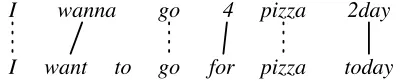
I wanna go 4 pizza 2day
[image:4.612.325.525.64.106.2]I want to go for pizza today
Figure 1: Variant–normalized alignment with the variant form above and the normalized form below; solid lines show potential normalizations, while dashed lines repre-sent identical translations.
However, there are also cases where this is not true, for instance, in the wordvelvet, we do not wish to separate the letterslandv. Thus, we shall describe the process we use to decide when to apply these transformations.
4.1 From Sentences To Phrases
The process to find phrases from sentences has been throughly studied in Machine Translation. This is generally done in two steps, Word Alignments and Phrase Extraction.
Alignment. The first step is to find the word-level alignments between the original post and its nor-malization. This is a well studied problem in MT, referred as Word Alignment (Brown et al., 1993). Many alignment models have been proposed, such as, the HMM-based word alignment models (Vo-gel et al., 1996) and the IBM models (Och and Ney, 2003). Generally, a symmetrization step is per-formed, where the bidirectional alignments are com-bined heuristically. In our work, we use the fast aligner proposed in (Dyer et al., 2013) to obtain the word alignments. Figure 1 shows an example of an word aligned pair of a tweet and its normalization.
Table 4: Fragment of the phrase normalization model built, for each original phraseo, we present the top-3 nor-malized forms ranked byf(n|o).
Original (o) Normalization (n) f(n|o)
wanna want to 0.4679
wanna will 0.0274
wanna going to 0.0114
4 4 0.5641
4 for 0.01795
go 4 go for 1.0000
words inside the pair that are aligned to words not in the pair. For instance, in the example above, the phrase pair that normalizeswannatowant towould be extracted, but the phrase pair normalizingwanna towant to gowould not, because the wordgoin the normalization is aligned to a word not in the pair.
Phrasal Features. After extracting the phrase pairs, a model is produced with features derived from phrase pair occurrences during extraction. This model is equivalent to phrasal translation model in MT, but we shall refer to it as the normalization model. For a phrase pairho,ni, whereois the origi-nal phrase, andnis the normalized phrase, we com-pute the normalization relative frequencyf(n|o) =
C(n,o)
C(o) , whereC(n,o) denotes the number of times owas normalized tonandC(o)denotes the number of timesowas seen in the extracted phrase pairs. Ta-ble 4 gives a fragment of the normalization model. The columns represent the original phrase, its nor-malization and the probability, respectively.
In Table 4, we observe that the abbreviation wanna is normalized to want to with a relatively high probability, but it can also be normalized to other equivalent expressions, such as will and go-ing to. The word 4 by itself has a low probability to be normalized to the prepositionfor. This is ex-pected, since this decision cannot be made without context. However, we see that the phrase go 4 is normalized togo forwith a high probability, which specifies that within the context ofgo,4is generally used as a preposition.
4.2 From Phrases to Characters
While we can learn lexical variants that are in the corpora using the phrase model, we can only address word forms that have been observed in the corpora.
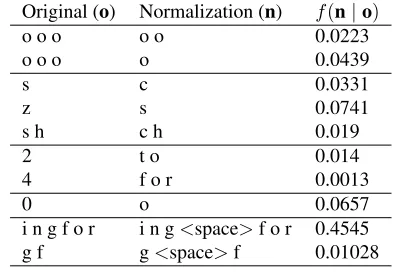
Table 5: Fragment of the character normalization model where examples representative of the lexical variant gen-eration process are encoded in the model.
Original (o) Normalization (n) f(n|o)
o o o o o 0.0223
o o o o 0.0439
s c 0.0331
z s 0.0741
s h c h 0.019
2 t o 0.014
4 f o r 0.0013
0 o 0.0657
i n g f o r i n g<space>f o r 0.4545 g f g<space>f 0.01028
This is quite limited, since we cannot expect all the word forms to be present, such as all the possible orthographic errors for the wordcat, such as catt, kat and caaaat. Thus, we will build a character-based model that learns the process lexical variants are generated at the subword level.
Our character-based model is similar to the phrase-based model, except that, rather than learn-ing word-based mapplearn-ings from the original tweet and the normalization sentences, we learn character-based mappings from the original phrases to the nor-malizations of those phrases. Thus, we extract the phrase pairs in the phrasal normalization model, and use them as a training corpora. To do this, for each phrase pair, we add a start token, <start>, and a end token,<end>, at the beginning and ending of the phrase pair. Afterwards, we separate all charac-ters by space and add a space token<space>where spaces were originally. For instance, the phrase pair normalizing DanielVeuleman toDaniel Veule-manwould be converted to<start>d a n i e l v e u l e m a n<end>and<start>d a n i e l<space>v e u l e m a n<end>.
[image:5.612.95.278.107.190.2]We observe that many of the normalizations dealt with in the previous model by memorizing phrases are captured with string transformations. For in-stance, from phrase pairs such as tooo to too and soooto so, we learn that sequences of o’s can be reduced to 2 or 1 o. Other examples include or-thographic substitutions, such as 2 for to and 4 for for (as found in 2gether, 2morrow, 4ever and 4get). Moreover, orthographic errors can be gener-ated from mistaking characters with similar phonetic properties, such as,stoc,ztosandshtoch, gener-ating lexical variants such asreprecenting. Finally, we learn that the number0that resembles the letter o, can be used as a replacement, as ing00d. Finally, we can see that the ruleingfortoing forattempts to find segmentation errors, such asgoingfor, where a space betweengoingandforwas omitted.6
5 Normalization Decoder
In section 4, we built two models to learn the process of normalization, the phrase-based model and the character-based model. In this section, we describe the decoder we used to normalize the sentences.
The advantage of the phrase-based model is that it can make decisions for normalization based on con-text. That is, it contains phrasal units, such as,go 4, that determine, when the word 4should be nor-malized to the prepositionfor and when to leave it as a number. However, it cannot address words that are unseen in the corpora. For instance, if the word form4ever is not seen in the training corpora, it is not be able to normalize it, even if it has seen the word4getnormalized toforget. On the other hand, the character-based model learns subword normal-izations, for instance, if we see the word nnnnno normalized to no, we can learn that repetitions of the letter n are generally shorted to n, which al-lows it to generate new word forms. This model has strong generalization potential, but the weak-ness of the character-based model is that it fails to
6
Note that this captures the context in which such transfor-mations are likely to occur: there are not many words that con-tain the sequenceingfor, so the probability that these should be normalized by inserting a space is high. On the other hand, we cannot assume that if we observe the sequencegf, we can safely separate these with a space. This is because, there are many words that contain this sequence, such as the abbreviation of gf(girlfriend),dogfight, andbigfoot.
consider the context of the normalization that the phrase-based model uses to make normalization de-cisions. Thus, our goal in this section is describe a decoder that uses both models to improve the quality of the normalizations.
5.1 Phrasal Decoder
We use Moses, an off-the-shelf phrase-based MT system (Koehn et al., 2007), to “translate” the orig-inal tweet its normalized form using the phrasal model (§4.1). Aside form the normalization prob-ability, we also use the common features used in MT. These are the reverse normalization probabil-ity, the lexical and reverse lexical probabilities and the phrase penalty. We also use the MSD reorder-ing model proposed in (Koehn et al., 2005), which adds reordering features.7 The final score of each phrase pair is given as a sum of weighted log fea-tures. The weights for these features are optimized using MERT (Och, 2003). In our work, we sampled 150 tweets randomly from Twitter and normalized them manually, and used these samples as devel-opment data for MERT. As for the character-based model features, we simply rank the training phrase pairs by their relative frequency thef(n|o), and use the top-1000 phrase pairs as development set. Fi-nally, a language model is required during decoding as a prior, since it defines the type of language that is produced by the output. We wish to normalized to formal language, which is generally better pro-cessed by NLP tools. Thus, for the phrase model, we use the English NIST dataset composed of 8M sentences in English from the news domain to build a 5-gram Kneser-Ney smoothed language model.
5.2 Character and Phrasal Decoder
We now turn to how to apply the character-based (§4.2), together with the phrasal model. For this model, we again use Moses, treating each charac-ter as a “word”. The simplest way to combine both methods is first to decode the inputosentence with the character-based decoder, normalizing each word independently and then normalizing the resulting output using the phrase-based decoder, which en-ables the phrase model to score the outputs of the character model in context.
0 I 1 2 3 4 5 6 wanna
want to meeeeet
meet met
[image:7.612.79.515.67.110.2]DanielVeuleman Daniel Veuleman
Figure 2: Example output lattice of the character-based decoder, for the sentenceI wanna meeeeet DanielVeuleman.
Our process is as follows. Given the input sen-tence o, with the words o1, . . . , om, where m is the number of words in the input, we generate for each word oi a list ofn-best normalization candi-dates zo1
i, . . . , z
n
oi. We further filter the candidates
using two criteria. We start by filtering each can-didatezoji that occurs less frequently than the
orig-inal wordoi. This is motivated by our observation that lexical variants occur far less than the respec-tive standard form. Second, we build a corpus of English language Twitter consisting of 70M tweets, extract the unigram counts, and perform Brown clus-tering (Brown et al., 1992) withk = 3000clusters. Next, we calculate the cluster similarity betweenoi and each surviving candidate,zjoi. We filter the
can-didate if the similarity is less than 0.8. The similar-ity between two clusters represented as bit strings,
S[c(oi), c(zoji)], calculated as:
S(x, y) = 2· |lpm{x, y)}|
|x|+|y| ,
wherelpmcomputes the longest common prefix of the contexts and|x|is the length of the bit string.8 If a candidate contains more than one word (because a space was inserted), we set its count as the mini-mum count among its words. To find the cluster for multiple word units, we concatenate the words to-gether, and find the cluster with the resulting word if it exists. This is motivated by the fact that it is com-mon for missing spaces to exist in microblog cor-pora, generating new word forms, such aswantto, goingfor, and given a large enough corpora as the one we used, these errors occur frequently enough to be placed in the correct cluster. In fact, the variants such aswannaandtmi, occur in the same clusters as the wordswanttoandtoomuchinformation.
Remaining candidates are combined into a word lattice, enabling us to perform lattice-based
decod-8Brown clusters are organized such that more words with more similar distributions share common prefixes.
ing with the phrasal model (Dyer et al., 2008). Fig-ure 2, provides an example of such a lattice for the variant sentenceI wanna meeeet DanielVeuleman.
5.3 Learning Variants from Monolingual Data
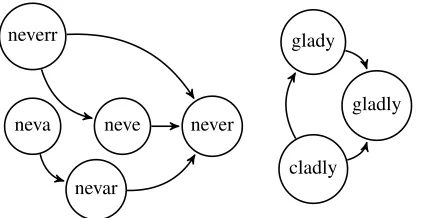
Until now, we learned normalizations from pairs of original tweets and their normalizations. We shall now describe a process to leverage monolingual doc-uments to learn new normalizations, since the mono-lingual data is far easier to obtain than parallel data. This process is similar to the work in (Han et al., 2012), where confusion sets of contextually simi-lar words are built initially as potential normaliza-tion candidates. We again use thek = 3000Brown clusters,9and this time consider the contents of each cluster as a set of possible normalization variants. For instance, we find that the cluster that includes the wordnever, also includes the variant formsneverrrr, neva and nevahhh. However, the cluster also con-tains non-variant forms, such asgladly and glady. Thus, we want to find thatneverrrrmaps tonever, whilegladymaps togladlyin the same cluster. Our work differs from previous work in that, rather than defining features manually, we use our character-based decoder to find the mappings between lexical variants and their normalizations.
For every word type wi in cluster c(wi) =
{w1, . . . , wn}, we generate a set of possible candi-dates for each word wi1, . . . , wim. Then, we build a directed acyclic graph (DAG), where every word. We add an edge between wi and wj, if wi can be decoded intowj using the character model from the previous section, and also ifwi occurs less thanwj; the second condition guarantees that the graph will be acyclic. Sample graphs are shown in Figure 3.
Afterwards, we find the number of paths between all nodes in the graph (this can be computed effi-ciently inO(|V|+|E|)time). Then, for each word
neverr
neva neve
nevar
never
glady
gladly
[image:8.612.75.287.57.166.2]cladly
Figure 3: Example DAGs, built from the cluster contain-ing the wordsneverandgladly.
wi, we find thewj to which it has the highest num-ber of paths to and extract the normalization ofwi towj. In case of a tie, we choose the wordwj that occurs more often in the monolingual corpora. This is motivated by the fact that normalizations are tran-sitive. Thus, even ifnevacannot be decoded directly tonever, we can usenevaras an intermediate step to find the correct normalization. This is performed for all the clusters, and the resulting dictionary of lexi-cal variants mapped to their standard forms is added to the training data of the character-based model.
6 Experiments
We evaluate our normalization model intrinsically by testing whether our normalizations more closely resemble standardized data, and then extrinsically by testing whether we can improve the translation quality of in-house as well as online Machine Trans-lation systems by normalizing the input.
6.1 Setup
We use the gold standard by Ling et al. (2013), com-posed by 2581 English-Mandarin microblog sen-tence pairs. From this set, we randomly select 1290 pairs for development and 1291 pairs for testing.
The normalizer model is trained on the corpora extracted and filtered in section 3, in total, there were 1.3M normalization pairs used during training. The test sentences are normalized using four differ-ent setups. The first setup leaves the input sdiffer-entence unchanged, which we call No Norm. The second uses the phrase-based model to normalize the input sentence, which we will denoteNorm+phrase. The third uses the character-based model to output lat-tices, and then decodes with the phrase based model,
which we will denoteNorm+phrase+char. Finally, we test the same model after adding the training data extracted using monolingual documents, which we will refer asNorm+phrase+char+mono.
To test the normalizations themselves, we used Google Translate to translate the Mandarin side of the 1291 test sentence pairs back to English and use the original English tweet. While, this is by itself does not guarantee that the normalizations are cor-rect, since the normalizations could be syntactically and semantically incorrect, it will allow us to check whether the normalizations are closer to those pro-duced by systems trained on news data. This exper-iment will be calledNorm.
As an application and extrinsic evaluation for our normalizer, we test if we can obtain gains on the MT task on microblog data by using our normalizer prior to translation. We build two MT systems us-ing Moses. Firstly, we build a out-of-domain model using the full 2012 NIST Chinese-English dataset (approximately 8M sentence pairs), which is dataset from the news domain, and we will denote this sys-tem as Inhouse+News. Secondly, we build a in-domain model using the 800K sentence pairs from
µtopia corpora (Ling et al., 2013). We also add the NIST dataset to improve coverage. We call this systemInhouse+News+Weibo. To train these sys-tems, we use the Moses phrase-based MT system with standard features (Koehn et al., 2003). For re-ordering, we use the MSD reordering model (Axel-rod et al., 2005). As the language model, we train a 5-gram model with Kneser-ney smoothing using a 10M tweets from twitter. Finally, the weights were tuned using MERT (Och, 2003). As for online sys-tems, we consider the systems used to generate the paraphrase corpora in section 3, which we will de-note asOnline A,Online BandOnline C10
The normalization and MT results are evaluated with BLEU-4 (Papineni et al., 2002) comparing the produced translations or normalizations with the ap-propriate reference.
6.2 Results
Results are shown in Table 6. In terms of the normal-izations, we observe a much better match between
Table 6: Normalization and MT Results. Rows denote different normalizations, and columns different translation systems, except the first column (Norm), which denotes the normalization experiment. Cells display the BLEU score of that experiment.
Moses Moses
Condition Norm (News) (News+Weibo) Online A Online B Online C
baseline 19.90 15.10 24.37 20.09 17.89 18.79
norm+phrase 21.96 15.69 24.29 20.50 18.13 18.93
norm+phrase+char 22.39 15.87 24.40 20.61 18.22 19.08 norm+phrase+char+mono 22.91 15.94 24.46 20.78 18.37 19.21
the normalized text with the reference, than the orig-inal tweets. In most cases, adding character-based models improves the quality of the normalizations.
We observe that better normalizations tend to lead to better translations. The relative improvements are most significant, when moving from No Norm to norm+phrase normalization. This is because, we are normalizing words that are not seen in gen-eral MT system’s training data, but occur frequently in microblog data, such aswanna to want to, u to youandimtoi’m. The only exception is in the In-house+News+Weibosystem, where the normaliza-tion deteriorates the results. This is to be expected, since this system is trained on the same microblog data used to learn the normalizations. However, we can observe onnorm+phrase+charthat if we add the character-based model, we can observe improve-ments for this system as well as for all other ones. This is because the model is actually learning nor-malizations that are unseen in the data. Some ex-amples of these normalization include, normalizing lookintolooking,nutz tonuts andmaimitomiami but also separating peaceof to peace of. The fact that these improvements are obtained for all sys-tems is strong evidence that we are actually produc-ing good normalizations, and not overfittproduc-ing to one of the systems that we used to generate our data. The gains are much smaller from norm+phrase
tonorm+phrase+char, since the improvements we obtain come from normalizing less frequent words. Finally, we can obtain another small improvement by adding monolingual data to the character-based model innorm+phrase+char+mono.
7 Related Work
Most of the work in microblog normalization is fo-cused on finding the standard forms of lexical
vari-ants (Yang and Eisenstein, 2013; Han et al., 2013; Han et al., 2012; Kaufmann, 2010; Han and Bald-win, 2011; Gouws et al., 2011; Aw et al., 2006). A lexical variant is a variation of a standard word in a different lexical form. This ranges from minor or major spelling errors, such as jst, juxt and justhat are lexical variants ofjust, to abbreviations, such as tmiand wanna, which stand fortoo much informa-tion and want to, respectively. Jargon can also be treated as variants, for instancecdayis a slang word forbirthday, in some groups.
would be needed to find the mapping betweeng8, 2dayand4evertogreat,todayandforever, respec-tively. Moreover, visual character similarity features would be required to find the mapping betweeng00d andιtogoodandi.
Clearly, learning this process is a challenging task, and addressing each different case individually would require vast amounts of resources. Further-more, once we change the language to normalize to another language, the types of rules that generate lexical variants would radically change and a new set of features would have to be engineered. We believe that to be successful in normalizing microblogs, the process to learn new lexical variants should be learned from data, making as few assumptions as possible. We learn our models without using any type of predefined features, such as phonetic fea-tures or lexical feafea-tures. In fact, we will not assume that most words and characters map to themselves, as it is assumed in methods using the Levenshtein distance (Kaufmann, 2010; Han et al., 2012; Wang and Ng, 2013). All these mappings are learned from our data. Furthermore, in the work above, the dictio-naries built using these methods assume that lexical variants are mapped to standard forms in a word-to-word mapping. Thus, variants such aswanna,gonna andimmaare not normalizable, since they are nor-malized to multiple wordswant to, going to and I am gonna. Moreover, there are segmentation errors that occur from missing spaces, such assortof and goingfor, which also map to more than one word to sort of andgoing for. These cases shall also be ad-dressed in our work.
Wang and Ng (2013) argue that microblog nor-malization is not simply to map lexical variants into standard forms, but that other tasks, such as punctua-tion correcpunctua-tion and missing word recovery should be performed. Consider the example tweetyou free?, while there are no lexical variants in this message, the authors consider that it is the normalizer should recover the missing article are and normalize this tweet toare you free?. To do this, the authors train a series of models to detect and correct specific errors. While effective for narrow domains, training models to address each specific type of normalization is not scalable over all types of normalizations that need to be performed within the language, and the fact that a set of new models must be implemented for another
language limits the applicability of this work. Another strong point of the work above is that a decoder is presented, while the work on build-ing dictionaries only normalize out of vocabu-lary (OOV) words. The work on (Han et al., 2012) trains a classifier to decide whether to normalize a word or not, but is still preconditioned on the fact that the word in question is OOV. Thus, lexical vari-ants, such as,4 and u, with the standard forms for andyou, are left untreated, since they occur in other contexts, such asu inu s a. Inspired by the work above, we also propose a decoder based on the exist-ing off-the-self decoder Moses (Koehn et al., 2007). Finally, the work in (Xu et al., 2013) obtains para-phrases from Twitter, by finding tweets that contain common entities, such asObama, that occur during the same period by matching temporal expressions. The resulting paraphrase corpora can also be used to train a normalizer.
8 Conclusion
We introduced a data-driven approach to microblog normalization based on paraphrasing. We build a corpora of tweets and their normalizations using par-allel corpora from microblogs using MT techniques. Then, we build two models that learn generalizations of the normalization process, one the phrase level and on the character level. Then, we build a de-coder that combines both models during decoding. Improvements on multiple MT systems support the validity of our method.
In future work, we shall attempt to build normal-izations for other languages. We shall also attempt to learn an unsupervised normalization model with only monolingual data, similar to the work for MT in (Ravi and Knight, 2011).
Acknowledgements
The PhD thesis of Wang Ling is supported by FCT – Fundac¸˜ao para a Ciˆencia e a Tecnologia, under project SFRH/BD/51157/2010. This work was supported by na-tional funds through FCT – Fundac¸˜ao para a Ciˆencia e a Tecnologia, under project PEst-OE/EEI/LA0021/2013.
References
[Aw et al.2006] AiTi Aw, Min Zhang, Juan Xiao, and Jian Su. 2006. A phrase-based statistical model for SMS text normalization. InProceedings of the ACL, COLING-ACL ’06, pages 33–40, Stroudsburg, PA, USA. Association for Computational Linguistics. [Axelrod et al.2005] Amittai Axelrod, Ra Birch Mayne,
Chris Callison-burch, Miles Osborne, and David Tal-bot. 2005. Edinburgh system description for the 2005 iwslt speech translation evaluation. InIn Proc. Inter-national Workshop on Spoken Language Translation (IWSLT.
[Bannard and Callison-Burch2005] Colin Bannard and Chris Callison-Burch. 2005. Paraphrasing with bilin-gual parallel corpora. InProceedings of the 43rd An-nual Meeting of the Association for Computational Linguistics (ACL’05), pages 597–604, Ann Arbor, Michigan, June. Association for Computational Lin-guistics.
[Bansal et al.2011] Mohit Bansal, Chris Quirk, and Robert C. Moore. 2011. Gappy phrasal alignment by agreement. InProceedings of the 49th Annual Meet-ing of the Association for Computational LMeet-inguistics: Human Language Technologies - Volume 1, HLT ’11, pages 1308–1317, Stroudsburg, PA, USA. Association for Computational Linguistics.
[Brown et al.1992] Peter F Brown, Peter V Desouza, Robert L Mercer, Vincent J Della Pietra, and Jenifer C Lai. 1992. Class-based n-gram models of natural lan-guage.Computational linguistics, 18(4):467–479. [Brown et al.1993] Peter F. Brown, Vincent J. Della
Pietra, Stephen A. Della Pietra, and Robert L. Mer-cer. 1993. The mathematics of statistical machine translation: parameter estimation. Comput. Linguist., 19:263–311, June.
[Denkowski and Lavie2011] Michael Denkowski and Alon Lavie. 2011. Meteor 1.3: Automatic metric for reliable optimization and evaluation of machine translation systems. In Proceedings of the Sixth Workshop on Statistical Machine Translation, pages 85–91, Edinburgh, Scotland, July. Association for Computational Linguistics.
[Dyer et al.2008] Chris Dyer, Smaranda Muresan, and Philip Resnik. 2008. Generalizing word lattice trans-lation. InProceedings of HLT-ACL.
[Dyer et al.2013] Chris Dyer, Victor Chahuneau, and Noah A Smith. 2013. A simple, fast, and effective reparameterization of ibm model 2. InProceedings of NAACL-HLT, pages 644–648.
[Eisenstein et al.2011] Jacob Eisenstein, Noah A. Smith, and Eric P. Xing. 2011. Discovering sociolinguis-tic associations with structured sparsity. In Proceed-ings of the 49th Annual Meeting of the Association for
Computational Linguistics: Human Language Tech-nologies - Volume 1, HLT ’11, pages 1365–1374, Stroudsburg, PA, USA. Association for Computational Linguistics.
[Eisenstein2013] Jacob Eisenstein. 2013. What to do about bad language on the internet. InProceedings of NAACL-HLT, pages 359–369.
[Gouws et al.2011] Stephan Gouws, Dirk Hovy, and Don-ald Metzler. 2011. Unsupervised mining of lexical variants from noisy text. InProceedings of the First Workshop on Unsupervised Learning in NLP, EMNLP ’11, pages 82–90, Stroudsburg, PA, USA. Association for Computational Linguistics.
[Han and Baldwin2011] Bo Han and Timothy Baldwin. 2011. Lexical normalisation of short text messages: makn sens a #twitter. InProceedings of the 49th An-nual Meeting of the Association for Computational Linguistics: Human Language Technologies - Volume 1, HLT ’11, pages 368–378, Stroudsburg, PA, USA. Association for Computational Linguistics.
[Han et al.2012] Bo Han, Paul Cook, and Timothy Bald-win. 2012. Automatically constructing a normalisa-tion dicnormalisa-tionary for microblogs. InProceedings of the 2012 Joint Conference on Empirical Methods in Natu-ral Language Processing and Computational NatuNatu-ral Language Learning, EMNLP-CoNLL ’12, pages 421– 432, Stroudsburg, PA, USA. Association for Compu-tational Linguistics.
[Han et al.2013] Bo Han, Paul Cook, and Timothy Bald-win. 2013. Lexical normalization for social media text. ACM Transactions on Intelligent Systems and Technology (TIST), 4(1):5.
[Hawn2009] Carleen Hawn. 2009. Take two aspirin and tweet me in the morning: how twitter, facebook, and other social media are reshaping health care. Health affairs, 28(2):361–368.
[Kaufmann2010] M. Kaufmann. 2010. Syntactic Nor-malization of Twitter Messages. studies, 2.
[Koehn et al.2003] Philipp Koehn, Franz Josef Och, and Daniel Marcu. 2003. Statistical phrase-based trans-lation. InProceedings of the 2003 Conference of the North American Chapter of the Association for Com-putational Linguistics on Human Language Technol-ogy - Volume 1, NAACL ’03, pages 48–54, Morris-town, NJ, USA. Association for Computational Lin-guistics.
[Koehn et al.2005] Philipp Koehn, Amittai Axelrod, Alexandra Birch Mayne, Chris Callison-Burch, Miles Osborne, David Talbot, and Michael White. 2005. Edinburgh system description for the 2005 nist mt evaluation. In Proceedings of Machine Translation Evaluation Workshop 2005.
Aachen, Alexandra Constantin, Marcello Federico, Nicola Bertoldi, Chris Dyer, Brooke Cowan, Wade Shen, Christine Moran, and Ondrej Bojar. 2007. Moses: Open source toolkit for statistical machine translation. InProceedings of the 45th Annual Meet-ing of the Association for Computational LMeet-inguistics Companion Volume Proceedings of the Demo and Poster Sessions, pages 177–180, Prague, Czech Re-public, June. Association for Computational Linguis-tics.
[Laviosa1998] Sara Laviosa. 1998. Core patterns of lexical use in a comparable corpus of English lexical prose.Meta, 43(4):557–570.
[Ling et al.2010] Wang Ling, Tiago Lu´ıs, Jo˜ao Grac¸a, Lu´ısa Coheur, and Isabel Trancoso. 2010. Towards a general and extensible phrase-extraction algorithm. In IWSLT ’10: International Workshop on Spoken Lan-guage Translation, pages 313–320, Paris, France. [Ling et al.2013] Wang Ling, Guang Xiang, Chris Dyer,
Alan Black, and Isabel Trancoso. 2013. Microblogs as parallel corpora. In Proceedings of the 51st An-nual Meeting on Association for Computational Lin-guistics, ACL ’13. Association for Computational Lin-guistics.
[Och and Ney2003] Franz Josef Och and Hermann Ney. 2003. A systematic comparison of various statis-tical alignment models. Computational linguistics, 29(1):19–51.
[Och and Ney2004] Franz Josef Och and Hermann Ney. 2004. The alignment template approach to statistical machine translation. Comput. Linguist., 30(4):417– 449, December.
[Och2003] Franz Josef Och. 2003. Minimum error rate training in statistical machine translation. In Pro-ceedings of the 41st Annual Meeting on Association for Computational Linguistics - Volume 1, ACL ’03, pages 160–167, Stroudsburg, PA, USA. Association for Computational Linguistics.
[Papineni et al.2002] Kishore Papineni, Salim Roukos, Todd Ward, and Wei-Jing Zhu. 2002. Bleu: a method for automatic evaluation of machine transla-tion. InProceedings of the 40th Annual Meeting on Association for Computational Linguistics, ACL ’02, pages 311–318, Stroudsburg, PA, USA. Association for Computational Linguistics.
[Ravi and Knight2011] Sujith Ravi and Kevin Knight. 2011. Deciphering foreign language. InACL, pages 12–21.
[Resnik and Smith2003] Philip Resnik and Noah A Smith. 2003. The web as a parallel corpus. Com-putational Linguistics, 29(3):349–380.
[Tang et al.2012] Hao Tang, Joseph Keshet, and Karen Livescu. 2012. Discriminative pronunciation
mod-eling: A large-margin, feature-rich approach. In Pro-ceedings of the 50th Annual Meeting of the Association for Computational Linguistics: Long Papers-Volume 1, pages 194–203. Association for Computational Lin-guistics.
[Vogel et al.1996] S. Vogel, H. Ney, and C. Tillmann. 1996. Hmm-based word alignment in statistical trans-lation. InProceedings of the 16th conference on Com-putational linguistics-Volume 2, pages 836–841. Asso-ciation for Computational Linguistics.
[Volansky et al.2013] Vered Volansky, Noam Ordan, and Shuly Wintner. 2013. On the features of transla-tionese.Literary and Linguistic Computing.
[Wang and Ng2013] Pidong Wang and Hwee Ng. 2013. A beam-search decoder for normalization of social media text with application to machine translation. In Proceedings of NAACL-HLT 2013, NAACL ’13. As-sociation for Computational Linguistics.
[Xu et al.2013] Wei Xu, Alan Ritter, and Ralph Grish-man. 2013. Gathering and generating paraphrases from twitter with application to normalization. In Pro-ceedings of the Sixth Workshop on Building and Us-ing Comparable Corpora, pages 121–128, Sofia, Bul-garia, August. Association for Computational Linguis-tics.