807
Description-Based Zero-shot Fine-Grained Entity Typing
Rasha Obeidat, Xiaoli Fern, Hamed Shahbazi and Prasad Tadepalli
School of Electrical Engineering and Computer Science, Oregon State University {obeidatr, Xfern, shahbazh, tadepall}@eecs.oregonstate.edu
Abstract
Fine-grained Entity typing (FGET) is the task of assigning a fine-grained type from a hierar-chy to entity mentions in the text. As the tax-onomy of types evolves continuously, it is de-sirable for an entity typing system to be able to recognize novel types without additional train-ing. This work proposes azero-shotentity typ-ing approach that utilizes the type description available from Wikipedia to build a distributed semantic representation of the types. During training, our system learns to align the entity mentions and their corresponding type repre-sentations on the known types. At test time, any new type can be incorporated into the sys-tem given its Wikipedia descriptions. We eval-uate our approach on FIGER, a public bench-mark entity tying dataset. Because the exist-ing test set of FIGER covers only a small por-tion of the fine-grained types, we create a new test set by manually annotating a portion of the noisy training data. Our experiments demon-strate the effectiveness of the proposed method in recognizing novel types that are not present in the training data.
1 Introduction
Entity Typing assigns a semantic type (e.g., per-son, location, organization) to an entity mention in text based on the local context. It is useful for enhancing a variety of Natural Language Process-ing(NLP) tasks such as question answering (Han et al., 2017; Das et al., 2017), relation extrac-tion (Liu et al.,2014;Yaghoobzadeh et al.,2016), and entity linking (Stern et al.,2012). Traditional Named Entity Typing systems consider a small set of coarse types (e.g., person, location, organiza-tion) (Tjong Kim Sang and De Meulder,2003; Kr-ishnan and Manning,2006;Chieu and Ng,2002). Recent studies address larger sets of fine-grained types organized in type hierarchies (e.g., per-son/artist, person/author) (Ling and Weld,2012;
Corro et al.,2015;Xu and Barbosa,2018;Murty et al.,2018). Fine-Grained Entity Typing (FGET) is usually approached as a multi-label classifica-tion task where an entity menclassifica-tion can be assigned multiple types that usually constitute a path in the hierarchy (Ren et al.,2016).
In real-world scenarios, there is a need to deal with ever-growing type taxonomies. New types emerge, and existing types are refined into finer sub-categories. Traditional methods for entity typ-ing assume that the traintyp-ing data contains all pos-sible types, thus require new annotation effort for each new type that emerges. Zero-shot learning (ZSL), a special kind of transfer learning, allows for new types to be incorporated at the predic-tion stage without the need for addipredic-tional annota-tion and retraining. The main idea behind ZSL is to learn a shared semantic space for representing both the seen and unseen types, which allows the knowledge about how examples link to the seen types to be transferred to unseen types.
For fine-grained entity types, we observe that their associated Wikipedia pages often provide a rich description of the types. To capture this, we propose a Description-based Zero-shot Entity Typing (DZET) approach that utilizes the Wikipedia description of each type (e.g.,
see https://en.wikipedia.org/wiki/
Artistfor description of the typeperson/artist) to generate a representation of that type. We learn to project the entity-mention representations and the type representations into a shared semantic space, such that the mention is closer to the cor-rect type(s) than the incorcor-rect types. The mid-level type representation derived from the Wikipedia page along with the learned projection function al-lows the system to recognize new types requiring zero training examples.
Wikipedia descriptions. Note that the descriptions can be quite long, often containing many different parts that are useful for recognizing different entity mentions. This motivates us to generate a bag of representations for each type and apply average pooling to aggregate the results.
We evaluate the performance of our methods on FIGER, a benchmark dataset for the FNET task, in which types are organized in 2-levels hierarchy. In this work, We focus on testing our method’s ca-pability in recognizing unseen fine-grained types ( Level-2 types in this dataset). As the current test set of FIGER contains examples from only a few level-2 types, we created a new test data that cov-ers most of the level-2 types by manually annotat-ing a portion of the noisy trainannotat-ing data. Below we summarize our main contributions.
• We proposed a description-based zero-shot fine-grained entity typing framework that uses Wikipedia descriptions to represent and detect novel types unseen in training.
• We created a new test set for fine-grained en-tity typing that provides much better cover-age of the level-2 (fine-grained) types com-pared to the original FIGER test data.
• We provided experimental evidence of the ef-fectiveness of our approach in comparison with established baselines.
2 Related Work
Existing work on FGET focuses on perform-ing context-sensitive typperform-ing (Gillick et al., 2014;
Corro et al., 2015), learning from noisy training data (Abhishek et al.,2017;Ren et al.,2016;Xu and Barbosa,2018), and exploiting the type hier-archies to improve the learning and inference ( Yo-gatama et al.,2015;Murty et al.,2018). More re-cent studies support even finer granularity (Choi et al.,2018;Murty et al.,2018). However, all the methods above have the limitation that they as-sume all types are present during training.
Zero-Shot Learning has been extensively stud-ied in Computer Vision (CV) (Wang et al.,2019) for tasks such as image classification (Lampert et al., 2014;Zhang and Saligrama, 2015;Socher et al., 2013), object localization (Li et al., 2014,
2017) and image retrieval (Xu et al.,2017;Zhang et al., 2018). A common approach for zero-shot learning in CV is to represent each class (e.g.,
Zebra) by a set of semantic attributes such as its shape and color. The semantic attributes serve as the intermediate level that connects the visual fea-tures with the classes. The model is trained to learn an alignment between the semantic attributes and the visual features where a new class can be recognized using its semantic attributes without the need for any training examples. In contrast, this type of approach tends not to work well for NLP applications as the semantic concepts/classes in NLP are often more complex and cannot be easily described by a set of pre-defined attributes. This explains why the few studies of ZSL for NLP use very different methods to create the transfer-able intermediate representations.
Zero-Shot Learning has been studied for a number of NLP tasks including event extraction (Huang et al.,2018;Lee and Jha,2018;Srivastava et al.,2018), relation extraction(Liu et al.,2014), Conversational Language Understanding (Lee and Jha, 2018). Specifically, Zero shot entity typing has also been explored, where most of the prior methods adopt the idea of learning a shared se-mantic space for representing the entities as well as the types, but differ in how they construct the type embeddings. In OTyper (Yuan and Downey,
2018), each type is represented by averaging the embedding of the words constitutes the type label. On the other hand, ProtoLE (Ma et al.,2016) rep-resents each type by a prototype that consists of manually selected entity mentions, where the type embedding is obtained by averaging the prototype mentions’ word embeddings.In contrast, our work differs from OTyper and ProtoLE by constructing the type representations based on the Wikipedia descriptions of the types, which not only carry more information about the type but also can be easily adapted to other tasks such as event typing and text classification.
3 Proposed Approaches
Following prior work on fine-grained entity typ-ing, we formulate it as a multi-class multi-label classification problem. Given an entity mentionm along with its left textual contextcland right
con-textcr, We learn a classifier that predicts a binary
label vector y ∈ {0,1}|L|, where L denotes the set of all types, which forms a hierarchyΨ. Here y(t) = 1if the mentionmis of typet, and0
3.1 The Typing Function
We will begin by introducing our typing function that is used to compute a score between a given mention and type pair, given their corresponding vector representations. We will discuss how to construct the representations in later sections.
Formally, the input to this typing function con-sists of the representation of the mention, denoted byx ∈ Rd; and the representation of a candidate typet, denoted byyt∈R
´
d. It computes a bi-linear
score for the(x, yt)pair as follows:
f(x, yt, W) =xTW yt
whereW ∈ Rd×d´is a compatibility matrix. Fol-lowing (Yogatama et al., 2015;Ma et al., 2016), we factorizeW as a product of two low-rank ma-trices to reduce the number of parameters. That is W = ATB, where A ∈ Rh×d andB ∈ Rh×d´
(We useh = 20). The scoring function f can be rewritten as:
f(x, yt, A, B) =θ(x, A)·φ(yt, B) = (Ax)TByt
where θ(x, A) : x → Axand φ(yt, B) : yt →
Byt serve as the projection functions that mapx
andytinto a shared semantic space.
3.2 Entity Mention Representation
To obtain the representation for entity mentions, we adopt the same neural approach proposed by Shimaoka et al. (2017). Given an entity men-tion with its context, we compute a vectorvm to
present the mention m itself, and another vector vcto represent its left and right contextsclandcr.
vm is computed by simply averaging the
embed-ding of the individual words inm.
To compute the context embedding vc, we first
encode cl and cr using a bidirectional-LSTM. Let cl1, ..., cls and cr1, ..., crs be the word embed-ding of the left and the right context respectively, where s is the window size (we use s = 10), the output layer of the bi-LSTM is denoted as: −
→ hl1,
←− hl1...,
− → hls,
←−
hls and −→hr1,←h−1r...,−→hrs,←h−rs. We then compute a scalar attention for each context word using a 2-level feedforward neural network:
eji =tanh(We
− → hji ←− hji
); ˜a
j
i =exp(Wae j i)
Where We ∈ Rdh×2×da, Wa ∈ R1×da, dh is
the dimension of LSTM,dais the attention
dimen-sion, j ∈ {l, r}. Next, we normalize ajis such
that they sum up to 1. i.e., aji = ˜a
j i
Ps
i=1(˜ali+˜ari) . Finally the context representation is computed as
vc=
Ps i=1(ali
"−→ hli ←− hli #
+ari "−→
hri ←− hri #
). The final
repre-sentation of the entity mention x ∈ Rd is a con-catenation ofvmandvc.
3.3 Type Representation
LetPtbe the Wikipedia page that is used to build
a representation for type t. Some types do not have a Wikipedia page with a title the same as the type label. In such cases, we manually look for a Wikipedia page of a similar concept. For ex-ample, we represent the type living-thing by the Wikipedia pageorganism.
To get a type representation, We started by the simplest possible method which is averaging the embedding of words in the Wikipedia page ( we call thisAvg encoder). Since some words in the Wikipedia page carry more of the type semantic than the other words we also consider a (tf-idf)-weighted version of the Avg encoder.
Learning multiple representations. Wikipedia descriptions are often long and contain multiple parts, where different parts may capture different aspects of the type and relate to different mentions. Moreover, sequence models such as LSTM cannot be applied to such long sequences. This motivates us to consider the approach of constructing a bag of multiple representations for each type based on its Wikipedia description. To obtain a bag of rep-resentations for typet, we first use a fixed-length window to incrementally break Pt into multiple
parts, one paragraph at a time. If a paragraph fits in the current Window, it is added. Otherwise, a new window is initiated. Each window of text rti is
then used to generate one representation. To con-struct an embedding forrti, we adopt the same
Bi-directional LSTM and attention mechanism that are used to embed the mention context.
3.4 Training and inference
Given the training data, we jointly train the repre-sentation and the scoring function by minimizing a ranking score. Let Y(i) andY(i) denote the set
of correct and incorrect types assigned to the ex-amplex(i)respectively, we learn to score types in Y(i) higher than types in Y(i) with a multi-label
max-margin ranking objective as follows:
X
y∈Y X
´
y∈Y
max(0,1−f(x, y, A, B)+f(x,y, A, B´ ))
At testing, both seen and unseen types are mapped to their learned representations, which are then scored for a given input. Given the scores, we con-duct a top-down search following the type hierar-chyΨ. Starting from the root we recursively find the type with the highest score among the children. Since we focus on the fine-grained types, we stop the search when a leaf type is reached and predict that the mention is positive for all types along the path leading the to leaf type.
4 Experiments
Datasets. Our experiments use FIGER, a pub-licly available fine-grained entity typing bench-mark dataset in which types are organized into a 2-level hierarchy. The training data consists of sen-tences sampled from Wikipedia articles and auto-matically annotated via distant supervision (Ling and Weld,2012). The test data consisting of man-ually annotated sentences sampled from news re-ports.
Setting. To evaluate our capability to recognize fine-grained types in zero-shot setting, we assume all second-level types are unseen during training, i.e., we remove all level-2 types from the train and dev data but keep them in the test data. We observe that the FIGER test set covers only a small number of second-level types. This renders it insufficient for testing under the evaluation setting we adopt. Moreover, the training data is noisy since it is au-tomatically annotated by distant supervision. As a result, we cannot just use part of it for testing.
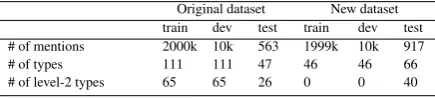
[image:4.595.74.292.693.742.2]Original dataset New dataset train dev test train dev test # of mentions 2000k 10k 563 1999k 10k 917 # of types 111 111 47 46 46 66 # of level-2 types 65 65 26 0 0 40
Table 1: Statistics of FIGER dataset.
To overcome this limitation, We manually an-notated a new test set from the noisy training data. We first divide the train set into clean and noisy as suggested in (Ren et al., 2016). Clean examples are those whose types fall on a single path (not necessarily ending with a leaf) inΨ. For instance, the mention with labels person, person/author, and person/doctor is considered as noisy exam-ple because the labels form two paths. We then manually verify the correctness of up to 20 exam-ples from the clean training data for every level-2 type. These examples are removed from training and added to the test set. We ignore the types with no clean examples. The statistics of the new and original datasets are reported in Table1.
Baselines. We consider two baselines that em-ploy the same neural architecture but use different type representations. The Label embd baseline use the average of the embedding of the words in the type label as the type representation.ProtoLE
baseline uses the prototypes-based label embed-ding learned by Ma et al. (2016), where each type is represented by the set of the most representa-tive entity mentions. The type embedding is the average of all mentions in the corresponding pro-totype.
Evaluation metrics. Following prior works in FGET, we report Accuracy (Strict-F1), loose Macro-averaged F1 (F1ma) and loose
Micro-averagedF1(F1mi)(Ling and Weld,2012). The
training and hyperparameter tuning details are de-scribed in the Appendices.
Results and discussions. Table 2 presents the results on FIGER, evaluated on all types (Over-all), the seen types (Level-1) and the unseen types (Level-2) respectively. From the results, we can see that our description based methods have a par-ticularly strong advantage over baselines on level-2 types. This is consistent with our expectation because Wikipedia descriptions tend to be highly informative for fine-grained types, but less so for coarser types.
oth-Approach Overall Level-1 Level-2 Acc F1ma F1mi F1ma F1mir F1ma F1mir
[image:5.595.102.494.61.145.2]Label embd 0.2846 0.5510 0.5603 0.8165 0.8163 0.2854 0.2954 ProtoLE 0.2541 0.4982 0.5093 0.7424 0.7422 0.2541 0.2657 DZET + Avg encoder 0.3141 0.5522 0.5614 0.7903 0.7902 0.3141 0.3247 DZET + Weighted Avg encoder 0.3261 0.5500 0.5607 0.7740 0.7738 0.3261 0.3390 DZET + Multi-rep 0.3806 0.5953 0.6045 0.8100 0.8098 0.3806 0.3926
Table 2: Level-1 , Level-2 and overall performance of the models on FIGER dataset.
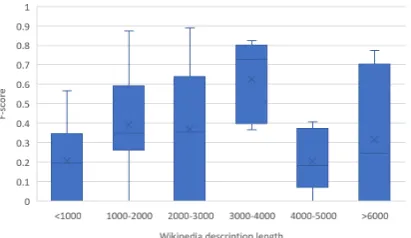
Figure 1: The relationship between the length of the Wikipedia description (word count) of level-2 types and the F-score obtained byDZET+Multi-rep method.
ers by a large margin while maintaining a highly competitive performance for level-1 types.
The effect of description quality. Figure1 an-alyzes the relationship between the length of the Wikipedia description as one criterion of the de-scription quality and the performance ofMulti-rep
method. In particular, we group the types based on the length of their Wikipedia descriptions and provide the five-number summary box plot of the F-scores for each group. It can be readily ob-served that the performance is low when the de-scription of the type’s Wikipedia page is too short (< 1000 words) or too long ( > 4000 words). Short descriptions are less informative and carry less shared semantics with the type’s mentions. On the other hand, overly long descriptions could also be confusing as it might share a significant number of common words with the descriptions of other types. A closer look into the results unveils some exceptions. For example, the F-score on the type ‘/education/educational-degree’ is 0.7742 even it has a long description (6845 words). The description of this type is indeed very informative and includes a comprehensive list of the educa-tional degrees awarded all around the world.
The length of the description is not the only
fac-tor that affects the performance of DZET meth-ods. One factor is the performance on the Level-1 types. Since the inference is performed by follow-ing the type hierarchy, if an incorrect type is in-ferred at level-1, there is no hope to get the cor-rect level-2 type. Another factor is the amount of overlapping between the descriptions of the related types. For instance, Multi-rep produces zero F-score on the types‘/event/protest’ and ‘/lo-cation/province’ because they share a lot of com-mon words with the types ‘/event/attack’ and ‘/lo-cation/county’ respectively, which negatively af-fects the ability of Multi-rep to distinguish be-tween the related types. Both ‘/event/protest’ and ‘/location/province’ have a description length be-tween 2000 and 3000 words.
To mitigate the effect of the contents overlap-ping between the highly related type, We plan to apply mention-sensitive attention mechanisms for future work to aggregate the scores in Multi-rep instead of max-pooling.
5 Conclusions
In this paper, we propose a novel zero-shot entity typing approach that uses Wikipedia descriptions to construct type embeddings. Our architecture re-lies on the type embeddings to make predictions for unseen types. Experimental results demon-strate the effectiveness of the proposed methods.
Acknowledgments
We thank Jordan University of Science and Tech-nology for Ph.D. fellowship (to R. O.).
References
[image:5.595.77.283.198.317.2]Hai Leong Chieu and Hwee Tou Ng. 2002. Named en-tity recognition: a maximum entropy approach using global information. InProceedings of the 19th inter-national conference on Computational linguistics-Volume 1, pages 1–7. Association for Computational Linguistics.
Eunsol Choi, Omer Levy, Yejin Choi, and Luke Zettle-moyer. 2018. Ultra-fine entity typing. InIn Annual Meeting of the Association for Computational Lin-guistics.
Luciano del Corro, Abdalghani Abujabal, Rainer Gemulla, and Gerhard Weikum. 2015. Finet: Context-aware fine-grained named entity typing. Assoc. for Computational Linguistics.
Rajarshi Das, Manzil Zaheer, Siva Reddy, and Andrew McCallum. 2017. Question answer-ing on knowledge bases and text usanswer-ing universal schema and memory networks. arXiv preprint arXiv:1704.08384.
Dan Gillick, Nevena Lazic, Kuzman Ganchev, Jesse Kirchner, and David Huynh. 2014. Context-dependent fine-grained entity type tagging. arXiv preprint arXiv:1412.1820.
Sangdo Han, Soonchoul Kwon, Hwanjo Yu, and Gary Geunbae Lee. 2017. Answer ranking based on named entity types for question answering. In
Proceedings of the 11th International Conference on Ubiquitous Information Management and Commu-nication, page 71. ACM.
Lifu Huang, Heng Ji, Kyunghyun Cho, and Clare R Voss. 2018. Zero-shot transfer learning for event ex-tractions. InProceedings of the 56th Annual Meet-ing of the Association for Computational LMeet-inguis- Linguis-tics, volume 1.
Diederik P Kingma and Jimmy Ba. 2014. Adam: A method for stochastic optimization. arXiv preprint arXiv:1412.6980.
Vijay Krishnan and Christopher D Manning. 2006. An effective two-stage model for exploiting non-local dependencies in named entity recognition. In
Proceedings of the 21st International Conference on Computational Linguistics and the 44th annual meeting of the Association for Computational Lin-guistics, pages 1121–1128. Association for Compu-tational Linguistics.
Christoph H Lampert, Hannes Nickisch, and Stefan Harmeling. 2014. Attribute-based classification for zero-shot visual object categorization. IEEE Trans-actions on Pattern Analysis and Machine Intelli-gence, 36(3):453–465.
Sungjin Lee and Rahul Jha. 2018. Zero-shot adaptive transfer for conversational language understanding.
arXiv preprint arXiv:1808.10059.
Zhenyang Li, Efstratios Gavves, Thomas Mensink, and Cees GM Snoek. 2014. Attributes make sense on segmented objects. In European Conference on Computer Vision, pages 350–365. Springer.
Zhenyang Li, Ran Tao, Efstratios Gavves, Cees GM Snoek, and Arnold WM Smeulders. 2017. Track-ing by natural language specification. In2017 IEEE Conference on Computer Vision and Pattern Recog-nition (CVPR), pages 7350–7358. IEEE.
Xiao Ling and Daniel S Weld. 2012. Fine-grained en-tity recognition. InAAAI, volume 12, pages 94–100.
Yang Liu, Kang Liu, Liheng Xu, and Jun Zhao. 2014. Exploring fine-grained entity type constraints for distantly supervised relation extraction. In Pro-ceedings of COLING 2014, the 25th International Conference on Computational Linguistics: Techni-cal Papers, pages 2107–2116.
Yukun Ma, Erik Cambria, and Sa Gao. 2016. La-bel embedding for zero-shot fine-grained named en-tity typing. In Proceedings of COLING 2016, the 26th International Conference on Computational Linguistics: Technical Papers, pages 171–180.
Tomas Mikolov, Ilya Sutskever, Kai Chen, Greg S Cor-rado, and Jeff Dean. 2013. Distributed representa-tions of words and phrases and their composition-ality. In C. J. C. Burges, L. Bottou, M. Welling, Z. Ghahramani, and K. Q. Weinberger, editors, Ad-vances in Neural Information Processing Systems 26, pages 3111–3119. Curran Associates, Inc.
Shikhar Murty, Patrick Verga, Luke Vilnis, Irena Radovanovic, and Andrew McCallum. 2018. Hier-archical losses and new resources for fine-grained entity typing and linking. In Proceedings of the 56th Annual Meeting of the Association for Compu-tational Linguistics (Volume 1: Long Papers), vol-ume 1, pages 97–109.
Jeffrey Pennington, Richard Socher, and Christopher Manning. 2014. Glove: Global vectors for word representation. InProceedings of the 2014 confer-ence on empirical methods in natural language pro-cessing (EMNLP), pages 1532–1543.
Xiang Ren, Wenqi He, Meng Qu, Lifu Huang, Heng Ji, and Jiawei Han. 2016. Afet: Automatic fine-grained entity typing by hierarchical partial-label embed-ding. In Proceedings of the 2016 Conference on Empirical Methods in Natural Language Process-ing, pages 1369–1378.
Sonse Shimaoka, Pontus Stenetorp, Kentaro Inui, and Sebastian Riedel. 2017. Neural architectures for fine-grained entity type classification. In In Pro-ceedings of the 15th Conference of the European Chapter of the Association for Computational Lin-guistics (EACL).
Shashank Srivastava, Igor Labutov, and Tom Mitchell. 2018. Zero-shot learning of classifiers from natu-ral language quantification. In Proceedings of the 56th Annual Meeting of the Association for Compu-tational Linguistics (Volume 1: Long Papers), vol-ume 1, pages 306–316.
Rosa Stern, Benoˆıt Sagot, and Fr´ed´eric B´echet. 2012. A joint named entity recognition and entity linking system. InProceedings of the Workshop on Innova-tive Hybrid Approaches to the Processing of Textual Data, pages 52–60. Association for Computational Linguistics.
Erik F Tjong Kim Sang and Fien De Meulder. 2003. Introduction to the conll-2003 shared task: Language-independent named entity recognition. In
Proceedings of the seventh conference on Natural language learning at HLT-NAACL 2003-Volume 4, pages 142–147. Association for Computational Lin-guistics.
Wei Wang, Vincent W Zheng, Han Yu, and Chunyan Miao. 2019. A survey of zero-shot learning: Set-tings, methods, and applications. ACM Transac-tions on Intelligent Systems and Technology (TIST), 10(2):13.
Peng Xu and Denilson Barbosa. 2018. Neural fine-grained entity type classification with hierarchy-aware loss. InProceedings of the 2018 Conference of the North American Chapter of the Association for Computational Linguistics: Human Language Technologies, Volume 1 (Long Papers), volume 1, pages 16–25.
Yahui Xu, Yang Yang, Fumin Shen, Xing Xu, Yuxuan Zhou, and Heng Tao Shen. 2017. Attribute hash-ing for zero-shot image retrieval. InMultimedia and Expo (ICME), 2017 IEEE International Conference on, pages 133–138. IEEE.
Yadollah Yaghoobzadeh, Heike Adel, and Hinrich Sch¨utze. 2016. Noise mitigation for neural en-tity typing and relation extraction. arXiv preprint arXiv:1612.07495.
Dani Yogatama, Daniel Gillick, and Nevena Lazic. 2015. Embedding methods for fine grained entity type classification. InProceedings of the 53rd An-nual Meeting of the Association for Computational Linguistics and the 7th International Joint Confer-ence on Natural Language Processing (Volume 2: Short Papers), volume 2, pages 291–296.
Zheng Yuan and Doug Downey. 2018. Otyper: A neu-ral architecture for open named entity typing. In
Thirty-Second AAAI Conference on Artificial Intel-ligence.
Haofeng Zhang, Yang Long, and Ling Shao. 2018. Zero-shot hashing with orthogonal projection for image retrieval. Pattern Recognition Letters.
Ziming Zhang and Venkatesh Saligrama. 2015. Zero-shot learning via semantic similarity embedding. In
A Appendices
A.1 Training and Hyperparamters
For every model we trained, we tune all of the hyper-parameters using a dev set. We use the version of FIGER provided by (Shimaoka et al.,
2017) which already withhold a portion of the train set as a dev set. For each experiment, we report that testing results of the model that has the bestaccuracyon the dev set. We adoptglove 300-dimensional word embedding (Pennington et al.,
2014) throughout this work except forprototype