Lexical Reference: a Semantic Matching Subtask
Oren Glickman and Eyal Shnarch and Ido Dagan Computer Science Department
Bar Ilan University Ramat Gan, Israel
{glikmao, dagan}@cs.biu.ac.il
Abstract
Semantic lexical matching is a prominent subtask within text understanding applica-tions. Yet, it is rarely evaluated in a di-rect manner. This paper proposes a def-inition for lexical reference which cap-tures the common goals of lexical match-ing. Based on this definition we created and analyzed a test dataset that was uti-lized to directly evaluate, compare and im-prove lexical matching models. We sug-gest that such decomposition of the global semantic matching task is critical in order to fully understand and improve individual components.
1 Introduction
A fundamental task for text understanding ap-plications is to identify semantically equivalent pieces of text. For example, Question Answer-ing (QA) systems need to match correspondAnswer-ing parts in the question and in the answer passage, even though such parts may be expressed in dif-ferent terms. Summarization systems need to rec-ognize (redundant) semantically matching parts in multiple sentences that are phrased differently. Other applications, such as information extraction and retrieval, face pretty much the same seman-tic matching task. The degree of semanseman-tic match-ing found is typically factored into systems’ scor-ing and rankscor-ing mechanisms. The recently pro-posed framework of textual entailment (Dagan et al., 2006) attempts to formulate the generic seman-tic matching problem in an application indepen-dent manner.
The most commonly implemented semantic matching component addresses the lexical level.
At this level the goal is to identify whether the meaning of a lexical item of one text is expressed also within the other text. Typically, lexical match-ing models measure the degree of literal lexical overlap, augmented with lexical substitution cri-teria based on resources such as Wordnet or the output of statistical similarity methods (see Sec-tion 2). Many systems apply semantic matching only at the lexical level, which is used to approx-imate the overall degree of semantic matching be-tween texts. Other systems incorporate lexical matching as a component within more complex models that examine matching at higher syntactic and semantic levels.
While lexical matching models are so promi-nent within semantic systems they are rarely eval-uated in a direct manner. Typically, improve-ments to a lexical matching model are evaluated by their marginal contribution to overall system per-formance. Yet, such global and indirect evaluation does not indicate the absolute performance of the model relative to the sheer lexical matching task for which it was designed. Furthermore, the indi-rect application-dependent evaluation mode does not facilitate improving lexical matching models in an application dependent manner, and does not allow proper comparison of such models which were developed (and evaluated) by different re-searchers within different systems.
This paper proposes a generic definition for the lexical matching task, which we termlexical ref-erence. This definition is application indepen-dent and enables annotating test datasets that eval-uate directly lexical matching models. Conse-quently, we created a dataset annotated for lexical reference, using a sample of sentence pairs (text-hypothesis) from the 1st Recognising Textual En-tailment dataset. Further analysis identified
eral sub-types of lexical reference, pointing at the many interesting cases where lexical reference is derived from a complete context rather than from a particular matching lexical item.
Next, we used the lexical reference dataset to evaluate and compare several state-of-the-art ap-proaches for lexical matching. Having a direct evaluation task enabled us to capture the actual performance level of these models, to reveal their relative strengths and weaknesses, and even to construct a simple combination of two models that outperforms all the original ones. Overall, we sug-gest that it is essential to decompose global se-mantic matching and textual entailment tasks into proper subtasks, like lexical reference. Such de-composition is needed in order to fully understand the behavior of individual system components and to guide their future improvements.
2 Background
2.1 Term Matching
Thesaurus-based term expansion is a commonly used technique for enhancing the recall of NLP systems and coping with lexical variability. Ex-pansion consists of altering a given text (usu-ally a query) by adding terms of similar meaning. WordNet is commonly used as a source of related words for expansion. For example, manyQA sys-tems perform expansion in the retrieval phase us-ing query related words based on WordNet’s lexi-cal relations such as synonymy or hyponymy (e.g (Harabagiu et al., 2000; Hovy et al., 2001)). Lex-ical similarity measures (e.g. (Lin, 1998)) have also been suggested to measure semantic similar-ity. They are based on the distributional hypothe-sis, suggesting that words that occur within similar contexts are semantically similar.
2.2 Textual Entailment
The Recognising Textual Entailment (RTE-1) chal-lenge (Dagan et al., 2006) is an attempt to promote an abstract generic task that captures major seman-tic inference needs across applications. The task requires to recognize, given two text fragments, whether the meaning of one text can be inferred (entailed) from another text. Different techniques and heuristics were applied on the RTE-1 dataset to specifically model textual entailment. Interest-ingly, a number of works (e.g. (Bos and Mark-ert, 2005; Corley and Mihalcea, 2005; Jijkoun and de Rijke, 2005; Glickman et al., 2006)) applied or
utilized lexical based word overlap measures. Var-ious word-to-word similarity measures where ap-plied, including distributional similarity (such as (Lin, 1998)), web-based co-occurrence statistics and WordNet based similarity measures (such as (Leacock et al., 1998)).
2.3 Paraphrase Acquisition
A substantial body of work has been dedicated to learning patterns of semantic equivalency between different language expressions, typically consid-ered as paraphrases. Recently, several works ad-dressed the task of acquiring paraphrases (semi-) automatically from corpora. Most attempts were based on identifying corresponding sentences in parallel or ‘comparable’ corpora, where each cor-pus is known to include texts that largely corre-spond to texts in another corpus (e.g. (Barzilay and McKeown, 2001)). Distributional Similarity was also used to identify paraphrase patterns from a single corpus rather than from a comparable set of corpora (Lin and Pantel, 2001). Similarly, (Glickman and Dagan, 2004) developed statistical methods that match verb paraphrases within a reg-ular corpus.
3 The Lexical Reference Dataset
3.1 Motivation and Definition
One of the major observations of the 1st Recog-nizing Textual Entailment (RTE-1) challenge re-ferred to the rich structure of entailment modeling systems and the need to evaluate and optimize in-dividual components within them. When building such a compound system it is valuable to test each component directly during its development, rather than indirectly evaluating the component’s perfor-mance via the behavior of the entire system. If given tools to evaluate each component indepen-dently researchers can target and perfect the per-formance of the subcomponents without the need of building and evaluating the entire end-to-end system.
A common subtask, addressed by practically all participating systems in RTE-1, was to recognize whether each lexical meaning in the hypothesis is referenced by some meaning in the corresponding text. We suggest that this common goal can be captured through the following definition:
from a set of words intto a possible meaning of w.
Lexical reference may be viewed as a natural ex-tension of textual entailment for sub-sentential hy-potheses such as words. In this work we fo-cus on words meanings, however this work can be directly generalized to word compounds and phrases. A concrete version of detailed annotation guidelines for lexical reference is presented in the next section.1Lexical Reference is, in some sense, a more general notion than paraphrases. If the text includes a paraphrase forwthen naturally it does refer to w’s meaning. However, a text need not include a paraphrase for the concrete meaning of the referenced wordw, but only an implied refer-ence. Accordingly, the referring part might be a large segment of the text, which captures informa-tion different thanw’s meaning, but still implies a reference towas part of the text’s meaning.
It is typically a necessary, but not sufficient, condition for textual entailment that the lexical concepts in a hypothesish are referred in a given text t. For example, in order to infer from a text the hypothesis “a dog bit a man,” it is a neces-sary that the concepts ofdog,biteandman must be referenced by the text, either directly or in an implied manner. However, for proper entailment it is further needed that the right relations would hold between these concepts2. Therefore lexical entailment should typically be a component within a more complex entailment modeling (or semantic matching) system.
3.2 Dataset Creation and Annotation Process
We created a lexical reference dataset derived from the RTE-1 development set by randomly choosing 400 out of the 567 text-hypothesis exam-ples. We then created sentence-word examples for all content words in the hypotheses which do not appear in the corresponding sentence and are not a morphological derivation of a word in it (since a simple morphologic module could easily identify these cases). This resulted in a total of 708 lexi-cal reference examples. Two annotators annotated these examples as described in the next section.
1These terms should not be confused with the use of
lex-ical entailmentin WordNet, which is used to describe an en-tailment relationship between verb lexical types, nor with the related notion ofreferencein classical linguistics, generally describing the relation between nouns or pronouns and ob-jects that are named by them (Frege, 1892)
2or quoting the known journalism saying – “
Dog bites man” isn’t news, but “Man bites dog” is.
Taking the same approach as of theRTE-1 dataset creation (Dagan et al., 2006), we limited our ex-periments to the resulting 580 examples that the two annotators agreed upon3.
3.2.1 Annotation guidelines
We asked two annotators to annotate the sentence-word examples according to the follow-ing guidelines. Given a sentence and a target word the annotators were asked to decide whether the target word is referred by the sentence (true) or not (false). Annotators were guided to mark the pair as true in the following cases:
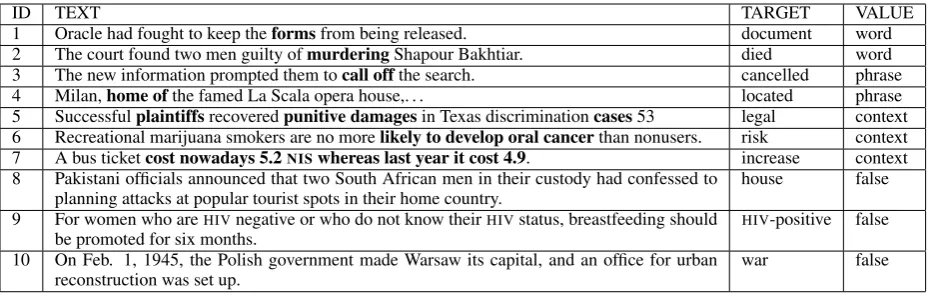
Word: if there is a word in the sentence which, in the context of the sentence, implies a meaning of the target word (e.g. a synonym or hyponym), or which implies a reference to the target word’s meaning (e.g. blind→see, sight). See examples 1-2 in Table 1 where the word that implies the refer-ence is emphasized in the text. Note that in exam-ple 2 murder is not a synonym of died nor does it share the same meaning of died; however it is clear from its presence in the sentence that it refers to a death. Also note that in example 8 although home is a possible synonym for house, in the context of the text it does not appear in that meaning and the example should be annotated as false.
Phrase: if there is a multi-word independent ex-pression in the sentence that implies the target (im-plication in the same sense that a Word does). See examples 3-4 in Table 1.
Context: if there is a clear reference to the mean-ing of the target word by the overall meanmean-ing of some part(s) of the sentence (possibly all the sen-tence), though it is not referenced by any single word or phrase. The reference is derived from the complete context of the relevant sentence part. See examples 5-7 in Table 1.
If there is no reference from the sentence to the target word the annotators were instructed to choose false. In example 9 in Table 1 the target word “HIV-positive” should be considered as one word that cannot be broken down from its unit and although both the general term “HIV status” and the more specific term “HIVnegative” are referred to, the target word cannot be understood or derived from the text. In example 10 although the year 1945 may refer to a specific war, there is no ”war” either specifically or generally understood by the text.
3dataset avaiable at http://ir-srv.cs.biu.ac.
ID TEXT TARGET VALUE 1 Oracle had fought to keep theformsfrom being released. document word 2 The court found two men guilty ofmurderingShapour Bakhtiar. died word 3 The new information prompted them tocall offthe search. cancelled phrase 4 Milan,home ofthe famed La Scala opera house,. . . located phrase 5 Successfulplaintiffsrecoveredpunitive damagesin Texas discriminationcases53 legal context 6 Recreational marijuana smokers are no morelikely to develop oral cancerthan nonusers. risk context 7 A bus ticketcost nowadays 5.2NISwhereas last year it cost 4.9. increase context 8 Pakistani officials announced that two South African men in their custody had confessed to
planning attacks at popular tourist spots in their home country.
house false
9 For women who areHIVnegative or who do not know theirHIVstatus, breastfeeding should be promoted for six months.
HIV-positive false
10 On Feb. 1, 1945, the Polish government made Warsaw its capital, and an office for urban reconstruction was set up.
[image:4.595.72.540.62.210.2]war false
Table 1: Lexical Reference Annotation Examples
3.2.2 Annotation results
We measured the agreement on the lexical refer-ence binary task (in which Word, Phrase and Con-text are conflated to true). The resulting kappa statistic of 0.63 is regarded as substantial agree-ment (Landis and Koch, 1997). The resulting dataset is not balanced in terms of true and false examples and a straw-baseline for accuracy is 0.61, representing a system which predicts all ex-amples as true.
3.3 Dataset Analysis
In a similar manner to (Bar-Haim et al., 2005; Van-derwende et al., 2005) we investigated the rela-tionship between lexical reference and textual en-tailment. We checked the performance of a textual entailment system which relies solely on an ideal lexical reference component which makes no mis-takes and asserts that a hypothesis is entailed from a text if and only if all content words in the hypoth-esis are referred in the text. Based on the lexical reference dataset annotations, such an “ideal” sys-tem would obtain an accuracy of 74% on the cor-responding subset of the textual entailment task. The corresponding precision is 68% and a recall of 82%. This is significantly higher than the re-sults of the best performing systems that partici-pated in the challenge on the RTE-1 test set. This suggests that lexical reference is a valuable sub-task for entailment. Interestingly, a similar entail-ment system based on a lexical reference compo-nent which doesn’t account for the contextual lex-ical reference (i.e. all Context annotations are re-garded as false) would achieve an accuracy of only 63% with 41% precision and a recall of 63%. This suggests that lexical reference in general and con-textual entailment in particular, play an important
(though not sufficient) role in entailment recogni-tion.
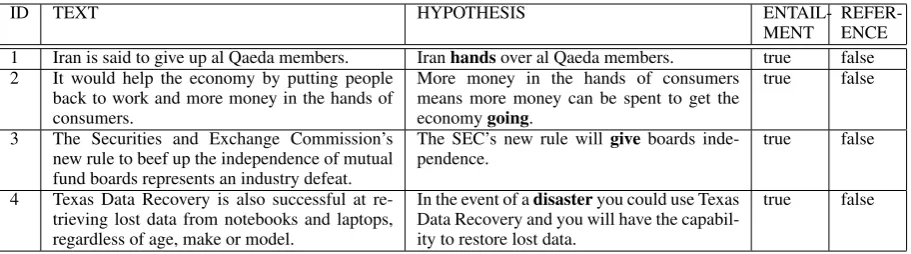
Further, we wanted to investigate the validity of the assumption that for entailment relationship to hold all content words in the hypothesis must be referred by the text. We examined the exam-ples in our dataset which were derived from text-hypothesis pairs that were annotated as true (en-tailing) in theRTEdataset. Out of 257 such exam-ples only 34 were annotated as false by both anno-tators. Table 2 lists a few such examples in which entailment at whole holds, however, there exists a word in the hypothesis (highlighted in the table) which is not lexically referenced by the text. In many cases, the target word was part of a non com-positional compound in the hypothesis, and there-fore should not be expected to be referenced by the text (see examples 1-2). This finding indicates that the basic assumption is a reasonable approxi-mation for entailment. We could not have revealed this fact without the dataset for the subtask of lex-ical reference.
4 Lexical Reference Models
ID TEXT HYPOTHESIS ENTAIL-MENT
REFER-ENCE 1 Iran is said to give up al Qaeda members. Iranhandsover al Qaeda members. true false 2 It would help the economy by putting people
back to work and more money in the hands of consumers.
More money in the hands of consumers means more money can be spent to get the economygoing.
true false
3 The Securities and Exchange Commission’s new rule to beef up the independence of mutual fund boards represents an industry defeat.
The SEC’s new rule willgiveboards inde-pendence.
true false
4 Texas Data Recovery is also successful at re-trieving lost data from notebooks and laptops, regardless of age, make or model.
In the event of adisasteryou could use Texas Data Recovery and you will have the capabil-ity to restore lost data.
[image:5.595.73.529.62.189.2]true false
Table 2: examples demonstrating cases when lexical entailment does not correlate with entailment. Tar-get word is shown in bold.
4.1 WordNet
Following the common practice in NLP applica-tions (see Section 2.1) we evaluated the perfor-mance of a straight-forward utilization of Word-Net’s lexical information. Our wordnet model first lemmatizes the text and target word. It then as-signs a score of 1 if the text contains a synonym, hyponym or derived form of the target word and a score of 0 otherwise.
4.2 Similarity
As a second measure we used the distributional similarity measure of (Lin, 1998). For a texttand a worduwe assign the max similarity score as fol-lows:
similarity(t, u) = max
v∈t sim(u, v) (1)
wheresim(u, v) is the similarity score foru and v4.
4.3 Alignment model
(Glickman et al., 2006) was among the top scor-ing systems on theRTE-1 challenge and supplies a probabilistically motivated lexical measure based on word co-occurrence statistics. It is defined for a texttand a worduas follows:
align(t, u) = max
v∈t P(u|v) (2)
whereP(u|v)is simply the co-occurrence proba-bility – the probaproba-bility that a sentence containing v also contains u. The co-occurrence statistics were collected from the Reuters Corpus Volume 1.
4the scores were obtained from the following online
re-source: http://www.cs.ualberta.ca/˜lindek/ downloads.htm
4.4 Baysean model
(Glickman et al., 2005) provide a contextual mea-sure which takes into account the whole context of the text rather than from a single word in the text as do the previous models. This model is the only model which addresses contextual refer-ence rather than just word-to-word matching. The model is based on a Na¨ıve Bayes text classification approach in which corpus sentences serve as doc-uments and the class is the reference of the target wordu. Sentences containing the worduare used as positive examples while all other sentences are considered as negative examples. It is defined for a texttand a worduas follows:
bayes(t, u) =
P(u)Q
v∈tP(v|u) n(v,t)
P(¬u)Qv∈tP(v|¬u)n(v,t)+P(u)Q
v∈tP(v|u) n(v,t)
(3) wheren(w, t)is the number of times wordw ap-pears int, P(u)is the probability that a sentence contains the worduandP(v|¬u)is the probability that a sentence NOT containingu containsv. In order to reduce data size and to account for zero probabilities we applied smoothing and informa-tion gain based feature selecinforma-tion on the data prior to running the model. The co-occurrence prob-abilities were collected from sentences from the Reuters corpus in a similar manner to the align-ment model.
4.5 Combined Model
interpolation of the two models (by simply averag-ing the score of the two models). This model have not been previously suggested and to the best of our knowledge this type of combination is novel.
5 Empirical Evaluation and Analysis
5.1 Results
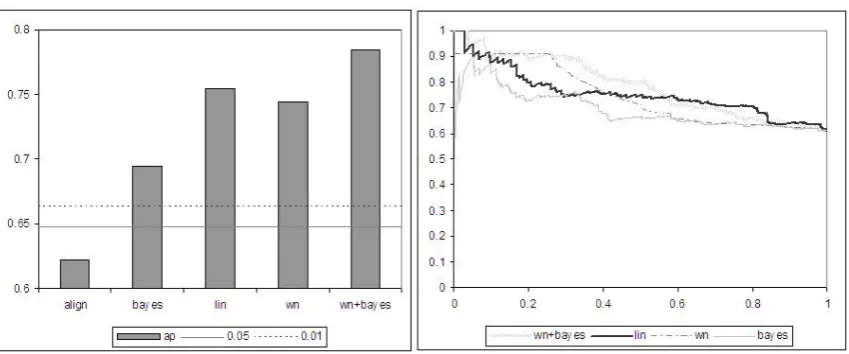
[image:6.595.330.504.292.348.2]In order to evaluate the scores produced by the various models as a potential component in an en-tailment system we compared the recall-precision graphs. In addition we compared theaverage pre-cision which is a single number measure equiv-alent to the area under an uninterpolated recall-precision curve and is commonly used to evaluate a systems ranking ability (Voorhees and Harman, 1999). On our dataset an average precision greater than 0.65 is better than chance at the 0.05 level and an average precision greater than 0.66 is sig-nificant at the 0.01 level.
Figure 1 compares the average precision and recall-precision results for the various models. As can be seen, the combined wordnet+bayes model performs best. In terms of average precision, the similarity and wordnet models are comparable and are slightly better than bayes. The alignment model, however, is not significantly better than random guessing. The recall-precision figure indi-cates that the baysian model succeeds to rank quite well both within the the positively scored wordnet examples and within the negatively scored word-net examples and thus resulting in improved av-erage precision of the combined model. A better understanding of the systems’ performance is evi-dent from the following analysis.
5.2 Analysis
Table 3 lists a few examples from the lexical refer-ence dataset along with their gold-standard anno-tation and the Bayesian model score. Manual in-spection of the data shows that the Bayesian model commonly assigns a low score to correct examples which have an entailing trigger word or phrase in the sentence but yet the context of the sentence as a whole is not typical for the target hypothesized en-tailed word. For example, in example 5 the entail-ing phrase ‘set in place’ and in example 6 the en-tailing word ‘founder’ do appear in the text how-ever the contexts of the sentences are not typical news domain contexts of issued or founded. An in-teresting future work would be to change the gen-erative story and model to account for such cases.
The WordNet model identified a matching word in the text for 99 out of the 580 examples. This corresponds to a somewhat low recall of 25% and a quite high precision of 90%. Table 4 lists typical mistakes of the wordnet model. Examples 1-3 are false positive examples in which there is a word in the text (emphasized in the table) which is a synonym or hyponym of the target word for some sense in WordNet, however in the context of the text it is not of such a sense. Examples 4-6 show false negative examples, in which the annotators identified a trigger word in the text (emphasized in the table) but yet it or no other word in the text is a synonym or hyponym of the target word.
5.3 Subcategory analysis
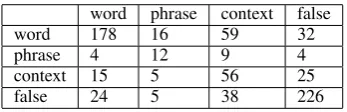
word phrase context false
word 178 16 59 32
phrase 4 12 9 4
context 15 5 56 25
false 24 5 38 226
Table 5: inter-annotator confusion matrix for the auxiliary annotation.
As seen above, the combined model outper-forms the others since it identifies both word-to-word lexical reference as well as context-to-word lexical reference. These are quite different cases. We asked the annotators to state the sub-category when they annotated an example as true (as described in the annotation guidelines in Sec-tion 3.2.1). The Word subcategory corresponds to a word-to-word match andPhraseandContext subcategories correspond to more than one word to word match. As can be expected, the agreement on such a task resulted in a lower Kappa of 0.5 which corresponds to moderate agreement (Landis and Koch, 1997). the confusion matrix between the two annotators is presented in Table 5. This de-composition enables the evaluation of the strength and weakness of different lexical reference mod-ules, free from the context of the bigger entailment system.
Figure 1: comparison of average precision (left) and recall-precision (right) results for the various models
id text token annotation score
1 QNX Software Systems Ltd., a leading provider of real-time software and ser-vices to the embedded computing market, is pleased to announce the appoint-ment of Mr. Sachin Lawande to the position of vice president, engineering ser-vices.
named PHRASE 0.98
2 NIH’s FY05 budget request of$28.8 billion includes$2 billion for the National Institute of General Medical Sciences, a 3.4-percent increase, and$1.1 billion for the National Center for Research Resources, and a 7.2-percent decrease from FY04 levels.
reduced WORD 0.91
3 Pakistani officials announced that two South African men in their custody had confessed to planning attacks at popular tourist spots in their home country.
security CONTEXT 0.80
4 With$549 million in cash as of June 30, Google can easily afford to make amends.
shares FALSE 0.03
5 In the year 538, Cyrus set in place a policy which demanded the return of the various gods to their proper places.
issued PHRASE 7e-4
6 The black Muslim activist said that he had relieved Muhammad of his duties ”until he demonstrates that he is willing to conform to the manner of representing Allah and the honorable Elijah Muhammad (founder of the Nation of Islam)”.
[image:7.595.74.522.266.463.2]founded WORD 3e-6
Table 3: A sample from the lexical reference dataset along with the Bayesian model’s score
id text token annotation
1 KerryhitBush hard on his conduct on the war in Iraq shot FALSE 2 Pakistani officials announced that two South Africanmenin their custody had confessed to
planning attacks at popular tourist spots in their home country
forces FALSE
3 It would help the economy by putting people back toworkand more money in the hands of consumers
get FALSE
4 Eating lots of foods that are a good source of fiber may keep your bloodglucosefrom rising too fast after you eat
sugar WORD
5 Hippos do come into conflict withpeoplequite often human WORD 6 Weinstock painstakingly reviewed dozens of studies for evidence of any link between
sun-screen use and either an increase or decrease inmelanoma
cancer WORD
Table 4: A few erroneous examples of WordNet model
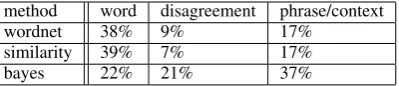
is better at identifying phrase and context exam-ples. The combined WordNet and Bayesian mod-els’ strength can be explained by the quite dif-ferent behaviors of the two models - the Word-Net model seems to be better in identifying the word-to-word explicit reference examples while the Bayesian model is better in modeling the
con-textual implied references.
6 Conclusions
method word disagreement phrase/context
wordnet 38% 9% 17%
similarity 39% 7% 17%
[image:8.595.84.284.62.105.2]bayes 22% 21% 37%
Table 6: Breakdown of recall of correctly identi-fied example types at an overall system’s recall of 25%. Disagreement refers to examples for which the annotators did not agree on the subcategory an-notation (word vs. phrase/context).
that address more complex tasks. This defini-tion enabled us to create an annotated dataset for the lexical reference task, which provided insights into interesting sub-classes that require different types of modeling. The dataset enabled us to make a direct evaluation and comparison of lexical matching models, reveal insightful differences be-tween them, and create a simple improved model combination. In the long run, we believe that the availability of such datasets will facilitate im-proved models that consider the various sub-cases of lexical reference, as well as applying supervised learning to optimize model combination and per-formance.
References
[Bar-Haim et al.2005] Roy Bar-Haim, Idan Szpecktor, and Oren Glickman. 2005. Definition and analysis of intermediate entailment levels. In Proceedings of the ACL Workshop on Empirical Modeling of Se-mantic Equivalence and Entailment, pages 55–60, Ann Arbor, Michigan, June. Association for Com-putational Linguistics.
[Barzilay and McKeown2001] Regina Barzilay and Kathleen McKeown. 2001. Extracting paraphrases from a parallel corpus. InACL, pages 50–57.
[Bos and Markert2005] Johan Bos and Katja Markert. 2005. Recognising textual entailment with logical inference techniques. InEMNLP.
[Corley and Mihalcea2005] Courtney Corley and Rada Mihalcea. 2005. Measuring the semantic similarity of texts. In Proceedings of the ACL Workshop on Empirical Modeling of Semantic Equivalence and Entailment, pages 13–18.
[Dagan et al.2006] Ido Dagan, Oren Glickman, and Bernardo Magnini, editors. 2006. The PASCAL Recognising Textual Entailment Challenge, volume 3944. Lecture Notes in Computer Science.
[Frege1892] Gottlob Frege. 1892. On sense and reference. Reprinted in P. Geach and M. Black, eds., Translations from the Philosophical Writings of Gottlob Frege. 1960.
[Glickman and Dagan2004] Oren Glickman and Ido Dagan, 2004. Recent Advances in Natural Lan-guage Processing III, chapter Acquiring lexical paraphrases from a single corpus, pages 81–90. John Benjamins.
[Glickman et al.2005] Oren Glickman, Ido Dagan, and Moshe Koppel. 2005. A probabilistic classification approach for lexical textual entailment. In AAAI, pages 1050–1055.
[Glickman et al.2006] Oren Glickman, Ido Dagan, and Moshe Koppel. 2006. A lexical alignment model for probabilistic textual entailment, volume 3944. InLecture Notes in Computer Science, pages 287 – 298. Springer.
[Harabagiu et al.2000] Sanda M. Harabagiu, Dan I. Moldovan, Marius Pasca, Rada Mihalcea, Mihai Surdeanu, Razvan C. Bunescu, Roxana Girju, Vasile Rus, and Paul Morarescu. 2000. Falcon: Boosting knowledge for answer engines. InTREC.
[Hovy et al.2001] Eduard H. Hovy, Ulf Hermjakob, and Chin-Yew Lin. 2001. The use of external knowl-edge of factoid QA. InText REtrieval Conference.
[Jijkoun and de Rijke2005] Valentin Jijkoun and Maarten de Rijke. 2005. Recognizing textual entailment using lexical similarity. Proceedings of the PASCAL Challenges Workshop on Recognising Textual Entailment (and forthcoming LNAI book chapter).
[Landis and Koch1997] J. R. Landis and G. G. Koch. 1997. The measurements of observer agreement for categorical data.Biometrics, 33:159–174.
[Leacock et al.1998] Claudia Leacock, George A. Miller, and Martin Chodorow. 1998. Using corpus statistics and wordnet relations for sense identification.Comput. Linguist., 24(1):147–165.
[Lin and Pantel2001] Dekang Lin and Patrik Pantel. 2001. Discovery of inference rules for question an-swering. Natural Language Engineering, 4(7):343– 360.
[Lin1998] Dekang Lin. 1998. Automatic retrieval and clustering of similar words. In Proceedings of the 17th international conference on Computational lin-guistics, pages 768–774, Morristown, NJ, USA. As-sociation for Computational Linguistics.
[Vanderwende et al.2005] Lucy Vanderwende, Deborah Coughlin, and Bill Dolan. 2005. What syntax can contribute in entailment task. Proceedings of the PASCAL Challenges Workshop on Recognising Textual Entailment.