Automatic Keyphrase Extraction via Topic Decomposition
Zhiyuan Liu, Wenyi Huang, Yabin Zheng and Maosong Sun
Department of Computer Science and Technology State Key Lab on Intelligent Technology and Systems National Lab for Information Science and Technology
Tsinghua University, Beijing 100084, China
{lzy.thu, harrywy, yabin.zheng}@gmail.com, [email protected]
Abstract
Existing graph-based ranking methods for keyphrase extraction compute a single impor-tance score for each word via a single ran-dom walk. Motivated by the fact that both documents and words can be represented by a mixture of semantic topics, we propose to decompose traditional random walk into mul-tiple random walks specific to various topics. We thus build a Topical PageRank (TPR) on word graph to measure word importance with respect to different topics. After that, given the topic distribution of the document, we fur-ther calculate the ranking scores of words and extract the top ranked ones as keyphrases. Ex-perimental results show that TPR outperforms state-of-the-art keyphrase extraction methods on two datasets under various evaluation met-rics.
1 Introduction
Keyphrases are defined as a set of terms in a doc-ument that give a brief summary of its content for readers. Automatic keyphrase extraction is widely used in information retrieval and digital library (Tur-ney, 2000; Nguyen and Kan, 2007). Keyphrase ex-traction is also an essential step in various tasks of natural language processing such as document cate-gorization, clustering and summarization (Manning and Schutze, 2000).
There are two principled approaches to extracting keyphrases: supervised and unsupervised. The su-pervised approach (Turney, 1999) regards keyphrase extraction as a classification task, in which a model is trained to determine whether a candidate phrase is a keyphrase. Supervised methods require a
doc-ument set with human-assigned keyphrases as train-ing set. In Web era, articles increase exponentially and change dynamically, which demands keyphrase extraction to be efficient and adaptable. However, since human labeling is time consuming, it is im-practical to label training set from time to time. We thus focus on the unsupervised approach in this study.
In the unsupervised approach, graph-based rank-ing methods are state-of-the-art (Mihalcea and Ta-rau, 2004). These methods first build a word graph according to word co-occurrences within the docu-ment, and then use random walk techniques (e.g., PageRank) to measure word importance. After that, top ranked words are selected as keyphrases.
Existing graph-based methods maintain a single importance score for each word. However, a docu-ment (e.g., news article or research article) is usu-ally composed of multiple semantic topics. Taking this paper for example, it refers to two major top-ics, “keyphrase extraction” and “random walk”. As words are used to express various meanings corre-sponding to different semantic topics, a word will play different importance roles in different topics of the document. For example, the words “phrase” and “extraction” will be ranked to be more impor-tant in topic “keyphrase extraction”, while the words “graph” and “PageRank” will be more important in topic “random walk”. Since they do not take topics into account, graph-based methods may suffer from the following two problems:
1. Good keyphrases should be relevant to the ma-jor topics of the given document. In graph-based methods, the words that are strongly con-nected with other words tend to be ranked high,
which do not necessarily guarantee they are rel-evant to major topics of the document.
2. An appropriate set of keyphrases should also have a good coverage of the document’s ma-jor topics. In graph-based methods, the ex-tracted keyphrases may fall into a single topic of the document and fail to cover other substan-tial topics of the document.
To address the problem, it is intuitive to consider the topics of words and document in random walk for keyphrase extraction. In this paper, we pro-pose to decompro-pose traditional PageRank into multi-ple PageRanks specific to various topics and obtain the importance scores of words under different top-ics. After that, with the help of the document topics, we can further extract keyphrases that are relevant to the document and at the same time have a good coverage of the document’s major topics. We call the topic-decomposed PageRank as Topical PageR-ank (TPR).
In experiments we find that TPR can extract keyphrases with high relevance and good cover-age, which outperforms other baseline methods un-der various evaluation metrics on two datasets. We also investigate the performance of TPR with dif-ferent parameter values and demonstrate its robust-ness. Moreover, TPR is unsupervised and language-independent, which is applicable in Web era with enormous information.
TPR for keyphrase extraction is a two-stage pro-cess:
1. Build a topic interpreter to acquire the topics of words and documents.
2. Perform TPR to extract keyphrases for docu-ments.
We will introduce the two stages in Section 2 and Section 3.
2 Building Topic Interpreters
To run TPR on a word graph, we have to acquire topic distributions of words. There are roughly two approaches that can provide topics of words: (1) Use manually annotated knowledge bases, e.g., Word-Net (Miller et al., 1990); (2) Use unsupervised ma-chine learning techniques to obtain word topics from
a large-scale document collection. Since the vocab-ulary in WordNet cannot cover many words in mod-ern news and research articles, we employ the sec-ond approach to build topic interpreters for TPR.
In machine learning, various methods have been proposed to infer latent topics of words and docu-ments. These methods, known as latent topic mod-els, derive latent topics from a large-scale document collection according to word occurrence informa-tion. Latent Dirichlet Allocation (LDA) (Blei et al., 2003) is a representative of topic models. Com-pared to Latent Semantic Analysis (LSA) (Landauer et al., 1998) and probabilistic LSA (pLSA) (Hof-mann, 1999), LDA has more feasibility for inference and can reduce the risk of over-fitting.
In LDA, each wordwof a documentdis regarded to be generated by first sampling a topiczfromd’s topic distribution θ(d), and then sampling a word from the distribution over words φ(z) that charac-terizes topic z. In LDA, θ(d) and φ(z) are drawn
from conjugate Dirichlet priorsαandβ, separately. Therefore,θandφare integrated out and the prob-ability of word w given document dand priors is represented as follows:
pr(w|d, α, β) =
K
X
z=1
pr(w|z, β)pr(z|d, α), (1)
whereKis the number of topics.
Using LDA, we can obtain the topic distribution of each word w, namely pr(z|w) for topic z∈K. The word topic distributions will be used in TPR. Moreover, using the obtained word topic distribu-tions, we can infer the topic distribution of a new document (Blei et al., 2003), namely pr(z|d) for each topicz ∈K, which will be used for ranking keyphrases.
3 Topical PageRank for Keyphrase
Extraction
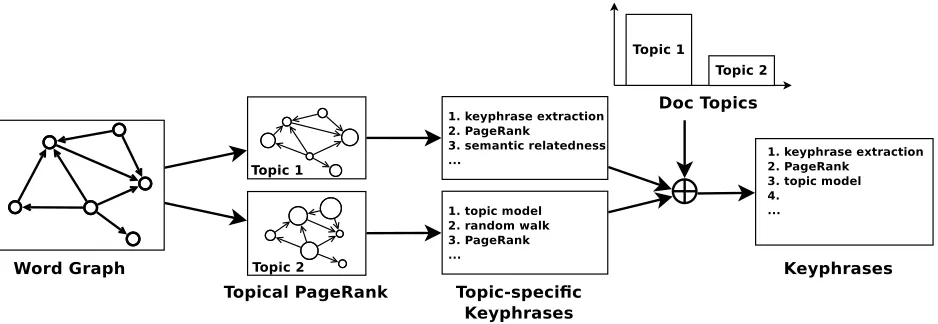
After building a topic interpreter to acquire the topics of words and documents, we can perform keyphrase extraction for documents via TPR. Given a documentd, the process of keyphrase extraction using TPR consists of the following four steps which is also illustrated in Fig. 1:
Figure 1: Topical PageRank for Keyphrase Extraction.
2. Perform TPR to calculate the importance scores for each word with respect to different topics.
3. Using the topic-specific importance scores of words, rank candidate keyphrases respect to each topic separately.
4. Given the topics of documentd, integrate the topic-specific rankings of candidate keyphrases into a final ranking, and the top ranked ones are selected as keyphrases.
3.1 Constructing Word Graph
We construct a word graph according to word co-occurrences within the given document, which ex-presses the cohesion relationship between words in the context of document. The document is re-garded as a word sequence, and the link weights be-tween words is simply set to the co-occurrence count within a sliding window with maximumW words in the word sequence.
It was reported in (Mihalcea and Tarau, 2004) the graph direction does not influence the perfor-mance of keyphrase extraction very much. In this paper we simply construct word graphs with direc-tions. The link directions are determined as follows. When sliding aW-width window, at each position, we add links from the first word pointing to other words within the window. Since keyphrases are usu-ally noun phrases, we only add adjectives and nouns in word graph.
3.2 Topical PageRank
Before introducing TPR, we first give some formal notations. We denoteG= (V, E)as the graph of a document, with vertex set V ={w1, w2,· · · , wN}
and link set (wi, wj) ∈ E if there is a link from
wi to wj. In a word graph, each vertex represents
a word, and each link indicates the relatedness be-tween words. We denote the weight of link(wi, wj)
as e(wi, wj), and the out-degree of vertex wi as
O(wi) =Pj:wi→wje(wi, wj).
Topical PageRank is based on PageRank (Page et al., 1998). PageRank is a well known ranking al-gorithm that uses link information to assign global importance scores to web pages. The basic idea of PageRank is that a vertex is important if there are other important vertices pointing to it. This can be regarded as voting or recommendation among ver-tices. In PageRank, the scoreR(wi)of word wi is
defined as
R(wi) =λ
X
j:wj→wi
e(wj, wi)
O(wj)
R(wj) + (1−λ)
1
|V|,
(2) whereλis a damping factor range from0to1, and
dis-tribution. In PageRank, the second term is set to be the same value |V1| for all vertices within the graph, which indicates there are equal probabilities of ran-dom jump to all vertices.
In fact, the second term of PageRank in Eq. (2) can be set to be non-uniformed. Suppose we as-sign larger probabilities to some vertices, the final PageRank scores will prefer these vertices. We call this Biased PageRank.
The idea of Topical PageRank (TPR) is to run Biased PageRank for each topic separately. Each topic-specific PageRank prefers those words with high relevance to the corresponding topic. And the preferences are represented using random jump probabilities of words.
Formally, in the PageRank of a specific topic
z, we will assign a topic-specific preference value
pz(w) to each wordw as its random jump
proba-bility with Pw∈V pz(w) = 1. The words that are
more relevant to topiczwill be assigned larger prob-abilities when performing the PageRank. For topic
z, the topic-specific PageRank scores are defined as follows:
Rz(wi) =λ
X
j:wj→wi
e(wj, wi)
O(wj)
Rz(wj)+(1−λ)pz(wi).
(3) In Fig. 1, we show an example with two topics. In this figure, we use the size of circles to indicate how relevant the word is to the topic. In the PageRanks of the two topics, high preference values will be as-signed to different words with respect to the topic. Finally, the words will get different PageRank val-ues in the two PageRanks.
The setting of preference valuespz(w)will have
a great influence to TPR. In this paper we use three measures to set preference values for TPR:
• pz(w) =pr(w|z), is the probability that word
w occurs given topic z. This indicates how much that topiczfocuses on wordw.
• pz(w) =pr(z|w), is the probability of topicz
given word w. This indicates how much that wordwfocuses on topicz.
• pz(w) =pr(w|z)×pr(z|w), is the product of
hub and authority values. This measure is in-spired by the work in (Cohn and Chang, 2000).
Both PageRank and TPR are all iterative algo-rithms. We terminate the algorithms when the num-ber of iterations reaches100or the difference of each vertex between two neighbor iterations is less than 0.001.
3.3 Extract Keyphrases Using Ranking Scores
After obtaining word ranking scores using TPR, we begin to rank candidate keyphrases. As reported in (Hulth, 2003), most manually assigned keyphrases turn out to be noun phrases. We thus select noun phrases from a document as candidate keyphrases for ranking.
The candidate keyphrases of a document is ob-tained as follows. The document is first tokenized. After that, we annotate the document with part-of-speech (POS) tags 1. Third, we extract noun phrases with pattern (adjective)*(noun)+, which represents zero or more adjectives followed by one or more nouns. We regard these noun phrases as candidate keyphrases.
After identifying candidate keyphrases, we rank them using the ranking scores obtained by TPR. In PageRank for keyphrase extraction, the ranking score of a candidate keyphrase p is computed by summing up the ranking scores of all words within the phrase:R(p) =Pw
i∈pR(wi)(Mihalcea and
Ta-rau, 2004; Wan and Xiao, 2008a; Wan and Xiao, 2008b). Then candidate keyphrases are ranked in descending order of ranking scores. The topM can-didates are selected as keyphrases.
In TPR for keyphrase extraction, we first com-pute the ranking scores of candidate keyphrases sep-arately for each topic. That is for each topicz we compute
Rz(p) =
X
wi∈p
Rz(wi). (4)
By considering the topic distribution of document, We further integrate topic-specific rankings of can-didate keyphrases into a final ranking and extract top-ranked ones as the keyphrases of the document. Denote the topic distribution of the document d
as pr(z|d) for each topic z. For each candidate keyphrasep, we compute its final ranking score as
1In experiments we use Stanford POS Tagger fromhttp:
//nlp.stanford.edu/software/tagger.shtml
follows:
R(p) =
K
X
z=1
Rz(p)×pr(z|d). (5)
After ranking candidate phrases in descending order of their integrated ranking scores, we select the top
M as the keyphrases of documentd.
4 Experiments
4.1 Datasets
To evaluate the performance of TPR for keyphrase extraction, we carry out experiments on two datasets.
One dataset was built by Wan and Xiao 2 which was used in (Wan and Xiao, 2008b). This dataset contains308news articles in DUC2001 (Over et al., 2001) with 2,488manually annotated keyphrases. There are at most10keyphrases for each document. In experiments we refer to this dataset asNEWS.
The other dataset was built by Hulth3which was used in (Hulth, 2003). This dataset contains2,000 abstracts of research articles and 19,254manually annotated keyphrases. In experiments we refer to this dataset asRESEARCH.
Since neither NEWS nor RESEARCH itself is large enough to learn efficient topics, we use the Wikipedia snapshot at March 2008 4 to build topic interpreters with LDA. After removing non-article pages and the articles shorter than 100words, we collected 2,122,618 articles. After tokenization, stop word removal and word stemming, we build the vocabulary by selecting20,000words according to their document frequency. We learn LDA models by taking each Wikipedia article as a document. In ex-periments we learned several models with different numbers of topics, from 50 to 1,500 respectively. For the words absent in topic models, we simply set the topic distribution of the word as uniform distri-bution.
4.2 Evaluation Metrics
For evaluation, the words in both standard and ex-tracted keyphrases are reduced to base forms using
2http://wanxiaojun1979.googlepages.com.
3
It was obtained from the author.
4
http://en.wikipedia.org/wiki/Wikipedia_ database.
Porter Stemmer 5 for comparison. In experiments we select three evaluation metrics.
The first metric is precision/recall/F-measure rep-resented as follows,
p= ccorrect
cextract
, r= ccorrect
cstandard
, f = 2pr
p+r, (6)
where ccorrect is the total number of correct
keyphrases extracted by a method, cextract the
to-tal number of automatic extracted keyphrases, and
cstandard the total number of human-labeled
stan-dard keyphrases.
We note that the ranking order of extracted keyphrases also indicates the method performance. An extraction method will be better than another one if it can rank correct keyphrases higher. However, precision/recall/F-measure does not take the order of extracted keyphrases into account. To address the problem, we select the following two additional met-rics.
One metric is binary preference measure
(Bpref) (Buckley and Voorhees, 2004). Bpref is desirable to evaluate the performance considering the order in which the extracted keyphrases are ranked. For a document, if there are R correct keyphrases within M extracted keyphrases by a method, in whichr is a correct keyphrase andnis an incorrect keyphrase, Bpref is defined as follows,
Bpref= 1
R
X
r∈R
1−|nranked higher thanr|
M . (7)
The other metric is mean reciprocal rank (MRR) (Voorhees, 2000) which is used to evaluate how the first correct keyphrase for each document is ranked. For a documentd,rankdis denoted as the
rank of the first correct keyphrase with all extracted keyphrases, MRR is defined as follows,
MRR= 1
|D|
X
d∈D
1
rankd
, (8)
whereDis the document set for keyphrase extrac-tion.
Note that although the evaluation scores of most keyphrase extractors are still lower compared to
5
http://tartarus.org/˜martin/
other NLP-tasks, it does not indicate the perfor-mance is poor because even different annotators may assign different keyphrases to the same document.
4.3 Influences of Parameters to TPR
There are four parameters in TPR that may influence the performance of keyphrase extraction including: (1) window sizeW for constructing word graph, (2) the number of topics K learned by LDA, (3) dif-ferent settings of preference values pz(w), and (4)
damping factorλof TPR.
In this section, we look into the influences of these parameters to TPR for keyphrase extraction. Except the parameter under investigation, we set parameters to the following values:W= 10,K= 1,000,λ= 0.3 andpz(w) =pr(z|w), which are the settings when
TPR achieves the best (or near best) performance on
bothNEWSandRESEARCH. In the following tables,
we use “Pre.”, “Rec.” and “F.” as the abbreviations of precision, recall and F-measure.
4.3.1 Window SizeW
In experiments onNEWS, we find that the perfor-mance of TPR is stable whenW ranges from5to20 as shown in Table 1. This observation is consistent with the findings reported in (Wan and Xiao, 2008b).
Size Pre. Rec. F. Bpref MRR 5 0.280 0.345 0.309 0.213 0.636 10 0.282 0.348 0.312 0.214 0.638 15 0.282 0.347 0.311 0.214 0.646 20 0.284 0.350 0.313 0.215 0.644
Table 1: Influence of window sizeW when the num-ber of keyphrasesM= 10onNEWS.
Similarly, whenW ranges from 2to10, the per-formance on RESEARCH does not change much. However, the performance on NEWS will become poor whenW = 20. This is because the abstracts
inRESEARCH(there are121words per abstract on
average) are much shorter than the news articles in NEWS (there are 704 words per article on av-erage). If the window size W is set too large on
RESEARCH, the graph will become full-connected
and the weights of links will tend to be equal, which cannot capture the local structure information of ab-stracts for keyphrase extraction.
4.3.2 The Number of TopicsK
We demonstrate the influence of the number of topicsK of LDA models in Table 2. Table 2 shows the results when K ranges from 50 to 1,500 and
M= 10onNEWS. We observe that the performance does not change much as the number of topics varies until the number is much smaller (K = 50). The influence is similar onRESEARCHwhich indi-cates that LDA is appropriate for obtaining topics of words and documents for TPR to extract keyphrases.
K Pre. Rec. F. Bpref MRR
50 0.268 0.330 0.296 0.204 0.632 100 0.276 0.340 0.304 0.208 0.632 500 0.284 0.350 0.313 0.215 0.648 1000 0.282 0.348 0.312 0.214 0.638 1500 0.282 0.348 0.311 0.214 0.631
Table 2: Influence of the number of topicsK when the number of keyphrasesM= 10onNEWS.
4.3.3 Damping Factorλ
Damping factor λ of TPR reconciles the influ-ences of graph walks (the first term in Eq.(3)) and preference values (the second term in Eq.(3)) to the topic-specific PageRank scores. We demonstrate the influence of λ on NEWS in Fig. 2. This fig-ure shows the precision/recall/F-measfig-ure whenλ= 0.1,0.3,0.5,0.7,0.9 and M ranges from 1 to 20. From this figure we find that, whenλis set from0.2 to 0.7, the performance is consistently good. The values of Bpref and MRR also keep stable with the variations ofλ.
4.3.4 Preference Values
Finally, we explore the influences of different set-tings of preference values for TPR in Eq.(3). In Ta-ble 3 we show the influence when the number of keyphrasesM = 10on NEWS. From the table, we observe thatpr(z|w)performs the best. The similar observation is also got onRESEARCH.
1 23 4 56 78 9 10 11 12 13 14 15 16 17 18 19 20 0.2
0.25 0.3 0.35 0.4 0.45 0.5
Keyphrase Number
Precision
λ=0.1
λ=0.3
λ=0.5
λ=0.7
λ=0.9
(a) Precision
1 23 45 67 89 10 11 12 13 14 15 16 17 18 19 20
0.05 0.1 0.15 0.2 0.25 0.3 0.35 0.4 0.45 0.5
Keyphrase Number
Recall λ=0.1
λ=0.3
λ=0.5
λ=0.7
λ=0.9
(b) Recall
12 34 5 67 89 10 11 12 13 14 15 16 17 18 19 20
0.1 0.12 0.14 0.16 0.18 0.2 0.22 0.24 0.26 0.28 0.3
Keyphrase Number
F−measure
λ=0.1
λ=0.3
λ=0.5
λ=0.7
λ=0.9
[image:7.612.89.528.70.192.2](c) F-measure
Figure 2: Precision, recall and F-measure of TPR withλ= 0.1,0.3,0.5,0.7and0.9whenM ranges from1 to20onNEWS.
common words will always be assigned to a rela-tively large value in each topic-specific PageRank and finally obtain a high rank. pr(w|z)is thus not a good setting of preference values in TPR. In the con-trast, pr(z|w)prefers those words that are focused on the given topic. Usingpr(z|w)to set preference values for TPR, we will tend to extract topic-focused phrases as keyphrases.
Pref Pre. Rec. F. Bpref MRR
pr(w|z) 0.256 0.316 0.283 0.192 0.584
pr(z|w) 0.282 0.348 0.312 0.214 0.638 prod 0.259 0.320 0.286 0.193 0.587
Table 3: Influence of three preference value settings when the number of keyphrasesM= 10onNEWS.
4.4 Comparing with Baseline Methods
After we explore the influences of parameters to TPR, we obtain the best results on both NEWS and
RESEARCH. We further select three baseline
meth-ods, i.e., TFIDF, PageRank and LDA, to compare with TPR.
The TFIDF computes the ranking scores of words based on words’ tf idf values in the document, namelyR(w) =tfw×log(idfw). While in
PageR-ank (i.e., TextRPageR-ank), the rPageR-anking scores of words are obtained using Eq.(2). The two baselines do not use topic information of either words or documents. The LDA computes the ranking score for each word us-ing the topical similarity between the word and the document. Given the topics of the documentdand a word w, We have used various methods to
com-pute similarity including cosine similarity, predic-tive likelihood and KL-divergence (Heinrich, 2005), among which cosine similarity performs the best on both datasets. Therefore, we only show the results of the LDA baseline calculated using cosine similarity. In Tables 4 and 5 we show the compar-ing results of the four methods on both NEWS
and RESEARCH. Since the average number of
manual-labeled keyphrases on NEWS is larger than
RESEARCH, we setM = 10 for NEWS andM =
5 for RESEARCH. The parameter settings on both
NEWSandRESEARCHhave been stated in Section
4.3.
Method Pre. Rec. F. Bpref MRR TFIDF 0.239 0.295 0.264 0.179 0.576 PageRank 0.242 0.299 0.267 0.184 0.564 LDA 0.259 0.320 0.286 0.194 0.518 TPR 0.282 0.348 0.312 0.214 0.638
Table 4: Comparing results onNEWSwhen the num-ber of keyphrasesM= 10.
Method Pre. Rec. F. Bpref MRR TFIDF 0.333 0.173 0.227 0.255 0.565 PageRank 0.330 0.171 0.225 0.263 0.575 LDA 0.332 0.172 0.227 0.254 0.548 TPR 0.354 0.183 0.242 0.274 0.583
Table 5: Comparing results onRESEARCHwhen the number of keyphrasesM= 5.
0.2 0.25 0.3 0.35 0.4 0.45 0.5 0
0.05 0.1 0.15 0.2 0.25 0.3 0.35 0.4 0.45 0.5
Precision
Recall
TFIDF
PageRank LDA
[image:8.612.348.502.63.179.2]TPR
Figure 3: Precision-recall results onNEWSwhenM
ranges from1to20.
First, TPR outperform all baselines on both datasets. The improvements are all statistically sig-nificant tested with bootstrap re-sampling with 95% confidence. This indicates the robustness and effec-tiveness of TPR.
Second, LDA performs equal or better than TFIDF and PageRank under precision/recall/F-measure. However, the performance of LDA un-der MRR is much worse than TFIDF and PageR-ank, which indicates LDA fails to correctly extract the first keyphrase earlier than other methods. The reason is: (1) LDA does not consider the local struc-ture information of document as PageRank, and (2) LDA also does not consider the frequency infor-mation of words within the document. In the con-trast, TPR enjoys the advantages of both LDA and TFIDF/PageRank, by using the external topic infor-mation like LDA and internal document structure like TFIDF/PageRank.
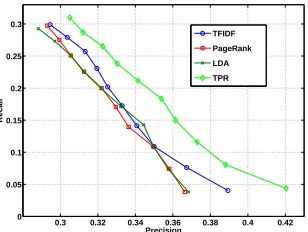
Moreover, in Figures 3 and 4 we show the precision-recall relations of four methods onNEWS
andRESEARCH. Each point on the precision-recall
curve is evaluated on different numbers of extracted keyphrases M. The closer the curve to the upper right, the better the overall performance. The results again illustrate the superiority of TPR.
4.5 Extracting Example
At the end, in Table 6 we show an example of extracted keyphrases using TPR from a news arti-cle with title “Arafat Says U.S. Threatening to Kill PLO Officials” (The article number in DUC2001 is AP880510-0178). Here we only show the top 10 keyphrases, and the correctly extracted ones
0.3 0.32 0.34 0.36 0.38 0.4 0.42 0
0.05 0.1 0.15 0.2 0.25 0.3
Precision
Recall
TFIDF PageRank LDA TPR
Figure 4: Precision-recall results on RESEARCH
whenM ranges from1to10.
are marked with “(+)”. We also mark the num-ber of correctly extracted keyphrases after method name like “(+7)” after TPR. We also illustrate the top 3 topics of the document with their topic-specific keyphrases. It is obvious that the top topics, on “Palestine”, “Israel” and “terrorism” separately, have a good coverage on the discussion objects of this article, which also demonstrate a good diversity with each other. By integrating these topic-specific keyphrases considering the proportions of these top-ics, we obtain the best performance of keyphrase ex-traction using TPR.
In Table 7 we also show the extracted keyphrases of baselines from the same news article. For TFIDF, it only considered the frequency properties of words, and thus highly ranked the phrases with “PLO” which appeared about 16 times in this article, and failed to extract the keyphrases on topic “Israel”. LDA only measured the importance of words using document topics without considering the frequency information of words and thus missed keyphrases with high-frequency words. For example, LDA failed to extract keyphrase “political assassination”, in which the word “assassination” occurred8times in this article.
5 Related Work
[image:8.612.108.261.63.178.2]TPR (+7)
PLO leader Yasser Arafat(+), Abu Jihad, Khalil Wazir(+), slaying Wazir, political assassina-tion(+), Palestinian guerrillas(+), particulary Palestinian circles, Israeli officials(+), Israeli squad(+), terrorist attacks(+)
TPR, Rank 1 Topic on “Palestine”
PLO leader Yasser Arafat(+), United States(+), State Department spokesman Charles Redman, Abu Jihad, U.S. government document, Palestine Liberation Organization leader, political assassi-nation(+), Israeli officials(+), alleged document TPR, Rank 2 Topic on “Israel”
PLO leader Yasser Arafat(+), United States(+), Palestine Liberation Organization leader, Israeli officials(+), U.S. government document, alleged document, Arab government, slaying Wazir, State Department spokesman Charles Redman, Khalil Wazir(+)
TPR, Rank 3 Topic on “terrorism”
terrorist attacks(+), PLO leader Yasser Arafat(+), Abu Jihad, United States(+), alleged docu-ment, U.S. government docudocu-ment, Palestine Lib-eration Organization leader, State Department spokesman Charles Redman, political assassina-tion(+), full cooperation
Table 6: Extracted keyphrases by TPR.
Starting with TextRank (Mihalcea and Tarau, 2004), graph-based ranking methods are becoming the most widely used unsupervised approach for keyphrase extraction. Litvak and Last (2008) ap-plied HITS algorithm on the word graph of a docu-ment for keyphrase extraction. Although HITS itself worked the similar performance to PageRank, we plan to explore the integration of topics and HITS in future work. Wan (2008b; 2008a) used a small num-ber of nearest neighbor documents to provide more knowledge for keyphrase extraction. Some meth-ods used clustering techniques on word graphs for keyphrase extraction (Grineva et al., 2009; Liu et al., 2009). The clustering-based method performed well on short abstracts (with F-measure 0.382 on
RESEARCH) but poorly on long articles (NEWSwith
F-measure score 0.216) due to two non-trivial is-sues: (1) how to determine the number of
clus-TFIDF (+5)
PLO leader Yasser Arafat(+), PLO attacks, PLO offices, PLO officials(+), PLO leaders, Abu Ji-had, terrorist attacks(+), Khalil Wazir(+), slaying wazir, political assassination(+)
PageRank (+3)
PLO leader Yasser Arafat(+), PLO officials(+), PLO attacks, United States(+), PLO offices, PLO leaders, State Department spokesman Charles Redman, U.S. government document, alleged document, Abu Jihad
LDA (+5)
PLO leader Yasser Arafat(+), Palestine Liberation Organization leader, Khalil Wazir(+), Palestinian guerrillas(+), Abu Jihad, Israeli officials(+), par-ticulary Palestinian circles, Arab government, State Department spokesman Charles Redman, Israeli squad(+)
Table 7: Extracted keyphrases by baselines.
ters, and (2) how to weight each cluster and select keyphrases from the clusters. In this paper we fo-cus on improving graph-based methods via topic de-composition, we thus only compare with PageRank as well as TFIDF and LDA and do not compare with clustering-based methods in details.
In recent years, two algorithms were proposed to rank web pages by incorporating topic information of web pages within PageRank (Haveliwala, 2002; Nie et al., 2006). The method in (Haveliwala, 2002), is similar to TPR which also decompose PageRank into various topics. However, the method in (Haveli-wala, 2002) only considered to set the preference values usingpr(w|z)(In the context of (Haveliwala, 2002),windicates Web pages). In Section 4.3.4 we have shown that the setting of usingpr(z|w)is much better thanpr(w|z).
Nie et al. (2006) proposed a more complicated ranking method. In this method, topical PageRanks are performed together. The basic idea of (Nie et al., 2006) is, when surfing following a graph link from vertexwi towj, the ranking score on topicz ofwi
will have a higher probability to pass to the same topic ofwj and have a lower probability to pass to
a different topic ofwj. When the inter-topic jump
(Haveli-wala, 2002). We implemented the method and found that the random jumps between topics did not help improve the performance for keyphrase extraction, and did not demonstrate the results of this method.
6 Conclusion and Future Work
In this paper we propose a new graph-based frame-work, Topical PageRank, which incorporates topic information within random walk for keyphrase ex-traction. Experiments on two datasets show that TPR achieves better performance than other base-line methods. We also investigate the influence of various parameters on TPR, which indicates the ef-fectiveness and robustness of the new method.
We consider the following research directions as future work.
1. In this paper we obtained latent topics us-ing LDA learned from Wikipedia. We de-sign to obtain topics using other machine learn-ing methods and from other knowledge bases, and investigate the influence to performance of keyphrase extraction.
2. In this paper we integrated topic information in PageRank. We plan to consider topic infor-mation in other graph-based ranking algorithms such as HITS (Kleinberg, 1999).
3. In this paper we used Wikipedia to train LDA by assuming Wikipedia is an exten-sive snapshot of human knowledge which can cover most topics talked about in NEWS and
RESEARCH. In fact, the learned topics are
highly dependent on the learning corpus. We will investigate the influence of corpus selec-tion in training LDA for keyphrase extracselec-tion using TPR.
Acknowledgments
This work is supported by the National Natu-ral Science Foundation of China under Grant No. 60873174. The authors would like to thank Anette Hulth and Xiaojun Wan for kindly sharing their datasets. The authors would also thank Xiance Si, Tom Chao Zhou, Peng Li for their insightful sug-gestions and comments.
References
David M. Blei, Andrew Y. Ng, and Michael I. Jordan. 2003. Latent dirichlet allocation. Journal of Machine
Learning Research, 3:993–1022, January.
C. Buckley and E.M. Voorhees. 2004. Retrieval evalu-ation with incomplete informevalu-ation. In Proceedings of
SIGIR, pages 25–32.
David Cohn and Huan Chang. 2000. Learning to prob-abilistically identify authoritative documents. In
Pro-ceedings of ICML, pages 167–174.
M. Grineva, M. Grinev, and D. Lizorkin. 2009. Extract-ing key terms from noisy and multi-theme documents. In Proceedings of WWW, pages 661–670.
Taher H. Haveliwala. 2002. Topic-sensitive pagerank. In
Proceedings of WWW, pages 517–526.
G. Heinrich. 2005. Parameter estimation for text anal-ysis. Web: http://www. arbylon.
net/publications/text-est.
Thomas Hofmann. 1999. Probabilistic latent semantic indexing. In Proceedings of SIGIR, pages 50–57. Anette Hulth. 2003. Improved automatic keyword
ex-traction given more linguistic knowledge. In
Proceed-ings of EMNLP, pages 216–223.
J.M. Kleinberg. 1999. Authoritative sources in a hyper-linked environment. Journal of the ACM, 46(5):604– 632.
T.K. Landauer, P.W. Foltz, and D. Laham. 1998. An in-troduction to latent semantic analysis. Discourse
Pro-cesses, 25:259–284.
Marina Litvak and Mark Last. 2008. Graph-based key-word extraction for single-document summarization. In Proceedings of the workshop Multi-source
Mul-tilingual Information Extraction and Summarization,
pages 17–24.
Zhiyuan Liu, Peng Li, Yabin Zheng, and Maosong Sun. 2009. Clustering to find exemplar terms for keyphrase extraction. In Proceedings of EMNLP, pages 257– 266.
C.D. Manning and H. Schutze. 2000. Foundations of
statistical natural language processing. MIT Press.
Rada Mihalcea and Paul Tarau. 2004. Textrank: Bring-ing order into texts. In ProceedBring-ings of EMNLP, pages 404–411.
George A. Miller, Richard Beckwith, Christiane Fell-baum, Derek Gross, and Katherine Miller. 1990. WordNet: An on-line lexical database. International
Journal of Lexicography, 3:235–244.
Thuy Nguyen and Min-Yen Kan. 2007. Keyphrase ex-traction in scientific publications. In Proceedings of
Lan Nie, Brian D. Davison, and Xiaoguang Qi. 2006. Topical link analysis for web search. In Proceedings
of SIGIR, pages 91–98.
P. Over, W. Liggett, H. Gilbert, A. Sakharov, and M. Thatcher. 2001. Introduction to duc-2001: An in-trinsic evaluation of generic news text summarization systems. In Proceedings of DUC2001.
L. Page, S. Brin, R. Motwani, and T. Winograd. 1998. The pagerank citation ranking: Bringing order to the web. Technical report, Stanford Digital Library
Tech-nologies Project, 1998.
Peter D. Turney. 1999. Learning to extract keyphrases from text. National Research Council Canada, In-stitute for Information Technology, Technical Report ERB-1057.
Peter D. Turney. 2000. Learning algorithms for keyphrase extraction. Information Retrieval,
2(4):303–336.
E.M. Voorhees. 2000. The trec-8 question answering track report. In Proceedings of TREC, pages 77–82. Xiaojun Wan and Jianguo Xiao. 2008a. Collabrank:
Towards a collaborative approach to single-document keyphrase extraction. In Proceedings of COLING, pages 969–976.