Application of Information-Geometric Support Vector
Machine on Fault Diagnosis of Hydraulic Pump
Zhipeng Wang, Chen Lu and Zili Wang
APPLICATION OF INFORMATION-GEOMETRIC SUPPORT VECTOR MACHINE ON FAULT DIAGNOSIS OF HYDRAULIC PUMP. ZHIPENG WANG,CHEN LU AND ZILI WANG
Zhipeng Wang, Chen Lu1 and Zili Wang
School of Reliability and Systems Engineering, Beihang University, Beijing, 100191, China Science & Technology Laboratory on Reliability & Environmental Engineering, Beijing, 100191, China
E-mail: [email protected]
Abstract.The growing demand for the safety and reliability in industries triggers the development of condition
monitoring and fault diagnosis technologies. Hydraulic pump is the critical part of a hydraulic system. The diagnosis of hydraulic pump is very crucial for reliability. This paper presents a method based on information-geometric support vector machine (SVM), which is employed for fault diagnosis of hydraulic pump. The IG-SVM, which uses information geometry to modify IG-SVM, improves the performance in a data-dependent way. To diagnose faults of hydraulic pump, a residual error generator is designed based on the IG-SVM. This residual error generator is firstly trained using data from normal state. Then, it can be used for fault clustering by analysis of the residual error. Its feasibility and efficiency has also been validated via a plunger pump test-bed.
1.Introduction
As processes and machinery become more and more complex, fault detection and diagnosis are emerging as the main task of a monitoring system and have an effective role for the safe operation and long life of systems. Condition monitoring is important for increasing machinery availability, improving manufacturing process productivity and reliability [1].
Hydraulic pump is a key component which varies the volume of fluid delivered to constant system pressure. If a fault detection scheme can be developed that gives an early warning of component failures, then repairs or replacements can take place at the earliest or most convenient time with the minimum loss of productivity [2]. So, diagnosis of hydraulic pump is necessary. However, hydraulic pump is complex and in a very high degree of coupling [3]. Considering the complexity and the severe working conditions, data-driven fault detection method is usually applies to its online fault diagnosis. By now, a lot of data-driven methods have been proposed, such as: wavelet decomposition [4], neural networks (ANNs) [5, 6], fuzzy logic, kernel principal component analysis [7], as well as D-S evidence theory [8].
Support vector machine (SVM), as a data-driven method, has been widely applied. Compared with ANNs, SVM overcomes many detects, such as over-fitting, local convergence. Additionally, SVM has advantages over ANNs, in terms of robustness and prevention of Curse of Dimensionality, etc. It has been applied in many fields, such as pattern recognition and fault diagnosis [1].
Despite the excellent applicability, the performance of SVM largely depends on the kernel [9, 10]. Mostly, the kernel functions are chosen by experience. However, unsuitably chosen kernel functions may lead to significantly poor performance [11]. By now, there seems to be no systematic way of choosing appropriate kernel functions [12]. It is reported that choosing a kernel corresponds to a smoothness assumption of the discriminant function of the classifier. In case when we have some prior knowledge, we can utilize them to choose a kernel [13]. However, in practice, the prior knowledge is usually unknown. Therefore, it is important to optimize the kernel in a data-dependent way. Here, an information-geometric method is employed in this study. By analyzing the structure of the Riemannian geometry induced in the input space by the kernel, the SVM can be modified in a data-dependent way and the information-geometric SVM (IG-SVM) can be obtained.
In this paper, a residual error generator based the IG-SVM is designed to detect several types of failures of hydraulic pump with one-step prediction of chaotic time series. The feasibility and efficiency of this method is validated via a plunger pump test-bed.
2.Methodology
2.1.Modified SVM using information geometry
The SVM, proposed by Vapnik, aims at minimizing an upper bound of the generalization error through maximizing the margin between the separating hyperplane and the data. Suppose a pattern classifier, which uses a hyperplane to separate two classes of patterns based on given examples
(
)
(
)
{
1, 1 , ..., i, i}
D= x y x y , where x is a vector in the input space S=Rd, y∈ −
{
1, 1}
is class label and1, ...,
i= l. A nonlinear SVM maps the input data x into a high dimensional feature space F=Rn (n may be infinite) by using a nonlinear mapping φ
( )
x . Detailed explanation about the basic concepts ofSVM theory can be found in reference [11].
To modify SVM kernel using information geometry, it is necessary to analyze the geometrical structure induced in the input space by a kernel as follows [14].
The mapping φ
( )
x defines an embedding of S into S as a curved submanifold. When F is aEuclidean or Hilbert space, a Riemannian metric is thereby induced in the space S, where the length of a small line element dx in S is defined by the length in the larger space F.
Denote by z the mapped pattern of x in the feature space, i.e., z=φ
( )
x . A small vector dx ismapped to
( )
( )
i i i dz x dx x dx x φ ∂ φ = ∇ = ∂∑
(1) where( )
( )
i x x x φ ∂ φ ∇ = ∂ (2)The squared length of dz
(
dz)
α= is written in the quadratic form as
(
)
2( )
, ij i j i j dz dzα g x dx dx α =∑
=∑
(3) where( )
( )
( )
ij i j g x x x x x φ φ ∂ ∂ = ∂ ∂ (4)The dot denoting the summation over index α of φ. The n×n positive-definite matrix
( )
(
ij( )
)
G x = g x is the Riemannian metric tensor induced in S. It shows that the metric is directly derived from the kernel.
Based on the above analysis, in order to improve the forecasting precision in regression problems, special nonlinear map φ , can be constructed such that gij
( )
x is reduced around the neighboring areasof hyperplane: y− f x
( )
−b =ξ, which is contrary to the method of Amari in classification problems. This idea can be implemented by a conformal transformation of kernel,(
, ')
( ) ( ) (
' , ')
K x xɶ =c x c x K x x (5)
with a properly positive scalar function c x
( )
. K x xɶ(
, ')
is called a conformal transformation of akernel by factor. The nonlinear mapping φ
( )
x can be regarded as being modified to( )
x c( ) ( )
x xφɶ = φ , which satisfies the Mercer positivity condition.
Therefore, if we choose the function c x
( )
in a way such that its value is large when x is close to the boundary and small otherwise, we can realize the idea of enlarging the spatial resolution around the boundary [9]. Taking the above analysis into consideration, c x( )
can be chosen as:( )
2 2 1 1 exp m i i x o c x m τ = − − = ∑
(6)where the parameter m, oi, τ are the number of the partitioning points, the center and the width of the
ith partition, respectively. Out of the circles, the value of c x
( )
is very small, so is its derivative [13]. Therefore, this function satisfies the aforementioned requirement and can be used to modify SVM in a data-dependent way.2.2.Residual error generator
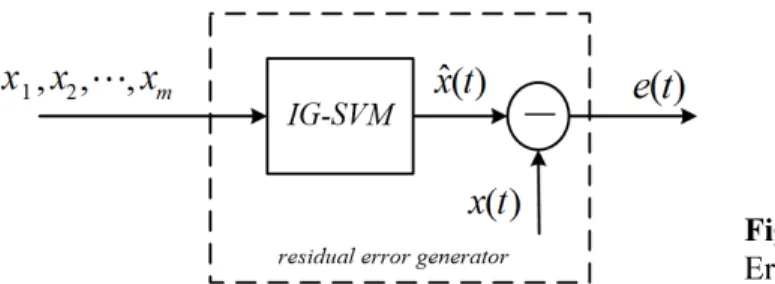
Residual error generator can be designed for fault diagnosis based on IG-SVM prediction process. The structure is shown in figure 1.
Figure 1. Structure of Residual Error Generator based on IG-SVM. Where, x t
( )
is the time series which can be observed of actual system, IG-SVM is the residual error generator trained by the data from normal state, x tɶ( )
is the one-step prediction value of IG-SVM, and e t( )
is the output of residual error generator.The diagnostic decision is obtained based on the following rule:
eval th
r >J → Fault state detected eval th
r ≤J → Normal state
Where, reval is the mean absolute value of residual error signal, and th
J is the threshold and can be determined by experience.
3.Experimental results
In this section, a test rig of SCY Hydraulic plunger pump, was tested and analyzed to verify the presented method. In the experiment, two common types of fault in plunger pump were set respectively: wear fault between swash plate and slipper and wear fault of valve plate. Under three kinds of states, including normal state, as shown in table 1, vibration signal was respectively acquired from the end face of plunger pump, with a stabilized motor speed at 5280r/min, and a sampling rate of 1000Hz.
Table 1. Hydraulic pump’s datasets.
Data State
Data1 Normal condition
Data2 Wear fault between swash plate and slipper
Data3 Wear fault of valve plate
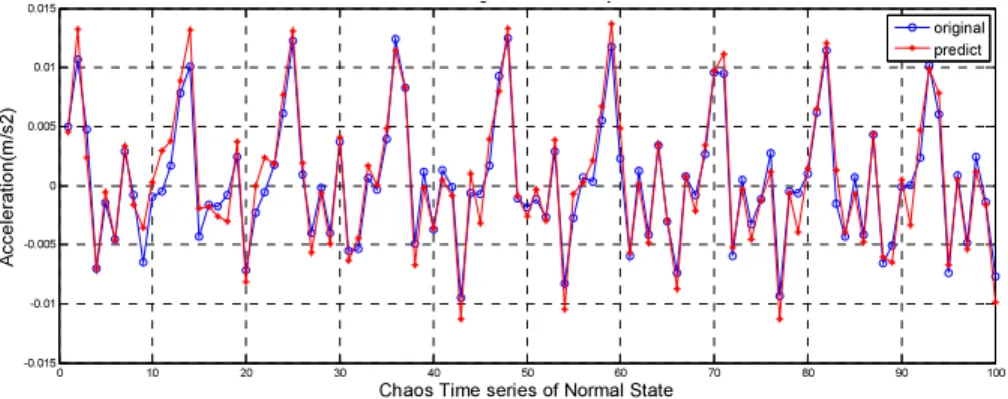
In this case, 200 points of time series data from normal state were used. The first 100 samples were employed for training of SVMs, and the last 100 samples for testing and determination of the threshold of fault diagnosis. The number of input nodes of SVM was 6. After training and testing, prediction model of normal state can be determined. Figure 2 shows the result using one-step iterative prediction based IG-SVM.
0 10 20 30 40 50 60 70 80 90 100 -0.015 -0.01 -0.005 0 0.005 0.01 0.015
Chaos Time series of Normal State
Ac c e ler at io n(m /s 2 )
Train Set Regression Predict by PSVM
original predict
Figure 2. One-step iterative predicted result of data from normal state.
3.1.Residual error of normal state
With the residual error generator, the residual error of normal data can be gained. As aforementioned eval
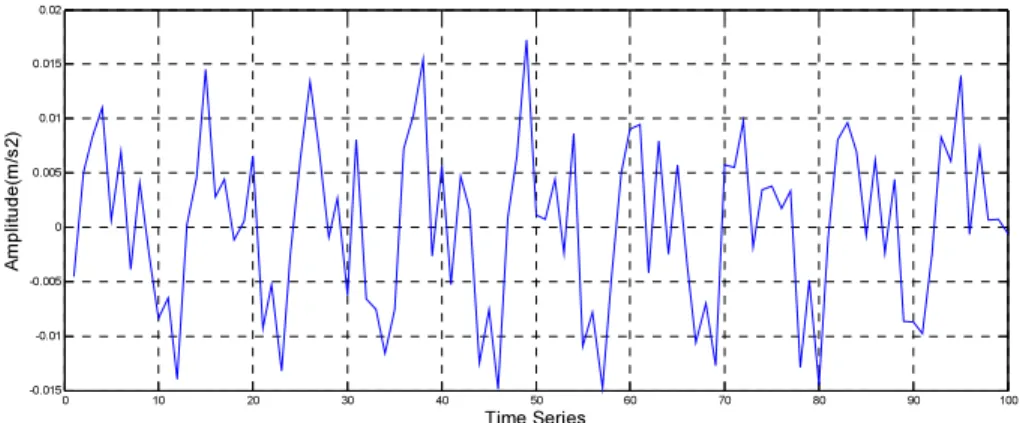
r the mean absolute value of residual error will be used for fault clustering. Figure 3 shows the absolute value of residual error of normal state.
0 10 20 30 40 50 60 70 80 90 100 0 0.005 0.01 0.015 0.02 0.025 0.03 Time Series A mp li tu de (m /s 2 )
Figure 3. Absolute value of residual error of normal state.
3.2.Residual error of wear fault between swash plate and slipper
Here, 100 points of time series data from the vibration signal with wear fault between swash plate and slipper were used via the residual error generator. Figure 4 shows the absolute value of residual error of wear fault between swash plate and slipper.
0 10 20 30 40 50 60 70 80 90 100 -0.015 -0.01 -0.005 0 0.005 0.01 0.015 0.02 Time Series A m p li tu d e (m /s 2 )
Figure 4. Absolute value of residual error of wear fault between swash plate and slipper.
3.3.Residual error of wear fault of valve plate
100 points of time series data from the vibration signal of hydraulic pump with wear fault of valve plate were used for fault detection. Figure 5 shows the absolute value of residual error.
0 10 20 30 40 50 60 70 80 90 100 0 0.005 0.01 0.015 0.02 0.025 0.03 0.035 Time Series A m p li tu d e (m /s 2 )
Figure 5. Absolute value of residual error of wear fault of valve plate. 3.3.1.Discussion
As aforementioned, with the residual error generator based on IG-SVM, the residual error series were calculated respectively. The results show a 100% success rate in correct detection and isolation of hydraulic pump faults. This implies that the IG-SVM residual error generator can diagnose faults of hydraulic pump successfully.
4.Conclusion
The strong nonlinearity features in the vibration signals of hydraulic pump bring difficulties for fault diagnosis. In this paper, a method based on IG-SVM is presented to solve this problem. The IG-SVM improves the performance of SVM in a data-dependent way. This advantage is utilized to construct a residual error generator for fault diagnosis. Additional works are needed to further validate the method in wider applications. Meanwhile, how to determine the number of input nodes of SVM is also an issue that should be recognized.
Acknowledgments
This research was supported by the National Natural Science Foundation of China (Grant No. 61074083, 50705005 and 51105019), the Technology Foundation Program of National Defense (Grant No. Z132010B004), as well as the Innovation Foundation of BUAA for PhD Graduates.
References
[1] Xiaoming H 2012 Study on fault diagnosis of hydraulic pump based on sphere-structured support vector machines 2012 2nd International Conference on Consumer Electronics,
Communications and Networks (CECNet) 2894–96
[2] Shields D N and Damy S 1998 A quantitative fault detection method for a class of nonlinear systems, Transactions of the Institute of Measurement and Control 20 125–33
[3] Jun D and Shaoping W 2010 Hiberarchy clustering fault diagnosis of hydraulic pump
Prognostics and Health Management Conference, 2010 PHM '10 1–07
[4] Xiliang L, Guiming C, Fangxi L, Qian Z and Zhenqi D 2012 Fault diagnosis for gear pump based on feature fusion of vibration signal 2012 International Conference on Quality,
Reliability, Risk, Maintenance, and Safety Engineering (ICQR2MSE) 709–12
[5] Xiaochuang T, Zili W, Jian M and Huanzhen F 2012 Study on fault detection using wavelet packet and SOM neural network 2012 IEEE Conference on Prognostics and System Health
Management (PHM) 1–5
[6] Lu C, Ma N and Wang Z 2011 Fault detection for hydraulic pump based on chaotic parallel RBF network EURASIP Journal on Advances in Signal Processing 2011 1
[7] Wu S, Jiang W, Meng Y and Zhang S 2011 Kernel principal component analysis fault diagnosis method based on sound signal processing and its application in hydraulic pump 2011
International Conference onFluid Power and Mechatronics (FPM) 98–101
[8] Xiaoming H 2012 The fault diagnosis of hydraulic pump based on the data fusion of D-S evidence theory 2012 2nd International Conference on Consumer Electronics,
Communications and Networks (CECNet) 2982–84
[9] Amari S and Wu S 1999 Information-geometrical method for improving the performance of support vector machine classifiers Edinburgh UK 85–90
[10] Vatankhah M, Asadpour V and Fazel-Rezai R Perceptual pain classification using ANFIS adapted RBF kernel support vector machine for therapeutic usage Applied Soft Computing
[11] Azadeh A, Saberi M, Kazem A, Ebrahimipour V, Nourmohammadzadeh A and Saberi Z 2013 A flexible algorithm for fault diagnosis in a centrifugal pump with corrupted data and noise based on ANN and support vector machine with hyper-parameters optimization Applied Soft
Computing 13 1478–85
[12] Daoud E A and Turabieh H 2013 New empirical nonparametric kernels for support vector machine classification Applied Soft Computing 13 1759–65
[13] Wu S and Amari S 2002 Conformal transformation of kernel functions: A data-dependent way to improve support vector machine classifiers Neural Processing Letters 15, 59–67
[14] Amari S and Wu S 1999 Improving support vector machine classifiers by modifying kernel functions Neural Networks 12 783–89