Original Article
Impact of gene
polymorphisms located near ADAM17
and additional SNP-SNP interaction on ovarian
cancer risk in Chinese women
Xiaowu Xu, Haiyan Lin, Jinti Yang
Department of Obstetrics and Gynecology, The Fifth Affiliated Hospital, Southern Medical University, Guangzhou, Guangdong, China
Received September 27, 2017; Accepted May 3, 2018; Epub September 15, 2018; Published September 30, 2018
Abstract:Objectives: The aim of this study was to investigate the impact of single nucleotide polymorphisms (SNPs) located near A disintegrin and metalloproteinase 17 (ADAM17) and additional SNP-SNP interaction on ovarian can-cer (OC) risk. Methods: Four SNPs were detected by Taqman fluorescence probe, and ABI Prism 7000 software and
allelic discrimination procedure was used for genotyping. Generalized multifactor dimensionality reduction (GMDR) model and logistic regression model was used to examine the SNP-SNP interaction on OC risk, odds ratio (OR) and
95% confident interval (95% CI) were calculated. Results: OC risk was higher in carriers of the rs11684747-G allele than those with AA genotype (AG + GG versus AA), adjusted OR (95% CI)=1.63 (1.29-2.19), and higher in carriers of the rs12692386-G allele than those with AA genotype (AG + GG versus AA), adjusted OR (95% CI)=1.72 (1.46
- 2.08). However, we did not find any significant association between rs1524668 and rs11689958 and OC risk before or after covariates adjustment. GMDR analysis indicated a significant two-locus model (p=0.0107) involving
rs11684747 and rs12692386. Subjects with rs11684747-AG or GG and rs12692386-AG or GG genotype have the highest OC risk, compared to subjects with rs11684747-AA and rs12692386-AA genotype, OR (95% CI)=2.78 (1.79 - 3.98). Conclusions: rs11684747 and rs12692386 and additional combined effect of rs11684747-rs12692386 interaction were associated with increased OC risk.
Keywords: ADAM17, ovarian cancer, single nucleotide polymorphism, interaction
Introduction
Ovarian cancer (OC) is the third most com- mon gynecological cancer but the most lethal gynecological malignancy worldwide [1, 2]. Generally, higher incidence was observed in developed counties such as Northern Euro- pe (11.3/100,000) and Northern America (10.7/100,000), while China (3.2/100,000) has been found with the lower incidence [3]. But in recent years, the incidence of ovarian cancer in China showed an upward trend [4]. Previous epidemiologic studies have demonstrated sev-eral risk factors of EOC, such as nulliparity, obesity, early menarche and late menopause, as well as a strong familial aggregation [5, 6] with a wide inter-individual genetic variability in the susceptibility of OC. Previously published genome-wide association studies (GWASs) al- so reported several single nucleotide
polymor-phisms (SNPs) that confer low-penetrance sus-ceptibility to EOC [7-9].
addition, OC was determined by many types of genes and different SNPs, so it is necessary to investigate the impact of SNP-SNP interaction on OC risk. So the aim of current study was to investigate the impact of four SNPs of ADAM17 and additional SNP-SNP interaction on OC sus-ceptibility in Chinese women.
Materials and methods
Subjects
Chinese OC patients were consecutively rec- ruited from the No. 5 Affiliated Hospital of Southern Medical University between January 2008 and September 2014. All patients were diagnosed and graded according to the crite- ria of the International Federation of Gyna- ecology and Obstetrics (FIGO) [17]. The ovarian tissue samples (cancerous and non-cancerous) were fixed routinely in formaldehyde, embed-ded in paraffin, cut into thin slices and stained with hematoxyline/eosin for pathological exam-ination. The normal controls were selected from community volunteers, with the selection criteria of no individual family history of cancer, as well as frequency-matched age (± 5 years) and residential areas to the EOC cases, in addi-tion without any type of cancer, including OC. At last, a total of 822 females were included in this study, including 410 OC patients and 412 normal controls. The mean age of all subjects was 62.2 ± 14.5 years old. The selected sub-jects were similar to those who were not select-ed in terms of age, smoking status, alcohol consumption, number of pregnancies, use of hormone replacement therapy, excision of uterus and tubal ligation. Data on general demographic information, lifestyle information and gynecological diseases for all participants were obtained using a questionnaire
adminis-tered by trained staffs. Body weight, height and waist circumference (WC) was measured, and body mass index (BMI) was calculated as weight in kilograms divided by the square of the height in meters. Cigarette smokers were those who self-reported smoking cigarettes at least once a day for 1 year or more. Alcohol consumption was expressed as the sum of milliliters of alcohol per week from wine, beer, and spirits. Blood samples were collected in the morning after at least 8 hours of fasting. Written informed consent was obtained from all participants. This study was supported by Science and technology project of Guangdong Provincial Administration of traditional Chinese Medicine (20131180).
Genomic DNA extraction and genotyping
[image:2.612.91.524.86.208.2]We selected SNP located near ADAM17 gene according to the following standard, including: 1) more studied SNPs in previous studies, such as rs12692386 and rs1524668, which have been reported to be associated with oth-ers type of cancer [12-14]; and 2) the othoth-ers SNP, which was not reported having associa-tions with OA, but with others diseases, such as ischemic stroke [18], Alzheimer’s disease [19] and sepsis [20], such as rs11684747 and rs11689958, in order to find new SNP associ-ated with OC in Chinese population. At last, four SNPs were selected for genotyping in cur-rent case-control study: rs11684747, rs1269- 2386, rs1524668 and rs11689958. Genomic DNA from participants was extracted from EDTA-treated whole blood, using the DNA Bl- ood Mini Kit (Qiagen, Hilden, Germany) acc- ording to the manufacturer’s instructions. A 25 μL reaction mixture including 1.25 μL SNP Genotyping Assays (20×), 12.5 μL Genotyping Master Mix (2×), 20 ng DNA, and the conditions
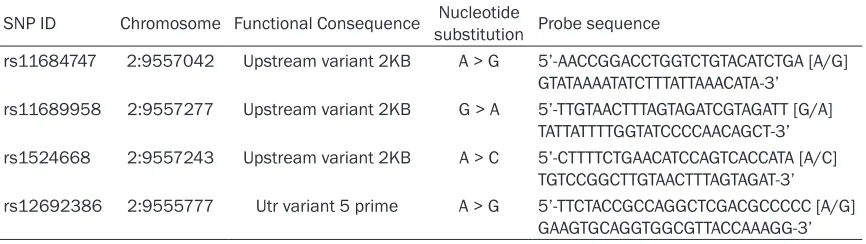
Table 1. Description and Probe sequence for 4 SNPs used for Taqman fluorescence probe analysis
SNP ID Chromosome Functional Consequence Nucleotide substitution Probe sequence
rs11684747 2:9557042 Upstream variant 2KB A > G 5’-AACCGGACCTGGTCTGTACATCTGA [A/G] GTATAAAATATCTTTATTAAACATA-3’
rs11689958 2:9557277 Upstream variant 2KB G > A 5’-TTGTAACTTTAGTAGATCGTAGATT [G/A] TATTATTTTGGTATCCCCAACAGCT-3’ rs1524668 2:9557243 Upstream variant 2KB A > C 5’-CTTTTCTGAACATCCAGTCACCATA [A/C]
TGTCCGGCTTGTAACTTTAGTAGAT-3’ rs12692386 2:9555777 Utr variant 5 prime A > G 5’-TTCTACCGCCAGGCTCGACGCCCCC [A/G]
were as follows: initial denaturation for 10 min at 95°C, denaturation for 15 s at 92°C, anne- aling and extension for 90 s at 60°C for 50 cycles. Four SNPs were detected by Taqman fluorescence probe, and Probe sequences of four SNPs were shown in Table 1. ABI Prism 7000 software and allelic discrimination pro- cedure was used for genotyping of fore-men-tioned four SNPs. Genotyping results were confirmed by randomly assaying 10% of the original specimens for replication to exclude genotyping errors. There were no discrepancies between genotypes determined in duplicate. Statistical analysis
The mean and SD was calculated for normally distributed continuous variables, and t test was used for comparison between cases and nor-mal controls. The percentage was calculated for categorical variable, X2 test was used for
comparison between cases and normal con-trols. Genotype and allele frequencies were obtained by direct count. Genotype distribu-tions in OC patients and controls were evaluat-ed by X2 test using SPSS (version 19.0; SPSS
Inc., Chicago, IL). Hardy-Weinberg equilibrium (HWE) was performed by using SNPStats (avail-able online at http://bioinfo.iconcologia.net/ SNPstats). Logistic regression model was used to examine the association between SNPs located near ADAM17 and OC risk, and the impact of SNP-SNP interaction on OC, odds
testing balanced accuracy, and the sign test, to assess each selected interaction were calcu-lated. The cross-validation consistency score is a measure of the degree of consistency with which the selected interaction is identified as the best model among all possibilities consid-ered. The testing balanced accuracy is a mea-sure of the degree to which the interaction accurately predicts case-control status with scores between 0.50 (indicating that the mo- del predicts no better than chance) and 1.00 (indicating perfect prediction). Finally, a sign test or a permutation test (providing empirical p-values) for prediction accuracy can be used to measure the significance of an identified model.
Results
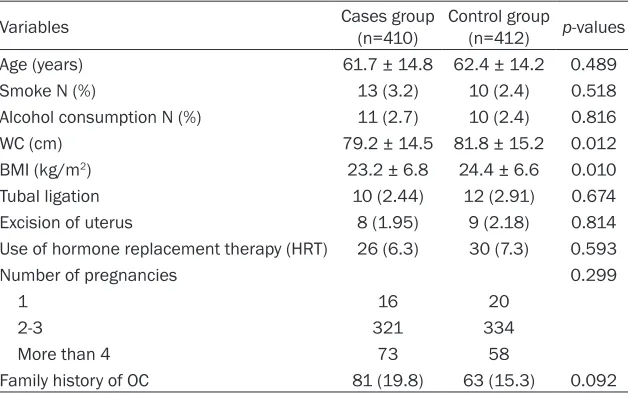
[image:3.612.93.407.96.293.2]A total of 822 participants were included in this study, including 410 OC patients and 412 normal controls. The mean age of all partici-pants was 62.2 ± 14.5 years old. Characteris- tics for cases and controls were shown in
Table 2. The distributions of smoking, alcohol consumption, and number of pregnancies, use of hormone replacement therapy, excision of uterus and tubal ligation and mean of age were not different between cases and controls. The mean of BMI and WC were lower in cases than that in controls.
All genotypes were distributed according to
Table 2. General characteristics of study participants in case and control group
Variables Cases group(n=410) Control group(n=412) p-values
Age (years) 61.7 ± 14.8 62.4 ± 14.2 0.489
Smoke N (%) 13 (3.2) 10 (2.4) 0.518
Alcohol consumption N (%) 11 (2.7) 10 (2.4) 0.816
WC (cm) 79.2 ± 14.5 81.8 ± 15.2 0.012
BMI (kg/m2) 23.2 ± 6.8 24.4 ± 6.6 0.010
Tubal ligation 10 (2.44) 12 (2.91) 0.674
Excision of uterus 8 (1.95) 9 (2.18) 0.814
Use of hormone replacement therapy (HRT) 26 (6.3) 30 (7.3) 0.593
Number of pregnancies 0.299
1 16 20
2-3 321 334
More than 4 73 58
Family history of OC 81 (19.8) 63 (15.3) 0.092
NOTE: Means ± standard deviation for age, WC, BMI. WC, waist circumference; BMI, body
mass index.
were calculated. Od- ds were adjusted for age, smoke and alco-hol consumption st- atus, WC, number of pregnancies, use of hormone replacement therapy, excision of uterus and tubal lig- ation. To correct for multiple testing, we defined a Bonferroni threshold of p=0.05/ C42=0.0083.
Table 3. Association between four SNPs located near ADAM17 and OC risk
SNPs Genotypes and Alleles Frequencies N (%) OR (95% CI)a P-valuesb HWE test for
controls
Case (n=410) Control (n=412) rs11684747
Additive
AA 202 (49.3) 260 (63.1) 1.00 0.000096 0.127
AG 161 (39.3) 128 (31.1) 1.52 (1.26-1.98)c
GG 47 (11.5) 24 (5.8) 2.01 (1.42-2.85)c
Dominant
AA 202 (49.3) 260 (63.1) 1.00
AG + GG 208 (50.7) 152 (36.9) 1.63 (1.29-2.19)c 0.000064
A 565 (68.9) 648 (78.6) 0.000007
G 255 (31.1) 176 (21.4)
rs11689958
Additive
GG 216 (52.7) 236 (57.3) 1.00 0.269 0.190
GA 154 (37.6) 145 (35.2) 1.18 (0.95-1.47)
AA 40 (9.7) 31 (7.5) 1.36 (0.91-1.72)
Dominant
GG 216 (52.7) 236(57.3) 1.00
GA + AA 194 (47.3) 176(42.7) 1.20 (0.94-1.49) 0.198
G 586 (71.5) 617 (74.9) 0.159
A 234 (28.5) 207 (25.1)
rs12692386
Additive
AA 209 (51.0) 263 (63.8) 1.00 0.000448 0.420
AG 164 (40.0) 129 (31.3) 1.42 (1.21-1.85)c
GG 37 (9.0) 20 (4.9) 2.27(1.63-3.14)c
Dominant
AA 209 (51.0) 263 (63.8) 1.00
AG + GG 201 (49.0) 149 (36.2) 1.72 (1.46-2.08)c 0.000193
A 582 (71.0) 655 (79.5) 0.000064
G 238 (29.0) 169 (20.5)
rs1524668
Additive
AA 219 (53.4) 240 (58.2) 1.00 0.420 0.318
AC 158 (38.5) 144 (35.0) 1.14 (0.93-1.47)
CC 33 (8.1) 28 (6.8) 1.26 (0.88-1.62)
Dominant
AA 219 (53.4) 240 (58.2) 1.00
AC + CC 191 (46.6) 172 (41.8) 1.18 (0.91-1.50) 0.287
A 596 (72.7) 624 (75.7) 0.183
C 224 (27.3) 200 (24.3)
aAdjusted for age, smoke and alcohol consumption status, WC, number of pregnancies, use of hormone replacement therapy,
excision of uterus and tubal ligation; bthe comparison of the genotype/allele between case and control group; P-values less
than 0.05 were considered statistically significant; cp<0.0125 (Bonferroni correction threshold).
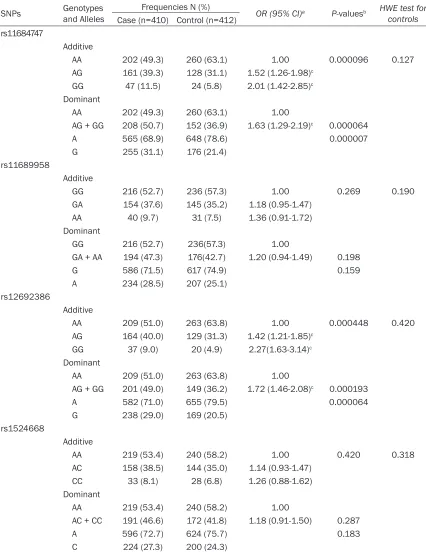
more than 0.05). There were significant
allele of rs11684747 was higher in cases (31.1% in OC patients and 21.4% in controls, p=0.000007). Logistic analysis showed that the OC risk was higher in carriers of the rs11684747-G allele than those with AA geno-type (AG + GG versus AA), adjusted OR (95% CI)=1.63 (1.29 - 2.19). The frequency for the G allele of rs12692386 was higher in cases (29.0% in OC patients and 20.5% in controls, p=0.000064. Logistic analysis showed that the OC risk was higher in carriers of the rs12692386-G allele than those with AA ge- notype (AG + GG versus AA), adjusted OR (95% CI)=1.72 (1.46 - 2.08). However, we did not find any significant association between other two SNPs and OC risk before or after covariates adjustment for age, smoke and alcohol con-sumption status, WC, number of pregnancies, use of hormone replacement therapy, excision of uterus and tubal ligation.
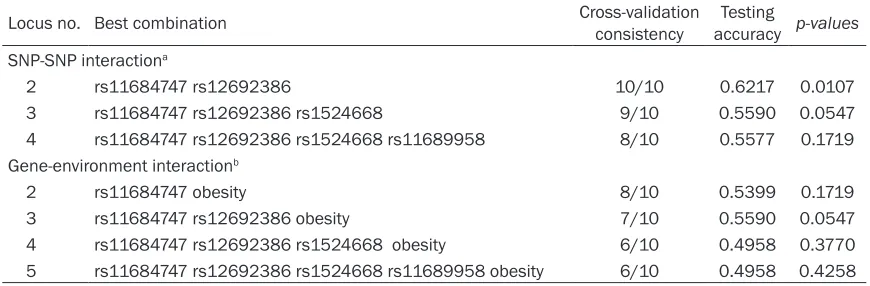
[image:5.612.89.524.86.229.2]GMDR analysis was used to assess the impact of the ADAM17 SNP-SNP interaction on OC risk.
Table 4 summarizes the results obtained from
rs11684747-AG or GG and rs12692386-AG or GG genotype have the highest OC risk, com-pared to subjects with rs11684747-AA and rs12692386-AA genotype, OR (95% CI)=2.78 (1.79 - 3.98), after adjustment for age, smoke and alcohol consumption status, WC, number of pregnancies, use of hormone replacement therapy, excision of uterus and tubal ligation (Table 5).
Discussion
The result of this study indicated that the OC risk was higher in carriers of the rs11684747-G allele than those with AA genotype (AG + GG versus AA). The OC risk was also higher in ca- rriers of the rs12692386-G allele than those with AA genotype (AG + GG versus AA). How- ever, we did not find any significant association between other two SNPs and OC risk before or after covariates adjustment for age, smoke and alcohol consumption status, WC, number of pregnancies, use of hormone replacement therapy, excision of uterus and tubal ligation.
Table 4. Best combination on SNP-SNP interaction by using GMDR analysis
Locus no. Best combination Cross-validation consistency accuracyTesting p-values
SNP-SNP interactiona
2 rs11684747 rs12692386 10/10 0.6217 0.0107
3 rs11684747 rs12692386 rs1524668 9/10 0.5590 0.0547
4 rs11684747 rs12692386 rs1524668 rs11689958 8/10 0.5577 0.1719
Gene-environment interactionb
2 rs11684747 obesity 8/10 0.5399 0.1719
3 rs11684747 rs12692386 obesity 7/10 0.5590 0.0547
4 rs11684747 rs12692386 rs1524668 obesity 6/10 0.4958 0.3770
5 rs11684747 rs12692386 rs1524668 rs11689958 obesity 6/10 0.4958 0.4258
aAdjusted for age, smoke and alcohol consumption status, WC, number of pregnancies, use of hormone replacement therapy,
excision of uterus and tubal ligation. bAdjusted for age, smoke and alcohol consumption status, number of pregnancies, use of
[image:5.612.89.326.305.377.2]hormone replacement therapy, excision of uterus and tubal ligation.
Table 5. Interaction analysis for rs11684747 and rs12692386 on OC risk by using logistic regression
rs11684747 rs12692386 OR (95% CI)a P-values
AA AA 1.00
-AG or GG AA 1.31 (1.12-1.67)b 0.001
AA AG or GG 1.52 (1.23-1.92)b 0.00012
AG or GG AG or GG 2.78 (1.79-3.98)b 0.00006
aAdjusted for age, smoke and alcohol consumption status, WC,
number of pregnancies, use of hormone replacement therapy, exci-sion of uterus and tubal ligation; bp<0.0125 (Bonferroni correction
threshold).
GMDR analysis for two- to four-locus models. We found a significant two- locus model (p=0.0107) involving rs- 11684747 and rs12692386. The cross-validation consistency of two-locus mod-els is 10/10, and the testing accuracy is 62.17%. Because BMI was different between cases and controls, so we also included obesity (BMI more than 24 kg/ m2), but we did not find any significant
The ADAMs was a family of multidomain pro-teins, which play important role in both prote-olysis and cell adhesion [22, 23]. The best established role for ADAMs is the activation of the proforms of certain growth factors and cytokines as well as the shedding of the ex- tracellular domains of growth factor receptors and adhesion proteins. Previously, several studies focused on the association between ADAM17 gene polymorphism and others dis-eases have been conducted previously [12-14]. However, till now, no study reported the asso-ciation between ADAM17 polymorphism and OC, and to the best of our knowledge, this is the first study that has identified ADAM17 polymorphism to be associated with an in- creased OC risk. ADAM17 is up-regulated in tumor and could therefore conceivably contrib-ute to tumorigenesis, particularly if aberrant activity amplifies shedding of EGFR ligands with known roles in cancer, such as TGF-α, HB-EGF, and amphiregulin [24]. An increased expression of individual ADAM family me- mbers in various types of cancer has been described even though in several cases the precise cellular expression pattern and the relevance for tumor progression is not clear. However, increased mRNA or protein expres-sion of ADAM17 was shown in several different tumour tissues, including ovary [25]. Rosso et al. [26] conducted a study and indicated that the ADAM17/TACE molecule was expressed in EOC cell lines and ADAM17/TACE silencing by specific small interfering RNA-reduced AL- CAM shedding, so ADAM17/TACE takes part in ALCAM-mediated adhesion, which may be relevant to EOC invasive potential and relevant step in EOC motility.
The pathogenesis of OC is diverse, and OC is associated with several genetic factors, and the synergistic effect among many related genetic factors, and was determined by many SNPs in ADAM17 gene, so it is necessary to investigate the impact of SNP-SNP interaction on OC risk. Current study investigates this in- teraction on OC susceptibility in Chinese wo- men by using GMDR model. To our knowled- ge, this is the first study involved in SNP-SNP interaction in ADAM17 gene. We found a signi- ficant two-locus model (p=0.0107) involving rs11684747 and rs12692386, and subjects with rs11684747-AG or GG and rs12692386-AG or GG genotype have the highest OC risk,
compared to subjects with rs11684747-AA and rs12692386-AA genotype. The underlying mechanism for impact of this SNP-SNP in- teraction on OC risk was not well known. Ya- mashita et al. [27] suggested that activation of TACE/ADAM17 via a PKC-induced c-Src-de- pendent manner mediates proteolytic activa-tion of the EGF-like factors that are involved in the induction of granulosa cell differentia-tion, cumulus expansion, and meiotic matura-tion of porcine oocytes in vitro. ADAM17 (also known as TNF-α converting enzyme or TACE) is the major sheddase for TNF-α, amphiregulin, HB-EGF and epiregulin [28, 29]. Given the in- volvement of the EGFR in the development of tumors of epithelial origin and the importance of ADAM17 in its control, several studies have focused on this ADAM protein. For example, ADAM17 overexpression was found in many types cancer, including OC [20]. Overexpres- sion of ADAM17 increases invasion and prolif-eration of MCF-7 (human breast adenocar- cinoma cell line) cells, whereas down-regulation of ADAM17 expression decreases invasion and proliferation of MDA-MB-435 (a melanoma cell line) cells.
Several limitations of this study should be considered. Firstly, More SNPs located near ADAM17 should been included in the study, not only locate near in ADAM17, but also in other ADAM family, this association should be ch- ecked in different nationality, especially in eth-nic minority of China, and gene-environment interaction should be conducted in the future studies. Secondly, although the number of study participants met the requirement for analysis, the present sample size was relative- ly small. Thirdly, we did not obtain the informa-tion on survival, so we could not analyze the influence of survival bias on the results in this study.
rs11684747-AA and rs12692386-AA genoty- pe.
Acknowledgements
This study was supported by Science and te- chnology project of Guangdong Provincial Administration of traditional Chinese Medi- cine (20131180). We thank all the partners and staffs who help us in the process of this study.
Disclosure of conflict of interest
None.
Address correspondence to: Xiaowu Xu, Depart- ment of Obstetrics and Gynecology, The Fifth
Affiliated Hospital, Southern Medical University, 566
Guangzhou Avenue, Conghua District, Guangzhou 510900, Guangdong, China. Tel: +86-13902320- 793; E-mail: [email protected]
References
[1] Schüler S, Lattrich C, Skrzypczak M, Fehm T, Ortmann O, Treeck O. Icb-1 gene polymor-phism rs1467465 is associated with suscepti-bility to ovarian cancer. J Ovarian Res 2014; 7: 42.
[2] Du JZ, Dong YL, Wan GX, Tao L, Lu LX, Li F, Pang LJ, Jia W. Lack of association between the COMT rs4680 polymorphism and ovarian cancer risk: evidence from a meta-analysis of 3,940 individuals. Asian Pac J Cancer Prev 2014; 15: 7941-7945.
[3] Wang B, Liu SZ, Zheng RS, Zhang F, Chen WQ, Sun XB. Time trends of ovarian cancer inci -dence in China. Asian Pac J Cancer Prev 2014; 15: 191-3.
[4] Wong KH, Mang OW, Au KH, Law SC. Incidence, mortality, and survival trends of ovarian can-cer in Hong Kong, 1997 to 2006: a population-based study. Hong Kong Med J 2012; 18: 466-74.
[5] Lichtenstein P, Holm NV, Verkasalo PK, Iliadou A, Kaprio J, Koskenvuo M, Pukkala E, Skytthe A, Hemminki K. Environmental and heritable factors in the causation of cancer-analyses of cohorts of twins from Sweden, Denmark, and Finland. N Engl J Med 2000; 343: 78-85. [6] World Cancer Report 2014: World Health
Orga-nization. 2014. pp. Chapter 5. 12.
[7] Song H, Ramus SJ, Tyrer J, Bolton KL,
Gentry-Maharaj A, Wozniak E, Anton-Culver H, Chang-Claude J, Cramer DW, DiCioccio R, Dörk T, Goode EL, Goodman MT, Schildkraut JM,
Sell-ers T, Baglietto L, Beckmann MW, Beesley J,
Blaakaer J, Carney ME, Chanock S, Chen Z,
Cunningham JM, Dicks E, Doherty JA, Dürst M,
Ekici AB, Fenstermacher D, Fridley BL, Giles G,
Gore ME, De Vivo I, Hillemanns P, Hogdall C, Hogdall E, Iversen ES, Jacobs IJ, Jakubowska
A, Li D, Lissowska J, Lubiński J, Lurie G, Mc -Guire V, McLaughlin J, Medrek K, Moorman PG, Moysich K, Narod S, Phelan C, Pye C, Risch
H, Runnebaum IB, Severi G, Southey M, Stram
DO, Thiel FC, Terry KL, Tsai YY, Tworoger SS,
Van Den Berg DJ, Vierkant RA, Wang-Gohrke S, Webb PM, Wilkens LR, Wu AH, Yang H, Brews -ter W, Ziogas A; Australian Cancer (Ovarian) Study; Australian Ovarian Cancer Study Group; Ovarian Cancer Association Consortium, Hou- lston R, Tomlinson I, Whittemore AS, Rossing
MA, Ponder BA, Pearce CL, Ness RB, Menon U,
Kjaer SK, Gronwald J, Garcia-Closas M,
Fasch-ing PA, Easton DF, Chenevix-Trench G, Ber -chuck A, Pharoah PD, Gayther SA. A
genome-wide association study identifies a new ovarian
cancer susceptibility locus on 9p22.2. Nat Genet 2009; 41: 996-1000.
[8] Goode EL, Chenevix-Trench G, Song H, Ramus SJ, Notaridou M, Lawrenson K, Widschwendter
M, Vierkant RA, Larson MC, Kjaer SK, Birrer MJ, Berchuck A, Schildkraut J, Tomlinson I,
Kiemeney LA, Cook LS, Gronwald J, Garcia-Closas M, Gore ME, Campbell I, Whittemore AS, Sutphen R, Phelan C, Anton-Culver H, Pearce CL, Lambrechts D, Rossing MA,
Chang-Claude J, Moysich KB, Goodman MT, Dörk T, Nevanlinna H, Ness RB, Rafnar T, Hogdall C, Hogdall E, Fridley BL, Cunningham JM, Sieh W,
McGuire V, Godwin AK, Cramer DW, Hernandez D, Levine D, Lu K, Iversen ES, Palmieri RT, Houlston R, van Altena AM, Aben KK,
Massug-er LF, Brooks-Wilson A, Kelemen LE, Le ND,
Jakubowska A, Lubinski J, Medrek K, Stafford
A, Easton DF, Tyrer J, Bolton KL, Harrington P, Eccles D, Chen A, Molina AN, Davila BN, Aran -go H, Tsai YY, Chen Z, Risch HA, McLaughlin J,
Narod SA, Ziogas A, Brewster W, Gentry-Maha -raj A, Menon U, Wu AH, Stram DO, Pike MC;
Wellcome Trust Case-Control Consortium, Bee -sley J, Webb PM; Australian Cancer Study (Ovarian Cancer); Australian Ovarian Cancer Study Group; Ovarian Cancer Association
Con-sortium (OCAC), Chen X, Ekici AB, Thiel FC, Beckmann MW, Yang H, Wentzensen N, Lis -sowska J, Fasching PA, Despierre E, Amant F, Vergote I, Doherty J, Hein R, Wang-Gohrke S, Lurie G, Carney ME, Thompson PJ, Runnebaum
I, Hillemanns P, Dürst M, Antonenkova N, Bog
-danova N, Leminen A, Butzow R, Heikkinen T, Stefansson K, Sulem P, Besenbacher S, Sell -ers TA, Gayther SA, Pharoah PD; Ovarian Can-cer Association Consortium (OCAC). A
loci for ovarian cancer at 2q31 and 8q24. Nat Genet 2010; 42: 874-9.
[9] Bolton KL, Tyrer J, Song H, Ramus SJ, Notari -dou M, Jones C, Sher T, Gentry-Maharaj A, Wozniak E, Tsai YY, Weidhaas J, Paik D, Van
Den Berg DJ, Stram DO, Pearce CL, Wu AH, Brewster W, Anton-Culver H, Ziogas A, Narod SA, Levine DA, Kaye SB, Brown R, Paul J, Flana -gan J, Sieh W, McGuire V, Whittemore AS, Campbell I, Gore ME, Lissowska J, Yang HP, Medrek K, Gronwald J, Lubinski J, Jakubowska
A, Le ND, Cook LS, Kelemen LE, Brooks-Wilson
A, Massuger LF, Kiemeney LA, Aben KK, van Altena AM, Houlston R, Tomlinson I, Palmieri RT, Moorman PG, Schildkraut J, Iversen ES, Phelan C, Vierkant RA, Cunningham JM, Goode
EL, Fridley BL, Kruger-Kjaer S, Blaeker J, Hog
-dall E, Hog-dall C, Gross J, Karlan BY, Ness RB, Edwards RP, Odunsi K, Moyisch KB, Baker JA, Modugno F, Heikkinenen T, Butzow R, Nevan
-linna H, Leminen A, Bogdanova N, Antonenko -va N, Doerk T, Hillemanns P, Dürst M, Run-nebaum I, Thompson PJ, Carney ME, Goodman MT, Lurie G, Wang-Gohrke S, Hein R, Chang-Claude J, Rossing MA, Cushing-Haugen KL,
Doherty J, Chen C, Rafnar T, Besenbacher S, Sulem P, Stefansson K, Birrer MJ, Terry KL,
Hernandez D, Cramer DW, Vergote I, Amant F,
Lambrechts D, Despierre E, Fasching PA, Beck
-mann MW, Thiel FC, Ekici AB, Chen X; Austra -lian ovarian cancer Study Group; Austra-lian Cancer Study (ovarian cancer); ovarian cancer Association Consortium, Johnatty SE, Webb
PM, Beesley J, Chanock S, Garcia-Closas M, Sellers T, Easton DF, Berchuck A,
Chenevix-Trench G, Pharoah PD, Gayther SA. Common variants at 19p13 are associated with suscep-tibility to ovarian cancer. Nat Genet 2010; 42: 880-4.
[10] Sahin U, Weskamp G, Kelly K, Zhou HM, Hi-gashiyama S, Peschon J, Hartmann D, Saftig P,
Blobel CP. Distinct roles for ADAM10 and
ADAM17 in ectodomain shedding of six EGFR
ligands. J Cell Biol 2004; 164: 769-79.
[11] Ringel J, Jesnowski R, Moniaux N, Lüttges J,
Ringel J, Choudhury A, Batra SK, Klöppel G,
Löhr M. Aberrant expression of a disintegrin and metalloproteinase 17/tumor necrosis factor-alpha converting enzyme increases the malignant potential in human pancreatic duc-tal adenocarcinoma. Cancer Res 2006; 66: 9045-53.
[12] Kodama T, Ikeda E, Okada A, Ohtsuka T, Shimoda M, Shiomi T, Yoshida K, Nakada M, Ohuchi E, Okada Y. ADAM12 is selectively over-expressed in human glioblastomas and is as-sociated with glioblastoma cell proliferation and shedding of heparin-binding epidermal growth factor. Am J Pathol 2004; 165: 1743-53.
[13] Blanchot-Jossic F, Jarry A, Masson D,
Bach-Ngohou K, Paineau J, Denis MG, Laboisse CL, Mosnier JF. Up-regulated expression of ADAM17 in human colon carcinoma: co-ex-pression with EGFR in neoplastic and endothe-lial cells. J Pathol 2005; 207: 156-63.
[14] Hart S, Fischer OM, Ullrich A. Cannabinoids induce cancer cell proliferation via tumor ne-crosis factor alpha-converting enzyme (TACE/ ADAM17)-mediated transactivation of the epi-dermal growth factor receptor. Cancer Res 2004; 64: 1943-50.
[15] Duffy MJ, McKiernan E, O’Donovan N, Mc-Gowan P. Role of ADAMs in cancer formation and progression. Clin Cancer Res 2007; 13: 2335-2343.
[16] Duffy MJ, McKiernan E, O’Donovan N, Mc-Gowan P. The role of ADAMs in disease patho-physiology. Clin Chim Acta 2009; 403: 31-36. [17] Report Meeting. The new FIGO staging system
for cancers of the vulva, cervix, endometrium and sarcomas. Gynecol Oncol 2009; 115: 325-8.
[18] Li Y, Cui LL, Li QQ, Ma GD, Cai YJ, Chen YY, Gu
XF, Zhao B, Li KS. Association between
ADAM17 promoter polymorphisms and isch-emic stroke in a Chinese population. J Athero-scler Thromb 2014; 21: 878-93.
[19] Wang M, Li Y, Lu Y, Zuo X, Wang F, Zhang Z, Jia J. The relationship between ADAM17 promoter polymorphisms and sporadic Alzheimer’s dis-ease in a northern Chinese Han population. J Clin Neurosci 2010; 17: 1276-9.
[20] Shao Y, He J, Chen F, Cai Y, Zhao J, Lin Y, Yin Z, Tao H, Shao X, Huang P, Yin M, Zhang W, Liu Z, Cui L. Association study between promoter polymorphisms of ADAM17 and progression of
sepsis. Cell Physiol Biochem 2016; 39:
1247-61.
[21] Lou XY, Chen GB, Yan L, Ma JZ, Zhu J, Elston
RC, Li MD. A generalized combinatorial ap-proach for detecting by gene and gene-by-environment interactions with application to nicotine dependence. Am J Hum Genet 2007; 80: 1125-1137.
[22] Murphy G. The ADAMs: Signaling scissors in the tumour microenvironment. Nat Rev Cancer 2008; 8: 929-41.
[23] Blobel CP. ADAMS: key components in EGFR
signalling and development. Nature Rev Can-cer 2005; 6: 32-43
[24] Ongusaha PP, Kwak JC, Zwible AJ, Macip S,
Hi-gashiyama S, Taniguchi N, Fang L, Lee SW.
HB-EGF is a potent inducer of tumor growth and angiogenesis. Cancer Res 2004; 64: 5283-90. [25] Tanaka Y, Miyamoto S, Suzuki SO, Oki E, Yagi
H, Sonoda K, Yamazaki A, Mizushima H, Maehara Y, Mekada E, Nakano H. Clinical
significance of heparin-binding epidermal
disinteg-rin and metalloprotease 17 expression in hu-man ovarian cancer. Clin Cancer Res 2005; 11: 4783-92
[26] Rosso O, Piazza T, Bongarzone I, Rossello A,
Mezzanzanica D, Canevari S, Orengo AM, Pup-po A, Ferrini S, Fabbi M. The ALCAM shedding by the metalloprotease ADAM17/TACE is in-volved in motility of ovarian carcinoma cells. Mol Cancer Res 2007; 5: 1246-53.
[27] Yamashita Y, Okamoto M, Ikeda M, Okamoto A, Sakai M, Gunji Y, Nishimura R, Hishinuma M, Shimada M. Protein kinase C (PKC) increases TACE/ADAM17 enzyme activity in porcine ovar-ian somatic cells, which is essential for granu-losa cell luteinization and oocyte maturation. Endocrinology 2014; 155: 1080-90.
[28] Kawaguchi N, Horiuchi K, Becherer JD, Toya-ma Y, Besmer P, Blobel CP. Different ADAMs have distinct influences on Kit ligand
proce-ssing: phorbol-ester-stimulated ectodomain shedding of Kitl1 by ADAM17 is reduced by ADAM19. J Cell Sci 2007; 120: 943-952 [29] Horiuchi K, Le Gall S, Schulte M, Yamaguchi T,
Reiss K, Murphy G, Toyama Y, Hartmann D,
Saftig P, Blobel CP. Substrate selectivity of
epidermal growth factor-receptor ligand shed-dases and their regulation by phorbol esters
and calcium influx. Mol Biol Cell 2007; 18: