Context and Learning in Novelty Detection
Barry Schiffman and Kathleen R. McKeown Department of Computer Science
Columbia University New York, N.Y.
{bschiff,kathy}@cs.columbia.edu
Abstract
We demonstrate the value of using con-text in a new-information detection sys-tem that achieved the highest precision scores at the Text Retrieval Conference’s Novelty Track in 2004. In order to de-termine whether information within a sen-tence has been seen in material read pre-viously, our system integrates information about the context of the sentence with novel words and named entities within the sentence, and uses a specialized learning algorithm to tune the system parameters.
1 Introduction
New-information detection addresses two important problems in a society awash in more digital infor-mation than people can exploit. A novelty detection system could help people who are tracking an event in the news, where numerous sources present simi-lar material. It could also provide a way to organize summaries by focusing on the most recent informa-tion, much like an automated bulletin service.
We envision that many types of users would find such a system valuable. Certainly analysts, busi-ness people, and anyone interested in current events, would benefit from being able to track news stories automatically, without repetition. Different news or-ganizations report on the same event, often working hard to make their reports look different from one another, whether or not they have new material to report. Our system would help readers to zero in
on new information. In addition, a focus on new information provides a way of organizing a general summary.
Our approach is unique in representing and main-taining the focus in discourse. The idea stems from the fact that novelty often comes in bursts, which is not surprising since the articles are composed of some number of smaller, coherent segments. Each segment is started by some kind of introductory pas-sage, and that is where we expect to find the novel words. Novel words are identified by comparing the current sentence’s words against a table of all words seen in the inputs to that point. They let us know whether the entire segment is likely to con-tain more novel material. Subsequent passages are likely to continue the novel discussion whether or not they contain novel words. They may contain pronomial references or other anaphoric references to the novel entity. Our long-term goal is to inte-grate the approach described in this paper into our larger new-information detector, a system that per-forms a more complicated syntactic analysis of the input texts and employs machine learning to classify passages as new or old.
Meanwhile, we tested our focus-based approach at the Novelty Track at the Text Retrieval Confer-ence (TREC) in 2004. The Novelty Tracks in 2003 and in 2004 were divided into four tasks; Task 1 and Task 3 incorporate retrieval, requiring submis-sions to locate the relevant sentences before filter-ing them for novelty. Tasks 2 and 4 are novelty de-tection alone, using the relevant sentences selected by humans as input. Since our interest is in
elty detection, we chose to concentrate on Task 21 Our TREC submission was also designed to test a specialized learning mechanism we implemented to target either high precision or high recall.
In all, the problem of novelty detection is decep-tively difficult. We were struck by the difficulty that all groups in the Novelty Track in 2002 and 2003 had in obtaining high precision scores. Submissions that classify a very large proportion of the input sentences as novel reached the highest F-measure scores by getting high recall scores, but failed to achieve any substantial compression of material for users. Given that our goal is to generate an up-date summary, we focused on improving precision and increasing compression, removing as many false positives as possible.
The next section discusses the Novelty Track and the approaches others have tried; Section 3 details our system, and Section 4 presents the experiments.
2 Novelty Track
Much of the work in new-information detection has been done for the TREC Novelty Track. The task is related to first story detection, which is defined on whole documents rather than on passages within documents. In Task 1 of the Novelty Track, a system is given about 25 documents on a topic and asked to find all sentences relevant to the topic. In Task 2, the inputs are the set of relevant sentences, so that the program does not see the entire documents. The program must scan the sentences in order and output all that contain new information, that is information not seen in the previous input sentences.
2.1 Related Work
At the recent TREC, Dublin City University did well by comparing the words in a sentence against the accumulated words in all previous sentences (Blott et al., 2004). Their runs varied the way in which the words were weighted with frequency and inverse document frequency. Like our system, theirs follows from the intuition that words that are new to a cussion are evidence of novelty. But our system
dis-1
Task 4 was similar to Task 2, in that both have the human annotations as input. For Task 2, participants only get the anno-tations, but in Task 4, they also receive the novel sentences from the first five documents as input. We felt that we would learn as much from the one task as from both.
tinguishes between several kinds of words, includ-ing common nouns, named persons, named organi-zation, etc. Our system also incorporates a mecha-nism for looking at the context of the sentence.
Both the Dublin system and ours are preceded by the University of Iowa’s approach at TREC 2003. It based novelty decisions on a straightforward count of new named entities and noun phrases in a sen-tence (Eichmann et al., 2003). In 2004, the Iowa sys-tem (Eichmann et al., 2004) tried several embellish-ments, one using synonyms in addition to the words for novelty comparisons, and one using word-sense disambiguation. These two runs were above average in F-measure and about average in precision.
The University of Massachusetts system (Abdul-Jaleel et al., 2004) mixed a vector-space model with cosine similarity and a count of previously unseen named entities. Their system resembled one of two baseline methods that we submitted without our fo-cus feature. Their submission used a similarity threshold that was tuned experimentally, while ours was learned automatically. In earlier work with the TREC 2002 data, UMass (Allan et al., 2003) com-pared a number of sentence-based models ranging in complexity from a count of new words and cosine distance, to a variety of sophisticated models based on KL divergence with different smoothing strate-gies and a “core mixture model” that considered the distribution of the words in the sentence with the distributions in a topic model and a general English model.
A number of groups have experimented with matrix-based methods. In 2003, a group from the University of Maryland and the Center for Com-puting Sciences (Conroy et al., 2003) used three techniques that used QR decomposition and sin-gular value decomposition. The University of Maryland, Baltimore County, worked with cluster-ing algorithms and scluster-ingular value decomposition in sentence-sentence similarity matrices (Kallurkar et al., 2003). In 2004, Conroy (Conroy, 2004) tested Maximal Marginal Relevance (Goldstein et al., 2000) as well as QR decomposition.
with sentence-by-sentence comparisons.
2.2 Precision
At all three Novelty Track evaluations, from 2002 to 2004, it is clear that high precision is much harder to obtain than high recall. Trivial baselines – such as accept all sentences as novel – have proved to be difficult to beat by very much. This one-line algo-rithm automatically obtains 100% recall and preci-sion equal to the proportion of novel sentences in the input. In 2003, when 66% of the relevant sen-tences were novel, the mean precision score was 0.6352and the median was 0.7. In 2004, 41% of the relevant sentences were novel, and the average pre-cision dropped to 0.46. The median prepre-cision was also 0.46. Meanwhile, average recall scores across all submissions actually rose to 0.861 in 2004, com-pared with 0.795 in 2003. In terms of a real world system, this means that as the number of target sen-tences shrank, the number of sensen-tences in the aver-age program output rose. Likewise, a trivial system could guarantee no errors by returning nothing, but this would have no value.
2.3 Sentences
Normally, in Information Retrieval tasks, stricter thresholds result in higher precision, and looser thresholds, higher recall. In that way, a system can target its results to a user’s needs. But in new-information detection, this rule of thumb fails at some point as thresholds become stricter. Recall does fall, but precision does not rise. In other words, there seems to be a ceiling for precision.
Several participants noted that their simpler strategies produced the best results. For example, in 2003, the Chinese Academy of Sciences (Sun et al., 2003), noted that word overlap was surprisingly strong as a similarity measure. As we have seen above, the Iowa approach of counting nouns was in-corporated by a few others for 2004, including us. This strategy compares words in a sentence against all previous seen words and thus, avoids comput-ing pairwise similarity between all sentences.
Al-2
One group appeared to have submitted a large number of ir-relevant sentences in its submission, since it obtained relatively high recall scores, but very low precision scores, causing the average to drop below 0.66. The average precision of all other groups is about 0.7.
most all participants performed such pairwise com-parisons of systems.
A sentence-by-sentence comparison is clearly not the optimal operation for establishing novelty. Sen-tences with a large amount of overlap can express very different thoughts. In the extreme, a single word change can reverse the meaning of two sen-tences: accept and reject. This phenomenon led the Tsinghua University group to remark, “many sen-tences with an overlap of nearly 1 are real novel ones.” (Ru et al., 2004).
On the other hand, it’s not hard to find cases where realizations of equivalent statements take many dif-ferent surface forms – with difdif-ferent choices of words and different syntactic structures. The data in the Novelty Task is drawn from three news services and clustered into fairly cohesive sets. The news writers consciously try to avoid echoing each other, and over time, echoing themselves. Sentences such as these have low word overlap, but are not novel. For this reason, we turned to a strategy of classifying each sentenceSiagainst the cumulative background of all the words in all preceding sentencesS1...i−1.
3 System
The system described in this paper was built with the Novelty Track in mind. The goal was to look at ways to consider longer spans of text than a sentence, and to avoid sentence by sentence comparisons.
In the Novelty track, the relevant sentences are presented in natural order, i.e. by the date of the document they came from, and then by their loca-tion in the document. The key characteristics of our program include:
• For each relevant sentence, our program cal-culates a sum of novel terms, which are terms that have not been previously seen. The terms are weighted according to their category, like person, location, common noun or verb. The weights are learned automatically.
All input documents are fed in parallel into a named-entity recognizer, which marks persons, or-ganizations, locations, part-of-speech tags for com-mon nouns, and into a finite-state parser, which is used only to identify sentences beginning with sub-ject pronouns. The output from the two preprocess-ing modules are merged and sent to the classifier.
The classifier reads a configuration file that con-tains a set of weights that were learned on the 2003 Novelty Track data to apply to different classes of words that have not been previously seen.
For each sentence, the system adds up the amount of novelty from the weighted terms in a sentence and compares that to a learned threshold; it classifies the sentence as novel if it exceeds the threshold. It also stores the classification in a focus variable. If the novelty threshold is not met, the system performs a series of tests described below, and possibly classi-fies some sentences with few content words as novel, depending on the status of the focus variable. Our algorithm enumerates all cases of changes in focus, and tests these in the order that allows the system to make the decision it can be most confident about first. Thus, when we find a named entity new to the discussion, we can be pretty sure that we have found a novel sentence. We can classify that sentence as new without regard to what preceded it. But, when we find a sentence devoid of high-content words, like “She said the idea sounded good,” the system uses the classification of the previous sentence. If the antecedents to she or idea are novel, then this sentence must also be novel. The series of learned thresholds are imposed in a cascade to maximize the number of correct decisions over the training cases, in hopes the values will also cover unseen cases.
Thus, the classifier puts each sentence through the tests below, using the learned thresholds and weights described in Section 3.1. If any test succeeds, the system goes on to the next sentence.
1. If there is a sufficient concentration of novel
words, classify the sentence as novel A
suffi-cient concentration occurs when the sum of the weights of the novel content words (including named entities) exceeds a threshold, Tnovel. If the previous focus was old, this indicates the focus has shifted to a novel segment.
2. If there is a lack of novel words, classify the
sentence as old This is computed by
compar-ing the sum of the weights of the already-seen content words to a separate threshold,Told. If the previous focus was novel, this means the focus has shifted to an old segment.
3. For any remaining sentences, the classification is based on context:
(a) If the sentence does not have a sufficient
number of content words, use the classifi-cation in the focus variable. This adds the
sums of both new and old content words and compares that to a threshold,Tkeep. (b) If the first noun phrase is a third person
personal pronoun, use the classification in the focus variable. Pronouns are known
to signal that the same focus continues (Grosz and Sidner, 1986).
(c) If the sentence has not met any of the
above tests but has a minimum number of content words, shift the focus. If all tests
above fail and there are a minimum num-ber of content words, with a sum ofTshif t shift the focus.
4. Default This rarely occurs but the default is to continue the focus, whether novel or old.
We examined the 2003 Novelty Track data and found that more than half the novel sentences ap-pear in sequences of consecutive sentences (See Ta-ble 1). This circumstance creates an opportunity to make principled classifications on some sentences that have few, if any, clearly novel words, but con-tinue a new segment. The use of a focus variable handles these cases.
3.1 Learning
Length of Run Count
1 1338
2 421
3 132
4 72
5 43
6 22
7 11
8 2
9 3
10 3
11 2
12 2
15 2
[image:5.612.316.543.59.199.2]17 1
Table 1: Novelty often comes in bursts. This table shows that 1,338 of the novel sentences in the 2003 evaluation were singletons, and not a part of a run of novel sentences. Meanwhile, 1,526 of the sentences were part of runs of 2, 3 or 4 sentences.
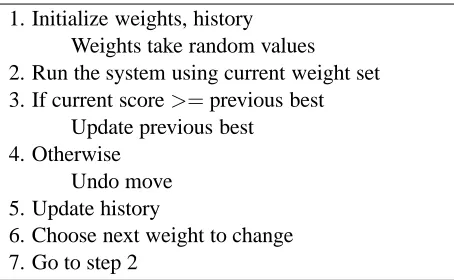
for instance i−1, i−2, and possibly all the way back to instance1, because the classification for in-stance ipartly depends on the classification of pre-vious instances. Not only do many standard super-vised learning methods assume conditional indepen-dence, but they also do not provide access to the on-line classifications during learning. We constructed a randomized hill-climbing. The learner is struc-tured like a neural net, but the weight adjustments are chosen at random as they are in genetic algo-rithms (See Figure 1). The evaluation, or fitness function, is the Novelty Track score itself, and the training data was the 2003 Novelty Track data.
Changes to the hypothesis are selected at random and evaluated. If the change does not hurt results, it is accepted. Otherwise the program backtracks and chooses another weight to update. We required the new configuration to produce a score greater than or equal to the previous one before we accepted it. The choice of which weight to update is made at ran-dom, in an effort to avoid local minima in the search space, but with an important restriction: the previous nchoices are kept in a history list, which is checked to avoid re-use. This list is updated at each iteration. The configurations usually converge well within 100 iterations.
1. Initialize weights, history Weights take random values 2. Run the system using current weight set 3. If current score>=previous best
Update previous best 4. Otherwise
Undo move 5. Update history
6. Choose next weight to change 7. Go to step 2
Figure 1: The learning algorithm uses a randomized hill climbing approach with backtracking
3.2 Bias Adjustment
In training on the 2003 data, the biggest problem was to find a way to deal with the large percentage of novel sentences. About 65% of the instances are positive, so that a random system achieves a rela-tively high F-measure by increasing the number of sentences it calls novel – until recall reaches 1.0. Another strategy would be to choose only the sen-tences in the first document, achieving a high pre-cision – more than 90% of the relevant sentences in the first document for each topic were called novel.
In the Novelty Track the F-measure was set to give equal weight to precision and recall, but we wanted to be able to coax the learner to give greater weight to either precision or by adjusting the F-measure computation:
F = 1
β prec+
(1−β)
recall
βis a number between 0 and 1. The closer it gets to 1, the more the formula favors precision.
We chose whether to emphasize precision or re-call by altering the value ofβ. At the most extreme, we setβat 0.9 for the largest emphasis on precision. When emphasizing recall, we leftβat 0.5.
[image:5.612.136.235.59.263.2]that produced a trivial solution, and we could choose one of the intermediate configurations that produced a more reasonable score.
3.3 Vector-Space Module
In addition to the system which integrates novel word features with focus tracking, we also imple-mented a vector-space approach as a baseline – the
Cosine run. We tested the vector-space system alone
to contrast it with the focus system, but we also tested a version which integrated the vector-space system with the focus system.
Our vector-space module assigns all non-stop-words a value of 1, and uses the cosine distance met-ric to compute similarity.
Cos(u, v) = u·v
kuk · kvk
and
N ovel(si)
T rue if Cos(si, sj)< T, for j= 1. . . i−1
F alse otherwise
As each sentence is scanned, its similarity is com-puted with all previous sentences and the maximum similarity is compared to a thresholdT. If that max-imum exceeds T, it is considered novel. We chose the value ofT after trials on the 2003 Novelty Track data. It was set at 0.385, resulting in a balanced sys-tem that matched the results of one of the strongest performers at the TREC evaluations that year.
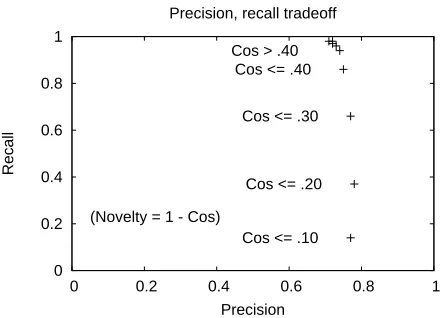
On the 2003 data, when we setT at .9, we found that we had a precision of .71 and a recall of 0.98, indicating that about 6% of the sentences were quite similar to some preceding sentence (See Figure 2). After that, each point of precision was very costly in terms of recall. Our experience was mirrored by the participants at TREC 2003 and again at TREC 2004. We considered this vector-space model to be our baseline. We also tried it in combination with the
Recall run explained above. Because both the Re-call and Cosine runs produced a relatively large
out-put and because they used different methods, we thought the intersection would result in higher pre-cision, though with some loss of recall.
In practice, the range of recall was much greater than precision. Judging from the experiences of the
0 0.2 0.4 0.6 0.8 1
0 0.2 0.4 0.6 0.8 1
Recall
Precision Precision, recall tradeoff
Cos <= .10 Cos <= .20 Cos <= .30 Cos <= .40 Cos > .40
[image:6.612.317.538.66.225.2](Novelty = 1 - Cos)
Figure 2: The precision and recall scores of a vector-space model with cosine similarity at differ-ent thresholds, on the TREC 2003 data. Making the test for novelty stricter fails to improve precision but has a drastic effect on recall.
participants at TREC and our own exploratory ex-periments, it was difficult to push precision above 0.80 with the TREC 2003 data, and above 0.50 with the TREC 2004 data.
4 Experiments
4.1 Results from TREC 2004
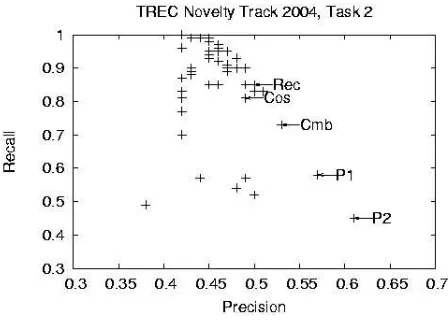
Our results are encouraging, especially since the configurations that were oriented toward higher pre-cision, indeed, achieved the best precision scores in the evaluation, with our best precision run about 20% higher in precision than the best of all the runs by other groups (See Figure 3.) Meanwhile, our recall-oriented run was one of eight runs that were in a virtual tie for achieving the top f-measure. These eight runs were within 0.01 of one another in the measure.
Our five submitted runs were:
Prec1 aimed at moderately high precision, with
rea-sonable recall.
Prec2 aimed at high precision, with little attention
to recall.
Recall weighted precision and recall equally.
Cosine a baseline of a standard vector-space model
Figure 3: The graph shows all 54 submission in Task 2 for the Novelty Track, with our five submis-sions labeled. Our precision-oriented runs were well ahead of all others in precision, while our recall-oriented run was in a large group that reached about 0.5 precision with relatively high recall.
Combo a composite submission using the
intersec-tion of Recall and Cosine.
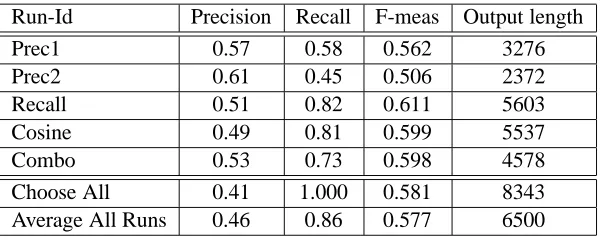
Table 2 shows the numbers of our performance of our five submissions. Prec1 had an F-score close to the average of 0.577 for all systems, while Prec2 was 50% ahead of random selection in accuracy. Both our Combo system and our baseline Cosine were above average in F-measure. Our emphasis on precision is justified in a number of ways, although the official yardstick was the F-measure.
An analysis of the system’s behavior under the different parameters showed that the precision-oriented runs, in particular Prec1, valued verbs and common nouns more than named entities in decid-ing novelty. The precision-oriented runs also bene-fited more from the focus variable, with their scores about 5% higher in terms of F-measure than they were without it. The pronoun test, however, was rarely used, firing less than 1% of the time.
We note that we are developing novelty detection for summarization, where compression of the report is valuable. Table 2 shows the lengths of our re-turns. It is impossible to compare these precisely with other systems, because the averages given by NIST are averages of the scores for each of the 50 sets, and we do not have the breakdown of the
num-bers by set for any submissions but our own. How-ever, we can estimate the size of the other output by considering average precision and recall as if they were computed over the total number of sentences in all 50 sets. This computation shows an average out-put for all participants of about 6,500 sentences and a median of 6,981 – out of a total of 8,343 sentences. However, this total includes some amount of header material, not only the headline, but the document ID and other identifiers, the date and some shorthand messages from the wire services to its clients. In addition, a number of the sets had near perfect du-plicate articles. This is in sharp contrast with typi-cal summaries. At the 2004 Document Understand-ing Conference, the typical input cluster contained more than 4,000 words, and the task required that this be reduced to 100 words. We contend there is little value in a system that does no more than weed out very few sentences, even though they might have achieved high F-measures.
Second, our experience, and the results of other groups, shows that high precision is harder than high recall. In all three years of the Novelty Track, pre-cision scores tended to hover in a narrow band just above what one would get by mechanically labeling all sentences as novel.
5 Conclusion
The success of our use of context in the TREC Novelty Track led us to incorporate the idea into a larger system. This system identifies clauses within sentences that express new information and tries to identify semantic equivalents. It is being developed as part of a multi-document summarizer that pro-duces topical updates for users.
In addition, the work here suggests three direc-tions for future work:
• Adapt the features used here to some of the newer probabilistic formalisms, like condi-tional random fields.
• Try full segmentation of the input documents rather than treat the sentences as a sequence.
• Try to identify all nominal references to canon-ical forms.
Run-Id Precision Recall F-meas Output length
Prec1 0.57 0.58 0.562 3276
Prec2 0.61 0.45 0.506 2372
Recall 0.51 0.82 0.611 5603
Cosine 0.49 0.81 0.599 5537
Combo 0.53 0.73 0.598 4578
[image:8.612.157.457.58.178.2]Choose All 0.41 1.000 0.581 8343 Average All Runs 0.46 0.86 0.577 6500
Table 2: Comparison of results of our five runs, compared to a random selection of sentences, and the overall average F-scores by all 55 submissions.
we obtained the program settings to do this auto-matically. High precision is very difficult to obtain, and every point in precision costs too much in recall. Further exploration is needed to determine whether linguistic knowledge will help, and whether state-of-the-art tools are powerful enough to improve per-formance.
Beyond new-information detection, the idea of tracking context with a surface means like the focus variable is worth exploring in other tasks, including summarization and question-answering.
References
Nasreen Abdul-Jaleel, James Allan, W. Bruce Croft, Fer-nando Diaz, Leah Larkey, Xiaoyan Li, Donald Met-zler, Mark D. Smucker, Trevor Strohman, Howard Tur-tle, and Courtney Wade. 2004. Umass at trec 2004: Notebook. In The Thirteenth Text Retrieval
Confer-ence (TREC 2004) Notebook.
James Allan, Courtney Wade, and Alvaro Bolivar. 2003. Retrieval and novelty detection at the sentence level. In Proceedings of the ACM SIGIR conference on
re-search and development in information retrieval.
Stephen Blott, Oisin Boydell, Fabrice Camous, Paul Fer-guson, Georgina Gaughan, Cathal Gurrin, Noel Mur-phy, Noel O’Connor, Alan F. Smeaton, Barry Smyth,
and Peter Wilkins. 2004. Experiments in terabyte
searching, genomic retrieval and novelty detection for trec-2004. In The Thirteenth Text Retrieval
Confer-ence (TREC 2004) Notebook.
John M Conroy, Daniel M. Dunlavy, and Dianne P. O’Leary. 2003. From trec to duc to trec again. In
TREC Notebook Proceedings.
John M. Conroy. 2004. A hidden markov model for trec’s novelty task. In The Thirteenth Text Retrieval
Conference (TREC 2004) Notebook.
David Eichmann, Padmini Srinivasan, Marc Light, Hudong Wang, Xin Ying Qiu, Robert J. Arens, and Aditya Sehgal. 2003. Experiments in novelty, genes and questions at the university of iowa. In TREC
Note-book Proceedings.
David Eichmann, Yi Zhang, Shannon Bradshaw,
Xin Ying Qiu, Li Zhou, Padmini Srinivasan,
Aditya Kumar Sehgal, and Hudon Wong. 2004. Nov-elty, question answering and genomics: The univer-sity of iowa response. In The Thirteenth Text Retrieval
Conference (TREC 2004) Notebook.
Jade Goldstein, Vibhu Mittal, Jaime Carbonell, and Mark Kantrowitz. 2000. Multi-document summarization by sentence extraction. In Proceedings of
ANLP/NAACL-2000 Workshop on Automatic Summarization.
Barbara J. Grosz and Candace L. Sidner. 1986. Atten-tion, intenAtten-tion, and the structure of discourse.
Compu-tational Linguistics, 12(3):175–204.
Srikanth Kallurkar, Yongmei Shi, R. Scott Cost, Charles Nicholas, Akshay Java, Christopher James, Sowjanya Rajavaram, Vishal Shanbhag, Sachin Bhatkar, and Drew Ogle. 2003. Umbc at trec 12. In TREC
Note-book Proceedings.
R. Ohgaya, A. Shimmura, and T. Takagi. 2003. Meiji university web and novelty track experiments at trec 2003. In TREC Notebook Proceedings.
Liyun Ru, Le Zhao, Min Zhang, and Shaoping Ma. 2004. Improved feature selection and redundancy computing – thuir at trec 2004 novelty track. In The Thirteenth
Text Retrieval Conference (TREC 2004) Notebook.
Ian Soboroff. 2004. Draft overview of the trec 2004 nov-elty track. In The Thirteenth Text Retrieval Conference
(TREC 2004) Notebook.
Jian Sun, Wenfeng pan, Huaping Zhang, Zhe Yang, Bin Wang, Gang Zhang, and Xueqi Cheng. 2003. Trec-2003 novelty and web track at ict. In TREC Notebook