Inference of Phrase-Based Translation Models
via Minimum Description Length
Jes´us Gonz´alez-Rubio and Francisco Casacuberta
Departamento de Sistemas Inform´aticos y Computaci´on
Universitat Polit`ecnica de Val`encia, Camino de Vera s/n, 46021 Valencia (Spain)
{jegonzalez, fcn}@dsic.upv.es
Abstract
We present an unsupervised inference pro-cedure for phrase-based translation mod-els based on the minimum description length principle. In comparison to cur-rent inference techniques that rely on long pipelines of training heuristics, this procedure represents a theoretically well-founded approach to directly infer phrase lexicons. Empirical results show that the proposed inference procedure has the po-tential to overcome many of the prob-lems inherent to the current inference ap-proaches for phrase-based models.
1 Introduction
Since their introduction at the beginning of the twenty-first century, phrase-based (PB) transla-tion models (Koehn et al., 2003) have become the state-of-the-art for statistical machine translation (SMT). PB model provide a big leap in translation quality with respect to the previous word-based translation models (Brown et al., 1990; Vogel et al., 1996). However, despite their empirical suc-cess, inference procedures for PB models rely on a long pipeline of heuristics (Och and Ney, 2003) and mismatched learning models, such as the long outperformed word-based models. Latter stages of the pipeline cannot recover mistakes or omis-sions made in earlier stages which forces the indi-vidual stages to massively overgenerate hypothe-ses. This manifests as a huge redundancy in the inferred phrase lexicons, which in turn largely pe-nalizes the efficiency of PB systems at run-time. The fact that PB models usually cannot generate the sentence pairs in which they have been trained in, or that it is even possible to improve the perfor-mance of a PB system by discarding most of the learned phrases are clear indicators of these defi-ciencies (Sanchis-Trilles et al., 2011).
We introduce an unsupervised procedure to in-fer PB models based on the minimum descrip-tion length (MDL) principle (Solomonoff, 1964;
Rissanen, 1978). MDL, formally described in Section 2, is a general inference procedure that “learns” by “finding data regularities”. MDL takes its name from the fact that regularities allow to compressthe data, i.e. to describe it using fewer symbols than those required to describe the data literally. As such, MDL embodies a form of Oc-cam’s Razor in which the best model for a given data is the one that provides a better trade-off be-tween goodness-of-fit on the data and “complex-ity” or “richness” of the model.
MDL has been previously used to infer mono-lingual grammars (Gr¨unwald, 1996) and inversion transduction grammars (Saers et al., 2013). Here, we adapt the basic principles described in the lat-ter article to the inference of PB models. The MDL inference procedure, described in Section 3, learns PB models by iteratively generalizing an initial model that perfectly overfits training data. An MDL objective is used to guide this process. MDL inference has the following desirable prop-erties:
• Training and testing are optimized upon the same model; a basic principle of machine learn-ing largely ignored in PB models.
• It provides a joint estimation of the structure (set of bilingual phrases) and the parameters (phrase probabilities) of PB models.
• It automatically protects against overfitting by implementing a trade-off between the expres-siveness of the model and training data fitting.
The empirical evaluation described in Section 4 focuses on understanding the behavior of MDL-based PB models and their specific traits. That is, in contrast to a typical PB system building pa-per, we are not exclusively focused on a short term boost in translation quality. Instead, we aim at studying the adequacy and future potential of MDL as inference procedure for PB models.
2 The MDL Principle
Given a set of dataD, the MDL principle aims at obtaining the simplest possible model Φthat de-scribesD as well as possible (Solomonoff, 1964; Rissanen, 1978). Central to MDL is the one-to-one correspondence between description length functions and probability distributions that follows from the Kraft-McMillan inequality (McMillan, 1956). For any probability distribution Pr(·), it is possible to construct a coding scheme such that the length (in bits) of the encoded data is mini-mum and equal to−log2(Pr(D)). In other words, searching for a minimum description length re-duces to searching for a good probability distribu-tion, and vice versa. Taking these considerations into account, MDL inference is formalized as:
b
Φ= argmin
Φ DL(Φ,D) (1)
= argmin
Φ DL(Φ) + DL(D |Φ) (2)
where DL(Φ) denotes the description length of the model, and DL(D | Φ) denotes the descrip-tion length of the data given the model. A com-plete introductory tutorial of the MDL principle and methods can be found in (Gr¨unwald, 2004).
3 MDL Phrase-Based Models
3.1 Description Length Functions
We start by defining how to computeDL(Φ)and
DL(D |Φ)for any PB model and data set. Let PrΦ(D) be the probability of data set D according to PB model Φ. We follow the Kraft-McMillan inequality and define the de-scription length of the data given the model as
DL(D |Φ) =−log2(PrΦ(D)), which it is the lower bound for the description length of the data. Regarding the description length of the PB model, DL(Φ), we compute it by serializing Φ
into a sequence of symbols and then computing the length of the optimal encoding of such se-quence. To do that, we need one symbol for each word in the source and target languages, another symbol to separate the source and target sides in a phrase pair, and one additional symbol to dis-tinguish between the different pairs in the phrase lexicon. For example, the following toy PB model
La|||The casa|||house azul|||blue
is serialized as La|The•casa|house•azul|blue, where symbol• separates the phrase pairs, and|
separates the two sides of each pair. Assuming a uniform distribution over theKdifferent symbols, each symbol would require−log2(K1) bits to en-code. We will thus require3 bits to encode each of the8symbols in the example, and33bits to en-code the whole serialized PB model (11symbols).
3.2 Inference Procedure
We now describe how to perform the maximiza-tion in Equamaximiza-tion (2). In the case of PB models, this reduces to a search for the optimal phrase lex-icon. Obviously, an exhaustive search over all pos-sible sets of phrase pairs in the data is unfeapos-sible in practice. Following the ideas in (Vilar and Vi-dal, 2005), we implement a search procedure that iteratively generalizes an initial PB model that per-fectly fits the data. Let D = {fn,en}Nn=1 be a
data set withN sentence pairs, wherefnare sen-tences in the source language andenare their cor-responding translation in the target language. Our initial PB model will be as follows:
f1|||e1 · · · fn|||en · · · fN|||eN where the probability of each pair is given by the number of occurrences of the pair in the data di-vided by the number of occurrences of the source (or target) language sentence.
To generalize this initial PB model, we need to identify parts of the existing phrase pairs that could be validly used in isolation. As a result, the PB model will be able to generate new transla-tions different from the ones in the training data. From a probabilistic point of view, this process moves some of the probability mass which is con-centrated in the training data out to other data still unseen; the very definition of generalization. Con-sider a PB model such as:
La casa azul|||The blue house Esta casa azul|||This blue house Esta casa verde|||This green house
It can be segmented to obtain a new PB model:
La|||The casa azul|||blue house Esta|||This casa verde|||green house
which is able to generate one new sentence pair (La casa verde→The green house) and has a
shorter description length (19 symbols) in compar-ison to the original model (23 symbols). We only consider segmentations that bisect the source and target phrases. More sophisticated segmentation approaches are beyond the scope of this article.
Algorithm 1: Iterative inference procedure.
input : Φ(initial PB model)
output : Φb(generalized PB model)
auxiliary :collect(Φ)(Returns the set of possible segmentations of modelΦ)
∆DL(s,Φ)(Returns variation in DL when segmentingΦaccording tos) sort(S)(Sorts segmentation setSby
variation in DL)
commit(S,Φ)(Apply segmentations inS toΦ, returns variation in DL)
begin
1
repeat
2
S ←collect(Φ);
3
candidates←[];
4
fors∈ Sdo
5
∆0←∆DL(s,Φ);
6
if∆0≤0then
7
candidates.append({∆0,s});
8
sort(candidates);
9
∆←commit(candidates,Φ);
10
until∆>0;
11
returnΦ;
12
end
13
model (line 3). Then, we estimate the variation in description length due to the application of each segmentation (lines 4 to 8). Finally, we sort the segmentations by variation in description length (line 9) and commit to the best of them (line 10). Specifically, given that different segmentations may modify the same phrase pair, we apply each segmentation only if it only affect phrase pairs unaffected by previous segmentations inS. The algorithm stops when none of the segmentations lead to a reduction in description length. Saers et al., (2013) follow a similar greedy algorithm to generalize inversion transduction grammars.
The key component of Algorithm 1 is function
∆DL(s,Φ) that evaluates the impact of a candi-date segmentation s on the description length of PB modelΦ. That is, ∆DL(s,Φ) computes the difference in description length between the cur-rent modelΦand the modelΦ0 that would result from committing tos:
∆DL(s,Φ) = DL(Φ0)−DL(Φ)
+ DL(D |Φ0)−DL(D |Φ) (3)
The length difference between the phrase lexi-cons (DL(Φ0)−DL(Φ)) is trivial. We merely have to compute the difference between the lengths of the phrase pairs added and removed. The differ-ence for the data is given by −log2PrΦ0(D)
PrΦ(D)
, where PrΦ0(D) and PrΦ(D) are the probability ofD according toΦ0 andΦ respectively. These
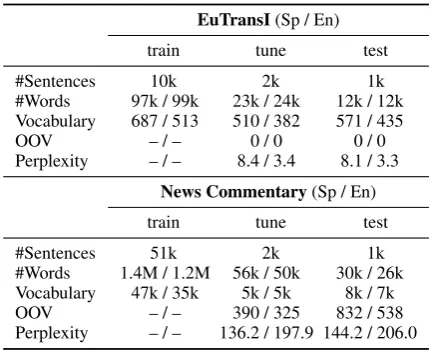
EuTransI(Sp / En)
train tune test
#Sentences 10k 2k 1k
#Words 97k / 99k 23k / 24k 12k / 12k Vocabulary 687 / 513 510 / 382 571 / 435
OOV – / – 0 / 0 0 / 0
Perplexity – / – 8.4 / 3.4 8.1 / 3.3
News Commentary(Sp / En)
train tune test
#Sentences 51k 2k 1k
#Words 1.4M / 1.2M 56k / 50k 30k / 26k Vocabulary 47k / 35k 5k / 5k 8k / 7k
OOV – / – 390 / 325 832 / 538
[image:3.595.307.523.61.236.2]Perplexity – / – 136.2 / 197.9 144.2 / 206.0
Table 1: Main figures of the experimental corpora. M and k stand for millions and thousands of ele-ments respectively. Perplexity was calculated us-ing 5-gram language models.
probabilities can be computed by translating the training data. However, this is a very expensive process that we cannot afford to perform for each candidate segmentation. Instead, we estimate the description length of the data in closed form based on the probabilities of the phrase pairs involved. The probability of a phrase pair{˜f,˜e}is computed as the the number of occurrences of the pair di-vided by the number of occurrences of the source (or target) phrase. We thus estimate the probabil-ities in the segmented model Φ0 by counting the occurrences of the replaced phrase pairs as occur-rences of the segmented pairs. Let {˜f0,˜e0} be
the phrase pair we are splitting into {˜f1,˜e1} and
{˜f2,˜e2}. The direct phrase probabilities inΦ0will
be identical to those inΦexcept that:
PΦ0(˜e0 |˜f0) = 0
PΦ0(˜e1 |˜f1) = NΦ({˜f1,˜e1}) + NΦ({˜f0,˜e0})
NΦ(˜f1) + NΦ({˜f0,˜e0})
PΦ0(˜e2 |˜f2) = NΦ({˜f2,˜e2}) + NΦ({˜f0,˜e0})
NΦ(˜f2) + NΦ({˜f0,˜e0})
whereNΦ(·)are counts inΦ. Inverse probabilities are computed accordingly. Finally, we compute the variation in data description length using:
PrΦ0(D)
PrΦ(D) ≈
PΦ0(˜e1|˜f1)·PΦ0(˜e2 |˜f2)
PΦ(˜e0|˜f0)
·PΦ0(˜f1 |˜e1)·PΦ0(˜f2|˜e2)
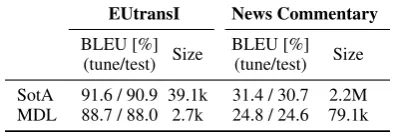
EUtransI News Commentary
[image:4.595.306.526.60.180.2]BLEU [%] Size BLEU [%] Size(tune/test) (tune/test) SotA 91.6 / 90.9 39.1k 31.4 / 30.7 2.2M MDL 88.7 / 88.0 2.7k 24.8 / 24.6 79.1k
Table 2: Size (number of phrase pairs) of the MDL-based PB models, and quality of the gener-ated translations. We compare against a state-of-the-art PB inference pipeline (SotA).
For a segmentation set, we first estimate the new modelΦ0 to reflect all the applied segmentations, and then sum the differences in description length.
4 Empirical Results
We evaluated the proposed inference procedure on the EuTransI (Amengual et al., 2000) and the News Commentary (Callison-Burch et al., 2007) corpora. Table 1 shows their main figures.
We inferred PB models (set of phrase pairs and their corresponding probabilities) with the training partitions as described in Section 3.2. Then, we included these MDL-based PB models in a con-ventional log-linear model optimized with the tun-ing partitions (Och, 2003). Finally, we generated translations for the test partitions using a conven-tional PB decoder (Koehn et al., 2007).
Table 2 shows size (number of phrase pairs) of the inferred MDL-based PB models, and BLEU score (Papineni et al., 2002) of their translations of the tune and test partitions. As a comparison, we display results for a state-of-the-art (SotA) PB sys-tem (Koehn et al., 2007). These results show that MDL inference obtained much more concise mod-els (less than one tenth the number of phrases) than the standard inference pipeline. Additionally, the translations of the simple EuTransI corpus were of a similar quality as the ones obtained by the SotA system. In contrast, the quality of the translations for News Commentary was significantly lower.
To better understand these results, Figure 1 dis-plays the histogram of phrase lengths (number of source words plus target words) of the SotA model and the MDL-based model for the News Commen-taries corpus. We first observed that the length of the phrase pairs followed a completely different distribution depending on the inference procedure. Most of the phrase pairs of the MDL-based model translated one source word by one target word with an exponential decay in frequency for longer phrase pairs; a typical distribution of events in
0 10 20 30
0 10 20 30 40 50 60 70 80
Length of the phrase pair (words)
Relative frequency [%]
[image:4.595.81.278.64.130.2]SotA MDL
Figure 1: Histogram of lengths (source plus target words) for the phrase pairs in the inferred models.
ural language (Zipf, 1935). Longer phrase pairs, about45%of the total, contain sequences of words that only appear once in the corpus, and thus, they cannot be segmented in any way that leads to a re-duction in description length. Although formally correct, long phrase pairs generalize poorly which explains the comparatively poor performance of MDL inference for the News Commentaries cor-pus. This problem was largely attenuated for Eu-TransI due to its simplicity.
5 Conclusions and Future Developments
We have described a simple, unsupervised infer-ence procedure for PB models that learns phrase lexicons by iteratively splitting existing phrases into smaller phrase pairs using a theoretically well-founded minimum description length objec-tive. Empirical results have shown that the in-ferred PB models, far from the artificial redun-dancy of the conventional PB inference pipeline, are very parsimonious and provide competitive translations for simple translation tasks.
The proposed methodology provides a solid foundation from where to develop new PB infer-ence approaches that overcome the problems in-herent to the long pipeline of heuristics that nowa-days constitute the state-of-the-art. Future devel-opments in this direction will include:
• A more sophisticated segmentation procedure that allow to divide the phrases into more that two segments.
• A hybrid approach where the long phrase pairs remaining after the MDL inference are further segmented, e.g., according to a word lexicon. • The inclusion of lexical models in the definition
Acknowledgments
Work supported by the European Union 7th
Framework Program (FP7/2007-2013) under the CasMaCat project (grans agreement no 287576), by Spanish MICINN under grant TIN2012-31723, and by the Generalitat Valenciana under grant ALMPR (Prometeo/2009/014).
References
Juan-Carlos Amengual, M. Asunci´on Casta˜no, Anto-nio Castellanos, V´ıctor M. Jim´enez, David Llorens, Andr´es Marzal, Federico Prat, Juan Miguel Vilar, Jos´e-Miguel Bened´ı, Francisco Casacuberta, Mois´es Pastor, and Enrique Vidal. 2000. The eutrans spo-ken language translation system. Machine Transla-tion, 15(1-2):75–103.
Peter F. Brown, John Cocke, Stephen A. Della Pietra, Vincent J. Della Pietra, Fredrick Jelinek, John D. Lafferty, Robert L. Mercer, and Paul S. Roossin. 1990. A statistical approach to machine translation.
Computational Linguistics, 16:79–85.
Chris Callison-Burch, Cameron Fordyce, Philipp Koehn, Christof Monz, and Josh Schroeder. 2007. (Meta-) evaluation of machine translation. In Pro-ceedings of the Workshop on Statistical Machine Translation, pages 136–158.
Peter Gr¨unwald. 1996. A minimum description length approach to grammar inference. Connectionist, Sta-tistical, and Symbolic Approaches to Learning for Natural Language Processing, pages 203–216.
Peter Gr¨unwald. 2004. A tutorial introduc-tion to the minimum descripintroduc-tion length principle. http://arxiv.org/abs/math/0406077.
Philipp Koehn, Franz Josef Och, and Daniel Marcu. 2003. Statistical phrase-based translation. In Pro-ceedings of the North American Chapter of the As-sociation for Computational Linguistics on Human Language Technology, pages 48–54.
Philipp Koehn, Hieu Hoang, Alexandra Birch, Chris Callison-Burch, Marcello Federico, Nicola Bertoldi, Brooke Cowan, Wade Shen, Christine Moran, Richard Zens, Chris Dyer, Ondrej Bojar, Alexandra Constantin, and Evan Herbst. 2007. Moses: Open Source Toolkit for Statistical Machine Translation. InProceedings of the Association for Computational Linguistics, demonstration session, June.
Brockway McMillan. 1956. Two inequalities implied by unique decipherability. IRE Transactions on In-formation Theory, 2(4):115–116.
Franz Josef Och and Hermann Ney. 2003. A sys-tematic comparison of various statistical alignment models. Computational Linguistics, 29(1):19–51.
Franz Josef Och. 2003. Minimum error rate training in statistical machine translation. InProceedings of the Meeting on Association for Computational Linguis-tics, pages 160–167. Association for Computational Linguistics.
Kishore Papineni, Salim Roukos, Todd Ward, and Wei-Jing Zhu. 2002. Bleu: A method for automatic eval-uation of machine translation. InProceedings of the Meeting on Association for Computational Linguis-tics, pages 311–318. Association for Computational Linguistics.
Jorma Rissanen. 1978. Modeling by shortest data de-scription. Automatica, 14(5):465 – 471.
Markus Saers, Karteek Addanki, and Dekai Wu. 2013. Iterative rule segmentation under minimum descrip-tion length for unsupervised transducdescrip-tion grammar induction. InStatistical Language and Speech Pro-cessing, volume 7978 ofLecture Notes in Computer Science, pages 224–235. Springer.
Germ´an Sanchis-Trilles, Daniel Ortiz-Mart´ınez, Jes´us Gonz´alez-Rubio, Jorge Gonz´alez, and Francisco Casacuberta. 2011. Bilingual segmentation for phrasetable pruning in statistical machine transla-tion. In Proceedings of the 15th Conference of the European Association for Machine Translation. Ray Solomonoff. 1964. A formal theory of inductive
inference, parts 1 and 2. Information and Control, 7:1–22, 224–254.
Juan Miguel Vilar and Enrique Vidal. 2005. A recur-sive statistical translation model. InProceedings of the ACL Workshop on Building and Using Parallel Texts, pages 199–207.
Stephan Vogel, Hermann Ney, and Christoph Tillmann. 1996. HMM-based word alignment in statistical translation. In Proceedings of the 16th conference on Computational linguistics, pages 836–841. George Kingsley Zipf. 1935. The Psychobiology of