The Automotive Supply Chain Complexity Model using SysML Language
Khadija Rahoum
1, Hicham Jamouli
21
Ph.D. Student, Laboratory of Systems Engineering and Decision Support, National School of Applied Sciences, Ibn
Zohr University, BP 80000, Agadir, Morocco
2
Professor, Laboratory of Systems Engineering and Decision Support, National School of Applied Sciences, Ibn Zohr
University, BP 80000, Agadir, Morocco
---***---Abstract - The automotive supply chain is a complex system due to the complexity of its structure, operations, and requirements [1]. This complexity increases more and more with the progressive suppliers settled near to the terminal automakers, and the multitude of components and vehicles changed with every new car project and customer expectations. Consequently, the automotive assemblers aim to control and reduce origins and aspects of this complexity
for managing better their logistic performance. In this
context, this article articulates on modeling the automotive
supply chain complexity through the systems engineering concept. This model allows the decision-makers to list the sources and types of envisaged complexity in order to prevent, reduce, eliminate, and control this highly challenging. First of all, we introduce the research works related to the complexity problematic, the automotive supply chain, and the Systemes Modeling Language (SysML). After that, we present our research methodology of modeling according to the mentioned concepts and the automotive supply chain specificities. Lastly, we apply our conceptual model to a real case study of the Moroccan Automotive Supply Chain (MASC).
Key Words: Complexity, Modeling, SysML Language, Supply Chain, Automotive Industry
1. INTRODUCTION
“I think the 21st century will be the century of complexity,” Stephen Hawking (1942-2018).
The VUCA (Volatility, Uncertainty, Complexity, and Ambiguity) environments seem to become more and more challenging for the companies to deal with it, hence the necessity to keep these factors in mind during the management and improvement of its performances. One of the VUCA factors, we have the complexity, which characterized any interconnected and networked system such as the supply chain [2].
In the Moroccan context, the value chain becomes more and more complicated due to the growth of international production offshoring and outsourcing, especially in the aeronautical and automotive industries. Besides, the internationalization of supply chains increases uncertainty and the need for responsiveness towards the networks of large international companies [3].
The global and local integration of the Moroccan automotive sector has progressed gradually, which will strengthen the local supply chain and increase the variety of local and exported car parts and components. As a result, the Moroccan Automotive Supply Chain (MASC) became more competitive and simultaneously more complex.
From this problematic, we modeled the complexity of the automotive supply chain in order to attenuate later the impact of product variety and supplier numbers on its performance. We also studied the internal and external origins of this complexity type.
The rest of the article is structured as follows. The second part presents the related works and research framework of the complexity of the automotive supply chain as well as the SysML language devoted to the complex systems modeling. The third part proposes our research methodology when the fourth one illustrates its application in the Moroccan automotive industry. The last section is dedicated to conclude and provide new prospects.
2. RELATED WORKS AND RESEARCH FRAMEWORK
2.1Automotive Supply Chain Complexity
In general, the term “complex” describes a system, its components, its functions, or both, which are difficult to understand and verify [4]. A complex system contains multiple interactions and variations between many different components [1].
For the supply chain, the complexity is defined as the variety and uncertainty associated with a system. There are two mean types of supply chain complexity: the static or structural complexity and the dynamic or operational complexity [5].
In the literature, many researchers conducted the problem of the automotive supply chain complexity. Dreher (1997) developed a complexity index for a German car manufacturer to show the complexity of its assembling process. This index shows that a car assembly needs from between 3, 000 to more than 20, 000 parts [7].
Other authors mention that the complexity of the automotive supply chain is related to the variety of product specifications, the multiplicity of stocking locations, the customer behavior, the demand seasonality, and the stock aging [8]. Between emerging and established markets, the product variety has an impact on the complexity of automobile manufacturing and its costs [9]. This variety takes part in the complexity propagation in multi-stage assembly systems and multi-echelon supply chains [10].
From these researches, we conclude that the automotive supply chain is a complex system, and its complexity is related more to the product variety. In the next part, we study the Moroccan Automotive Supply Chain (MASC) and its complexity according to different research articles.
2.2 Moroccan Automotive Supply Chain Complexity
The Economic Complexity Index (ECI) ranks Morocco in the 78th in comparison to 124 countries [11] regarding the
diversification of its exports [12]. As a result, hundreds of automotive suppliers and businesses are installed in Morocco [13, 14], within the context of the National industrial acceleration strategy 2014-2020 [12, 15], which increases the complexity of the upstream supply chain, and inter-firms relations [16].
Among the problems faced at the Moroccan automotive upstream logistics, we cite the lack of expertise in design, research and development [17], the weakness of the logistic maturity [18, 19], the difficulty of integration [20] and collaboration [21], and the non-conformity of Electronic Data Interchange [22], especially for the small and medium-sized suppliers. As well, we mention the synchronization issue of raw material flows between the automotive assembler and its suppliers [23].
The Moroccan researchers recommend the modeling and management of processes in the automotive industry, at the upstream and downstream supply chains [24, 25], in order to evaluate and improve its performance indicators [26], manage envisaged logistic risks [27], and answer well the customer needs. In Table-1, we synthesize the different complexity drivers related to the MASC.
From this review, we constat that the mean origins of complexity in the MASC come from the suppliers, product variety, and processes management.
Table-1: Review of the complexity in the Moroccan Automotive Supply Chain.
References Complexity
Drivers Complexity Type Complexity Origin
[Ibn El Farouk et al.,
2009] -Supplier -Product Type
-Product Variety -Process
-Information Technology (IT)
-Static
-Dynamic -External -Internal
[Hakim and Adnan, 2013] -Supplier -Product Type
-Product Variety
Static External
[Jardini et al., 2015] -Supplier
-IT Dynamic -External -Supply Interface [Rahoum et al., 2015] -Supplier
-Process -Static -Dynamic -External -Internal [K. El mokri, 2016] -Supplier
-Product Variety Static -External [M. Ait El Kadi, 2016] -Supplier
-Environement Static -External
[ Benabdejlil et al., 2016] -Supplier Static -External [Haddach et al., 2017] -Supplier
-Product Variety -Product Number
Static -Internal
[Ibn El Farouk and Jawab,
2017] -Supplier -Process
-IT
Dynamic -External -Internal -Supply and Demand Interface [Hahn and Auktor 2017] -Supplier
-Product Variety Static -External [Rahoum and Jamouli,
2017] -Supplier -Design
-Process
Static -External
-Internal
[Elhammouchi and
Abouabdellah, 2018] -Design -Customer -Process
Static -External
-Internal
[Sghiouri and
Abouabdellah, 2018] -Supplier -Costumer -Process
Dynamic -External -Internal -Demand Interface [Lemghari et al., 2018] -Supplier
-Process Dynamic -External -Internal -Supply and Demand Interface [Yahiaoui et al., 2018] -Supplier
-Design Static -External -Internal
2.3 Systems Modeling Language
The Object Management Group (OMG) adopted the Systems Modeling Language (SysML) in 2006. It is a graphical modeling language derived from UML: Unified Modeling Language to model the complex systems. This language goes well beyond the problems of computing. It has the possibility of integrating other elements not used on UML 2.0, such as system requirements, non-software elements, physical equations, continuous flows, and many others [28].
The SysML models the requirements, the structure, and the behavior of a complex system through nine mean diagrams (see Fig-1). We have three types of these diagrams:
-Structural diagrams: including the block definition, the
internal block, the package, and the parametric diagrams;
-Behavioral diagrams: containing the use case, the
sequence, the activity, and the state machine diagrams;
-Requirement diagram.
-
-
Fig -1: SysML Diagrams according to [OMG, 2017]
Systems Engineering is the basic concept of SysML. It is a methodological approach based on models to answer complex problems by the realization of software and hardware solutions. This concept is aimed at many industrial and services sectors such as automotive, aeronautics, railway, space, military, telecom, medicine, and others. This method relies on the modeling and simulation to validate requirements or to evaluate a system [29].
[image:3.595.160.553.46.593.2]order to give a new definition to our complex system by integrating different characteristics of this issue in the design and engineering phases. In the next section, we present our research methodology.
3. METHODOLOGY
Our problematic consists of the structural and operational complexities of the automotive supply chain. Consequently, we show and model this complexity according to its drivers, its typology, and its sources. This model also includes the specificities of the automotive supply chain as a complex system. We need before to model our complex chain, to know and illustrate its structure and its behaviors. The multitude of flows, processes, resources, parts, and actors reinforces more this issue.
The SysML Language is the appropriate language to model the complexity of the automotive supply chains. The SysML Block Definition Diagram (BDD) describes the hierarchy of the supply chain system, its sub-systems, components, and connections. This diagram models the system structure in the form of blocks characterized by parts, operations, values, and properties. The composition, aggregation, association, and generalization relations manage the interactions and the flows between different blocks [30]. In the BDD, the bloc can be either system, sub-system, component, resource, actor, information, hardware, software, or process. Every system component has to satisfy one or more requirements and verify one or more constraints.
In figure Fig-2, we illustrate our conceptual model based on the Block Definition Diagram and the mean characteristics of a complex system and supply chain complexity concept. According to the definition of a complex system, every complex supply chain contains sub-systems, components, and functions with variable and uncertain interactions. This chain has to deal with different complexity drivers with different types, origins, and degrees.
Fig -2: Supply Chain Complexity Model
The origins of complexity can be decision making, external, and or internal drivers, from different natures: supply and demand interfaces, static and or dynamic complexities. Its evaluation depends on whether the complexity is necessary, unnecessary, potential, or current. Therefore, the decision-makers have to identify and evaluate this complexity and choose a good strategy or solution to attenuate and control it.
The use of the system engineering concept and SysML language contributes to discover and illustrate the supply chain complexity even from the design phase and attenuate later its effects on the local and global performances of the studied system. Also, it gives a redefinition of the engineering and management of systems complexity. We present below a real case study and application to the Moroccan automotive supply chain.
4. APPLICATION
The automotive industry is the primary sector of the national economy, the leading export sector in Morocco, and the first car maker in Africa.
Two international car manufacturers are installed in Morocco and will reach a production capacity of 650,000 units per year by 2020, and exports with 100 billion Moroccan Dirhams. The local integration rate of suppliers will drop from 50% to 65%, and more than 500,000 jobs will be created by 2020 to respond to the forecasts set by the National Industrial Acceleration Plan.
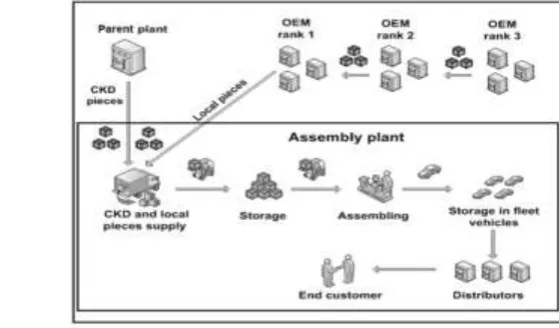
The figure (Fig-3) represents the general structure of the automotive supply chain in Morocco. Two main activities characterized the Moroccan automotive manufacturing:
- The manufacturing of car components by the Original
Equipment Manufacturers (OEM);
- The assembly of car components and complete
knock-down (CKD) parts manufactured by the automotive parent plants.
[image:4.595.274.554.597.761.2]The CKD parts and local car components will be supplied, stocked, and assembled in order to give the form of a specified vehicle according to the customer order. After its storage in the vehicle fleet, the vehicles will be distributed and sold to the car dealers and agencies.
After an oral interview with the purchasing manager in a Moroccan car assembly plant, we could study the complexity of one local component belonging to his work perimeter, which is the car dashboard (see Fig-4).
Fig -4: Plastic Car Dashboard
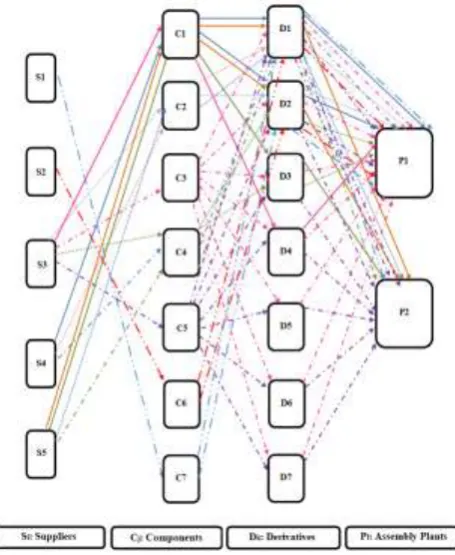
For our case study, we studied the complexity of the variety of car dashboards. We have five local suppliers of dashboards and accessories located in three Moroccan cities: V1, V2, and V3. These suppliers work on behalf of two automotive assembly plants, P1 et P2, for the same manufacturer, located in the cities V1 et V2. Every car dashboard has 21 components with 44 derivatives, which 14 components are shared with all car ranges manufactured for the same assembly plant. On the other hand, we have seven components C, with 31 possibilities of derivatives D. In Figure Fig-5, we illustrate the complexity of these car dashboard derivatives.
Fig -5: The Complexity of the Car Dashboard Derivatives
The complexity of our case study also resides in:
- The multitude of derivatives for a single dashboard;
- The production capacity of suppliers and assembly
plants is not the same;
- Some local suppliers work only for a single type of
part or component;
- Some local suppliers must strictly provide
components for an assembly plant, with a distance of more than 350 kilometers every day.
Before modeling our system, we present the automotive sourcing supply chain as a sub-system of the whole automotive supply chain system and the more complex one. Three mean actors constitute its structure:
- Suppliers who manufacture and deliver ordered car
parts and components;
- Transporters who deliver it to assembly plants;
- Terminal assembly plants.
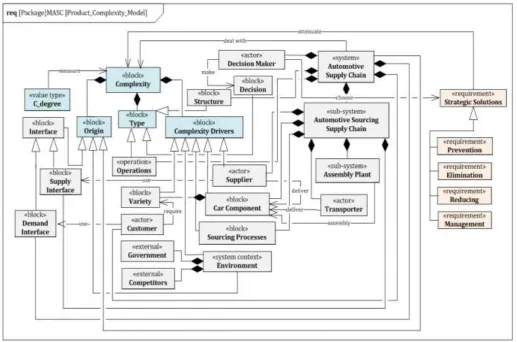
In Figure Fig-6, we illustrate the aspects of the complexity of our automotive upstream supply chain according to five drivers complexity being the suppliers, sourcing processes, environment, car components, and its varieties. This complexity comes from different environments and actors such as national government strategies and the fierceness of international competitors, and also the customer force in terms of needs, behaviors, and implicit and explicit requirements. Another origin of this issue, we confront the complexity of data management and interfaces between different internal and external users for supplying and ordering automotive components.
The variety of supplied car pieces or parts depends as well on the structure of the whole supply chain and the different operations related to the sourcing supply chain from planning to returning. The wrong decision-making can also be a source of complexity, for example, the selection of wrong sourcing, packaging, transport, delay measure, and quantity to be delivered or stocked.
Consequently, the strategist decision-makers should select the adequate solutions to prevent, measure, manage, and attenuate these structural and operational complexities. These strategic solutions represent the non-functional requirements of our system complex. In Table-2, we propose a set of strategies to control our car component complexity drivers according to three criteria: suppliers, processes, and product variety.
[image:5.595.72.252.224.294.2] [image:5.595.47.275.476.754.2]and attenuation of the product complexity, help the decision-makers to increase the export diversification to emerging countries and improve the local integration of
automotive suppliers, which are the strategic objectives of the Moroccan government.
Fig -6: AutomotiveSupply Chain Complexity Model
Table-2: Proposition of Strategic Solutions to manage the car component complexity in the MASC.
Car
component drivers
Strategic Solutions
Suppliers
-Local Integration Increasing; -Logistic Maturity ;
-Vertical and Horizontal Collaboration;
-Process Modularization;
-Improvement of Machines Capabilities;
- Research and Development of New Technologies;
-…
Product variety
-Product Redesign; -Product Standardization; -Product Modularization; -Product Engineering; -Customization; -…
Processes
-Compliance of EDI; -Flows Synchronization; -Just-in-Time;
-Processes Standardization; -Application of International Logistic Best Practices;
-…
5. CONCLUSION
[image:6.595.39.557.141.483.2]complexities. The proposed model will represent later a decision tool for the decision-makers in the car industry, especially to come up with the national strategy of industrial acceleration expectations. The prospect of this work is to evaluate the car component complexity impact on the flexibility of the automotive supply chain, using a
multi-criteria approach.
ACKNOWLEDGMENT
The first author would like to express her sincerest thanks to her supervisor and the anonymous reviewers for their instructions and directives. She also gives a special gratitude to the National Center for Scientific and Technical Research in Morocco (CNRST), for awarding a research grant.
REFERENCES
[1] J. Ladyman, J. Lambert, and K. Wiesner, “What is a Complex System?,” European Journal for Philosophy of Science, vol.3, iss.1, 2012, pp. 33-67.
[2] O. Mack, A. Khare, A. Krämer, and T. Burgartz, “Managing in VUCA World,” Springer International Publishing, 2016.
[3] L. Jaidi and Y. Msadfa, “The Complexity of Rise the Global Value Chains: Case of the Automotive and Aeronautical Industries in Morocco and Tunisia,” Policy Paper, PP-17/08, OCP Policy Center, September 2017.
[4] N. Goldenfeld and L. P. Kadanoff, “Simple Lessons from Complexity,” Science, vol.284, April 1999, pp. 87–89.
[5] G. Frizelle, E. Woodcock, “Measuring Complexity as an Aid to Developing Operational Strategy,” International Journal of Operations and Production Management vol.15, iss. 5, 1995, pp. 26–39.
[6] S. Serdarasan, “A Review of Supply Chain Complexity Drivers,” Computers and Industrial Engineering, vol. 66, iss. 3, Elsevier, 2013, Pages 533-540.
[7] D. Dreher, “Logistics Benchmarking in the Automobile Industry: a Leadership Instrument for Increasing Competitiveness (Planning, Organization, and Enterprise Conduct),” Paperback January 1, 1997 (in German).
[8] K. Turner and G. Williams, “Modelling Complexity in the Automotive Industry Supply Chain,” Journal of Manufacturing Technology Management, vol.16 iss.4, 2005, pp. 447–458.
[9] H. Schleich, J. Schaffer, and L.F. Scavarda, “Managing Complexity in Automotive Production,” Proceeding of the 19th International Conference on Production Research (ICPR 19), July & August 2007.
[10] S.J. Hu, X. Zhu, H. Wang, and Y. Koren, “Product Variety and Manufacturing Complexity in Assembly Systems and Supply Chain,” Cirp Annals-Manufacturing Technology, vol.57 no.1, 2008, pp. 45–48.
[11] R. Hausmann, C.A. Hidalgo, S. Bustos, M. Coscia, S. Chung, J. Jimenez, A. Simoes, and M. Yildirim, "The Atlas of Economic Complexity Mapping Paths to Prosperity," Puritan Press, Cambridge, 2014.
[12] K. El mokri., "Morocco's 2014-2020 Industrial Strategy and its Potential Implications for the Structural Transformation Process," Policy Brief n°16/27, OCP Policy Center, 2016.
[13] A. Hakim and S. Adnan, "The Automotive Industry in Morocco, Opportunities, and Perspectives," Moroccan Association for Automotive Industry and Trade, AMICA, 2013.
[14] N. Benabdejlil, Y. Lung, and A. Piveteau, "The Emergence of an Automotive Cluster in Tangier Morocco," Research Group in Theoretical and Applied Economics, GREThA NoteBook, n°2016-04, CNRS, France, 2016.
[15] Ministry of Industry, Trade, Green and Digital
Economy, "Study for Private Sector Development in the Kingdom of Morocco, Information Collection and Analysis," Final Report, Japanese Agency of International Cooperation, March 2014 (in French).
[16] M. Ait El Kadi, “The Mechanism of Behaviours
Adjustment between "Market" Economy and "Organization" Economy: The Case of the Automotive Supply Chain in Morocco: Study of the Sites SOMACA and RENAULT-Tangier," Ph.D. thesis, Doctoral School Abbé Grégoire, CNAM, Paris, 2016, pp. 309-317 (in French with English summary).
[17] T. Hahn, and G.V. Auktor, "The Effectiveness of Morocco’s Industrial Policy in Promoting a National Automotive Industry," Discussion Paper, No. 27/2017, German Development Institute, DIE, Bonn, 2017.
[18] K. Rahoum and H. Jamouli “Analysis and Evaluation of
the Moroccan Automotive Supply Chain,” Proceeding of Xth International Conference of Integrated Design and Production, CPI 2015, Morocco, pp. CDROM (in French).
[19] S. Yahiaoui, F. Fedouaki, and A. Mouchtachi, "Design of a Supply Chain Maturity Model Adapted to SMEs in the Automotive Industry, "The Second International Conference On Smart Applications and Data Analysis for Smart Cities, Morocco,2018.
Morocco,” Proceedings of 2nd International Conference on Logistics and Supply Chain Management (Logistiqua), Morocco, 2009, (in French).
[21] A. Haddach, L. Ben Allal, A. Laglaoui, and M. Ammari,
"Moroccan Automotive Industry: Opportunities and Perspectives," American Journal of Engineering Research, AJER, vol. 6, iss. 8, 2017, pp-75-82.
[22] B. Jardini, M. El Kyal, and M. Amri, "the Complexity of Electronic Data Interchange (EDI) Compliance for Automotive Supply Chain," International Conference on Industrial Engineering and Engineering Management IEEM, IEEE, Singapore, 2015, pp.361-365.
[23] I. Ibn El Farouk, and F. Jawab, "Synchronous Flow in Automotive Industry Case Study of RENAULT," International Colloquium on Logistics and Supply Chain Management (LOGISTIQUA), IEEE, Rabat, Morocco, 2017, pp. 199-203.
[24] R. Sghiouri, and A. Abouabdellah," Exploitation of the Forecasted Need to Pilot Upstream Logistics in Moroccan Automotive Industries," Proceedings of the International Conference on Industrial Engineering and Operations Management Paris, France, IEOM Society International, 2018, pp. 737-743.
[25] C. Elhammouchi and A. Abouabdellah, "Proposal of Professional Referential Evaluating the Performance of Downstream Supply Chain in the Moroccan Automotive Industry," Proceedings of the International Conference on Industrial Engineering and Operations Management, IEOM Society International, Paris, France, July 2018, pp.716-722.
[26] R. Lemghari, C. Okar, and D. Sarsri, "Supply Chain Performance Measurement: a Case Study about Applicability of SCOR Model in Automotive Industry Firm," International Workshop on Transportation and Supply Chain Engineering, IWTSCE, MATEC Web of Conferences, 2018.
[27] K. Rahoum, and H. Jamouli, “Modelling and
Classification of the Moroccan Automotive Supply Chain Risks,” Proceeding of the 3rd International Congress of Industrial Engineering and Systems Management - CIGIMS, ENSAM, Morocco, May 2017, pp. 324-330, (in French).
[28] OMG, "SysML: Systems Modeling Language," Object Management Group, Version 1.6, 2019.
[29] INCOSE, "About Systems Engineering," International Council on Systems Engineering, 2019.
[30] P. Roques, “SysML by Example, a Modelling Language
for Complex Systems,” Eyrolles Edition, 2009, (in French).
BIOGRAPHIES
Khadija Rahoum is a Ph.D. Student and Industrial Engineer who graduated from the National School of Applied Sciences at Ibn Zohr University in Agadir Morocco. She is a temporary trainer within the Specialized Institute in Road Transport in Agadir. She worked before at Moroccan Automotive Assembly Industry. Her primary researches are related to Systems Engineering and Supply Chain Modeling.
![Fig -1: SysML Diagrams according to [OMG, 2017]](https://thumb-us.123doks.com/thumbv2/123dok_us/9302514.429997/3.595.160.553.46.593/fig-sysml-diagrams-according-omg.webp)